
OPTOM.ASKAR.PK
Subjective
Refraction-
PART 1
2
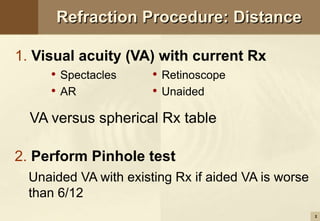
1. Visual acuity (VA) with current Rx
VA versus spherical Rx table
• Spectacles
• AR
• Retinoscope
• Unaided
2. Perform Pinhole test
Unaided VA with existing Rx if aided VA is worse
than 6/12
Refraction Procedure: Distance
3
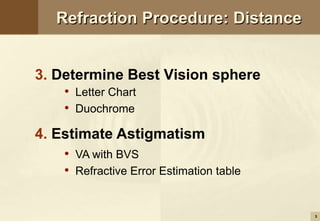
• Letter Chart
• Duochrome
4. Estimate Astigmatism
• VA with BVS
• Refractive Error Estimation table
3. Determine Best Vision sphere
Refraction Procedure: Distance
4
5. Refine Astigmatism (cylinder)
• Axis location
• Astigmatic power
- Fan & Block
- Jackson X-cyl
- Cyl trial lens Rotation & Letter
chart
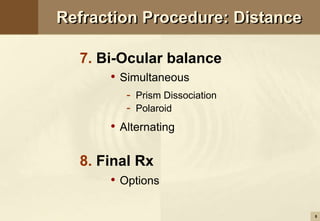
6. Refine Sphere of Rx
• +1.00 DS Fog to blur vision
Refraction Procedure: Distance
5
7. Bi-Ocular balance
• Simultaneous
• Alternating
- Prism Dissociation
- Polaroid
8. Final Rx
• Options
Refraction Procedure: Distance
6
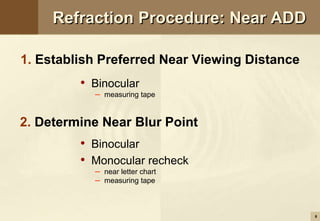
2. Determine Near Blur Point
• Binocular
• Monocular recheck
– near letter chart
– measuring tape
• Binocular
– measuring tape
Refraction Procedure: Near ADD
1. Establish Preferred Near Viewing Distance
7
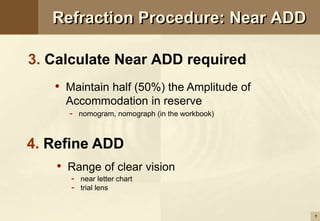
• Maintain half (50%) the Amplitude of
Accommodation in reserve
- nomogram, nomograph (in the workbook)
4. Refine ADD
• Range of clear vision
- near letter chart
- trial lens
3. Calculate Near ADD required
Refraction Procedure: Near ADD
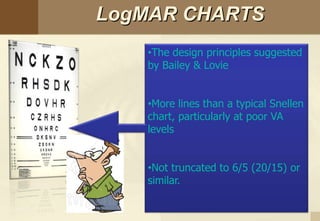
LogMAR CHARTS
•The design principles suggested
by Bailey & Lovie
•More lines than a typical Snellen
chart, particularly at poor VA
levels
•Not truncated to 6/5 (20/15) or
similar.
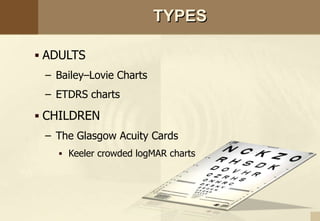
TYPES
 ADULTS
– Bailey–Lovie Charts
– ETDRS charts
 CHILDREN
– The Glasgow Acuity Cards
 Keeler crowded logMAR charts
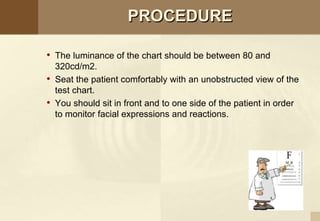
PROCEDURE
• The luminance of the chart should be between 80 and
320cd/m2.
• Seat the patient comfortably with an unobstructed view of the
test chart.
• You should sit in front and to one side of the patient in order
to monitor facial expressions and reactions.
•They should be pushed to determine
whether they can see any more.
•If they make four or more mistakes
on a line of five
•Ask them to move closer if chart not
seen
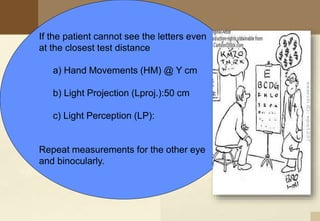
If the patient cannot see the letters even
at the closest test distance
a) Hand Movements (HM) @ Y cm
b) Light Projection (Lproj.):50 cm
c) Light Perception (LP):
Repeat measurements for the other eye
and binocularly.
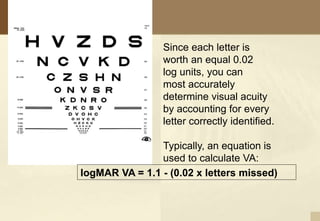
Since each letter is
worth an equal 0.02
log units, you can
most accurately
determine visual acuity
by accounting for every
letter correctly identified.
Typically, an equation is
used to calculate VA:
logMAR VA = 1.1 - (0.02 x letters missed)
Most common errors
1. Allowing cautious patients to decide their acuity (i.e. not pushing them to
guess).
2. Permitting the patient to screw their eyes up and improve their VA.
3. Permitting the patient to look around the occluder or through their fingers and
view binocularly when measuring monocular VA.
4. Taking distance VAs in a PAL or varifocal wearer when they are not looking
through the distance vision section of the lens.
5. Using an incorrect working distance.
6. Not recording the result immediately and guessing the result at the end of the
examination.
VA MEASUREMENT USING SNELLEN
CHART
• Procedure is similar to logMAR chart
• Vn is recorded as the smallest line in which the majority of
letters are seen,irrespective of subjective blurr.
• Errors are recorded by appending a -1,-2, or -3 to snellen
fraction
Eg:6/9(-2),6/9(-3)…
If pt couldn’t see 6/60 letter @ 6m,but could @
2m,recorded as 2/60.
Recording
• The Snellen fraction is defined as:
- Test Distance
/Distance at which the letters subtend 5 min of arc.
1. Test distance can be provided in metres (metric) or
feet (imperial).
1. Snellen VA can be labelled in either decimal or
conventional Snellen notation
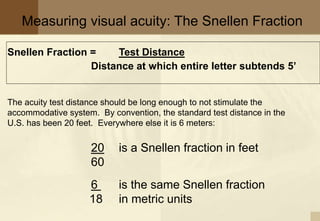
Snellen Fraction = Test Distance
Distance at which entire letter subtends 5’
The acuity test distance should be long enough to not stimulate the
accommodative system. By convention, the standard test distance in the
U.S. has been 20 feet. Everywhere else it is 6 meters:
20 is a Snellen fraction in feet
60
6 is the same Snellen fraction
18 in metric units
Measuring visual acuity: The Snellen Fraction
Measuring Distance Visual Acuity
Testing Sequence
By convention you always test in the following order
1st OD ocular dexter Right eye (cover left eye)
2nd OS ocular sinister Left eye (cover right eye)
3rd OU ocular utrique Both eyes
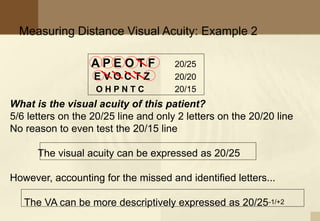
Measuring Distance Visual Acuity: Example 2
A P E O T F 20/25
E V O C T Z 20/20
O H P N T C 20/15
What is the visual acuity of this patient?
5/6 letters on the 20/25 line and only 2 letters on the 20/20 line
No reason to even test the 20/15 line
The visual acuity can be expressed as 20/25
However, accounting for the missed and identified letters...
The VA can be more descriptively expressed as 20/25-1/+2
22
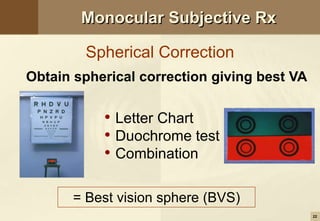
Monocular Subjective Rx
• Letter Chart
• Duochrome test
• Combination
Spherical Correction
= Best vision sphere (BVS)
Obtain spherical correction giving best VA
23
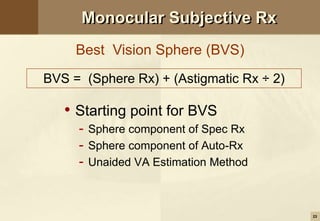
• Starting point for BVS
- Sphere component of Spec Rx
- Sphere component of Auto-Rx
- Unaided VA Estimation Method
BVS = (Sphere Rx) + (Astigmatic Rx ÷ 2)
Best Vision Sphere (BVS)
Monocular Subjective Rx
24
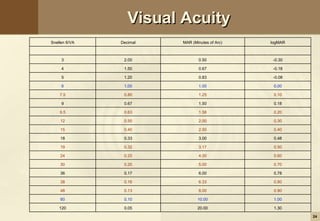
Snellen 6/VA Decimal MAR (Minutes of Arc) logMAR
3 2.00 0.50 -0.30
4 1.50 0.67 -0.18
5 1.20 0.83 -0.08
6 1.00 1.00 0.00
7.5 0.80 1.25 0.10
9 0.67 1.50 0.18
9.5 0.63 1.58 0.20
12 0.50 2.00 0.30
15 0.40 2.50 0.40
18 0.33 3.00 0.48
19 0.32 3.17 0.50
24 0.25 4.00 0.60
30 0.20 5.00 0.70
36 0.17 6.00 0.78
38 0.16 6.33 0.80
48 0.13 8.00 0.90
60 0.10 10.00 1.00
120 0.05 20.00 1.30
Visual Acuity
25
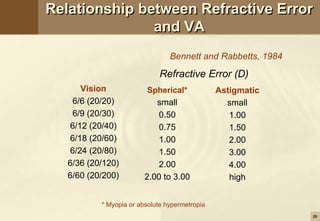
Relationship between Refractive Error
and VA
Vision
6/6 (20/20)
6/9 (20/30)
6/12 (20/40)
6/18 (20/60)
6/24 (20/80)
6/36 (20/120)
6/60 (20/200)
Spherical*
small
0.50
0.75
1.00
1.50
2.00
2.00 to 3.00
Astigmatic
small
1.00
1.50
2.00
3.00
4.00
high
Refractive Error (D)
Bennett and Rabbetts, 1984
* Myopia or absolute hypermetropia
26
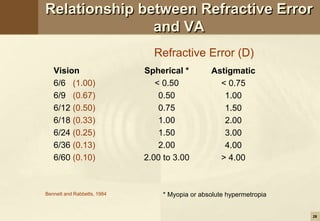
Relationship between Refractive Error
and VA
Vision
6/6 (1.00)
6/9 (0.67)
6/12 (0.50)
6/18 (0.33)
6/24 (0.25)
6/36 (0.13)
6/60 (0.10)
Spherical *
< 0.50
0.50
0.75
1.00
1.50
2.00
2.00 to 3.00
Astigmatic
< 0.75
1.00
1.50
2.00
3.00
4.00
> 4.00
Refractive Error (D)
Bennett and Rabbetts, 1984 * Myopia or absolute hypermetropia
27
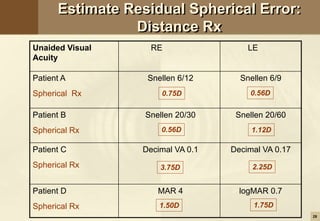
• Note the Best Snellen VA obtained
• Estimate the Amount of Spherical Error
Procedure
Estimate Residual Spherical Error:
Distance Rx
Residual Spherical Error =
Snellen (metric) VA Denominator ÷16
28
Unaided Visual
Acuity
RE LE
Patient A
Spherical Rx
Snellen 6/12 Snellen 6/9
Patient B
Spherical Rx
Snellen 20/30 Snellen 20/60
Patient C
Spherical Rx
Decimal VA 0.1 Decimal VA 0.17
Patient D
Spherical Rx
MAR 4 logMAR 0.7
0.75D 0.56D
0.56D 1.12D
2.25D3.75D
1.50D 1.75D
Estimate Residual Spherical Error:
Distance Rx
29
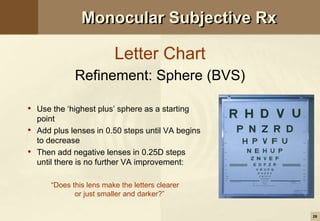
• Use the ‘highest plus’ sphere as a starting
point
• Add plus lenses in 0.50 steps until VA begins
to decrease
• Then add negative lenses in 0.25D steps
until there is no further VA improvement:
“Does this lens make the letters clearer
or just smaller and darker?”
Refinement: Sphere (BVS)
Monocular Subjective Rx
Letter Chart
30
Spherical Correction
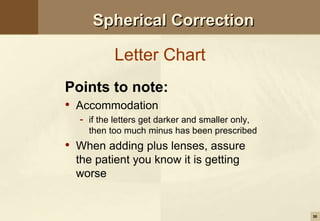
Points to note:
• Accommodation
- if the letters get darker and smaller only,
then too much minus has been prescribed
• When adding plus lenses, assure
the patient you know it is getting
worse
Letter Chart
31
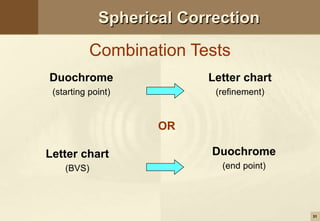
Spherical Correction
Duochrome
(starting point)
Combination Tests
Letter chart
(refinement)
Duochrome
(end point)
Letter chart
(BVS)
OR
32
THANK UUU..

Subjective Refraction-1

  • 1.
  • 2.
    2 1. Visual acuity(VA) with current Rx VA versus spherical Rx table • Spectacles • AR • Retinoscope • Unaided 2. Perform Pinhole test Unaided VA with existing Rx if aided VA is worse than 6/12 Refraction Procedure: Distance
  • 3.
    3 • Letter Chart •Duochrome 4. Estimate Astigmatism • VA with BVS • Refractive Error Estimation table 3. Determine Best Vision sphere Refraction Procedure: Distance
  • 4.
    4 5. Refine Astigmatism(cylinder) • Axis location • Astigmatic power - Fan & Block - Jackson X-cyl - Cyl trial lens Rotation & Letter chart 6. Refine Sphere of Rx • +1.00 DS Fog to blur vision Refraction Procedure: Distance
  • 5.
    5 7. Bi-Ocular balance •Simultaneous • Alternating - Prism Dissociation - Polaroid 8. Final Rx • Options Refraction Procedure: Distance
  • 6.
    6 2. Determine NearBlur Point • Binocular • Monocular recheck – near letter chart – measuring tape • Binocular – measuring tape Refraction Procedure: Near ADD 1. Establish Preferred Near Viewing Distance
  • 7.
    7 • Maintain half(50%) the Amplitude of Accommodation in reserve - nomogram, nomograph (in the workbook) 4. Refine ADD • Range of clear vision - near letter chart - trial lens 3. Calculate Near ADD required Refraction Procedure: Near ADD
  • 9.
    LogMAR CHARTS •The designprinciples suggested by Bailey & Lovie •More lines than a typical Snellen chart, particularly at poor VA levels •Not truncated to 6/5 (20/15) or similar.
  • 10.
    TYPES  ADULTS – Bailey–LovieCharts – ETDRS charts  CHILDREN – The Glasgow Acuity Cards  Keeler crowded logMAR charts
  • 11.
    PROCEDURE • The luminanceof the chart should be between 80 and 320cd/m2. • Seat the patient comfortably with an unobstructed view of the test chart. • You should sit in front and to one side of the patient in order to monitor facial expressions and reactions.
  • 13.
    •They should bepushed to determine whether they can see any more. •If they make four or more mistakes on a line of five •Ask them to move closer if chart not seen
  • 14.
    If the patientcannot see the letters even at the closest test distance a) Hand Movements (HM) @ Y cm b) Light Projection (Lproj.):50 cm c) Light Perception (LP): Repeat measurements for the other eye and binocularly.
  • 15.
    Since each letteris worth an equal 0.02 log units, you can most accurately determine visual acuity by accounting for every letter correctly identified. Typically, an equation is used to calculate VA: logMAR VA = 1.1 - (0.02 x letters missed)
  • 16.
    Most common errors 1.Allowing cautious patients to decide their acuity (i.e. not pushing them to guess). 2. Permitting the patient to screw their eyes up and improve their VA. 3. Permitting the patient to look around the occluder or through their fingers and view binocularly when measuring monocular VA. 4. Taking distance VAs in a PAL or varifocal wearer when they are not looking through the distance vision section of the lens. 5. Using an incorrect working distance. 6. Not recording the result immediately and guessing the result at the end of the examination.
  • 17.
    VA MEASUREMENT USINGSNELLEN CHART • Procedure is similar to logMAR chart • Vn is recorded as the smallest line in which the majority of letters are seen,irrespective of subjective blurr. • Errors are recorded by appending a -1,-2, or -3 to snellen fraction Eg:6/9(-2),6/9(-3)… If pt couldn’t see 6/60 letter @ 6m,but could @ 2m,recorded as 2/60.
  • 18.
    Recording • The Snellenfraction is defined as: - Test Distance /Distance at which the letters subtend 5 min of arc. 1. Test distance can be provided in metres (metric) or feet (imperial). 1. Snellen VA can be labelled in either decimal or conventional Snellen notation
  • 19.
    Snellen Fraction =Test Distance Distance at which entire letter subtends 5’ The acuity test distance should be long enough to not stimulate the accommodative system. By convention, the standard test distance in the U.S. has been 20 feet. Everywhere else it is 6 meters: 20 is a Snellen fraction in feet 60 6 is the same Snellen fraction 18 in metric units Measuring visual acuity: The Snellen Fraction
  • 20.
    Measuring Distance VisualAcuity Testing Sequence By convention you always test in the following order 1st OD ocular dexter Right eye (cover left eye) 2nd OS ocular sinister Left eye (cover right eye) 3rd OU ocular utrique Both eyes
  • 21.
    Measuring Distance VisualAcuity: Example 2 A P E O T F 20/25 E V O C T Z 20/20 O H P N T C 20/15 What is the visual acuity of this patient? 5/6 letters on the 20/25 line and only 2 letters on the 20/20 line No reason to even test the 20/15 line The visual acuity can be expressed as 20/25 However, accounting for the missed and identified letters... The VA can be more descriptively expressed as 20/25-1/+2
  • 22.
    22 Monocular Subjective Rx •Letter Chart • Duochrome test • Combination Spherical Correction = Best vision sphere (BVS) Obtain spherical correction giving best VA
  • 23.
    23 • Starting pointfor BVS - Sphere component of Spec Rx - Sphere component of Auto-Rx - Unaided VA Estimation Method BVS = (Sphere Rx) + (Astigmatic Rx ÷ 2) Best Vision Sphere (BVS) Monocular Subjective Rx
  • 24.
    24 Snellen 6/VA DecimalMAR (Minutes of Arc) logMAR 3 2.00 0.50 -0.30 4 1.50 0.67 -0.18 5 1.20 0.83 -0.08 6 1.00 1.00 0.00 7.5 0.80 1.25 0.10 9 0.67 1.50 0.18 9.5 0.63 1.58 0.20 12 0.50 2.00 0.30 15 0.40 2.50 0.40 18 0.33 3.00 0.48 19 0.32 3.17 0.50 24 0.25 4.00 0.60 30 0.20 5.00 0.70 36 0.17 6.00 0.78 38 0.16 6.33 0.80 48 0.13 8.00 0.90 60 0.10 10.00 1.00 120 0.05 20.00 1.30 Visual Acuity
  • 25.
    25 Relationship between RefractiveError and VA Vision 6/6 (20/20) 6/9 (20/30) 6/12 (20/40) 6/18 (20/60) 6/24 (20/80) 6/36 (20/120) 6/60 (20/200) Spherical* small 0.50 0.75 1.00 1.50 2.00 2.00 to 3.00 Astigmatic small 1.00 1.50 2.00 3.00 4.00 high Refractive Error (D) Bennett and Rabbetts, 1984 * Myopia or absolute hypermetropia
  • 26.
    26 Relationship between RefractiveError and VA Vision 6/6 (1.00) 6/9 (0.67) 6/12 (0.50) 6/18 (0.33) 6/24 (0.25) 6/36 (0.13) 6/60 (0.10) Spherical * < 0.50 0.50 0.75 1.00 1.50 2.00 2.00 to 3.00 Astigmatic < 0.75 1.00 1.50 2.00 3.00 4.00 > 4.00 Refractive Error (D) Bennett and Rabbetts, 1984 * Myopia or absolute hypermetropia
  • 27.
    27 • Note theBest Snellen VA obtained • Estimate the Amount of Spherical Error Procedure Estimate Residual Spherical Error: Distance Rx Residual Spherical Error = Snellen (metric) VA Denominator ÷16
  • 28.
    28 Unaided Visual Acuity RE LE PatientA Spherical Rx Snellen 6/12 Snellen 6/9 Patient B Spherical Rx Snellen 20/30 Snellen 20/60 Patient C Spherical Rx Decimal VA 0.1 Decimal VA 0.17 Patient D Spherical Rx MAR 4 logMAR 0.7 0.75D 0.56D 0.56D 1.12D 2.25D3.75D 1.50D 1.75D Estimate Residual Spherical Error: Distance Rx
  • 29.
    29 • Use the‘highest plus’ sphere as a starting point • Add plus lenses in 0.50 steps until VA begins to decrease • Then add negative lenses in 0.25D steps until there is no further VA improvement: “Does this lens make the letters clearer or just smaller and darker?” Refinement: Sphere (BVS) Monocular Subjective Rx Letter Chart
  • 30.
    30 Spherical Correction Points tonote: • Accommodation - if the letters get darker and smaller only, then too much minus has been prescribed • When adding plus lenses, assure the patient you know it is getting worse Letter Chart
  • 31.
    31 Spherical Correction Duochrome (starting point) CombinationTests Letter chart (refinement) Duochrome (end point) Letter chart (BVS) OR
  • 32.