Perspectives on Learning-: The humanistic  approach EDU 301 Educational Psychology  Semester 111 2011-2012 Kingdom of Saudi Arabia The Royal Commission at Yanbu Yanbu University College Yanbu Al-Sinaiyah  x
Agenda Humanistic views. How these views are translated into the classroom practice. 10/10/11 EDU 301-111 Dr. Hala Fawzi
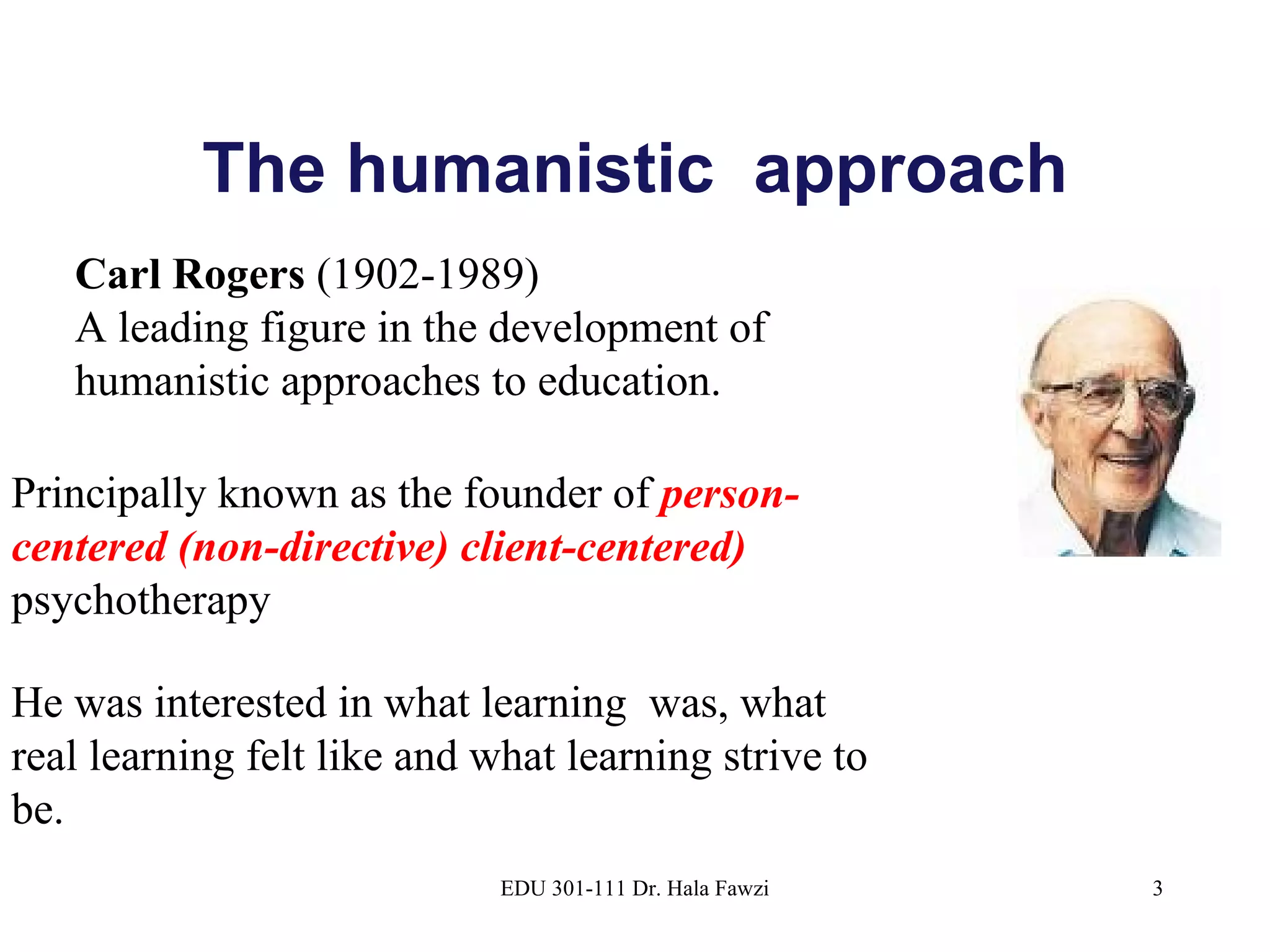
The humanistic  approach EDU 301-111 Dr. Hala Fawzi Carl Rogers  (1902-1989)  A leading figure in the development of humanistic approaches to education.  Principally known as the founder of  person-centered (non-directive) client-centered)  psychotherapy He was interested in what learning  was, what real learning felt like and what learning strive to be.
The humanistic  approach Focuses on the  unobservable private mental  world of an individual. Emphasizes on  holism : the need to study the whole person. Emphasizes the " natural desire" of everyone to learn.
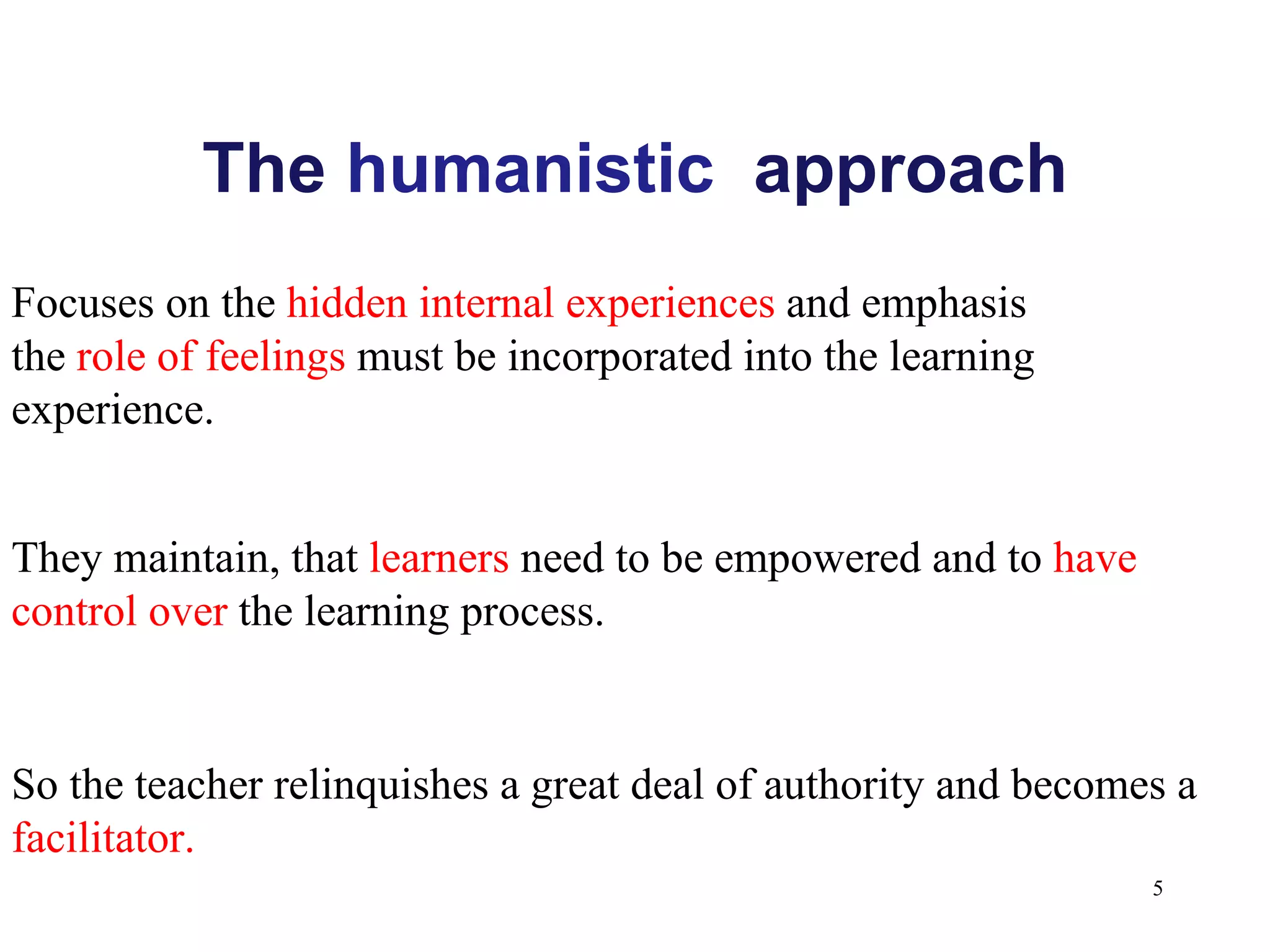
The  humanistic   approach So the teacher relinquishes a great deal of authority and becomes a  facilitator. Focuses on the  hidden internal experiences  and emphasis the  role of feelings  must be incorporated into the learning experience. They maintain, that  learners  need to be empowered and to  have control over  the learning process.
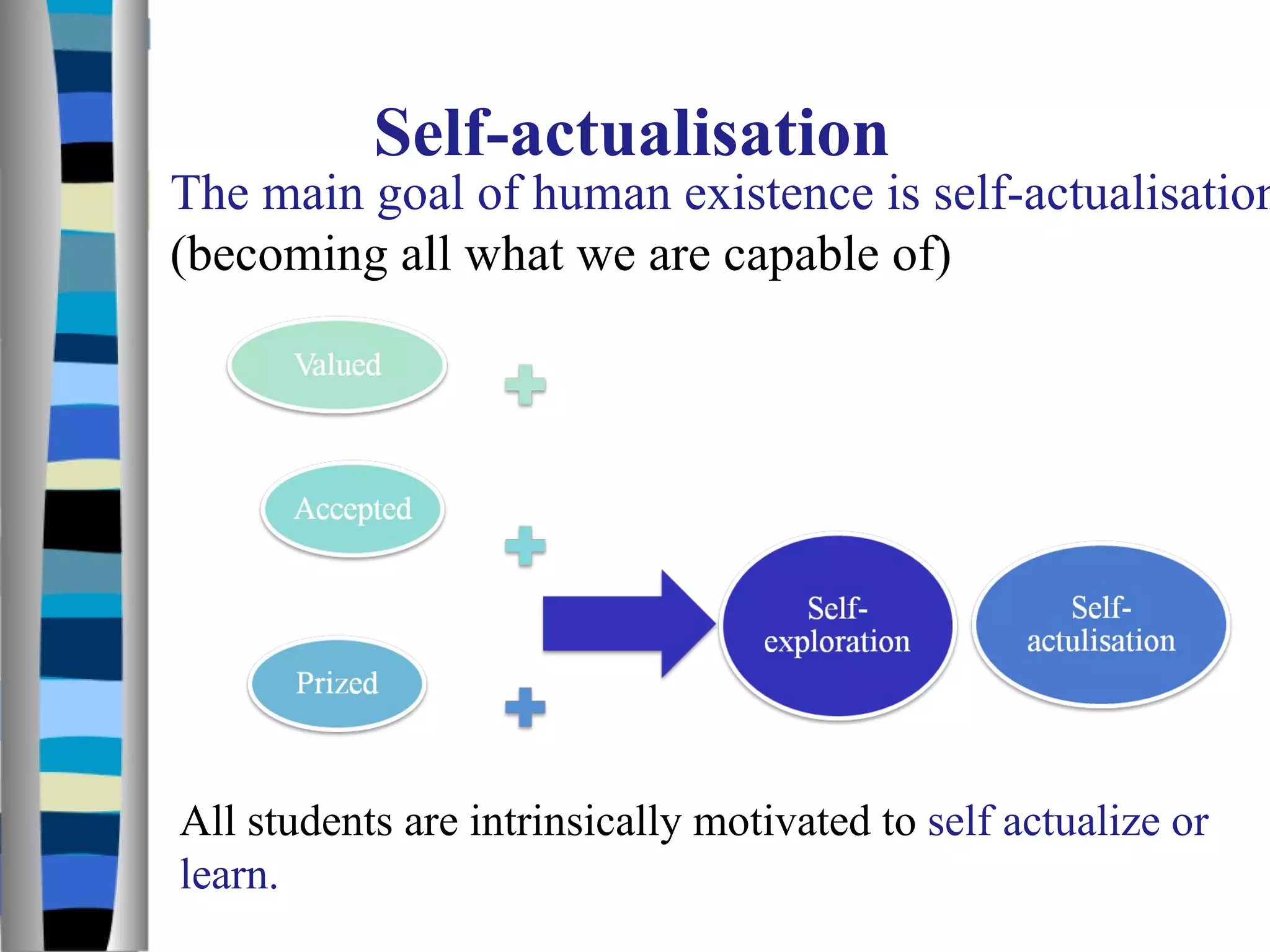
Self-actualisation The main goal of human existence is self-actualisation :(becoming all what we are capable of) All students are intrinsically motivated to  self actualize or learn.
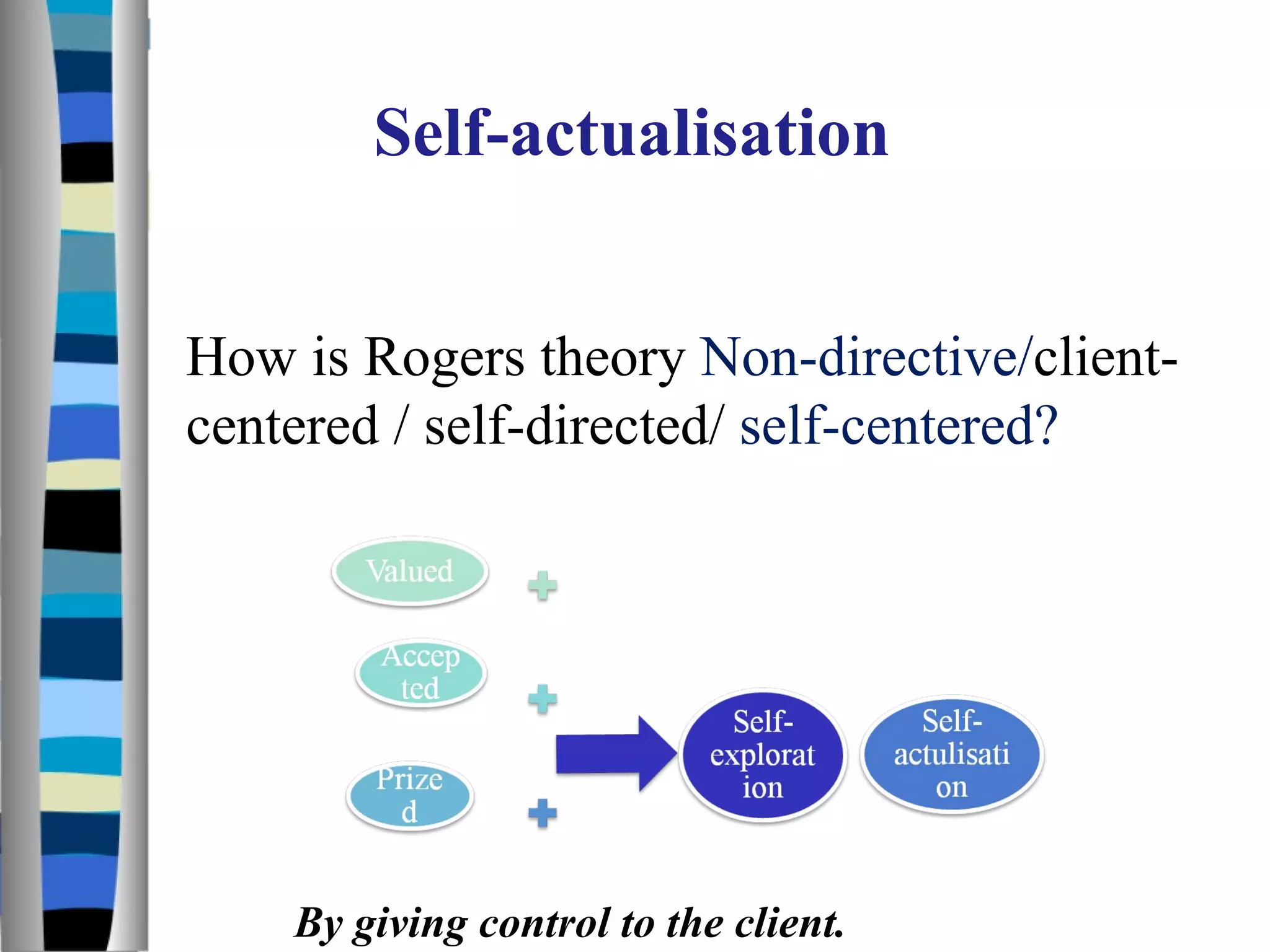
Self-actualisation How is Rogers theory  Non-directive/ client- centered / self-directed/  self-centered? By giving control to the client.
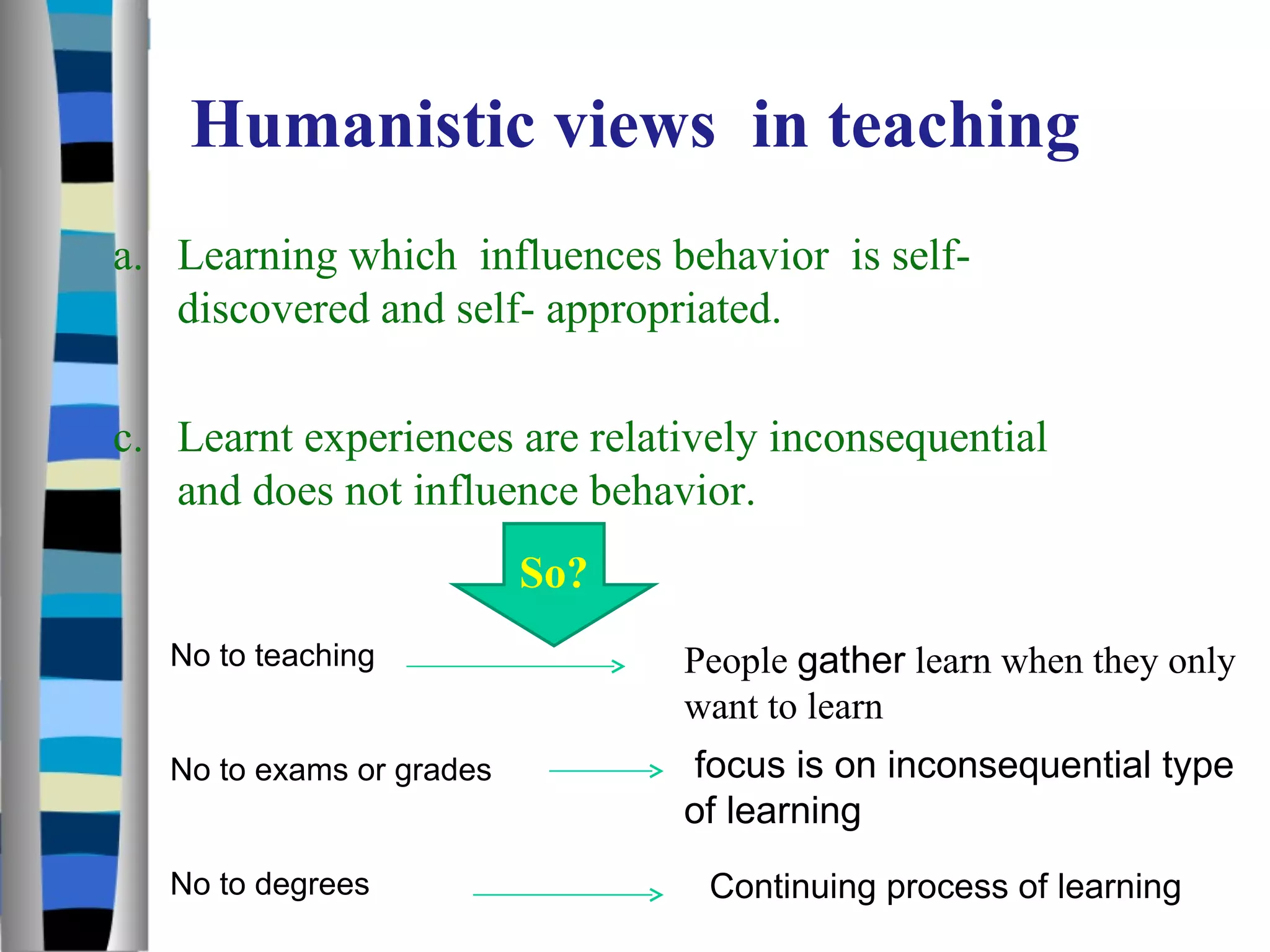
Humanistic views  in teaching Learning which  influences behavior  is self-discovered and self- appropriated. Learnt experiences are relatively inconsequential and does not influence behavior. So? No to teaching No to exams or grades No to degrees People  gather  learn when they only want to learn  focus is on inconsequential type of learning  Continuing process of learning
Traditional vs. Person-centered teaching modes Rogers views developed over time. Review Table 2.2 p. 31(Comparison between traditional and person-centered modes of teaching) 10/10/11 EDU 301-111 Dr. Hala Fawzi
Application of Humanist approach The approach refers to many other approaches.(Kirschenbaum 1975) Humanistic Content Curricula.  (Students’ lives) Humanistic  Process Curricula.( life skills-the whole) School and Group Structures.( restructuring learning environment to pursue humanistic aims)
Application of Humanist approach On whole school  level :  Open classrooms , class  meetings, alternative modes of assessment. On class level : would support: -Students having  control  over daily activities. -Students  monitor  their own progress, andsSelf-evaluation. -Teacher does not control learning process, only a facilitator. -Integrating personal and communications skills  ( Cooperative learning)
Values: 1. Balancing  teaching  and  achieving academic skills  with the need  to acquire personal and life skills.  (Snow and Swanson, 1992, Johnson and Johnson 1992)  2. Helping  to involve children with disabilities  in mainstream class(Putnam, 1993).  Applications within the humanistic approach:  1.Co-operative learning
Values: 1. Balancing  teaching  and  achieving academic skills  with the need  to acquire personal and life skills.  (Snow and Swanson, 1992, Johnson and Johnson 1992)  2. Helping  to involve children with disabilities  in mainstream class(Putnam, 1993).  Applications within the humanistic approach:  1.Co-operative learning  p.33: Read  the example  and study about  the four components of cooperative learning
Applications within the humanistic approach:  2. Emotional literacy classes Teaching emotional skills will: Improve children academic skills. Enhances schools’ ability to teach. (Goleman (1996) Emphasizes  the role of emotional intelligence. Aims  at  teaching emotional  skills, not acknowledging the role of feelings and emotions in learning.
Evaluation of humanistic approach Ambiguous and vague: students learn what they want to learn.(Is it teaching competency?) Could be applied to the: content of the curriculum,  methods of teaching and  teaching styles.
Lecture  round –up  In today’s session, we have learnt about: . . .
Next class discussion Read :  progress exercise 2. Prepare  Review exercise  p.36 to prepare for assignment 1 next week. 10/10/11 EDU 301-111 Dr. Hala Fawzi

The humanistic approach

  • 1.
    Perspectives on Learning-:The humanistic approach EDU 301 Educational Psychology Semester 111 2011-2012 Kingdom of Saudi Arabia The Royal Commission at Yanbu Yanbu University College Yanbu Al-Sinaiyah x
  • 2.
    Agenda Humanistic views.How these views are translated into the classroom practice. 10/10/11 EDU 301-111 Dr. Hala Fawzi
  • 3.
    The humanistic approach EDU 301-111 Dr. Hala Fawzi Carl Rogers (1902-1989) A leading figure in the development of humanistic approaches to education. Principally known as the founder of person-centered (non-directive) client-centered) psychotherapy He was interested in what learning was, what real learning felt like and what learning strive to be.
  • 4.
    The humanistic approach Focuses on the unobservable private mental world of an individual. Emphasizes on holism : the need to study the whole person. Emphasizes the " natural desire" of everyone to learn.
  • 5.
    The humanistic approach So the teacher relinquishes a great deal of authority and becomes a facilitator. Focuses on the hidden internal experiences and emphasis the role of feelings must be incorporated into the learning experience. They maintain, that learners need to be empowered and to have control over the learning process.
  • 6.
    Self-actualisation The maingoal of human existence is self-actualisation :(becoming all what we are capable of) All students are intrinsically motivated to self actualize or learn.
  • 7.
    Self-actualisation How isRogers theory Non-directive/ client- centered / self-directed/ self-centered? By giving control to the client.
  • 8.
    Humanistic views in teaching Learning which influences behavior is self-discovered and self- appropriated. Learnt experiences are relatively inconsequential and does not influence behavior. So? No to teaching No to exams or grades No to degrees People gather learn when they only want to learn focus is on inconsequential type of learning Continuing process of learning
  • 9.
    Traditional vs. Person-centeredteaching modes Rogers views developed over time. Review Table 2.2 p. 31(Comparison between traditional and person-centered modes of teaching) 10/10/11 EDU 301-111 Dr. Hala Fawzi
  • 10.
    Application of Humanistapproach The approach refers to many other approaches.(Kirschenbaum 1975) Humanistic Content Curricula. (Students’ lives) Humanistic Process Curricula.( life skills-the whole) School and Group Structures.( restructuring learning environment to pursue humanistic aims)
  • 11.
    Application of Humanistapproach On whole school level : Open classrooms , class meetings, alternative modes of assessment. On class level : would support: -Students having control over daily activities. -Students monitor their own progress, andsSelf-evaluation. -Teacher does not control learning process, only a facilitator. -Integrating personal and communications skills ( Cooperative learning)
  • 12.
    Values: 1. Balancing teaching and achieving academic skills with the need to acquire personal and life skills. (Snow and Swanson, 1992, Johnson and Johnson 1992) 2. Helping to involve children with disabilities in mainstream class(Putnam, 1993). Applications within the humanistic approach: 1.Co-operative learning
  • 13.
    Values: 1. Balancing teaching and achieving academic skills with the need to acquire personal and life skills. (Snow and Swanson, 1992, Johnson and Johnson 1992) 2. Helping to involve children with disabilities in mainstream class(Putnam, 1993). Applications within the humanistic approach: 1.Co-operative learning p.33: Read the example and study about the four components of cooperative learning
  • 14.
    Applications within thehumanistic approach: 2. Emotional literacy classes Teaching emotional skills will: Improve children academic skills. Enhances schools’ ability to teach. (Goleman (1996) Emphasizes the role of emotional intelligence. Aims at teaching emotional skills, not acknowledging the role of feelings and emotions in learning.
  • 15.
    Evaluation of humanisticapproach Ambiguous and vague: students learn what they want to learn.(Is it teaching competency?) Could be applied to the: content of the curriculum, methods of teaching and teaching styles.
  • 16.
    Lecture round–up In today’s session, we have learnt about: . . .
  • 17.
    Next class discussionRead : progress exercise 2. Prepare Review exercise p.36 to prepare for assignment 1 next week. 10/10/11 EDU 301-111 Dr. Hala Fawzi

Editor's Notes

  • #5 Behaviorism: observable behavior.
  • #6 Behaviorism: behavior depends of the past antecedents, punished or rewarded.
  • #7 When a client/person feels valued and accepted by his/her therapist, he starts to explore himself in a safe environment. Through a self exploration, he/she continues to self –actualisation.
  • #8 When a client/person feels valued and accepted by his/her therapist, he starts to explore himself in a safe environment. Through a self exploration, he/she continues to self –actualisation. Learning should be reinforced.
  • #12 This imply features like..
  • #15 One recent application within the humanistic framework is the beginning of