MotivationKingdom of Saudi ArabiaThe Royal Commission at YanbuYanbu University CollegeYanbu Al-Sinaiyah xEDU 301 EDUCATIONAL PSYCHOLOGYSemester 1022011-2012Dr. Hala Fawzi
What is Motivation?Motivation is derived from Latin words moverewhich means “to move”.
Motivations  tries to explain why we are engaged in certain behaviour.
Motivation is “something that drives people to do what they do”. (Cohen, 1990).Motivation is “the result of processes,                              to the individual,  that arouse enthusiasm and persistenceto pursue a certain course of action”. It directs and maintains behaviour3What is Motivation?internal or external
4Why do we need to know about Motivation?The role of others in developing motivation is central to teaching and education.Can we give motivation to our students?No!Teacher cannot control the motivation of their students.
They are not responsible of the motivation of their students.They can only influence motivation. (Taylor and Thornton 1995).
Types of Motivation?5
Types of Motivation?In general, motivation can be considered as either extrinsic(behavioural) or intrinsic(biological, cognitive, affective, cognitive, or spiritual.Intrinsic and extrinsic6
Types of Motivation:IntrinsicAhmed  and Amal example“To do something when we don’t have to”.Intrinsicmotivation is the natural human tendency to seek out and conquer challenges as we pursue personal interests and exercise capabilities. 7
Types of Motivation:IntrinsicWhen we are intrinsically  motivated, we do NOT  need incentives or punishments, because  the activity itself is satisfying and rewarding.Do you know  what are  incentives ?Objects or events that encourages or discourages behaviour. 8
Types of Motivation:ExtrinsicExtrinsicmotivation is created by external factors such as grades, rewards and punishments Based on factors NOT related to the activity itself. We are NOTreally interested in the activity for its own    sake; we care ONLY  about what it will gain us9
10Intrinsic vs. Extrinsic motivationIntrinsically Motivated Behaviour: Behaviour that is performed for its own sake.2.  Includes recognition ,status, authority, participation etc.Extrinsically Motivated Behaviour:      1.  Behaviour that is performed to acquire material or social rewards,  or to avoid punishment.	2.  Includes incentive, bonus, reward etc.
Adopting intrinsic vs. extrinsic concept   11Impossible to identify any of them by just looking to the behaviour and punishments. The essential difference between the intrinsic and extrinsic motivation is the person's (student’s) reason for acting.locus of causality Meaning== whether the location of the causefor the action is internal or external- inside or outside the person.
How does locus of causality apply to motivation? 12
How does locus of causality apply to motivation? Students who practice painting may have freely chosen this activity based on their personal interests ….(internal locus of causality/intrinsic motivation)OR… because someone or something else outside is influencing them...(external locus of causality/extrinsic motivation)13
How does locus of causality apply to motivation? 14If the locus is internal==motivation is intrinsic.If the locus is external==motivation is extrinsic .
15
Attribution theory (Weiner 1974)16It is the location  (internal or external)  of the cause of behaviour. Internal locus of control – believing that success or failure is attributable to one’s own effort or ability.External locus of control – attributing success or failure to factors outside of one’s control (e.g. luck, poor teaching, etc). High achievers attribute success to internal and stable (fixed or unchangeable) causesHigh achievers attribute failure to external and stable causes (test was not fair) or internal and unstable causes (I didn’t revise). Go to table 7.3, page 128.
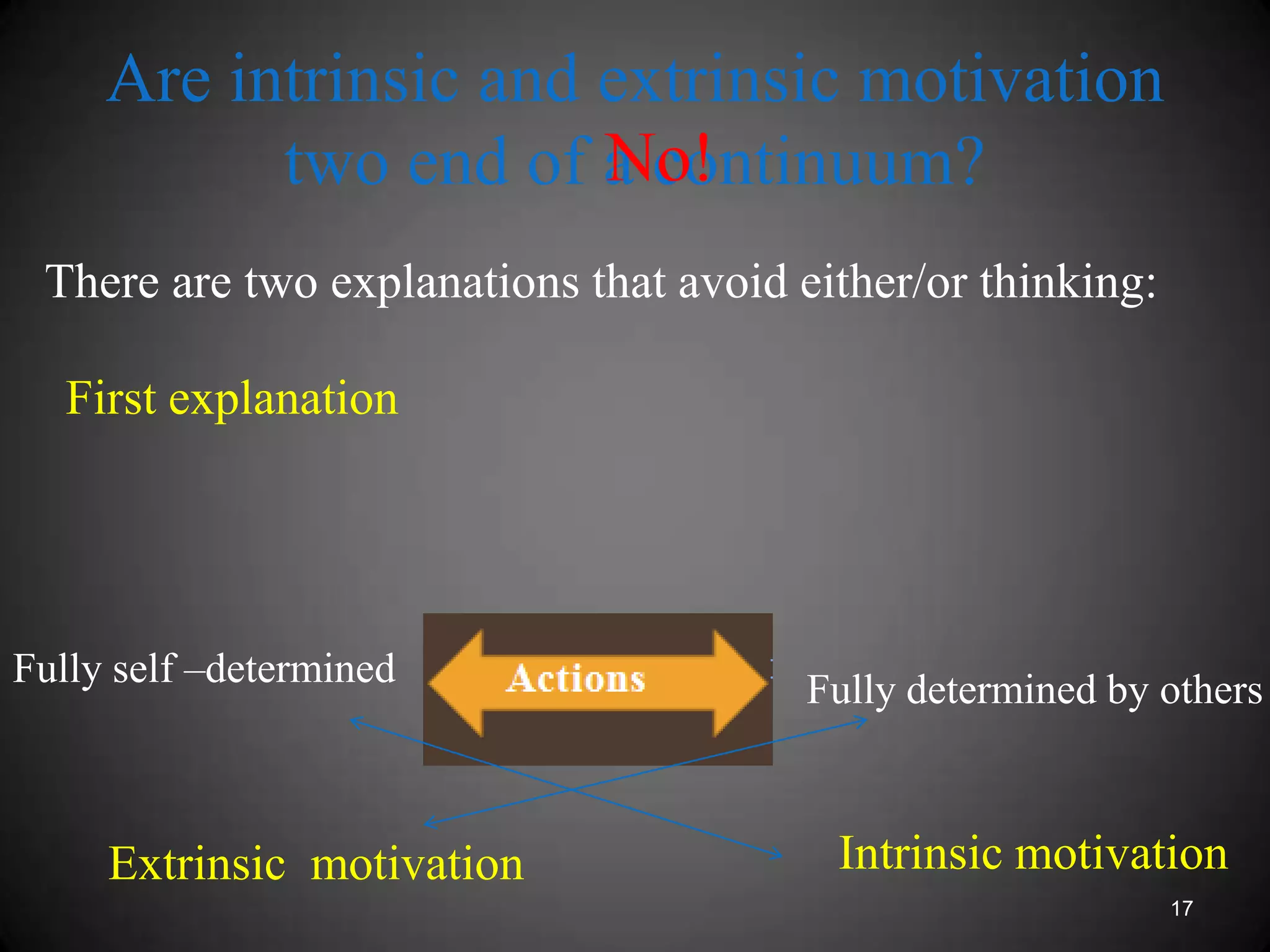
Are intrinsic and extrinsic motivation two end of a continuum?There are two explanations that avoid either/or thinking:17No!First explanation Fully self –determined Fully determined by others Intrinsic motivationExtrinsic  motivation
Are intrinsic and extrinsicmotivation two end of a continuum?Are you thinking about your own motivation now?intrinsic OR extrinsic18Spending hours to study educational psychology to become a good English language teacherIt’s in between!You are freely choosing to accept outside causes, such as license requirements, and then trying to get the most benefit from the requirement. You have internalized an external cause.
Are intrinsic and extrinsicmotivation two end of a continuum?19Second  explanation Intrinsic and extrinsic motivation are NOT two end of a continuum.Most motivation has  elements of both.. At any given time, we can be motivated by some of each.Extrinsic and extrinsic maybe two separate tendencies:-both can operate at the same time in a given situation.
“Mastery orientated”20Dweck and Leggett 1988Termed ‘Mastery orientated’Persist in the face of failure
Low achievers attribute success to internal unstable causes
(I passed because I did lots of revision) or external causes such as ‘the test was easy’ or ‘I was lucky my favourite topics came up’.They fail to make the connection between personal ability and consequences.
Label themselves as thick and useless.
They have low expectations and lower levels of motivation. 
21
Learned Helplessness Seligman and Maier (1967)22Dogs and the electrical shocks.
Conditions changed, dogs did not escape.
Linked  it to the apathy in depression-feeling helplessness. “ It is seen as the state where motivation to engage in adaptive behavior is extremely low or non-existent”. p.130-133 improving motivation and reducing learned helplessness
Do you remember slide 14? Attribution theory (Weinger 1974)23It is the location  (internal or external)  of the cause of behaviour. Internal locus of control – believing that success or failure is attributable to one’s own effort or ability.External locus of control – attributing success or failure to factors outside of one’s control (e.g. luck, poor teaching, etc). High achievers attribute success to internal and stable (fixed or unchangeable) causesHigh achievers attribute failure to external and stable causes (test was not fair) or internal and unstable causes (I didn’t revise). Go to table 7.3, page 128.
Learned Helplessness in Motivation241. “Nothing I did matters==zero or low motivation to try.(Hayes 1994)2. Learned Helplessness influence self-esteem==“chronic low self-esteem is due to Learned Helplessness. (Renshaw1990)Suggestions to help in increasing motivation: (Deweck (1999)If Learned Helplessness is due to:A faulty attributional  style=== attributional  training.Ones’ belief that he/she no control over the environment===encouraging greater participations’ making choices, decisions and setting personal targets. Chronic low self-esteem===measuring to boost self-esteem.
25A form of ‘learned helplessness’ (Dweck 1978). Point out – cognitive approachRemedy – Teacher has to persuade the child to think differently about themselves.
Motivation and Teaching 26Teachers CAN NOT give motivation. They can only influence it.
Teachers CANcreate intrinsic motivation by connecting to students’ interests and supporting growing competence.
Teachers MUST  encourage and nurture intrinsic  motivation while making sure that extrinsic motivation supports learning.To be able to this, teachers NEED to know about the factors that influence motivation
Key factors in motivation according to  learning theories271. Drive theoriesOne of the earliest research into motivation
Saw motivation in terms of need states and drive activities.
Works as follows: recognition of a need __ drive activity trigged to behave in such a manner to reach the goal stimulus, which in turn would reduce the need.
Centered on biological needs such as hunger and thirst.Key factors in motivation according to  learning theories281. Drive theoriesMakes sense when talking about physiological needs (food, water, sex)
How can it be applied to psychological needs (need to achievement)?“Physiological needs can be satisfied, but psychological needs are never satisfied”. (leFrancois 1997)
Key factors in motivation according to  learning theories29
The role of arousal: the Yerkes-Dodson Law Physiological component to motivation: Arousal  is “the changes in heart rate, brain and activity and respiration.30Psychological component to motivation: Arousal  is “the degree of focused attention”.
The role of arousal: the Yerkes-Dodson Law There is a relationship between level of arousal, complexity of task and effectiveness of performance.31
The role of arousal: the Yerkes-Dodson Law Arousal can be equated with motivation :more arousal results in more motivation, resulting in maximum performance..32
The role of arousal: the Yerkes-Dodson Law Greater levels of arousal lead to greater level of achievement.Examples: Your book, p.123. 33
34
Key factors in motivation according to  learning theories352. Humanistic approach to motivationEmphasized intrinsic  sources of motivation as a person's needs for “self-actualization” (Maslow), the inborn “actualizing tendency” (Rogers), the need for “self-determination” (Ryan)To motivate means to encourage  people's inner resources;  their self competence, self-esteem and self-actualization. Maslow theory.
Key factors in motivation according to  learning theories363. Cognitive approaches to motivationBehavior is determined by our thinking, not by how we are rewarded or punished. Behavior is initiated are regulated by plans, schemas, expectations and attributions. People are viewed as active and curious, searching to solve problems.Thus, cognitive theories emphasized intrinsic motivation.
Bandura’s theory of self-efficacy373. Cognitive approaches to motivationself-efficacy :The concept is crucial because it determines what the individual chooses to do + the amount of effort that they expend in the task + the motivation  to engage in the task.The higher the level --- the greater the individual’s persistence in the face of difficulty.
38Questions:”If I try hard, can I succeed?”, If I succeed, will the outcome be valuable or rewarding to me?”(Bandura’s theory of self-efficacy).

Motivation, Educational Psychology

  • 1.
    MotivationKingdom of SaudiArabiaThe Royal Commission at YanbuYanbu University CollegeYanbu Al-Sinaiyah xEDU 301 EDUCATIONAL PSYCHOLOGYSemester 1022011-2012Dr. Hala Fawzi
  • 2.
    What is Motivation?Motivationis derived from Latin words moverewhich means “to move”.
  • 3.
    Motivations triesto explain why we are engaged in certain behaviour.
  • 4.
    Motivation is “somethingthat drives people to do what they do”. (Cohen, 1990).Motivation is “the result of processes, to the individual, that arouse enthusiasm and persistenceto pursue a certain course of action”. It directs and maintains behaviour3What is Motivation?internal or external
  • 5.
    4Why do weneed to know about Motivation?The role of others in developing motivation is central to teaching and education.Can we give motivation to our students?No!Teacher cannot control the motivation of their students.
  • 6.
    They are notresponsible of the motivation of their students.They can only influence motivation. (Taylor and Thornton 1995).
  • 7.
  • 8.
    Types of Motivation?Ingeneral, motivation can be considered as either extrinsic(behavioural) or intrinsic(biological, cognitive, affective, cognitive, or spiritual.Intrinsic and extrinsic6
  • 9.
    Types of Motivation:IntrinsicAhmed and Amal example“To do something when we don’t have to”.Intrinsicmotivation is the natural human tendency to seek out and conquer challenges as we pursue personal interests and exercise capabilities. 7
  • 10.
    Types of Motivation:IntrinsicWhenwe are intrinsically motivated, we do NOT need incentives or punishments, because the activity itself is satisfying and rewarding.Do you know what are incentives ?Objects or events that encourages or discourages behaviour. 8
  • 11.
    Types of Motivation:ExtrinsicExtrinsicmotivationis created by external factors such as grades, rewards and punishments Based on factors NOT related to the activity itself. We are NOTreally interested in the activity for its own sake; we care ONLY about what it will gain us9
  • 12.
    10Intrinsic vs. ExtrinsicmotivationIntrinsically Motivated Behaviour: Behaviour that is performed for its own sake.2. Includes recognition ,status, authority, participation etc.Extrinsically Motivated Behaviour: 1. Behaviour that is performed to acquire material or social rewards, or to avoid punishment. 2. Includes incentive, bonus, reward etc.
  • 13.
    Adopting intrinsic vs.extrinsic concept 11Impossible to identify any of them by just looking to the behaviour and punishments. The essential difference between the intrinsic and extrinsic motivation is the person's (student’s) reason for acting.locus of causality Meaning== whether the location of the causefor the action is internal or external- inside or outside the person.
  • 14.
    How does locusof causality apply to motivation? 12
  • 15.
    How does locusof causality apply to motivation? Students who practice painting may have freely chosen this activity based on their personal interests ….(internal locus of causality/intrinsic motivation)OR… because someone or something else outside is influencing them...(external locus of causality/extrinsic motivation)13
  • 16.
    How does locusof causality apply to motivation? 14If the locus is internal==motivation is intrinsic.If the locus is external==motivation is extrinsic .
  • 17.
  • 18.
    Attribution theory (Weiner1974)16It is the location (internal or external) of the cause of behaviour. Internal locus of control – believing that success or failure is attributable to one’s own effort or ability.External locus of control – attributing success or failure to factors outside of one’s control (e.g. luck, poor teaching, etc). High achievers attribute success to internal and stable (fixed or unchangeable) causesHigh achievers attribute failure to external and stable causes (test was not fair) or internal and unstable causes (I didn’t revise). Go to table 7.3, page 128.
  • 19.
    Are intrinsic andextrinsic motivation two end of a continuum?There are two explanations that avoid either/or thinking:17No!First explanation Fully self –determined Fully determined by others Intrinsic motivationExtrinsic motivation
  • 20.
    Are intrinsic andextrinsicmotivation two end of a continuum?Are you thinking about your own motivation now?intrinsic OR extrinsic18Spending hours to study educational psychology to become a good English language teacherIt’s in between!You are freely choosing to accept outside causes, such as license requirements, and then trying to get the most benefit from the requirement. You have internalized an external cause.
  • 21.
    Are intrinsic andextrinsicmotivation two end of a continuum?19Second explanation Intrinsic and extrinsic motivation are NOT two end of a continuum.Most motivation has elements of both.. At any given time, we can be motivated by some of each.Extrinsic and extrinsic maybe two separate tendencies:-both can operate at the same time in a given situation.
  • 22.
    “Mastery orientated”20Dweck andLeggett 1988Termed ‘Mastery orientated’Persist in the face of failure
  • 23.
    Low achievers attributesuccess to internal unstable causes
  • 24.
    (I passed becauseI did lots of revision) or external causes such as ‘the test was easy’ or ‘I was lucky my favourite topics came up’.They fail to make the connection between personal ability and consequences.
  • 25.
    Label themselves asthick and useless.
  • 26.
    They have lowexpectations and lower levels of motivation. 
  • 27.
  • 28.
    Learned Helplessness Seligmanand Maier (1967)22Dogs and the electrical shocks.
  • 29.
  • 30.
    Linked itto the apathy in depression-feeling helplessness. “ It is seen as the state where motivation to engage in adaptive behavior is extremely low or non-existent”. p.130-133 improving motivation and reducing learned helplessness
  • 31.
    Do you rememberslide 14? Attribution theory (Weinger 1974)23It is the location (internal or external) of the cause of behaviour. Internal locus of control – believing that success or failure is attributable to one’s own effort or ability.External locus of control – attributing success or failure to factors outside of one’s control (e.g. luck, poor teaching, etc). High achievers attribute success to internal and stable (fixed or unchangeable) causesHigh achievers attribute failure to external and stable causes (test was not fair) or internal and unstable causes (I didn’t revise). Go to table 7.3, page 128.
  • 32.
    Learned Helplessness inMotivation241. “Nothing I did matters==zero or low motivation to try.(Hayes 1994)2. Learned Helplessness influence self-esteem==“chronic low self-esteem is due to Learned Helplessness. (Renshaw1990)Suggestions to help in increasing motivation: (Deweck (1999)If Learned Helplessness is due to:A faulty attributional style=== attributional training.Ones’ belief that he/she no control over the environment===encouraging greater participations’ making choices, decisions and setting personal targets. Chronic low self-esteem===measuring to boost self-esteem.
  • 33.
    25A form of‘learned helplessness’ (Dweck 1978). Point out – cognitive approachRemedy – Teacher has to persuade the child to think differently about themselves.
  • 34.
    Motivation and Teaching26Teachers CAN NOT give motivation. They can only influence it.
  • 35.
    Teachers CANcreate intrinsicmotivation by connecting to students’ interests and supporting growing competence.
  • 36.
    Teachers MUST encourage and nurture intrinsic motivation while making sure that extrinsic motivation supports learning.To be able to this, teachers NEED to know about the factors that influence motivation
  • 37.
    Key factors inmotivation according to learning theories271. Drive theoriesOne of the earliest research into motivation
  • 38.
    Saw motivation interms of need states and drive activities.
  • 39.
    Works as follows:recognition of a need __ drive activity trigged to behave in such a manner to reach the goal stimulus, which in turn would reduce the need.
  • 40.
    Centered on biologicalneeds such as hunger and thirst.Key factors in motivation according to learning theories281. Drive theoriesMakes sense when talking about physiological needs (food, water, sex)
  • 41.
    How can itbe applied to psychological needs (need to achievement)?“Physiological needs can be satisfied, but psychological needs are never satisfied”. (leFrancois 1997)
  • 42.
    Key factors inmotivation according to learning theories29
  • 43.
    The role ofarousal: the Yerkes-Dodson Law Physiological component to motivation: Arousal is “the changes in heart rate, brain and activity and respiration.30Psychological component to motivation: Arousal is “the degree of focused attention”.
  • 44.
    The role ofarousal: the Yerkes-Dodson Law There is a relationship between level of arousal, complexity of task and effectiveness of performance.31
  • 45.
    The role ofarousal: the Yerkes-Dodson Law Arousal can be equated with motivation :more arousal results in more motivation, resulting in maximum performance..32
  • 46.
    The role ofarousal: the Yerkes-Dodson Law Greater levels of arousal lead to greater level of achievement.Examples: Your book, p.123. 33
  • 47.
  • 48.
    Key factors inmotivation according to learning theories352. Humanistic approach to motivationEmphasized intrinsic sources of motivation as a person's needs for “self-actualization” (Maslow), the inborn “actualizing tendency” (Rogers), the need for “self-determination” (Ryan)To motivate means to encourage people's inner resources; their self competence, self-esteem and self-actualization. Maslow theory.
  • 49.
    Key factors inmotivation according to learning theories363. Cognitive approaches to motivationBehavior is determined by our thinking, not by how we are rewarded or punished. Behavior is initiated are regulated by plans, schemas, expectations and attributions. People are viewed as active and curious, searching to solve problems.Thus, cognitive theories emphasized intrinsic motivation.
  • 50.
    Bandura’s theory ofself-efficacy373. Cognitive approaches to motivationself-efficacy :The concept is crucial because it determines what the individual chooses to do + the amount of effort that they expend in the task + the motivation to engage in the task.The higher the level --- the greater the individual’s persistence in the face of difficulty.
  • 51.
    38Questions:”If I tryhard, can I succeed?”, If I succeed, will the outcome be valuable or rewarding to me?”(Bandura’s theory of self-efficacy).
  • 52.
    Bandura’s theory ofself-efficacy393. Cognitive approaches to motivationBanduraoutlines four factors that influence our motivation:EnactiveVicariousPrecursoryEmotiveRead p.125 for more details.Students with high self-efficacy (estimates regarding their personal effectiveness ) display greater effort, persistence and intrinsic interest in their education.
  • 53.
  • 54.
    Key factors inmotivation according to learning theories414. Socio-cultural views of motivationThe emphasis is on participation, identities and interpersonal relations within communities of practice. People engage in activities to maintain their identities and their relations with the community. “We learn by the company we keep.”Students are motivated to learn if they are members of a classroom or school community that values learning. (Wenger)
  • 55.
    Key factors inmotivation according to learning theories425. Social cognitive approaches to motivationExpectancy X value approach to motivation:Motivation is seen as the product of two main forces: the individual expectations of reaching the goal and the value of that goal to him/her. Motivation is a product of these two factors. If either factor is ZERO, motivation to work toward the goal is ZERO.Questions:”If I try hard, can I succeed?”, If I succeed, will the outcome be valuable or rewarding to me?”(Bandura’s theory of self-efficacy).
  • 56.
    Key factors inmotivation according to learning theories436. Behaviorist approaches to motivationThey tend to emphasize extrinsic motivation caused by incentives, rewards and punishment.An understanding of the student’s motivation starts with careful analysis of the incentives and rewards found in the classroom .Ex. Receiving a reward, receiving A +Providing reinforces (stickers, stars, etc) for learning-or demerits for behavior- is an attempt to motivate students by extrinsic means of incentives, rewards or punishments.
  • 57.
    Key factors inmotivation according to learning theories446. Behaviorist approaches to motivationCox (1991) talks about primary and secondary motivation And positive and negative motivation.Primary is derived from the activity itself. Example: motivation from attending a lesson, writing an essay.Secondary is any form of influence, except those that are directly connected to the doing the activity itself. Example: praise from a teacher or parents, rewards, prizes.
  • 58.
    Key factors inmotivation according to learning theories456. Behaviorist approaches to motivationAccording to Cox, There is a complex relationship between motivation and feedback. Cox talks of both primary and secondary motivation , which can be perceived as either positive or negative.Primary positive motivation / primary negative motivation:Feedback from the student himself derived from internal thoughts or emotions. Example. p.126 Secondary positive motivation / Secondary negative motivation:Feedback from secondary sources. Example. p.126
  • 59.
    Study the noteson the bottom of this slide.46
  • 60.
  • 61.
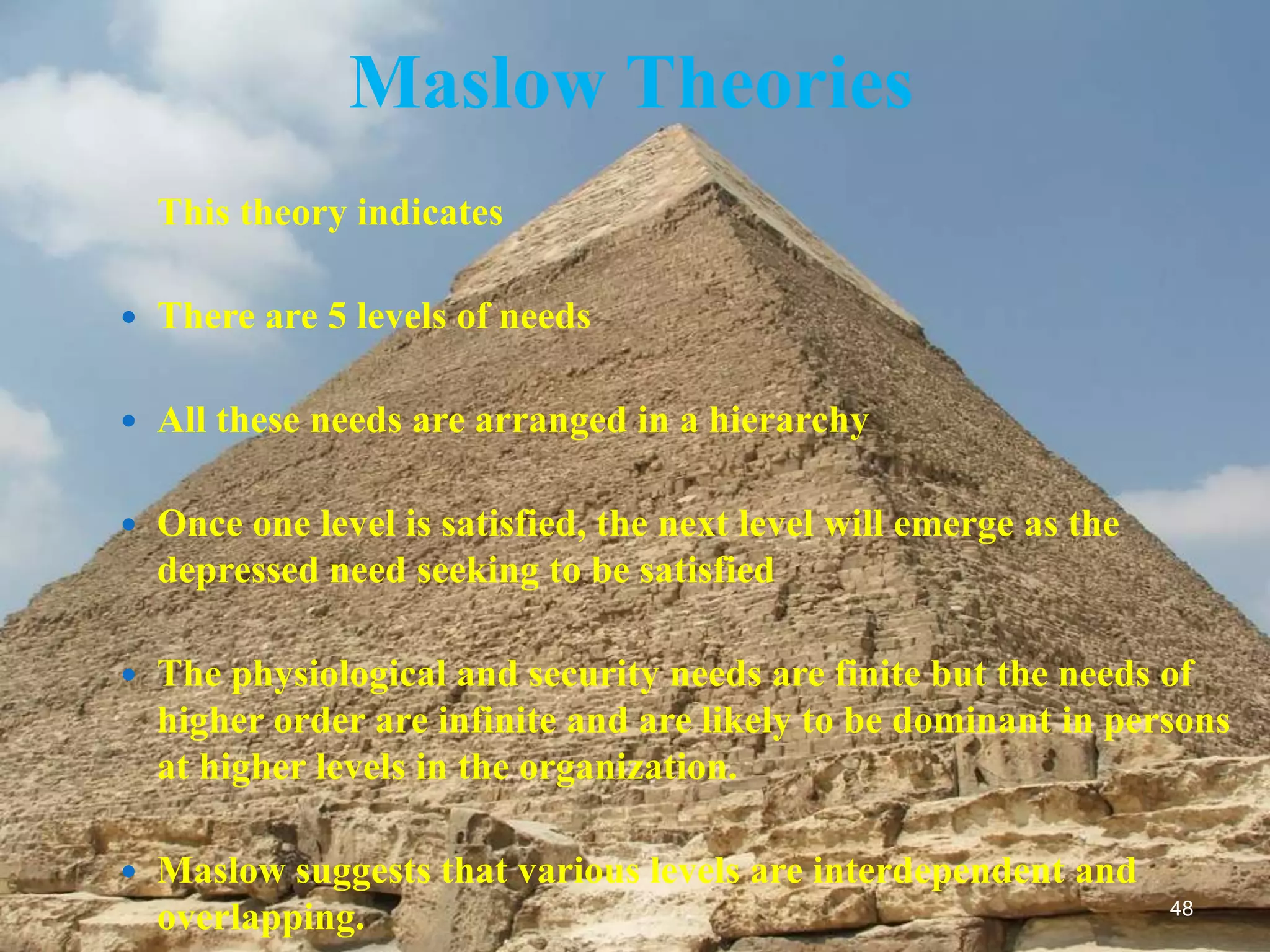
    Maslow Theories Thistheory indicates There are 5 levels of needs
  • 62.
    All these needsare arranged in a hierarchy
  • 63.
    Once one levelis satisfied, the next level will emerge as the depressed need seeking to be satisfied
  • 64.
    The physiological andsecurity needs are finite but the needs of higher order are infinite and are likely to be dominant in persons at higher levels in the organization.
  • 65.
    Maslow suggests thatvarious levels are interdependent and overlapping.48
  • 66.
    Intrinsic works bestfor most. Extrinsic rewards will work provided that the teacher is around.49Impacting motivation in the classroomThere are a variety of specific actions that teachers can take to increase motivation on classroom tasks. In general, these fall into the two categories: intrinsic motivation and extrinsic motivation.
  • 67.
    Lecture round –upIn today’s session, we have learnt about:
  • 68.
    Take Away Points & Terms11/10/2011LING 411-103 Dr. Hala Fawzi51

Editor's Notes

  • #6 In general, motivation can be considered as either extrinsic (behavioural) or intrinsic (biological, cognitive, affective, cognitive, or spiritual.
  • #8 Examples:Doing something just because you think it's the right thing to do, not because you hope to get a reward or avoid punishment.Writing poetry to express your innermost thoughts and feelings, even though you may not be attempting to sell a book or publish for money.Studying something on your own because you desire to know that subject matter. You may not be doing this for any class or for any grade.
  • #9 Examples Ahmed studies chemistry outside the class. He reads about it for hours and knows more than the teacher. He gets C and and Bs. He never returns homework at time. but he is so happy about it.Amal gets back to the teacher about every step. She wants to be perfect. Once a teacher gave her a bonus for art work. Now, she does it every time. She wont accept losing marks. If the topic is not in the exam, she is not interested.
  • #17 Weiner theory examined how an individual interpreted success or failure. The explanation we give ourselves for our successes or failures will determine our expectations of experiencing future successes or failures and as a result, our motivation to engage in tasks where success or failure is possible outcome. Example: students may choose to work hard on activities they do but they don’t find enjoyable but the know that they are important to reach a valued goal.
  • #31 Emotive influences can be linked to Yerkes-Dodson. Too much emotional arousal will cause a decrease in self-efficacy and thus a drop in motivation and performance.
  • #36 LeFrancois (1997) points out that physiological needs can be satisfied and psychological needs are never completely satisfiedAir, water, food2. security, protection, freedom,danger,threat3. love, affection, belongingness,acceptance4. Status, strength,creativitySelf actualization needs: desire for personal achievement or mission of his life.Self – actualized persons have frequent occurrence of peak experiences, which are energized moments of profound happiness and harmony. According to Maslow, only a small percentage of the population reaches the level of self- actualization.3. Love Belongingness Affection
  • #45 Rewards and Reinforcement Cox (1991) believes that motivation is a drive that can be influenced and purposefully changed by well thought-out environmental manipulations. A behaviourist view. Cox (1991)Primary motivation – derived from activity itself (Intrinsic rewards) Secondary motivation – Influence from outside the activity (e.g. praise and other rewards) (Extrinsic Rewards)  Positive motivation  Primary – your appraisal of how well you are doing (Intrinsic) Secondary – positive comments and encouragement from others (Extrinsic) Negative motivation Primary – Feeling bad about what you are attempting Secondary – bad marks for work.
  • #47 What are key factors in motivation according to behavioural viewpoint? A humanistic viewpoint? A cognitive viewpoint? A social cognitive point of view? A sociocultural point of view?Behaviorists tend to emphasize extrinsic motivation caused by incentives, rewards and punishments. Humanistic views stress the intrinsic motivation created by the need for personal growth, fulfillment, and self-determination. Cognitive views stress t person’s active search for meaning, understanding and competence and the power of the individuals attributions and interpretations. Social cognitive theories take into account both the behaviorists’ concern with the consequences of behavior and the cognitivists’ interest in the impact of individual beliefs and expectations. Many influential social cognitive explanations of motivation can be characterized as expectancy x value theories. Socialcultural views emphasize legitimate engaged participation and identity within a community.
  • #48 Abraham was born in Brooklyn since 1908 – 1970.Maslow was a psychologist who studied the lives and activities of individuals that he found considered them to be “successful and productive”. Maslow is a famous theorist which encompass everything from basic needs to self-actualization in order to demonstrate what motivates people.  The basis of Maslow's theory of motivation is that human beings are motivated by unsatisfied needs, and that certain lower needs need to be satisfied before higher needs can be addressed. Per the teachings of Abraham Maslow, there are general needs (physiological, safety, love, and esteem) which have to be fulfilled before a person is able to act unselfishly. These needs were dubbed "deficiency needs." While a person is motivated to fulfill these basal desires, they continue to move toward growth, and eventually self-actualization. The satisfaction of these needs is quite healthy. while preventing their gratification makes us ill or act evilly.