Dunn & Dunn Learning Style Model EDU 5701 Summer 2006 Professor Melissa Perna Barbara Marie King Assignment #7                                                                                                                                                                                                                       
The Dunn & Dunn Learning Style Model An Overview of the Model
 
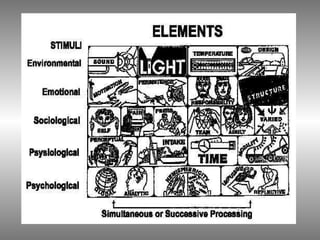
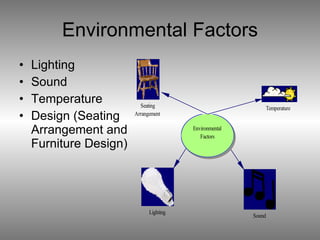
Environmental Factors Lighting Sound Temperature Design (Seating Arrangement and Furniture Design)
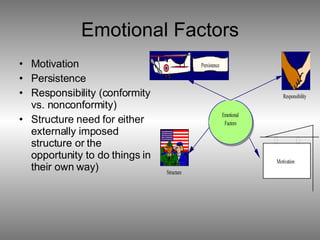
Emotional Factors Motivation Persistence Responsibility (conformity vs. nonconformity) Structure need for either externally imposed structure or the opportunity to do things in their own way)
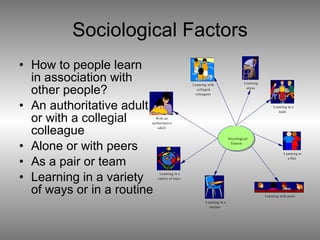
Sociological Factors How to people learn in association with other people? An authoritative adult or with a collegial colleague Alone or with peers As a pair or team Learning in a variety of ways or in a routine
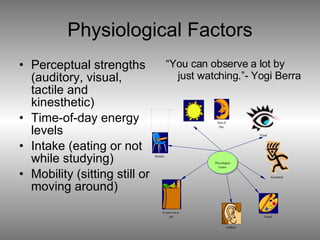
Physiological Factors Perceptual strengths (auditory, visual, tactile and kinesthetic) Time-of-day energy levels Intake (eating or not while studying) Mobility (sitting still or moving around) “ You can observe a lot by just watching.”- Yogi Berra
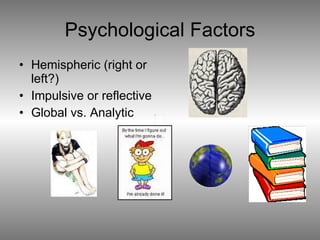
Psychological Factors Hemispheric (right or left?) Impulsive or reflective Global vs. Analytic
The Global Learner
Global Learners Global learners are spontaneous and intuitive. They do not like to be bored. Information needs to be presented in an interesting manner using attractive materials. Cooperative learning strategies and holistic reading methods work well with these learners. The information must relate to their lives, and permit active involvement. Global learners learn best through:  choral reading  recorded books  story writing  computer programs  games  group activities
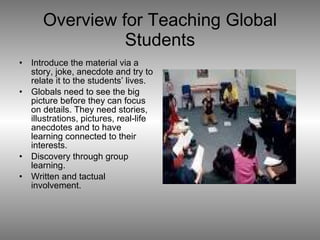
Overview for Teaching Global Students Introduce the material via a story, joke, anecdote and try to relate it to the students’ lives. Globals need to see the big picture before they can focus on details. They need stories, illustrations, pictures, real-life anecdotes and to have learning connected to their interests.  Discovery through group learning. Written and tactual involvement.
Specific Guidelines for Teaching Global Students Introduce lessons globally-begin with a story, joke, anecdote or something humorous.  Relate introduction to concept.  Provide an overview of the concept.  Provide a sense of purpose. Use discovery learning.  Provide small-group experiences such as team learning, circle of knowledge, case studies or brainstorming.  Relate facts to each other and to realistic experiences.  Avoid giving too many facts. Provide many types of materials.  Offer opportunities to demonstrate mastery in a written form such as essays and graphs.  Provide factual experiences.  Provide kinesthetic experiences. Provide continuous feedback.  Interact with students frequently.  Check work in progress at each stage.  Encourage persistence.
Ideas for Global Learners If you are a global learner, it can be helpful for you to realize that you need the big picture of a subject before you can master details. If your instructor plunges directly into new topics without bothering to explain how they relate to what you already know, it can cause problems for you. Fortunately, there are steps you can take that may help you get the big picture more rapidly. Before you begin to study the first section of a chapter in a text, skim through the entire chapter to get an overview. Doing so may be time-consuming initially but it may save you from going over and over individual parts later. Instead of spending a short time on every subject every night, you might find it more productive to immerse yourself in individual subjects for large blocks. Try to relate the subject to things you already know, either by asking the instructor to help you see connections or by consulting references. Above all, don't lose faith in yourself; you will eventually understand the new material, and once you do your understanding of how it connects to other topics and disciplines may enable you to apply it in ways that most sequential thinkers would never dream of.
The Analytic Learner
Analytic Learners Analytic learners plan and organize their work. They focus on details and are logical. They learn best when:  information is presented in sequential steps  lessons are structured and teacher-directed  goals are clear  requirements are spelled out
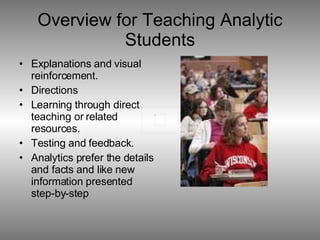
Overview for Teaching Analytic Students Explanations and visual reinforcement. Directions Learning through direct teaching or related resources. Testing and feedback. Analytics prefer the details and facts and like new information presented step-by-step
Specific Guidelines for Teaching Analytic Students Provide explanations and visual reinforcements.  Explain all procedures to be used.  Write key information on chalkboard.  Answer questions with detail. Write specific directions, objectives, test dates on ditto sheets or chart paper. Use direct teaching methods.  Proceed step-by-step through needed information.  Write key information on chalkboard.  Underline important facts on handouts. Test frequently, provide instant feedback, respond to questions as soon as possible, itemize expectations, check assignments and test when you say you will
Ideas for Analytic Learners ANALYTICAL learners should try not to let an ambiguous learning situation (e.g. a difficult-to-grasp point of grammar) overly frustrate them, but be willing to give it time. (Time is a great clarifier of grammar and difficult vocabulary!) Don't set your goals unrealistically high, but find out from other students the average time each textbook takes to complete. Ensure that you allot sufficient time for conversation practice -- don't just sit at your desk poring over your books all day.
Global and Analytic Teachers How to Introduce new and difficult lessons globally and analytically
Ideas for Introducing Lessons Team Learning with creative assignments, inference questions, and factual material in that order to global students Reverse that order for analytic students  Teachers need to learn how to integrate global and analytic teaching strategies to reach all students Teachers also need to be able to present new and difficult information in all four modalities Providing multiple and varied opportunities for students to interact with content will enable them to initially gain knowledge through their strength modality and reinforce it with others To retain what they have learned requires that students engage in creating something with the new information and sharing what they have created with others (see ThinkQuest NYC slide for additional idea) Use Individualized instruction such as Programmed Learning Sequences (PLS), Contract Activity Packages (CAP’s) and Multisensory Instructional Packages (MIP’s)
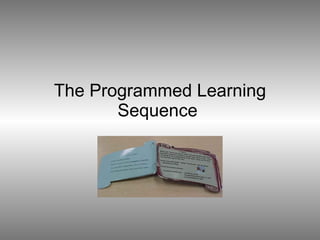
The Programmed Learning Sequence
The Benefits of a PLS Design a Programmed Learning Sequence to respond to individual learning styles.  It is based upon several important principles: Only one item is presented at a time The student is required to be an active, rather than passive, learner  The student is immediately informed of the correctness of each response The student may not continue into the next phase of a program until each previous phase has been understood and mastered The student is exposed to material that gradually progresses from the easy to the more difficult As the student proceeds in the program, fewer hints and crutches are provided  Programmed Learning Sequences introduce material globally  They incorporate tactual devices into the frames, thus helping low auditory and low visual students reinforce through another sense They are sequential, so they appeal to the analytic student Reinforce every seven or eight frames to revitalize learning on an ongoing basis They are accompanied by a tape so that nonreading students or poor readers may learn content regardless of inadequate reading skills They provide immediate feedback They teach at each student’s own pace They question, answer and reinforce They can often joke a little
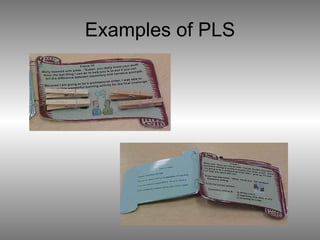
How to Design a Programmed Learning Sequence Identify your topic, concept or skill that you want to teach Write the name as a heading at the top of a blank sheet of paper Translate the heading into an introductory sentence that explains exactly what the student will be able to accomplish List all the prerequisites for using the program effectively Create a global story, fantasy, cartoon, or humorous beginning that relates to the topic Decide whether to use: Linear programming-which presents materials in frames that ends with an item that requires an answer, or, Intrinsic Programming-doesn’t require every student to complete every frame Outline how you plan to teach each topic Divide the sentences in your outline into frames Using index cards to represent each frame, develop a sequence that teaches a subject and that tests the student’s growing knowledge of it Refine each index card frame Review the sequence to be certain that it is logical and does not teach too much on each frame Check the spelling, grammar, and punctuation of each frame  Examine the vocabulary to be certain it is understandable by all students Reread the entire series to be certain correct sequencing occurs Then, add colorful illustrations to clarify the main point on each index card. Read the written material on each frame onto a cassette so that poor readers may use the PLS by listening to the frames being read to them as they simultaneously read along Ask for 3-4 students to try the PLS, and correct any errors, omissions, or areas of difficulty If necessary, revise the PLS based upon the students’ usage Laminate each card of the PLS with clear contact paper Add miniature tactual activities for reinforcement of the most important information on the PLS Ask additional students to use the PLS When all “bugs” have been worked out, add a font and back cover if possible, to represent the subject matter Design a record-keeping form so you know which students are using and have used the program, how much, and if they were successful
Examples of PLS
Contract Activity Packages
Basic Principles of Contract Activity Packages Simply stated objectives that itemize exactly what the student is required to learn Multisensory Alternative Resources that teach the information that the objectives indicate must be mastered A series of activities through which the information that has been mastered is used in a creative way A series of alternative ways in which creative instructional resources developed by one student may be shared with one or more-but no more than six to eight-classmates At least three small-group techniques A pretest, a self-test, and a posttest
How to Design a Contract Activity Package Begin by identifying a topic, concept, or skill that you want to teach Develop a humorous or clever global subtitle List the things about this topic that you believe are so important that every student in your class should learn them Translate the important items into behavioral objectives Design at least 3-4 Activity Alternatives for each behavioral objective (or a group of related objectives) so that students may choose how they demonstrate that they have learned what the objectives require of them  Create a Reporting Alternative for each of the Activity Alternatives that you have designed List all the resources you can locate that students may use to gain the information required by their behavioral objectives Add at least three small-group techniques to the developing Contract Activity Package.  Always include a Team Learning. Develop a test that is directly related to each of the behavioral objectives in your CAP Design an illustrated cover for the CAP Develop an informational top sheet Reread each of the parts of the CAP Add illustrations to the pages to make the CAP attractive and motivating Duplicate the number of copies you will need Design a record-keeping form so that you know which students are using and have used the CAP and how much of it they have completed successfully Try a CAP with those students who can work well with any two or three small-group techniques
What a knowledgeable teacher who is aware of students’ individual differences could do to help their students to achieve
Teaching global learners
Global Learners Global learners are spontaneous and intuitive. They do not like to be bored. Information needs to be presented in an interesting manner using attractive materials. Cooperative learning strategies and holistic reading methods work well with these learners. Global learners learn best through:  choral reading  recorded books  story writing  computer programs  games  group activities
Activities for Global Students Introduce lessons globally-begin with a story, joke, anecdote or something humorous.  Relate introduction to concept.  Provide an overview of the concept.  Provide a sense of purpose. Use discovery learning.  Provide small-group experiences such as team learning, circle of knowledge, case studies or brainstorming.  Relate facts to each other and to realistic experiences.  Avoid giving too many facts. Provide many types of materials.  Offer opportunities to demonstrate mastery in a written form such as essays and graphs.  Provide factual experiences.  Provide kinesthetic experiences. Provide continuous feedback.  Interact with students frequently.  Check work in progress at each stage.  Encourage persistence.
Teaching tactual learners
Tactual Learners Students with this strength learn best by touching. They understand directions that they write and will learn best through manipulatives. These students will also benefit from whole language approaches to reading. They'll learn best by : drawing  playing board games  making dioramas  making models  following instructions to make something
Activities for Tactual Learners Pictures Posters Murals Maps Charts/Graphics Games Models Underlining what they read Flashcards Puzzles At the secondary level, students can create their own tactual resources Task cards Electroboard Flip Chutes Calculators Computer Games Touch-Compute Can Pic-A-Hole
Teaching kinesthetic learners
Kinesthetic Learners Kinesthetic learners also learn by touching or manipulating objects. They need to involve their whole body in learning. They remember material best if they act it out. These students learn best by: playing games that involve their whole body  movement activities  making models  following instructions to make something  setting up experiments
Activities for Kinesthetic Learners Video Field Trips Mock TV Shows Radio Broadcasts Demonstrations Dramatizations Construction Interviews Playing Games (floor, table and wall) Computer learning experiences Inventing Experimenting Action-packed learning experiences
Ideas for Kinesthetic Learners 1. Use many of your senses as possible when you study: see, hear, touch, taste, smell.  2. Move around when you study. Put as much as you can on study cards. Lay study cards out  on the floor in    various locations and practice reciting them as you move around the room. 3. Carry study cards with you everywhere and use them whenever you have to wait. 4. Study in small, frequent chunks. Give yourself breaks and rewards. 5. Use a timer and decide upon an amount of time you feel you can effectively sit and   work.  Underestimate and work up to longer time periods if possible. When the timer   sounds, take a break and do something physical.  6. Set a goal as to a specific amount of information you will cover such as five pages, etc.   When you reach your goal, take a break. 7.For surface learning, use a mnemonic device called the method of place. When you have to recall items on a list, mentally imagine them placed in sequential locations in your home and associate them with those places. For example, if you have to remember the names of the presidents of the  United States, begin in your kitchen. Wash Washington in the sink, bake Adams' apple in the oven, and so on. In order to trigger recall for a test, imagine yourself walking to each area. 8. Study with another kinesthetic person. Their gestures and activities may give you additional input. 9. When solving problems, move around and manipulate items to represent parts of the problem. 10.When taking exams, try to "feel" how you stored information by remembering what you physically did as you studied.
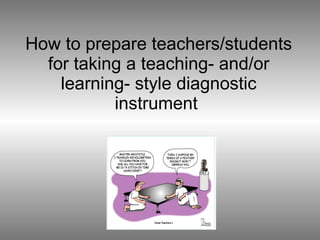
How to prepare teachers/students for taking a teaching- and/or learning- style diagnostic instrument
Preparing Students and/or Teachers Begin by explaining the differences in learning styles that exist among all classes, families, and cultures After this discussion, read either Two-of-a-Kind Learning Styles (Pena, 1989) (Grades 5-8) about Global Myrna and Analytic Victor, or use A Guide to Explaining Learning Styles to High School Students or Teachers As you read the story, tape record it Encourage students to guess the learning styles of members of their family Explain that it is important for each person to understand his or her style strengths Introduce the idea of learning about one’s strengths through a series of questions-which each person must answer truthfully, or there is no way to learn how each should be taught, or do homework, or study efficiently When the results of these questions are ascertained, you will be able to tell each student exactly how he or she should study in order to remember anything that ordinarily would be difficult.  For teachers, explain how understanding one’s own learning styles can give them a better understanding in introducing lessons and activities that will help their student’s achievement Teachers need to be able to present new and difficult material in all four modalities.  Providing multiple and varied opportunities for students to interact with content will enable them to initially gain knowledge through their strength modality and reinforce it with others.
General Guidelines for Teaching test-taking skills Ligon and Jones suggest that an appropriate activity for preparing students for standardized testing is:  "one which contributes to students' performing on the test near their true achievement levels, and one which contributes more to their scores than would an equal amount of regular classroom instruction" (1982, p. 1).   Matter suggests that:  "Ideally, test preparation activities should not be additional activities imposed upon teachers. Rather, they should be incorporated into the regular, ongoing instructional activities whenever possible." (1986, p. 10)   If you follow the suggestion by Ligon and Jones, you might spend some time teaching students general test-taking skills. These skills would help students answer questions correctly if they have mastered the objectives. Without some level of test-taking skills, even knowledgeable students could miss an item (or a set of items) because they did not understand the mechanics of taking a test.
Problems of tactual learners in traditional instruction
Tactual Learners They learn best through a hands-on approach.  In other words, these are your touchers and feelers; they like to be physically involved as they find it extremely difficult to sit still.  They often get out of their desks, pace around the classroom, want to have music or television playing in the background.  In short, they are almost constantly finding themselves distracted.  May Want to: Creativity is essential for learning new material Use task cards, building models, using puzzles or other games which are helpful Follow activities with reading answers and participating in a lecture/discussion to help the learning process
Problems of kinesthetic learners in traditional instruction
Kinesthetic Learners Kinesthetic students prefer the tactile sense. They are poor listeners, learn by doing, express emotions physically, and have an outgoing personality. They must touch or feel to understand. They learn best by engaging in hands-on activities (Kanar, 1995). If they can touch and feel whatever they are learning about, the kinesthetic/tactile learner will process and remember the information quite well. As students in a classroom, these people are usually quite restless, have more difficulty paying attention, and “can’t seem to get focused” (a visual term). These learners like to speak about learning in terms of their feelings and say things like “I feel” or “I’d like to get a better handle on this information.”  Kinesthetic learners do not have the internal pictures of neatness and organization that visual learners make so easily in their minds. This is one of the reasons that kinesthetic learners have a more difficult time demonstrating what they know in traditional classrooms. It is normal for them not to be organized. These students often have a poor “sense” of time (“When Learning,” 2001). May Want to: Try an active participation exercise to learn new material Draw or write special notations next to important points in their notes Use computers, games, and word associations Answer questions in writing after use of above Teachers of kinesthetic/tactile learners need to provide many activities to allow students to participate in learning. They need to provide hands-on activities, provide for physical movement within the classroom, and encourage note taking. If possible, they should provide stories filled with action. Students should also be advised to summarize daily activities in their notes as a study aid. Advice to kinesthetic learners should include:  Learn by doing, touching, or practicing.  Write notes to help remember things.  Take notes during lectures and discussions.  Underline important information in the textbook.  Take frequent breaks where you stand up and stretch.  Draw pictures of what is learned.  Build projects to help explain ideas.
Strategies that Teachers can employ to facilitate the students’ achievement based on their learning-style strengths
Strategies to Employ “ Teachers also need to be able to present new and difficult information in all four modalities. Providing multiple and varied opportunities for students to interact with content will enable them to initially gain knowledge through their strength modality and reinforce it with two others. Options for gaining knowledge could include listening to a tape or lecture, reading, seeing a video, manipulating a model, taking notes, role-playing, conducting an experiment, or taking a field trip. To retain what they have learned requires that students engage in creating something with the new information and sharing what they have created with others (Dunn, 1991). Options for using their perceptual strengths for demonstrating what they have learned could include giving a speech, participating in a debate or panel discussion; writing a story, play, poem, review; designing a brochure, poster, chart, map, model; and conducting an interview, or creating a video, mock TV show, role-play, or newspaper.”  -http://www.esu.edu/ctl/lrnstyle.html#factips Here is an example of a project that employs all four modalities that I have utilized with my 7 th  & 8 th  students in the 2 schools that I teach in.
ThinkQuest NYC Each year my entire 7 th  & 8 th  grade completes an interactive, educational website on a Hispanic theme (for Spanish class).  They work in pairs or teams and research and build their website throughout the year. Their completed website is then entered in a New York City website building competition entitled, “ThinkQuest NYC”. The following websites are examples of my students work this past year.  This project is a perfect example of Dunn’s quote, “to retain what they have learned requires that students engage in creating something with the new information and sharing what they have created with others”. http://www.tqnyc.org
Student-Created Websites  The Spanish Red Carpet http://www.tqnyc.org/NYC062675/ The Days of the Dead http://www.tqnyc.org/NYC063058/ Hispanic Players of Major League Baseball http://www.tqnyc.org/NYC063141/ The Coral Reefs of Mexico-An Underwater Paradise! http://www.tqnyc.org/NYC063144/ The Real Pirates of the Caribbean http://www.tqnyc.org/NYC051310/ The Ancient Aztecs & Mayans http://www.tqnyc.org/NYC051314 The Knights of Spain http://www.tqnyc.org/NYC062689/
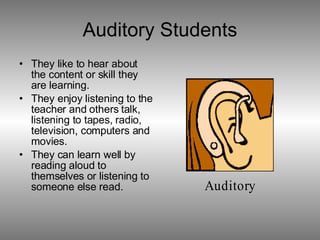
Auditory Students They like to hear about the content or skill they are learning. They enjoy listening to the teacher and others talk, listening to tapes, radio, television, computers and movies. They can learn well by reading aloud to themselves or listening to someone else read.
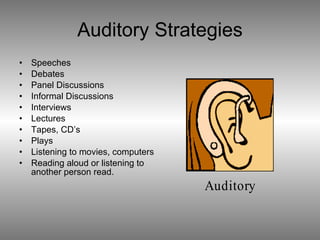
Auditory Strategies Speeches Debates Panel Discussions Informal Discussions Interviews Lectures Tapes, CD’s Plays Listening to movies, computers Reading aloud or listening to another person read.
Visual Students They like to read or see the new content or skills that they have to learn. Looking at movies, videotapes, television, plays, books, magazines, computers are all ways these students like to learn.
Visual Strategies Writing Scripts Poems Songs Book Reports Movies Diaries Stories Letters  Computers Videotapes Television
Tactual Students These students like hands-on experiences. Underlining what they read, taking notes, writing about what they are learning, using flashcards, puzzles, and models all help tactile learners remember what they learn. These students like working with their hands, and especially the computer.
Tactual Strategies Pictures Posters Murals Maps Charts/Graphics Games Models Underlining what they read Flashcards Puzzles
Kinesthetic Students Kinesthetic learners like to be actively involved in what they are learning. They enjoy acting out what they are learning, interviewing others, playing games and simulations, working with computer learning experiences, inventing, and experimenting. They enjoy field trips and other action-packed learning experiences.
Kinesthetic Strategies Video Field Trips Mock TV Shows Radio Broadcasts Demonstrations Dramatizations Construction Interviews Playing Games Computer learning experiences Inventing Experimenting Action-packed learning experiences
Bibliography http://www.teresadybvig.com/learnsty.htm http://www.geocities.com/~educationplace/element.html http://www.everythingesl.net/inservices/learningstyle.php http://www.ncsu.edu/felder-public/ILSdir/styles.htm http://pareonline.net/getvn.asp?v=1&n=11 http://language.com.hk/articles/styles1.html http://cc.ysu.edu/csp/lrnstyinv.htm http://www.iste.org/Content/NavigationMenu/Publications/JRTE/Issues/Volume_331/Number_5_Summer_2001/Learning_Style_Awareness-A_Basis_For_Developing_Teaching_and_Learning_Strategies.htm Dunn, Rita & Dunn, Kenneth,  Teaching Secondary Students through their Individual Learning Styles , Allyn & Bacon, 1993.

Edu 5701 7 Dunn & Dunn Learning Styles Model[1]

  • 1.
    Dunn & DunnLearning Style Model EDU 5701 Summer 2006 Professor Melissa Perna Barbara Marie King Assignment #7                                                                                                                                                                                                                     
  • 2.
    The Dunn &Dunn Learning Style Model An Overview of the Model
  • 3.
  • 4.
    Environmental Factors LightingSound Temperature Design (Seating Arrangement and Furniture Design)
  • 5.
    Emotional Factors MotivationPersistence Responsibility (conformity vs. nonconformity) Structure need for either externally imposed structure or the opportunity to do things in their own way)
  • 6.
    Sociological Factors Howto people learn in association with other people? An authoritative adult or with a collegial colleague Alone or with peers As a pair or team Learning in a variety of ways or in a routine
  • 7.
    Physiological Factors Perceptualstrengths (auditory, visual, tactile and kinesthetic) Time-of-day energy levels Intake (eating or not while studying) Mobility (sitting still or moving around) “ You can observe a lot by just watching.”- Yogi Berra
  • 8.
    Psychological Factors Hemispheric(right or left?) Impulsive or reflective Global vs. Analytic
  • 9.
  • 10.
    Global Learners Globallearners are spontaneous and intuitive. They do not like to be bored. Information needs to be presented in an interesting manner using attractive materials. Cooperative learning strategies and holistic reading methods work well with these learners. The information must relate to their lives, and permit active involvement. Global learners learn best through: choral reading recorded books story writing computer programs games group activities
  • 11.
    Overview for TeachingGlobal Students Introduce the material via a story, joke, anecdote and try to relate it to the students’ lives. Globals need to see the big picture before they can focus on details. They need stories, illustrations, pictures, real-life anecdotes and to have learning connected to their interests. Discovery through group learning. Written and tactual involvement.
  • 12.
    Specific Guidelines forTeaching Global Students Introduce lessons globally-begin with a story, joke, anecdote or something humorous. Relate introduction to concept. Provide an overview of the concept. Provide a sense of purpose. Use discovery learning. Provide small-group experiences such as team learning, circle of knowledge, case studies or brainstorming. Relate facts to each other and to realistic experiences. Avoid giving too many facts. Provide many types of materials. Offer opportunities to demonstrate mastery in a written form such as essays and graphs. Provide factual experiences. Provide kinesthetic experiences. Provide continuous feedback. Interact with students frequently. Check work in progress at each stage. Encourage persistence.
  • 13.
    Ideas for GlobalLearners If you are a global learner, it can be helpful for you to realize that you need the big picture of a subject before you can master details. If your instructor plunges directly into new topics without bothering to explain how they relate to what you already know, it can cause problems for you. Fortunately, there are steps you can take that may help you get the big picture more rapidly. Before you begin to study the first section of a chapter in a text, skim through the entire chapter to get an overview. Doing so may be time-consuming initially but it may save you from going over and over individual parts later. Instead of spending a short time on every subject every night, you might find it more productive to immerse yourself in individual subjects for large blocks. Try to relate the subject to things you already know, either by asking the instructor to help you see connections or by consulting references. Above all, don't lose faith in yourself; you will eventually understand the new material, and once you do your understanding of how it connects to other topics and disciplines may enable you to apply it in ways that most sequential thinkers would never dream of.
  • 14.
  • 15.
    Analytic Learners Analyticlearners plan and organize their work. They focus on details and are logical. They learn best when: information is presented in sequential steps lessons are structured and teacher-directed goals are clear requirements are spelled out
  • 16.
    Overview for TeachingAnalytic Students Explanations and visual reinforcement. Directions Learning through direct teaching or related resources. Testing and feedback. Analytics prefer the details and facts and like new information presented step-by-step
  • 17.
    Specific Guidelines forTeaching Analytic Students Provide explanations and visual reinforcements. Explain all procedures to be used. Write key information on chalkboard. Answer questions with detail. Write specific directions, objectives, test dates on ditto sheets or chart paper. Use direct teaching methods. Proceed step-by-step through needed information. Write key information on chalkboard. Underline important facts on handouts. Test frequently, provide instant feedback, respond to questions as soon as possible, itemize expectations, check assignments and test when you say you will
  • 18.
    Ideas for AnalyticLearners ANALYTICAL learners should try not to let an ambiguous learning situation (e.g. a difficult-to-grasp point of grammar) overly frustrate them, but be willing to give it time. (Time is a great clarifier of grammar and difficult vocabulary!) Don't set your goals unrealistically high, but find out from other students the average time each textbook takes to complete. Ensure that you allot sufficient time for conversation practice -- don't just sit at your desk poring over your books all day.
  • 19.
    Global and AnalyticTeachers How to Introduce new and difficult lessons globally and analytically
  • 20.
    Ideas for IntroducingLessons Team Learning with creative assignments, inference questions, and factual material in that order to global students Reverse that order for analytic students Teachers need to learn how to integrate global and analytic teaching strategies to reach all students Teachers also need to be able to present new and difficult information in all four modalities Providing multiple and varied opportunities for students to interact with content will enable them to initially gain knowledge through their strength modality and reinforce it with others To retain what they have learned requires that students engage in creating something with the new information and sharing what they have created with others (see ThinkQuest NYC slide for additional idea) Use Individualized instruction such as Programmed Learning Sequences (PLS), Contract Activity Packages (CAP’s) and Multisensory Instructional Packages (MIP’s)
  • 21.
  • 22.
    The Benefits ofa PLS Design a Programmed Learning Sequence to respond to individual learning styles. It is based upon several important principles: Only one item is presented at a time The student is required to be an active, rather than passive, learner The student is immediately informed of the correctness of each response The student may not continue into the next phase of a program until each previous phase has been understood and mastered The student is exposed to material that gradually progresses from the easy to the more difficult As the student proceeds in the program, fewer hints and crutches are provided Programmed Learning Sequences introduce material globally They incorporate tactual devices into the frames, thus helping low auditory and low visual students reinforce through another sense They are sequential, so they appeal to the analytic student Reinforce every seven or eight frames to revitalize learning on an ongoing basis They are accompanied by a tape so that nonreading students or poor readers may learn content regardless of inadequate reading skills They provide immediate feedback They teach at each student’s own pace They question, answer and reinforce They can often joke a little
  • 23.
    How to Designa Programmed Learning Sequence Identify your topic, concept or skill that you want to teach Write the name as a heading at the top of a blank sheet of paper Translate the heading into an introductory sentence that explains exactly what the student will be able to accomplish List all the prerequisites for using the program effectively Create a global story, fantasy, cartoon, or humorous beginning that relates to the topic Decide whether to use: Linear programming-which presents materials in frames that ends with an item that requires an answer, or, Intrinsic Programming-doesn’t require every student to complete every frame Outline how you plan to teach each topic Divide the sentences in your outline into frames Using index cards to represent each frame, develop a sequence that teaches a subject and that tests the student’s growing knowledge of it Refine each index card frame Review the sequence to be certain that it is logical and does not teach too much on each frame Check the spelling, grammar, and punctuation of each frame Examine the vocabulary to be certain it is understandable by all students Reread the entire series to be certain correct sequencing occurs Then, add colorful illustrations to clarify the main point on each index card. Read the written material on each frame onto a cassette so that poor readers may use the PLS by listening to the frames being read to them as they simultaneously read along Ask for 3-4 students to try the PLS, and correct any errors, omissions, or areas of difficulty If necessary, revise the PLS based upon the students’ usage Laminate each card of the PLS with clear contact paper Add miniature tactual activities for reinforcement of the most important information on the PLS Ask additional students to use the PLS When all “bugs” have been worked out, add a font and back cover if possible, to represent the subject matter Design a record-keeping form so you know which students are using and have used the program, how much, and if they were successful
  • 24.
  • 25.
  • 26.
    Basic Principles ofContract Activity Packages Simply stated objectives that itemize exactly what the student is required to learn Multisensory Alternative Resources that teach the information that the objectives indicate must be mastered A series of activities through which the information that has been mastered is used in a creative way A series of alternative ways in which creative instructional resources developed by one student may be shared with one or more-but no more than six to eight-classmates At least three small-group techniques A pretest, a self-test, and a posttest
  • 27.
    How to Designa Contract Activity Package Begin by identifying a topic, concept, or skill that you want to teach Develop a humorous or clever global subtitle List the things about this topic that you believe are so important that every student in your class should learn them Translate the important items into behavioral objectives Design at least 3-4 Activity Alternatives for each behavioral objective (or a group of related objectives) so that students may choose how they demonstrate that they have learned what the objectives require of them Create a Reporting Alternative for each of the Activity Alternatives that you have designed List all the resources you can locate that students may use to gain the information required by their behavioral objectives Add at least three small-group techniques to the developing Contract Activity Package. Always include a Team Learning. Develop a test that is directly related to each of the behavioral objectives in your CAP Design an illustrated cover for the CAP Develop an informational top sheet Reread each of the parts of the CAP Add illustrations to the pages to make the CAP attractive and motivating Duplicate the number of copies you will need Design a record-keeping form so that you know which students are using and have used the CAP and how much of it they have completed successfully Try a CAP with those students who can work well with any two or three small-group techniques
  • 28.
    What a knowledgeableteacher who is aware of students’ individual differences could do to help their students to achieve
  • 29.
  • 30.
    Global Learners Globallearners are spontaneous and intuitive. They do not like to be bored. Information needs to be presented in an interesting manner using attractive materials. Cooperative learning strategies and holistic reading methods work well with these learners. Global learners learn best through: choral reading recorded books story writing computer programs games group activities
  • 31.
    Activities for GlobalStudents Introduce lessons globally-begin with a story, joke, anecdote or something humorous. Relate introduction to concept. Provide an overview of the concept. Provide a sense of purpose. Use discovery learning. Provide small-group experiences such as team learning, circle of knowledge, case studies or brainstorming. Relate facts to each other and to realistic experiences. Avoid giving too many facts. Provide many types of materials. Offer opportunities to demonstrate mastery in a written form such as essays and graphs. Provide factual experiences. Provide kinesthetic experiences. Provide continuous feedback. Interact with students frequently. Check work in progress at each stage. Encourage persistence.
  • 32.
  • 33.
    Tactual Learners Studentswith this strength learn best by touching. They understand directions that they write and will learn best through manipulatives. These students will also benefit from whole language approaches to reading. They'll learn best by : drawing playing board games making dioramas making models following instructions to make something
  • 34.
    Activities for TactualLearners Pictures Posters Murals Maps Charts/Graphics Games Models Underlining what they read Flashcards Puzzles At the secondary level, students can create their own tactual resources Task cards Electroboard Flip Chutes Calculators Computer Games Touch-Compute Can Pic-A-Hole
  • 35.
  • 36.
    Kinesthetic Learners Kinestheticlearners also learn by touching or manipulating objects. They need to involve their whole body in learning. They remember material best if they act it out. These students learn best by: playing games that involve their whole body movement activities making models following instructions to make something setting up experiments
  • 37.
    Activities for KinestheticLearners Video Field Trips Mock TV Shows Radio Broadcasts Demonstrations Dramatizations Construction Interviews Playing Games (floor, table and wall) Computer learning experiences Inventing Experimenting Action-packed learning experiences
  • 38.
    Ideas for KinestheticLearners 1. Use many of your senses as possible when you study: see, hear, touch, taste, smell. 2. Move around when you study. Put as much as you can on study cards. Lay study cards out  on the floor in    various locations and practice reciting them as you move around the room. 3. Carry study cards with you everywhere and use them whenever you have to wait. 4. Study in small, frequent chunks. Give yourself breaks and rewards. 5. Use a timer and decide upon an amount of time you feel you can effectively sit and   work.  Underestimate and work up to longer time periods if possible. When the timer   sounds, take a break and do something physical. 6. Set a goal as to a specific amount of information you will cover such as five pages, etc.   When you reach your goal, take a break. 7.For surface learning, use a mnemonic device called the method of place. When you have to recall items on a list, mentally imagine them placed in sequential locations in your home and associate them with those places. For example, if you have to remember the names of the presidents of the  United States, begin in your kitchen. Wash Washington in the sink, bake Adams' apple in the oven, and so on. In order to trigger recall for a test, imagine yourself walking to each area. 8. Study with another kinesthetic person. Their gestures and activities may give you additional input. 9. When solving problems, move around and manipulate items to represent parts of the problem. 10.When taking exams, try to "feel" how you stored information by remembering what you physically did as you studied.
  • 39.
    How to prepareteachers/students for taking a teaching- and/or learning- style diagnostic instrument
  • 40.
    Preparing Students and/orTeachers Begin by explaining the differences in learning styles that exist among all classes, families, and cultures After this discussion, read either Two-of-a-Kind Learning Styles (Pena, 1989) (Grades 5-8) about Global Myrna and Analytic Victor, or use A Guide to Explaining Learning Styles to High School Students or Teachers As you read the story, tape record it Encourage students to guess the learning styles of members of their family Explain that it is important for each person to understand his or her style strengths Introduce the idea of learning about one’s strengths through a series of questions-which each person must answer truthfully, or there is no way to learn how each should be taught, or do homework, or study efficiently When the results of these questions are ascertained, you will be able to tell each student exactly how he or she should study in order to remember anything that ordinarily would be difficult. For teachers, explain how understanding one’s own learning styles can give them a better understanding in introducing lessons and activities that will help their student’s achievement Teachers need to be able to present new and difficult material in all four modalities. Providing multiple and varied opportunities for students to interact with content will enable them to initially gain knowledge through their strength modality and reinforce it with others.
  • 41.
    General Guidelines forTeaching test-taking skills Ligon and Jones suggest that an appropriate activity for preparing students for standardized testing is: "one which contributes to students' performing on the test near their true achievement levels, and one which contributes more to their scores than would an equal amount of regular classroom instruction" (1982, p. 1). Matter suggests that: "Ideally, test preparation activities should not be additional activities imposed upon teachers. Rather, they should be incorporated into the regular, ongoing instructional activities whenever possible." (1986, p. 10) If you follow the suggestion by Ligon and Jones, you might spend some time teaching students general test-taking skills. These skills would help students answer questions correctly if they have mastered the objectives. Without some level of test-taking skills, even knowledgeable students could miss an item (or a set of items) because they did not understand the mechanics of taking a test.
  • 42.
    Problems of tactuallearners in traditional instruction
  • 43.
    Tactual Learners Theylearn best through a hands-on approach.  In other words, these are your touchers and feelers; they like to be physically involved as they find it extremely difficult to sit still.  They often get out of their desks, pace around the classroom, want to have music or television playing in the background.  In short, they are almost constantly finding themselves distracted. May Want to: Creativity is essential for learning new material Use task cards, building models, using puzzles or other games which are helpful Follow activities with reading answers and participating in a lecture/discussion to help the learning process
  • 44.
    Problems of kinestheticlearners in traditional instruction
  • 45.
    Kinesthetic Learners Kinestheticstudents prefer the tactile sense. They are poor listeners, learn by doing, express emotions physically, and have an outgoing personality. They must touch or feel to understand. They learn best by engaging in hands-on activities (Kanar, 1995). If they can touch and feel whatever they are learning about, the kinesthetic/tactile learner will process and remember the information quite well. As students in a classroom, these people are usually quite restless, have more difficulty paying attention, and “can’t seem to get focused” (a visual term). These learners like to speak about learning in terms of their feelings and say things like “I feel” or “I’d like to get a better handle on this information.” Kinesthetic learners do not have the internal pictures of neatness and organization that visual learners make so easily in their minds. This is one of the reasons that kinesthetic learners have a more difficult time demonstrating what they know in traditional classrooms. It is normal for them not to be organized. These students often have a poor “sense” of time (“When Learning,” 2001). May Want to: Try an active participation exercise to learn new material Draw or write special notations next to important points in their notes Use computers, games, and word associations Answer questions in writing after use of above Teachers of kinesthetic/tactile learners need to provide many activities to allow students to participate in learning. They need to provide hands-on activities, provide for physical movement within the classroom, and encourage note taking. If possible, they should provide stories filled with action. Students should also be advised to summarize daily activities in their notes as a study aid. Advice to kinesthetic learners should include: Learn by doing, touching, or practicing. Write notes to help remember things. Take notes during lectures and discussions. Underline important information in the textbook. Take frequent breaks where you stand up and stretch. Draw pictures of what is learned. Build projects to help explain ideas.
  • 46.
    Strategies that Teacherscan employ to facilitate the students’ achievement based on their learning-style strengths
  • 47.
    Strategies to Employ“ Teachers also need to be able to present new and difficult information in all four modalities. Providing multiple and varied opportunities for students to interact with content will enable them to initially gain knowledge through their strength modality and reinforce it with two others. Options for gaining knowledge could include listening to a tape or lecture, reading, seeing a video, manipulating a model, taking notes, role-playing, conducting an experiment, or taking a field trip. To retain what they have learned requires that students engage in creating something with the new information and sharing what they have created with others (Dunn, 1991). Options for using their perceptual strengths for demonstrating what they have learned could include giving a speech, participating in a debate or panel discussion; writing a story, play, poem, review; designing a brochure, poster, chart, map, model; and conducting an interview, or creating a video, mock TV show, role-play, or newspaper.” -http://www.esu.edu/ctl/lrnstyle.html#factips Here is an example of a project that employs all four modalities that I have utilized with my 7 th & 8 th students in the 2 schools that I teach in.
  • 48.
    ThinkQuest NYC Eachyear my entire 7 th & 8 th grade completes an interactive, educational website on a Hispanic theme (for Spanish class). They work in pairs or teams and research and build their website throughout the year. Their completed website is then entered in a New York City website building competition entitled, “ThinkQuest NYC”. The following websites are examples of my students work this past year. This project is a perfect example of Dunn’s quote, “to retain what they have learned requires that students engage in creating something with the new information and sharing what they have created with others”. http://www.tqnyc.org
  • 49.
    Student-Created Websites The Spanish Red Carpet http://www.tqnyc.org/NYC062675/ The Days of the Dead http://www.tqnyc.org/NYC063058/ Hispanic Players of Major League Baseball http://www.tqnyc.org/NYC063141/ The Coral Reefs of Mexico-An Underwater Paradise! http://www.tqnyc.org/NYC063144/ The Real Pirates of the Caribbean http://www.tqnyc.org/NYC051310/ The Ancient Aztecs & Mayans http://www.tqnyc.org/NYC051314 The Knights of Spain http://www.tqnyc.org/NYC062689/
  • 50.
    Auditory Students Theylike to hear about the content or skill they are learning. They enjoy listening to the teacher and others talk, listening to tapes, radio, television, computers and movies. They can learn well by reading aloud to themselves or listening to someone else read.
  • 51.
    Auditory Strategies SpeechesDebates Panel Discussions Informal Discussions Interviews Lectures Tapes, CD’s Plays Listening to movies, computers Reading aloud or listening to another person read.
  • 52.
    Visual Students Theylike to read or see the new content or skills that they have to learn. Looking at movies, videotapes, television, plays, books, magazines, computers are all ways these students like to learn.
  • 53.
    Visual Strategies WritingScripts Poems Songs Book Reports Movies Diaries Stories Letters Computers Videotapes Television
  • 54.
    Tactual Students Thesestudents like hands-on experiences. Underlining what they read, taking notes, writing about what they are learning, using flashcards, puzzles, and models all help tactile learners remember what they learn. These students like working with their hands, and especially the computer.
  • 55.
    Tactual Strategies PicturesPosters Murals Maps Charts/Graphics Games Models Underlining what they read Flashcards Puzzles
  • 56.
    Kinesthetic Students Kinestheticlearners like to be actively involved in what they are learning. They enjoy acting out what they are learning, interviewing others, playing games and simulations, working with computer learning experiences, inventing, and experimenting. They enjoy field trips and other action-packed learning experiences.
  • 57.
    Kinesthetic Strategies VideoField Trips Mock TV Shows Radio Broadcasts Demonstrations Dramatizations Construction Interviews Playing Games Computer learning experiences Inventing Experimenting Action-packed learning experiences
  • 58.
    Bibliography http://www.teresadybvig.com/learnsty.htm http://www.geocities.com/~educationplace/element.htmlhttp://www.everythingesl.net/inservices/learningstyle.php http://www.ncsu.edu/felder-public/ILSdir/styles.htm http://pareonline.net/getvn.asp?v=1&n=11 http://language.com.hk/articles/styles1.html http://cc.ysu.edu/csp/lrnstyinv.htm http://www.iste.org/Content/NavigationMenu/Publications/JRTE/Issues/Volume_331/Number_5_Summer_2001/Learning_Style_Awareness-A_Basis_For_Developing_Teaching_and_Learning_Strategies.htm Dunn, Rita & Dunn, Kenneth, Teaching Secondary Students through their Individual Learning Styles , Allyn & Bacon, 1993.