Humanistic Approaches to Teaching http://www.learningandteaching.info/learning/humanist.htm
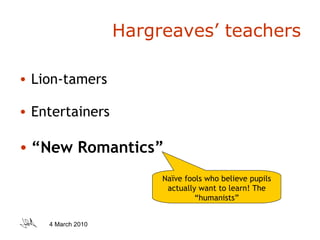
Hargreaves’ teachers Lion-tamers Entertainers “ New Romantics” Many years ago, David Hargreaves typified school-teachers in these categories…
Hargreaves’ teachers Lion-tamers Entertainers “ New Romantics” --they believe pupils are wild animals who don’t want to learn, but who can be made to learn—if you crack the whip hard enough…
Hargreaves’ teachers Lion-tamers Entertainers “ New Romantics” Also believe pupils don’t want to learn. But they will if we can make it enough “fun”
Hargreaves’ teachers Lion-tamers Entertainers “ New Romantics” Naïve fools who believe pupils actually want to learn! The “humanists”
Humanistic approaches Humanistic "theories" of learning are highly  value-driven   and hence more like  pre scriptions than  de scriptions.  Emphasise the  "natural desire"  of everyone to learn.  Whether this natural desire is  to learn whatever it is you are teaching , however, is not clear!
Implications So, learners need to be  empowered  and to have  control  over the learning process.  So the teacher relinquishes a great deal of authority and becomes a  facilitator .
Two traditions Liberal Radical
Two traditions Liberal Radical Confined mainly to the tactics of teaching…
Two traditions Liberal Radical Contests the very values and aims of education and its institutions
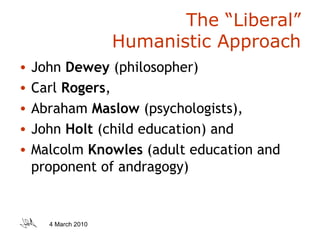
The “Liberal” Humanistic Approach John  Dewey  (philosopher) Carl  Rogers , Abraham  Maslow  (psychologists),  John  Holt  (child education) and  Malcolm  Knowles  (adult education and proponent of andragogy)
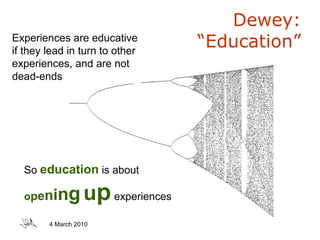
Dewey:  “Education” Experiences are educative if they lead in turn to other experiences, and are not  dead-ends  So  education  is about  o p e n i n g   u p   experiences
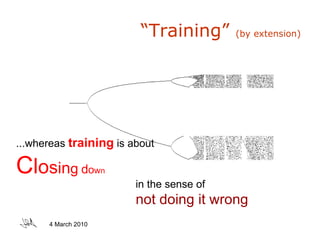
“ Training”  (by extension) ...whereas  training  is about C l o s in g   d o w n in the sense of  not doing it wrong
Education and training are two sides of the same coin; The humanistic tradition, however, does not handle training very well.
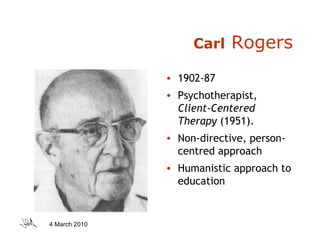
Carl  Rogers 1902-87 m  (1902-87) Psychotherapist,  Client-Centered Therapy  (1951). Non-directive, person-centred approach Humanistic approach to education
Rogers’ Principles 1 Human beings have a natural potentiality for learning "They are curious about their world,  until and unless this curiosity is blunted by their experience in our educational system .  They are ambivalently eager to develop and learn. The reason for the ambivalence is that any significant learning involves a certain amount of pain, either pain connected with the learning itself or distress connected with giving up certain previous learnings."
Rogers ctd. 2  Significant learning takes place when the subject matter is  perceived by the student as having relevance for his own purpose . 3  Learning which involves  a change in self organisation   —in the perception of oneself—is  threatening  and tends to be resisted. 4  Those learnings which are threatening to the self are more easily perceived and assimilated when  external threats are at a minimum.
Rogers 6  Much significant learning is acquired through  doing . 7  Learning is facilitated when the student  participates  responsibly  in the learning process. 8  Self-initiated learning   which involves the whole person of the learner—feelings as well as intellect—is the  most lasting and pervasive. 9  Independence, creativity and self-reliance are all facilitated when  self-criticism and self-evaluation are basic   and evaluation by others is of secondary importance. 10 The most social useful learning in the modern world is the  learning of the process of learning , a continuing openness to experience and incorporation into oneself of the process of change ... ROGERS C R (1969)  Freedom to Learn  Merrill: Columbus Ohio (ch 7)
The “Radical” Humanistic Approach Paulo Freire (Adult literacy) Conscientisation Ivan Illich De-schooling Michael Collins links with critical theory (Frankfurt school) Jack Mezirow (Adult education) transformative learning Among others, of course
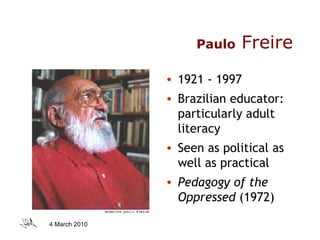
Paulo   Freire 1921 - 1997 Brazilian educator: particularly adult literacy Seen as political as well as practical Pedagogy of the Oppressed  (1972)
Freire “ This book will present some aspects of what the writer has termed the “ pedagogy of the oppressed ”, a pedagogy which must be forged  with , not  for , the oppressed (be they individuals or whole peoples) in the incessant struggle to regain their humanity.  This pedagogy makes oppression and its causes objects of reflection by the oppressed,  and from that reflection will come their  necessary engagement in the struggle for their liberation .  And in the struggle this pedagogy will be made and remade.” From Freire P  The Pedagogy of the Oppressed  Penguin 1972:25 Let’s get real. This is a very badly written book, guilty of egregious pseudo-intellectual obscurantism, and a manifesto for a revolution which never delivered. It’s idealistic crypto-marxist b***s**t P.S. I don’t like it.
“ Banking” education the teacher teaches and the students are taught;  the teacher knows everything and the students know nothing;  the teacher thinks and the students are thought about;  the teacher talks and the students listen—meekly;  the teacher disciplines and the students are disciplined; the teacher chooses and enforces his choice, and the students comply; the teacher acts and the students have the illusion of acting through the action of the teacher;  the teacher chooses the program content, and the students (who were not consulted) adapt to it;  the teacher confuses the authority of knowledge with his own professional authority, which he sets in opposition to the freedom of the students;  the teacher is the Subject of the learning process, while the pupils are mere objects. On the other hand, this analysis is spot-on!
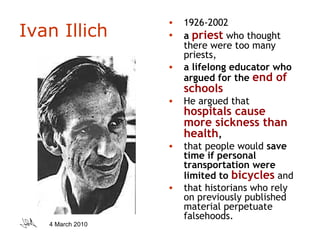
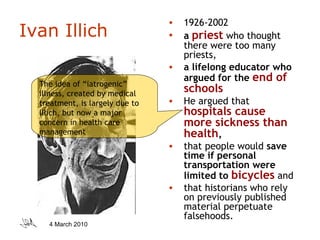
Ivan Illich 1926-2002 a  priest  who thought there were too many priests,  a lifelong educator who argued for the  end of schools   He argued that  hospitals cause more sickness than health ,  that people would  save time if personal transportation were limited to  bicycles  and  that historians who rely on previously published material perpetuate falsehoods.
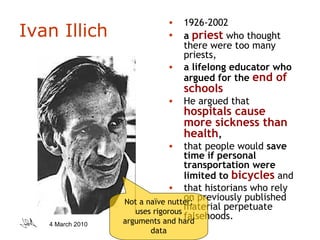
Ivan Illich 1926-2002 a  priest  who thought there were too many priests,  a lifelong educator who argued for the  end of schools   He argued that  hospitals cause more sickness than health ,  that people would  save time if personal transportation were limited to  bicycles  and  that historians who rely on previously published material perpetuate falsehoods.  Not a naïve nutter; uses rigorous arguments and hard data
Ivan Illich 1926-2002 a  priest  who thought there were too many priests,  a lifelong educator who argued for the  end of schools   He argued that  hospitals cause more sickness than health ,  that people would  save time if personal transportation were limited to  bicycles  and  that historians who rely on previously published material perpetuate falsehoods.  The idea of “iatrogenic” illness, created by medical treatment, is largely due to Illich, but now a major concern in health care management
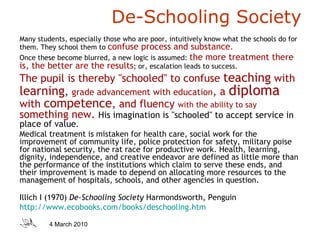
De-Schooling Society Many students, especially those who are poor, intuitively know what the schools do for them. They school them to  confuse process and substance .  Once these become blurred, a new logic is assumed:  the more treatment there is, the better are the results ; or, escalation leads to success.   The pupil is thereby "schooled" to confuse  teaching  with  learning ,  grade advancement with education , a  diploma  with  competence , and fluency  with the ability to say  something new.   His imagination is "schooled" to accept service in place of value .  Medical treatment is mistaken for health care, social work for the improvement of community life, police protection for safety, military poise for national security, the rat race for productive work. Health, learning, dignity, independence, and creative endeavor are defined as little more than the performance of the institutions which claim to serve these ends, and their improvement is made to depend on allocating more resources to the management of hospitals, schools, and other agencies in question. Illich I (1970)  De-Schooling Society  Harmondsworth, Penguin http://www.ecobooks.com/books/deschooling.htm
Situated Learning
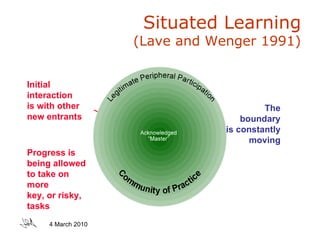
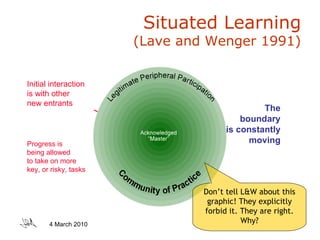
Situated Learning (Lave and Wenger 1991) Initial interaction is with other new entrants Progress is being allowed to take on more key, or risky, tasks Note:  Lave & Wenger explicitly reject this kind of depiction of their model The boundary is constantly moving
Situated Learning (Lave and Wenger 1991) Initial interaction is with other new entrants Progress is being allowed to take on more key, or risky, tasks Note:  Lave & Wenger explicitly reject this kind of depiction of their model The boundary is constantly moving Don’t tell L&W about this graphic! They explicitly forbid it. They are right. Why?
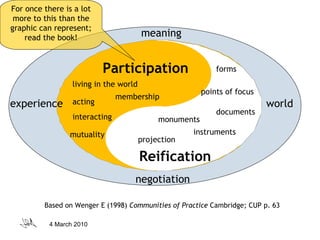
For once there is a lot more to this than the graphic can represent; read the book! Based on Wenger E (1998)  Communities of Practice  Cambridge; CUP p. 63 Participation Reification meaning world experience negotiation living in the world membership acting interacting mutuality forms points of focus documents monuments instruments projection
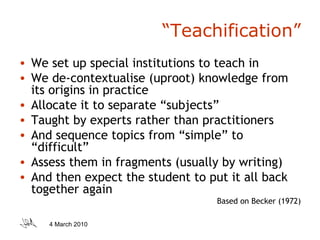
“ Teachification” We set up special institutions to teach in We de-contextualise (uproot) knowledge from its origins in practice Allocate it to separate “subjects” Taught by experts rather than practitioners And sequence topics from “simple” to “difficult” Assess them in fragments (usually by writing) And then expect the student to put it all back together again Based on Becker (1972)
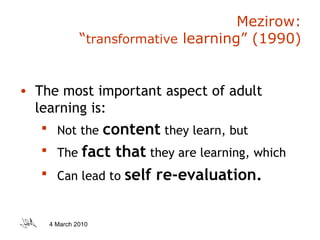
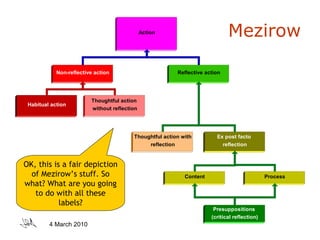
Mezirow:  “ transformative  learning” (1990) The most important aspect of adult learning is: Not the  content  they learn, but The  fact that  they are learning, which Can lead to  self re-evaluation.
Mezirow OK, this is a fair depiction of Mezirow’s stuff. So what? What are you going to do with all these labels?
But see Ecclestone K and Hayes D (2009)  The Dangerous Rise of Therapeutic Education  Abingdon; Routledge A counter-blast. It’s a polemic and a rant (and of course all the more entertaining for that) but the argument needs to be had  (sorry about that construction…)

Humanistic education

  • 1.
    Humanistic Approaches toTeaching http://www.learningandteaching.info/learning/humanist.htm
  • 2.
    Hargreaves’ teachers Lion-tamersEntertainers “ New Romantics” Many years ago, David Hargreaves typified school-teachers in these categories…
  • 3.
    Hargreaves’ teachers Lion-tamersEntertainers “ New Romantics” --they believe pupils are wild animals who don’t want to learn, but who can be made to learn—if you crack the whip hard enough…
  • 4.
    Hargreaves’ teachers Lion-tamersEntertainers “ New Romantics” Also believe pupils don’t want to learn. But they will if we can make it enough “fun”
  • 5.
    Hargreaves’ teachers Lion-tamersEntertainers “ New Romantics” Naïve fools who believe pupils actually want to learn! The “humanists”
  • 6.
    Humanistic approaches Humanistic"theories" of learning are highly value-driven and hence more like pre scriptions than de scriptions. Emphasise the "natural desire" of everyone to learn. Whether this natural desire is to learn whatever it is you are teaching , however, is not clear!
  • 7.
    Implications So, learnersneed to be empowered and to have control over the learning process. So the teacher relinquishes a great deal of authority and becomes a facilitator .
  • 8.
  • 9.
    Two traditions LiberalRadical Confined mainly to the tactics of teaching…
  • 10.
    Two traditions LiberalRadical Contests the very values and aims of education and its institutions
  • 11.
    The “Liberal” HumanisticApproach John Dewey (philosopher) Carl Rogers , Abraham Maslow (psychologists), John Holt (child education) and Malcolm Knowles (adult education and proponent of andragogy)
  • 12.
    Dewey: “Education”Experiences are educative if they lead in turn to other experiences, and are not dead-ends So education is about o p e n i n g u p experiences
  • 13.
    “ Training” (by extension) ...whereas training is about C l o s in g d o w n in the sense of not doing it wrong
  • 14.
    Education and trainingare two sides of the same coin; The humanistic tradition, however, does not handle training very well.
  • 15.
    Carl Rogers1902-87 m (1902-87) Psychotherapist, Client-Centered Therapy (1951). Non-directive, person-centred approach Humanistic approach to education
  • 16.
    Rogers’ Principles 1Human beings have a natural potentiality for learning "They are curious about their world, until and unless this curiosity is blunted by their experience in our educational system . They are ambivalently eager to develop and learn. The reason for the ambivalence is that any significant learning involves a certain amount of pain, either pain connected with the learning itself or distress connected with giving up certain previous learnings."
  • 17.
    Rogers ctd. 2 Significant learning takes place when the subject matter is perceived by the student as having relevance for his own purpose . 3 Learning which involves a change in self organisation —in the perception of oneself—is threatening and tends to be resisted. 4 Those learnings which are threatening to the self are more easily perceived and assimilated when external threats are at a minimum.
  • 18.
    Rogers 6 Much significant learning is acquired through doing . 7 Learning is facilitated when the student participates responsibly in the learning process. 8 Self-initiated learning which involves the whole person of the learner—feelings as well as intellect—is the most lasting and pervasive. 9 Independence, creativity and self-reliance are all facilitated when self-criticism and self-evaluation are basic and evaluation by others is of secondary importance. 10 The most social useful learning in the modern world is the learning of the process of learning , a continuing openness to experience and incorporation into oneself of the process of change ... ROGERS C R (1969) Freedom to Learn Merrill: Columbus Ohio (ch 7)
  • 19.
    The “Radical” HumanisticApproach Paulo Freire (Adult literacy) Conscientisation Ivan Illich De-schooling Michael Collins links with critical theory (Frankfurt school) Jack Mezirow (Adult education) transformative learning Among others, of course
  • 20.
    Paulo Freire 1921 - 1997 Brazilian educator: particularly adult literacy Seen as political as well as practical Pedagogy of the Oppressed (1972)
  • 21.
    Freire “ Thisbook will present some aspects of what the writer has termed the “ pedagogy of the oppressed ”, a pedagogy which must be forged with , not for , the oppressed (be they individuals or whole peoples) in the incessant struggle to regain their humanity. This pedagogy makes oppression and its causes objects of reflection by the oppressed, and from that reflection will come their necessary engagement in the struggle for their liberation . And in the struggle this pedagogy will be made and remade.” From Freire P The Pedagogy of the Oppressed Penguin 1972:25 Let’s get real. This is a very badly written book, guilty of egregious pseudo-intellectual obscurantism, and a manifesto for a revolution which never delivered. It’s idealistic crypto-marxist b***s**t P.S. I don’t like it.
  • 22.
    “ Banking” educationthe teacher teaches and the students are taught; the teacher knows everything and the students know nothing; the teacher thinks and the students are thought about; the teacher talks and the students listen—meekly; the teacher disciplines and the students are disciplined; the teacher chooses and enforces his choice, and the students comply; the teacher acts and the students have the illusion of acting through the action of the teacher; the teacher chooses the program content, and the students (who were not consulted) adapt to it; the teacher confuses the authority of knowledge with his own professional authority, which he sets in opposition to the freedom of the students; the teacher is the Subject of the learning process, while the pupils are mere objects. On the other hand, this analysis is spot-on!
  • 23.
    Ivan Illich 1926-2002a priest who thought there were too many priests, a lifelong educator who argued for the end of schools He argued that hospitals cause more sickness than health , that people would save time if personal transportation were limited to bicycles and that historians who rely on previously published material perpetuate falsehoods.
  • 24.
    Ivan Illich 1926-2002a priest who thought there were too many priests, a lifelong educator who argued for the end of schools He argued that hospitals cause more sickness than health , that people would save time if personal transportation were limited to bicycles and that historians who rely on previously published material perpetuate falsehoods. Not a naïve nutter; uses rigorous arguments and hard data
  • 25.
    Ivan Illich 1926-2002a priest who thought there were too many priests, a lifelong educator who argued for the end of schools He argued that hospitals cause more sickness than health , that people would save time if personal transportation were limited to bicycles and that historians who rely on previously published material perpetuate falsehoods. The idea of “iatrogenic” illness, created by medical treatment, is largely due to Illich, but now a major concern in health care management
  • 26.
    De-Schooling Society Manystudents, especially those who are poor, intuitively know what the schools do for them. They school them to confuse process and substance . Once these become blurred, a new logic is assumed: the more treatment there is, the better are the results ; or, escalation leads to success. The pupil is thereby "schooled" to confuse teaching with learning , grade advancement with education , a diploma with competence , and fluency with the ability to say something new. His imagination is "schooled" to accept service in place of value . Medical treatment is mistaken for health care, social work for the improvement of community life, police protection for safety, military poise for national security, the rat race for productive work. Health, learning, dignity, independence, and creative endeavor are defined as little more than the performance of the institutions which claim to serve these ends, and their improvement is made to depend on allocating more resources to the management of hospitals, schools, and other agencies in question. Illich I (1970) De-Schooling Society Harmondsworth, Penguin http://www.ecobooks.com/books/deschooling.htm
  • 27.
  • 28.
    Situated Learning (Laveand Wenger 1991) Initial interaction is with other new entrants Progress is being allowed to take on more key, or risky, tasks Note: Lave & Wenger explicitly reject this kind of depiction of their model The boundary is constantly moving
  • 29.
    Situated Learning (Laveand Wenger 1991) Initial interaction is with other new entrants Progress is being allowed to take on more key, or risky, tasks Note: Lave & Wenger explicitly reject this kind of depiction of their model The boundary is constantly moving Don’t tell L&W about this graphic! They explicitly forbid it. They are right. Why?
  • 30.
    For once thereis a lot more to this than the graphic can represent; read the book! Based on Wenger E (1998) Communities of Practice Cambridge; CUP p. 63 Participation Reification meaning world experience negotiation living in the world membership acting interacting mutuality forms points of focus documents monuments instruments projection
  • 31.
    “ Teachification” Weset up special institutions to teach in We de-contextualise (uproot) knowledge from its origins in practice Allocate it to separate “subjects” Taught by experts rather than practitioners And sequence topics from “simple” to “difficult” Assess them in fragments (usually by writing) And then expect the student to put it all back together again Based on Becker (1972)
  • 32.
    Mezirow: “transformative learning” (1990) The most important aspect of adult learning is: Not the content they learn, but The fact that they are learning, which Can lead to self re-evaluation.
  • 33.
    Mezirow OK, thisis a fair depiction of Mezirow’s stuff. So what? What are you going to do with all these labels?
  • 34.
    But see EcclestoneK and Hayes D (2009) The Dangerous Rise of Therapeutic Education Abingdon; Routledge A counter-blast. It’s a polemic and a rant (and of course all the more entertaining for that) but the argument needs to be had (sorry about that construction…)