Humanism is an approach to
recognise that moral values are
properly founded on human nature
and experience alone -
Robert Ashby
Humanism is a democratic and
ethical life stance, which affirms
that human beings have the right
and responsibility to give
meaning and shape to their own
lives.
- International Humanist and
Ethical Union
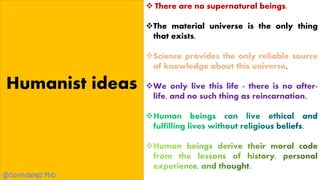
 There are no supernatural beings.
The material universe is the only thing
that exists.
Science provides the only reliable source
of knowledge about this universe.
We only live this life - there is no after-
life, and no such thing as reincarnation.
Humanist ideas
Supporting the disadvantaged and the
handicapped
Transcend divisive parochial loyalties based
on race, religion, gender, nationality, creed,
class, sexual orientation, or ethnicity, and
strive to work together
Enjoying life here and now and in
developing our creative talents to their
fullest.
Some core principles are important:
a) respect for life and human dignity;
b) equal rights and social justice;
respect for cultural diversity, as well
as a sense of shared responsibility
and
c) a commitment to international
solidarity.
Recognizes the diversity of
knowledge systems,
worldviews, and
conceptions of well-being
as a source of wealth.
Diversity of lived realities
while reaffirming a
common core of universal
values.
 Development of the whole
student with an emphasis on
emotional aspects of the
student.
Understanding of talents,
strengths and weaknesses,
and a belief in your ability
to improve.
.
.
.
Gage and Berliner (1991) described 4
basic objectives:
1. Promote and develop positive self-
direction and independence;
2. Develop the ability to take
responsibility for what is learned;
 Students will learn best what they
want and need to know.
 Allow the student to have a choice in the selection of tasks
and activities
Humanistic Applications/
Humanist Way of Teaching
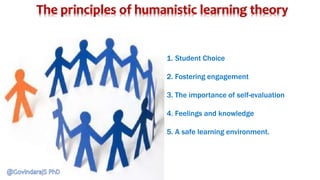
1. Student Choice
2. Fostering engagement
3. The importance of self-evaluation
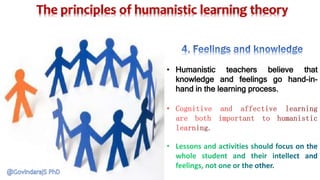
4. Feelings and knowledge
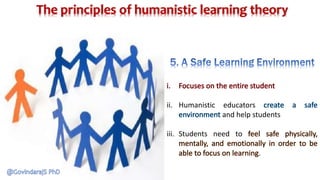
5. A safe learning environment.
The principles of humanistic learning theory
a) Humanistic learning is ,
students
b) Students are encouraged to
The principles of humanistic learning theory
2. Fostering engagement
a. Fostering engagement to inspire students
to become self-motivated to learn.
b. Humanistic learning relies on educators
working to engage students, encouraging
them to find things they are passionate
about so they are excited about learning.
The principles of humanistic learning theory
.
ii. Grading students encourages students to
work for the grade, instead of doing things
based on their
.
iii. Humanistic educators help students
.
The principles of humanistic learning theory
• Humanistic teachers believe that
knowledge and feelings go hand-in-
hand in the learning process.
The principles of humanistic learning theory
ii. Humanistic educators
and help students
iii. Students need to
.
The principles of humanistic learning theory
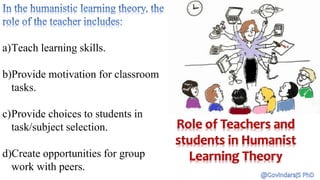
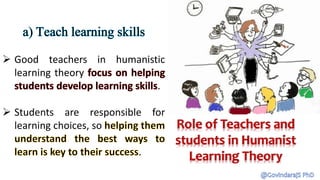
a)Teach learning skills.
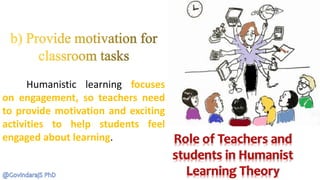
b)Provide motivation for classroom
tasks.
c)Provide choices to students in
task/subject selection.
d)Create opportunities for group
work with peers.
Role of Teachers and
students in Humanist
Learning Theory
 Good teachers in humanistic
learning theory
.
 Students are responsible for
learning choices, so
.
Role of Teachers and
students in Humanist
Learning Theory
Humanistic learning focuses
on engagement, so teachers need
to provide motivation and exciting
activities to help students feel
engaged about learning. Role of Teachers and
students in Humanist
Learning Theory
 Teachers have a role in
helping work with students
to make choices about what
to learn.
Role of Teachers and
students in Humanist
Learning Theory
As a facilitator in the
classroom, teachers create group
opportunities to help students
.
Role of Teachers and
students in Humanist
Learning Theory
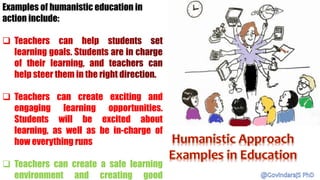
Examples of humanistic education in
action include:
 Teachers can create exciting and
engaging learning opportunities.
Students will be excited about
learning, as well as be in-charge of
how everything runs
 Teachers can create a safe learning
environment and creating good
https://www.yourdictionary.com/humanism
https://www.britannica.com/topic/humanism
https://www.bbc.co.uk/religion/religions/atheism/types/hu
manism.shtml
https://trenducation.wordpress.com/2016/04/25/education
-needs-a-humanistic-approach/
https://simple.wikipedia.org/wiki/Humanism
https://americanhumanist.org/what-is-
humanism/definition-of-humanism/
https://danielmiessler.com/blog/the-principles-of-secular-
humanism/
https://www.wgu.edu/blog/what-humanistic-learning-
theory-education2007.html

Humanism