EDU 301 EDUCATIONAL PSYCHOLOGY
Dr. Hala Fawzi
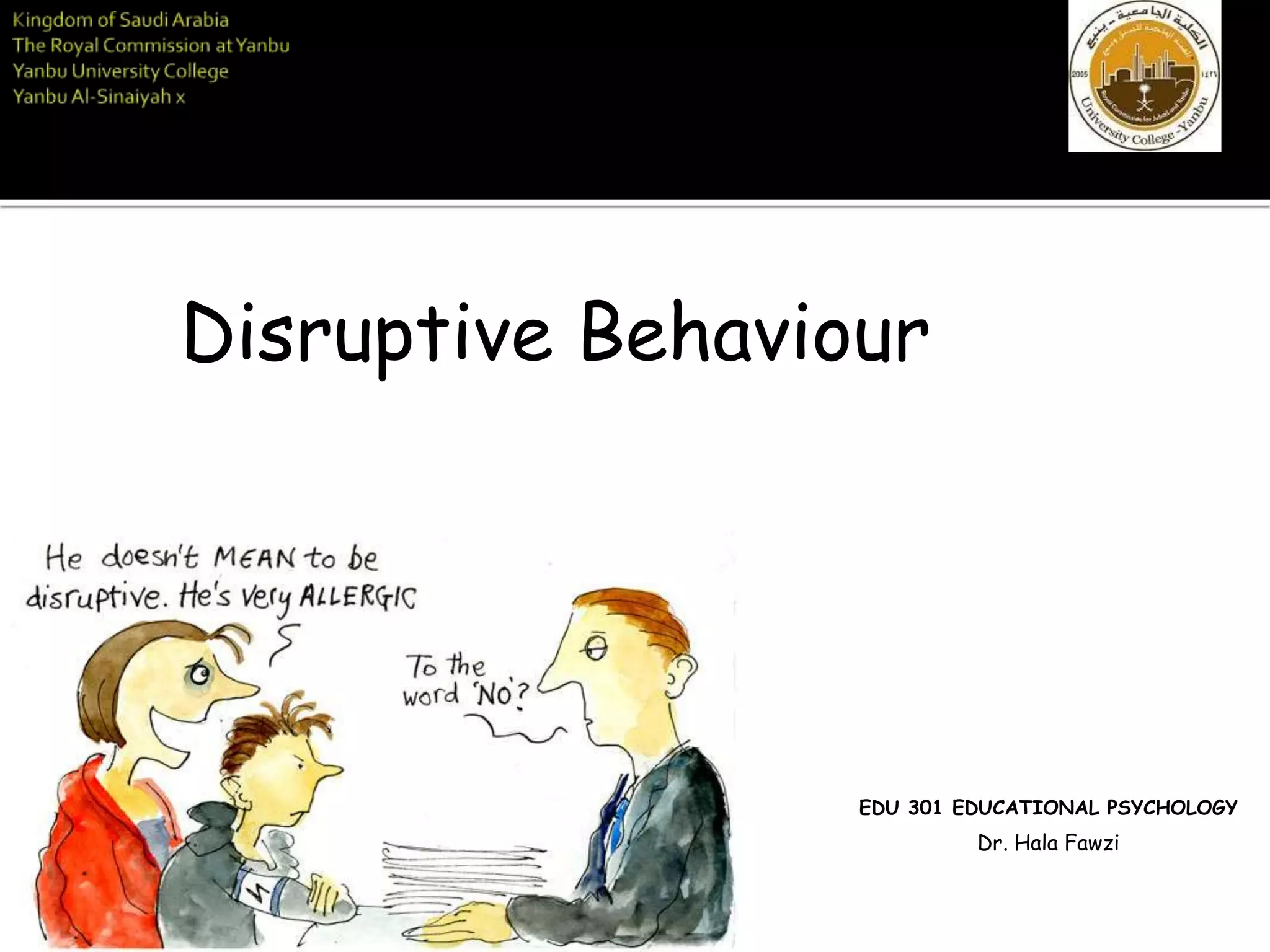
Disruptive Behaviour
How teachers define
disruptive behaviour?
Definitions
Types
Causes
Interventions
How would you create aY/N checklist to
measure disruptive behaviour?
 Talking or texting on mobile telephone
 Talking without permission
 Eating and drinking or smoking in class
 Out of seat
 Brushing hair
 Makeup
 Passing notes
 Shouting
 Throwing objects (paper aeroplanes)
 Chewing gum
 Playing with equipment
 Attention seeking
 Swearing
 Fire alarm
 Singing
 Crawling on floor
 Attacking pupils or teachers
 Other?
It’s NOT naughtiness and emotional difficulties.
 Emotional Behavioural problem
 Young person
 Interferes with their personal, social
and/or educational development.
p:136
Cooper (1996)
Emotional Behavioural Difficulties (EBD)
 Obvious verbally or physically
 Challenges the authority of the teacher or the school.
Emotional Behavioural Difficulties (EBD)
Charlton and David (1993) (From the school point of view)
p:136
 Prevents children’s participation in educational activities
 Isolates them from their peers
 Affects other pupils
 Reduces opportunities for involvement in ordinary community activities
 Excessive demands upon teachers, staff and resources
 Places the child or others in physical danger
 Makes future placement difficult
Garner and Hill (1995) ( negative effects)
Emotional Behavioural Difficulties (EBD)
p:137
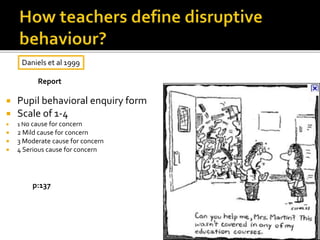
 Pupil behavioral enquiry form
 Scale of 1-4
 1 No cause for concern
 2 Mild cause for concern
 3 Moderate cause for concern
 4 Serious cause for concern
Daniels et al 1999
Report
p:137
5 areas
1. Work skills – care of books, homework, settling to work,
following instructions, requesting appropriate help,
accepting advice.
2. Verbal behaviour– refuses to follow instructions, talks when
teacher talks, talks to teacher when should be working,
shouts out, mimics, threatens other pupils or teacher, makes
inappropriate noises.
Daniels et al 1999
Verbal behaviourWork skills
3. Non-verbal behaviour – leaving classroom, wanders about
classroom, moves around in seats, disrespect for other
people’s property.
4. Emotional profile – cries easily, tantrums, isolated from
peers, physical self-abuse, cannot express emotions.
5. Personal organisation – truants, late, leaving coat on, failing
to bring books or kit, etc
Daniels et al 1999
Non-verbal behaviour Emotional profile Personal organisation
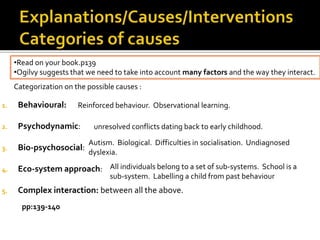
1. Behavioural:
2. Psychodynamic:
3. Bio-psychosocial:
4. Eco-system approach:
5. Complex interaction: between all the above.
•Read on your book.p139
•Ogilvy suggests that we need to take into account many factors and the way they interact.
Reinforced behaviour. Observational learning.
unresolved conflicts dating back to early childhood.
Autism. Biological. Difficulties in socialisation. Undiagnosed
dyslexia.
All individuals belong to a set of sub-systems. School is a
sub-system. Labelling a child from past behaviour
pp:139-140
Categorization on the possible causes :
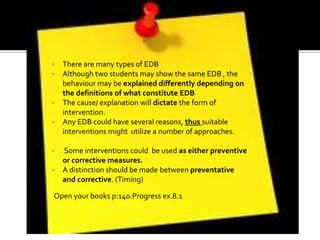
 There are many types of EDB
 Although two students may show the same EDB , the
behaviour may be explained differently depending on
the definitions of what constitute EDB
 The cause/ explanation will dictate the form of
intervention.
 Any EDB could have several reasons, thus suitable
interventions might utilize a number of approaches.
 Some interventions could be used as either preventive
or corrective measures.
 A distinction should be made between preventative
and corrective. (Timing)
Open your books p:140.Progress ex.8.1
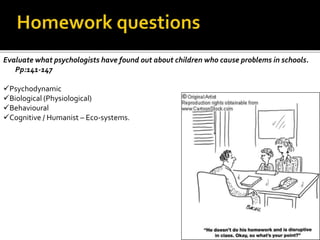
Evaluate what psychologists have found out about children who cause problems in schools.
Pp:141-147
Psychodynamic
Biological (Physiological)
Behavioural
Cognitive / Humanist – Eco-systems.
1. Good teaching
2. An appropriate curriculum.
3. An effective behavior policy.
4. Staff to learn from their actions.
5. Key staff understands the nature
Ways forward: Read more about each on p:147
What are the characteristics underlie success on Daniels et al (1999) research
report?
Distruptive Behaviour

Distruptive Behaviour

  • 1.
    EDU 301 EDUCATIONALPSYCHOLOGY Dr. Hala Fawzi Disruptive Behaviour
  • 2.
    How teachers define disruptivebehaviour? Definitions Types Causes Interventions
  • 3.
    How would youcreate aY/N checklist to measure disruptive behaviour?
  • 4.
     Talking ortexting on mobile telephone  Talking without permission  Eating and drinking or smoking in class  Out of seat  Brushing hair  Makeup  Passing notes  Shouting  Throwing objects (paper aeroplanes)  Chewing gum  Playing with equipment  Attention seeking  Swearing  Fire alarm  Singing  Crawling on floor  Attacking pupils or teachers  Other? It’s NOT naughtiness and emotional difficulties.
  • 5.
     Emotional Behaviouralproblem  Young person  Interferes with their personal, social and/or educational development. p:136 Cooper (1996) Emotional Behavioural Difficulties (EBD)
  • 6.
     Obvious verballyor physically  Challenges the authority of the teacher or the school. Emotional Behavioural Difficulties (EBD) Charlton and David (1993) (From the school point of view) p:136
  • 7.
     Prevents children’sparticipation in educational activities  Isolates them from their peers  Affects other pupils  Reduces opportunities for involvement in ordinary community activities  Excessive demands upon teachers, staff and resources  Places the child or others in physical danger  Makes future placement difficult Garner and Hill (1995) ( negative effects) Emotional Behavioural Difficulties (EBD) p:137
  • 8.
     Pupil behavioralenquiry form  Scale of 1-4  1 No cause for concern  2 Mild cause for concern  3 Moderate cause for concern  4 Serious cause for concern Daniels et al 1999 Report p:137
  • 9.
    5 areas 1. Workskills – care of books, homework, settling to work, following instructions, requesting appropriate help, accepting advice. 2. Verbal behaviour– refuses to follow instructions, talks when teacher talks, talks to teacher when should be working, shouts out, mimics, threatens other pupils or teacher, makes inappropriate noises. Daniels et al 1999 Verbal behaviourWork skills
  • 10.
    3. Non-verbal behaviour– leaving classroom, wanders about classroom, moves around in seats, disrespect for other people’s property. 4. Emotional profile – cries easily, tantrums, isolated from peers, physical self-abuse, cannot express emotions. 5. Personal organisation – truants, late, leaving coat on, failing to bring books or kit, etc Daniels et al 1999 Non-verbal behaviour Emotional profile Personal organisation
  • 11.
    1. Behavioural: 2. Psychodynamic: 3.Bio-psychosocial: 4. Eco-system approach: 5. Complex interaction: between all the above. •Read on your book.p139 •Ogilvy suggests that we need to take into account many factors and the way they interact. Reinforced behaviour. Observational learning. unresolved conflicts dating back to early childhood. Autism. Biological. Difficulties in socialisation. Undiagnosed dyslexia. All individuals belong to a set of sub-systems. School is a sub-system. Labelling a child from past behaviour pp:139-140 Categorization on the possible causes :
  • 12.
     There aremany types of EDB  Although two students may show the same EDB , the behaviour may be explained differently depending on the definitions of what constitute EDB  The cause/ explanation will dictate the form of intervention.  Any EDB could have several reasons, thus suitable interventions might utilize a number of approaches.  Some interventions could be used as either preventive or corrective measures.  A distinction should be made between preventative and corrective. (Timing) Open your books p:140.Progress ex.8.1
  • 13.
    Evaluate what psychologistshave found out about children who cause problems in schools. Pp:141-147 Psychodynamic Biological (Physiological) Behavioural Cognitive / Humanist – Eco-systems.
  • 14.
    1. Good teaching 2.An appropriate curriculum. 3. An effective behavior policy. 4. Staff to learn from their actions. 5. Key staff understands the nature Ways forward: Read more about each on p:147 What are the characteristics underlie success on Daniels et al (1999) research report?