Introduction to Backwards Planning
Backwards Planning: A Definition Backwards planning means first identifying your goal and then choosing the actions that are most likely to help you to arrive efficiently at your goal.
Agenda Vacation example Steps to backwards plan Applying backwards planning to lessons Common pitfalls Conclusion and Next steps
Let’s say we’re planning a vacation.  We can go anywhere.
First, we’ll probably identify our destination- a place we’re really excited to see.
Before we can figure out how to get there, we need to know where we’re starting.
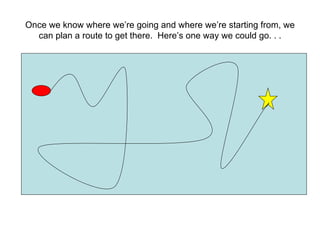
Once we know where we’re going and where we’re starting from, we can plan a route to get there.  Here’s one way we could go. . .
And here’s another way.
But of course, if our vacation is short, we’re going to want to arrive as fast as possible so that we can get the most out of our vacation.
Because we’re driving and because we have a schedule and a destination, we’ll probably build in checks along the way – planning to arrive at certain landmarks by certain times to ensure we’re going to arrive at our final destination on time.
Then, although we have made a careful plan, as we’re driving, we may encounter a roadblock. When that happens, because we really want to enjoy our vacation, we’ll try to get back on track as soon as possible to arrive at our final destination.
Imagine if you knew your destination but did not know your starting point, how would you plan your trip effectively?
And what if you knew where you were starting but did not know where you were going?
What would happen if you knew where you were starting and where you wanted to go, but you didn’t have a plan for how arrive?  How could you be sure you would arrive on time?
Agenda Vacation example Steps to effectively backwards plan Applying backwards planning to lessons Common Pitfalls Conclusion and Next steps
Steps for Making an Effective Plan Identify your destination and describe how you will know if you’ve reached it. Identify your starting point and how you will know what it is. Create a plan that will help you to arrive purposefully and efficiently at your goal. Create ways to check your progress along the way. Adjust according to the situation.
Agenda Vacation example Steps to effectively backwards plan Applying backwards planning to lessons Common pitfalls Conclusion and Next steps
Planning a class for your students is just like planning a vacation.  Planning your lessons
When we start teaching, we have a blank slate, and it is our job to seek out the information that we need to plan our year.
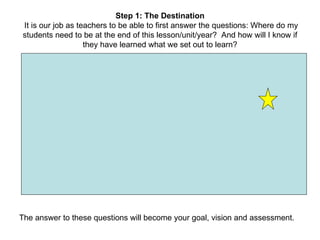
Step 1: The Destination   It is our job as teachers to be able to first answer the questions: Where do my students need to be at the end of this lesson/unit/year?  And how will I know if they have learned what we set out to learn? The answer to these questions will become your goal, vision and assessment.
Step 2: The Starting Point  Then, the teacher needs to be able to answer the questions, “Where are my students starting in terms of their learning?  How do I know?” To answer these questions, you will likely need to administer a diagnostic exam.
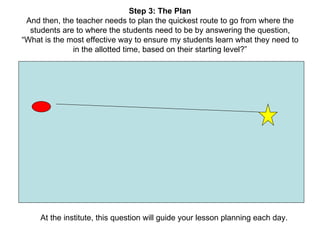
Step 3: The Plan And then, the teacher needs to plan the quickest route to go from where the students are to where the students need to be by answering the question, “What is the most effective way to ensure my students learn what they need to in the allotted time, based on their starting level?” At the institute, this question will guide your lesson planning each day.
Step 4: Build Benchmarks The teacher needs to build in checks along the way to make sure that there are no surprises in the end.  You need to answer the question “How will I know at a given moment if my students are on track to achieve our learning goal?”  During the institute, this question will help you to build effective daily assessments and regular checks for understanding.
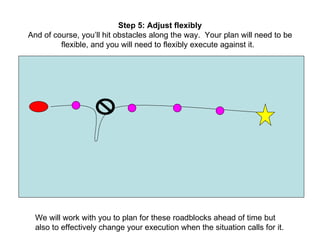
Step 5: Adjust flexibly And of course, you’ll hit obstacles along the way.  Your plan will need to be flexible, and you will need to flexibly execute against it.  We will work with you to plan for these roadblocks ahead of time but also to effectively change your execution when the situation calls for it.
Agenda Vacation example Steps to effectively backwards plan Applying backwards planning to lessons Common pitfalls Conclusion and Next steps
There are 4 common pitfalls in planning:   You have no way to benchmark success along the way. The activities do not align with the goal.  The sub-goals don’t lead to the final goal. The activities are not purposeful.
Pitfall 1: No way to benchmark success Some teachers may accurately determine the destination and starting point and create a plan, but they may not create benchmarks for success.  This may mean they do not progress quickly enough and fall short of the goal.
Pitfall 2: Activities do not align with the goal Another common mistake new teachers make is to make assumptions about what students need to know in the end and what they know at the start of the year.  If this doesn’t match up with the reality, you may end up teaching the wrong thing.  In addition, the teacher may plan activities that seem fun but do not align with the ultimate learning goal, so students to not master it.
Pitfall 3: Benchmarks do not align with the goal Another common mistake is for the teacher to create benchmarks for success that when achieved, do not ensure that a student is on track to reach a given goal.
Pitfall 4: Activities are not purposeful. Unfortunately, many new teachers start by planning activities that seem like they will be fun or engaging for students but don’t think about the purpose behind those activities and whether they are the best activities to reach the goal.  This could mean that you waste valuable time in trying to reach your goal and you may not arrive.
Agenda Vacation example Steps to effectively backwards plan Applying backwards planning to lessons Common pitfalls Conclusion and Next steps
Sneak Peak of Year-Long Planning Year  Lesson Unit During the year, you will use backwards planning to first plan your year, then each unit, then each lesson.
Sneak Peak of Lesson Planning Vision + Assessment Opening and Closing Practice At the institute, in the coming sessions we will learn that you do not plan your lessons from beginning to end, but rather you backwards plan them.
Things to Remember As a teacher, it is my job to always plan backwards to ensure that all of my students reach our learning goals. In order to do this effectively, I will first identify my goal and how I will know if I’ve reached it.  I’ll then identify my starting point and then make a plan for the most efficient and effective way to arrive at my goal.  Finally, I’ll build in checks along the way to make sure I’m on track. I owe this to my students, and operating in this way will make me a more effective teacher and a more effective leader.

Backwards planning

  • 1.
  • 2.
    Backwards Planning: ADefinition Backwards planning means first identifying your goal and then choosing the actions that are most likely to help you to arrive efficiently at your goal.
  • 3.
    Agenda Vacation exampleSteps to backwards plan Applying backwards planning to lessons Common pitfalls Conclusion and Next steps
  • 4.
    Let’s say we’replanning a vacation. We can go anywhere.
  • 5.
    First, we’ll probablyidentify our destination- a place we’re really excited to see.
  • 6.
    Before we canfigure out how to get there, we need to know where we’re starting.
  • 7.
    Once we knowwhere we’re going and where we’re starting from, we can plan a route to get there. Here’s one way we could go. . .
  • 8.
  • 9.
    But of course,if our vacation is short, we’re going to want to arrive as fast as possible so that we can get the most out of our vacation.
  • 10.
    Because we’re drivingand because we have a schedule and a destination, we’ll probably build in checks along the way – planning to arrive at certain landmarks by certain times to ensure we’re going to arrive at our final destination on time.
  • 11.
    Then, although wehave made a careful plan, as we’re driving, we may encounter a roadblock. When that happens, because we really want to enjoy our vacation, we’ll try to get back on track as soon as possible to arrive at our final destination.
  • 12.
    Imagine if youknew your destination but did not know your starting point, how would you plan your trip effectively?
  • 13.
    And what ifyou knew where you were starting but did not know where you were going?
  • 14.
    What would happenif you knew where you were starting and where you wanted to go, but you didn’t have a plan for how arrive? How could you be sure you would arrive on time?
  • 15.
    Agenda Vacation exampleSteps to effectively backwards plan Applying backwards planning to lessons Common Pitfalls Conclusion and Next steps
  • 16.
    Steps for Makingan Effective Plan Identify your destination and describe how you will know if you’ve reached it. Identify your starting point and how you will know what it is. Create a plan that will help you to arrive purposefully and efficiently at your goal. Create ways to check your progress along the way. Adjust according to the situation.
  • 17.
    Agenda Vacation exampleSteps to effectively backwards plan Applying backwards planning to lessons Common pitfalls Conclusion and Next steps
  • 18.
    Planning a classfor your students is just like planning a vacation. Planning your lessons
  • 19.
    When we startteaching, we have a blank slate, and it is our job to seek out the information that we need to plan our year.
  • 20.
    Step 1: TheDestination It is our job as teachers to be able to first answer the questions: Where do my students need to be at the end of this lesson/unit/year? And how will I know if they have learned what we set out to learn? The answer to these questions will become your goal, vision and assessment.
  • 21.
    Step 2: TheStarting Point Then, the teacher needs to be able to answer the questions, “Where are my students starting in terms of their learning? How do I know?” To answer these questions, you will likely need to administer a diagnostic exam.
  • 22.
    Step 3: ThePlan And then, the teacher needs to plan the quickest route to go from where the students are to where the students need to be by answering the question, “What is the most effective way to ensure my students learn what they need to in the allotted time, based on their starting level?” At the institute, this question will guide your lesson planning each day.
  • 23.
    Step 4: BuildBenchmarks The teacher needs to build in checks along the way to make sure that there are no surprises in the end. You need to answer the question “How will I know at a given moment if my students are on track to achieve our learning goal?” During the institute, this question will help you to build effective daily assessments and regular checks for understanding.
  • 24.
    Step 5: Adjustflexibly And of course, you’ll hit obstacles along the way. Your plan will need to be flexible, and you will need to flexibly execute against it. We will work with you to plan for these roadblocks ahead of time but also to effectively change your execution when the situation calls for it.
  • 25.
    Agenda Vacation exampleSteps to effectively backwards plan Applying backwards planning to lessons Common pitfalls Conclusion and Next steps
  • 26.
    There are 4common pitfalls in planning: You have no way to benchmark success along the way. The activities do not align with the goal. The sub-goals don’t lead to the final goal. The activities are not purposeful.
  • 27.
    Pitfall 1: Noway to benchmark success Some teachers may accurately determine the destination and starting point and create a plan, but they may not create benchmarks for success. This may mean they do not progress quickly enough and fall short of the goal.
  • 28.
    Pitfall 2: Activitiesdo not align with the goal Another common mistake new teachers make is to make assumptions about what students need to know in the end and what they know at the start of the year. If this doesn’t match up with the reality, you may end up teaching the wrong thing. In addition, the teacher may plan activities that seem fun but do not align with the ultimate learning goal, so students to not master it.
  • 29.
    Pitfall 3: Benchmarksdo not align with the goal Another common mistake is for the teacher to create benchmarks for success that when achieved, do not ensure that a student is on track to reach a given goal.
  • 30.
    Pitfall 4: Activitiesare not purposeful. Unfortunately, many new teachers start by planning activities that seem like they will be fun or engaging for students but don’t think about the purpose behind those activities and whether they are the best activities to reach the goal. This could mean that you waste valuable time in trying to reach your goal and you may not arrive.
  • 31.
    Agenda Vacation exampleSteps to effectively backwards plan Applying backwards planning to lessons Common pitfalls Conclusion and Next steps
  • 32.
    Sneak Peak ofYear-Long Planning Year Lesson Unit During the year, you will use backwards planning to first plan your year, then each unit, then each lesson.
  • 33.
    Sneak Peak ofLesson Planning Vision + Assessment Opening and Closing Practice At the institute, in the coming sessions we will learn that you do not plan your lessons from beginning to end, but rather you backwards plan them.
  • 34.
    Things to RememberAs a teacher, it is my job to always plan backwards to ensure that all of my students reach our learning goals. In order to do this effectively, I will first identify my goal and how I will know if I’ve reached it. I’ll then identify my starting point and then make a plan for the most efficient and effective way to arrive at my goal. Finally, I’ll build in checks along the way to make sure I’m on track. I owe this to my students, and operating in this way will make me a more effective teacher and a more effective leader.