Definition: An approach in study, philosophy, or practice that focuses on human values and concerns. A system of thought that rejects religious beliefs and centers on humans and their values, capacities, and worth.
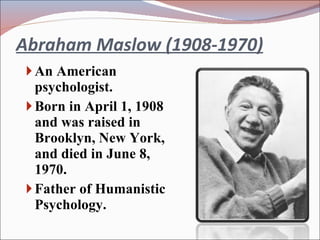
Abraham Maslow (1908-1970) An American psychologist. Born in April 1, 1908 and was raised in Brooklyn, New York, and died in June 8, 1970. Father of Humanistic Psychology.
Humanistic Theory of Learning Maslow’s theory is based on the notion that experience is the primary phenomenon in the study of human learning and behavior. He placed emphasis on choice, creativity, values, self-realization, all distinctively human qualities, and believed that meaningfulness and subjectivity were more important than objectivity.
Maslow rejected behaviorist views and Freud’s theories on the basis of their reductionistic approaches. He felt Freud’s view of human nature was negative, and he valued goodness, nobility, and reason. Also, Freud concentrated on mentally ill, and Maslow was interested in healthy human psychology.
Maslow and his colleagues came to refer to their movement as “third force psychology”. 1. Psychoanalysis 2. Behaviorism 3. Humanism/Existentialism Maslow is famous for proposing that human motivation is based on the  Hierarchy of needs.
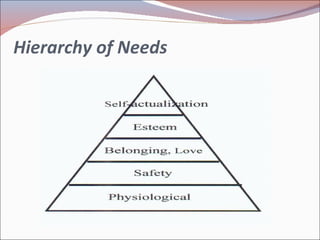
Hierarchy of Needs
Hierarchy of Needs Physiological Needs - These are biological needs. They consist of needs for oxygen, food, water, and a relatively constant body temperature. They are the strongest needs because if a person were deprived of all needs, the physiological ones would come first in the person's search for satisfaction.
Hierarchy of Needs Safety Needs - When all physiological needs are satisfied and are no longer controlling thoughts and behaviors, the needs for security can become active. Adults have little awareness of their security needs except in times of emergency or periods of disorganization in the social structure.
Hierarchy of Needs Needs of Love, Affection and Belongingness - Maslow states that people seek to overcome feelings of loneliness and alienation. This involves both giving and receiving love, affection and the sense of belonging.
Hierarchy of Needs Needs for Esteem - These involve needs for both self-esteem and for the esteem a person gets from others. Humans have a need for a stable, firmly based, high level of self-respect, and respect from others. When these needs are satisfied, the person feels self-confident and valuable as a person in the world.
Hierarchy of Needs Needs for Self-Actualization - Maslow describes self-actualization as a person's need to be and do that which the person was "born to do." These needs make themselves felt in signs of restlessness. The person feels on edge, tense, lacking something, in short, restless.
Maslow proposed other goals of learning, including the following: 1. one’s vocation or destiny 2. knowledge of values 3. realization of life as precious 4. acquisition of peak experiences 5. sense of accomplishment
6. satisfaction of psychological needs 7. awareness of beauty and wonder of life 8. impulse control 9. developing choice 10. grappling with the critical existential problems of life.
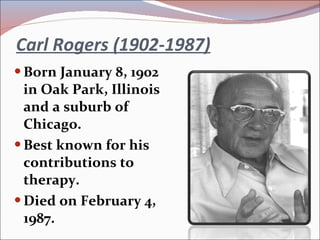
Carl Rogers (1902-1987) Born January 8, 1902 in Oak Park, Illinois and a suburb of Chicago. Best known for his contributions to therapy. Died on February 4, 1987.
Humanistic Psychology “ People are essentially trustworthy, that they have a vast potential for understanding themselves and resolving their own problems without direct intervention on the therapist’s part, and that they are capable of self-directed growth if they are involved in a specific kind of therapeutic relationship.”
He was reactive against the traditional psychoanalytic techniques such as advice, suggestion, direction, persuasion, teaching, diagnosis and interpretation.  Humanistic psychology included existential therapy, person-centered and Gestalt therapy and all have in common basic tenets such as freedom, choice, values, responsibility, autonomy, purpose and meaning. 
Actualization Tendency “ There is one central source of energy in the human organism; it is a function of the whole organism rather than some portion of it; and it is perhaps best conceptualized as a tendency toward fulfillment, toward actualization, toward the maintenance and enhancement of the organism.”
Actualization Tendency Carl Rogers sees people as basically good or healthy or at very least, not bad or ill. In other words, he sees mental health as the normal progression of life, and he sees mental illness, criminality, and other human problems, as distortions of that natural tendency.
Actualization Tendency Roger’s theory is built on a single “force of life” he calls “the actualizing tendency”. It can be defined as the built-in motivation present in every life—form to develop its potentials to the fullest extent possible.
Actualization Tendency Rogers captures with the single great need or motive all other motives that other theorists talk about. He asks us: a. Why do we want air, water, and food? b. Why do we seek safety, love, and a sense of competence? c. Why, indeed, do we seek to discover new medicines, invent new power sources, or create new works of art?
Organismic Valuing “ One of the basic things which I was a long time in realizing, and which I am still learning, is that when an activity feels as though it is valuable or worth doing, it is worth doing.  Put another way, I have learned that my total organismic sensing of a situation is more trustworthy than my intellect.”
Organismic Valuing Rogers tells us that organisms know what is good for them. Rogers, like Maslow, is just as interested in describing the healthy person. His term is “fully-functioning”, and involves the ff. qualities:
openness to experience Existential living Organismic trusting Experiential freedom creativity
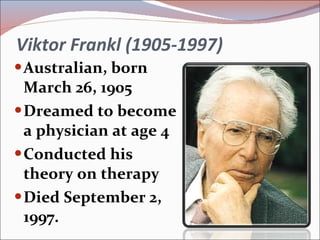
Viktor Frankl (1905-1997) Australian, born March 26, 1905 Dreamed to become a physician at age 4 Conducted his theory on therapy Died September 2, 1997.
Logotherapy From Greek word Logos, which mean study, word, spirit, God, or meaning. Postulates “a will to meaning” Frankl also uses the Greek word noos, which means mind or spirit.
Logotherapy In addition, Frankl says that we should pay attention to noodynamics, wherein tension is necessary for health, at least when it comes to meaning.
Logotherapy Frankl believed that entire generations of doctors and scientists were being indoctrinated into what could only lead to a certain cynicism in the study of human existence. He said, “the de-neuroticization of humanity requires a re-humanization of psychotherapy.
Conscience One of Frankl’s major concept He sees conscience as a sort of unconscious that Freud and others emphasize. Core of our being and the source of our personal integrity.
Conscience “ being human is being responsible—existentially responsible, responsible for one’s own existence.” “ pre-reflective ontological self-understanding” or “the wisdom of the heart,” “more sensitive than reason can ever be sensible.”
Psychopathology the study of  mental illness , mental distress and abnormal, maladaptive behavior. The term is most commonly used within  psychiatry  where  pathology  refers to disease processes.  Abnormal psychology  is a similar term used more frequently in the non-medical field of  psychology .
Psychopathology Factors: 1. Depression- founded in a “vital low”, a diminishment of physical energy. On the psychological level, he relates depression to the feelings of inadequacy we feel when we are confronted by tasks that are beyond our capacities, physical or mental.
Psychopathology 2. Schizophrenia- understood by Frankl as rooted in a physiological dysfunction, in this case one which leads to the person experiencing himself as an object rather than a subject.
Finding Meaning So how do we find meaning?
Finding Meaning 3 Broad Approaches: 1. Experiential Values- experiencing something—or someone—we value. example: love we feel towards each other.
Finding Meaning 2. Creative Values- doing a deed. Traditional existential idea of providing oneself with meaning by becoming involved in one’s projects, or, better, in the project of one’s own life. example: music, writing, invention
Finding Meaning 3. Attitudinal Values- include such virtues as compassion, bravery, a good sense of humor, and so on. example: achieving meaning by way of suffering
Basic Principles Current and future welfare of students. Worth and rights of the individuals. Openness, honesty, selflessness, altruism. Competition for academic success.
Motivation Theory Hierarchy of needs of Abraham Maslow wherein he emphasizes the basic needs of human beings before anything else. Actualization tendency of Carl Rogers wherein he sees human beings functioning as a whole and not just a part of it.
View of Nature Humanism view human beings as naturally good and healthy. Humanism view human beings as unique individuals. Humanism view human beings as important organisms.
View of Control of Human Behavior and How Values are Developed Humanist teachers and Students - humanist teacher’s effort would be put into developing a child’s self-esteem. It would be important for children to feel good about themselves.
Implications and Applications in Values Education Applications: Humanism can apply to the curriculum, teaching method, or style of teacher. Implications: Discovery learning, respect student’s feelings and aspirations, right to self-determination, social personal development, provide opportunity for success.

Humanism powerpoint

  • 1.
  • 2.
    Definition: An approachin study, philosophy, or practice that focuses on human values and concerns. A system of thought that rejects religious beliefs and centers on humans and their values, capacities, and worth.
  • 3.
    Abraham Maslow (1908-1970)An American psychologist. Born in April 1, 1908 and was raised in Brooklyn, New York, and died in June 8, 1970. Father of Humanistic Psychology.
  • 4.
    Humanistic Theory ofLearning Maslow’s theory is based on the notion that experience is the primary phenomenon in the study of human learning and behavior. He placed emphasis on choice, creativity, values, self-realization, all distinctively human qualities, and believed that meaningfulness and subjectivity were more important than objectivity.
  • 5.
    Maslow rejected behavioristviews and Freud’s theories on the basis of their reductionistic approaches. He felt Freud’s view of human nature was negative, and he valued goodness, nobility, and reason. Also, Freud concentrated on mentally ill, and Maslow was interested in healthy human psychology.
  • 6.
    Maslow and hiscolleagues came to refer to their movement as “third force psychology”. 1. Psychoanalysis 2. Behaviorism 3. Humanism/Existentialism Maslow is famous for proposing that human motivation is based on the Hierarchy of needs.
  • 7.
  • 8.
    Hierarchy of NeedsPhysiological Needs - These are biological needs. They consist of needs for oxygen, food, water, and a relatively constant body temperature. They are the strongest needs because if a person were deprived of all needs, the physiological ones would come first in the person's search for satisfaction.
  • 9.
    Hierarchy of NeedsSafety Needs - When all physiological needs are satisfied and are no longer controlling thoughts and behaviors, the needs for security can become active. Adults have little awareness of their security needs except in times of emergency or periods of disorganization in the social structure.
  • 10.
    Hierarchy of NeedsNeeds of Love, Affection and Belongingness - Maslow states that people seek to overcome feelings of loneliness and alienation. This involves both giving and receiving love, affection and the sense of belonging.
  • 11.
    Hierarchy of NeedsNeeds for Esteem - These involve needs for both self-esteem and for the esteem a person gets from others. Humans have a need for a stable, firmly based, high level of self-respect, and respect from others. When these needs are satisfied, the person feels self-confident and valuable as a person in the world.
  • 12.
    Hierarchy of NeedsNeeds for Self-Actualization - Maslow describes self-actualization as a person's need to be and do that which the person was "born to do." These needs make themselves felt in signs of restlessness. The person feels on edge, tense, lacking something, in short, restless.
  • 13.
    Maslow proposed othergoals of learning, including the following: 1. one’s vocation or destiny 2. knowledge of values 3. realization of life as precious 4. acquisition of peak experiences 5. sense of accomplishment
  • 14.
    6. satisfaction ofpsychological needs 7. awareness of beauty and wonder of life 8. impulse control 9. developing choice 10. grappling with the critical existential problems of life.
  • 15.
    Carl Rogers (1902-1987)Born January 8, 1902 in Oak Park, Illinois and a suburb of Chicago. Best known for his contributions to therapy. Died on February 4, 1987.
  • 16.
    Humanistic Psychology “People are essentially trustworthy, that they have a vast potential for understanding themselves and resolving their own problems without direct intervention on the therapist’s part, and that they are capable of self-directed growth if they are involved in a specific kind of therapeutic relationship.”
  • 17.
    He was reactiveagainst the traditional psychoanalytic techniques such as advice, suggestion, direction, persuasion, teaching, diagnosis and interpretation.  Humanistic psychology included existential therapy, person-centered and Gestalt therapy and all have in common basic tenets such as freedom, choice, values, responsibility, autonomy, purpose and meaning. 
  • 18.
    Actualization Tendency “There is one central source of energy in the human organism; it is a function of the whole organism rather than some portion of it; and it is perhaps best conceptualized as a tendency toward fulfillment, toward actualization, toward the maintenance and enhancement of the organism.”
  • 19.
    Actualization Tendency CarlRogers sees people as basically good or healthy or at very least, not bad or ill. In other words, he sees mental health as the normal progression of life, and he sees mental illness, criminality, and other human problems, as distortions of that natural tendency.
  • 20.
    Actualization Tendency Roger’stheory is built on a single “force of life” he calls “the actualizing tendency”. It can be defined as the built-in motivation present in every life—form to develop its potentials to the fullest extent possible.
  • 21.
    Actualization Tendency Rogerscaptures with the single great need or motive all other motives that other theorists talk about. He asks us: a. Why do we want air, water, and food? b. Why do we seek safety, love, and a sense of competence? c. Why, indeed, do we seek to discover new medicines, invent new power sources, or create new works of art?
  • 22.
    Organismic Valuing “One of the basic things which I was a long time in realizing, and which I am still learning, is that when an activity feels as though it is valuable or worth doing, it is worth doing.  Put another way, I have learned that my total organismic sensing of a situation is more trustworthy than my intellect.”
  • 23.
    Organismic Valuing Rogerstells us that organisms know what is good for them. Rogers, like Maslow, is just as interested in describing the healthy person. His term is “fully-functioning”, and involves the ff. qualities:
  • 24.
    openness to experienceExistential living Organismic trusting Experiential freedom creativity
  • 25.
    Viktor Frankl (1905-1997)Australian, born March 26, 1905 Dreamed to become a physician at age 4 Conducted his theory on therapy Died September 2, 1997.
  • 26.
    Logotherapy From Greekword Logos, which mean study, word, spirit, God, or meaning. Postulates “a will to meaning” Frankl also uses the Greek word noos, which means mind or spirit.
  • 27.
    Logotherapy In addition,Frankl says that we should pay attention to noodynamics, wherein tension is necessary for health, at least when it comes to meaning.
  • 28.
    Logotherapy Frankl believedthat entire generations of doctors and scientists were being indoctrinated into what could only lead to a certain cynicism in the study of human existence. He said, “the de-neuroticization of humanity requires a re-humanization of psychotherapy.
  • 29.
    Conscience One ofFrankl’s major concept He sees conscience as a sort of unconscious that Freud and others emphasize. Core of our being and the source of our personal integrity.
  • 30.
    Conscience “ beinghuman is being responsible—existentially responsible, responsible for one’s own existence.” “ pre-reflective ontological self-understanding” or “the wisdom of the heart,” “more sensitive than reason can ever be sensible.”
  • 31.
    Psychopathology the studyof mental illness , mental distress and abnormal, maladaptive behavior. The term is most commonly used within psychiatry where pathology refers to disease processes. Abnormal psychology is a similar term used more frequently in the non-medical field of psychology .
  • 32.
    Psychopathology Factors: 1.Depression- founded in a “vital low”, a diminishment of physical energy. On the psychological level, he relates depression to the feelings of inadequacy we feel when we are confronted by tasks that are beyond our capacities, physical or mental.
  • 33.
    Psychopathology 2. Schizophrenia-understood by Frankl as rooted in a physiological dysfunction, in this case one which leads to the person experiencing himself as an object rather than a subject.
  • 34.
    Finding Meaning Sohow do we find meaning?
  • 35.
    Finding Meaning 3Broad Approaches: 1. Experiential Values- experiencing something—or someone—we value. example: love we feel towards each other.
  • 36.
    Finding Meaning 2.Creative Values- doing a deed. Traditional existential idea of providing oneself with meaning by becoming involved in one’s projects, or, better, in the project of one’s own life. example: music, writing, invention
  • 37.
    Finding Meaning 3.Attitudinal Values- include such virtues as compassion, bravery, a good sense of humor, and so on. example: achieving meaning by way of suffering
  • 38.
    Basic Principles Currentand future welfare of students. Worth and rights of the individuals. Openness, honesty, selflessness, altruism. Competition for academic success.
  • 39.
    Motivation Theory Hierarchyof needs of Abraham Maslow wherein he emphasizes the basic needs of human beings before anything else. Actualization tendency of Carl Rogers wherein he sees human beings functioning as a whole and not just a part of it.
  • 40.
    View of NatureHumanism view human beings as naturally good and healthy. Humanism view human beings as unique individuals. Humanism view human beings as important organisms.
  • 41.
    View of Controlof Human Behavior and How Values are Developed Humanist teachers and Students - humanist teacher’s effort would be put into developing a child’s self-esteem. It would be important for children to feel good about themselves.
  • 42.
    Implications and Applicationsin Values Education Applications: Humanism can apply to the curriculum, teaching method, or style of teacher. Implications: Discovery learning, respect student’s feelings and aspirations, right to self-determination, social personal development, provide opportunity for success.