‘the whole person’
prepared by:
Sermin Vardal Ocakli
Guler Duman
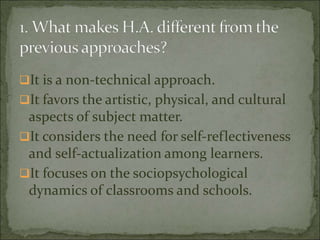
It is a non-technical approach.
It favors the artistic, physical, and cultural
aspects of subject matter.
It considers the need for self-reflectiveness
and self-actualization among learners.
It focuses on the sociopsychological
dynamics of classrooms and schools.
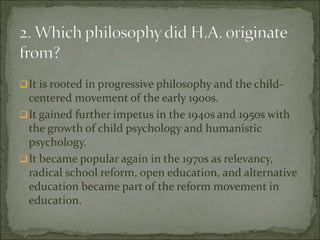
It is rooted in progressive philosophy and the child-
centered movement of the early 1900s.
It gained further impetus in the 1940s and 1950s with
the growth of child psychology and humanistic
psychology.
It became popular again in the 1970s as relevancy,
radical school reform, open education, and alternative
education became part of the reform movement in
education.
Parker, Dewey, Kilpatrick, and Washburne are the
representatives of Humanistic Approach.
Lessons are based on
- life experiences
- group games/group projects
- dramatizations
- field trips
- learning and interest centers
- homework and tutoring stations
These activities include creative problem solving and
active student participation.
In this approach, the following curriculum types are
also worthwhile:
- Informal curriculum
- Hidden curriculum
S/he is the facilitator.
S/he encourages self-reflection.
S/he does not dominate the class.
S/he promotes cooperative learning, independent
learning, small-group learning, and social
activities instead of competitive, large-group
learning.
S/he is an independent and cooperative learner.
S/he has considerable input in the curriculum and
shares responsibility with parents, teachers, and
curriculum specialists in planning classroom
instruction.
S/he is invited into curriculum meetings to express
their views on contents and experiences thanks to
bottom up curriculum committees.
Humanistic Approach advances strong arguments
that it is the total person- the cognitive, the
affective, and even the spiritual self- who is
involved in gaining knowledge and working
toward wisdom. The students’ self-concept and
self-esteem are essential factors in this process.
 Ornstein, A. C., & Hunkins, F. P. (1998). Curriculum:
Foundations, principles, and issues. Boston: Allyn and
Backon.

Humanistic Approach

  • 1.
    ‘the whole person’ preparedby: Sermin Vardal Ocakli Guler Duman
  • 2.
    It is anon-technical approach. It favors the artistic, physical, and cultural aspects of subject matter. It considers the need for self-reflectiveness and self-actualization among learners. It focuses on the sociopsychological dynamics of classrooms and schools.
  • 3.
    It is rootedin progressive philosophy and the child- centered movement of the early 1900s. It gained further impetus in the 1940s and 1950s with the growth of child psychology and humanistic psychology. It became popular again in the 1970s as relevancy, radical school reform, open education, and alternative education became part of the reform movement in education.
  • 4.
    Parker, Dewey, Kilpatrick,and Washburne are the representatives of Humanistic Approach.
  • 5.
    Lessons are basedon - life experiences - group games/group projects - dramatizations - field trips - learning and interest centers - homework and tutoring stations These activities include creative problem solving and active student participation.
  • 6.
    In this approach,the following curriculum types are also worthwhile: - Informal curriculum - Hidden curriculum
  • 7.
    S/he is thefacilitator. S/he encourages self-reflection. S/he does not dominate the class. S/he promotes cooperative learning, independent learning, small-group learning, and social activities instead of competitive, large-group learning.
  • 8.
    S/he is anindependent and cooperative learner. S/he has considerable input in the curriculum and shares responsibility with parents, teachers, and curriculum specialists in planning classroom instruction. S/he is invited into curriculum meetings to express their views on contents and experiences thanks to bottom up curriculum committees.
  • 9.
    Humanistic Approach advancesstrong arguments that it is the total person- the cognitive, the affective, and even the spiritual self- who is involved in gaining knowledge and working toward wisdom. The students’ self-concept and self-esteem are essential factors in this process.
  • 10.
     Ornstein, A.C., & Hunkins, F. P. (1998). Curriculum: Foundations, principles, and issues. Boston: Allyn and Backon.