TOPIC:
Humanistic Approach For Cross Over
Curriculum
Dr. Kaneez Fatima
Associate Professor
Marathwada College Of Education,
The Curriculum is the sum of learning stated as
Educational ends, Educational activities,
School subjects and/or topic decided upon
and provided within the framework of an
Educational institution or in a less
formal set up (Garcia, 2007)
Curriculum Reforms in India
Before Idependence
AfterIndependence
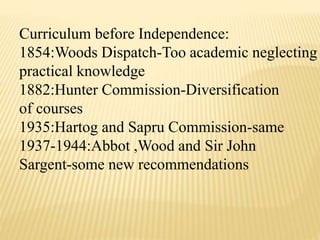
Curriculum before Independence:
1854:Woods Dispatch-Too academic neglecting
practical knowledge
1882:Hunter Commission-Diversification
of courses
1935:Hartog and Sapru Commission-same
1937-1944:Abbot ,Wood and Sir John
Sargent-some new recommendations
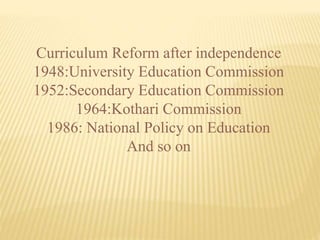
Curriculum Reform after independence
1948:University Education Commission
1952:Secondary Education Commission
1964:Kothari Commission
1986: National Policy on Education
And so on
Curriculum Design:
It is the purposeful ,deliberate and
systematic organization of
curriculum
Types of Curriculum Design based on approach:
Subject Area Approach
Broad Field Approach
Problem Centered Approach
Learner Centered Approach
Process of Curriculum designing:
Sequencing: putting content in some sort of
order of succession
Continuity: is the link provided in the
curriculum for progressively
more demanding performance
Integration: is establishing relationships
between various subjects taught
to the learners
Integration of curriculum is meant to
make the teaching learning activities
meaningful. Interpretation varies on the basis
of organisation of curriculum by following
Integration principles
Organisation of curriculum by means
of Integration Principles:
Trans-disciplinary: beyond the scope of
disciplines
Pluri-disciplinary: disciplines assumed to
be more or less related
Multi-disciplinary: several disciplines
found on one problem with no direct
attempt to integrate
Inter-disciplinary: a curriculum that
conciuosly applies method and language
from more thanone discipline to examine
the problem
Cross-disciplinary: viewing one
discipline from the perspective of another
Cross over curriculum
.Crossover curriculum involves
more than one subject
.Crossover learning refers to
comprehensive understanding of
learning that bridges formal and
informal learning
.Crossover teaching is
characterized by sensitivity
towards synthesis of knowledge
,skills and understanding from
various subject areas
Approaches to Cross over curriculum
.Behavioural Approach: oriented to
behavioural objectives
.System-Managerial Approach: focus on the
management and improvement
of the school system based on policies, plans
and people
.Intellectual Approach: is knowledge oriented
approach
.Humanistic Approach: valuing ego identity,
Freedom to learn and personal fulfillment
Humanistic Approach
.Emphasizes the uniqueness of each
child
.Curriculum based on the needs ,
interest and ability of children
.Stress on Self-actualisation and
Self-reflectiveness
.Active interaction among learners
and teachers
How Humanistic Approach differ
From other Approaches
.It is non-technical approach
.It favours artistic , physical and cultural
aspects of subject matter
.It considers the need of self-reflectiveness
and self-actualisation among learners
.This approach focus on the whole child rather
Content or teacher
Basic philosophy behind
Humanistic Approach:
.Based on Progressive educational
Philosophy
.Progressivism is improvement of
society by reform
.It focus on whole child
.Based on ideas of progress
Representatives of Humanistic
Approach:
. Parker
. Dewey
. Kilpatrick
. Washburne
Humanistic Approach gained
further impetus with the growth of
child psychology and humanistic
psychology
.Humanistic psychology emerged
During 1950s
Humanistic Psychology
.Fundamental belief of humanistic
psychology –people are innately good
.Utilize potentials fruitfully
.Humanistic psychology help individual to
fulfill childs potential
And maximize their wellbeing
Representatives of Humanistic
Psychology:
.Abraham Maslow: Father of
Humanistic Psychology
.Carl Rogger
.Rollo
.Erich Fromin
Strategies used in HA and HP
.Active interaction
.Problem solving
.Cooperative learning
.Collaborative learning
.Independent learning
.Small group learning
.Team teaching ,etc.
Development of child as a whole
The Humanistic Approach advances
strong argument that it is the
total(whole) person –the Cognitive, the
Affective and the Conative involved in
gaining knowledge and working
towards wisdom
Cognitive Domain
.It is related with mental development
,has 6 levels
.Remember-Knowledge
.Understanding- comprhension
.Apply
.Analysis
.Synthesis-create
.Evaluate
Affective Domain
.It is related with emotional
development ,has 5 levels
.Receiving
.Responding
.Valueing
.Organizing
.Characterizing
A
Conative /Psychomotor Domain
.It is related with physical or muscular
development
It has 5 levels
.Perception
.Set
.Guided response
.Mechanism
.Complex overt response
Role of Teacher
.Facilitator
.Encourage self-reflection
.Guide
.Motivator
.Link creator
.Decision maker
.Evaluator
.Mentor,etc.
Conclusion:
.There is no right or wrong approach
for integration of curriculum.
.Diagnose the needs and possibilities of
school and student.
.Select the combination that best serve
our students
Humanistic approach for crossover curriculum

Humanistic approach for crossover curriculum

  • 1.
    TOPIC: Humanistic Approach ForCross Over Curriculum
  • 2.
    Dr. Kaneez Fatima AssociateProfessor Marathwada College Of Education,
  • 3.
    The Curriculum isthe sum of learning stated as Educational ends, Educational activities, School subjects and/or topic decided upon and provided within the framework of an Educational institution or in a less formal set up (Garcia, 2007)
  • 4.
    Curriculum Reforms inIndia Before Idependence AfterIndependence
  • 5.
    Curriculum before Independence: 1854:WoodsDispatch-Too academic neglecting practical knowledge 1882:Hunter Commission-Diversification of courses 1935:Hartog and Sapru Commission-same 1937-1944:Abbot ,Wood and Sir John Sargent-some new recommendations
  • 6.
    Curriculum Reform afterindependence 1948:University Education Commission 1952:Secondary Education Commission 1964:Kothari Commission 1986: National Policy on Education And so on
  • 7.
    Curriculum Design: It isthe purposeful ,deliberate and systematic organization of curriculum
  • 8.
    Types of CurriculumDesign based on approach: Subject Area Approach Broad Field Approach Problem Centered Approach Learner Centered Approach
  • 9.
    Process of Curriculumdesigning: Sequencing: putting content in some sort of order of succession Continuity: is the link provided in the curriculum for progressively more demanding performance Integration: is establishing relationships between various subjects taught to the learners
  • 10.
    Integration of curriculumis meant to make the teaching learning activities meaningful. Interpretation varies on the basis of organisation of curriculum by following Integration principles
  • 11.
    Organisation of curriculumby means of Integration Principles: Trans-disciplinary: beyond the scope of disciplines Pluri-disciplinary: disciplines assumed to be more or less related Multi-disciplinary: several disciplines found on one problem with no direct attempt to integrate
  • 12.
    Inter-disciplinary: a curriculumthat conciuosly applies method and language from more thanone discipline to examine the problem Cross-disciplinary: viewing one discipline from the perspective of another
  • 13.
    Cross over curriculum .Crossovercurriculum involves more than one subject .Crossover learning refers to comprehensive understanding of learning that bridges formal and informal learning .Crossover teaching is characterized by sensitivity towards synthesis of knowledge ,skills and understanding from various subject areas
  • 14.
    Approaches to Crossover curriculum .Behavioural Approach: oriented to behavioural objectives .System-Managerial Approach: focus on the management and improvement of the school system based on policies, plans and people .Intellectual Approach: is knowledge oriented approach .Humanistic Approach: valuing ego identity, Freedom to learn and personal fulfillment
  • 15.
    Humanistic Approach .Emphasizes theuniqueness of each child .Curriculum based on the needs , interest and ability of children .Stress on Self-actualisation and Self-reflectiveness .Active interaction among learners and teachers
  • 16.
    How Humanistic Approachdiffer From other Approaches .It is non-technical approach .It favours artistic , physical and cultural aspects of subject matter .It considers the need of self-reflectiveness and self-actualisation among learners .This approach focus on the whole child rather Content or teacher
  • 17.
    Basic philosophy behind HumanisticApproach: .Based on Progressive educational Philosophy .Progressivism is improvement of society by reform .It focus on whole child .Based on ideas of progress
  • 18.
    Representatives of Humanistic Approach: .Parker . Dewey . Kilpatrick . Washburne
  • 19.
    Humanistic Approach gained furtherimpetus with the growth of child psychology and humanistic psychology .Humanistic psychology emerged During 1950s
  • 20.
    Humanistic Psychology .Fundamental beliefof humanistic psychology –people are innately good .Utilize potentials fruitfully .Humanistic psychology help individual to fulfill childs potential And maximize their wellbeing
  • 21.
    Representatives of Humanistic Psychology: .AbrahamMaslow: Father of Humanistic Psychology .Carl Rogger .Rollo .Erich Fromin
  • 22.
    Strategies used inHA and HP .Active interaction .Problem solving .Cooperative learning .Collaborative learning .Independent learning .Small group learning .Team teaching ,etc.
  • 23.
    Development of childas a whole The Humanistic Approach advances strong argument that it is the total(whole) person –the Cognitive, the Affective and the Conative involved in gaining knowledge and working towards wisdom
  • 24.
    Cognitive Domain .It isrelated with mental development ,has 6 levels .Remember-Knowledge .Understanding- comprhension .Apply .Analysis .Synthesis-create .Evaluate
  • 25.
    Affective Domain .It isrelated with emotional development ,has 5 levels .Receiving .Responding .Valueing .Organizing .Characterizing A
  • 26.
    Conative /Psychomotor Domain .Itis related with physical or muscular development It has 5 levels .Perception .Set .Guided response .Mechanism .Complex overt response
  • 27.
    Role of Teacher .Facilitator .Encourageself-reflection .Guide .Motivator .Link creator .Decision maker .Evaluator .Mentor,etc.
  • 28.
    Conclusion: .There is noright or wrong approach for integration of curriculum. .Diagnose the needs and possibilities of school and student. .Select the combination that best serve our students

Editor's Notes

  • #12 Passive teaching methods
  • #14 Participatory teaching
  • #15 What student demand
  • #16 Characteristics of GOOD method:
  • #18 Basic philosophy