1Royal University of Phnom PenhInstitute of Foreign LanguagesDepartment of EnglishINTERACTIONAL HYPOTHESIS(Michael H. Long)Applied Linguistics 401Course lecturer:Mr. MEAS SopheakGroup: 12Mr. BUT BorethMr. CHEA PisethClass: E4.5Year 2010-2011
2OUTLINEI. Introduction	- Krashen’s input hypothesis	- Long’sinteractionalhypothesis	- DefinitionII. Howdoesthetheorywork?III. Limitationof Interactional Hypothesis PerspectiveIV. Conclusion
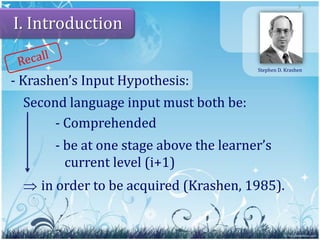
3I. IntroductionRecallStephen D. Krashen- Krashen’s Input Hypothesis: Second language input must both be:	- Comprehended	- be at one stage above the learner’s 	  	   current level (i+1) in order to be acquired (Krashen, 1985).
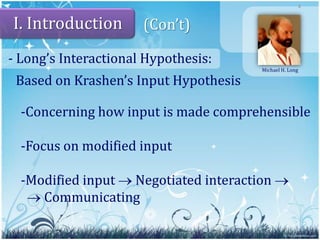
4I. Introduction(Con’t)- Long’s Interactional Hypothesis: Michael H. LongBased on Krashen’s Input Hypothesis Concerning how input is made comprehensible
Focus on modified input
Modified input  Negotiated interaction  Communicating
5I. Introduction(Con’t)Definition: Interactional hypothesis referred to when learners engaged with their interlocutors in negotiations around meaning, the nature of the input might be qualitatively changed. (Long 1981, 1983a, 1996)
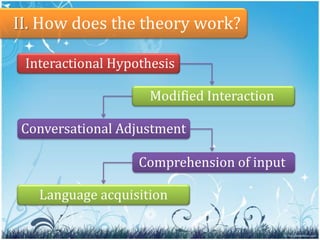
6II. Howdoesthetheorywork?Interactional HypothesisModified InteractionConversational AdjustmentComprehension of inputLanguage acquisition
7II. Howdoesthetheorywork?(Con’t)Types of modified input:Pre-modified input:when the speech of NS is characterized with decreased complexity, but increased 	length and redundancy like foreigner talk.Interactionallymodified input:NS provides opportunities for NS-NNS interaction.
8II. Howdoesthetheorywork?(Con’t)- Language users  struggle to maximize comprehension- The more adjustment within interaction  The more input becomes comprehensible- Facilitation of comprehension by input modification (to overwhelm some communicative difficulties) :Repetition:	- You said.....	- Toputitdifferentlyor in anotherway, .....	- In other words.....
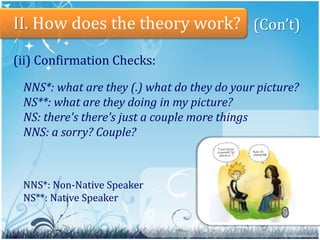
9II. Howdoesthetheorywork?(Con’t)(ii) Confirmation Checks:NNS*: what are they (.) what do they do your picture?NS**: what are they doing in my picture?NS: there's there's just a couple more thingsNNS: a sorry? Couple?NNS*: Non-Native SpeakerNS**: Native Speaker
10II. Howdoesthetheorywork?(Con’t)(iii) Comprehension Checks:	Do youunderstand?Isthisclear? 	Do youseethat...?(iv) Clarification Request:	Could you say that again?	Could you elaborate?	What do you mean by this...?
11III. Limitation of IH Perspective1interaction facilitates comprehension (not cause it)when learners have opportunity to signal their non-understanding and try to ask for clarification (Ellis, 1999)
12III. Limitation of IH Perspective(Con’t)2comprehension does not depend on negotiation.Learners may benefit from the dialogic interaction by other learners (Ellis, 1999)
13III. Limitation of IH Perspective(Con’t)3the most important factor to acquisition of word meaning is range (different contexts). (Ellis, 1999)4Input and interaction alone are not enough to learn a target language5Individual differences have been neglected(Ellis, 1999, & Ziglari, 2008)
14III. Limitation of IH Perspective(Con’t)6Interactional hypothesis has an atomistic(1) aspect, while language is, in fact, holistic(2) and dynamic. (Ellis, 1999, & Van Lier, 2004)modified input just facilitates acquisition of word meanings not the whole utterance(1) atomistic: Consisting of many separate, often disparate elements(2) holistic: Concerned with wholes rather than analysis or separation into parts
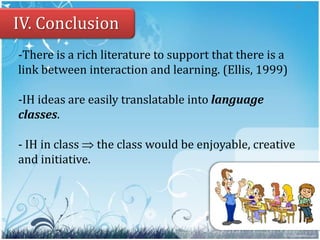
15IV. ConclusionThere is a rich literature to support that there is a link between interaction and learning. (Ellis, 1999)

Interactional hypothesis

  • 1.
    1Royal University ofPhnom PenhInstitute of Foreign LanguagesDepartment of EnglishINTERACTIONAL HYPOTHESIS(Michael H. Long)Applied Linguistics 401Course lecturer:Mr. MEAS SopheakGroup: 12Mr. BUT BorethMr. CHEA PisethClass: E4.5Year 2010-2011
  • 2.
    2OUTLINEI. Introduction - Krashen’sinput hypothesis - Long’sinteractionalhypothesis - DefinitionII. Howdoesthetheorywork?III. Limitationof Interactional Hypothesis PerspectiveIV. Conclusion
  • 3.
    3I. IntroductionRecallStephen D.Krashen- Krashen’s Input Hypothesis: Second language input must both be: - Comprehended - be at one stage above the learner’s current level (i+1) in order to be acquired (Krashen, 1985).
  • 4.
    4I. Introduction(Con’t)- Long’sInteractional Hypothesis: Michael H. LongBased on Krashen’s Input Hypothesis Concerning how input is made comprehensible
  • 5.
  • 6.
    Modified input Negotiated interaction  Communicating
  • 7.
    5I. Introduction(Con’t)Definition: Interactionalhypothesis referred to when learners engaged with their interlocutors in negotiations around meaning, the nature of the input might be qualitatively changed. (Long 1981, 1983a, 1996)
  • 8.
    6II. Howdoesthetheorywork?Interactional HypothesisModifiedInteractionConversational AdjustmentComprehension of inputLanguage acquisition
  • 9.
    7II. Howdoesthetheorywork?(Con’t)Types ofmodified input:Pre-modified input:when the speech of NS is characterized with decreased complexity, but increased length and redundancy like foreigner talk.Interactionallymodified input:NS provides opportunities for NS-NNS interaction.
  • 10.
    8II. Howdoesthetheorywork?(Con’t)- Languageusers  struggle to maximize comprehension- The more adjustment within interaction  The more input becomes comprehensible- Facilitation of comprehension by input modification (to overwhelm some communicative difficulties) :Repetition: - You said..... - Toputitdifferentlyor in anotherway, ..... - In other words.....
  • 11.
    9II. Howdoesthetheorywork?(Con’t)(ii) ConfirmationChecks:NNS*: what are they (.) what do they do your picture?NS**: what are they doing in my picture?NS: there's there's just a couple more thingsNNS: a sorry? Couple?NNS*: Non-Native SpeakerNS**: Native Speaker
  • 12.
    10II. Howdoesthetheorywork?(Con’t)(iii) ComprehensionChecks: Do youunderstand?Isthisclear? Do youseethat...?(iv) Clarification Request: Could you say that again? Could you elaborate? What do you mean by this...?
  • 13.
    11III. Limitation ofIH Perspective1interaction facilitates comprehension (not cause it)when learners have opportunity to signal their non-understanding and try to ask for clarification (Ellis, 1999)
  • 14.
    12III. Limitation ofIH Perspective(Con’t)2comprehension does not depend on negotiation.Learners may benefit from the dialogic interaction by other learners (Ellis, 1999)
  • 15.
    13III. Limitation ofIH Perspective(Con’t)3the most important factor to acquisition of word meaning is range (different contexts). (Ellis, 1999)4Input and interaction alone are not enough to learn a target language5Individual differences have been neglected(Ellis, 1999, & Ziglari, 2008)
  • 16.
    14III. Limitation ofIH Perspective(Con’t)6Interactional hypothesis has an atomistic(1) aspect, while language is, in fact, holistic(2) and dynamic. (Ellis, 1999, & Van Lier, 2004)modified input just facilitates acquisition of word meanings not the whole utterance(1) atomistic: Consisting of many separate, often disparate elements(2) holistic: Concerned with wholes rather than analysis or separation into parts
  • 17.
    15IV. ConclusionThere isa rich literature to support that there is a link between interaction and learning. (Ellis, 1999)