TSYS ME
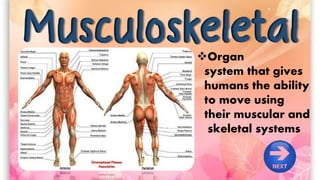
Organ
system that gives
humans the ability
to move using
their muscular and
skeletal systems
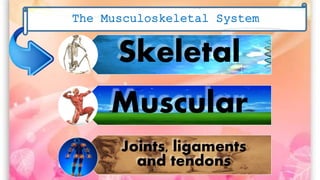
Skeletal
Muscular
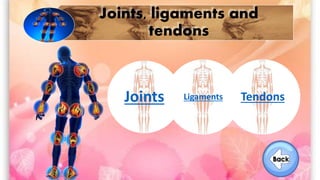
Joints, ligaments
and tendons
The Musculoskeletal System
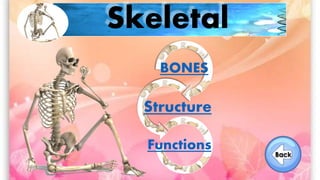
Skeletal
BONES
Structure
Functions
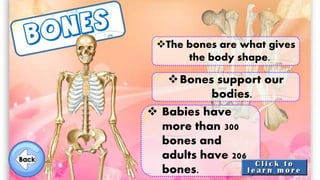
The bones are what gives
the body shape.
Bones support our
bodies.
 Babies have
more than 300
bones and
adults have 206
bones.
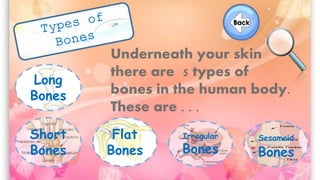
Underneath your skin
there are 5 types of
bones in the human body.
These are . . .
Long
Bones
Short
Bones
Flat
Bones
Irregular
Bones
Sesamoid
Bones
Long
Bones
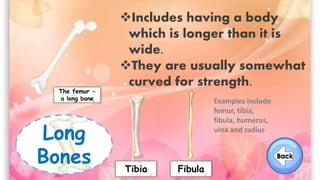
Includes having a body
which is longer than it is
wide.
They are usually somewhat
curved for strength.
The femur -
a long bone
Tibia Fibula
Examples include
femur, tibia,
fibula, humerus,
ulna and radius
Short
Bones
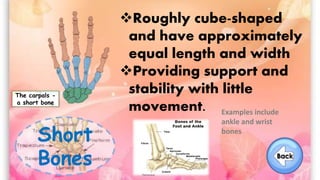
The carpals -
a short bone
Roughly cube-shaped
and have approximately
equal length and width
Providing support and
stability with little
movement. Examples include
ankle and wrist
bones
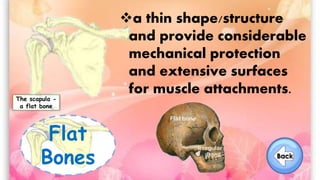
Flat
Bones
The scapula -
a flat bone
a thin shape/structure
and provide considerable
mechanical protection
and extensive surfaces
for muscle attachments.
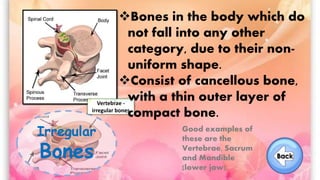
Irregular
Bones
Vertebrae -
irregular bones
Bones in the body which do
not fall into any other
category, due to their non-
uniform shape.
Consist of cancellous bone,
with a thin outer layer of
compact bone.
Good examples of
these are the
Vertebrae, Sacrum
and Mandible
(lower jaw).
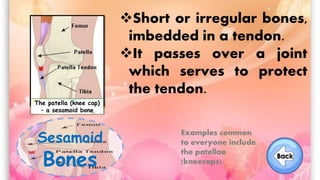
Sesamoid
Bones
The patella (knee cap)
– a sesamoid bone
Short or irregular bones,
imbedded in a tendon.
It passes over a joint
which serves to protect
the tendon.
Examples common
to everyone include
the patellae
(kneecaps).
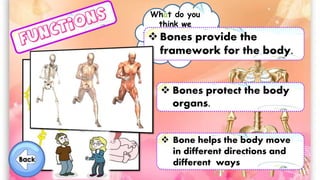
What do you
think we
would look
like without
bones?
 Bones provide the
framework for the body.
 Bones protect the body
organs.
 Bone helps the body move
in different directions and
different ways
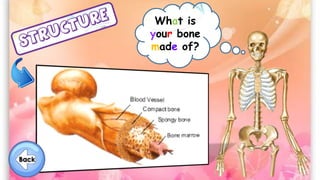
What is
your bone
made of?
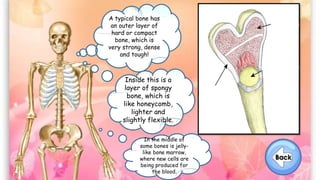
A typical bone has
an outer layer of
hard or compact
bone, which is
very strong, dense
and tough!
Inside this is a
layer of spongy
bone, which is
like honeycomb,
lighter and
slightly flexible.
In the middle of
some bones is jelly-
like bone marrow,
where new cells are
being produced for
the blood.
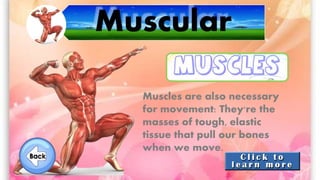
Muscular
Muscles are also necessary
for movement: They're the
masses of tough, elastic
tissue that pull our bones
when we move.
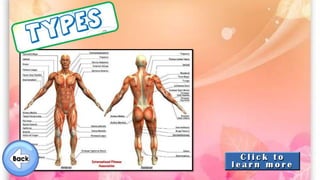
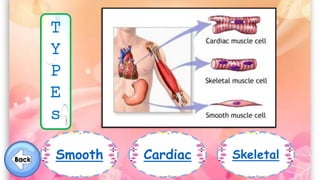
Smooth Cardiac Skeletal
T
Y
P
E
s
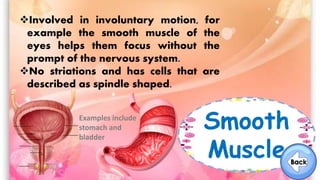
Smooth
Muscle
Involved in involuntary motion, for
example the smooth muscle of the
eyes helps them focus without the
prompt of the nervous system.
No striations and has cells that are
described as spindle shaped.
Examples include
stomach and
bladder
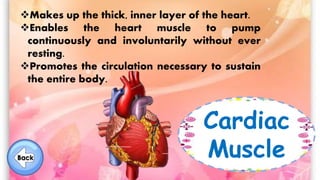
Cardiac
Muscle
Makes up the thick, inner layer of the heart.
Enables the heart muscle to pump
continuously and involuntarily without ever
resting.
Promotes the circulation necessary to sustain
the entire body.
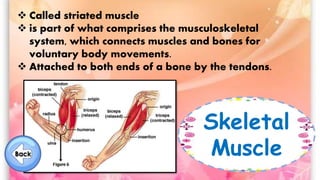
Skeletal
Muscle
 Called striated muscle
 is part of what comprises the musculoskeletal
system, which connects muscles and bones for
voluntary body movements.
 Attached to both ends of a bone by the tendons.
Joints, ligaments and
tendons
Joints Ligaments Tendons
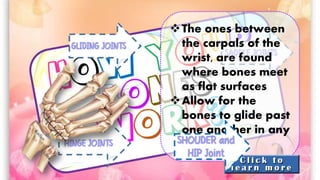
The ones between
the carpals of the
wrist, are found
where bones meet
as flat surfaces
Allow for the
bones to glide past
one another in any
direction.
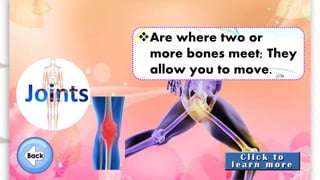
Are where two or
more bones meet; They
allow you to move.
 Such as the one between the first
metacarpal and trapezium bone,
permit 360 degree motion by allowing
the bones to pivot along two axes.
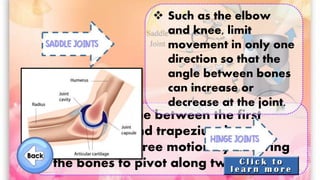
 Such as the elbow
and knee, limit
movement in only one
direction so that the
angle between bones
can increase or
decrease at the joint.
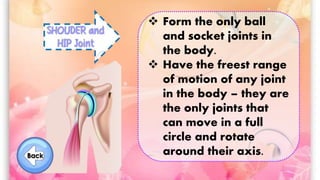
 Form the only ball
and socket joints in
the body.
 Have the freest range
of motion of any joint
in the body – they are
the only joints that
can move in a full
circle and rotate
around their axis.
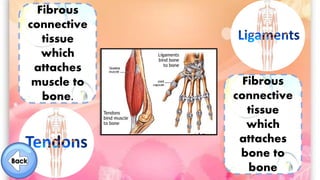
Fibrous
connective
tissue
which
attaches
muscle to
bone.
Fibrous
connective
tissue
which
attaches
bone to
bone

The Human Musculoskeletal System

  • 2.
  • 3.
    Organ system that gives humansthe ability to move using their muscular and skeletal systems
  • 4.
  • 5.
  • 6.
    The bones arewhat gives the body shape. Bones support our bodies.  Babies have more than 300 bones and adults have 206 bones.
  • 7.
    Underneath your skin thereare 5 types of bones in the human body. These are . . . Long Bones Short Bones Flat Bones Irregular Bones Sesamoid Bones
  • 8.
    Long Bones Includes having abody which is longer than it is wide. They are usually somewhat curved for strength. The femur - a long bone Tibia Fibula Examples include femur, tibia, fibula, humerus, ulna and radius
  • 9.
    Short Bones The carpals - ashort bone Roughly cube-shaped and have approximately equal length and width Providing support and stability with little movement. Examples include ankle and wrist bones
  • 10.
    Flat Bones The scapula - aflat bone a thin shape/structure and provide considerable mechanical protection and extensive surfaces for muscle attachments.
  • 11.
    Irregular Bones Vertebrae - irregular bones Bonesin the body which do not fall into any other category, due to their non- uniform shape. Consist of cancellous bone, with a thin outer layer of compact bone. Good examples of these are the Vertebrae, Sacrum and Mandible (lower jaw).
  • 12.
    Sesamoid Bones The patella (kneecap) – a sesamoid bone Short or irregular bones, imbedded in a tendon. It passes over a joint which serves to protect the tendon. Examples common to everyone include the patellae (kneecaps).
  • 13.
    What do you thinkwe would look like without bones?  Bones provide the framework for the body.  Bones protect the body organs.  Bone helps the body move in different directions and different ways
  • 14.
  • 15.
    A typical bonehas an outer layer of hard or compact bone, which is very strong, dense and tough! Inside this is a layer of spongy bone, which is like honeycomb, lighter and slightly flexible. In the middle of some bones is jelly- like bone marrow, where new cells are being produced for the blood.
  • 16.
    Muscular Muscles are alsonecessary for movement: They're the masses of tough, elastic tissue that pull our bones when we move.
  • 18.
  • 19.
    Smooth Muscle Involved in involuntarymotion, for example the smooth muscle of the eyes helps them focus without the prompt of the nervous system. No striations and has cells that are described as spindle shaped. Examples include stomach and bladder
  • 20.
    Cardiac Muscle Makes up thethick, inner layer of the heart. Enables the heart muscle to pump continuously and involuntarily without ever resting. Promotes the circulation necessary to sustain the entire body.
  • 21.
    Skeletal Muscle  Called striatedmuscle  is part of what comprises the musculoskeletal system, which connects muscles and bones for voluntary body movements.  Attached to both ends of a bone by the tendons.
  • 22.
  • 23.
    The ones between thecarpals of the wrist, are found where bones meet as flat surfaces Allow for the bones to glide past one another in any direction.
  • 24.
    Are where twoor more bones meet; They allow you to move.
  • 25.
     Such asthe one between the first metacarpal and trapezium bone, permit 360 degree motion by allowing the bones to pivot along two axes.  Such as the elbow and knee, limit movement in only one direction so that the angle between bones can increase or decrease at the joint.
  • 26.
     Form theonly ball and socket joints in the body.  Have the freest range of motion of any joint in the body – they are the only joints that can move in a full circle and rotate around their axis.
  • 27.