ANATOMY & PHYSIOLOGY
-Dr.Salil Choudhary
WHY ????
DEFINITION
 Anatomy – the study of the structure and shape
of the body and body parts & their relationships
to one another. The term anatomy comes from
the Greek words meaning to cut (tomy) apart (
ana) .
 Gross anatomy( macroscopic anatomy) – the
study of large, easily observable structures (by
naked eye), such as the heart or bone.
 Microscopic anatomy (cytology, histology) – the
study of very small structures, where a
magnifying lens or microscope is needed.
 Physiology – the study of how the body and its
parts work or function
physio =nature , ology = the study of.
 Like anatomy , physiology has many
subdivisions. For example, neurophysiology
explains the working of the nervous system ,
and cardiac physiology studies the function of
the heart.
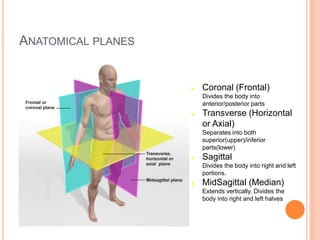
ANATOMICAL PLANES
 Coronal (Frontal)
Divides the body into
anterior/posterior parts
 Transverse (Horizontal
or Axial)
Separates into both
superior(upper)/inferior
parts(lower)
 Sagittal
Divides the body into right and left
portions.
 MidSagittal (Median)
Extends vertically. Divides the
body into right and left halves
STRUCTURAL ORGANIZATION
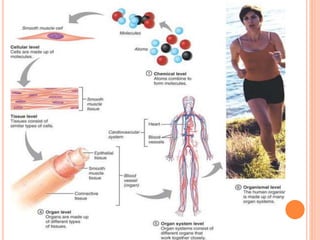
The human body exhibits 6 levels of structural
complexity :
1- Chemical level , the simplest level of structural ladder
.At this level atoms combine to form molecules such as
water, sugar, & proteins
2- Cellular level the smallest units of living things.
3- Tissue level , groups of similar cells that have a common
function (4 basic types)
 Epithelial tissue
 Connective tissue
 Muscular tissue
 Nervous tissue
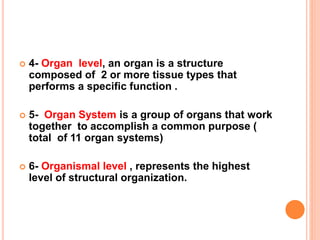
 4- Organ level, an organ is a structure
composed of 2 or more tissue types that
performs a specific function .
 5- Organ System is a group of organs that work
together to accomplish a common purpose (
total of 11 organ systems)
 6- Organismal level , represents the highest
level of structural organization.
10
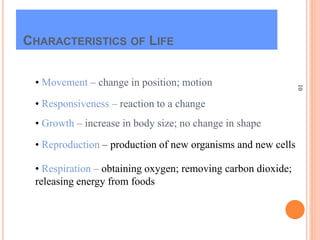
CHARACTERISTICS OF LIFE
• Movement – change in position; motion
• Responsiveness – reaction to a change
• Growth – increase in body size; no change in shape
• Respiration – obtaining oxygen; removing carbon dioxide;
releasing energy from foods
• Reproduction – production of new organisms and new cells
11
CHARACTERISTICS OF LIFE CONTINUED
• Absorption – passage of substances through membranes and
into body fluids
• Circulation – movement of substances in body fluids
• Assimilation – changing of absorbed substances into
chemically different forms
• Excretion – removal of wastes produced by metabolic
reactions
• Digestion – breakdown of food substances into simpler
forms
12
MAINTENANCE OF LIFE
• Life depends on five (5) environmental factors:
• Water
• Food
• Oxygen
• Heat
• Pressure
13
REQUIREMENTS OF ORGANISMS
• Water
- most abundant substance in body
- required for metabolic processes
- required for transport of substances
- regulates body temperature
• Food
- provides necessary nutrients
- supplies energy
- supplies raw materials
14
REQUIREMENTS OF ORGANISMS
• Oxygen (gas)
- one-fifth of air
- used to release energy from nutrients
• Heat
- form of energy
- partly controls rate of metabolic reactions
• Pressure
- application of force on an object
- atmospheric pressure – important for breathing
- hydrostatic pressure – keeps blood flowing
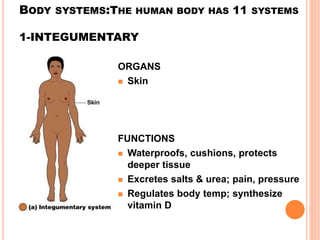
BODY SYSTEMS:THE HUMAN BODY HAS 11 SYSTEMS
1-INTEGUMENTARY
ORGANS
 Skin
FUNCTIONS
 Waterproofs, cushions, protects
deeper tissue
 Excretes salts & urea; pain, pressure
 Regulates body temp; synthesize
vitamin D
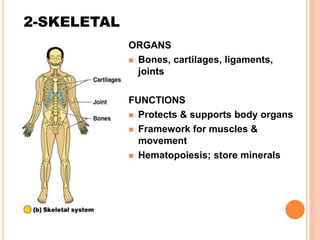
2-SKELETAL
ORGANS
 Bones, cartilages, ligaments,
joints
FUNCTIONS
 Protects & supports body organs
 Framework for muscles &
movement
 Hematopoiesis; store minerals
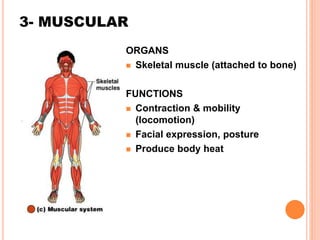
3- MUSCULAR
ORGANS
 Skeletal muscle (attached to bone)
FUNCTIONS
 Contraction & mobility
(locomotion)
 Facial expression, posture
 Produce body heat
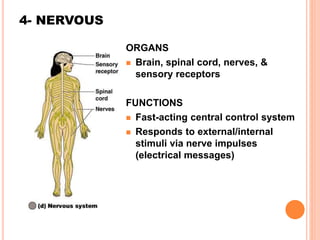
4- NERVOUS
ORGANS
 Brain, spinal cord, nerves, &
sensory receptors
FUNCTIONS
 Fast-acting central control system
 Responds to external/internal
stimuli via nerve impulses
(electrical messages)
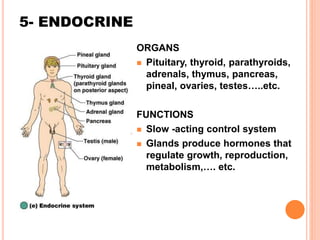
5- ENDOCRINE
ORGANS
 Pituitary, thyroid, parathyroids,
adrenals, thymus, pancreas,
pineal, ovaries, testes…..etc.
FUNCTIONS
 Slow -acting control system
 Glands produce hormones that
regulate growth, reproduction,
metabolism,…. etc.
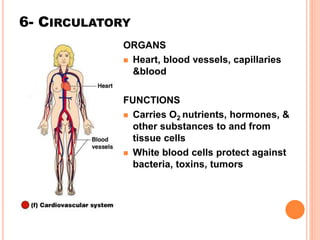
6- CIRCULATORY
ORGANS
 Heart, blood vessels, capillaries
&blood
FUNCTIONS
 Carries O2 nutrients, hormones, &
other substances to and from
tissue cells
 White blood cells protect against
bacteria, toxins, tumors
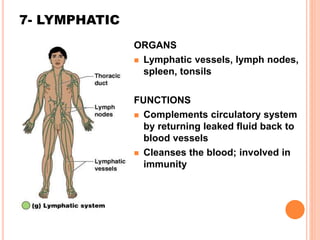
7- LYMPHATIC
ORGANS
 Lymphatic vessels, lymph nodes,
spleen, tonsils
FUNCTIONS
 Complements circulatory system
by returning leaked fluid back to
blood vessels
 Cleanses the blood; involved in
immunity
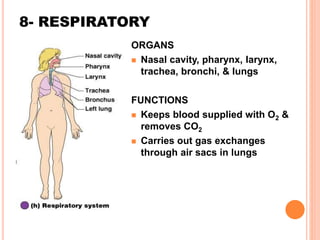
8- RESPIRATORY
ORGANS
 Nasal cavity, pharynx, larynx,
trachea, bronchi, & lungs
FUNCTIONS
 Keeps blood supplied with O2 &
removes CO2
 Carries out gas exchanges
through air sacs in lungs
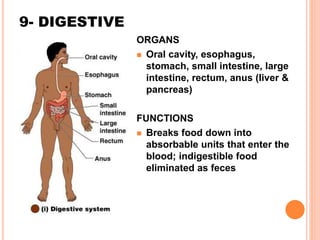
9- DIGESTIVE
ORGANS
 Oral cavity, esophagus,
stomach, small intestine, large
intestine, rectum, anus (liver &
pancreas)
FUNCTIONS
 Breaks food down into
absorbable units that enter the
blood; indigestible food
eliminated as feces
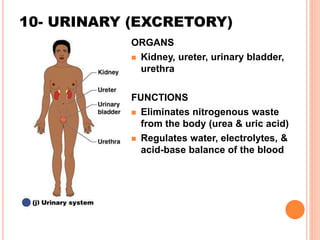
10- URINARY (EXCRETORY)
ORGANS
 Kidney, ureter, urinary bladder,
urethra
FUNCTIONS
 Eliminates nitrogenous waste
from the body (urea & uric acid)
 Regulates water, electrolytes, &
acid-base balance of the blood
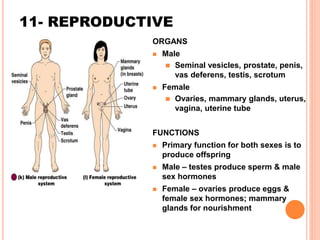
11- REPRODUCTIVE
ORGANS
 Male
 Seminal vesicles, prostate, penis,
vas deferens, testis, scrotum
 Female
 Ovaries, mammary glands, uterus,
vagina, uterine tube
FUNCTIONS
 Primary function for both sexes is to
produce offspring
 Male – testes produce sperm & male
sex hormones
 Female – ovaries produce eggs &
female sex hormones; mammary
glands for nourishment

basics of physiology

  • 1.
  • 2.
  • 3.
    DEFINITION  Anatomy –the study of the structure and shape of the body and body parts & their relationships to one another. The term anatomy comes from the Greek words meaning to cut (tomy) apart ( ana) .  Gross anatomy( macroscopic anatomy) – the study of large, easily observable structures (by naked eye), such as the heart or bone.  Microscopic anatomy (cytology, histology) – the study of very small structures, where a magnifying lens or microscope is needed.
  • 4.
     Physiology –the study of how the body and its parts work or function physio =nature , ology = the study of.  Like anatomy , physiology has many subdivisions. For example, neurophysiology explains the working of the nervous system , and cardiac physiology studies the function of the heart.
  • 5.
    ANATOMICAL PLANES  Coronal(Frontal) Divides the body into anterior/posterior parts  Transverse (Horizontal or Axial) Separates into both superior(upper)/inferior parts(lower)  Sagittal Divides the body into right and left portions.  MidSagittal (Median) Extends vertically. Divides the body into right and left halves
  • 7.
    STRUCTURAL ORGANIZATION The humanbody exhibits 6 levels of structural complexity : 1- Chemical level , the simplest level of structural ladder .At this level atoms combine to form molecules such as water, sugar, & proteins 2- Cellular level the smallest units of living things. 3- Tissue level , groups of similar cells that have a common function (4 basic types)  Epithelial tissue  Connective tissue  Muscular tissue  Nervous tissue
  • 8.
     4- Organlevel, an organ is a structure composed of 2 or more tissue types that performs a specific function .  5- Organ System is a group of organs that work together to accomplish a common purpose ( total of 11 organ systems)  6- Organismal level , represents the highest level of structural organization.
  • 10.
    10 CHARACTERISTICS OF LIFE •Movement – change in position; motion • Responsiveness – reaction to a change • Growth – increase in body size; no change in shape • Respiration – obtaining oxygen; removing carbon dioxide; releasing energy from foods • Reproduction – production of new organisms and new cells
  • 11.
    11 CHARACTERISTICS OF LIFECONTINUED • Absorption – passage of substances through membranes and into body fluids • Circulation – movement of substances in body fluids • Assimilation – changing of absorbed substances into chemically different forms • Excretion – removal of wastes produced by metabolic reactions • Digestion – breakdown of food substances into simpler forms
  • 12.
    12 MAINTENANCE OF LIFE •Life depends on five (5) environmental factors: • Water • Food • Oxygen • Heat • Pressure
  • 13.
    13 REQUIREMENTS OF ORGANISMS •Water - most abundant substance in body - required for metabolic processes - required for transport of substances - regulates body temperature • Food - provides necessary nutrients - supplies energy - supplies raw materials
  • 14.
    14 REQUIREMENTS OF ORGANISMS •Oxygen (gas) - one-fifth of air - used to release energy from nutrients • Heat - form of energy - partly controls rate of metabolic reactions • Pressure - application of force on an object - atmospheric pressure – important for breathing - hydrostatic pressure – keeps blood flowing
  • 15.
    BODY SYSTEMS:THE HUMANBODY HAS 11 SYSTEMS 1-INTEGUMENTARY ORGANS  Skin FUNCTIONS  Waterproofs, cushions, protects deeper tissue  Excretes salts & urea; pain, pressure  Regulates body temp; synthesize vitamin D
  • 16.
    2-SKELETAL ORGANS  Bones, cartilages,ligaments, joints FUNCTIONS  Protects & supports body organs  Framework for muscles & movement  Hematopoiesis; store minerals
  • 17.
    3- MUSCULAR ORGANS  Skeletalmuscle (attached to bone) FUNCTIONS  Contraction & mobility (locomotion)  Facial expression, posture  Produce body heat
  • 18.
    4- NERVOUS ORGANS  Brain,spinal cord, nerves, & sensory receptors FUNCTIONS  Fast-acting central control system  Responds to external/internal stimuli via nerve impulses (electrical messages)
  • 19.
    5- ENDOCRINE ORGANS  Pituitary,thyroid, parathyroids, adrenals, thymus, pancreas, pineal, ovaries, testes…..etc. FUNCTIONS  Slow -acting control system  Glands produce hormones that regulate growth, reproduction, metabolism,…. etc.
  • 20.
    6- CIRCULATORY ORGANS  Heart,blood vessels, capillaries &blood FUNCTIONS  Carries O2 nutrients, hormones, & other substances to and from tissue cells  White blood cells protect against bacteria, toxins, tumors
  • 21.
    7- LYMPHATIC ORGANS  Lymphaticvessels, lymph nodes, spleen, tonsils FUNCTIONS  Complements circulatory system by returning leaked fluid back to blood vessels  Cleanses the blood; involved in immunity
  • 22.
    8- RESPIRATORY ORGANS  Nasalcavity, pharynx, larynx, trachea, bronchi, & lungs FUNCTIONS  Keeps blood supplied with O2 & removes CO2  Carries out gas exchanges through air sacs in lungs
  • 23.
    9- DIGESTIVE ORGANS  Oralcavity, esophagus, stomach, small intestine, large intestine, rectum, anus (liver & pancreas) FUNCTIONS  Breaks food down into absorbable units that enter the blood; indigestible food eliminated as feces
  • 24.
    10- URINARY (EXCRETORY) ORGANS Kidney, ureter, urinary bladder, urethra FUNCTIONS  Eliminates nitrogenous waste from the body (urea & uric acid)  Regulates water, electrolytes, & acid-base balance of the blood
  • 25.
    11- REPRODUCTIVE ORGANS  Male Seminal vesicles, prostate, penis, vas deferens, testis, scrotum  Female  Ovaries, mammary glands, uterus, vagina, uterine tube FUNCTIONS  Primary function for both sexes is to produce offspring  Male – testes produce sperm & male sex hormones  Female – ovaries produce eggs & female sex hormones; mammary glands for nourishment