By: Mrs. Kalaivani Sathish
M.Pharmacy
 Cell is the structural and funtional unit of all
living organism.bacteria are unicellular (consist
of single cell),human beings are multicellular
(may have upto 10 cells.
 Each cell take nutrients and converts energy.a
cell also carried out specialized funtions and
reproduces and stores its own set of instructions
for carrying out these activities.
 There are two types of cells called prokaryote
and eukaryote cells.procaryote cells are usually
independent while eukaryote cells are found in
multicellular organisms.
 The simplest form and the first type of cells to evolve are
prokaryote cells. Prokaryotes are unicellular organisms
that do not developed or differentiate into multicellular
forms .some bacteria grow in filaments or masses of cells
but each cell in the colony is identical and capable of
independent existence. they may adjacent to one another
because they do not separate after cell division though
there is no continuity or communication between them.
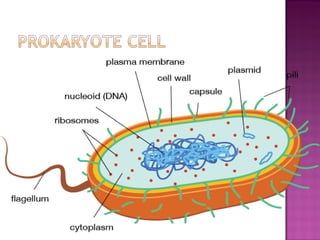
 Besides lack of nuclear membrane, a prokaryote cell also
lacks intracellular organelles. Prokaryotic cells have three
architectural region that includes appendages called
flagella and vili, cell envelope or cell wall consisting of a
capsule and a cytoplasmic region.
 Enclosing a cell, there is cell envelope ,which
generally consists of a cell wall, covering a plasma
membrane .some bacteria have a further covering
layer, called capsule.
 A cell wall consists of peptidoglycans in bacteria and
act as a barrier against the external forces .it prevent
the cell from expanding and bursting insides the cell
is cytoplasmic region that contains cell genome
(DNA), ribosomes and various other inclusion.
 Prokaryotes carry chromosomal DNA elements called
plasmids, it function such as antibiotics resistance.
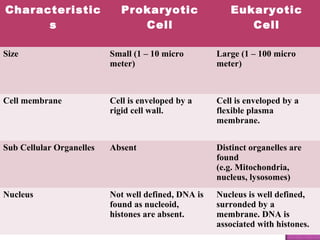
Characteristic
s
Prokaryotic
Cell
Eukaryotic
Cell
Size Small (1 – 10 micro
meter)
Large (1 – 100 micro
meter)
Cell membrane Cell is enveloped by a
rigid cell wall.
Cell is enveloped by a
flexible plasma
membrane.
Sub Cellular Organelles Absent Distinct organelles are
found
(e.g. Mitochondria,
nucleus, lysosomes)
Nucleus Not well defined, DNA is
found as nucleoid,
histones are absent.
Nucleus is well defined,
surronded by a
membrane. DNA is
associated with histones.
Characteristic
s
Prokaryotic
Cell
Eukaryotic
Cell
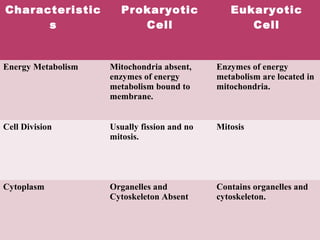
Energy Metabolism Mitochondria absent,
enzymes of energy
metabolism bound to
membrane.
Enzymes of energy
metabolism are located in
mitochondria.
Cell Division Usually fission and no
mitosis.
Mitosis
Cytoplasm Organelles and
Cytoskeleton Absent
Contains organelles and
cytoskeleton.
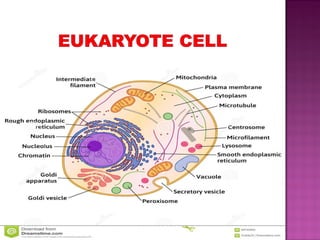
 Eukaryote cells include fungi, animal cells, plant cells
as well as some unicellular organisms. it 10 times
larger than a prokaryotic cell and can be as much as
1000 times more in volume.
 Composition and functions
 Human body contains different organs such as the
heart, lung and kidneys each one of which performs
different funtions.EC also have a set of intracellular
components called sub cellular organelles some of it
surrounded by a protective membrane. Composition
and functions of organelles are described below:
 Plasma membrane
The outer lining of a eukaryotic cell is called plasma
membrane. this serves to separate and protect cell
from its surrounding environment. it is made up of a
double layer of proteins and lipids.
 Cytoskeleton
Cytoskeleton is a complex and dynamic component that
acts to organise and maintain cell shape, anchor
organells in their place, helps during endocytosis
(uptake of material by the cell) and moves
intracellular organelles of the cell during the
processes of growth and motility. There are a number
of proteins associated with cytoskeleton.
 Cytoplasm
Inside the cell there is a large fluid –filled space called
cytoplasm. It is like soup within which all the cell
organelles .cytoplasm is also a home for cytoskeleton.it
contains several salts and is an excellent conductor of
electricity ,creating environment for the mechanics of
the cell.
 Nucleus
Nucleus ,also called cells information centre, is the most
conspicuous organelle found in a eukaryotic cell.
 It houses cells chromosomes and is a place where
almost all the DNA replication and RNA synthesis
occur. Nucleus is spheroidal in shape and is separated
from cytoplasm by a membrane called nuclear
envelope.
 Eukaryotic genetic material is more complex and is
divided into discrete units called genes. human genetic
material is made up of two distinct components called
nuclear genome and mitochondrial genome.
 Ribosome
Ribosome is a large complex composed of many
molecules, including RNA and proteins. these are
responsible for the processing of genetic instruction
carried by mRNA. the process of converting mRNA
codon into the sequence of amino acids that make up a
protein is called translation. some of the ribosome
float free in the cytoplasm, called free ribosome while
others are bound to endoplasmic reticulum.
 Mitochondria and chloroplasts
These are power generator and self-replicating
organelles. they occur in various numbers, shapes and
sizes in the cytoplasm of all eukaryotic cells. Both the
organelles are surrounded by a double membrane
with an intermembrane space. they have many
folding, filling their inner space. they have two
functionally distinct membrane systems, inward folds
are called cristae.
 Chloroplast are similar to mitochondria but are
found in plants where they convert light energy (from
the sun) into ATP through the process called
photosynthesis.
 Endoplasmic recticulam and golgi apparatus
ER is the transport network for molecules. It is present
in two forms called rough endoplasmic reticulum
(RER) and smooth endoplasmic reticulum (SER) .
Proteins that are to be exported out of the cell are passes
to the Golgi apparatus, also called golgi bodies or
Golgi complex .
 Lysosomes and peroxisomes
They are also referred as garbage disposal system of the
cell.both are spherical ,bound by a single membrane
and are rich in digestive enzymes for degrading
proteins, nucleic acids and polysaccharides that work
as low pH. an important function of lysosome is to
digest foreign bacteria that invade the cell.
 They also help in recycling of receptor proteins and
other membrane components , help in repair of the
damage to plasma membrane.
 Peroxisomes function to get the body of toxic
substances such as hydrogen peroxide or other
metabolites, and contain enzyme for enzyme
utilization. higher number of peroxisomes can be
found in liver where toxic by-products are known to
accumulate. it resemble lysosomes.peroxisomes are
self-replicating whereas lysosomes are formed in
Golgi complex.
 Centrosome
 Centrosome called cytoskeleton organizer,
produce microtubules of a cell, which is the key
component of cytoskeleton .cetrosomes are
composed of two centrioles. a single centrosome
is present in animal cells. it found in some fungi
and algae.
 Vacuoles
 Vacuoles store food and waste products. some
vacuoles also store water and are described as
liquid –filled spaces. they are surrounded by a
membrane.
 Cell membrane
 It refers to the outer covering of the cell and is
found in all living cells. it is a highly viscous
structure.
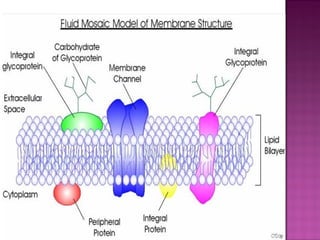
 Fluid-mosaic model of cell membrane
 Biological membranes have such a structure
where some proteins span a lipid bilayer while
others are partially immersed. this is called
Fluid-mosaic model as a membrane consists of
mosaic of proteins and lipids.
 1.cell membrane may be associated with several
enzymes e.g. Phospholipase are used as markers of cell
membrane.
 2. Membranes also contain specific receptors for
external stimuli such as hormones. after a hormone
binds to its receptor, it generates signals and regulates
intracellular activities.
 3.carbohydrates components of glycoproteins in a
membrane act as recognition sites for several
substance such as antibodies.
 4. A membrane also acts as a barrier thereby loss of
useful substances while permitting entry of nutrients,
thus it is important in transport of substances.
 Tight junctions are specialized sites of contact that
block solutes from diffusing between the cells in an
epithelium.
 A simple epithelium like the lining of the intestine or
the lungs is composed of a layer of cells that adhere
tightly to one another to form a thin cellular sheet.
 Solutes cannot diffuse freely through this layer
because of the specialized contacts referred to as
called tight junctions.
 Tight junction strands are composed of proteins called
occludin and claudins.
 Tight junction serves as a barrier to the free diffusion
of water and solutes from the extra-cellular
compartment to the other side.
 some tight junctions are permeable to specific ions or
solutes, to which other tight junctions are impermeale.
 TJ are also present between the endothelial cells that
line walls of the capillaries. it form blood brain
barrier, which prevent substance from passing from
the bloodstream into the brain. small ions and water
may not penetrate BBB.
 Cytoskeleton is a system of protein fibbers that
pervades cytoplasm. It is composed of three distinct
types of fibrous structures called microtubules,
intermediate filaments and microfilaments.
 Functions:
 1.it provides structural support that determines
shape of the cell .
 2.it functions as an internal frame work which is
responsible for the positioning of various organelles
within the cell.
 3.it functions as a force –generating apparatus that
moves cells from one place to another e.g
.locomotion of sperm, white blood cells.
 MICROTUBULES :
 Microtubules are stiff ,hollow and tubular structures
that are assembled from protein tubulin .these are
arranged in longitudinal rows and are called proto-
filaments.
 They help in determining shape of the cell and
maintaining the position of the membranous
organelles such as Endoplasmic Reticulum and Golgi
Complex.
Intermediate Filaments
They are strong rope like fibbers, Depending on the
cell type they are composed of a variety of different
globular proteins sub units. Examples: Keratin
filaments, Neuro filaments.
Microfilaments
They are composed of a double helical polymer of the
protein actin, which is one of the major proteins of
the muscle cells.
They play a key role in all type of contractility and
motility with in cells.
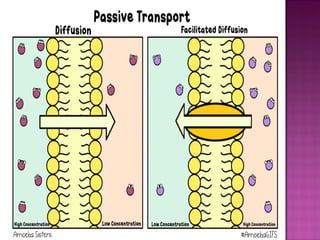
 Transport of various substances across
a plasma membrane may occur by
several mechanisms, which includes,
diffusion (passive diffusion), facilitated
diffusion and active transport.
 Diffusion of a substance may occur
either passively (called passive
diffusion) or may required some
carrier protein, which facilitates
diffusion (Called Facilitated diffusion).
 Diffusion or passive diffusion refers to
a process in which a solute moves
down an electro chemical gradient
from one side of the membrane to the
other.
 It is an energy independent process,
which takes place by the dissipating its
free energy stored in the gradient.
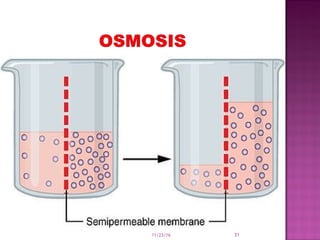
 Water moves readily through a semi
permeable membrane from a region of
lower solute concentration to a region
of higher solute concentration. This
process is called as osmosis.
11/23/16 31
 Large polar molecules such as glucose and amino
acids, cannot diffuse across the phospholipid
bilayer. Also ions such as Na+
or Cl-
cannot pass.
 These molecules pass through protein channels
instead. Diffusion through these channels is called
FACILITATED DIFFUSION.
 Movement of molecules is still PASSIVE just like
ordinary diffusion, the only difference is, the
molecules go through a protein channel instead of
passing between the phospholipids.
 To move substances against a concentration
or electrochemical gradient, a cell must use
energy. Active transport mechanisms do just
this, expending energy (often in the form of
ATP) to maintain the right concentrations of
ions and molecules in living cells
 Primary Active Transport – these are
found in all living organisms and require an
energy source such as ATP for the translocation
of the cations.
 These transporters since utilize ATP are also
referred to as ATPases.
 Secondary Active Transport – they
utilize a secondary source of energy such as
trans – membrane electro chemical gradient of
either Na+ or H + to translocate small organic
molecules e.g. Glucose and Amino Acids etc.
 When membrane is freely permeable to
ions (Na+, Cl-) and if the concentration of
ions on both the sides is different, the ions
freely diffuse to attain equal
concentration.
 Gibbs –Donnam observed that the presence
of a non-diffusible ion on one side of the
membrane alters the diffusion of the
diffusible ions.
 In Sodium Proteinate (Na+Pr-) the protein
(Pr-) ion is non-diffusable through the
membrane.
 In a compartment separated by a membrane.
Initially, sodium proteinate is on side – 1
while sodium chloride is on side – II.
 Diffusible ions (Na+ Cl-) can freely pass
through the membrane, on side 1. Na + ions
will balance the incoming Cl- ions besides pr-
ions, while on side – II Na + ions have to
balance only cl- ions.
 Therefore the concentration of Na+ on side 1
is greater than on side – II. However, from
the thermodynamical point of view , at
equilibrium, the concentration of Na+Cl- on
both sides should be the same.
 Thus Na+ Cl- 1 = Na+ Cl- Side – II
Na+ 1 > Na+ Side – II
Cl- 1 < Cl Side – II
Consequently, the concentration of Cl- ions
should be greater on side – II. Further, the
total concentration of ions on side 1 is higher
than on side II,
 The presence of a non-diffusible ion influences the
concentration of diffusible ions across the
membrane.
 The concentration of oppositely charged (Na+) is
greater on the side of membrane containing non
diffusible ions (Pr-)
 The concentration of simillarly charged ions (Cl-) is
higher on the side of the membrane not containing
non – diffusible ions (Pr-).
 The net concentration of total ions will be greater
on the side of the membrane containing non –
diffusible ions. This leads to a difference in the
osmotic pressure on either side of the membrane.
Introduction Biochemistry for BPT Students

Introduction Biochemistry for BPT Students

  • 1.
    By: Mrs. KalaivaniSathish M.Pharmacy
  • 3.
     Cell isthe structural and funtional unit of all living organism.bacteria are unicellular (consist of single cell),human beings are multicellular (may have upto 10 cells.  Each cell take nutrients and converts energy.a cell also carried out specialized funtions and reproduces and stores its own set of instructions for carrying out these activities.  There are two types of cells called prokaryote and eukaryote cells.procaryote cells are usually independent while eukaryote cells are found in multicellular organisms.
  • 4.
     The simplestform and the first type of cells to evolve are prokaryote cells. Prokaryotes are unicellular organisms that do not developed or differentiate into multicellular forms .some bacteria grow in filaments or masses of cells but each cell in the colony is identical and capable of independent existence. they may adjacent to one another because they do not separate after cell division though there is no continuity or communication between them.  Besides lack of nuclear membrane, a prokaryote cell also lacks intracellular organelles. Prokaryotic cells have three architectural region that includes appendages called flagella and vili, cell envelope or cell wall consisting of a capsule and a cytoplasmic region.
  • 5.
     Enclosing acell, there is cell envelope ,which generally consists of a cell wall, covering a plasma membrane .some bacteria have a further covering layer, called capsule.  A cell wall consists of peptidoglycans in bacteria and act as a barrier against the external forces .it prevent the cell from expanding and bursting insides the cell is cytoplasmic region that contains cell genome (DNA), ribosomes and various other inclusion.  Prokaryotes carry chromosomal DNA elements called plasmids, it function such as antibiotics resistance.
  • 8.
    Characteristic s Prokaryotic Cell Eukaryotic Cell Size Small (1– 10 micro meter) Large (1 – 100 micro meter) Cell membrane Cell is enveloped by a rigid cell wall. Cell is enveloped by a flexible plasma membrane. Sub Cellular Organelles Absent Distinct organelles are found (e.g. Mitochondria, nucleus, lysosomes) Nucleus Not well defined, DNA is found as nucleoid, histones are absent. Nucleus is well defined, surronded by a membrane. DNA is associated with histones.
  • 9.
    Characteristic s Prokaryotic Cell Eukaryotic Cell Energy Metabolism Mitochondriaabsent, enzymes of energy metabolism bound to membrane. Enzymes of energy metabolism are located in mitochondria. Cell Division Usually fission and no mitosis. Mitosis Cytoplasm Organelles and Cytoskeleton Absent Contains organelles and cytoskeleton.
  • 10.
     Eukaryote cellsinclude fungi, animal cells, plant cells as well as some unicellular organisms. it 10 times larger than a prokaryotic cell and can be as much as 1000 times more in volume.  Composition and functions  Human body contains different organs such as the heart, lung and kidneys each one of which performs different funtions.EC also have a set of intracellular components called sub cellular organelles some of it surrounded by a protective membrane. Composition and functions of organelles are described below:
  • 11.
     Plasma membrane Theouter lining of a eukaryotic cell is called plasma membrane. this serves to separate and protect cell from its surrounding environment. it is made up of a double layer of proteins and lipids.  Cytoskeleton Cytoskeleton is a complex and dynamic component that acts to organise and maintain cell shape, anchor organells in their place, helps during endocytosis (uptake of material by the cell) and moves intracellular organelles of the cell during the processes of growth and motility. There are a number of proteins associated with cytoskeleton.
  • 12.
     Cytoplasm Inside thecell there is a large fluid –filled space called cytoplasm. It is like soup within which all the cell organelles .cytoplasm is also a home for cytoskeleton.it contains several salts and is an excellent conductor of electricity ,creating environment for the mechanics of the cell.  Nucleus Nucleus ,also called cells information centre, is the most conspicuous organelle found in a eukaryotic cell.
  • 13.
     It housescells chromosomes and is a place where almost all the DNA replication and RNA synthesis occur. Nucleus is spheroidal in shape and is separated from cytoplasm by a membrane called nuclear envelope.  Eukaryotic genetic material is more complex and is divided into discrete units called genes. human genetic material is made up of two distinct components called nuclear genome and mitochondrial genome.
  • 14.
     Ribosome Ribosome isa large complex composed of many molecules, including RNA and proteins. these are responsible for the processing of genetic instruction carried by mRNA. the process of converting mRNA codon into the sequence of amino acids that make up a protein is called translation. some of the ribosome float free in the cytoplasm, called free ribosome while others are bound to endoplasmic reticulum.
  • 15.
     Mitochondria andchloroplasts These are power generator and self-replicating organelles. they occur in various numbers, shapes and sizes in the cytoplasm of all eukaryotic cells. Both the organelles are surrounded by a double membrane with an intermembrane space. they have many folding, filling their inner space. they have two functionally distinct membrane systems, inward folds are called cristae.  Chloroplast are similar to mitochondria but are found in plants where they convert light energy (from the sun) into ATP through the process called photosynthesis.
  • 16.
     Endoplasmic recticulamand golgi apparatus ER is the transport network for molecules. It is present in two forms called rough endoplasmic reticulum (RER) and smooth endoplasmic reticulum (SER) . Proteins that are to be exported out of the cell are passes to the Golgi apparatus, also called golgi bodies or Golgi complex .  Lysosomes and peroxisomes They are also referred as garbage disposal system of the cell.both are spherical ,bound by a single membrane and are rich in digestive enzymes for degrading proteins, nucleic acids and polysaccharides that work as low pH. an important function of lysosome is to digest foreign bacteria that invade the cell.
  • 17.
     They alsohelp in recycling of receptor proteins and other membrane components , help in repair of the damage to plasma membrane.  Peroxisomes function to get the body of toxic substances such as hydrogen peroxide or other metabolites, and contain enzyme for enzyme utilization. higher number of peroxisomes can be found in liver where toxic by-products are known to accumulate. it resemble lysosomes.peroxisomes are self-replicating whereas lysosomes are formed in Golgi complex.
  • 18.
     Centrosome  Centrosomecalled cytoskeleton organizer, produce microtubules of a cell, which is the key component of cytoskeleton .cetrosomes are composed of two centrioles. a single centrosome is present in animal cells. it found in some fungi and algae.  Vacuoles  Vacuoles store food and waste products. some vacuoles also store water and are described as liquid –filled spaces. they are surrounded by a membrane.
  • 19.
     Cell membrane It refers to the outer covering of the cell and is found in all living cells. it is a highly viscous structure.  Fluid-mosaic model of cell membrane  Biological membranes have such a structure where some proteins span a lipid bilayer while others are partially immersed. this is called Fluid-mosaic model as a membrane consists of mosaic of proteins and lipids.
  • 21.
     1.cell membranemay be associated with several enzymes e.g. Phospholipase are used as markers of cell membrane.  2. Membranes also contain specific receptors for external stimuli such as hormones. after a hormone binds to its receptor, it generates signals and regulates intracellular activities.  3.carbohydrates components of glycoproteins in a membrane act as recognition sites for several substance such as antibodies.  4. A membrane also acts as a barrier thereby loss of useful substances while permitting entry of nutrients, thus it is important in transport of substances.
  • 22.
     Tight junctionsare specialized sites of contact that block solutes from diffusing between the cells in an epithelium.  A simple epithelium like the lining of the intestine or the lungs is composed of a layer of cells that adhere tightly to one another to form a thin cellular sheet.  Solutes cannot diffuse freely through this layer because of the specialized contacts referred to as called tight junctions.  Tight junction strands are composed of proteins called occludin and claudins.
  • 23.
     Tight junctionserves as a barrier to the free diffusion of water and solutes from the extra-cellular compartment to the other side.  some tight junctions are permeable to specific ions or solutes, to which other tight junctions are impermeale.  TJ are also present between the endothelial cells that line walls of the capillaries. it form blood brain barrier, which prevent substance from passing from the bloodstream into the brain. small ions and water may not penetrate BBB.
  • 24.
     Cytoskeleton isa system of protein fibbers that pervades cytoplasm. It is composed of three distinct types of fibrous structures called microtubules, intermediate filaments and microfilaments.  Functions:  1.it provides structural support that determines shape of the cell .  2.it functions as an internal frame work which is responsible for the positioning of various organelles within the cell.  3.it functions as a force –generating apparatus that moves cells from one place to another e.g .locomotion of sperm, white blood cells.
  • 25.
     MICROTUBULES : Microtubules are stiff ,hollow and tubular structures that are assembled from protein tubulin .these are arranged in longitudinal rows and are called proto- filaments.  They help in determining shape of the cell and maintaining the position of the membranous organelles such as Endoplasmic Reticulum and Golgi Complex.
  • 26.
    Intermediate Filaments They arestrong rope like fibbers, Depending on the cell type they are composed of a variety of different globular proteins sub units. Examples: Keratin filaments, Neuro filaments. Microfilaments They are composed of a double helical polymer of the protein actin, which is one of the major proteins of the muscle cells. They play a key role in all type of contractility and motility with in cells.
  • 27.
     Transport ofvarious substances across a plasma membrane may occur by several mechanisms, which includes, diffusion (passive diffusion), facilitated diffusion and active transport.
  • 28.
     Diffusion ofa substance may occur either passively (called passive diffusion) or may required some carrier protein, which facilitates diffusion (Called Facilitated diffusion).
  • 29.
     Diffusion orpassive diffusion refers to a process in which a solute moves down an electro chemical gradient from one side of the membrane to the other.  It is an energy independent process, which takes place by the dissipating its free energy stored in the gradient.
  • 30.
     Water movesreadily through a semi permeable membrane from a region of lower solute concentration to a region of higher solute concentration. This process is called as osmosis.
  • 31.
  • 32.
     Large polarmolecules such as glucose and amino acids, cannot diffuse across the phospholipid bilayer. Also ions such as Na+ or Cl- cannot pass.  These molecules pass through protein channels instead. Diffusion through these channels is called FACILITATED DIFFUSION.  Movement of molecules is still PASSIVE just like ordinary diffusion, the only difference is, the molecules go through a protein channel instead of passing between the phospholipids.
  • 34.
     To movesubstances against a concentration or electrochemical gradient, a cell must use energy. Active transport mechanisms do just this, expending energy (often in the form of ATP) to maintain the right concentrations of ions and molecules in living cells
  • 35.
     Primary ActiveTransport – these are found in all living organisms and require an energy source such as ATP for the translocation of the cations.  These transporters since utilize ATP are also referred to as ATPases.
  • 36.
     Secondary ActiveTransport – they utilize a secondary source of energy such as trans – membrane electro chemical gradient of either Na+ or H + to translocate small organic molecules e.g. Glucose and Amino Acids etc.
  • 37.
     When membraneis freely permeable to ions (Na+, Cl-) and if the concentration of ions on both the sides is different, the ions freely diffuse to attain equal concentration.  Gibbs –Donnam observed that the presence of a non-diffusible ion on one side of the membrane alters the diffusion of the diffusible ions.
  • 38.
     In SodiumProteinate (Na+Pr-) the protein (Pr-) ion is non-diffusable through the membrane.  In a compartment separated by a membrane. Initially, sodium proteinate is on side – 1 while sodium chloride is on side – II.  Diffusible ions (Na+ Cl-) can freely pass through the membrane, on side 1. Na + ions will balance the incoming Cl- ions besides pr- ions, while on side – II Na + ions have to balance only cl- ions.
  • 39.
     Therefore theconcentration of Na+ on side 1 is greater than on side – II. However, from the thermodynamical point of view , at equilibrium, the concentration of Na+Cl- on both sides should be the same.  Thus Na+ Cl- 1 = Na+ Cl- Side – II Na+ 1 > Na+ Side – II Cl- 1 < Cl Side – II Consequently, the concentration of Cl- ions should be greater on side – II. Further, the total concentration of ions on side 1 is higher than on side II,
  • 40.
     The presenceof a non-diffusible ion influences the concentration of diffusible ions across the membrane.  The concentration of oppositely charged (Na+) is greater on the side of membrane containing non diffusible ions (Pr-)  The concentration of simillarly charged ions (Cl-) is higher on the side of the membrane not containing non – diffusible ions (Pr-).  The net concentration of total ions will be greater on the side of the membrane containing non – diffusible ions. This leads to a difference in the osmotic pressure on either side of the membrane.