INTRODUCTION
 The Musculoskeletal system is a combination of the
skeletal, muscular & articular systems of the body &
is responsible for the movement & locomotion of
the body.
 The musculoskeletal system provides form support,
stability and movement to the body.
 The musculoskeletal system’s primary functions
include supporting the body, allowing motion and
protecting vital organs.
Bursae
Cartilage
Ligaments Tendons
Joints
Muscles
Bones
Musculoskeletal
System
MUSCLES
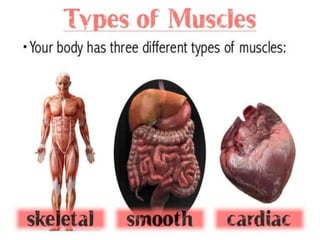
 Our skeletal system has more than 650 muscles,
most of them disposed in pair to provide movement.
 The muscles make up about 40 % of the body
mass.
 Muscular cells are called muscle fibers.
 Every fibers contain thousand of myofibrils.
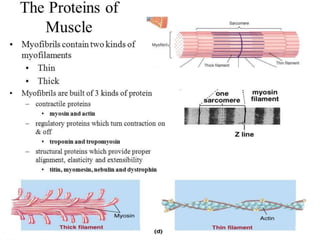
 Inside each mayofibril there are many
myofilaments that are made of 2 proteins :
1] Actin (Thin)
2] Myosin (Thick)
FUNCTIONS
 Enable us to move our body parts
 Give us our individual shape
 Protect and keep in place our abdominal organs
 Enable us to maintain good posture
 Help in the circulation of our blood
 Generate body heart when they contract
 Heat production
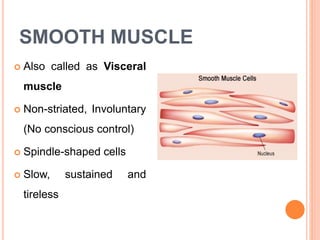
SMOOTH MUSCLE
 Also called as Visceral
muscle
 Non-striated, Involuntary
(No conscious control)
 Spindle-shaped cells
 Slow, sustained and
tireless
 Found in walls of the
digestive tract, bladder,
various ducts, arteries,
veins and other internal
organs.
 Controlled by the
Autonomic Nervous
System (ANS)
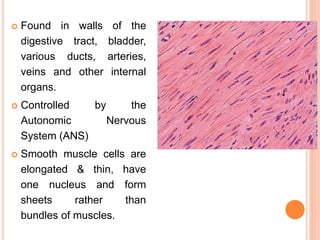
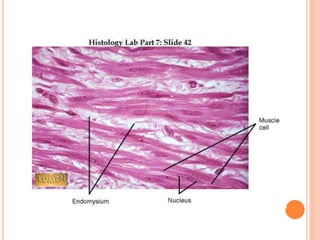
 Smooth muscle cells are
elongated & thin, have
one nucleus and form
sheets rather than
bundles of muscles.
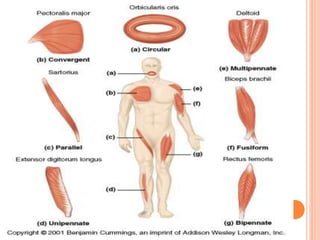
SKELETAL MUSCLE
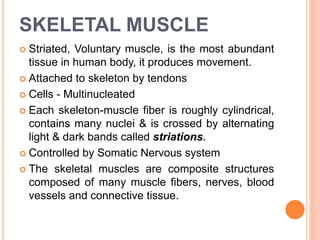
 Striated, Voluntary muscle, is the most abundant
tissue in human body, it produces movement.
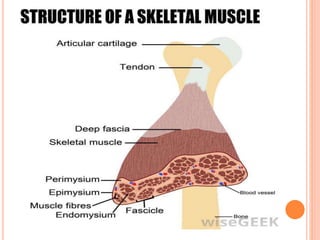
 Attached to skeleton by tendons
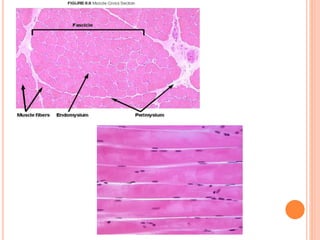
 Cells - Multinucleated
 Each skeleton-muscle fiber is roughly cylindrical,
contains many nuclei & is crossed by alternating
light & dark bands called striations.
 Controlled by Somatic Nervous system
 The skeletal muscles are composite structures
composed of many muscle fibers, nerves, blood
vessels and connective tissue.
SARCOMERE
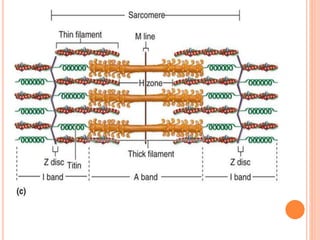
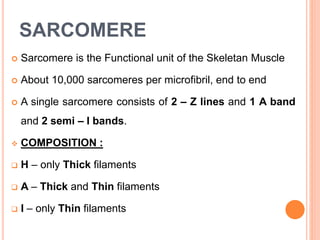
 Sarcomere is the Functional unit of the Skeletan Muscle
 About 10,000 sarcomeres per microfibril, end to end
 A single sarcomere consists of 2 – Z lines and 1 A band
and 2 semi – I bands.
 COMPOSITION :
 H – only Thick filaments
 A – Thick and Thin filaments
 I – only Thin filaments
CARDIAC MUSCLE
 Only found in the Heart
 Controlled by Autonomic Nervous System
 Has striations (similar like skeletan muscle)
 Involuntary
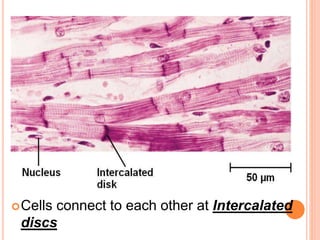
 Cells are branched and fused with one another
 Contractions of the heart muscle pump blood
throughout the body and account for the heartbeat.
 Cells are short, branching & have a single nucleus
 Never tired
Cells connect to each other at Intercalated
discs
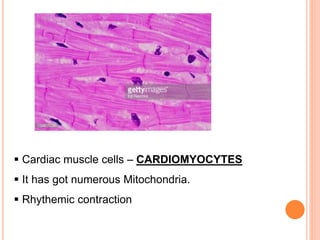
 Cardiac muscle cells – CARDIOMYOCYTES
 It has got numerous Mitochondria.
 Rhythemic contraction
SKELETAN
SYSTEM
FUNCTIONS
 Movement – Skeletal system provides points for
attachment for muscles.
 Support – It holds your head up and protects your
spinal cord.
 Protection – The bones of your skull protect your
brain, ribs protect your lungs & heart from injury.
 Make Blood – RBCs & WBCs are formed by tissue
called marrow.
 Storage – stores mineral such as Ca and Mg
BONES
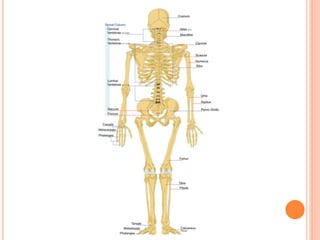
 The human skeleton is the internal framework of the
body.
 It is composed of 270 bones at birth – this total
decreases to 206 bones by adulthood after some bones
have fused together.
 The human skeleton can be divided into :-
1) The Axial Skeletan
2) The Appendicular Skeletan
AXIAL SKELETAN
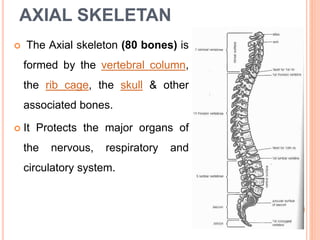
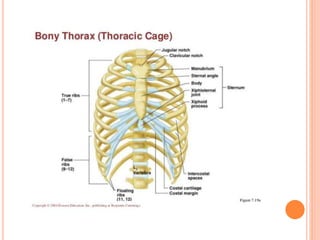
 The Axial skeleton (80 bones) is
formed by the vertebral column,
the rib cage, the skull & other
associated bones.
 It Protects the major organs of
the nervous, respiratory and
circulatory system.
APPENDICULAR SKELETAN
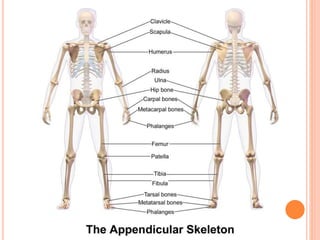
 The appendicular skeleton (126 bones), which is
attached to the axial skeleton, is formed by the
shoulder girdle, the pelvic girdle & the bones of
the upper and lower limbs.
 It makes the body movement possible and also
protects the organs of digestion, excretion, and
reproduction.
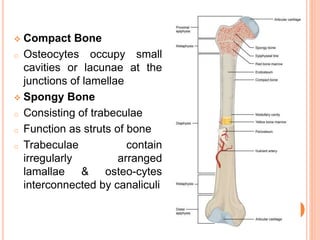
 Compact Bone
o Osteocytes occupy small
cavities or lacunae at the
junctions of lamellae
 Spongy Bone
o Consisting of trabeculae
o Function as struts of bone
o Trabeculae contain
irregularly arranged
lamallae & osteo-cytes
interconnected by canaliculi
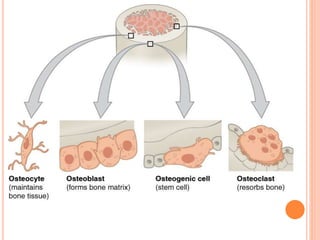
BONE CELLS
[1] Osteogenic cells
- Develop into Osteoblasts
[2] Osteoblasts cells
- growing portion of bone, including periosteum
and endosteum
[3] Osteocytes cells
- maintain mineral concentation of matrix
[4] Osteoclasts cells
- Bone resorption
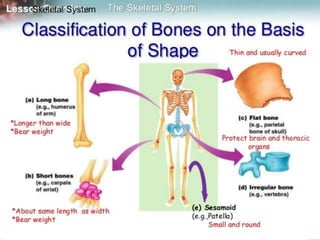
CLASSIFICATION OF BONES
[1] Long Bones
 Long bones have a
long shaft and two
distinct ends
 All bones of the limbs
{except patella, wrist &
ankle}
 The bones of the
fingers
 They are usually
somewhat curved for
strength
[2] SHORT BONES
 Short bones are roughly
cubelike
 Cube-shaped & have
approximately equal length
& width
 Providing support and
stability with little
movement
 Found in wrist & ankle
bones
[3] FLAT BONES
 Flat bones are thin,
flattened and usually
curved
 Provide considerable
mechanical protection &
extensive surfaces for
muscle attachments
 Ex. Scapula, Sternum,
Ribs, cranial bones
[4] IRREGULAR BONES
 Irregular bones don’t fit
into the previous
categories
 Complicated shapes
 Consist of cancellous
bone with a thin outer
layer of compact bone
 Ex. Vertebrae, Mandible,
Hip, Sacrum
[5] SESAMOID BONES
 Short or irregular
bones, imbedded in a
tendon
 It passes over a joint
which serves to
protect the tendon
 Ex. Patellae
(kneecaps)
JOINTS
 Also called as “Articulation”, where bone and
cartilage come together to form a connection.
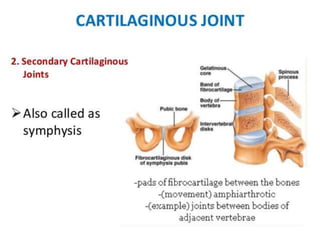
 Joints classified by Structures into 3 types :-
1) Fibrous joint - Immovable
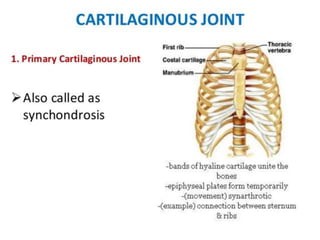
2) Cartilaginous joint – partly movable
3) Synovial joint – freely movable
FIBROUS JOINT
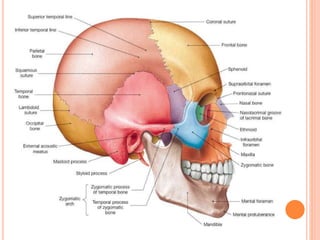
 All the bones of the skull,
except for the mandible,
are joined to each other
by a fibrous joint called a
suture.
 joined by dense regular
connective tissue that is
rich in collagen fibers.
SYNOVIAL JOINT
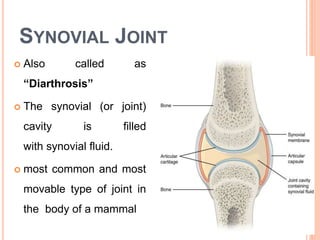
 Also called as
“Diarthrosis”
 The synovial (or joint)
cavity is filled
with synovial fluid.
 most common and most
movable type of joint in
the body of a mammal
CARTILAGE
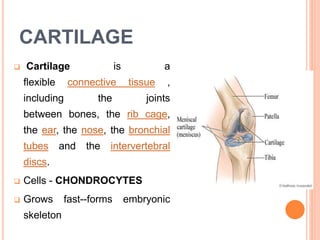
 Cartilage is a
flexible connective tissue ,
including the joints
between bones, the rib cage,
the ear, the nose, the bronchial
tubes and the intervertebral
discs.
 Cells - CHONDROCYTES
 Grows fast--forms embryonic
skeleton
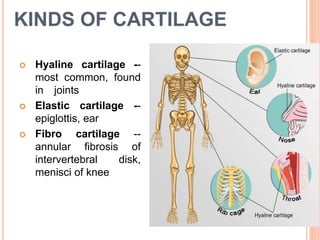
KINDS OF CARTILAGE
 Hyaline cartilage --
most common, found
in joints
 Elastic cartilage --
epiglottis, ear
 Fibro cartilage --
annular fibrosis of
intervertebral disk,
menisci of knee
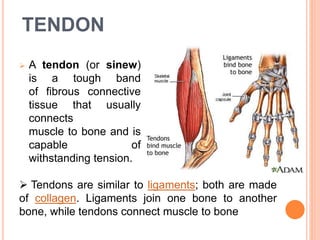
TENDON
 A tendon (or sinew)
is a tough band
of fibrous connective
tissue that usually
connects
muscle to bone and is
capable of
withstanding tension.
 Tendons are similar to ligaments; both are made
of collagen. Ligaments join one bone to another
bone, while tendons connect muscle to bone
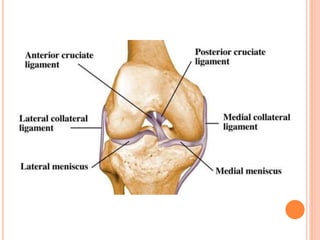
LIGAMENT
 A Ligament is the fibrous connective tissue that
connects bones to other bones and is also known
as articular ligament, articular larua, fibrous ligament,
or true ligament.
 Ligaments are similar to tendons and fasciae as they
are all made of connective tissue.
 The differences in them are in the connections that
they make; ligaments connect one bone to another
bone, tendons connect muscle to bone and fasciae
connect muscles to other muscles.
OSTEOMALACIA
 Osteomalacia is the softening of
the bones caused by deactivated bone
mineralization primary to adequate levels of
available phosphate & calcium.
 The most common cause of osteomalacia is a
deficiency of vitamin D, which is normally derived
from sunlight exposure and, to a lesser extent,
from the diet.
SYMPTOMS
 Muscle weakness
 Difficulty walking, often with waddling gait
 Hypocalcemia
 Compressed vertebrae and diminished stature
 Pelvic flattening
 Weak, soft bones
 Easy fracturing
 Bending of bones
TREATMENT
 Include daily sufficient Vitamin D , Protein
PAGET’S DISEASE
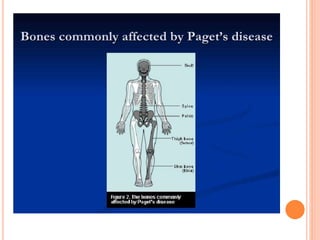
 It is chronic disease of skeletan
 Normal growth of bone is changed
 Bones break down more quickly
 Bones can grow larger than before
 Bone that replaced is soft and porous
 Symptoms :
 Pain in or over a bone
 The affected area may be feel extra warm
 The shape of bone may be change
 Bone of legs may blow out or bend
 The bone in the skull may get bigger
QUESTIONS
[1] Bones that surround the spinal cord are classified as
________ bones.
A. Short
B. Sesamoid
C. Flat
D. Irregular
E. Long
ANSWER:
(D) Irregular
 [2] What is the difference between compact bone
and spongy bone?
A. They have different bone marrow.
B. They are made of different materials.
C. They have different sizes of bone cells.
D. They have different arrangement of bone cells.
ANSWER:
(D) They have different
arrangement of bone cells.
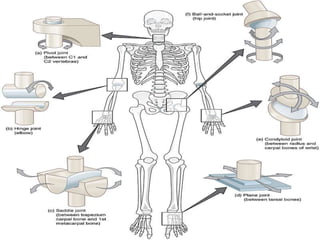
[3] A joint between radius and carpal bone is known
as ..
A. Hinge joint
B. Saddle joint
C. Ball and socket joint
D. Condyloid joint
E. Plane joint
ANSWER:
(D) Condyloid joint
[4] The tissue that surrounds a muscle cell (myofiber)
is known as……
A. Epimysium
B. Perimysium
C. Endomysium
D. Exomysium
E. Superficial mysium
ANSWER:
(C) Endomysium
Musculoskeleton system

Musculoskeleton system

  • 2.
    INTRODUCTION  The Musculoskeletalsystem is a combination of the skeletal, muscular & articular systems of the body & is responsible for the movement & locomotion of the body.  The musculoskeletal system provides form support, stability and movement to the body.  The musculoskeletal system’s primary functions include supporting the body, allowing motion and protecting vital organs.
  • 3.
  • 4.
    MUSCLES  Our skeletalsystem has more than 650 muscles, most of them disposed in pair to provide movement.  The muscles make up about 40 % of the body mass.  Muscular cells are called muscle fibers.  Every fibers contain thousand of myofibrils.  Inside each mayofibril there are many myofilaments that are made of 2 proteins : 1] Actin (Thin) 2] Myosin (Thick)
  • 5.
    FUNCTIONS  Enable usto move our body parts  Give us our individual shape  Protect and keep in place our abdominal organs  Enable us to maintain good posture  Help in the circulation of our blood  Generate body heart when they contract  Heat production
  • 8.
    SMOOTH MUSCLE  Alsocalled as Visceral muscle  Non-striated, Involuntary (No conscious control)  Spindle-shaped cells  Slow, sustained and tireless
  • 9.
     Found inwalls of the digestive tract, bladder, various ducts, arteries, veins and other internal organs.  Controlled by the Autonomic Nervous System (ANS)  Smooth muscle cells are elongated & thin, have one nucleus and form sheets rather than bundles of muscles.
  • 12.
    SKELETAL MUSCLE  Striated,Voluntary muscle, is the most abundant tissue in human body, it produces movement.  Attached to skeleton by tendons  Cells - Multinucleated  Each skeleton-muscle fiber is roughly cylindrical, contains many nuclei & is crossed by alternating light & dark bands called striations.  Controlled by Somatic Nervous system  The skeletal muscles are composite structures composed of many muscle fibers, nerves, blood vessels and connective tissue.
  • 17.
    SARCOMERE  Sarcomere isthe Functional unit of the Skeletan Muscle  About 10,000 sarcomeres per microfibril, end to end  A single sarcomere consists of 2 – Z lines and 1 A band and 2 semi – I bands.  COMPOSITION :  H – only Thick filaments  A – Thick and Thin filaments  I – only Thin filaments
  • 19.
    CARDIAC MUSCLE  Onlyfound in the Heart  Controlled by Autonomic Nervous System  Has striations (similar like skeletan muscle)  Involuntary  Cells are branched and fused with one another  Contractions of the heart muscle pump blood throughout the body and account for the heartbeat.  Cells are short, branching & have a single nucleus  Never tired
  • 20.
    Cells connect toeach other at Intercalated discs
  • 21.
     Cardiac musclecells – CARDIOMYOCYTES  It has got numerous Mitochondria.  Rhythemic contraction
  • 22.
  • 24.
    FUNCTIONS  Movement –Skeletal system provides points for attachment for muscles.  Support – It holds your head up and protects your spinal cord.  Protection – The bones of your skull protect your brain, ribs protect your lungs & heart from injury.  Make Blood – RBCs & WBCs are formed by tissue called marrow.  Storage – stores mineral such as Ca and Mg
  • 25.
    BONES  The humanskeleton is the internal framework of the body.  It is composed of 270 bones at birth – this total decreases to 206 bones by adulthood after some bones have fused together.  The human skeleton can be divided into :- 1) The Axial Skeletan 2) The Appendicular Skeletan
  • 26.
    AXIAL SKELETAN  TheAxial skeleton (80 bones) is formed by the vertebral column, the rib cage, the skull & other associated bones.  It Protects the major organs of the nervous, respiratory and circulatory system.
  • 29.
    APPENDICULAR SKELETAN  Theappendicular skeleton (126 bones), which is attached to the axial skeleton, is formed by the shoulder girdle, the pelvic girdle & the bones of the upper and lower limbs.  It makes the body movement possible and also protects the organs of digestion, excretion, and reproduction.
  • 31.
     Compact Bone oOsteocytes occupy small cavities or lacunae at the junctions of lamellae  Spongy Bone o Consisting of trabeculae o Function as struts of bone o Trabeculae contain irregularly arranged lamallae & osteo-cytes interconnected by canaliculi
  • 32.
    BONE CELLS [1] Osteogeniccells - Develop into Osteoblasts [2] Osteoblasts cells - growing portion of bone, including periosteum and endosteum [3] Osteocytes cells - maintain mineral concentation of matrix [4] Osteoclasts cells - Bone resorption
  • 34.
    CLASSIFICATION OF BONES [1]Long Bones  Long bones have a long shaft and two distinct ends  All bones of the limbs {except patella, wrist & ankle}  The bones of the fingers  They are usually somewhat curved for strength
  • 35.
    [2] SHORT BONES Short bones are roughly cubelike  Cube-shaped & have approximately equal length & width  Providing support and stability with little movement  Found in wrist & ankle bones
  • 36.
    [3] FLAT BONES Flat bones are thin, flattened and usually curved  Provide considerable mechanical protection & extensive surfaces for muscle attachments  Ex. Scapula, Sternum, Ribs, cranial bones
  • 37.
    [4] IRREGULAR BONES Irregular bones don’t fit into the previous categories  Complicated shapes  Consist of cancellous bone with a thin outer layer of compact bone  Ex. Vertebrae, Mandible, Hip, Sacrum
  • 38.
    [5] SESAMOID BONES Short or irregular bones, imbedded in a tendon  It passes over a joint which serves to protect the tendon  Ex. Patellae (kneecaps)
  • 40.
    JOINTS  Also calledas “Articulation”, where bone and cartilage come together to form a connection.  Joints classified by Structures into 3 types :- 1) Fibrous joint - Immovable 2) Cartilaginous joint – partly movable 3) Synovial joint – freely movable
  • 41.
    FIBROUS JOINT  Allthe bones of the skull, except for the mandible, are joined to each other by a fibrous joint called a suture.  joined by dense regular connective tissue that is rich in collagen fibers.
  • 44.
    SYNOVIAL JOINT  Alsocalled as “Diarthrosis”  The synovial (or joint) cavity is filled with synovial fluid.  most common and most movable type of joint in the body of a mammal
  • 46.
    CARTILAGE  Cartilage isa flexible connective tissue , including the joints between bones, the rib cage, the ear, the nose, the bronchial tubes and the intervertebral discs.  Cells - CHONDROCYTES  Grows fast--forms embryonic skeleton
  • 47.
    KINDS OF CARTILAGE Hyaline cartilage -- most common, found in joints  Elastic cartilage -- epiglottis, ear  Fibro cartilage -- annular fibrosis of intervertebral disk, menisci of knee
  • 48.
    TENDON  A tendon(or sinew) is a tough band of fibrous connective tissue that usually connects muscle to bone and is capable of withstanding tension.  Tendons are similar to ligaments; both are made of collagen. Ligaments join one bone to another bone, while tendons connect muscle to bone
  • 49.
    LIGAMENT  A Ligamentis the fibrous connective tissue that connects bones to other bones and is also known as articular ligament, articular larua, fibrous ligament, or true ligament.  Ligaments are similar to tendons and fasciae as they are all made of connective tissue.  The differences in them are in the connections that they make; ligaments connect one bone to another bone, tendons connect muscle to bone and fasciae connect muscles to other muscles.
  • 51.
    OSTEOMALACIA  Osteomalacia isthe softening of the bones caused by deactivated bone mineralization primary to adequate levels of available phosphate & calcium.  The most common cause of osteomalacia is a deficiency of vitamin D, which is normally derived from sunlight exposure and, to a lesser extent, from the diet.
  • 52.
    SYMPTOMS  Muscle weakness Difficulty walking, often with waddling gait  Hypocalcemia  Compressed vertebrae and diminished stature  Pelvic flattening  Weak, soft bones  Easy fracturing  Bending of bones TREATMENT  Include daily sufficient Vitamin D , Protein
  • 53.
    PAGET’S DISEASE  Itis chronic disease of skeletan  Normal growth of bone is changed  Bones break down more quickly  Bones can grow larger than before  Bone that replaced is soft and porous  Symptoms :  Pain in or over a bone  The affected area may be feel extra warm  The shape of bone may be change  Bone of legs may blow out or bend  The bone in the skull may get bigger
  • 55.
  • 56.
    [1] Bones thatsurround the spinal cord are classified as ________ bones. A. Short B. Sesamoid C. Flat D. Irregular E. Long
  • 57.
  • 58.
     [2] Whatis the difference between compact bone and spongy bone? A. They have different bone marrow. B. They are made of different materials. C. They have different sizes of bone cells. D. They have different arrangement of bone cells.
  • 59.
    ANSWER: (D) They havedifferent arrangement of bone cells.
  • 60.
    [3] A jointbetween radius and carpal bone is known as .. A. Hinge joint B. Saddle joint C. Ball and socket joint D. Condyloid joint E. Plane joint
  • 61.
  • 62.
    [4] The tissuethat surrounds a muscle cell (myofiber) is known as…… A. Epimysium B. Perimysium C. Endomysium D. Exomysium E. Superficial mysium
  • 63.