CPR
{CARDIO PULMONARY RESUSCITATION}
Presented by
Haroon Rashid
Msc Clinical Research
CPR
Cardiopulmonary resuscitation (CPR) is a
lifesaving technique useful in many
emergencies, including heart attack or
near drowning, in which someone's
breathing or heartbeat has stopped. CPR
can maintain circulation and breathing until
emergency medical help arrives.
.
•
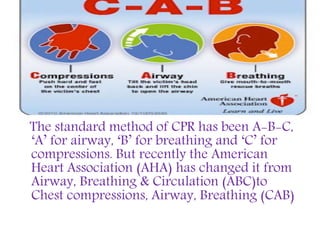
The standard method of CPR has been A-B-C,
‘A’ for airway, ‘B’ for breathing and ‘C’ for
compressions. But recently the American
Heart Association (AHA) has changed it from
Airway, Breathing & Circulation (ABC)to
Chest compressions, Airway, Breathing (CAB)
STEPS IN CPR
(1) Before starting CPR, check:
• Is the person conscious or unconscious?
• If the person appears unconscious, tap or
shake his or her shoulder and ask loudly, "Are
you OK?"
• If the person doesn't respond, call the local
emergency number and begin CPR.
(2) Circulation: Restore blood
circulation with chest compressions
• Put the person on his or her back on a firm
surface.
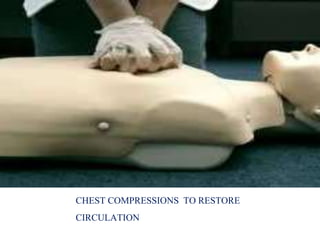
• Place the heel of one hand over the centre of
the person's chest. Place your other hand on
top of the first hand.
• Use your upper body weight and compress
the chest at least 2 inches.
• Push hard & fast at a rate of about 100
compressions a minute.
CHEST COMPRESSIONS TO RESTORE
CIRCULATION
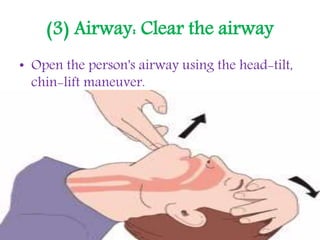
(3) Airway: Clear the airway
• Open the person's airway using the head-tilt,
chin-lift maneuver.
.
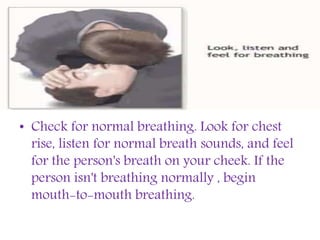
• Check for normal breathing. Look for chest
rise, listen for normal breath sounds, and feel
for the person's breath on your cheek. If the
person isn't breathing normally , begin
mouth-to-mouth breathing.
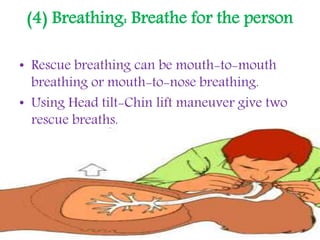
(4) Breathing: Breathe for the person
• Rescue breathing can be mouth-to-mouth
breathing or mouth-to-nose breathing.
• Using Head tilt-Chin lift maneuver give two
rescue breaths.
• 30 chest compressions followed by 2 rescue
breaths is considered 1 cycle.
Or 1 cycle = 30: 2
• Continue CPR until 5cycles are completed.
• If the person has not begun moving after five
cycles, administer one shock by using Automated
external defibrillator (AED).
• Continue CPR until there are signs of movement
or emergency medical personnel take over.
BIBLIOGRAPHY
• BLS & ACLS GUIDE (By American
Heart Association)
• CPR Guide (By Saudi Heart
Association of KFMC)
• American Medical ID
• Cyclopedic Medical Dictionary (By
Taber’s)
THANK YOU

CPR (cardio-pulmonary resuscitation)

  • 1.
    CPR {CARDIO PULMONARY RESUSCITATION} Presentedby Haroon Rashid Msc Clinical Research
  • 2.
    CPR Cardiopulmonary resuscitation (CPR)is a lifesaving technique useful in many emergencies, including heart attack or near drowning, in which someone's breathing or heartbeat has stopped. CPR can maintain circulation and breathing until emergency medical help arrives.
  • 3.
    . • The standard methodof CPR has been A-B-C, ‘A’ for airway, ‘B’ for breathing and ‘C’ for compressions. But recently the American Heart Association (AHA) has changed it from Airway, Breathing & Circulation (ABC)to Chest compressions, Airway, Breathing (CAB)
  • 4.
    STEPS IN CPR (1)Before starting CPR, check: • Is the person conscious or unconscious? • If the person appears unconscious, tap or shake his or her shoulder and ask loudly, "Are you OK?" • If the person doesn't respond, call the local emergency number and begin CPR.
  • 5.
    (2) Circulation: Restoreblood circulation with chest compressions • Put the person on his or her back on a firm surface. • Place the heel of one hand over the centre of the person's chest. Place your other hand on top of the first hand. • Use your upper body weight and compress the chest at least 2 inches. • Push hard & fast at a rate of about 100 compressions a minute.
  • 6.
    CHEST COMPRESSIONS TORESTORE CIRCULATION
  • 7.
    (3) Airway: Clearthe airway • Open the person's airway using the head-tilt, chin-lift maneuver.
  • 8.
    . • Check fornormal breathing. Look for chest rise, listen for normal breath sounds, and feel for the person's breath on your cheek. If the person isn't breathing normally , begin mouth-to-mouth breathing.
  • 9.
    (4) Breathing: Breathefor the person • Rescue breathing can be mouth-to-mouth breathing or mouth-to-nose breathing. • Using Head tilt-Chin lift maneuver give two rescue breaths.
  • 10.
    • 30 chestcompressions followed by 2 rescue breaths is considered 1 cycle. Or 1 cycle = 30: 2 • Continue CPR until 5cycles are completed. • If the person has not begun moving after five cycles, administer one shock by using Automated external defibrillator (AED). • Continue CPR until there are signs of movement or emergency medical personnel take over.
  • 11.
    BIBLIOGRAPHY • BLS &ACLS GUIDE (By American Heart Association) • CPR Guide (By Saudi Heart Association of KFMC) • American Medical ID • Cyclopedic Medical Dictionary (By Taber’s)
  • 12.