


UNDERSTANDING THE
GREENHOUSE EFFECT
PRANTI MAJUMDER
ADAMAS UNIVERSITY
AGENDA
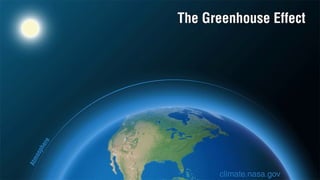
 The greenhouse effect refers to circumstances where the short
wavelengths of visible light from the sun pass through a
transparent medium and are absorbed, but the longer wavelengths
of the infrared re-radiation from the heated objects are unable to
pass through that medium. The trapping of the long wavelength
radiation leads to more heating and a higher resultant
temperature.
 The greenhouse effect helps trap heat from the sun, which
keeps the temperature on earth comfortable. But people’s activities
are increasing the amount of heat-trapping greenhouse gases in the
atmosphere, causing the earth to warm up.
 The process is called the greenhouse effect because the exchange of
incoming and outgoing radiation that warms the planet works in a
similar way to a greenhouse.
GREENHOUSE EFFECT
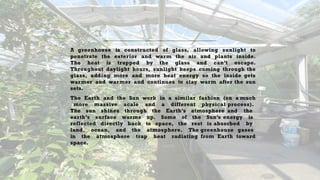
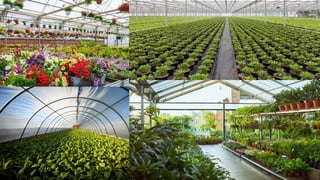
A greenhouse is constructed of glass, allowing sunlight to
penetrate the exterior and warm the air and plants inside.
The heat is trapped by the glass and can’t escape.
Throughout daylight hours, sunlight keeps coming through the
glass, adding more and more heat energy so the inside gets
warmer and warmer and continues to stay warm after the sun
sets.
The Earth and the Sun work in a similar fashion (on a much
more massive scale and a different physical process).
The sun shines through the Earth’s atmosphere and the
earth’s surface warms up. Some of the Sun’s energy is
reflected directly back to space, the rest is absorbed by
land, ocean, and the atmosphere. The greenhouse gases
in the atmosphere trap heat radiating from Earth toward
space.
Contributors to Greenhouse Effect . . .
 Those gas molecules in the Earth’s atmosphere with three or more atoms are called
“Greenhouse Gases”.
 Greenhouse gases allow the sun’
s light(insolation)to shine onto Earth’s surface, and then the gases trap the heat that
reflects back from the surface inside Earth’s atmosphere. The gases act like the glass wall of a greenhouse-thus the
name Greenhouse gas.
 Greenhouse Gases are naturally occurring. They include carbon dioxide, methane,
nitrous oxide, etc. Synthetic gases (CFCs, HFCs, PFCs, Sulfur Hexafluoride, Nitrogen
Trifluoride, etc. are man made chemicals and generally have a much higher global
warming potential than naturally occurring greenhouse gases.
 Methane is a more powerful greenhouse gas than CO 2, but has a shorter atmospheric
lifetime. Nitrous oxide, like CO2, is a long-lived greenhouse gas that accumulates in the
atmosphere over decades to centuries.
Greenhouse Gas Emissions - Main sources
There are 2 ways that greenhouse gas emissions enters our atmosphere.
 One of them is through human activities. The main human sources of greenhouse gas
emissions are: fossil fuel use, deforestation, intensive livestock farming, use of synthetic
fertilizers and industrial processes.
 The other is through natural processes like animal and plant respiration.
GLOBAL WARMING
warming is a phenomenon refers to the long-term increase in Earth's
 Global
average surface temperature due to the buildup of greenhouse gases in the
atmosphere. CO2 produced by human activities is the largest contributor to global
warming.
 Greenhouse gases, such as carbon dioxide (CO2), methane (CH4), and nitrous oxide
(N2O), trap heat from the sun's radiation within the Earth's atmosphere, leading to a
gradual warming of the planet.
 Global warming is the result of overexploitation of the green house effect.
 The greenhouse effect is a natural phenomenon and beneficial to life on Earth.
However, global warming is produced as a consequence of the combustion of fossil gases
expelled by industry, livestock, vehicles and other terrestrial elements, which generate an
increase in global temperature.
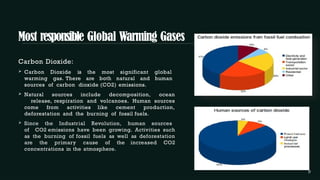
Carbon Dioxide:
 Carbon Dioxide is the most significant global
warming gas. There are both natural and human
sources of carbon dioxide (CO2) emissions.
 Natural sources include decomposition, ocean
release, respiration and volcanoes. Human sources
come from activities like cement production,
deforestation and the burning of fossil fuels.
 Since the Industrial Revolution, human sources
of CO2 emissions have been growing. Activities such
as the burning of fossil fuels as well as deforestation
are the primary cause of the increased CO2
concentrations in the atmosphere.
Most responsible Global Warming Gases
Continue…
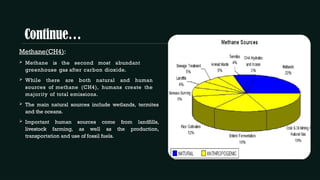
Methane(CH4):
 Methane is the second most abundant
greenhouse gas after carbon dioxide.
 While there are both natural and human
sources of methane (CH4), humans create the
majority of total emissions.
 The main natural sources include wetlands, termites
and the oceans.
 Important human sources come from landfills,
livestock farming, as well as the production,
transportation and use of fossil fuels.
Continue…
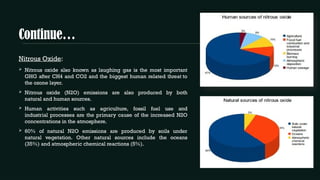
Nitrous Oxide:
 Nitrous oxide also known as laughing gas is the most important
GHG after CH4 and CO2 and the biggest human related threat to
the ozone layer.
 Nitrous oxide (N2O) emissions are also produced by both
natural and human sources.
 Human activities such as agriculture, fossil fuel use and
industrial processes are the primary cause of the increased N2O
concentrations in the atmosphere.
 60% of natural N2O emissions are produced by soils under
natural vegetation. Other natural sources include the oceans
(35%) and atmospheric chemical reactions (5%).
Continue…
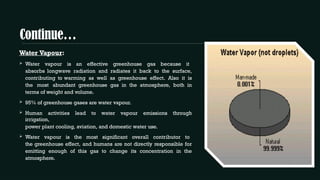
Water Vapour:
 Water vapour is an effective greenhouse gas because it
absorbs longwave radiation and radiates it back to the surface,
contributing to warming as well as greenhouse effect. Also it is
the most abundant greenhouse gas in the atmosphere, both in
terms of weight and volume.
 95% of greenhouse gases are water vapour.
 Human activities lead to water vapour emissions through
irrigation,
power plant cooling, aviation, and domestic water use.
 Water vapour is the most significant overall contributor to
the greenhouse effect, and humans are not directly responsible for
emitting enough of this gas to change its concentration in the
atmosphere.
Continue…
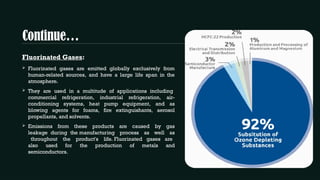
Fluorinated Gases:
 Fluorinated gases are emitted globally exclusively from
human-related sources, and have a large life span in the
atmosphere.
 They are used in a multitude of applications including
commercial refrigeration, industrial refrigeration, air-
conditioning systems, heat pump equipment, and as
blowing agents for foams, fire extinguishants, aerosol
propellants, and solvents.
 Emissions from these products are caused by gas
leakage during the manufacturing process as well as
throughout the product's life. Fluorinated gases are
also used for the production of metals and
semiconductors.
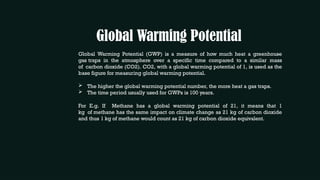
Global Warming Potential
Global Warming Potential (GWP) is a measure of how much heat a greenhouse
gas traps in the atmosphere over a specific time compared to a similar mass
of carbon dioxide (CO2). CO2, with a global warming potential of 1, is used as the
base figure for measuring global warming potential.
 The higher the global warming potential number, the more heat a gas traps.
 The time period usually used for GWPs is 100 years.
For E.g. If Methane has a global warming potential of 21, it means that 1
kg of methane has the same impact on climate change as 21 kg of carbon dioxide
and thus 1 kg of methane would count as 21 kg of carbon dioxide equivalent.
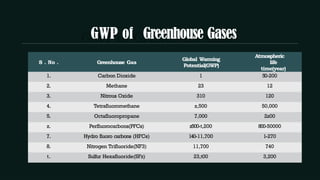
GWP of Greenhouse Gases
S . No . Greenhouse Gas
Global Warming
Potential(GWP)
Atmospheric
life
time(year)
1. Carbon Dioxide 1 50-200
2. Methane 23 12
3. Nitrous Oxide 310 120
4. Tetrafluoromethane z,500 50,000
5. Octafluoropropane 7,000 2z00
z. Perfluorocarbons(PFCs) z500-t,200 800-50000
7. Hydro fluoro carbons (HFCs) 140-11,700 1-270
8. Nitrogen Trifluoride(NF3) 11,700 740
t. Sulfur Hexafluoride(SFz) 23,t00 3,200
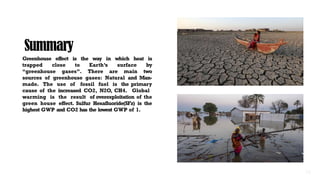
Summary
Greenhouse effect is the way in which heat is
trapped close to Earth’s surface by
“greenhouse gases”. There are main two
sources of greenhouse gases: Natural and Man-
made. The use of fossil fuel is the primary
cause of the increased CO2, N2O, CH4. Global
warming is the result of overexploitation of the
green house effect. Sulfur Hexafluoride(SFz) is the
highest GWP and CO2 has the lowest GWP of 1.
THANK YOU

GREEN HOUSE EFFECT_ALL YOU SHOULD KNOW..

  • 1.
  • 2.
  • 4.
     The greenhouseeffect refers to circumstances where the short wavelengths of visible light from the sun pass through a transparent medium and are absorbed, but the longer wavelengths of the infrared re-radiation from the heated objects are unable to pass through that medium. The trapping of the long wavelength radiation leads to more heating and a higher resultant temperature.  The greenhouse effect helps trap heat from the sun, which keeps the temperature on earth comfortable. But people’s activities are increasing the amount of heat-trapping greenhouse gases in the atmosphere, causing the earth to warm up.  The process is called the greenhouse effect because the exchange of incoming and outgoing radiation that warms the planet works in a similar way to a greenhouse. GREENHOUSE EFFECT
  • 5.
    A greenhouse isconstructed of glass, allowing sunlight to penetrate the exterior and warm the air and plants inside. The heat is trapped by the glass and can’t escape. Throughout daylight hours, sunlight keeps coming through the glass, adding more and more heat energy so the inside gets warmer and warmer and continues to stay warm after the sun sets. The Earth and the Sun work in a similar fashion (on a much more massive scale and a different physical process). The sun shines through the Earth’s atmosphere and the earth’s surface warms up. Some of the Sun’s energy is reflected directly back to space, the rest is absorbed by land, ocean, and the atmosphere. The greenhouse gases in the atmosphere trap heat radiating from Earth toward space.
  • 7.
    Contributors to GreenhouseEffect . . .  Those gas molecules in the Earth’s atmosphere with three or more atoms are called “Greenhouse Gases”.  Greenhouse gases allow the sun’ s light(insolation)to shine onto Earth’s surface, and then the gases trap the heat that reflects back from the surface inside Earth’s atmosphere. The gases act like the glass wall of a greenhouse-thus the name Greenhouse gas.  Greenhouse Gases are naturally occurring. They include carbon dioxide, methane, nitrous oxide, etc. Synthetic gases (CFCs, HFCs, PFCs, Sulfur Hexafluoride, Nitrogen Trifluoride, etc. are man made chemicals and generally have a much higher global warming potential than naturally occurring greenhouse gases.  Methane is a more powerful greenhouse gas than CO 2, but has a shorter atmospheric lifetime. Nitrous oxide, like CO2, is a long-lived greenhouse gas that accumulates in the atmosphere over decades to centuries.
  • 8.
    Greenhouse Gas Emissions- Main sources There are 2 ways that greenhouse gas emissions enters our atmosphere.  One of them is through human activities. The main human sources of greenhouse gas emissions are: fossil fuel use, deforestation, intensive livestock farming, use of synthetic fertilizers and industrial processes.  The other is through natural processes like animal and plant respiration.
  • 9.
    GLOBAL WARMING warming isa phenomenon refers to the long-term increase in Earth's  Global average surface temperature due to the buildup of greenhouse gases in the atmosphere. CO2 produced by human activities is the largest contributor to global warming.  Greenhouse gases, such as carbon dioxide (CO2), methane (CH4), and nitrous oxide (N2O), trap heat from the sun's radiation within the Earth's atmosphere, leading to a gradual warming of the planet.  Global warming is the result of overexploitation of the green house effect.  The greenhouse effect is a natural phenomenon and beneficial to life on Earth. However, global warming is produced as a consequence of the combustion of fossil gases expelled by industry, livestock, vehicles and other terrestrial elements, which generate an increase in global temperature.
  • 10.
    Carbon Dioxide:  CarbonDioxide is the most significant global warming gas. There are both natural and human sources of carbon dioxide (CO2) emissions.  Natural sources include decomposition, ocean release, respiration and volcanoes. Human sources come from activities like cement production, deforestation and the burning of fossil fuels.  Since the Industrial Revolution, human sources of CO2 emissions have been growing. Activities such as the burning of fossil fuels as well as deforestation are the primary cause of the increased CO2 concentrations in the atmosphere. Most responsible Global Warming Gases
  • 11.
    Continue… Methane(CH4):  Methane isthe second most abundant greenhouse gas after carbon dioxide.  While there are both natural and human sources of methane (CH4), humans create the majority of total emissions.  The main natural sources include wetlands, termites and the oceans.  Important human sources come from landfills, livestock farming, as well as the production, transportation and use of fossil fuels.
  • 12.
    Continue… Nitrous Oxide:  Nitrousoxide also known as laughing gas is the most important GHG after CH4 and CO2 and the biggest human related threat to the ozone layer.  Nitrous oxide (N2O) emissions are also produced by both natural and human sources.  Human activities such as agriculture, fossil fuel use and industrial processes are the primary cause of the increased N2O concentrations in the atmosphere.  60% of natural N2O emissions are produced by soils under natural vegetation. Other natural sources include the oceans (35%) and atmospheric chemical reactions (5%).
  • 13.
    Continue… Water Vapour:  Watervapour is an effective greenhouse gas because it absorbs longwave radiation and radiates it back to the surface, contributing to warming as well as greenhouse effect. Also it is the most abundant greenhouse gas in the atmosphere, both in terms of weight and volume.  95% of greenhouse gases are water vapour.  Human activities lead to water vapour emissions through irrigation, power plant cooling, aviation, and domestic water use.  Water vapour is the most significant overall contributor to the greenhouse effect, and humans are not directly responsible for emitting enough of this gas to change its concentration in the atmosphere.
  • 14.
    Continue… Fluorinated Gases:  Fluorinatedgases are emitted globally exclusively from human-related sources, and have a large life span in the atmosphere.  They are used in a multitude of applications including commercial refrigeration, industrial refrigeration, air- conditioning systems, heat pump equipment, and as blowing agents for foams, fire extinguishants, aerosol propellants, and solvents.  Emissions from these products are caused by gas leakage during the manufacturing process as well as throughout the product's life. Fluorinated gases are also used for the production of metals and semiconductors.
  • 15.
    Global Warming Potential GlobalWarming Potential (GWP) is a measure of how much heat a greenhouse gas traps in the atmosphere over a specific time compared to a similar mass of carbon dioxide (CO2). CO2, with a global warming potential of 1, is used as the base figure for measuring global warming potential.  The higher the global warming potential number, the more heat a gas traps.  The time period usually used for GWPs is 100 years. For E.g. If Methane has a global warming potential of 21, it means that 1 kg of methane has the same impact on climate change as 21 kg of carbon dioxide and thus 1 kg of methane would count as 21 kg of carbon dioxide equivalent.
  • 16.
    GWP of GreenhouseGases S . No . Greenhouse Gas Global Warming Potential(GWP) Atmospheric life time(year) 1. Carbon Dioxide 1 50-200 2. Methane 23 12 3. Nitrous Oxide 310 120 4. Tetrafluoromethane z,500 50,000 5. Octafluoropropane 7,000 2z00 z. Perfluorocarbons(PFCs) z500-t,200 800-50000 7. Hydro fluoro carbons (HFCs) 140-11,700 1-270 8. Nitrogen Trifluoride(NF3) 11,700 740 t. Sulfur Hexafluoride(SFz) 23,t00 3,200
  • 17.
    Summary Greenhouse effect isthe way in which heat is trapped close to Earth’s surface by “greenhouse gases”. There are main two sources of greenhouse gases: Natural and Man- made. The use of fossil fuel is the primary cause of the increased CO2, N2O, CH4. Global warming is the result of overexploitation of the green house effect. Sulfur Hexafluoride(SFz) is the highest GWP and CO2 has the lowest GWP of 1.
  • 18.