WEATHER AND
CLIMATE
MADE BY JORGE 5ºB
WEATHER
• WEATHER and CLIMATE are two
different things:
WEATHER : Refers to the
atmospheric conditions in a specific
area and time.
CLIMATE : Refers to the typical
weather in a region for a long
period of time.
THE ELEMENTS OF WEATHER
• ARE 5 ELEMENTS OF WEATHER :
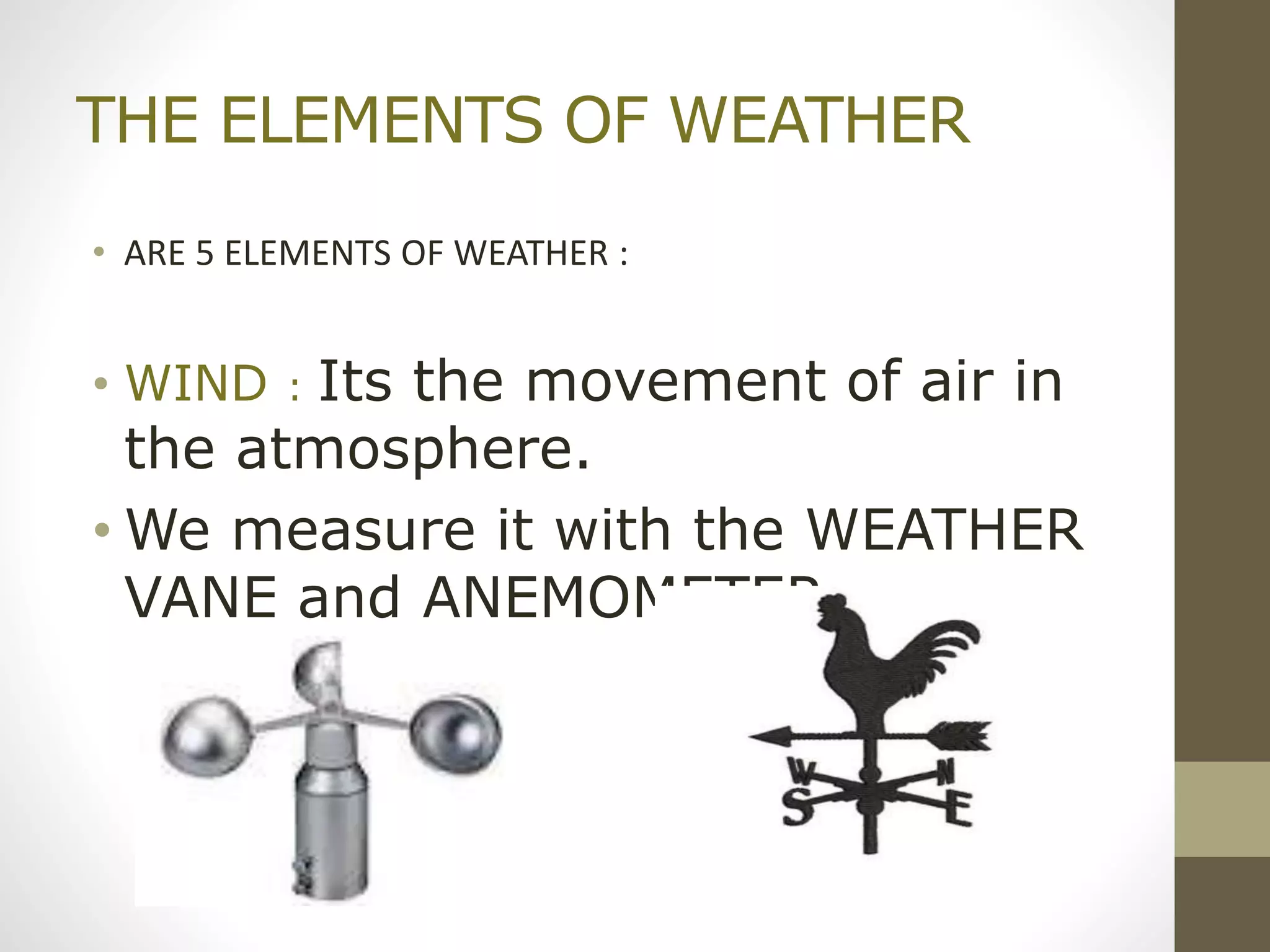
• WIND : Its the movement of air in
the atmosphere.
• We measure it with the WEATHER
VANE and ANEMOMETER.
THE ELEMENTS OF WEATHER.
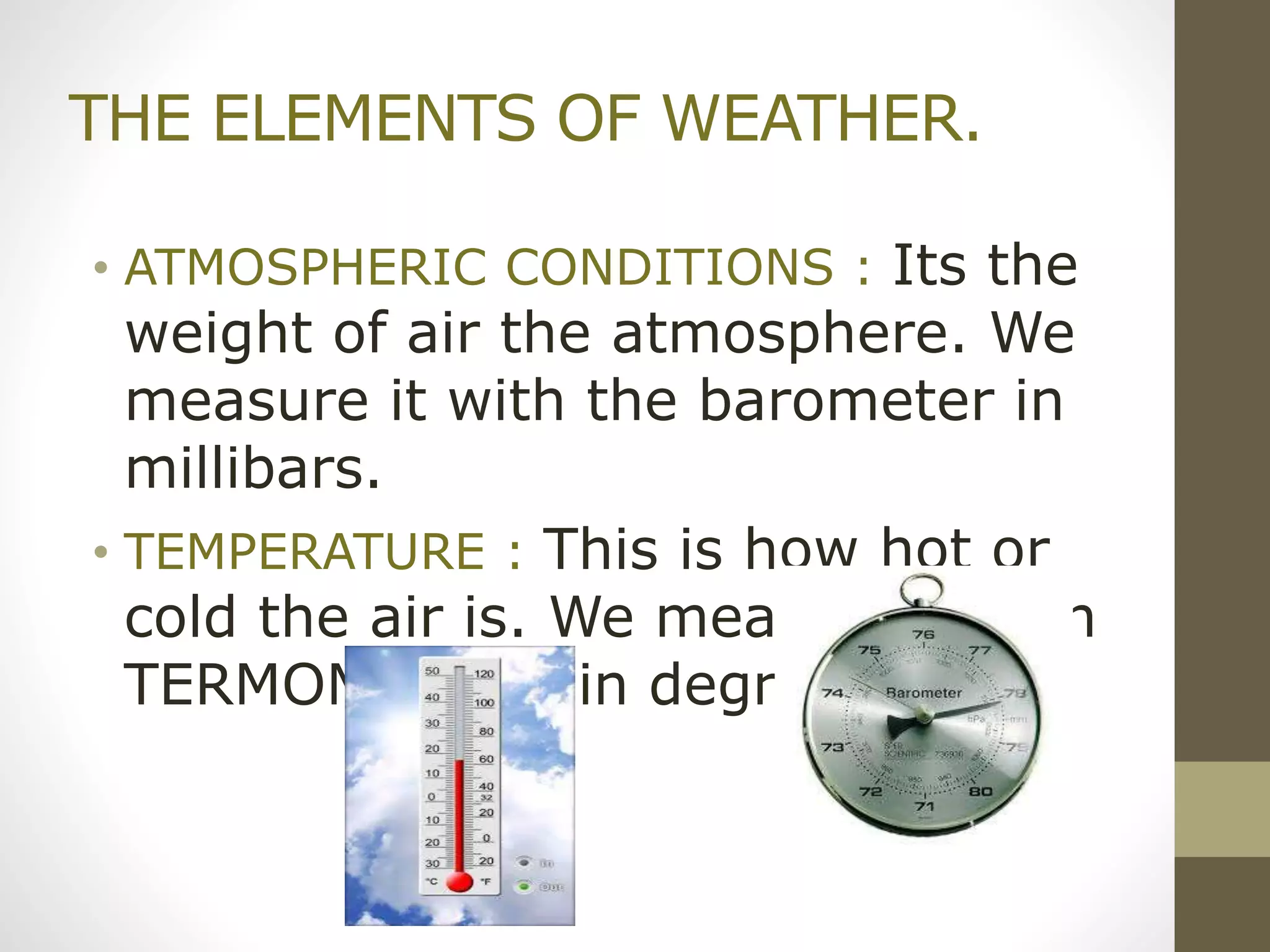
• ATMOSPHERIC CONDITIONS : Its the
weight of air the atmosphere. We
measure it with the barometer in
millibars.
• TEMPERATURE : This is how hot or
cold the air is. We measure it with
TERMOMETERS in degrees.
THE ELEMENTS OF WEATHER
• PRECIPITATION : Its the water that
falls from clouds. We measure it
with a RAIN GAUGE.
• HUMIDITY : Its the amount of
water vapour in air. We measure it
with the HYGROMETER.
CLIMATE
• CLIMATIC FACTORS :
•To study climate, scientist
study precipitation and
temperature of an area for a
period of 30 years . The
information for each year is
put in a CLIMATE GRAPH.
LATITUDE AND
ALTITUDE
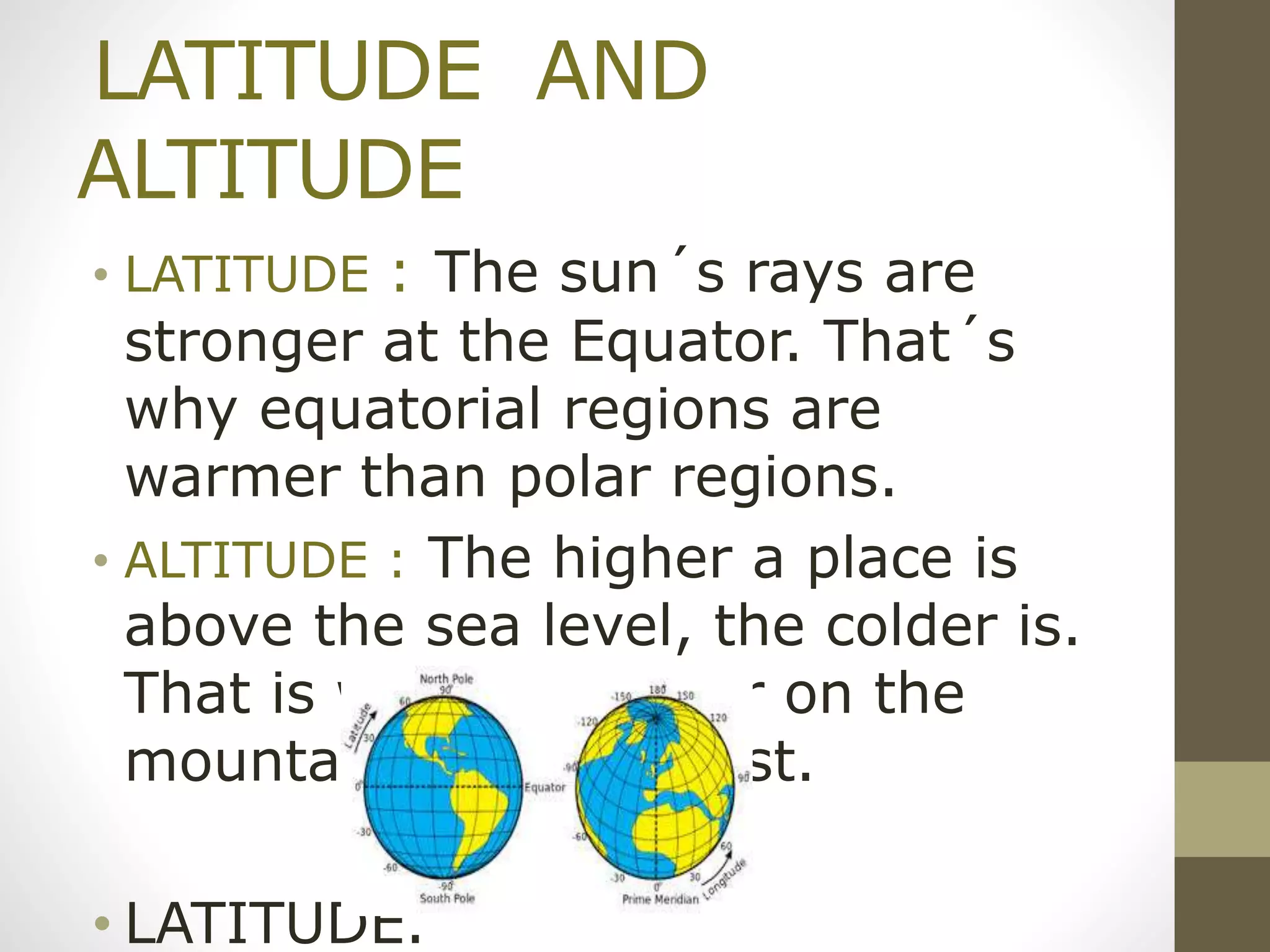
• LATITUDE : The sun´s rays are
stronger at the Equator. That´s
why equatorial regions are
warmer than polar regions.
• ALTITUDE : The higher a place is
above the sea level, the colder is.
That is why it is colder on the
mountains that in coast.
• LATITUDE.
DISTANCE FROM SEA
• The sea water heats up and cools
down more slowly than land.
CLIMATE ZONES
• ARE 3 CLIMATE ZONES :
• POLAR ZONES : They are near the
poles and in the mountains. They
have low temperatures all year
round . The little precipitations
they gets is in the form of snow.
• TROPICAL ZONES : They are near
the equator. They all have high
temperatures, but different
precipitacion.
CLIMATE ZONES
• TEMPERATE ZONES : There are two
of them on either side of the
tropical zone. Their temperatures
are between 0ºC and 20ºC,
depending on whether it is winter
or summer.
CLIMATE CHANGE
• GLOBAL WARMING : In the last few
decades, human activities have
increased the amoust of heat –
trapping gases. This cause the
atmosphere to store ( keep )
more heat than usual, raising
earth´s temperatures. Its call
GREEN HOUSE EFFECT.
CONSEQUENCES OF
GLOBAL WARMING
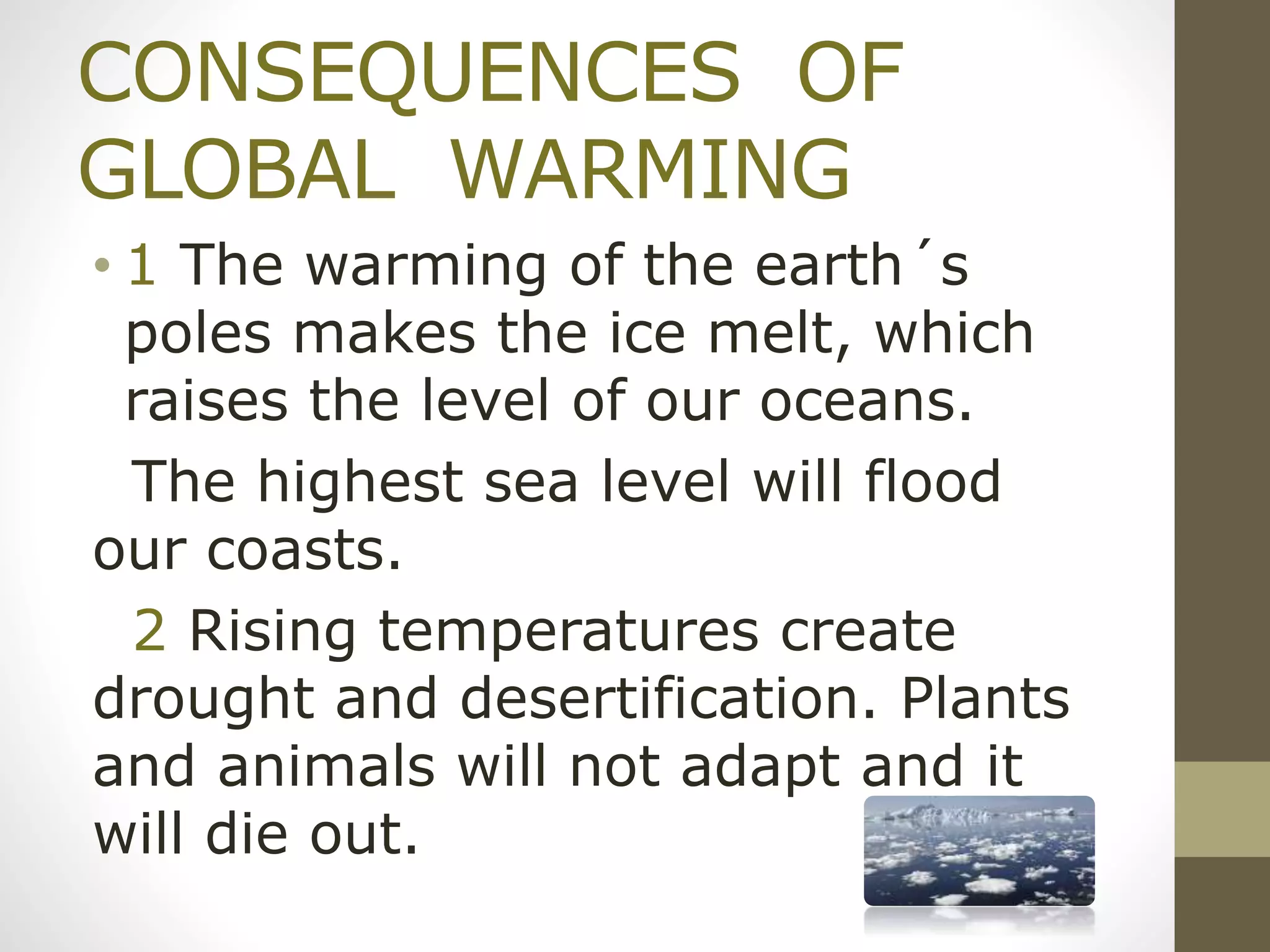
• 1 The warming of the earth´s
poles makes the ice melt, which
raises the level of our oceans.
The highest sea level will flood
our coasts.
2 Rising temperatures create
drought and desertification. Plants
and animals will not adapt and it
will die out.
SOLUTIONS TO CLIMATE
CHANGE
• POSIBLES SOLUTIONS : No
deforestation , plant more trees
and plants, no contamination and
do recycling , if you finish with
electricity, you turns off the tv or
the light.
• THE END
•Thanks for
watching
By jorge lr
5ºb

Weather and climate

  • 1.
  • 2.
    WEATHER • WEATHER andCLIMATE are two different things: WEATHER : Refers to the atmospheric conditions in a specific area and time. CLIMATE : Refers to the typical weather in a region for a long period of time.
  • 3.
    THE ELEMENTS OFWEATHER • ARE 5 ELEMENTS OF WEATHER : • WIND : Its the movement of air in the atmosphere. • We measure it with the WEATHER VANE and ANEMOMETER.
  • 4.
    THE ELEMENTS OFWEATHER. • ATMOSPHERIC CONDITIONS : Its the weight of air the atmosphere. We measure it with the barometer in millibars. • TEMPERATURE : This is how hot or cold the air is. We measure it with TERMOMETERS in degrees.
  • 5.
    THE ELEMENTS OFWEATHER • PRECIPITATION : Its the water that falls from clouds. We measure it with a RAIN GAUGE. • HUMIDITY : Its the amount of water vapour in air. We measure it with the HYGROMETER.
  • 6.
    CLIMATE • CLIMATIC FACTORS: •To study climate, scientist study precipitation and temperature of an area for a period of 30 years . The information for each year is put in a CLIMATE GRAPH.
  • 7.
    LATITUDE AND ALTITUDE • LATITUDE: The sun´s rays are stronger at the Equator. That´s why equatorial regions are warmer than polar regions. • ALTITUDE : The higher a place is above the sea level, the colder is. That is why it is colder on the mountains that in coast. • LATITUDE.
  • 8.
    DISTANCE FROM SEA •The sea water heats up and cools down more slowly than land.
  • 9.
    CLIMATE ZONES • ARE3 CLIMATE ZONES : • POLAR ZONES : They are near the poles and in the mountains. They have low temperatures all year round . The little precipitations they gets is in the form of snow. • TROPICAL ZONES : They are near the equator. They all have high temperatures, but different precipitacion.
  • 10.
    CLIMATE ZONES • TEMPERATEZONES : There are two of them on either side of the tropical zone. Their temperatures are between 0ºC and 20ºC, depending on whether it is winter or summer.
  • 11.
    CLIMATE CHANGE • GLOBALWARMING : In the last few decades, human activities have increased the amoust of heat – trapping gases. This cause the atmosphere to store ( keep ) more heat than usual, raising earth´s temperatures. Its call GREEN HOUSE EFFECT.
  • 12.
    CONSEQUENCES OF GLOBAL WARMING •1 The warming of the earth´s poles makes the ice melt, which raises the level of our oceans. The highest sea level will flood our coasts. 2 Rising temperatures create drought and desertification. Plants and animals will not adapt and it will die out.
  • 13.
    SOLUTIONS TO CLIMATE CHANGE •POSIBLES SOLUTIONS : No deforestation , plant more trees and plants, no contamination and do recycling , if you finish with electricity, you turns off the tv or the light.
  • 14.
    • THE END •Thanksfor watching By jorge lr 5ºb