What is Green House?
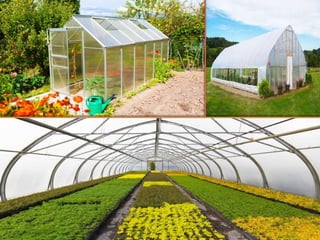
Green House is a special designed glass or
plastic enclosed frame structure for protecting
tender or out-of-season plants against
excessive cold or heat.
The system of Green House is also called
Phytomation System, Controlled Environment
Plant Production System (CEPPS) &
Controlled Environment Agriculture (CEA).
What is the historical background of
Green House?
 In the past, the green houses were not like the
green houses of today.
 The idea of growing plants in environmentally
controlled area existed in Roman times.
 During the 1450’s, the description of heated
green house was found by a royal physician of
the Joseon dynasty of Korea.
 In the 17th century greenhouses were ordinary
brick or timber shelters with a normal
proportion of window space and some means
of heating.
 First practical modern Green House was
created by French botanist Charles Lucien
Bonaparte during the 1800th.
 In 1960, greenhouses of wider sheets of
polyethylene film became available.
 In 1980’s and 1990’s, gutter-connected
greenhouses became available, where two or
more bays connected by a common wall and
covered with structured polycarbonate
materials.
What is green house effect :
The green house effect is the process by which
radiation from a planet’s atmosphere warms the
planet’s surface to a temperature above what it
would be without its atmosphere.
Webster’s New World College Dictionary:
The warming of a planet's surface and lower
atmosphere caused by trapped solar radiation:
solar shortwave radiation penetrates to the
planet's surface and is reradiated into the
atmosphere as infrared waves that are then
absorbed by carbon dioxide, water vapor, etc.
Historical background of greenhouse
effect:
 The term was first coined by Joseph Fourier in
1824.
 The argument and the evidence were
strengthened by these scientists:
 Claude Pouillet in 1827
 John Tyndall in 1859 about greenhouse gases
 Svante Arrhenius in 1896 about quantitative
prediction of global warming due to carbon dioxide.
 And at last Nils Gustaf Ekholm cleared this
concept in 1901.
What is greenhouse gas?
Greenhouse gases are a group of compounds
that are able to trap heat (long wave radiation) in
the atmosphere, keeping the Earth's surface
warmer than it would be if they were not present.
Which are the greenhouse gases?
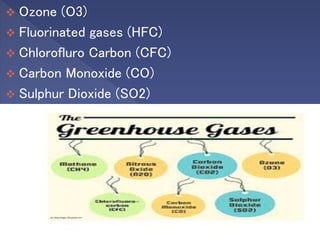
 Methane (CH4)
 Nitrous oxide (N2O)
 Carbon dioxide (CO2)
 Ozone (O3)
 Fluorinated gases (HFC)
 Chlorofluro Carbon (CFC)
 Carbon Monoxide (CO)
 Sulphur Dioxide (SO2)
What are the advantages of Greenhouse
effect?
 Maintains Temperature
 Filters unwanted solar energy and radiate back
harmful rays.
 Helps in growing off-season corps.
 Solar-powered water heaters use the green
house effect to heat water.
 Maintains the water level and restricts ice
melting.
What are the disadvantages of
Greenhouse effect?
 Summers will be warmer with natural disasters.
 Water level balance will be disturbed.
 Life & ecosystem will be disturbed.
 Affect the weather pattern, rainfall will become
erratic in many parts of the world.
How does the Greenhouse effect work?
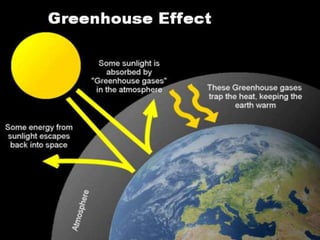
 The sun provides energy to the Earth. This
energy then enters the Earth’s atmosphere.
 The Earth’s surface absorbs most of this energy,
which warms the planet.
 Some of the energy is returned back through the
atmosphere.
 But, some of this energy that was to be returned
to space is captured by gases (carbon dioxide,
methane, and water) in the atmosphere and sent
back down to Earth.
 This is called the Greenhouse Effect.
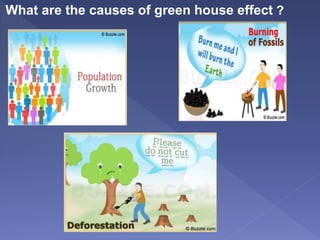
What are the causes of green house effect ?
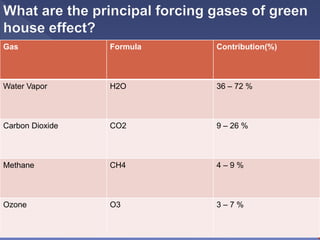
Gas Formula Contribution(%)
Water Vapor H2O 36 – 72 %
Carbon Dioxide CO2 9 – 26 %
Methane CH4 4 – 9 %
Ozone O3 3 – 7 %
Which are the risky countries for the
world considering green house gas
emission?
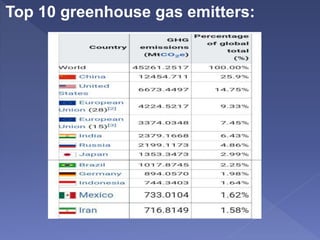
There are many countries who are most
responsible for greenhouse effect. This is a list
of countries by most greenhouse gas
emissions in 2013-2014.It is based on data for
carbon dioxide, methane, nitrous oxide, per
fluorocarbon & hydro fluorocarbon emission
complied by the world resources institute. The
data shown below do not include land use
change & forestry.
Top 10 greenhouse gas emitters:
Solution of greenhouse effect/ways to
reduced greenhouse effect:
If people become aware about the greenhouse
effect only then it can be possible to reduce
greenhouse effect. Some effective way to
reduce greenhouse effect are given below-
1) Planting trees.
2) Avoid those products with excessive
packaging.
3) Buy green electricity.
4) One can replace the light bulbs.
5) Dry the clothes by hanging them on the line.
6) People can use non toxic household products.
7) Often use the off-switch.
8) Use less hot water.
9) Buy energy efficient products.
10) Drive smart & less.
11) people especially those who can afford it can use
hybrid cars.
12) Reduce recycle & re use.
13) Use less heat & air conditioning.
14) More teleconference & telecommunicate about
greenhouse effect to aware people.
What is Climate?
 Climate (from ancient Greek Klima, meaning
inclination ) is commonly defined as the
weather averaged over a long period.
 Climate refers to average length of the weather
condition of 20-30 years for certain long term
places.
What is Climate change ?
Climate change refers to significant changes in
global temperature, precipitation, wind
patterns and other measures of climate that
occur over several decades or longer.
The climate change phenomenon refers to
seasonal changes over a long period with
respect to the growing accumulation of
greenhouse gases in the atmosphere.
Tackling this phenomenon is of utmost
important given the pivotal role that climate
plays in the formation of nature ecosystems
and the human economies and civilizations on
which they are based.
Causes of climate change:
1) Volcanic Eruptions
2) Ocean currents
3) Solon radiations
4) Earth orbital change
5) High fossil fuel
6) Argument variation
6) Greenhouse gasses -
 Water Vapor
 Carbon dioxide
 Methane
 Nitrous oxide
7) Chlorofluorocarbons
8) Human activities
9) Nuclear explosion
10)Industrial factory waste
11)Black smoke emitted from factories and cars
12)Deforestations etc.
What are the impacts of greenhouse
effect on climate change?
 Increase in Air temperature.
 Increase in Sea Level.
 Change in the Rainfall Patterns.
 Changes in Seasons and Seasonal
Characters.
 Shifts in disease/ pest cycles of animals and
plants.
- Shifts in disease cycles of plants and animals. Many
silly disease are attaining major ratio because
composition of microbial population is affected by
shifts in temperature and hydrological cycles.
- Change in water resources of world due to chaos in
hydrological cycles. Heavy rainfall tracts are gradually
converted into low rainfall tracts.
- Change in seasons and seasonal characters through
out the globe. These may even include shifts in
classification of earth into temperature, subtropical
and tropical climates.
What is global warming?
Global warming is the current increase in
temperature of the Earth’s surface as well as
it’s atmosphere. It is also executed century
scale rise in the average temperature of the
Earth’s climate system. Average temperatures
around the world have risen by 0.75C since
1975.
The natural greenhouse effect maintains the
Earth’s temperature at a safe level making it
possible for humans and many other life forms
to exist. It is accelerating the melting of ice
sheets, permafrost and glaciers which is
causing average sea levels to rise.
How greenhouse effect / green house gases
are responsible for global warming?
 The greenhouse effect is a natural process that
warms the Earth’s atmosphere , some of it is
reflected back to space and the rest is absorbed and
re-radiated by greenhouse gases.
 The absorbed energy warms the atmosphere and the
surface of the atmosphere and the surface of the
earth.
 The temperature of earth is rising at nearly twice
the rate it was 50 years ago.
 The two main gases responsible for the greenhouse
effect (and not only its recent increase) are:
Water Vapor (H20)
Carbon dioxide (c02)
 There are others such gases and even many others. The
primary greenhouse gases in Earths atmosphere are
water vapor, carbon dioxide, methane, nitrous oxide
and ozone.
 Without greenhouse effect, the Earth would not be able
to support life. But if the greenhouse effect becomes
too strong the earth will be too hot to support life.
 Even a little to much heat could hurt the animals,
plants, and everything else on the plant.
Conclusion
Without greenhouse effect, the Earth would not be
able to support life. But if the greenhouse effect
becomes too strong the earth will be too hot to
support life. Even a little to much heat could hurt
the animals, plants, and everything else on the
plant. Without the gases that surround the plants,
heat would escape back into escape back. Space
causing earths average tempter to be about 60
degrees colder.
Reference –
 http://www.ei.lehigh.edu/learners/cc/readings/whatgreenhouse.pdf
 www.epa.ie/pubs/reports/indicators/epa_factsheet_greenhouse_v
2.pdf
 www.ei.lehigh.edu/learners/cc/readings/whatgreenhouse.pdf
 www.hko.gov.hk/prtver/pdf/docs/cis/climchange/grnhse_e.pdf
 https://www.colorado.edu/geography/class.../Climate%20warming
%20basics_JP.pdf
 www.columbia.edu/itc/chemistry/environmental/lectures/greenhou
se_gas.pdf
 https://www.eea.europa.eu/publications/92-9157-202-0/3.1.pdf
 www.byju’s.com
 https://www.activesustainibility.com/climate-change/how-
greenhouse-gases-contribute-global -worming/

Green House Effect : Global Warming & Climate Change

  • 2.
    What is GreenHouse? Green House is a special designed glass or plastic enclosed frame structure for protecting tender or out-of-season plants against excessive cold or heat. The system of Green House is also called Phytomation System, Controlled Environment Plant Production System (CEPPS) & Controlled Environment Agriculture (CEA).
  • 4.
    What is thehistorical background of Green House?  In the past, the green houses were not like the green houses of today.  The idea of growing plants in environmentally controlled area existed in Roman times.  During the 1450’s, the description of heated green house was found by a royal physician of the Joseon dynasty of Korea.
  • 5.
     In the17th century greenhouses were ordinary brick or timber shelters with a normal proportion of window space and some means of heating.  First practical modern Green House was created by French botanist Charles Lucien Bonaparte during the 1800th.  In 1960, greenhouses of wider sheets of polyethylene film became available.  In 1980’s and 1990’s, gutter-connected greenhouses became available, where two or more bays connected by a common wall and covered with structured polycarbonate materials.
  • 6.
    What is greenhouse effect : The green house effect is the process by which radiation from a planet’s atmosphere warms the planet’s surface to a temperature above what it would be without its atmosphere. Webster’s New World College Dictionary: The warming of a planet's surface and lower atmosphere caused by trapped solar radiation: solar shortwave radiation penetrates to the planet's surface and is reradiated into the atmosphere as infrared waves that are then absorbed by carbon dioxide, water vapor, etc.
  • 7.
    Historical background ofgreenhouse effect:  The term was first coined by Joseph Fourier in 1824.  The argument and the evidence were strengthened by these scientists:  Claude Pouillet in 1827  John Tyndall in 1859 about greenhouse gases  Svante Arrhenius in 1896 about quantitative prediction of global warming due to carbon dioxide.  And at last Nils Gustaf Ekholm cleared this concept in 1901.
  • 8.
    What is greenhousegas? Greenhouse gases are a group of compounds that are able to trap heat (long wave radiation) in the atmosphere, keeping the Earth's surface warmer than it would be if they were not present. Which are the greenhouse gases?  Methane (CH4)  Nitrous oxide (N2O)  Carbon dioxide (CO2)
  • 9.
     Ozone (O3) Fluorinated gases (HFC)  Chlorofluro Carbon (CFC)  Carbon Monoxide (CO)  Sulphur Dioxide (SO2)
  • 10.
    What are theadvantages of Greenhouse effect?  Maintains Temperature  Filters unwanted solar energy and radiate back harmful rays.  Helps in growing off-season corps.  Solar-powered water heaters use the green house effect to heat water.  Maintains the water level and restricts ice melting.
  • 11.
    What are thedisadvantages of Greenhouse effect?  Summers will be warmer with natural disasters.  Water level balance will be disturbed.  Life & ecosystem will be disturbed.  Affect the weather pattern, rainfall will become erratic in many parts of the world.
  • 12.
    How does theGreenhouse effect work?  The sun provides energy to the Earth. This energy then enters the Earth’s atmosphere.  The Earth’s surface absorbs most of this energy, which warms the planet.  Some of the energy is returned back through the atmosphere.  But, some of this energy that was to be returned to space is captured by gases (carbon dioxide, methane, and water) in the atmosphere and sent back down to Earth.  This is called the Greenhouse Effect.
  • 14.
    What are thecauses of green house effect ?
  • 16.
    Gas Formula Contribution(%) WaterVapor H2O 36 – 72 % Carbon Dioxide CO2 9 – 26 % Methane CH4 4 – 9 % Ozone O3 3 – 7 %
  • 17.
    Which are therisky countries for the world considering green house gas emission? There are many countries who are most responsible for greenhouse effect. This is a list of countries by most greenhouse gas emissions in 2013-2014.It is based on data for carbon dioxide, methane, nitrous oxide, per fluorocarbon & hydro fluorocarbon emission complied by the world resources institute. The data shown below do not include land use change & forestry.
  • 18.
    Top 10 greenhousegas emitters:
  • 19.
    Solution of greenhouseeffect/ways to reduced greenhouse effect: If people become aware about the greenhouse effect only then it can be possible to reduce greenhouse effect. Some effective way to reduce greenhouse effect are given below- 1) Planting trees. 2) Avoid those products with excessive packaging. 3) Buy green electricity. 4) One can replace the light bulbs.
  • 20.
    5) Dry theclothes by hanging them on the line. 6) People can use non toxic household products. 7) Often use the off-switch. 8) Use less hot water. 9) Buy energy efficient products. 10) Drive smart & less. 11) people especially those who can afford it can use hybrid cars. 12) Reduce recycle & re use. 13) Use less heat & air conditioning. 14) More teleconference & telecommunicate about greenhouse effect to aware people.
  • 21.
    What is Climate? Climate (from ancient Greek Klima, meaning inclination ) is commonly defined as the weather averaged over a long period.  Climate refers to average length of the weather condition of 20-30 years for certain long term places.
  • 22.
    What is Climatechange ? Climate change refers to significant changes in global temperature, precipitation, wind patterns and other measures of climate that occur over several decades or longer. The climate change phenomenon refers to seasonal changes over a long period with respect to the growing accumulation of greenhouse gases in the atmosphere.
  • 23.
    Tackling this phenomenonis of utmost important given the pivotal role that climate plays in the formation of nature ecosystems and the human economies and civilizations on which they are based. Causes of climate change: 1) Volcanic Eruptions 2) Ocean currents 3) Solon radiations 4) Earth orbital change 5) High fossil fuel 6) Argument variation
  • 24.
    6) Greenhouse gasses-  Water Vapor  Carbon dioxide  Methane  Nitrous oxide 7) Chlorofluorocarbons 8) Human activities 9) Nuclear explosion 10)Industrial factory waste 11)Black smoke emitted from factories and cars 12)Deforestations etc.
  • 25.
    What are theimpacts of greenhouse effect on climate change?  Increase in Air temperature.  Increase in Sea Level.  Change in the Rainfall Patterns.  Changes in Seasons and Seasonal Characters.  Shifts in disease/ pest cycles of animals and plants.
  • 26.
    - Shifts indisease cycles of plants and animals. Many silly disease are attaining major ratio because composition of microbial population is affected by shifts in temperature and hydrological cycles. - Change in water resources of world due to chaos in hydrological cycles. Heavy rainfall tracts are gradually converted into low rainfall tracts. - Change in seasons and seasonal characters through out the globe. These may even include shifts in classification of earth into temperature, subtropical and tropical climates.
  • 27.
    What is globalwarming? Global warming is the current increase in temperature of the Earth’s surface as well as it’s atmosphere. It is also executed century scale rise in the average temperature of the Earth’s climate system. Average temperatures around the world have risen by 0.75C since 1975. The natural greenhouse effect maintains the Earth’s temperature at a safe level making it possible for humans and many other life forms to exist. It is accelerating the melting of ice sheets, permafrost and glaciers which is causing average sea levels to rise.
  • 28.
    How greenhouse effect/ green house gases are responsible for global warming?  The greenhouse effect is a natural process that warms the Earth’s atmosphere , some of it is reflected back to space and the rest is absorbed and re-radiated by greenhouse gases.  The absorbed energy warms the atmosphere and the surface of the atmosphere and the surface of the earth.  The temperature of earth is rising at nearly twice the rate it was 50 years ago.
  • 29.
     The twomain gases responsible for the greenhouse effect (and not only its recent increase) are: Water Vapor (H20) Carbon dioxide (c02)  There are others such gases and even many others. The primary greenhouse gases in Earths atmosphere are water vapor, carbon dioxide, methane, nitrous oxide and ozone.  Without greenhouse effect, the Earth would not be able to support life. But if the greenhouse effect becomes too strong the earth will be too hot to support life.  Even a little to much heat could hurt the animals, plants, and everything else on the plant.
  • 30.
    Conclusion Without greenhouse effect,the Earth would not be able to support life. But if the greenhouse effect becomes too strong the earth will be too hot to support life. Even a little to much heat could hurt the animals, plants, and everything else on the plant. Without the gases that surround the plants, heat would escape back into escape back. Space causing earths average tempter to be about 60 degrees colder.
  • 31.
    Reference –  http://www.ei.lehigh.edu/learners/cc/readings/whatgreenhouse.pdf www.epa.ie/pubs/reports/indicators/epa_factsheet_greenhouse_v 2.pdf  www.ei.lehigh.edu/learners/cc/readings/whatgreenhouse.pdf  www.hko.gov.hk/prtver/pdf/docs/cis/climchange/grnhse_e.pdf  https://www.colorado.edu/geography/class.../Climate%20warming %20basics_JP.pdf  www.columbia.edu/itc/chemistry/environmental/lectures/greenhou se_gas.pdf  https://www.eea.europa.eu/publications/92-9157-202-0/3.1.pdf  www.byju’s.com  https://www.activesustainibility.com/climate-change/how- greenhouse-gases-contribute-global -worming/