GREENHOUSE EFFECT
AND
GLOBAL WARMING
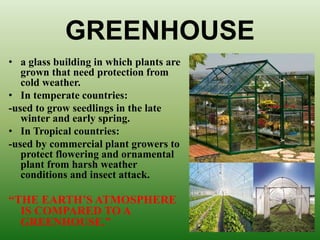
GREENHOUSE
• a glass building in which plants are
grown that need protection from
cold weather.
• In temperate countries:
-used to grow seedlings in the late
winter and early spring.
• In Tropical countries:
-used by commercial plant growers to
protect flowering and ornamental
plant from harsh weather
conditions and insect attack.
“THE EARTH’S ATMOSPHERE
IS COMPARED TO A
GREENHOUSE.”
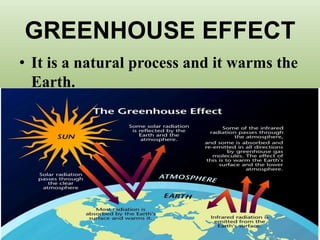
GREENHOUSE EFFECT
• It is a natural process and it warms the
Earth.
SOURCES OF GREENHOUSE
GASES
1. CARBON DIOXIDE
• Naturally produced when people and animals
breathe.
• Comes from the burning of fossil fuel, solid waste,
trees and wood products
• Releases when cutting down and burning trees
• a result of certain chemical reactions
2. NITROUS OXIDE
• emitted during agricultural and industrial
activities, as well as during combustion of fossil
fuels and solid waste.
SOURCES OF GREENHOUSE
GASES
3. METHANE
• Comes from grazing animals as they digest their
food and from decaying matter in wet rice fields.
• Can also be released from buried waste
• Coal mining also produces methane
4. OZONE
• Naturally present in the stratosphere.
SOURCES OF GREENHOUSE
GASES
5. CHLOROFLUOROCARBONS (CFC)
• Have been used in spray cans as propellants, in
refrigerators as refrigerants, and in making
foam plastics as foaming agents.
• It become dangerous when released into the
atmosphere, depleting the ozone layer.
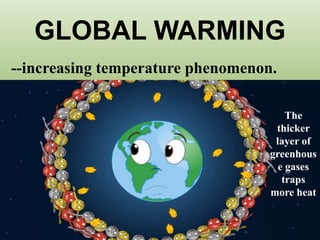
GLOBAL WARMING
--increasing temperature phenomenon.
The
thicker
layer of
greenhous
e gases
traps
more heat
GLOBAL WARMING
It is already
changing climates
around the globe
causing stronger
typhoons, and
creating many
health-related
problems
STEPS TO REDUCE
GLOBAL WARMING
1. Plant more trees
2. Reduce, reuse, recycle
3. Use less hot water
4. Turn off electronic
devices when not in use
5. Spread awareness
Greenhouse effect and global warming

Greenhouse effect and global warming

  • 1.
  • 2.
    GREENHOUSE • a glassbuilding in which plants are grown that need protection from cold weather. • In temperate countries: -used to grow seedlings in the late winter and early spring. • In Tropical countries: -used by commercial plant growers to protect flowering and ornamental plant from harsh weather conditions and insect attack. “THE EARTH’S ATMOSPHERE IS COMPARED TO A GREENHOUSE.”
  • 3.
    GREENHOUSE EFFECT • Itis a natural process and it warms the Earth.
  • 4.
    SOURCES OF GREENHOUSE GASES 1.CARBON DIOXIDE • Naturally produced when people and animals breathe. • Comes from the burning of fossil fuel, solid waste, trees and wood products • Releases when cutting down and burning trees • a result of certain chemical reactions 2. NITROUS OXIDE • emitted during agricultural and industrial activities, as well as during combustion of fossil fuels and solid waste.
  • 5.
    SOURCES OF GREENHOUSE GASES 3.METHANE • Comes from grazing animals as they digest their food and from decaying matter in wet rice fields. • Can also be released from buried waste • Coal mining also produces methane 4. OZONE • Naturally present in the stratosphere.
  • 6.
    SOURCES OF GREENHOUSE GASES 5.CHLOROFLUOROCARBONS (CFC) • Have been used in spray cans as propellants, in refrigerators as refrigerants, and in making foam plastics as foaming agents. • It become dangerous when released into the atmosphere, depleting the ozone layer.
  • 7.
    GLOBAL WARMING --increasing temperaturephenomenon. The thicker layer of greenhous e gases traps more heat
  • 8.
    GLOBAL WARMING It isalready changing climates around the globe causing stronger typhoons, and creating many health-related problems STEPS TO REDUCE GLOBAL WARMING 1. Plant more trees 2. Reduce, reuse, recycle 3. Use less hot water 4. Turn off electronic devices when not in use 5. Spread awareness