


MINDANAO STATE UNIVERSITY-MAGUINDANAO
GRADUATE SCHOOL
Tamontaka, Datu Odin Sinsuat, Maguindanao
SCIENCE EDUCATION 228
(Environmental Education)
2nd
Semester, S.Y. 2013-2014
GLOBAL WARMING
Presented by:
SALLY C. LAURENTE
MSCIEED Math – Istudent
DR. ROSEMARIE D.R. JOSUEDR. ROSEMARIE D.R. JOSUE
Visiting Professor
Global warming is the unusually
rapid increase in Earth’s average
temperature over the past century
due to the greenhouse gases
released as people burn fossil fuels.
What Is Global
Warming?
 To understand Global Warming, it’s
first necessary to become familiar with the
greenhouse effect.
 Earth’s natural greenhouse effect
makes life as we know it possible.
 A layer of greenhouse gases act as a
thermal blanket for the Earth, absorbing
heat and warming the surface to life
supporting average of 59 degrees
Fahrenheit (15 degrees Celsius).
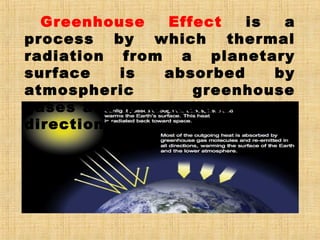
Greenhouse Effect is a
process by which thermal
radiation from a planetary
surface is absorbed by
atmospheric greenhouse
gases and is re-radiated in all
directions.

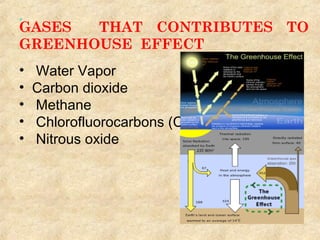
GASES THAT CONTRIBUTES TO
GREENHOUSE EFFECT
• Water Vapor
• Carbon dioxide
• Methane
• Chlorofluorocarbons (CFCs)
• Nitrous oxide
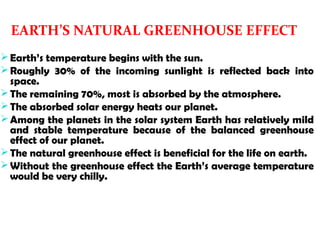
EARTH’S NATURAL GREENHOUSE EFFECT
Earth’s temperature begins with the sun.
Roughly 30% of the incoming sunlight is reflected back into
space.
The remaining 70%, most is absorbed by the atmosphere.
The absorbed solar energy heats our planet.
Among the planets in the solar system Earth has relatively mild
and stable temperature because of the balanced greenhouse
effect of our planet.
The natural greenhouse effect is beneficial for the life on earth.
Without the greenhouse effect the Earth’s average temperature
would be very chilly.
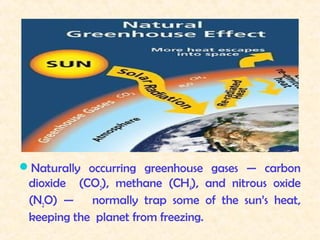
Naturally occurring greenhouse gases — carbon
dioxide (CO2), methane (CH4), and nitrous oxide
(N2O) — normally trap some of the sun’s heat,
keeping the planet from freezing.
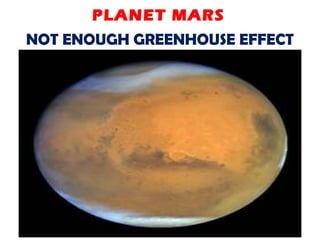
NOT ENOUGH GREENHOUSE EFFECT
The planet Mars has a very thin
atmosphere, nearly all carbon dioxide.
Because of the low atmospheric
pressure, and with little to no methane
or water vapor to reinforce the weak
greenhouse effect, Mars has a largely
frozen surface that shows no evidence
of life.
PLANET MARS
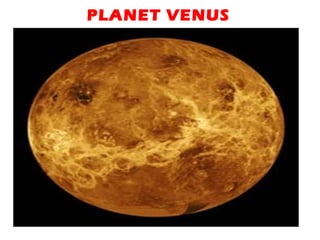
TOO MUCH GREENHOUSE EFFECT
The atmosphere of Venus, like
Mars, is nearly all carbon dioxide. But
Venus has about 300 times as much
carbon dioxide in its atmosphere as
Earth and Mars do, producing a
runaway greenhouse effect and a
surface temperature hot enough to
melt lead.
PLANET VENUS
HUMAN ACTIVITY THAT ENHANCED THE
GREENHOUSE EFFECT WHICH RESULTED TO
GLOBAL WARMING
Deforestation
 Land use change
Burning of fossil fuels
Decomposition of waste in the
landfills
Rice cultivation
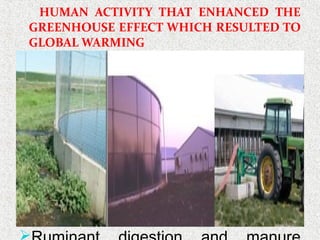
HUMAN ACTIVITY THAT ENHANCED THE
GREENHOUSE EFFECT WHICH RESULTED TO
GLOBAL WARMING
Use of commercial fertilizers
Fossil fuel combustion
Nitric acid production
Biomass burning
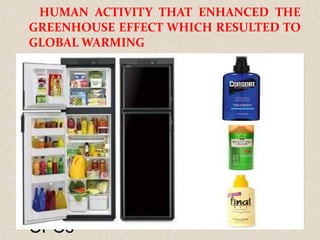
Use of synthetic compound like
CFCs
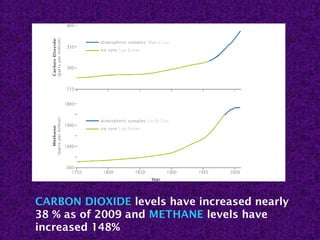
CARBON DIOXIDE levels have increased nearly
38 % as of 2009 and METHANE levels have
increased 148%
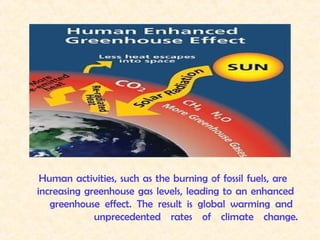
Human activities, such as the burning of fossil fuels, are
increasing greenhouse gas levels, leading to an enhanced
greenhouse effect. The result is global warming and
unprecedented rates of climate change.
GLOBAL WARMING AND CLIMATE
CHANGE
The atmosphere today contains more
greenhouse
gas molecules, so more of the infrared energy
emitted by the surface ends up being absorbed
by
the atmosphere. Since some of the extra energy
from a warmer atmosphere radiates back down
to the surface, Earth’s surface temperature
rises.
It's reasonable to assume that changes in
But several lines of evidence show that
current global warming cannot be explained
by changes in energy from the sun:
 Since 1750, the average amount of energy coming
from the Sun either remained constant or increased
slightly.
 If the warming were caused by a more active sun, then
scientists would expect to see warmer temperatures in
all layers of the atmosphere. Instead, they have
observed a cooling in the upper atmosphere, and a
warming at the surface and in the lower parts of the
atmosphere. That's because greenhouse gasses are
trapping heat in the lower atmosphere.
Most climate scientists agree the main
cause of the
current global warming trend is human
expansion of
the "greenhouse effect“  -- warming that
results
when the atmosphere traps heat
radiating from
Earth toward space.
If global warming continues unchecked,
it will cause
significant CLIMATE CHANGE, a rise
in sea levels,
increasing ocean acidification, extreme
weather
events and other severe natural and
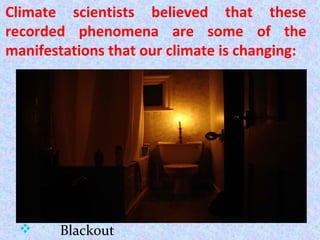
Climate scientists believed that these
recorded phenomena are some of the
manifestations that our climate is changing:
 Dry field
 Glaciers tore itself off
 Landslide
 Massive dust storms
 Toxic algae pollute drinking supply
lake
 Wild fire
 Blackout
CLIMATE CHANGE IN THE PHILIPPINES
The Philippines is extremely vulnerable to the
effects of climate change for two main reasons:
GEOGRAPHY and DEVELOPMENT.
A recent United Nations report identified the
country as the third-most at-risk from climate
change in the world, ranked behind the South
Pacific island nations of Vanuatu and Tonga.
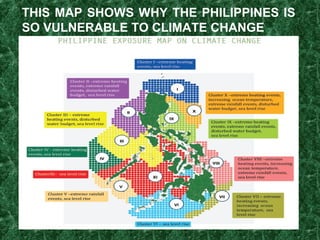
THIS MAP SHOWS WHY THE PHILIPPINES IS
SO VULNERABLE TO CLIMATE CHANGE
THE FIVE DIFFERENT RISK
FACTORS  THE MAP
IDENTIFIES: 
 Rise in sea levels
 Extreme rainfall events
 Extreme heating events
 Increased ocean temperatures
 A disturbed water budget
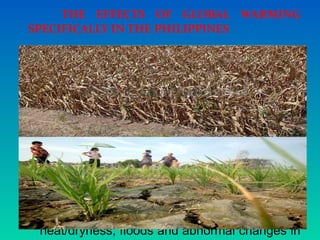
THE EFFECTS OF GLOBAL WARMING
SPECIFICALLY IN THE PHILIPPINES
 CLIMATE AND WEATHER - extreme heat
during
summer and colder during -ber months,
untimely and
stronger typhoons.
 SEA LEVEL RISE - the Philippines have the
risk of being
sunk.
 AGRICULTURE - plants/crops will die due to
extreme
heat/dryness, floods and abnormal changes in
THE EFFECTS OF GLOBAL WARMING
SPECIFICALLY IN THE PHILIPPINES
 BIODIVERSITY - some animals are in
danger of extinction or they migrate to other
places, again, abnormal
weather (some say global warming could
produce new
evolved species).
 HUMAN HEALTH - Filipinos are used to
warm weather so they are very sensitive to
decreasing temperatures. They catch colds
easily. There's also the threat of Dengue
WAYS TO HELP FIGHT CLIMATE
CHANGE
 Green your commute
 Be energy efficient
 Eat wisely
 Trim your waste
 Plant trees and protest deforestation
 Fly less
 Conserved water
 Get involved
 Encourage others
Global Warming

Global Warming

  • 1.
    MINDANAO STATE UNIVERSITY-MAGUINDANAO GRADUATESCHOOL Tamontaka, Datu Odin Sinsuat, Maguindanao SCIENCE EDUCATION 228 (Environmental Education) 2nd Semester, S.Y. 2013-2014 GLOBAL WARMING Presented by: SALLY C. LAURENTE MSCIEED Math – Istudent DR. ROSEMARIE D.R. JOSUEDR. ROSEMARIE D.R. JOSUE Visiting Professor
  • 2.
    Global warming isthe unusually rapid increase in Earth’s average temperature over the past century due to the greenhouse gases released as people burn fossil fuels. What Is Global Warming?
  • 4.
     To understandGlobal Warming, it’s first necessary to become familiar with the greenhouse effect.  Earth’s natural greenhouse effect makes life as we know it possible.  A layer of greenhouse gases act as a thermal blanket for the Earth, absorbing heat and warming the surface to life supporting average of 59 degrees Fahrenheit (15 degrees Celsius).
  • 5.
    Greenhouse Effect isa process by which thermal radiation from a planetary surface is absorbed by atmospheric greenhouse gases and is re-radiated in all directions.
  • 6.
     GASES THAT CONTRIBUTESTO GREENHOUSE EFFECT • Water Vapor • Carbon dioxide • Methane • Chlorofluorocarbons (CFCs) • Nitrous oxide
  • 7.
    EARTH’S NATURAL GREENHOUSEEFFECT Earth’s temperature begins with the sun. Roughly 30% of the incoming sunlight is reflected back into space. The remaining 70%, most is absorbed by the atmosphere. The absorbed solar energy heats our planet. Among the planets in the solar system Earth has relatively mild and stable temperature because of the balanced greenhouse effect of our planet. The natural greenhouse effect is beneficial for the life on earth. Without the greenhouse effect the Earth’s average temperature would be very chilly.
  • 8.
    Naturally occurring greenhousegases — carbon dioxide (CO2), methane (CH4), and nitrous oxide (N2O) — normally trap some of the sun’s heat, keeping the planet from freezing.
  • 9.
    NOT ENOUGH GREENHOUSEEFFECT The planet Mars has a very thin atmosphere, nearly all carbon dioxide. Because of the low atmospheric pressure, and with little to no methane or water vapor to reinforce the weak greenhouse effect, Mars has a largely frozen surface that shows no evidence of life. PLANET MARS
  • 10.
    TOO MUCH GREENHOUSEEFFECT The atmosphere of Venus, like Mars, is nearly all carbon dioxide. But Venus has about 300 times as much carbon dioxide in its atmosphere as Earth and Mars do, producing a runaway greenhouse effect and a surface temperature hot enough to melt lead. PLANET VENUS
  • 11.
    HUMAN ACTIVITY THATENHANCED THE GREENHOUSE EFFECT WHICH RESULTED TO GLOBAL WARMING Deforestation  Land use change Burning of fossil fuels Decomposition of waste in the landfills Rice cultivation
  • 12.
    HUMAN ACTIVITY THATENHANCED THE GREENHOUSE EFFECT WHICH RESULTED TO GLOBAL WARMING Use of commercial fertilizers Fossil fuel combustion Nitric acid production Biomass burning Use of synthetic compound like CFCs
  • 13.
    CARBON DIOXIDE levelshave increased nearly 38 % as of 2009 and METHANE levels have increased 148%
  • 14.
    Human activities, suchas the burning of fossil fuels, are increasing greenhouse gas levels, leading to an enhanced greenhouse effect. The result is global warming and unprecedented rates of climate change.
  • 15.
    GLOBAL WARMING ANDCLIMATE CHANGE The atmosphere today contains more greenhouse gas molecules, so more of the infrared energy emitted by the surface ends up being absorbed by the atmosphere. Since some of the extra energy from a warmer atmosphere radiates back down to the surface, Earth’s surface temperature rises. It's reasonable to assume that changes in
  • 16.
    But several linesof evidence show that current global warming cannot be explained by changes in energy from the sun:  Since 1750, the average amount of energy coming from the Sun either remained constant or increased slightly.  If the warming were caused by a more active sun, then scientists would expect to see warmer temperatures in all layers of the atmosphere. Instead, they have observed a cooling in the upper atmosphere, and a warming at the surface and in the lower parts of the atmosphere. That's because greenhouse gasses are trapping heat in the lower atmosphere.
  • 17.
    Most climate scientistsagree the main cause of the current global warming trend is human expansion of the "greenhouse effect“  -- warming that results when the atmosphere traps heat radiating from Earth toward space. If global warming continues unchecked, it will cause significant CLIMATE CHANGE, a rise in sea levels, increasing ocean acidification, extreme weather events and other severe natural and
  • 18.
    Climate scientists believedthat these recorded phenomena are some of the manifestations that our climate is changing:  Dry field  Glaciers tore itself off  Landslide  Massive dust storms  Toxic algae pollute drinking supply lake  Wild fire  Blackout
  • 19.
    CLIMATE CHANGE INTHE PHILIPPINES The Philippines is extremely vulnerable to the effects of climate change for two main reasons: GEOGRAPHY and DEVELOPMENT. A recent United Nations report identified the country as the third-most at-risk from climate change in the world, ranked behind the South Pacific island nations of Vanuatu and Tonga.
  • 20.
    THIS MAP SHOWSWHY THE PHILIPPINES IS SO VULNERABLE TO CLIMATE CHANGE
  • 21.
    THE FIVE DIFFERENT RISK FACTORS THE MAP IDENTIFIES:   Rise in sea levels  Extreme rainfall events  Extreme heating events  Increased ocean temperatures  A disturbed water budget
  • 22.
    THE EFFECTS OFGLOBAL WARMING SPECIFICALLY IN THE PHILIPPINES  CLIMATE AND WEATHER - extreme heat during summer and colder during -ber months, untimely and stronger typhoons.  SEA LEVEL RISE - the Philippines have the risk of being sunk.  AGRICULTURE - plants/crops will die due to extreme heat/dryness, floods and abnormal changes in
  • 23.
    THE EFFECTS OFGLOBAL WARMING SPECIFICALLY IN THE PHILIPPINES  BIODIVERSITY - some animals are in danger of extinction or they migrate to other places, again, abnormal weather (some say global warming could produce new evolved species).  HUMAN HEALTH - Filipinos are used to warm weather so they are very sensitive to decreasing temperatures. They catch colds easily. There's also the threat of Dengue
  • 24.
    WAYS TO HELPFIGHT CLIMATE CHANGE  Green your commute  Be energy efficient  Eat wisely  Trim your waste  Plant trees and protest deforestation  Fly less  Conserved water  Get involved  Encourage others