Habip TÜREYEN
SECTION 2
Tarık YÜTÜK
HACETTEPE UNIVERSITY
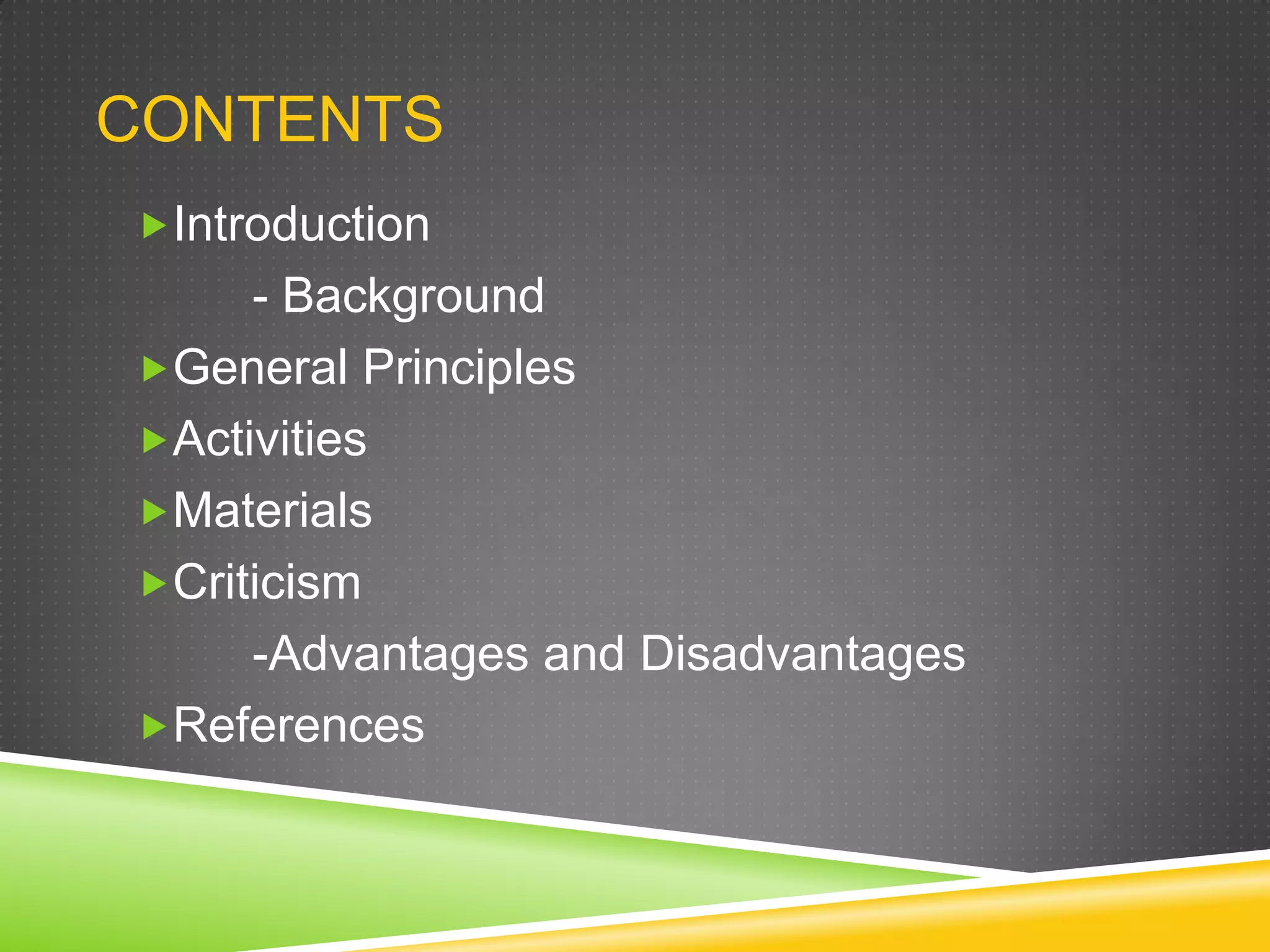
CONTENTS
Introduction

- Background
General Principles
Activities
Materials
Criticism
-Advantages and Disadvantages
References
BACKGROUND
The Communicative Approach emerged

in the early 1970s as a result of the work
of the Council of Europe experts.
A group of experts saw the need to focus

in communicative proficiency rather than
mastery of structures.
D.A. Wilkins (1972) proposed a functional or

communicative definition of language that
served as a basis for developing communicative
syllabuses for language teaching.
Wilkins's contribution was an analysis of the

communicative meanings that a language
learner needs to understand and express,
rather than describe the core of language
through traditional concepts of grammar and
vocabulary.
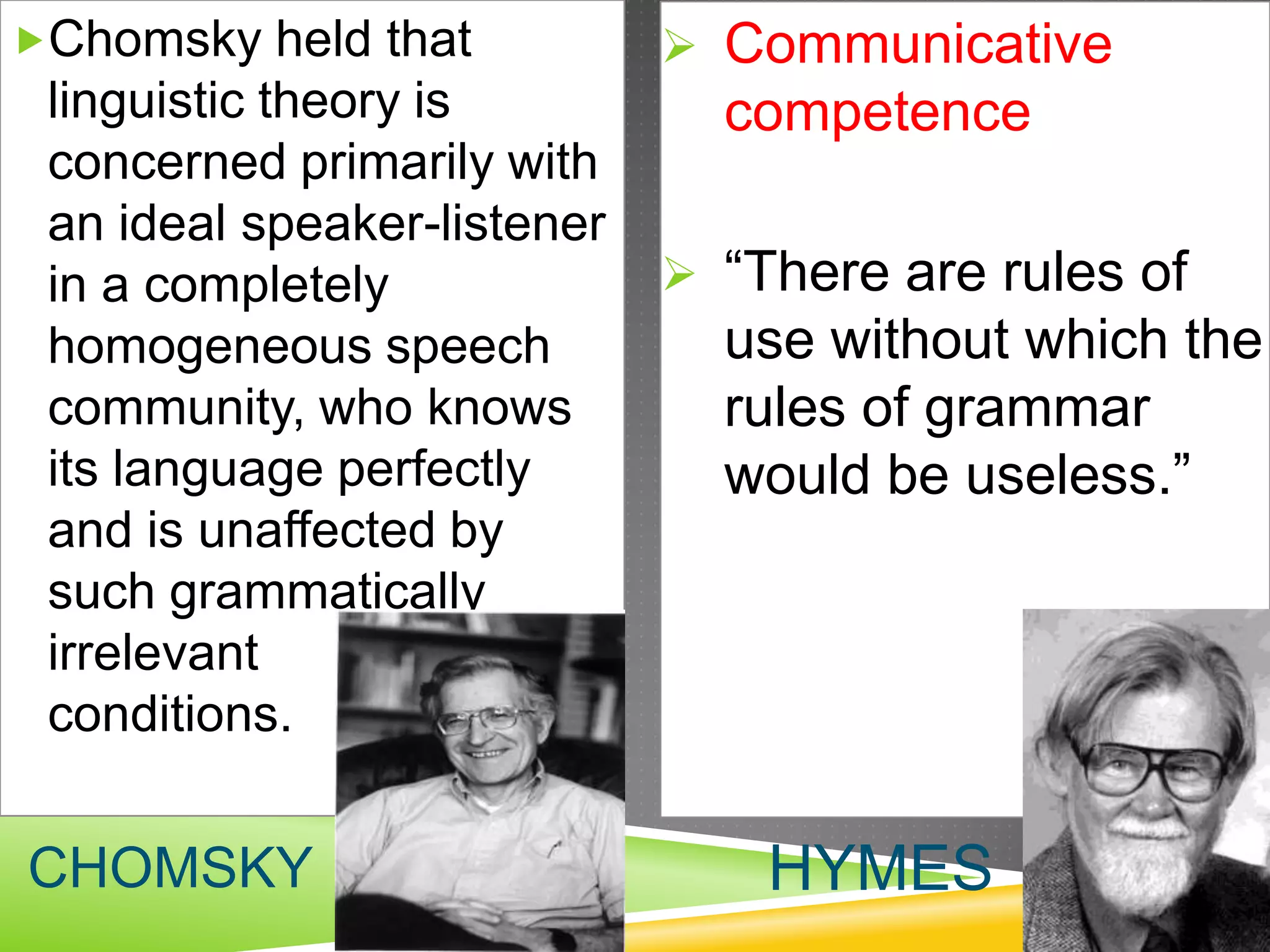
Chomsky held that

linguistic theory is
concerned primarily with
an ideal speaker-listener
in a completely
homogeneous speech
community, who knows
its language perfectly
and is unaffected by
such grammatically
irrelevant
conditions.

CHOMSKY

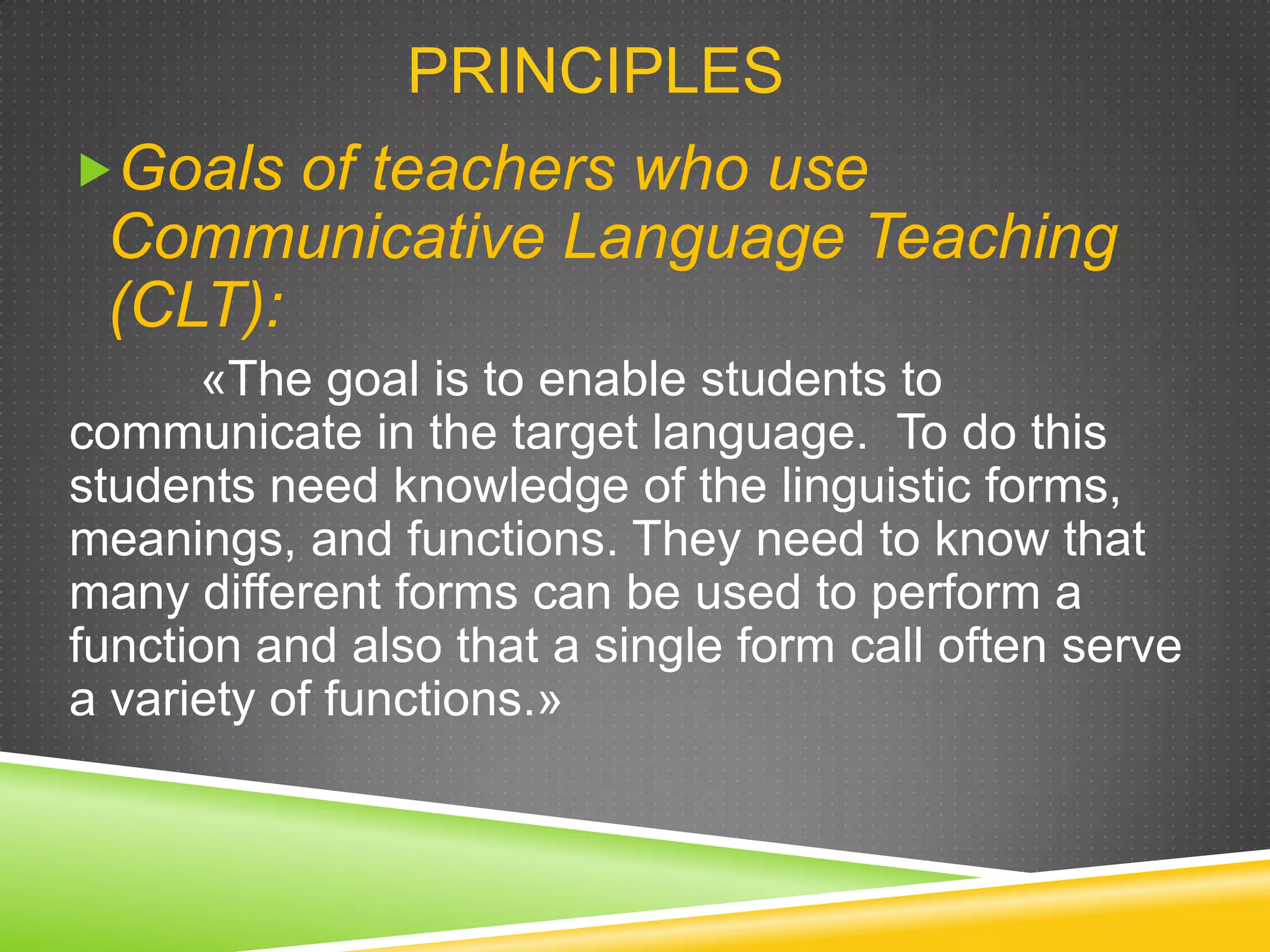
 Communicative

competence
 “There are rules of

use without which the
rules of grammar
would be useless.”

HYMES
PRINCIPLES
Goals of teachers who use

Communicative Language Teaching
(CLT):
«The goal is to enable students to
communicate in the target language. To do this
students need knowledge of the linguistic forms,
meanings, and functions. They need to know that
many different forms can be used to perform a
function and also that a single form call often serve
a variety of functions.»
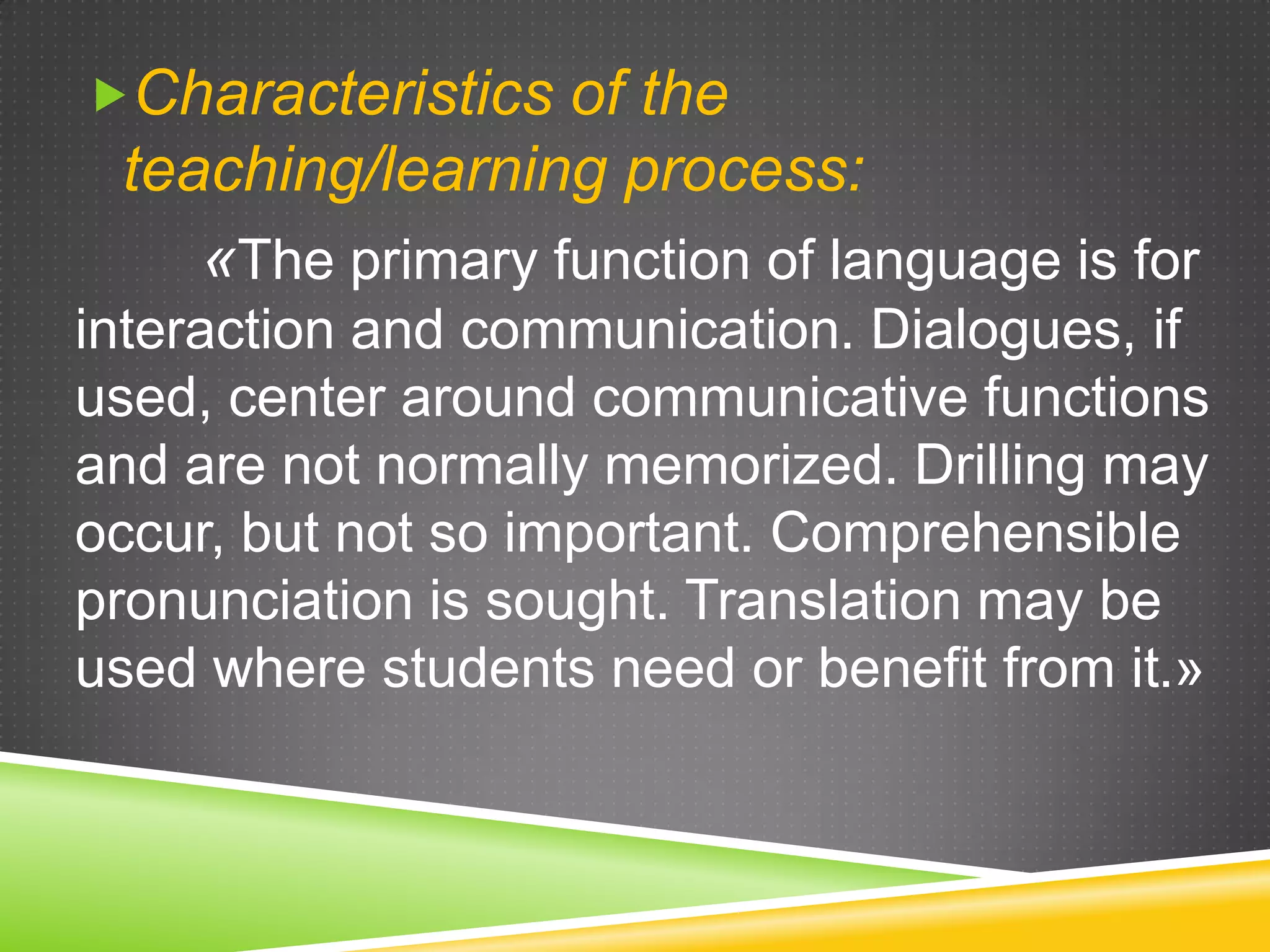
Role of the participants:
«The teacher facilitates the communication in
the classroom, and he also acts like an adviser and a
guide.
Students are communicators. They are actively
engage in trying to make themselves understood and
in understanding others.»
Characteristics of the

teaching/learning process:
«The primary function of language is for
interaction and communication. Dialogues, if
used, center around communicative functions
and are not normally memorized. Drilling may
occur, but not so important. Comprehensible
pronunciation is sought. Translation may be
used where students need or benefit from it.»


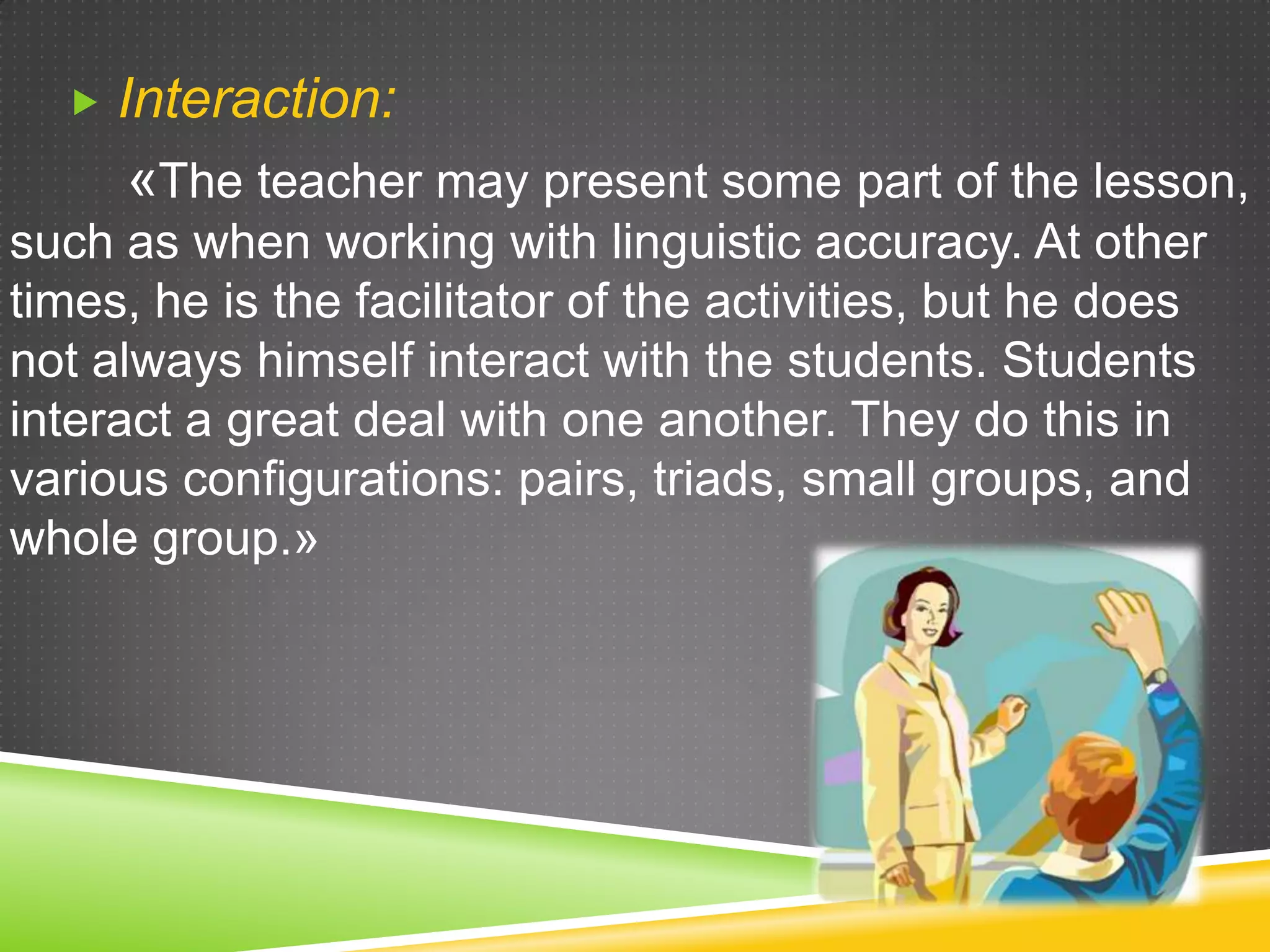
Interaction:
«The teacher may present some part of the lesson,

such as when working with linguistic accuracy. At other
times, he is the facilitator of the activities, but he does
not always himself interact with the students. Students
interact a great deal with one another. They do this in
various configurations: pairs, triads, small groups, and
whole group.»
 Students’ feelings:
«Students are given an opportunity to express their
individuality by having them share their ideas and
opinions on a regular basis.»

 Viewing the language:
«Language is for communication. Linguistic
competence, the knowledge of forms and their meanings,
is just one part of communicative competence. So,
learners need knowledge of forms and meanings and
functions.»
Emphasized language skills:

«Students work on all four skills from the
beginning. Just as oral communication is seen to
take place through negotiation between speaker and
listener, so too is meaning thought to be derived from
the written word through an interaction between the
reader and the writer.»
Students’ native language:

«Students’ native language is permitted in CLT.
However, whenever possible, the target language
should be used not only during communicative
activities, but also for explaining the activities to the
students or in assigning homework.»
Teacher’s response to errors:

«Errors of form are tolerated during fluencybased activities and are seen as a natural outcome
of the development of communication skills.»
 Evaluation:

«A teacher evaluates not only the
students’ accuracy, but also their fluency. He
can informally evaluate his students’
performance in his role as an adviser or cocommunicator.
ACTIVITIES
 Scrambled sentences

- The students are given a passage(a text ) in which
the sentences are in a scrambled order
 Language Games
- Games are used frequently in CLT. The students find them
enjoyable, and if they are properly designed, they give
students valuable communicative practice.
 Picture Strip Story
 Role Play
- Role plays are very important in CLT because they give
students an opportunity to practice communicating in
different social contexts and in different social roles.
 Newspaper, radio and television broadcast,

menus, weather forecast, timetables
 Realia
 Wh- questions (Why, What, When, Where, Who)
 Simulations
CRITICISM
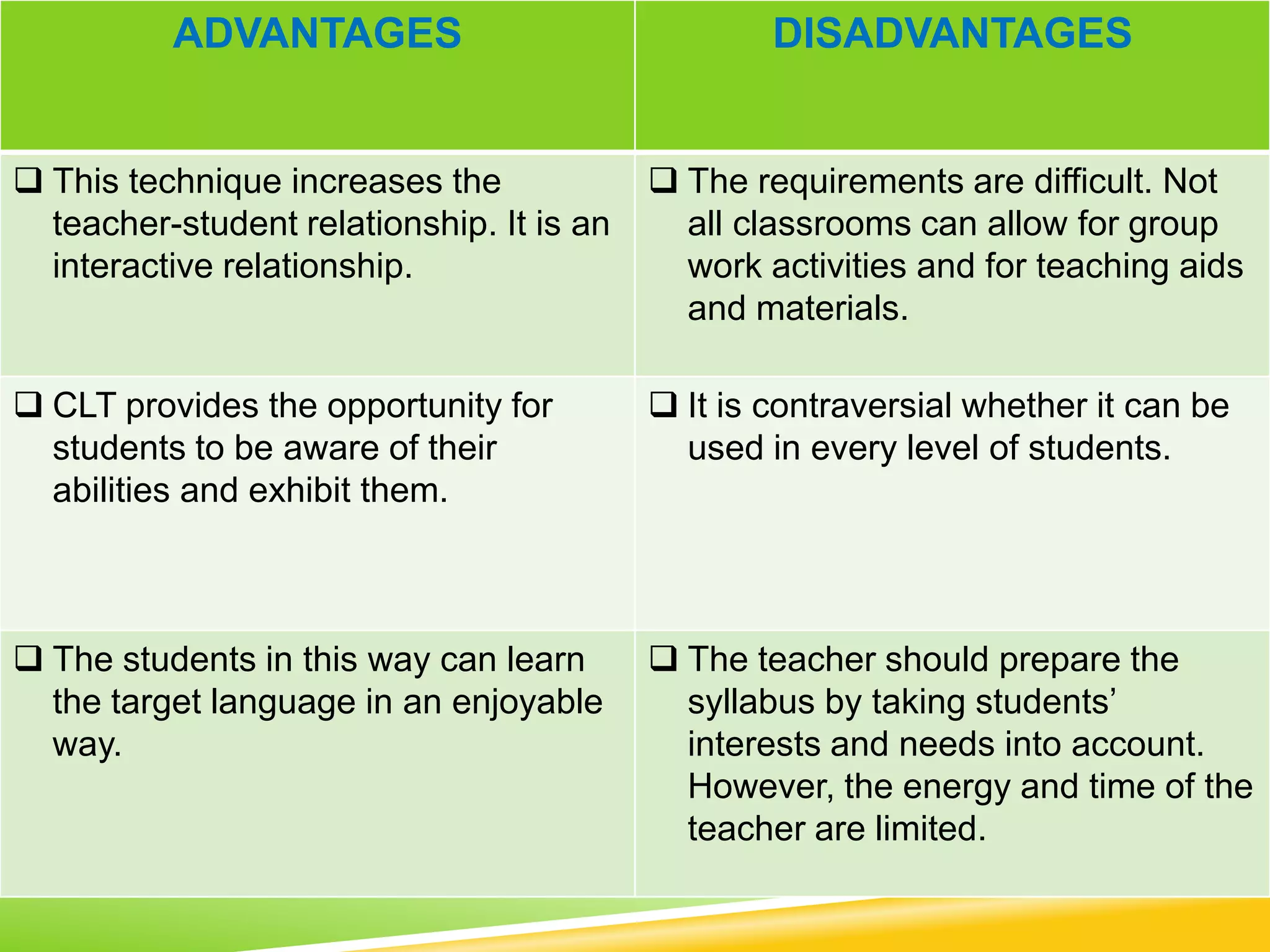
ADVANTAGES

DISADVANTAGES

 This technique increases the
teacher-student relationship. It is an
interactive relationship.

 The requirements are difficult. Not
all classrooms can allow for group
work activities and for teaching aids
and materials.

 CLT provides the opportunity for
students to be aware of their
abilities and exhibit them.

 It is contraversial whether it can be
used in every level of students.

 The students in this way can learn
the target language in an enjoyable
way.

 The teacher should prepare the
syllabus by taking students’
interests and needs into account.
However, the energy and time of the
teacher are limited.
REFERENCES
 Larsen-Freeman, D. (2000). Techniques and Principles in

Language Teaching. (second ed.). Oxford University Press.
 http://www.gebzekoleji.k12.tr/sunumlar/%C4%B0ngilizce%2

0E%C4%9Fitiminde%20%C4%B0leti%C5%9Fimsel%20Ya
kla%C5%9F%C4%B1m.ppt ACCESS DATE:12.11.2013 –
09:47
 http://en.wikipedia.org/wiki/Communicative_language_teach

ing ACCESS DATE: 12.11.2013 – 09:40
 http://www.slideshare.net/Patrmartin/clt-

14685674?from_search=3 ACCESS DATE: 13.11.2013 –
10.06
REFERENCES
 Larsen-Freeman, D. (2000). Techniques and Principles in

Language Teaching. (second ed.). Oxford University Press.
 http://en.wikipedia.org/wiki/Communicative_language_teaching

access date: 29.11.2013 – 19:40
 http://www.gebzekoleji.k12.tr/sunumlar/%C4%B0ngilizce%20E%C

4%9Fitiminde%20%C4%B0leti%C5%9Fimsel%20Yakla%C5%9F
%C4%B1m.ppt access date: 29.11.2013 – 18:57
 http://www.slideshare.net/sherzadjana/richards-

communicativelanguage-20699739 access date: 29.11.2013 –
18:33

COMMUNICATIVE LANGUAGE TEACHING

  • 1.
    Habip TÜREYEN SECTION 2 TarıkYÜTÜK HACETTEPE UNIVERSITY
  • 2.
  • 3.
    BACKGROUND The Communicative Approachemerged in the early 1970s as a result of the work of the Council of Europe experts. A group of experts saw the need to focus in communicative proficiency rather than mastery of structures.
  • 4.
    D.A. Wilkins (1972)proposed a functional or communicative definition of language that served as a basis for developing communicative syllabuses for language teaching. Wilkins's contribution was an analysis of the communicative meanings that a language learner needs to understand and express, rather than describe the core of language through traditional concepts of grammar and vocabulary.
  • 5.
    Chomsky held that linguistictheory is concerned primarily with an ideal speaker-listener in a completely homogeneous speech community, who knows its language perfectly and is unaffected by such grammatically irrelevant conditions. CHOMSKY  Communicative competence  “There are rules of use without which the rules of grammar would be useless.” HYMES
  • 6.
    PRINCIPLES Goals of teacherswho use Communicative Language Teaching (CLT): «The goal is to enable students to communicate in the target language. To do this students need knowledge of the linguistic forms, meanings, and functions. They need to know that many different forms can be used to perform a function and also that a single form call often serve a variety of functions.»
  • 7.
    Role of theparticipants: «The teacher facilitates the communication in the classroom, and he also acts like an adviser and a guide. Students are communicators. They are actively engage in trying to make themselves understood and in understanding others.»
  • 8.
    Characteristics of the teaching/learningprocess: «The primary function of language is for interaction and communication. Dialogues, if used, center around communicative functions and are not normally memorized. Drilling may occur, but not so important. Comprehensible pronunciation is sought. Translation may be used where students need or benefit from it.»
  • 9.
     Interaction: «The teacher maypresent some part of the lesson, such as when working with linguistic accuracy. At other times, he is the facilitator of the activities, but he does not always himself interact with the students. Students interact a great deal with one another. They do this in various configurations: pairs, triads, small groups, and whole group.»
  • 10.
     Students’ feelings: «Studentsare given an opportunity to express their individuality by having them share their ideas and opinions on a regular basis.»  Viewing the language: «Language is for communication. Linguistic competence, the knowledge of forms and their meanings, is just one part of communicative competence. So, learners need knowledge of forms and meanings and functions.»
  • 11.
    Emphasized language skills: «Studentswork on all four skills from the beginning. Just as oral communication is seen to take place through negotiation between speaker and listener, so too is meaning thought to be derived from the written word through an interaction between the reader and the writer.»
  • 12.
    Students’ native language: «Students’native language is permitted in CLT. However, whenever possible, the target language should be used not only during communicative activities, but also for explaining the activities to the students or in assigning homework.» Teacher’s response to errors: «Errors of form are tolerated during fluencybased activities and are seen as a natural outcome of the development of communication skills.»
  • 13.
     Evaluation: «A teacherevaluates not only the students’ accuracy, but also their fluency. He can informally evaluate his students’ performance in his role as an adviser or cocommunicator.
  • 14.
    ACTIVITIES  Scrambled sentences -The students are given a passage(a text ) in which the sentences are in a scrambled order  Language Games - Games are used frequently in CLT. The students find them enjoyable, and if they are properly designed, they give students valuable communicative practice.  Picture Strip Story  Role Play - Role plays are very important in CLT because they give students an opportunity to practice communicating in different social contexts and in different social roles.
  • 15.
     Newspaper, radioand television broadcast, menus, weather forecast, timetables  Realia  Wh- questions (Why, What, When, Where, Who)  Simulations
  • 16.
  • 17.
    ADVANTAGES DISADVANTAGES  This techniqueincreases the teacher-student relationship. It is an interactive relationship.  The requirements are difficult. Not all classrooms can allow for group work activities and for teaching aids and materials.  CLT provides the opportunity for students to be aware of their abilities and exhibit them.  It is contraversial whether it can be used in every level of students.  The students in this way can learn the target language in an enjoyable way.  The teacher should prepare the syllabus by taking students’ interests and needs into account. However, the energy and time of the teacher are limited.
  • 18.
    REFERENCES  Larsen-Freeman, D.(2000). Techniques and Principles in Language Teaching. (second ed.). Oxford University Press.  http://www.gebzekoleji.k12.tr/sunumlar/%C4%B0ngilizce%2 0E%C4%9Fitiminde%20%C4%B0leti%C5%9Fimsel%20Ya kla%C5%9F%C4%B1m.ppt ACCESS DATE:12.11.2013 – 09:47  http://en.wikipedia.org/wiki/Communicative_language_teach ing ACCESS DATE: 12.11.2013 – 09:40  http://www.slideshare.net/Patrmartin/clt- 14685674?from_search=3 ACCESS DATE: 13.11.2013 – 10.06
  • 19.
    REFERENCES  Larsen-Freeman, D.(2000). Techniques and Principles in Language Teaching. (second ed.). Oxford University Press.  http://en.wikipedia.org/wiki/Communicative_language_teaching access date: 29.11.2013 – 19:40  http://www.gebzekoleji.k12.tr/sunumlar/%C4%B0ngilizce%20E%C 4%9Fitiminde%20%C4%B0leti%C5%9Fimsel%20Yakla%C5%9F %C4%B1m.ppt access date: 29.11.2013 – 18:57  http://www.slideshare.net/sherzadjana/richards- communicativelanguage-20699739 access date: 29.11.2013 – 18:33