SUGGESTOPEDI
A
Bulgarian Educator and Psychologist
Georgi Lozanov
Origin
 “Suggestion” and “Pedagogy”
- a set of learning recommendations derived from
suggestology.
 It was originally developed in the 1970’s
 Drew from Soviet psychological research and yoga.
- Draws the importance of relaxation of mind for
maximum retention of material
- “all students can be taught a given subject matter at
the same level of skill’ Jack c. Richards
In the classroom
 Extended dialogues, often several pages in
length, accompanied by vocabulary lists and
observations on grammatical points. Typically these
dialogues would be read aloud to the students to the
accompaniment of music.
 The most formal of these readings, known as the
“concert reading” . This could be a pleasurable
event, with the learners free to focus on the music, the
text or both. The rhythm and intonation of the
reading would be exaggerated in order to fit with the
rhythm of music.
 Less formal reading would employ a
lighter, less striking piece of music, such as a
piece of Baroque music and less prominent
role.
 During both types of reading the learners
would sit in a comfortable seats and
stimulating environment in terms of décor
and lightning.
 After reading the with the accompaniment of
music the teacher would then make use of the
dialogues for more conventional language
work
The most important characteristics of
this method are:
Decoration
Furniture
Arrangement of the
classroom
Authoritative behavior of
the teacher
The use of soft Baroque
music (this makes the
method unique)
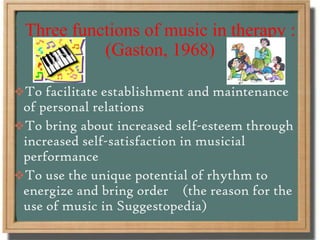
Three functions of music in therapy :
(Gaston, 1968)
To facilitate establishment and maintenance
of personal relations
To bring about increased self-esteem through
increased self-satisfaction in musicial
performance
To use the unique potential of rhythm to
energize and bring order (the reason for the
use of music in Suggestopedia)
Approach
Bancroft states that there are six
principle theoretical components of
Suggestopedia:
Authority
Infantilization
Double-planedness
Intonation, rhythm, and concert
pseudo-passiveness
Authority
 give control and authority to the
teacher completely
What makes a teacher authoritive?
 self-confidence
Personal distance
Acting ability
Possitive attitude
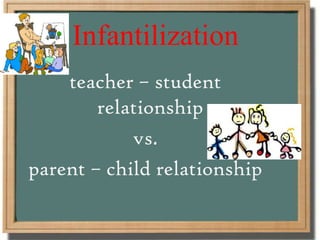
Infantilization
teacher – student
relationship
vs.
parent – child relationship
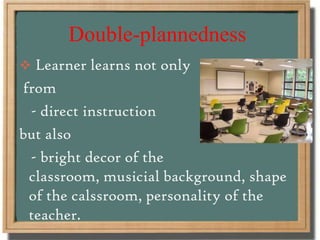
Double-plannedness
 Learner learns not only
from
- direct instruction
but also
- bright decor of the
classroom, musicial background, shape
of the calssroom, personality of the
teacher.
Intonation, Rhythm, Concert
Pseudo-Passiveness
Intonation plus Rhythm
coordinated with musicial
background
A relaxed attitude with the help of
musicial background : Concert
Pseudo-Passiveness
Design
Objectives
To deliver advanced conversational
competence quickly
To master prodigious lists of
vocabulary
Learning Activities
Question and answer
Role play
Listening exercises
Roles of Learners
 Pseudo-passiveness state
 Acting childishly
 Not to figure out
Not to manipulate
Not to study material
Roles Of Teachers
According to Lozanov, teachers
should give attention to
o Absolute confidence
o His/her manners and dress
o Organizing the lesson
(music choice, punctuality)
o Responding tactfully
o Modest enthusiasm
Role of Materials
Direct Supported Materials:
 Texts
 Tape
Indirect Supported Materials:
 Classroom fixtures
 Music
 Text books
 Learning environment
Criticisms
Disadvantages
 Hardness of finding colorful environment
 Negative effects of direct translation
 Concentration problems
Advantages
 Through Suggestopedia we learn to trust the power
of mind.
 We learn the deliberately included states of
relaxation
 The benefit from the use of music to get student sit
back and relax.
Conclusion
Learning is facilitated by environment
and music.
Teacher is the authority.
Psychological barriers are removed.
In texts target language and its native
language are given.

Suggestopedia

  • 1.
  • 2.
    Bulgarian Educator andPsychologist Georgi Lozanov
  • 3.
    Origin  “Suggestion” and“Pedagogy” - a set of learning recommendations derived from suggestology.  It was originally developed in the 1970’s  Drew from Soviet psychological research and yoga. - Draws the importance of relaxation of mind for maximum retention of material - “all students can be taught a given subject matter at the same level of skill’ Jack c. Richards
  • 4.
    In the classroom Extended dialogues, often several pages in length, accompanied by vocabulary lists and observations on grammatical points. Typically these dialogues would be read aloud to the students to the accompaniment of music.  The most formal of these readings, known as the “concert reading” . This could be a pleasurable event, with the learners free to focus on the music, the text or both. The rhythm and intonation of the reading would be exaggerated in order to fit with the rhythm of music.
  • 5.
     Less formalreading would employ a lighter, less striking piece of music, such as a piece of Baroque music and less prominent role.  During both types of reading the learners would sit in a comfortable seats and stimulating environment in terms of décor and lightning.  After reading the with the accompaniment of music the teacher would then make use of the dialogues for more conventional language work
  • 6.
    The most importantcharacteristics of this method are: Decoration Furniture Arrangement of the classroom Authoritative behavior of the teacher The use of soft Baroque music (this makes the method unique)
  • 7.
    Three functions ofmusic in therapy : (Gaston, 1968) To facilitate establishment and maintenance of personal relations To bring about increased self-esteem through increased self-satisfaction in musicial performance To use the unique potential of rhythm to energize and bring order (the reason for the use of music in Suggestopedia)
  • 8.
    Approach Bancroft states thatthere are six principle theoretical components of Suggestopedia: Authority Infantilization Double-planedness Intonation, rhythm, and concert pseudo-passiveness
  • 9.
    Authority  give controland authority to the teacher completely What makes a teacher authoritive?  self-confidence Personal distance Acting ability Possitive attitude
  • 10.
  • 11.
    Double-plannedness  Learner learnsnot only from - direct instruction but also - bright decor of the classroom, musicial background, shape of the calssroom, personality of the teacher.
  • 12.
    Intonation, Rhythm, Concert Pseudo-Passiveness Intonationplus Rhythm coordinated with musicial background A relaxed attitude with the help of musicial background : Concert Pseudo-Passiveness
  • 13.
    Design Objectives To deliver advancedconversational competence quickly To master prodigious lists of vocabulary
  • 14.
    Learning Activities Question andanswer Role play Listening exercises
  • 15.
    Roles of Learners Pseudo-passiveness state  Acting childishly  Not to figure out Not to manipulate Not to study material
  • 16.
    Roles Of Teachers Accordingto Lozanov, teachers should give attention to o Absolute confidence o His/her manners and dress o Organizing the lesson (music choice, punctuality) o Responding tactfully o Modest enthusiasm
  • 17.
    Role of Materials DirectSupported Materials:  Texts  Tape Indirect Supported Materials:  Classroom fixtures  Music  Text books  Learning environment
  • 18.
    Criticisms Disadvantages  Hardness offinding colorful environment  Negative effects of direct translation  Concentration problems Advantages  Through Suggestopedia we learn to trust the power of mind.  We learn the deliberately included states of relaxation  The benefit from the use of music to get student sit back and relax.
  • 19.
    Conclusion Learning is facilitatedby environment and music. Teacher is the authority. Psychological barriers are removed. In texts target language and its native language are given.