The Silent Way
Advanced Methodology For TESOL 2
Instructor : Dr. Hind Al-fadda
Prepared by : Taghreed Albalawi
‫بسم ا الرحمن الرحيم‬
Background

• The Silent Way, developed in the 1960s by
  Caleb Gattegno, is grounded in the belief that
  students should learn independently of the
  teacher. Gattegno proposed that students
  would learn better if they developed personal
  responsibility for their own learning. Thus, for
  much of the lesson, the teacher remains
  silent. Teaching is viewed as subordinate to
  learning.
Background

• Students are encouraged to work with one
  another to figure out meaning. Students are
  introduced to new material once through the
  use of Cuisenaire rods (small colored rods of
  varying lengths) and a series of wall charts.
  After the teacher introduces the material, it is
  up to the students to determine what they
  need to learn and independently work toward
  their academic goals.
Background

• Certain aspects of this approach, such as the
  use of Cuisenaire rods and developing student
  independence, continue to be used. However,
  this approach alone is rarely used because it is
  not practical within the class room, and
  students need and desire more teacher input.
Objective

 The objective of The Silent Way Method of
language teaching is for students to work as
      independent language learners.
Learning Hypotheses
• Learning is facilitated if the learner discovers
  or creates rather than remembers and repeats
  what is to be learned.
• Learning is facilitated by accompanying
  (mediating) physical objects.
• Learning is facilitated by problem solving
  involving the material to be learned.
Tell me and I forget ,

Teach me and I remember,

 Involve me and I learn.
Theory of Learning
• Gattegno makes extensive use of his
  understanding of first language learning
  processes as a basis for deriving principles for
  teaching foreign languages to adults.
  Gattegno recommends that the learner needs
  to "return to the state of mind that
  characterizes a baby's learning surrender"
Theory of Learning
• A successful learning involves commitment of
  the self to language acquisition through the
  use of silent awareness and then active trial.
• Silent Way learners acquire “inner criteria”.

• The Silent Way students are expected to
  become independent , responsible and
  autonomous .
Silent way principles
• The teacher should start with something the students already
  know and build from that to the unknown.
• Language learners are intelligent and bring with them the
  experience of already learning a language.
• Language is not learned by repeating after a model.
• Students should learn to rely on each other and themselves.
• Learning involves transferring what one knows to new
  contexts.
• Silence is a tool. It helps to foster autonomy, or the exercise
  of initiative. The teacher speaks, but only when necessary
Silent way principles
• Meaning is made clear by focusing students’ perceptions, not
  through translation.
• If the teacher praises (or criticizes) students, they will be less
  self-reliant.
• Errors are important and necessary to learning.
• At the beginning, the teacher needs to look for progress, not
  perfection. Learning takes place in time. Students learn at
  different rates.
• Students learn they must give the teacher their attention in
  order not to miss what he says. Student attention is a key to
  learning.
Silent way principles
• Students should engage in a great deal of meaningful practice
  without repetition.
• Language is for self-expression.
• The teacher can gain valuable information from student
  feedback.
• The syllabus is composed of linguistic structures.
• The structures of the syllabus are not arranged in a linear
  fashion, but rather are constantly being recycled.
• The skills of speaking, reading, and writing reinforce one
  another.
Materials & Techniques
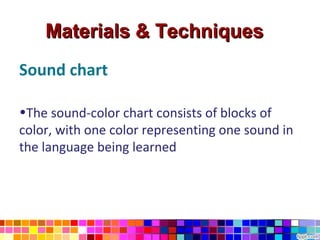
Sound chart

•The sound-color chart consists of blocks of
color, with one color representing one sound in
the language being learned
Materials & Techniques
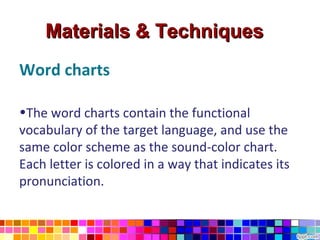
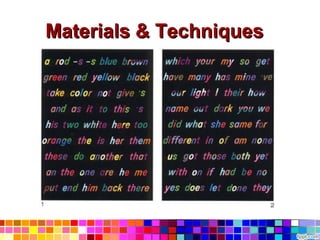
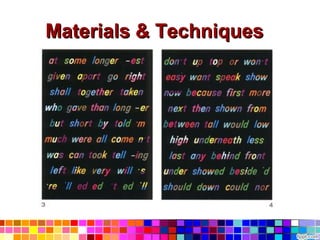
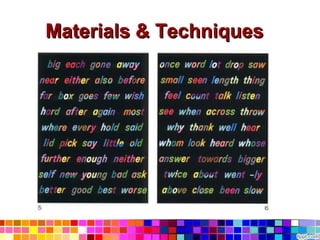
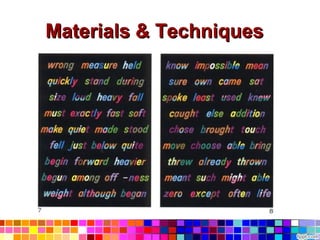
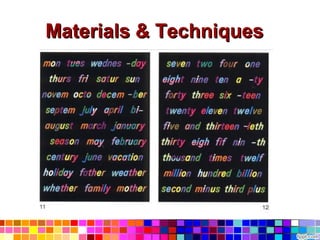
Word charts

•The word charts contain the functional
vocabulary of the target language, and use the
same color scheme as the sound-color chart.
Each letter is colored in a way that indicates its
pronunciation.
Materials & Techniques
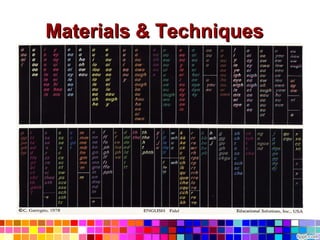
Fidel

•The Fidel is a set of charts presenting all the
possible spellings of each sound of the language
using the same colour code as the Sound/colour
rectangle chart and Word Charts.
Materials & Techniques

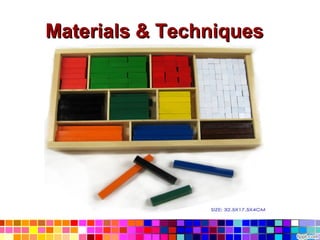
Cuisenaire rods

•The Cuisenaire rods are wooden, and come in
ten different lengths, but identical cross-section;
each length has its own assigned color.
Materials & Techniques
Pointer

•The teacher uses the pointer to indicate a
sound symbol for the students to produce.
Materials & Techniques
Other materials & Techniques
•Teacher’s silence .
•Stretchered feedback
•books and worksheets for practicing reading
and writing skills, picture books, tapes;
videotapes, films, gestures and other visual aids
Strategy
• The teacher introduces a discrete sound or structure by
  pointing at Silent Way charts or by using Cuisenaire rods to
  demonstrate a structure or grammar point.

• Students then figure out what they are learning and
  reproduce the sound or structure.

• Between activities or sessions, students may ask questions of
  the teacher.
Strategy
• The teacher then introduces another discrete sound or
  structure in the same manner.

• Students again figure out the meaning and reproduce the
  sound or structure.

• As time goes on, students are ideally able to combine
  discrete sounds and structures to create longer strings of
  language.
Recommended website


   •Educational solutions
‫و ما ت و في قي إ ِ ل بال ل ه ع ل ي ه‬
‫ّ ِ ّ ِ ََْ ِ‬                ‫)َ َ َ ْ ِ ِ‬
       ‫ت و ك ل ت و إ ِ ل ي ه أ ُ ني ب(‬
        ‫َ َ ّْ ُ َ َْ ِ ِ ُ‬

The silent way

  • 1.
    The Silent Way AdvancedMethodology For TESOL 2 Instructor : Dr. Hind Al-fadda Prepared by : Taghreed Albalawi
  • 2.
  • 3.
    Background • The SilentWay, developed in the 1960s by Caleb Gattegno, is grounded in the belief that students should learn independently of the teacher. Gattegno proposed that students would learn better if they developed personal responsibility for their own learning. Thus, for much of the lesson, the teacher remains silent. Teaching is viewed as subordinate to learning.
  • 4.
    Background • Students areencouraged to work with one another to figure out meaning. Students are introduced to new material once through the use of Cuisenaire rods (small colored rods of varying lengths) and a series of wall charts. After the teacher introduces the material, it is up to the students to determine what they need to learn and independently work toward their academic goals.
  • 5.
    Background • Certain aspectsof this approach, such as the use of Cuisenaire rods and developing student independence, continue to be used. However, this approach alone is rarely used because it is not practical within the class room, and students need and desire more teacher input.
  • 6.
    Objective The objectiveof The Silent Way Method of language teaching is for students to work as independent language learners.
  • 7.
    Learning Hypotheses • Learningis facilitated if the learner discovers or creates rather than remembers and repeats what is to be learned. • Learning is facilitated by accompanying (mediating) physical objects. • Learning is facilitated by problem solving involving the material to be learned.
  • 8.
    Tell me andI forget , Teach me and I remember, Involve me and I learn.
  • 9.
    Theory of Learning •Gattegno makes extensive use of his understanding of first language learning processes as a basis for deriving principles for teaching foreign languages to adults. Gattegno recommends that the learner needs to "return to the state of mind that characterizes a baby's learning surrender"
  • 10.
    Theory of Learning •A successful learning involves commitment of the self to language acquisition through the use of silent awareness and then active trial. • Silent Way learners acquire “inner criteria”. • The Silent Way students are expected to become independent , responsible and autonomous .
  • 11.
    Silent way principles •The teacher should start with something the students already know and build from that to the unknown. • Language learners are intelligent and bring with them the experience of already learning a language. • Language is not learned by repeating after a model. • Students should learn to rely on each other and themselves. • Learning involves transferring what one knows to new contexts. • Silence is a tool. It helps to foster autonomy, or the exercise of initiative. The teacher speaks, but only when necessary
  • 12.
    Silent way principles •Meaning is made clear by focusing students’ perceptions, not through translation. • If the teacher praises (or criticizes) students, they will be less self-reliant. • Errors are important and necessary to learning. • At the beginning, the teacher needs to look for progress, not perfection. Learning takes place in time. Students learn at different rates. • Students learn they must give the teacher their attention in order not to miss what he says. Student attention is a key to learning.
  • 13.
    Silent way principles •Students should engage in a great deal of meaningful practice without repetition. • Language is for self-expression. • The teacher can gain valuable information from student feedback. • The syllabus is composed of linguistic structures. • The structures of the syllabus are not arranged in a linear fashion, but rather are constantly being recycled. • The skills of speaking, reading, and writing reinforce one another.
  • 14.
    Materials & Techniques Soundchart •The sound-color chart consists of blocks of color, with one color representing one sound in the language being learned
  • 15.
  • 16.
    Materials & Techniques Wordcharts •The word charts contain the functional vocabulary of the target language, and use the same color scheme as the sound-color chart. Each letter is colored in a way that indicates its pronunciation.
  • 17.
  • 18.
  • 19.
  • 20.
  • 21.
  • 22.
  • 23.
    Materials & Techniques Fidel •TheFidel is a set of charts presenting all the possible spellings of each sound of the language using the same colour code as the Sound/colour rectangle chart and Word Charts.
  • 24.
  • 25.
    Materials & Techniques Cuisenairerods •The Cuisenaire rods are wooden, and come in ten different lengths, but identical cross-section; each length has its own assigned color.
  • 26.
  • 27.
    Materials & Techniques Pointer •Theteacher uses the pointer to indicate a sound symbol for the students to produce.
  • 28.
    Materials & Techniques Othermaterials & Techniques •Teacher’s silence . •Stretchered feedback •books and worksheets for practicing reading and writing skills, picture books, tapes; videotapes, films, gestures and other visual aids
  • 29.
    Strategy • The teacherintroduces a discrete sound or structure by pointing at Silent Way charts or by using Cuisenaire rods to demonstrate a structure or grammar point. • Students then figure out what they are learning and reproduce the sound or structure. • Between activities or sessions, students may ask questions of the teacher.
  • 30.
    Strategy • The teacherthen introduces another discrete sound or structure in the same manner. • Students again figure out the meaning and reproduce the sound or structure. • As time goes on, students are ideally able to combine discrete sounds and structures to create longer strings of language.
  • 31.
    Recommended website •Educational solutions
  • 32.
    ‫و ما تو في قي إ ِ ل بال ل ه ع ل ي ه‬ ‫ّ ِ ّ ِ ََْ ِ‬ ‫)َ َ َ ْ ِ ِ‬ ‫ت و ك ل ت و إ ِ ل ي ه أ ُ ني ب(‬ ‫َ َ ّْ ُ َ َْ ِ ِ ُ‬