What is CLT?Presented by: Ivan Aguilar
Communicative Language Teaching: Different DefinitionsCommunicative language teaching (CLT) is an approach to the teaching of second and foreign languages that emphasizes interaction as both the means and the ultimate goal of learning a language. It is also referred to as “communicative approach to the teaching of foreign languages” or simply the “communicative approach”.(Wikipedia)Its origins are many, insofar as one teaching methodology tends to influence the next. The communicative approach could be said to be the product of educators and linguists who had grown dissatisfied with the audiolingual and grammar-translation methods of foreign language instruction. (Center for Applied linguisitcs)This method aims at developing procedures for the teaching of the four skills that acknowledge the interdependence of language and communication. It aims at having students become communicatively competent.(Yemen Times) A set of principles about teaching including recommendations about method and syllabus  where the focus is on meaningful communication not structure, use not usage. In this approach, students are given tasks to accomplish using language, instead of studying the language.(ESL Glossary)
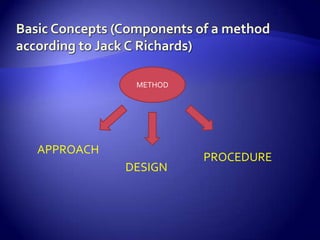
Basic Concepts (Components of a method according to Jack C Richards)METHODAPPROACHPROCEDUREDESIGN
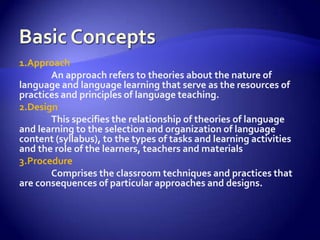
Basic Concepts1.ApproachAn approach refers to theories about the nature of language and language learning that serve as the resources of practices and principles of language teaching.2.DesignThis specifies the relationship of theories of language and learning to the selection and organization of language content (syllabus), to the types of tasks and learning activities and the role of the learners, teachers and materials3.ProcedureComprises the classroom techniques and practices that are consequences of particular approaches and designs.
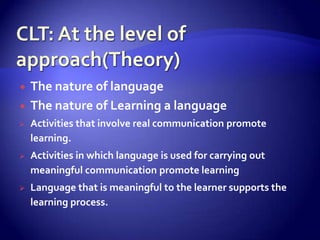
CLT: At the level of approach(Theory)The nature of languageThe nature of Learning a languageActivities that involve real communication promote learning.
Activities in which language is used for carrying out meaningful communication promote learning
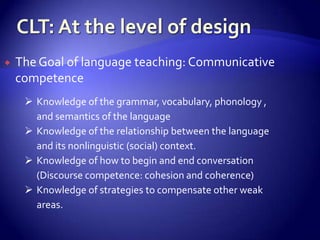
Language that is meaningful to the learner supports the learning process.CLT: At the level of designThe Goal of language teaching: Communicative competenceKnowledge of the grammar, vocabulary, phonology , and semantics of the language
Knowledge of the relationship between the language and its nonlinguistic (social) context.
Knowledge of how to begin and end conversation (Discourse competence: cohesion and coherence)
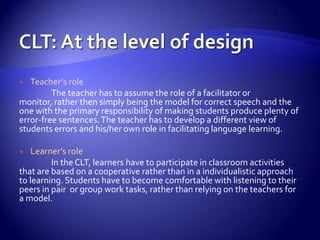
Knowledge of strategies to compensate other weak areas.CLT: At the level of designTeacher’s roleThe teacher has to assume the role of a facilitator or monitor, rather then simply being the model for correct speech and the one with the primary responsibility of making students produce plenty of error-free sentences. The teacher has to develop a different view of students errors and his/her own role in facilitating language learning.Learner’s roleIn the CLT, learners have to participate in classroom activities that are based on a cooperative rather than in a individualistic approach to learning. Students have to become comfortable with listening to their peers in pair  or group work tasks, rather than relying on the teachers for a model.
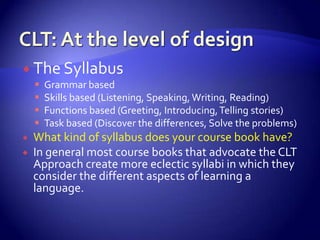
CLT: At the level of designThe SyllabusGrammar based
Skills based (Listening, Speaking, Writing, Reading)
Functions based (Greeting, Introducing, Telling stories)

What is CLT?

  • 1.
    What is CLT?Presentedby: Ivan Aguilar
  • 2.
    Communicative Language Teaching:Different DefinitionsCommunicative language teaching (CLT) is an approach to the teaching of second and foreign languages that emphasizes interaction as both the means and the ultimate goal of learning a language. It is also referred to as “communicative approach to the teaching of foreign languages” or simply the “communicative approach”.(Wikipedia)Its origins are many, insofar as one teaching methodology tends to influence the next. The communicative approach could be said to be the product of educators and linguists who had grown dissatisfied with the audiolingual and grammar-translation methods of foreign language instruction. (Center for Applied linguisitcs)This method aims at developing procedures for the teaching of the four skills that acknowledge the interdependence of language and communication. It aims at having students become communicatively competent.(Yemen Times) A set of principles about teaching including recommendations about method and syllabus where the focus is on meaningful communication not structure, use not usage. In this approach, students are given tasks to accomplish using language, instead of studying the language.(ESL Glossary)
  • 3.
    Basic Concepts (Componentsof a method according to Jack C Richards)METHODAPPROACHPROCEDUREDESIGN
  • 4.
    Basic Concepts1.ApproachAn approachrefers to theories about the nature of language and language learning that serve as the resources of practices and principles of language teaching.2.DesignThis specifies the relationship of theories of language and learning to the selection and organization of language content (syllabus), to the types of tasks and learning activities and the role of the learners, teachers and materials3.ProcedureComprises the classroom techniques and practices that are consequences of particular approaches and designs.
  • 5.
    CLT: At thelevel of approach(Theory)The nature of languageThe nature of Learning a languageActivities that involve real communication promote learning.
  • 6.
    Activities in whichlanguage is used for carrying out meaningful communication promote learning
  • 7.
    Language that ismeaningful to the learner supports the learning process.CLT: At the level of designThe Goal of language teaching: Communicative competenceKnowledge of the grammar, vocabulary, phonology , and semantics of the language
  • 8.
    Knowledge of therelationship between the language and its nonlinguistic (social) context.
  • 9.
    Knowledge of howto begin and end conversation (Discourse competence: cohesion and coherence)
  • 10.
    Knowledge of strategiesto compensate other weak areas.CLT: At the level of designTeacher’s roleThe teacher has to assume the role of a facilitator or monitor, rather then simply being the model for correct speech and the one with the primary responsibility of making students produce plenty of error-free sentences. The teacher has to develop a different view of students errors and his/her own role in facilitating language learning.Learner’s roleIn the CLT, learners have to participate in classroom activities that are based on a cooperative rather than in a individualistic approach to learning. Students have to become comfortable with listening to their peers in pair or group work tasks, rather than relying on the teachers for a model.
  • 11.
    CLT: At thelevel of designThe SyllabusGrammar based
  • 12.
    Skills based (Listening,Speaking, Writing, Reading)
  • 13.
    Functions based (Greeting,Introducing, Telling stories)