Community 
Language 
Learning 
( CLL )
• 1 – Background 
• 2 – Theory of language and learning 
• 3 – Design ( Objectives , Syllabus , 
Activities , roles of learners and 
teachers , material ) 
• 4 – Procedure
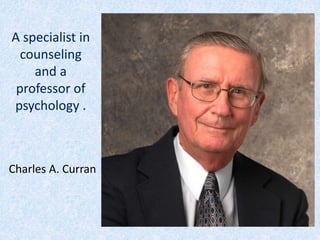
A specialist in 
counseling 
and a 
professor of 
psychology . 
Charles A. Curran
Background 
• CLL was developed by Charles A. Curran , 
• His application of psychological counseling 
techniques to learning is known as Counseling 
– Learning . 
• The term counseling means one person giving 
advice , assistance , and support to another 
who has a problem .
• CLL redefines the roles of teacher and learner. 
• Teacher = Counselor Learner = Client 
• CLL is also an example of Humanistic 
Approach , since it deals with the emotions 
and feelings as well as with linguistic 
knowledge and behavioral skills . 
• Humanistic techniques are those that blend 
what the student feels , thinks and knows with 
what he is learning .
• Humanistic techniques engage the Whole 
Person , including the emotions and feelings 
as well as linguistic knowledge and behavioral 
skill . 
• Whole person learning means that teachers 
consider not only their students’ intellect , but 
they also have some understanding of the 
relationship among students’ feelings , 
physical reactions , and desire to learn .
Theory of language and learning 
• Theory of language : Curran himself wrote little 
about his theory of language . 
• His student La Forge ( 1983 ) seems to accept that 
language theory must start with criteria for sound 
features , the sentence , and abstract models of 
language . 
• The foreign language learners’ tasks are to 
understand the sound system , derive meaning , 
and develop a basic grammar of the l2 .
• La Forge also elaborates on the interactional 
view of language underlying CLL . 
• Language = people . 
• Language = persons in contact . 
• Language = persons in response . 
• CLL interactions are of two kinds : 
• Interactions between learners and 
• Interactions between learners and knowers .
• Interactions between learners : 
• are unpredictable in content but typically involve 
exchanges of emotion . 
• Learners are intimate as they become a 
community of learners and the desire to be a part of 
this growing intimacy pushes learners to keep pace 
with the learning of their peers . 
• Interactions between learners and knowers : 
• Is initially dependent . 
• The learner tells the knower what he or she wishes 
to say in target language and the knower tells the 
learner how to say it .
• Theory of learning : Curran’s counseling 
experience led him to conclude that the 
techniques of counseling could be applied to 
learning in general ( Counseling Learning ) , 
and to language teaching in particular ( CLL ) . 
• The CLL view of learning is a holistic one , 
since true human learning is both cognitive 
and affective ( This is termed whole-person ). 
• Such learning takes place in a communicative 
situation where teachers and learners are 
involved in an interaction .
• The process is divided into five stages and 
compared to the development of a child . 
• Five stages are both psychological and 
linguistic . 
• The first three are entry stages and the last 
two are of increasing maturity .
• In the first , birth stage , feeling of security 
and belonging are established . 
• In the second , the learner begins to achieve a 
sense of independence from the teacher . 
• By the third ,the learner speaks independently 
• The fourth stage sees the learner as secure 
enough to take criticism . 
• By the last the learner merely works upon 
improving style and knowledge of linguistic 
appropriateness .
• According to Curran there are six factors which 
are essential to non-defensive whole person 
learning process . 
• 1- A sense of security . 
• 2- Paying attention to language in all its forms. 
• 3- Experience a feeling of self-assertion and 
aggression when ready . 
• 4- Reflection and participation in class activities . 
• 5- Internalization by retention at a deep level . 
• 6- Discrimination among the various elements of 
language and their functions .
Design 
• Objectives : The goal of this method is 
attaining near-native mastery of the target 
language . Specific goals include developing a 
whole person learning process and a trusting 
relationship among the members of the class .
• The syllabus : CLL does not use a conventional 
language syllabus , which determines in 
advance the grammar , vocabulary , and other 
items to be taught in specific orders . 
• The course progression is topic based with 
learners choosing the message they wish to 
communicate to other learners in the class . 
• It evolves its own syllabus .
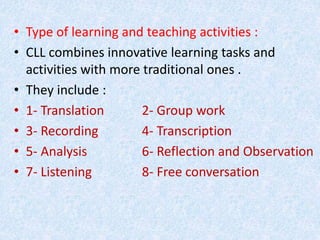
• Type of learning and teaching activities : 
• CLL combines innovative learning tasks and 
activities with more traditional ones . 
• They include : 
• 1- Translation 2- Group work 
• 3- Recording 4- Transcription 
• 5- Analysis 6- Reflection and Observation 
• 7- Listening 8- Free conversation
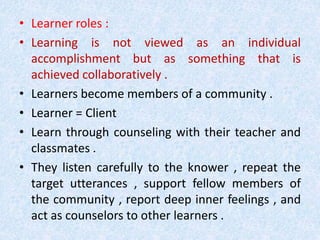
• Learner roles : 
• Learning is not viewed as an individual 
accomplishment but as something that is 
achieved collaboratively . 
• Learners become members of a community . 
• Learner = Client 
• Learn through counseling with their teacher and 
classmates . 
• They listen carefully to the knower , repeat the 
target utterances , support fellow members of 
the community , report deep inner feelings , and 
act as counselors to other learners .
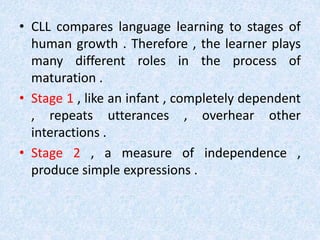
• CLL compares language learning to stages of 
human growth . Therefore , the learner plays 
many different roles in the process of 
maturation . 
• Stage 1 , like an infant , completely dependent 
, repeats utterances , overhear other 
interactions . 
• Stage 2 , a measure of independence , 
produce simple expressions .
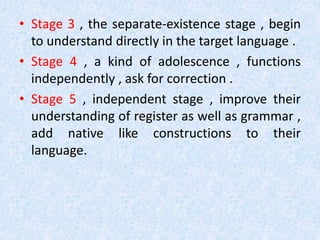
• Stage 3 , the separate-existence stage , begin 
to understand directly in the target language . 
• Stage 4 , a kind of adolescence , functions 
independently , ask for correction . 
• Stage 5 , independent stage , improve their 
understanding of register as well as grammar , 
add native like constructions to their 
language.
• Teacher roles : 
• Plays the role of counselor . 
• Respond calmly and nonjudgmentally . 
• Having a supportive manner . 
• Help the client to understand the problems 
better . 
• Provide a safe environment .
• More specific teacher roles are : 
• Provide target language translations . 
• Monitoring learner utterances . 
• Providing assistance when requested . 
• May intervene directly to correct the problem. 
• Advise on usage of grammar .
• The role of instructional materials : 
• Since a CLL course develops out of the 
interactions among the members of the 
community , a textbook is not considered a 
necessary component . 
• Material may be developed by the teacher as 
the course develops . 
• Conversation may also be transcribed and 
distributed for study and analysis . 
• Learners may work in groups to produce their 
own materials .
• Procedure : 
• Consists of six to twelve students sitting in a 
circle . 
• Students have visual contact with each other . 
• Teacher is out of the circle . 
• Teacher walks behind the students to provide 
assistance .
• Activities of the class : 
• 1- The students introduce themselves to each 
other in L1 . 
• 2- The teacher explains the goals and activities 
of the course . 
• 3- A conversation in L2 takes place : 
• 4- Students think about the process and they 
are asked to express their feelings about the 
experience .
• 5- The instructor chooses some sentences 
from the recorded material and writes them 
on the board to discuss the elements of 
grammar , spelling , and capitalization . 
• 6- Students are encouraged to ask questions . 
• 7- Students are encouraged to copy sentences 
from the board with notes on meaning and 
usage .
• By Ehsan Zolfaghari 
• Zolfaghari34@gmail.com

Community Language Learning ( CLL )

  • 1.
  • 2.
    • 1 –Background • 2 – Theory of language and learning • 3 – Design ( Objectives , Syllabus , Activities , roles of learners and teachers , material ) • 4 – Procedure
  • 3.
    A specialist in counseling and a professor of psychology . Charles A. Curran
  • 4.
    Background • CLLwas developed by Charles A. Curran , • His application of psychological counseling techniques to learning is known as Counseling – Learning . • The term counseling means one person giving advice , assistance , and support to another who has a problem .
  • 5.
    • CLL redefinesthe roles of teacher and learner. • Teacher = Counselor Learner = Client • CLL is also an example of Humanistic Approach , since it deals with the emotions and feelings as well as with linguistic knowledge and behavioral skills . • Humanistic techniques are those that blend what the student feels , thinks and knows with what he is learning .
  • 6.
    • Humanistic techniquesengage the Whole Person , including the emotions and feelings as well as linguistic knowledge and behavioral skill . • Whole person learning means that teachers consider not only their students’ intellect , but they also have some understanding of the relationship among students’ feelings , physical reactions , and desire to learn .
  • 7.
    Theory of languageand learning • Theory of language : Curran himself wrote little about his theory of language . • His student La Forge ( 1983 ) seems to accept that language theory must start with criteria for sound features , the sentence , and abstract models of language . • The foreign language learners’ tasks are to understand the sound system , derive meaning , and develop a basic grammar of the l2 .
  • 8.
    • La Forgealso elaborates on the interactional view of language underlying CLL . • Language = people . • Language = persons in contact . • Language = persons in response . • CLL interactions are of two kinds : • Interactions between learners and • Interactions between learners and knowers .
  • 9.
    • Interactions betweenlearners : • are unpredictable in content but typically involve exchanges of emotion . • Learners are intimate as they become a community of learners and the desire to be a part of this growing intimacy pushes learners to keep pace with the learning of their peers . • Interactions between learners and knowers : • Is initially dependent . • The learner tells the knower what he or she wishes to say in target language and the knower tells the learner how to say it .
  • 10.
    • Theory oflearning : Curran’s counseling experience led him to conclude that the techniques of counseling could be applied to learning in general ( Counseling Learning ) , and to language teaching in particular ( CLL ) . • The CLL view of learning is a holistic one , since true human learning is both cognitive and affective ( This is termed whole-person ). • Such learning takes place in a communicative situation where teachers and learners are involved in an interaction .
  • 11.
    • The processis divided into five stages and compared to the development of a child . • Five stages are both psychological and linguistic . • The first three are entry stages and the last two are of increasing maturity .
  • 12.
    • In thefirst , birth stage , feeling of security and belonging are established . • In the second , the learner begins to achieve a sense of independence from the teacher . • By the third ,the learner speaks independently • The fourth stage sees the learner as secure enough to take criticism . • By the last the learner merely works upon improving style and knowledge of linguistic appropriateness .
  • 13.
    • According toCurran there are six factors which are essential to non-defensive whole person learning process . • 1- A sense of security . • 2- Paying attention to language in all its forms. • 3- Experience a feeling of self-assertion and aggression when ready . • 4- Reflection and participation in class activities . • 5- Internalization by retention at a deep level . • 6- Discrimination among the various elements of language and their functions .
  • 14.
    Design • Objectives: The goal of this method is attaining near-native mastery of the target language . Specific goals include developing a whole person learning process and a trusting relationship among the members of the class .
  • 15.
    • The syllabus: CLL does not use a conventional language syllabus , which determines in advance the grammar , vocabulary , and other items to be taught in specific orders . • The course progression is topic based with learners choosing the message they wish to communicate to other learners in the class . • It evolves its own syllabus .
  • 16.
    • Type oflearning and teaching activities : • CLL combines innovative learning tasks and activities with more traditional ones . • They include : • 1- Translation 2- Group work • 3- Recording 4- Transcription • 5- Analysis 6- Reflection and Observation • 7- Listening 8- Free conversation
  • 17.
    • Learner roles: • Learning is not viewed as an individual accomplishment but as something that is achieved collaboratively . • Learners become members of a community . • Learner = Client • Learn through counseling with their teacher and classmates . • They listen carefully to the knower , repeat the target utterances , support fellow members of the community , report deep inner feelings , and act as counselors to other learners .
  • 18.
    • CLL compareslanguage learning to stages of human growth . Therefore , the learner plays many different roles in the process of maturation . • Stage 1 , like an infant , completely dependent , repeats utterances , overhear other interactions . • Stage 2 , a measure of independence , produce simple expressions .
  • 19.
    • Stage 3, the separate-existence stage , begin to understand directly in the target language . • Stage 4 , a kind of adolescence , functions independently , ask for correction . • Stage 5 , independent stage , improve their understanding of register as well as grammar , add native like constructions to their language.
  • 20.
    • Teacher roles: • Plays the role of counselor . • Respond calmly and nonjudgmentally . • Having a supportive manner . • Help the client to understand the problems better . • Provide a safe environment .
  • 21.
    • More specificteacher roles are : • Provide target language translations . • Monitoring learner utterances . • Providing assistance when requested . • May intervene directly to correct the problem. • Advise on usage of grammar .
  • 22.
    • The roleof instructional materials : • Since a CLL course develops out of the interactions among the members of the community , a textbook is not considered a necessary component . • Material may be developed by the teacher as the course develops . • Conversation may also be transcribed and distributed for study and analysis . • Learners may work in groups to produce their own materials .
  • 23.
    • Procedure : • Consists of six to twelve students sitting in a circle . • Students have visual contact with each other . • Teacher is out of the circle . • Teacher walks behind the students to provide assistance .
  • 24.
    • Activities ofthe class : • 1- The students introduce themselves to each other in L1 . • 2- The teacher explains the goals and activities of the course . • 3- A conversation in L2 takes place : • 4- Students think about the process and they are asked to express their feelings about the experience .
  • 25.
    • 5- Theinstructor chooses some sentences from the recorded material and writes them on the board to discuss the elements of grammar , spelling , and capitalization . • 6- Students are encouraged to ask questions . • 7- Students are encouraged to copy sentences from the board with notes on meaning and usage .
  • 26.
    • By EhsanZolfaghari • Zolfaghari34@gmail.com