THE DISCRETE
FOURIER
TRANSFORM
Prepared By:
Bongoyan, Rom Carlvren P.
Anabeso, Jose
Jorge, Cedric John
1
2
3
4
5
Students will be able to
understand the DFT.
Students will be able to
solve the DFT and IDFT.
Students will be able to
solve the DFT as a
linear transformation.
Examine its properties
Bring to the student's
attention the importance
and the advantages of
the DFT
OBJECTIVES:
INTRODUCTION
The discrete Fourier transform (DFT) operates on a finite set of
numbers or a finite segment of a discrete signal. Physically, the DFT
of a discrete-time function x(n) may be viewed as its frequency-
domain representation and used as a tool to approximate the DTFT,
FT, or the spectrum of the continuous-time function x(r) [from
which x(n) is produced). Mathematically, the DFT may be
formulated by extending the classical Fourier transform of
continuous-time signals to a finite-length discrete-time sequence
through sampling and windowing. Alternatively, the DFT can be
introduced as an operation specified by a transformation matrix
that converts a sequence x(n) to another sequence X (k) of the
same length.
Discrete Fourier Transform
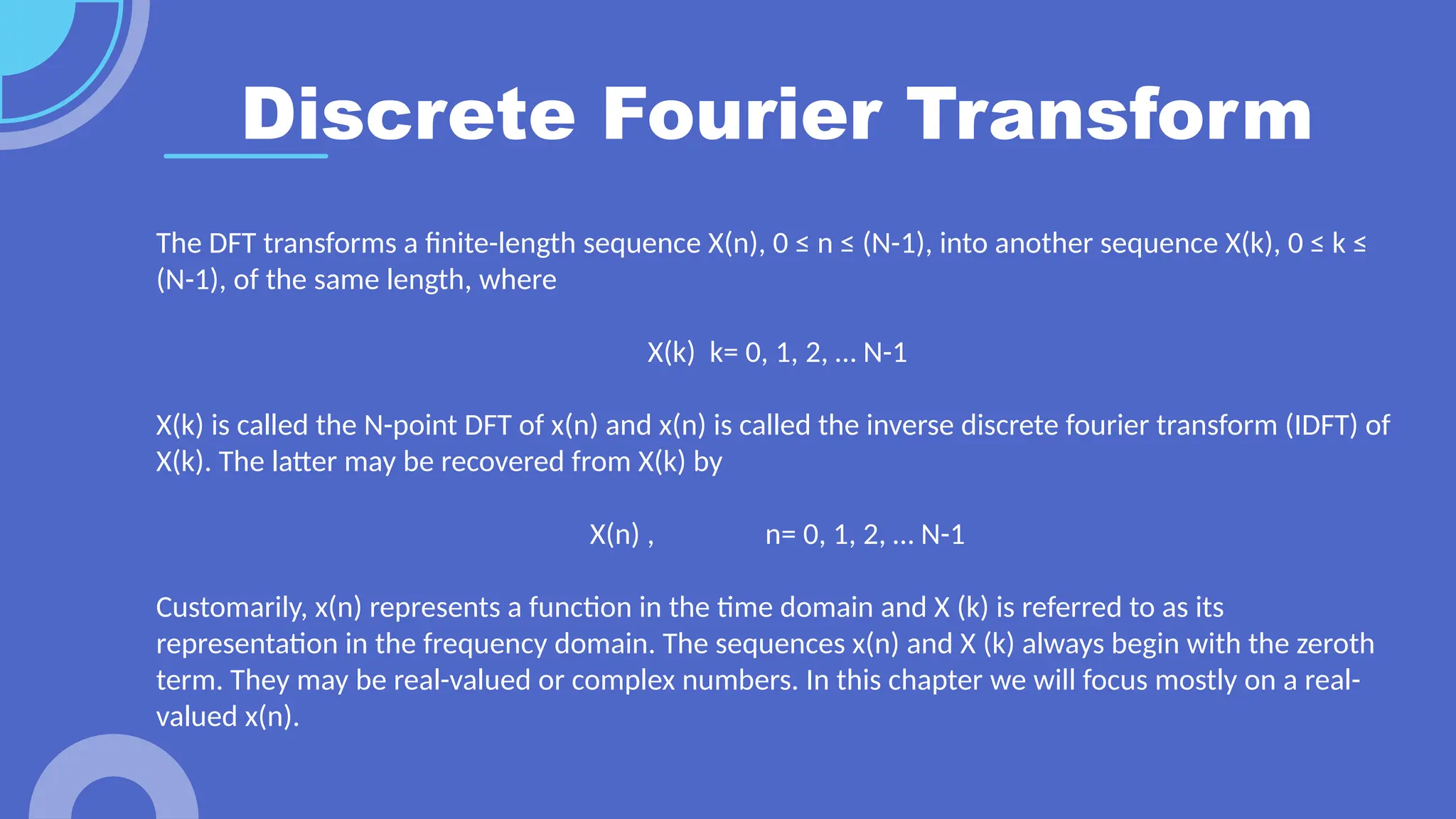
The DFT transforms a finite-length sequence X(n), 0 ≤ n ≤ (N-1), into another sequence X(k), 0 ≤ k ≤
(N-1), of the same length, where
X(k) k= 0, 1, 2, … N-1
X(k) is called the N-point DFT of x(n) and x(n) is called the inverse discrete fourier transform (IDFT) of
X(k). The latter may be recovered from X(k) by
X(n) , n= 0, 1, 2, … N-1
Customarily, x(n) represents a function in the time domain and X (k) is referred to as its
representation in the frequency domain. The sequences x(n) and X (k) always begin with the zeroth
term. They may be real-valued or complex numbers. In this chapter we will focus mostly on a real-
valued x(n).
Example of DFT
Compute the 4-point DFT of the sequence
x(n)= { 1, 2, 1, 2 }
Example of IDFT
Compute the 4-point IDFT of the sequence
X(k)= { 6, 0, -2, 0 }
The DFT as a linear transformation
• Now we will define the new term 'W' as
• This is called as “ Twiddle Factor”.
• Twiddle factor makes the computation of DFT a bit easy and fast.
• Using twiddle factor we can write equation of DFT and IDFT as follows:
X(k) k= 0, 1, 2, … N-1
And
X(n) , n= 0, 1, 2, … N-1
The DFT as a linear transformation
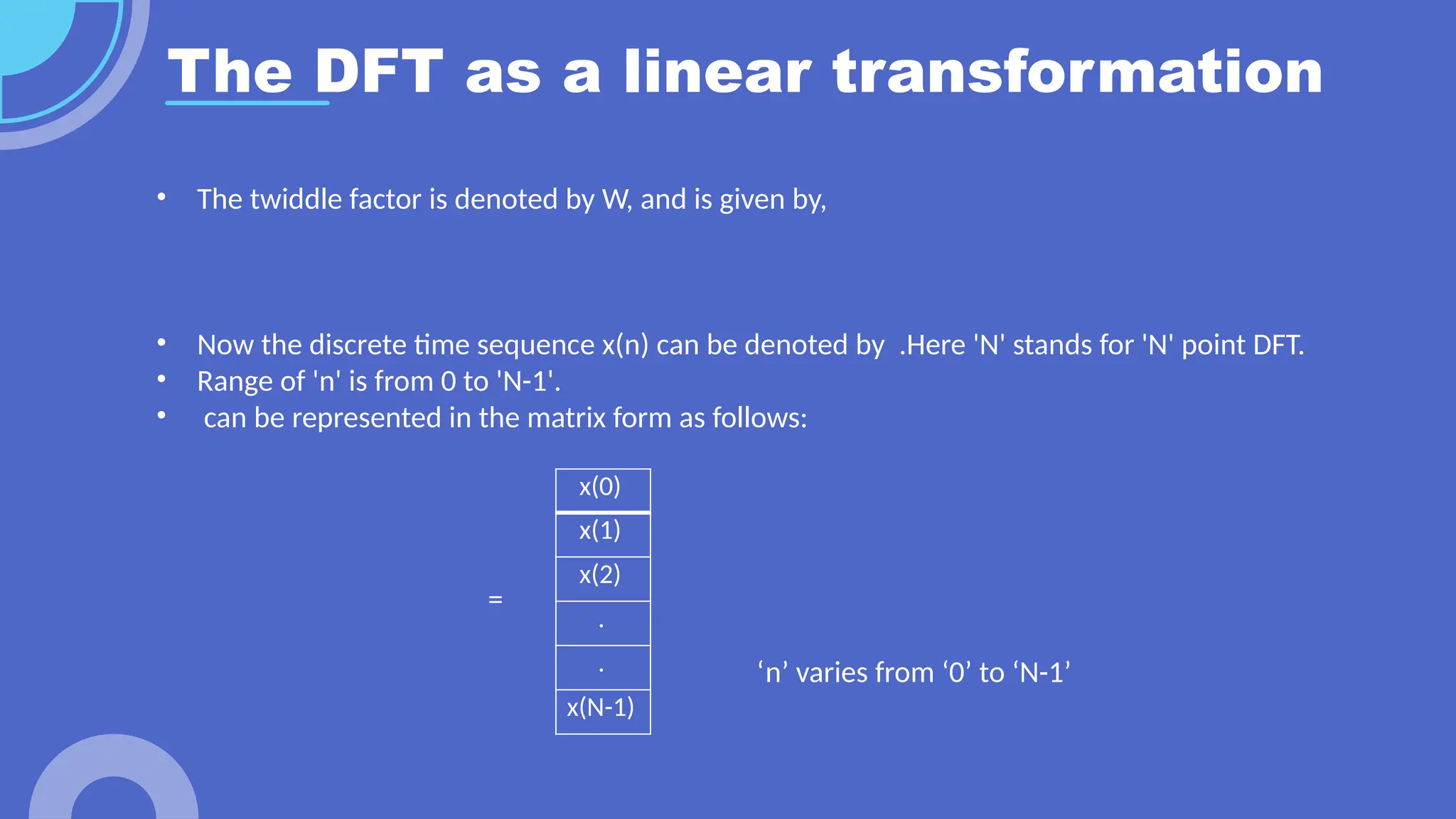
• The twiddle factor is denoted by W, and is given by,
• Now the discrete time sequence x(n) can be denoted by .Here 'N' stands for 'N' point DFT.
• Range of 'n' is from 0 to 'N-1'.
• can be represented in the matrix form as follows:
=
‘n’ varies from ‘0’ to ‘N-1’
x(0)
x(1)
x(2)
.
.
x(N-1)
The DFT as a linear transformation
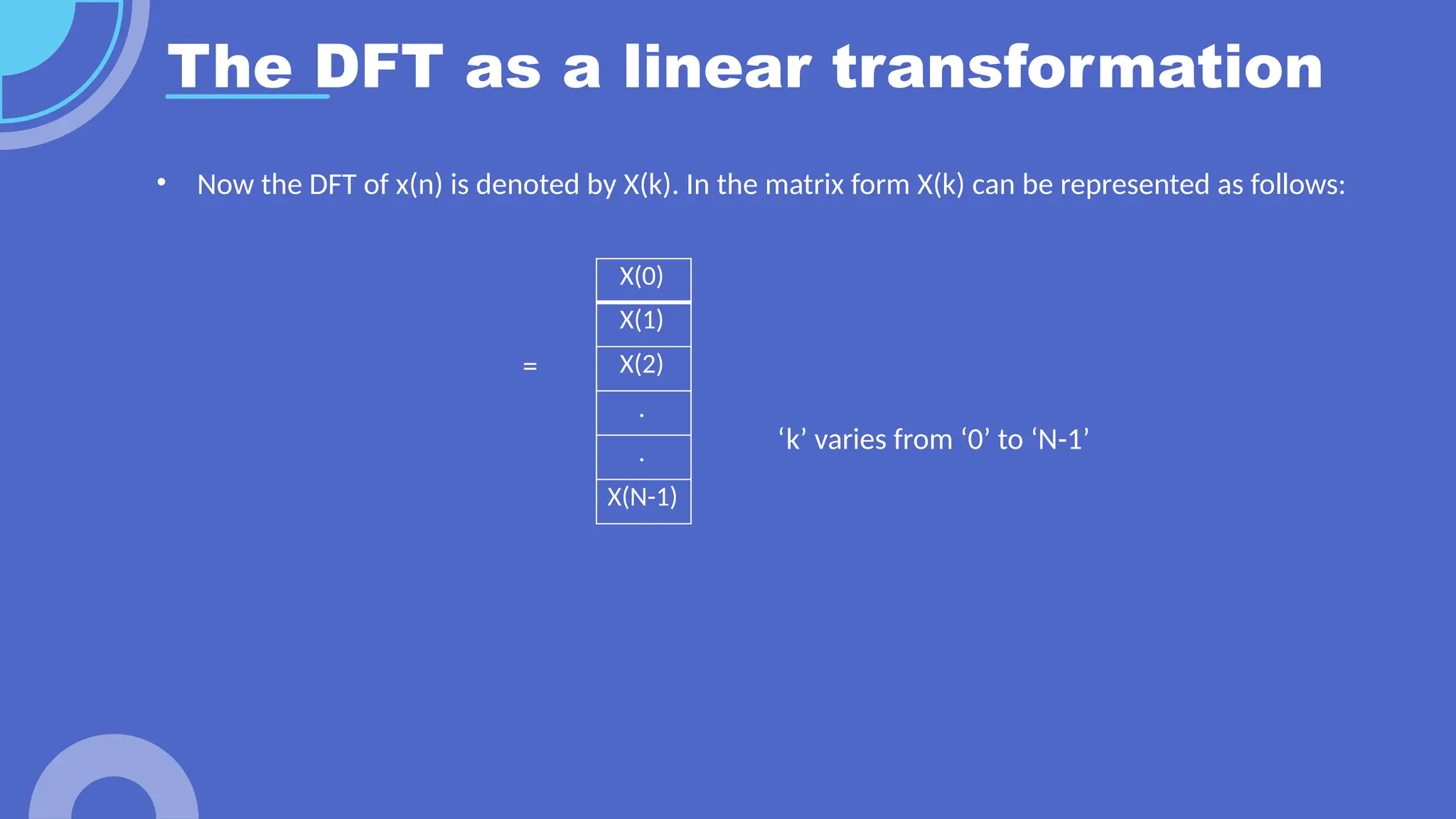
• Now the DFT of x(n) is denoted by X(k). In the matrix form X(k) can be represented as follows:
=
‘k’ varies from ‘0’ to ‘N-1’
X(0)
X(1)
X(2)
.
.
X(N-1)
The DFT as a linear transformation
• We can also represent in the matrix form. Remember that 'k' varies from 0 to N-1 and 'n' also
varies from 0 to N-1.
• Note that each value is obtained by taking multiplication of ‘k’ and ‘n’.
• For example, if k=2, n=2 then we get,
= =
n=0 n=1 n=2 n=3
k=0
= k=1
k=2
k=3
The DFT as a linear transformation
• Thus, DFT can be represented in the matrix form as
=
• Similarly IDFT can be represented in the matrix form as
=
• Here is the complex conjugate of .
Example of DFT as Linear Transformation
Calculate the 4-point DFT of the 4-point sequence
x(n)= { 1, 2, 1, 2 }
PROPERTIES
OF THE
DISCRETE
FOURIER
TRANSFORM
Properties of DFT:
1. Linearity
- The N-point DFT of ax(n)+by(n) is aX(k)+bY(k) for any x(n) and y(n) of the same length N and
any constants a and b.
x(n) X(k)
y(n) Y(k)
ax(n)+by(n) aX(k)+bY(k)
2. Periodicity
- If x(n) X(k) then,
x(n) = x(n+N), for all n
X(k) = X(k+N), for all k.
Properties of DFT:
3. Circular Symmetries of a sequence
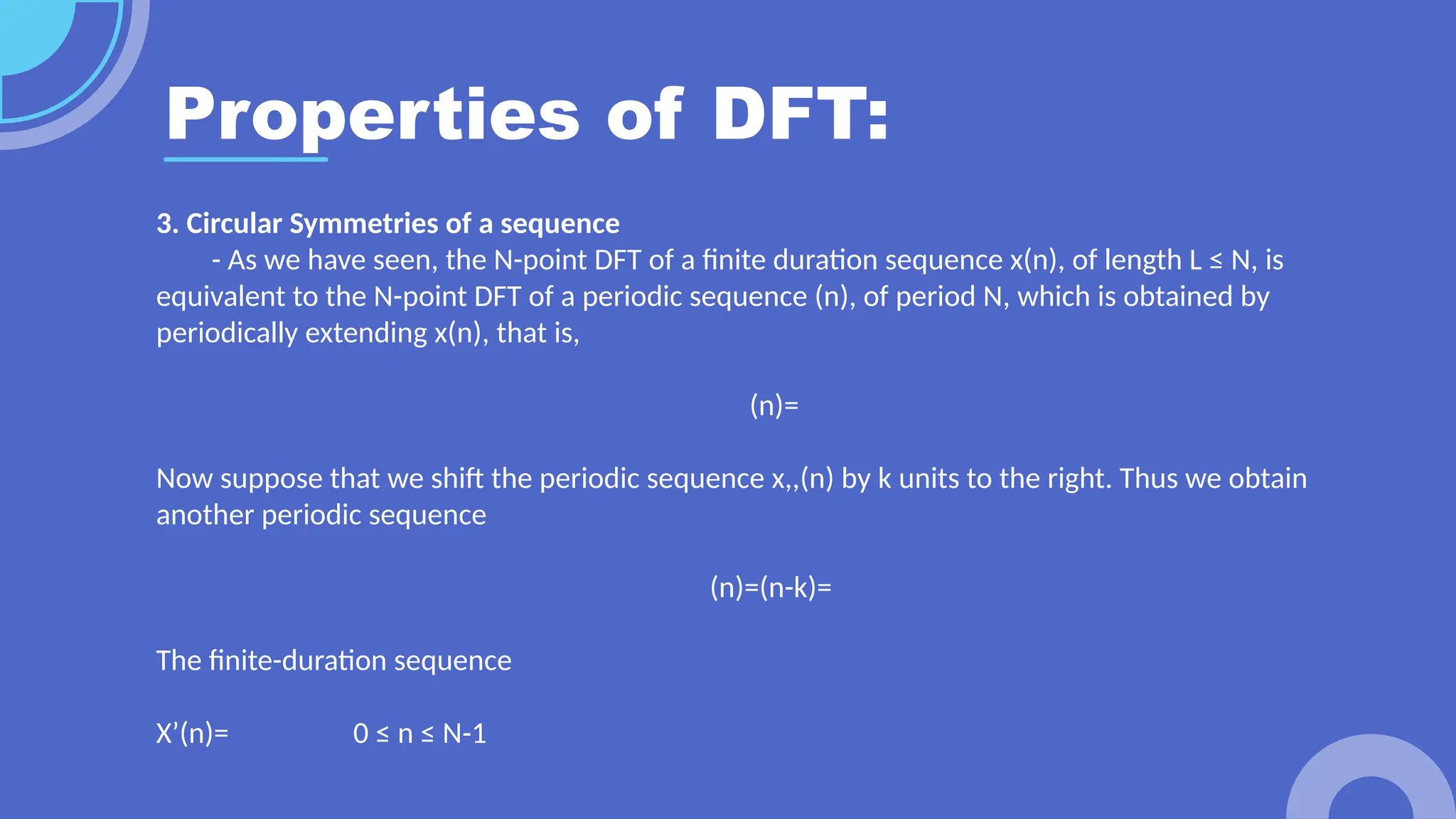
- As we have seen, the N-point DFT of a finite duration sequence x(n), of length L ≤ N, is
equivalent to the N-point DFT of a periodic sequence (n), of period N, which is obtained by
periodically extending x(n), that is,
(n)=
Now suppose that we shift the periodic sequence x,,(n) by k units to the right. Thus we obtain
another periodic sequence
(n)=(n-k)=
The finite-duration sequence
X’(n)= 0 ≤ n ≤ N-1
Multiplication of two DFTs
Suppose that we have two finite-duration sequences of length N, (n) and (n).
Their respective N-point DFT's are
(k) k= 0, 1, … N-1
(k) k= 0, 1, … N-1
If we multiply the two DFTS together, the result is a DFT, say (k), of a sequence (n) of length N. Let us
determine the relationship between (n) and the sequences (n) and (n).
We have
(k) = (k) (k) , k=0,1, …, N-1
The IDFT of {(k)} is
(m)
(m)
Circular Convolution
If,
DFT
(n) (k)
N
and
DFT
(n) (k)
N
then
DFT
(n) (n) (k) (k)
N
where (n) (n) denotes the circular convolution of the sequence (n) and (n).
ADDITIONAL
DFT
PROPERTIES
Time reversal of a sequence
If
DFT
x(n) X(k)
N
Then
DFT
N
Hence reversing the N-point sequence in time is equivalent to reversing the DFT values.
Circular time shift of a sequence
If
DFT
x(n) X(k) then
N
DFT
X
N
Circular Frequency Shift
If
DFT
x(n) X(k)
N
Then
DFT
x
N
Complex-conjugate properties
If
DFT
x(n) X(k) then
N
DFT
X*(n) X*
N
Multiplication of two sequences
If
DFT
(n) (k)
N
And
DFT
(n) (k)
N
Then
DFT
(n) (n) (k) (k)
N
Parseval’s Theorem
If
DFT
x(n) X(k)
N
And
DFT
y Y(k)
N
Then
=
ASSIGNMENT:
Compute the 5-point DFT of
a sequence x(n)= {1, 2, 3, 4}.
Then, find the IDFT of the
obtained DFT.
THANK YOU
E V E R Y O N E

The Discrete Fourier Transform by Group 7..pptx

  • 1.
    THE DISCRETE FOURIER TRANSFORM Prepared By: Bongoyan,Rom Carlvren P. Anabeso, Jose Jorge, Cedric John
  • 2.
    1 2 3 4 5 Students will beable to understand the DFT. Students will be able to solve the DFT and IDFT. Students will be able to solve the DFT as a linear transformation. Examine its properties Bring to the student's attention the importance and the advantages of the DFT OBJECTIVES:
  • 3.
    INTRODUCTION The discrete Fouriertransform (DFT) operates on a finite set of numbers or a finite segment of a discrete signal. Physically, the DFT of a discrete-time function x(n) may be viewed as its frequency- domain representation and used as a tool to approximate the DTFT, FT, or the spectrum of the continuous-time function x(r) [from which x(n) is produced). Mathematically, the DFT may be formulated by extending the classical Fourier transform of continuous-time signals to a finite-length discrete-time sequence through sampling and windowing. Alternatively, the DFT can be introduced as an operation specified by a transformation matrix that converts a sequence x(n) to another sequence X (k) of the same length.
  • 4.
    Discrete Fourier Transform TheDFT transforms a finite-length sequence X(n), 0 ≤ n ≤ (N-1), into another sequence X(k), 0 ≤ k ≤ (N-1), of the same length, where X(k) k= 0, 1, 2, … N-1 X(k) is called the N-point DFT of x(n) and x(n) is called the inverse discrete fourier transform (IDFT) of X(k). The latter may be recovered from X(k) by X(n) , n= 0, 1, 2, … N-1 Customarily, x(n) represents a function in the time domain and X (k) is referred to as its representation in the frequency domain. The sequences x(n) and X (k) always begin with the zeroth term. They may be real-valued or complex numbers. In this chapter we will focus mostly on a real- valued x(n).
  • 5.
    Example of DFT Computethe 4-point DFT of the sequence x(n)= { 1, 2, 1, 2 }
  • 6.
    Example of IDFT Computethe 4-point IDFT of the sequence X(k)= { 6, 0, -2, 0 }
  • 7.
    The DFT asa linear transformation • Now we will define the new term 'W' as • This is called as “ Twiddle Factor”. • Twiddle factor makes the computation of DFT a bit easy and fast. • Using twiddle factor we can write equation of DFT and IDFT as follows: X(k) k= 0, 1, 2, … N-1 And X(n) , n= 0, 1, 2, … N-1
  • 8.
    The DFT asa linear transformation • The twiddle factor is denoted by W, and is given by, • Now the discrete time sequence x(n) can be denoted by .Here 'N' stands for 'N' point DFT. • Range of 'n' is from 0 to 'N-1'. • can be represented in the matrix form as follows: = ‘n’ varies from ‘0’ to ‘N-1’ x(0) x(1) x(2) . . x(N-1)
  • 9.
    The DFT asa linear transformation • Now the DFT of x(n) is denoted by X(k). In the matrix form X(k) can be represented as follows: = ‘k’ varies from ‘0’ to ‘N-1’ X(0) X(1) X(2) . . X(N-1)
  • 10.
    The DFT asa linear transformation • We can also represent in the matrix form. Remember that 'k' varies from 0 to N-1 and 'n' also varies from 0 to N-1. • Note that each value is obtained by taking multiplication of ‘k’ and ‘n’. • For example, if k=2, n=2 then we get, = = n=0 n=1 n=2 n=3 k=0 = k=1 k=2 k=3
  • 11.
    The DFT asa linear transformation • Thus, DFT can be represented in the matrix form as = • Similarly IDFT can be represented in the matrix form as = • Here is the complex conjugate of .
  • 12.
    Example of DFTas Linear Transformation Calculate the 4-point DFT of the 4-point sequence x(n)= { 1, 2, 1, 2 }
  • 13.
  • 14.
    Properties of DFT: 1.Linearity - The N-point DFT of ax(n)+by(n) is aX(k)+bY(k) for any x(n) and y(n) of the same length N and any constants a and b. x(n) X(k) y(n) Y(k) ax(n)+by(n) aX(k)+bY(k) 2. Periodicity - If x(n) X(k) then, x(n) = x(n+N), for all n X(k) = X(k+N), for all k.
  • 15.
    Properties of DFT: 3.Circular Symmetries of a sequence - As we have seen, the N-point DFT of a finite duration sequence x(n), of length L ≤ N, is equivalent to the N-point DFT of a periodic sequence (n), of period N, which is obtained by periodically extending x(n), that is, (n)= Now suppose that we shift the periodic sequence x,,(n) by k units to the right. Thus we obtain another periodic sequence (n)=(n-k)= The finite-duration sequence X’(n)= 0 ≤ n ≤ N-1
  • 16.
    Multiplication of twoDFTs Suppose that we have two finite-duration sequences of length N, (n) and (n). Their respective N-point DFT's are (k) k= 0, 1, … N-1 (k) k= 0, 1, … N-1 If we multiply the two DFTS together, the result is a DFT, say (k), of a sequence (n) of length N. Let us determine the relationship between (n) and the sequences (n) and (n). We have (k) = (k) (k) , k=0,1, …, N-1 The IDFT of {(k)} is (m) (m)
  • 17.
    Circular Convolution If, DFT (n) (k) N and DFT (n)(k) N then DFT (n) (n) (k) (k) N where (n) (n) denotes the circular convolution of the sequence (n) and (n).
  • 18.
  • 19.
    Time reversal ofa sequence If DFT x(n) X(k) N Then DFT N Hence reversing the N-point sequence in time is equivalent to reversing the DFT values. Circular time shift of a sequence If DFT x(n) X(k) then N DFT X N
  • 20.
    Circular Frequency Shift If DFT x(n)X(k) N Then DFT x N Complex-conjugate properties If DFT x(n) X(k) then N DFT X*(n) X* N
  • 21.
    Multiplication of twosequences If DFT (n) (k) N And DFT (n) (k) N Then DFT (n) (n) (k) (k) N
  • 22.
  • 23.
    ASSIGNMENT: Compute the 5-pointDFT of a sequence x(n)= {1, 2, 3, 4}. Then, find the IDFT of the obtained DFT.
  • 24.
    THANK YOU E VE R Y O N E