DISTINGUISH BETWEEN
WALSH TRANSFORM
AND
HAAR TRANSFORM
DIGITAL IMAGE PROCESSING
NITHIN KALLEPALLY
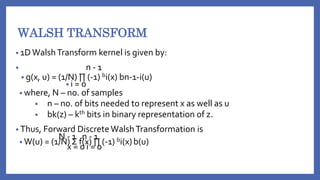
WALSH TRANSFORM
• 1DWalshTransform kernel is given by:
• n - 1
• g(x, u) = (1/N) ∏ (-1) bi(x) bn-1-i(u)
• i = 0
• where, N – no. of samples
• n – no. of bits needed to represent x as well as u
• bk(z) – kth bits in binary representation of z.
• Thus, Forward DiscreteWalshTransformation is
N - 1 n - 1
• W(u) = (1/N) Σ f(x) ∏ (-1) bi(x)b(u)
x = 0 i = 0
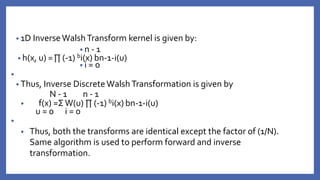
• 1D InverseWalshTransform kernel is given by:
• n - 1
• h(x, u) =∏ (-1) bi(x) bn-1-i(u)
• i = 0
•
• Thus, Inverse DiscreteWalshTransformation is given by
N - 1 n - 1
• f(x) =Σ W(u) ∏ (-1) bi(x) bn-1-i(u)
u = 0 i = 0
•
• Thus, both the transforms are identical except the factor of (1/N).
Same algorithm is used to perform forward and inverse
transformation.
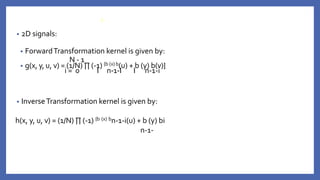
• 2D signals:
• ForwardTransformation kernel is given by:
N - 1
• g(x, y, u, v) = (1/N) ∏ (-1) {b (x) b(u) + b (y) b(v)}
i = 0 I n-1-I I n-1-i
• InverseTransformation kernel is given by:
h(x, y, u, v) = (1/N) ∏ (-1) {b (x) bn-1-i(u) + b (y) bi
n-1-
i
i
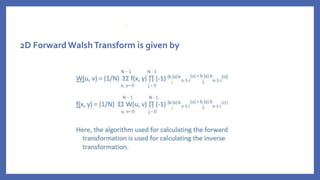
2D Forward WalshTransform is given by
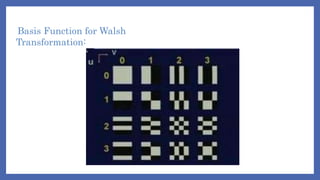
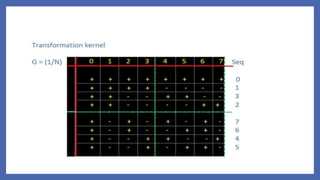
Basis Function for Walsh
Transformation:
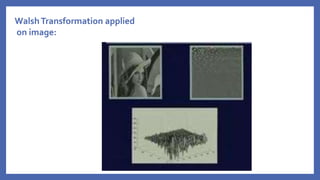
WalshTransformation applied
on image:
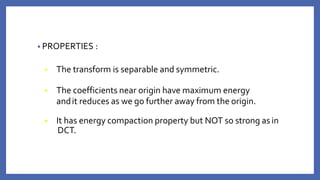
• PROPERTIES :
• The transform is separable and symmetric.
• The coefficients near origin have maximum energy
andit reduces as we go further away from the origin.
• It has energy compaction property but NOT so strong as in
DCT.
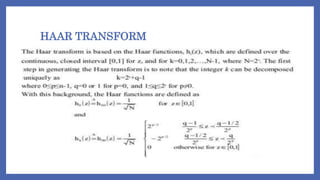
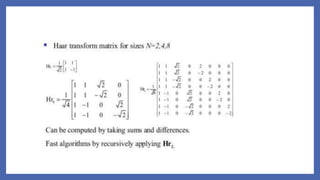
HAAR TRANSFORM
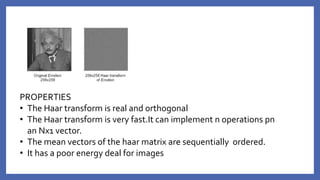
PROPERTIES
• The Haar transform is real and orthogonal
• The Haar transform is very fast.It can implement n operations pn
an Nx1 vector.
• The mean vectors of the haar matrix are sequentially ordered.
• It has a poor energy deal for images
THANK YOU…

DISTINGUISH BETWEEN WALSH TRANSFORM AND HAAR TRANSFORMDip transforms

  • 1.
    DISTINGUISH BETWEEN WALSH TRANSFORM AND HAARTRANSFORM DIGITAL IMAGE PROCESSING NITHIN KALLEPALLY
  • 2.
    WALSH TRANSFORM • 1DWalshTransformkernel is given by: • n - 1 • g(x, u) = (1/N) ∏ (-1) bi(x) bn-1-i(u) • i = 0 • where, N – no. of samples • n – no. of bits needed to represent x as well as u • bk(z) – kth bits in binary representation of z. • Thus, Forward DiscreteWalshTransformation is N - 1 n - 1 • W(u) = (1/N) Σ f(x) ∏ (-1) bi(x)b(u) x = 0 i = 0
  • 3.
    • 1D InverseWalshTransformkernel is given by: • n - 1 • h(x, u) =∏ (-1) bi(x) bn-1-i(u) • i = 0 • • Thus, Inverse DiscreteWalshTransformation is given by N - 1 n - 1 • f(x) =Σ W(u) ∏ (-1) bi(x) bn-1-i(u) u = 0 i = 0 • • Thus, both the transforms are identical except the factor of (1/N). Same algorithm is used to perform forward and inverse transformation.
  • 4.
    • 2D signals: •ForwardTransformation kernel is given by: N - 1 • g(x, y, u, v) = (1/N) ∏ (-1) {b (x) b(u) + b (y) b(v)} i = 0 I n-1-I I n-1-i • InverseTransformation kernel is given by: h(x, y, u, v) = (1/N) ∏ (-1) {b (x) bn-1-i(u) + b (y) bi n-1- i
  • 5.
  • 6.
    Basis Function forWalsh Transformation:
  • 7.
  • 8.
    • PROPERTIES : •The transform is separable and symmetric. • The coefficients near origin have maximum energy andit reduces as we go further away from the origin. • It has energy compaction property but NOT so strong as in DCT.
  • 10.
  • 12.
    PROPERTIES • The Haartransform is real and orthogonal • The Haar transform is very fast.It can implement n operations pn an Nx1 vector. • The mean vectors of the haar matrix are sequentially ordered. • It has a poor energy deal for images
  • 13.