The z-Transform


       主講人:虞台文
Content
 Introduction
 z-Transform
 Zeros and Poles
 Region of Convergence
 Important z-Transform Pairs
 Inverse z-Transform
 z-Transform Theorems and Properties
 System Function
The z-Transform


       Introduction
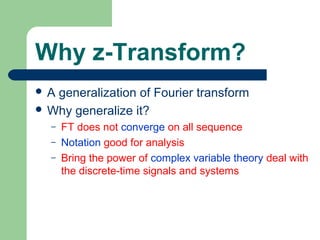
Why z-Transform?
A generalization of Fourier transform
 Why generalize it?
  –   FT does not converge on all sequence
  –   Notation good for analysis
  –   Bring the power of complex variable theory deal with
      the discrete-time signals and systems
The z-Transform


       z-Transform
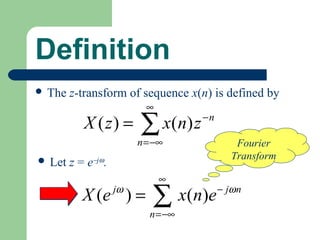
Definition
 The   z-transform of sequence x(n) is defined by
                           ∞
           X ( z) =      ∑ x ( n) z
                         n = −∞
                                      −n

                                               Fourier
                                              Transform
 Let   z = e−jω.
                               ∞
           X (e ) = jω
                            ∑ x ( n )e
                           n =−∞
                                           − jω n
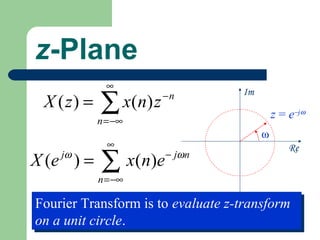
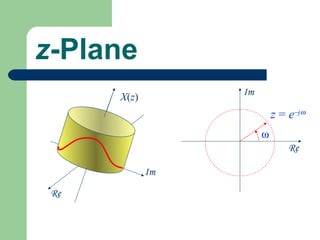
z-Plane
              ∞

            ∑ x ( n) z   −n        Im
 X ( z) =
            n = −∞
                                            z = e−jω
                                        ω
              ∞                                 Re
    jω
X (e ) =    ∑ x ( n )e
            n =−∞
                         − jω n


Fourier Transform is to evaluate z-transform
on a unit circle.
on a unit circle.
z-Plane
                  Im
      X(z)
                           z = e−jω
                       ω
                               Re

             Im

 Re
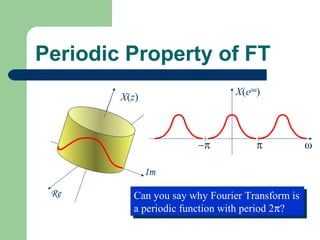
Periodic Property of FT
                                X(ejω)
        X(z)


                        −π           π            ω

               Im

 Re       Can you say why Fourier Transform is
           Can you say why Fourier Transform is
          aaperiodic function with period 2π?
             periodic function with period 2π?
The z-Transform


       Zeros and Poles
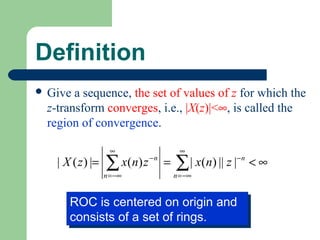
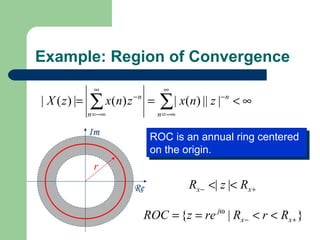
Definition
 Give a sequence, the set of values of z for which the
 z-transform converges, i.e., |X(z)|<∞, is called the
 region of convergence.

                    ∞                  ∞
   | X ( z ) |=   ∑ x ( n) z − n =
                  n = −∞
                                     ∑ | x(n) || z |− n < ∞
                                     n = −∞


      ROC is centered on origin and
      ROC is centered on origin and
      consists of a set of rings.
      consists of a set of rings.
Example: Region of Convergence
                 ∞                  ∞
| X ( z ) |=   ∑ x ( n) z − n =
               n = −∞
                                  ∑ | x(n) || z |− n < ∞
                                  n = −∞

               Im             ROC is an annual ring centered
                              ROC is an annual ring centered
                              on the origin.
                              on the origin.
                 r
                         Re                Rx − <| z |< Rx +
                                                  jω
                            ROC = {z = re | Rx − < r < Rx + }
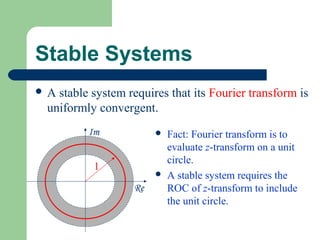
Stable Systems
A stable system requires that its Fourier transform is
 uniformly convergent.
         Im               Fact: Fourier transform is to
                           evaluate z-transform on a unit
                           circle.
          1
                          A stable system requires the
                  Re       ROC of z-transform to include
                           the unit circle.
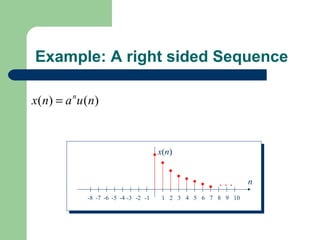
Example: A right sided Sequence

x ( n) = a n u ( n)


                                         x(n)


                                                        ...      n
               -8 -7 -6 -5 -4 -3 -2 -1    1 2 3 4 5 6 7 8 9 10
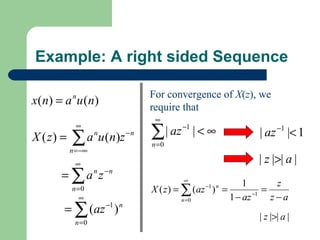
Example: A right sided Sequence

                              For convergence of X(z), we
x ( n) = a u ( n)
            n
                              require that
                               ∞

                              ∑
             ∞
                                | az −1 | < ∞            | az −1 |< 1
X ( z) =   ∑ a u (n)z
           n = −∞
                    n    −n
                              n =0

            ∞                                            | z |>| a |
       = ∑ a n z −n                   ∞
                                                      1        z
           n =0               X ( z ) = ∑ (az ) =
                                           −1 n
                                                         −1
                                                            =
              ∞                         n =0      1 − az      z−a
        = ∑ (az −1 ) n
                                                         | z |>| a |
            n =0
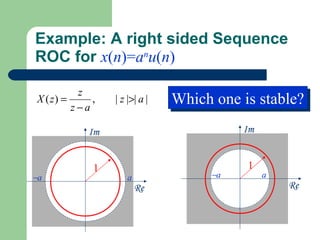
Example: A right sided Sequence
ROC for x(n)=anu(n)

          z
X ( z) =
         z−a
             ,   | z |>| a |   Which one is stable?
                               Which one is stable?
            Im                           Im


             1                            1
−a                   a              −a        a
                         Re                       Re
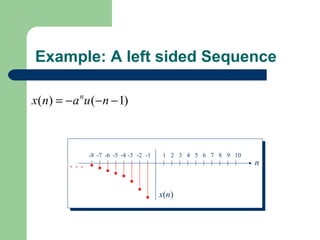
Example: A left sided Sequence

x(n) = −a nu (−n − 1)


              -8 -7 -6 -5 -4 -3 -2 -1    1 2 3 4 5 6 7 8 9 10
        ...                                                     n


                                        x(n)
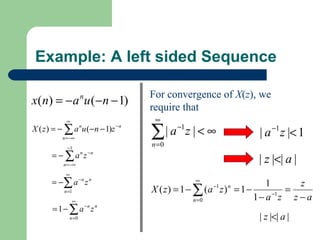
Example: A left sided Sequence

                                    For convergence of X(z), we
x(n) = −a u (−n − 1)n
                                    require that
            ∞                        ∞
X ( z ) = − ∑ a u (− n − 1)z
                                    ∑ | a −1 z | < ∞
                               −n
                                                               | a −1 z |< 1
                    n

          n = −∞
            −1
                                    n =0
      = − ∑ a n z −n
          n = −∞
                                                               | z |<| a |
           ∞
      = −∑ a − n z n                           ∞
                                                                    1      z
          n =1                      X ( z ) = 1 − ∑ (a z ) = 1 −
                                                   −1   n
                                                                      −1
                                                                         =
                ∞                                 n=0            1− a z z − a
      = 1 − ∑ a −n z n
             n =0                                              | z |<| a |
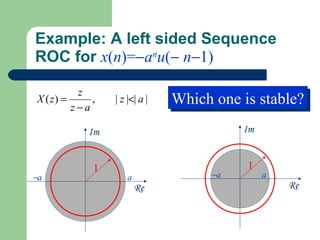
Example: A left sided Sequence
ROC for x(n)=−anu(− n−1)

          z
X ( z) =
         z−a
             ,   | z |<| a |   Which one is stable?
                               Which one is stable?
            Im                           Im


             1                            1
−a                   a              −a        a
                         Re                       Re
The z-Transform

       Region of
       Convergence
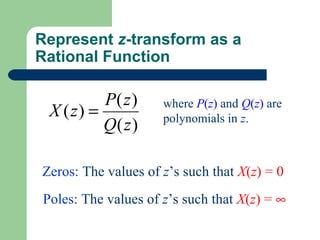
Represent z-transform as a
Rational Function

          P( z )     where P(z) and Q(z) are
 X ( z) =            polynomials in z.
          Q( z )

Zeros: The values of z’s such that X(z) = 0
Poles: The values of z’s such that X(z) = ∞
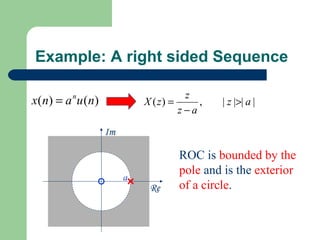
Example: A right sided Sequence

                                         z
x ( n) = a n u ( n)            X ( z) =     ,   | z |>| a |
                                        z−a

                      Im

                                       ROC is bounded by the
                                       pole and is the exterior
                           a
                                Re     of a circle.
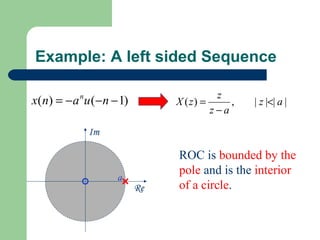
Example: A left sided Sequence

                                       z
x(n) = −a nu (−n − 1)        X ( z) =     ,   | z |<| a |
                                      z−a

            Im

                             ROC is bounded by the
                             pole and is the interior
                  a
                        Re   of a circle.
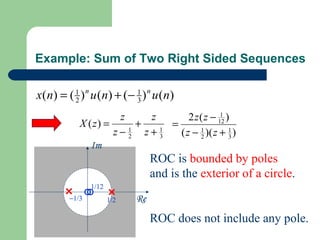
Example: Sum of Two Right Sided Sequences

x ( n) = ( 1 ) n u ( n) + ( − 1 ) n u ( n)
           2                  3

                       z     z        2 z ( z − 12 )
                                                 1
             X ( z) =      +     =
                      z−2 z+3
                         1     1
                                   ( z − 1 )( z + 1 )
                                          2         3
                Im
                                   ROC is bounded by poles
                                   and is the exterior of a circle.
                 1/12
          −1/3          1/2   Re
                                   ROC does not include any pole.
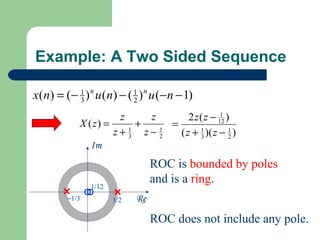
Example: A Two Sided Sequence

x(n) = (− 1 ) n u (n) − ( 1 ) n u (−n − 1)
          3               2

                      z     z        2 z ( z − 12 )
                                                1
            X ( z) =      +     =
                     z+3 z−2
                        1     1
                                  ( z + 1 )( z − 1 )
                                         3         2
               Im
                                 ROC is bounded by poles
                                 and is a ring.
               1/12
        −1/3          1/2   Re
                                 ROC does not include any pole.
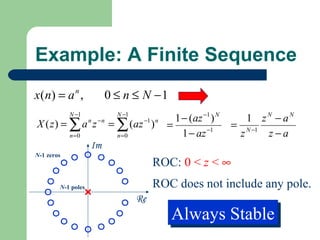
Example: A Finite Sequence
x ( n) = a n ,           0 ≤ n ≤ N −1
            N −1              N −1
                                               1 − (az −1 ) N      1 zN − aN
X ( z) = ∑ a z      n   −n
                             = ∑ ( az )
                                      −1 n
                                             =                  = N −1
            n =0              n =0               1 − az −1       z     z−a
                    Im
N-1 zeros
                                          ROC: 0 < z < ∞
        N-1 poles                         ROC does not include any pole.
                                     Re
                                              Always Stable
                                              Always Stable
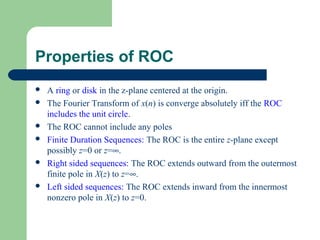
Properties of ROC
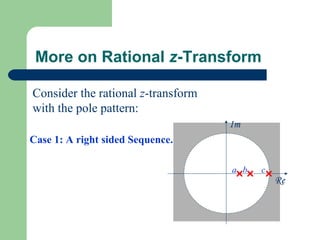
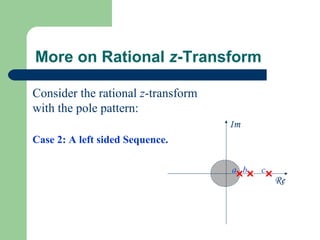
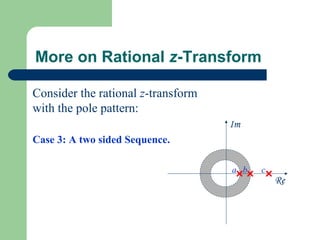
   A ring or disk in the z-plane centered at the origin.
   The Fourier Transform of x(n) is converge absolutely iff the ROC
    includes the unit circle.
   The ROC cannot include any poles
   Finite Duration Sequences: The ROC is the entire z-plane except
    possibly z=0 or z=∞.
   Right sided sequences: The ROC extends outward from the outermost
    finite pole in X(z) to z=∞.
   Left sided sequences: The ROC extends inward from the innermost
    nonzero pole in X(z) to z=0.
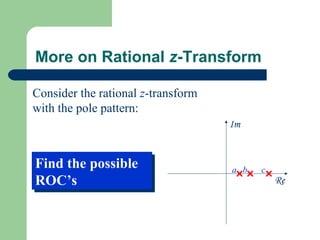
More on Rational z-Transform

Consider the rational z-transform
with the pole pattern:
                                    Im


Find the possible
Find the possible                   a b   c
ROC’s
ROC’s                                         Re
More on Rational z-Transform

Consider the rational z-transform
with the pole pattern:
                                    Im
Case 1: A right sided Sequence.

                                    a b   c
                                              Re
More on Rational z-Transform

Consider the rational z-transform
with the pole pattern:
                                    Im
Case 2: A left sided Sequence.

                                    a b   c
                                              Re
More on Rational z-Transform

Consider the rational z-transform
with the pole pattern:
                                    Im
Case 3: A two sided Sequence.

                                    a b   c
                                              Re
More on Rational z-Transform

Consider the rational z-transform
with the pole pattern:
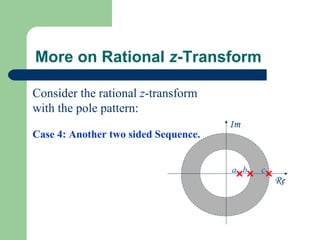
                                      Im
Case 4: Another two sided Sequence.


                                      a b   c
                                                Re
The z-Transform

       Important
       z-Transform Pairs
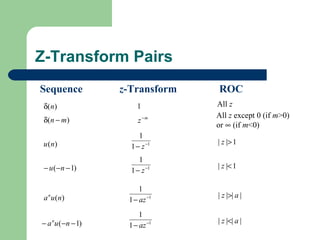
Z-Transform Pairs
Sequence          z-Transform   ROC
 δ(n)                 1         All z
                                All z except 0 (if m>0)
 δ( n − m )           z −m
                                or ∞ (if m<0)
                       1
 u (n)                          | z |> 1
                    1 − z −1
                       1
 − u (−n − 1)                   | z |< 1
                    1 − z −1

                       1
  n
 a u (n)                        | z |>| a |
                   1 − az −1
                       1
− a nu (−n − 1)                 | z |<| a |
                   1 − az −1
Z-Transform Pairs
Sequence                    z-Transform                    ROC
                              1 − [cos ω0 ] z −1
[cos ω0 n]u (n)                                            | z |> 1
                         1 − [ 2 cos ω0 ]z −1 + z −2

                               [sin ω0 ]z −1
 [sin ω0 n]u (n)                                           | z |> 1
                         1 − [2 cos ω0 ]z −1 + z −2

                             1 − [ r cos ω0 ]z −1
[r n cos ω0 n]u (n)                                        | z |> r
                       1 − [ 2r cos ω0 ]z −1 + r 2 z − 2

                               [r sin ω0 ] z −1
 [r n sin ω0 n]u (n)                                       | z |> r
                       1 − [ 2r cos ω0 ]z −1 + r 2 z − 2

a n   0 ≤ n ≤ N −1              1− aN z−N
                                                          | z |> 0
0     otherwise                  1 − az −1
The z-Transform


       Inverse z-Transform
The z-Transform

       z-Transform Theorems
       and Properties
Linearity
    Z [ x(n)] = X ( z ),     z ∈ Rx
    Z [ y (n)] = Y ( z ),   z ∈ Ry


Z [ax(n) + by (n)] = aX ( z ) + bY ( z ),    z ∈ Rx ∩ R y

                                             Overlay of
                                            the above two
                                                ROC’s
Shift
   Z [ x(n)] = X ( z ),     z ∈ Rx


  Z [ x(n + n0 )] = z X ( z )
                     n0
                                 z ∈ Rx
Multiplication by an Exponential Sequence


   Z [ x(n)] = X ( z ),        Rx- <| z |< Rx +


                          −1
   Z [a x(n)] = X (a z )
        n
                                     z ∈| a | ⋅Rx
Differentiation of X(z)
    Z [ x(n)] = X ( z ),      z ∈ Rx


                   dX ( z )
   Z [nx(n)] = − z                z ∈ Rx
                    dz
Conjugation
  Z [ x(n)] = X ( z ),       z ∈ Rx


  Z [ x * (n)] = X * ( z*)      z ∈ Rx
Reversal
  Z [ x(n)] = X ( z ),    z ∈ Rx


                     −1
  Z [ x(−n)] = X ( z )     z ∈ 1 / Rx
Real and Imaginary Parts

     Z [ x(n)] = X ( z ),           z ∈ Rx


  Re[ x(n)] = 1 [ X ( z ) + X * ( z*)]
              2                               z ∈ Rx
  Im[ x(n)] =   1
                2j   [ X ( z ) − X * ( z*)]    z ∈ Rx
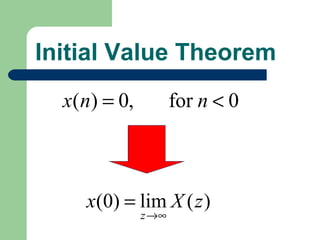
Initial Value Theorem
  x(n) = 0,          for n < 0


     x(0) = lim X ( z )
              z →∞
Convolution of Sequences

      Z [ x(n)] = X ( z ),         z ∈ Rx
      Z [ y (n)] = Y ( z ),        z ∈ Ry


  Z [ x(n) * y (n)] = X ( z )Y ( z )   z ∈ Rx ∩ R y
Convolution of Sequences
                         ∞
x ( n) * y ( n) =      ∑ x(k ) y (n − k )
                       k = −∞

                            ∞
                             ∞
                                            −n
Z [ x(n) * y (n)] = ∑  ∑ x(k ) y (n − k )  z
                    n = −∞  k = −∞        
      ∞         ∞                           ∞                      ∞
=   ∑ x(k ) ∑ y(n − k )z         −n
                                      =   ∑
                                          k = −∞
                                                   x(k ) z − k   ∑ y (n)z − n
                                                                 n = −∞
    k = −∞    n = −∞

= X ( z )Y ( z )
The z-Transform


       System Function
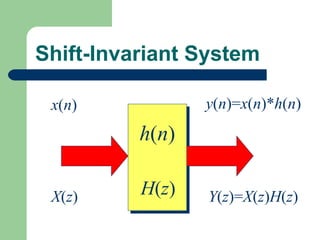
Shift-Invariant System

 x(n)            y(n)=x(n)*h(n)
          h(n)
          h(n)

 X(z)     H(z)   Y(z)=X(z)H(z)
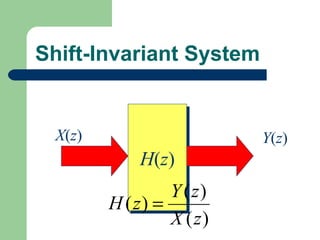
Shift-Invariant System


 X(z)                     Y(z)
             H(z)
             H(z)
                 Y ( z)
        H ( z) =
                 X ( z)
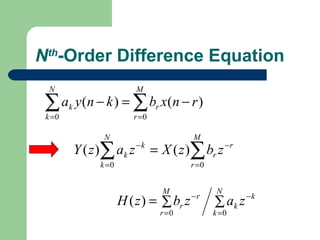
Nth-Order Difference Equation
  N                          M

 ∑a
 k =0
        k   y (n − k ) = ∑ br x(n − r )
                            r =0

                   N                        M
            Y ( z )∑ ak z − k = X ( z )∑ br z − r
                  k =0                      r =0


                                   M                N
                                            −r              −k
                         H ( z ) = ∑ br z          ∑ ak z
                                   r =0            k =0
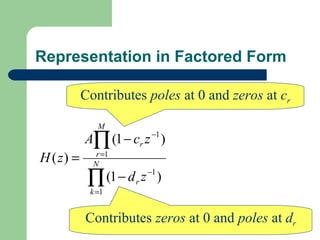
Representation in Factored Form

           Contributes poles at 0 and zeros at cr

              M
           A∏ (1 − cr z −1 )
H ( z) =     N
              r =1


            ∏ (1 − d r z −1 )
            k =1


           Contributes zeros at 0 and poles at dr
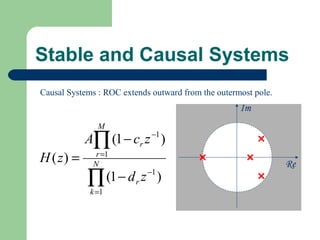
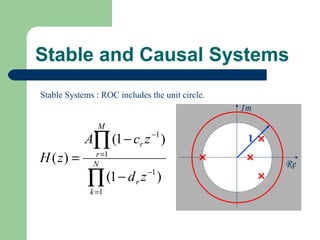
Stable and Causal Systems
Causal Systems : ROC extends outward from the outermost pole.
                                                    Im
               M
           A∏ (1 − cr z −1 )
H ( z) =     N
              r =1
                                                                Re
            ∏ (1 − d r z −1 )
             k =1
Stable and Causal Systems
Stable Systems : ROC includes the unit circle.
                                                 Im
                M
            A∏ (1 − cr z −1 )                     1
H ( z) =      N
               r =1
                                                      Re
             ∏ (1 − d r z −1 )
             k =1
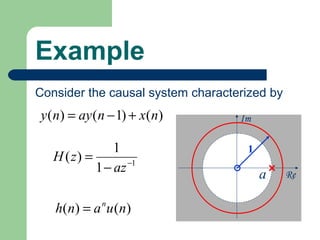
Example
Consider the causal system characterized by
y (n) = ay (n − 1) + x(n)          Im

                1                   1
   H ( z) =
            1 − az −1                   a     Re


   h( n) = a n u ( n)
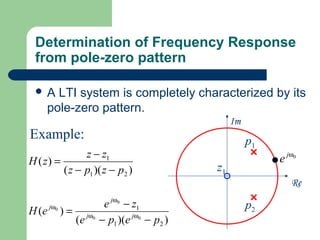
Determination of Frequency Response
 from pole-zero pattern

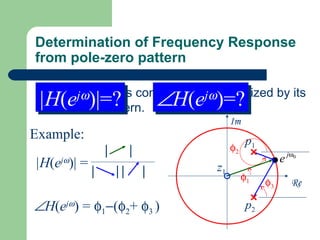
 A    LTI system is completely characterized by its
     pole-zero pattern.
                                                   Im
Example:                                                p1
               z − z1                                        e j ω0
H ( z) =
         ( z − p1 )( z − p2 )                 z1
                                                                 Re

                         e jω0 − z1                     p2
H (e jω0 ) =
               (e jω0   − p1 )(e jω0 − p2 )
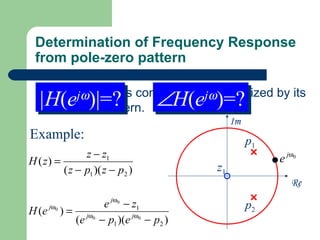
Determination of Frequency Response
 from pole-zero pattern


                                       ∠H(e )=?
 A    LTIjjω
           system is completely characterized by its
  |H(e )|=?
  |H(e )|=?ω
     pole-zero pattern.
                                  ω
                                 jjω
                                       ∠H(e )=?
                                                   Im
Example:                                                p1
               z − z1                                        e j ω0
H ( z) =
         ( z − p1 )( z − p2 )                 z1
                                                                 Re

                         e jω0 − z1                     p2
H (e jω0 ) =
               (e jω0   − p1 )(e jω0 − p2 )
Determination of Frequency Response
from pole-zero pattern


                                 ∠H(e )=?
A  LTIjjω
        system is completely characterized by its
        ω
 |H(e )|=?
 |H(e )|=?
  pole-zero pattern.
                               ω
                              jjω
                                 ∠H(e )=?
                                           Im
Example:                                         p1
                |        |                 φ2
     jω
|H(e )| =                                                  e j ω0
            |       ||       |        z1
                                                φ1    φ3       Re

∠H(ejω) = φ1−(φ2+ φ3 )                           p2
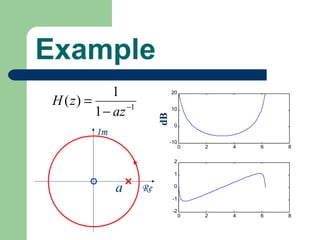
Example
             1                 20

H ( z) =        −1
         1 − az                10


                          dB
                                0
         Im
                               -10
                                     0   2   4   6   8

                                2

                                1


              a      Re         0

                                -1

                                -2
                                     0   2   4   6   8

Z transform ROC eng.Math

  • 1.
    The z-Transform 主講人:虞台文
  • 2.
    Content  Introduction  z-Transform Zeros and Poles  Region of Convergence  Important z-Transform Pairs  Inverse z-Transform  z-Transform Theorems and Properties  System Function
  • 3.
    The z-Transform Introduction
  • 4.
    Why z-Transform? A generalizationof Fourier transform  Why generalize it? – FT does not converge on all sequence – Notation good for analysis – Bring the power of complex variable theory deal with the discrete-time signals and systems
  • 5.
    The z-Transform z-Transform
  • 6.
    Definition  The z-transform of sequence x(n) is defined by ∞ X ( z) = ∑ x ( n) z n = −∞ −n Fourier Transform  Let z = e−jω. ∞ X (e ) = jω ∑ x ( n )e n =−∞ − jω n
  • 7.
    z-Plane ∞ ∑ x ( n) z −n Im X ( z) = n = −∞ z = e−jω ω ∞ Re jω X (e ) = ∑ x ( n )e n =−∞ − jω n Fourier Transform is to evaluate z-transform Fourier Transform is to evaluate z-transform on a unit circle. on a unit circle.
  • 8.
    z-Plane Im X(z) z = e−jω ω Re Im Re
  • 9.
    Periodic Property ofFT X(ejω) X(z) −π π ω Im Re Can you say why Fourier Transform is Can you say why Fourier Transform is aaperiodic function with period 2π? periodic function with period 2π?
  • 10.
    The z-Transform Zeros and Poles
  • 11.
    Definition  Give asequence, the set of values of z for which the z-transform converges, i.e., |X(z)|<∞, is called the region of convergence. ∞ ∞ | X ( z ) |= ∑ x ( n) z − n = n = −∞ ∑ | x(n) || z |− n < ∞ n = −∞ ROC is centered on origin and ROC is centered on origin and consists of a set of rings. consists of a set of rings.
  • 12.
    Example: Region ofConvergence ∞ ∞ | X ( z ) |= ∑ x ( n) z − n = n = −∞ ∑ | x(n) || z |− n < ∞ n = −∞ Im ROC is an annual ring centered ROC is an annual ring centered on the origin. on the origin. r Re Rx − <| z |< Rx + jω ROC = {z = re | Rx − < r < Rx + }
  • 13.
    Stable Systems A stablesystem requires that its Fourier transform is uniformly convergent. Im  Fact: Fourier transform is to evaluate z-transform on a unit circle. 1  A stable system requires the Re ROC of z-transform to include the unit circle.
  • 14.
    Example: A rightsided Sequence x ( n) = a n u ( n) x(n) ... n -8 -7 -6 -5 -4 -3 -2 -1 1 2 3 4 5 6 7 8 9 10
  • 15.
    Example: A rightsided Sequence For convergence of X(z), we x ( n) = a u ( n) n require that ∞ ∑ ∞ | az −1 | < ∞ | az −1 |< 1 X ( z) = ∑ a u (n)z n = −∞ n −n n =0 ∞ | z |>| a | = ∑ a n z −n ∞ 1 z n =0 X ( z ) = ∑ (az ) = −1 n −1 = ∞ n =0 1 − az z−a = ∑ (az −1 ) n | z |>| a | n =0
  • 16.
    Example: A rightsided Sequence ROC for x(n)=anu(n) z X ( z) = z−a , | z |>| a | Which one is stable? Which one is stable? Im Im 1 1 −a a −a a Re Re
  • 17.
    Example: A leftsided Sequence x(n) = −a nu (−n − 1) -8 -7 -6 -5 -4 -3 -2 -1 1 2 3 4 5 6 7 8 9 10 ... n x(n)
  • 18.
    Example: A leftsided Sequence For convergence of X(z), we x(n) = −a u (−n − 1)n require that ∞ ∞ X ( z ) = − ∑ a u (− n − 1)z ∑ | a −1 z | < ∞ −n | a −1 z |< 1 n n = −∞ −1 n =0 = − ∑ a n z −n n = −∞ | z |<| a | ∞ = −∑ a − n z n ∞ 1 z n =1 X ( z ) = 1 − ∑ (a z ) = 1 − −1 n −1 = ∞ n=0 1− a z z − a = 1 − ∑ a −n z n n =0 | z |<| a |
  • 19.
    Example: A leftsided Sequence ROC for x(n)=−anu(− n−1) z X ( z) = z−a , | z |<| a | Which one is stable? Which one is stable? Im Im 1 1 −a a −a a Re Re
  • 20.
    The z-Transform Region of Convergence
  • 21.
    Represent z-transform asa Rational Function P( z ) where P(z) and Q(z) are X ( z) = polynomials in z. Q( z ) Zeros: The values of z’s such that X(z) = 0 Poles: The values of z’s such that X(z) = ∞
  • 22.
    Example: A rightsided Sequence z x ( n) = a n u ( n) X ( z) = , | z |>| a | z−a Im ROC is bounded by the pole and is the exterior a Re of a circle.
  • 23.
    Example: A leftsided Sequence z x(n) = −a nu (−n − 1) X ( z) = , | z |<| a | z−a Im ROC is bounded by the pole and is the interior a Re of a circle.
  • 24.
    Example: Sum ofTwo Right Sided Sequences x ( n) = ( 1 ) n u ( n) + ( − 1 ) n u ( n) 2 3 z z 2 z ( z − 12 ) 1 X ( z) = + = z−2 z+3 1 1 ( z − 1 )( z + 1 ) 2 3 Im ROC is bounded by poles and is the exterior of a circle. 1/12 −1/3 1/2 Re ROC does not include any pole.
  • 25.
    Example: A TwoSided Sequence x(n) = (− 1 ) n u (n) − ( 1 ) n u (−n − 1) 3 2 z z 2 z ( z − 12 ) 1 X ( z) = + = z+3 z−2 1 1 ( z + 1 )( z − 1 ) 3 2 Im ROC is bounded by poles and is a ring. 1/12 −1/3 1/2 Re ROC does not include any pole.
  • 26.
    Example: A FiniteSequence x ( n) = a n , 0 ≤ n ≤ N −1 N −1 N −1 1 − (az −1 ) N 1 zN − aN X ( z) = ∑ a z n −n = ∑ ( az ) −1 n = = N −1 n =0 n =0 1 − az −1 z z−a Im N-1 zeros ROC: 0 < z < ∞ N-1 poles ROC does not include any pole. Re Always Stable Always Stable
  • 27.
    Properties of ROC  A ring or disk in the z-plane centered at the origin.  The Fourier Transform of x(n) is converge absolutely iff the ROC includes the unit circle.  The ROC cannot include any poles  Finite Duration Sequences: The ROC is the entire z-plane except possibly z=0 or z=∞.  Right sided sequences: The ROC extends outward from the outermost finite pole in X(z) to z=∞.  Left sided sequences: The ROC extends inward from the innermost nonzero pole in X(z) to z=0.
  • 28.
    More on Rationalz-Transform Consider the rational z-transform with the pole pattern: Im Find the possible Find the possible a b c ROC’s ROC’s Re
  • 29.
    More on Rationalz-Transform Consider the rational z-transform with the pole pattern: Im Case 1: A right sided Sequence. a b c Re
  • 30.
    More on Rationalz-Transform Consider the rational z-transform with the pole pattern: Im Case 2: A left sided Sequence. a b c Re
  • 31.
    More on Rationalz-Transform Consider the rational z-transform with the pole pattern: Im Case 3: A two sided Sequence. a b c Re
  • 32.
    More on Rationalz-Transform Consider the rational z-transform with the pole pattern: Im Case 4: Another two sided Sequence. a b c Re
  • 33.
    The z-Transform Important z-Transform Pairs
  • 34.
    Z-Transform Pairs Sequence z-Transform ROC δ(n) 1 All z All z except 0 (if m>0) δ( n − m ) z −m or ∞ (if m<0) 1 u (n) | z |> 1 1 − z −1 1 − u (−n − 1) | z |< 1 1 − z −1 1 n a u (n) | z |>| a | 1 − az −1 1 − a nu (−n − 1) | z |<| a | 1 − az −1
  • 35.
    Z-Transform Pairs Sequence z-Transform ROC 1 − [cos ω0 ] z −1 [cos ω0 n]u (n) | z |> 1 1 − [ 2 cos ω0 ]z −1 + z −2 [sin ω0 ]z −1 [sin ω0 n]u (n) | z |> 1 1 − [2 cos ω0 ]z −1 + z −2 1 − [ r cos ω0 ]z −1 [r n cos ω0 n]u (n) | z |> r 1 − [ 2r cos ω0 ]z −1 + r 2 z − 2 [r sin ω0 ] z −1 [r n sin ω0 n]u (n) | z |> r 1 − [ 2r cos ω0 ]z −1 + r 2 z − 2 a n 0 ≤ n ≤ N −1 1− aN z−N  | z |> 0 0 otherwise 1 − az −1
  • 36.
    The z-Transform Inverse z-Transform
  • 37.
    The z-Transform z-Transform Theorems and Properties
  • 38.
    Linearity Z [ x(n)] = X ( z ), z ∈ Rx Z [ y (n)] = Y ( z ), z ∈ Ry Z [ax(n) + by (n)] = aX ( z ) + bY ( z ), z ∈ Rx ∩ R y Overlay of the above two ROC’s
  • 39.
    Shift Z [ x(n)] = X ( z ), z ∈ Rx Z [ x(n + n0 )] = z X ( z ) n0 z ∈ Rx
  • 40.
    Multiplication by anExponential Sequence Z [ x(n)] = X ( z ), Rx- <| z |< Rx + −1 Z [a x(n)] = X (a z ) n z ∈| a | ⋅Rx
  • 41.
    Differentiation of X(z) Z [ x(n)] = X ( z ), z ∈ Rx dX ( z ) Z [nx(n)] = − z z ∈ Rx dz
  • 42.
    Conjugation Z[ x(n)] = X ( z ), z ∈ Rx Z [ x * (n)] = X * ( z*) z ∈ Rx
  • 43.
    Reversal Z[ x(n)] = X ( z ), z ∈ Rx −1 Z [ x(−n)] = X ( z ) z ∈ 1 / Rx
  • 44.
    Real and ImaginaryParts Z [ x(n)] = X ( z ), z ∈ Rx Re[ x(n)] = 1 [ X ( z ) + X * ( z*)] 2 z ∈ Rx Im[ x(n)] = 1 2j [ X ( z ) − X * ( z*)] z ∈ Rx
  • 45.
    Initial Value Theorem x(n) = 0, for n < 0 x(0) = lim X ( z ) z →∞
  • 46.
    Convolution of Sequences Z [ x(n)] = X ( z ), z ∈ Rx Z [ y (n)] = Y ( z ), z ∈ Ry Z [ x(n) * y (n)] = X ( z )Y ( z ) z ∈ Rx ∩ R y
  • 47.
    Convolution of Sequences ∞ x ( n) * y ( n) = ∑ x(k ) y (n − k ) k = −∞  ∞ ∞  −n Z [ x(n) * y (n)] = ∑  ∑ x(k ) y (n − k )  z n = −∞  k = −∞  ∞ ∞ ∞ ∞ = ∑ x(k ) ∑ y(n − k )z −n = ∑ k = −∞ x(k ) z − k ∑ y (n)z − n n = −∞ k = −∞ n = −∞ = X ( z )Y ( z )
  • 48.
    The z-Transform System Function
  • 49.
    Shift-Invariant System x(n) y(n)=x(n)*h(n) h(n) h(n) X(z) H(z) Y(z)=X(z)H(z)
  • 50.
    Shift-Invariant System X(z) Y(z) H(z) H(z) Y ( z) H ( z) = X ( z)
  • 51.
    Nth-Order Difference Equation N M ∑a k =0 k y (n − k ) = ∑ br x(n − r ) r =0 N M Y ( z )∑ ak z − k = X ( z )∑ br z − r k =0 r =0 M N −r −k H ( z ) = ∑ br z ∑ ak z r =0 k =0
  • 52.
    Representation in FactoredForm Contributes poles at 0 and zeros at cr M A∏ (1 − cr z −1 ) H ( z) = N r =1 ∏ (1 − d r z −1 ) k =1 Contributes zeros at 0 and poles at dr
  • 53.
    Stable and CausalSystems Causal Systems : ROC extends outward from the outermost pole. Im M A∏ (1 − cr z −1 ) H ( z) = N r =1 Re ∏ (1 − d r z −1 ) k =1
  • 54.
    Stable and CausalSystems Stable Systems : ROC includes the unit circle. Im M A∏ (1 − cr z −1 ) 1 H ( z) = N r =1 Re ∏ (1 − d r z −1 ) k =1
  • 55.
    Example Consider the causalsystem characterized by y (n) = ay (n − 1) + x(n) Im 1 1 H ( z) = 1 − az −1 a Re h( n) = a n u ( n)
  • 56.
    Determination of FrequencyResponse from pole-zero pattern A LTI system is completely characterized by its pole-zero pattern. Im Example: p1 z − z1 e j ω0 H ( z) = ( z − p1 )( z − p2 ) z1 Re e jω0 − z1 p2 H (e jω0 ) = (e jω0 − p1 )(e jω0 − p2 )
  • 57.
    Determination of FrequencyResponse from pole-zero pattern ∠H(e )=? A LTIjjω system is completely characterized by its |H(e )|=? |H(e )|=?ω pole-zero pattern. ω jjω ∠H(e )=? Im Example: p1 z − z1 e j ω0 H ( z) = ( z − p1 )( z − p2 ) z1 Re e jω0 − z1 p2 H (e jω0 ) = (e jω0 − p1 )(e jω0 − p2 )
  • 58.
    Determination of FrequencyResponse from pole-zero pattern ∠H(e )=? A LTIjjω system is completely characterized by its ω |H(e )|=? |H(e )|=? pole-zero pattern. ω jjω ∠H(e )=? Im Example: p1 | | φ2 jω |H(e )| = e j ω0 | || | z1 φ1 φ3 Re ∠H(ejω) = φ1−(φ2+ φ3 ) p2
  • 59.
    Example 1 20 H ( z) = −1 1 − az 10 dB 0 Im -10 0 2 4 6 8 2 1 a Re 0 -1 -2 0 2 4 6 8