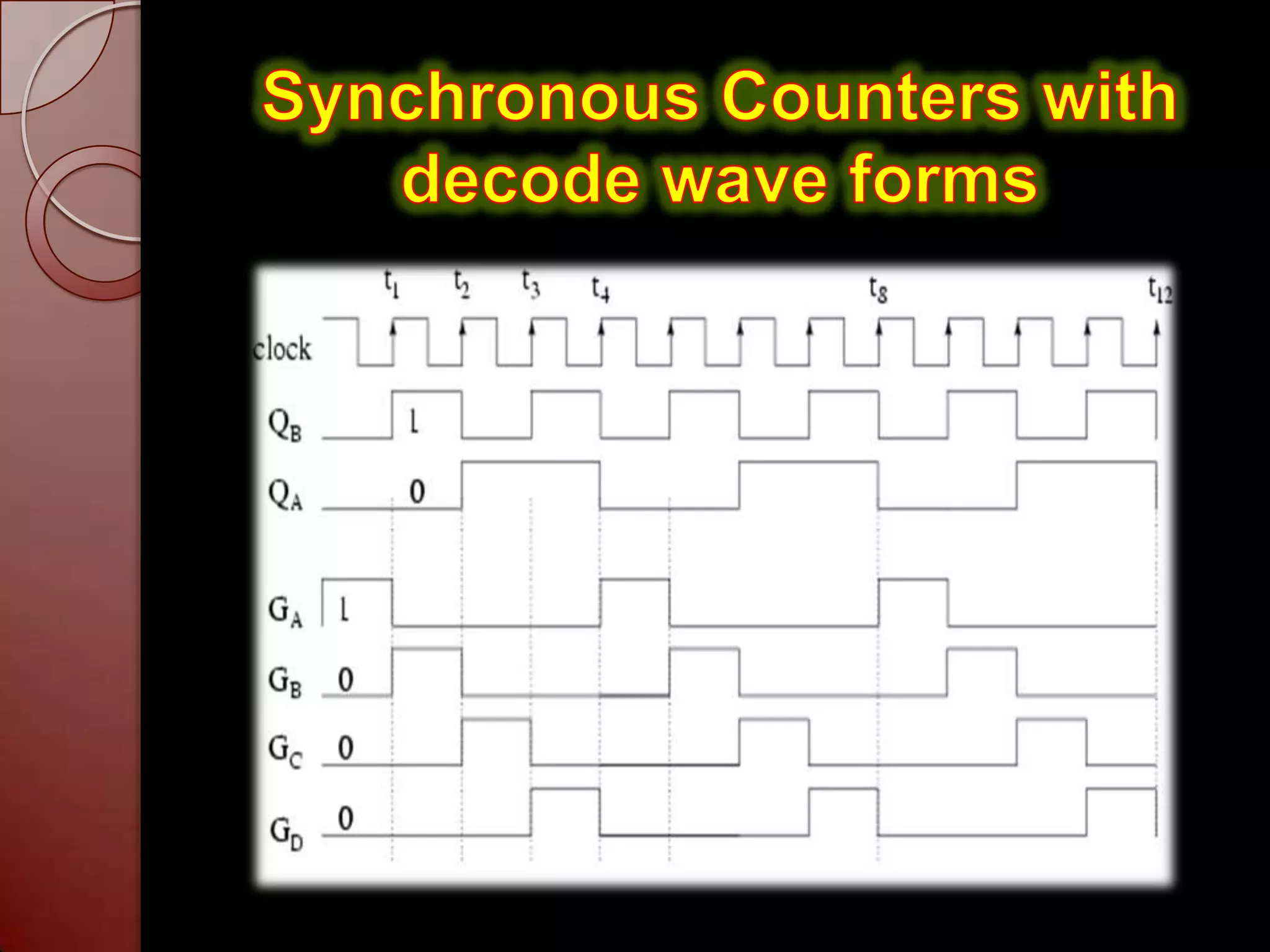
 Synchronous  means :
  Working or moving at the
   same rate
  Having the same period
   and phase of oscillation
   or cyclic movement.
 Circuitmeans:
  a route around which an
   electrical current can
   flow,    beginning   and
   ending at the same point.
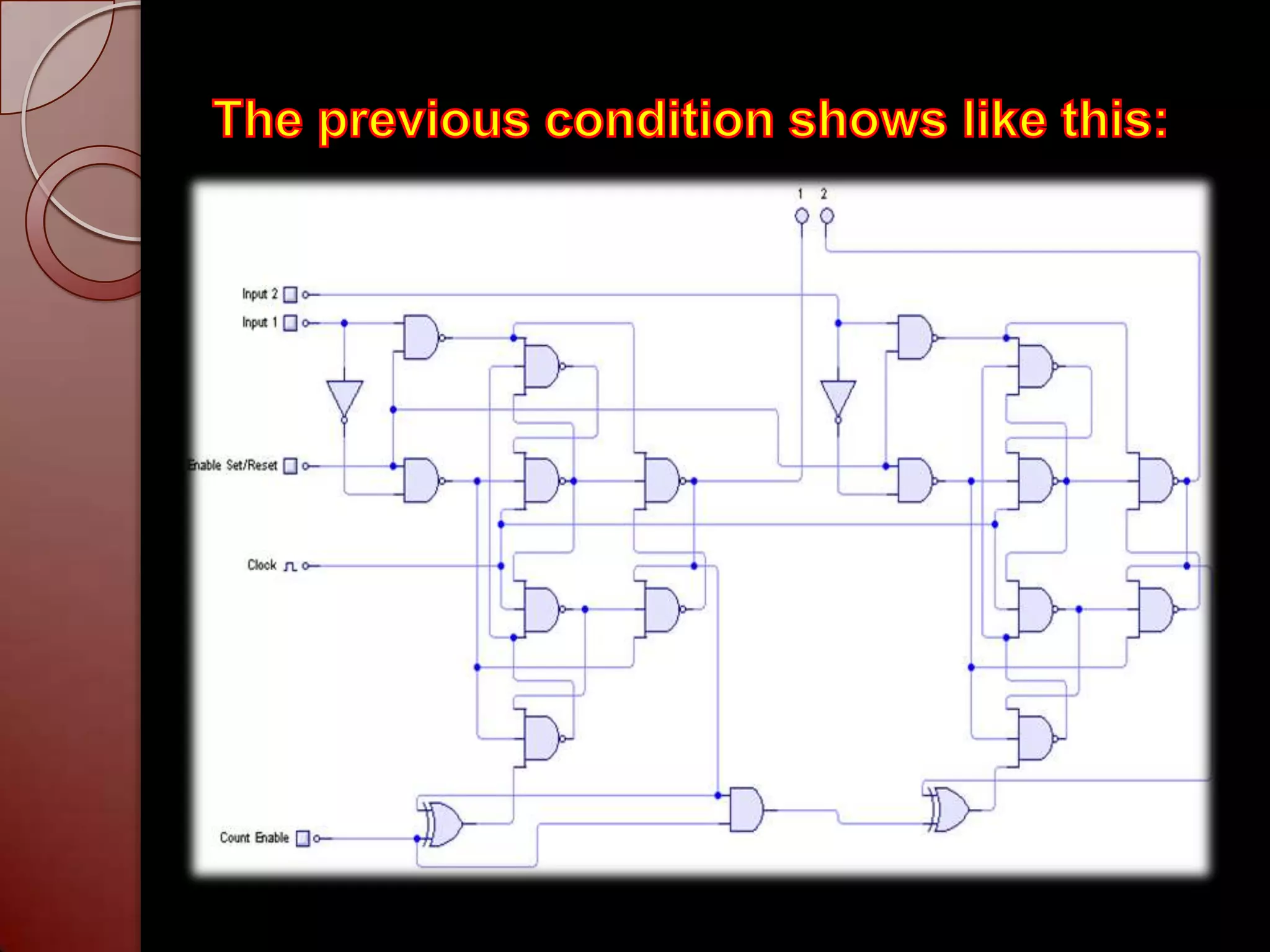
In this chapter we deal with synchronous
counters.     From       a   functional     point   of
view, synchronous counters implement finite
state machines. However, we use a syntactic
definition and show that every circuit that obeys
these syntactic rules implements a finite state
machine. Correct functionality of a synchronous
counters requires satisfaction of certain timing
constraints. Most importantly, all data inputs of
flip-flops must be stable during the critical
sections. A key advantage of the model (in which
the critical section and the instability interval of
each flip-flop are disjoint) is that it is possible to
satisfy all the timing constraints if the clock
period is sufficiently long.
In the canonic form, a synchronous
counter is decomposed into three parts:
     (i) the flip-flops store the state,
     (ii) a combinational circuit computes the
                   output, and
     (iii) a combinational circuit computes
the                next state.
     Finally, we deal with the issue of
initialization.         Loosely        speaking,
initialization of the circuit means that the
ip-ops output correct and stable values
during the rst clock period.
1. combinational gates
2. nets
3. flip-flops
A synchronous circuit is a circuit C
composed of combinational gates, nets,
and flip-flops that satisfies the following
                conditions:
 1. There is a net called clk that carries a clock signal.
 2. The clk net is fed by an input gate.
 3. The set of ports that are fed by the clk net equals
   the set of clock-inputs of the flip-flops.
 4. Define the circuit C0 as follows: The circuit C0 is
   obtained by (i) deleting the clk net, (ii) deleting the
   input gate that feeds the clk net, and (iii) replacing
   each flip-flop with an output gate (instead of the
   port D) and an input gate (instead of the port Q).
   We require that the circuit C0 is combinational.
In     parallel     (synchronous)
counters the input are pulses (or
levels and pulses) with certain
restrictions on pulse width and
circuit     propagation        delay.
Therefore synchronous circuits
can be divided into
sequential         circuits      and
              or pulsed sequential
circuits.
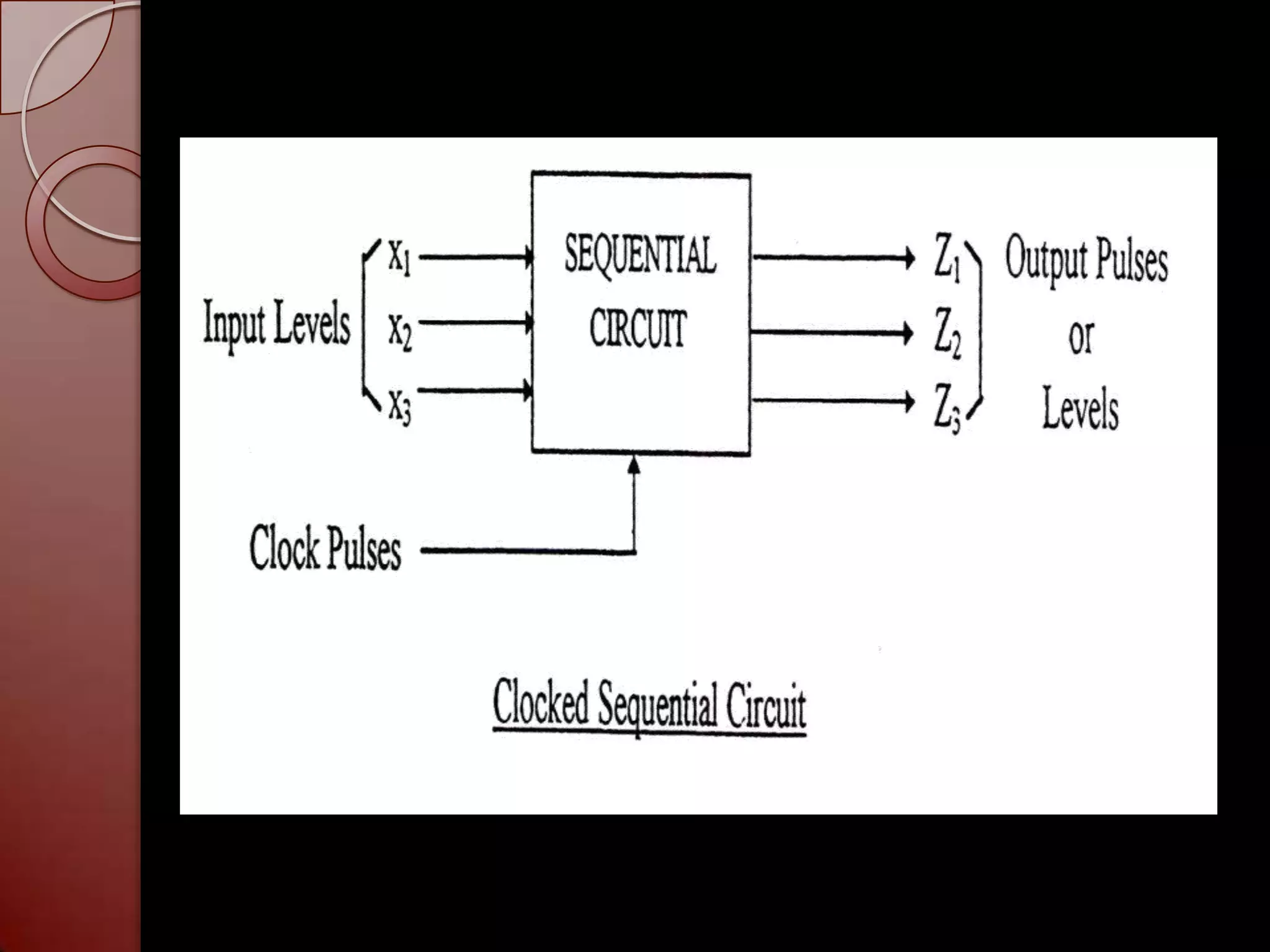
In a             sequential circuit
which has flip-flops or, in some
instances, gated latches, for its
memory      elements       there       is
a(synchronizing)     periodic     clock
connected to the clock inputs of all the
memory elements of the circuit, to
synchronize all internal changes of
state.
On    the     other hand in an
               or pulsed sequential
circuit, such a clock is not present.
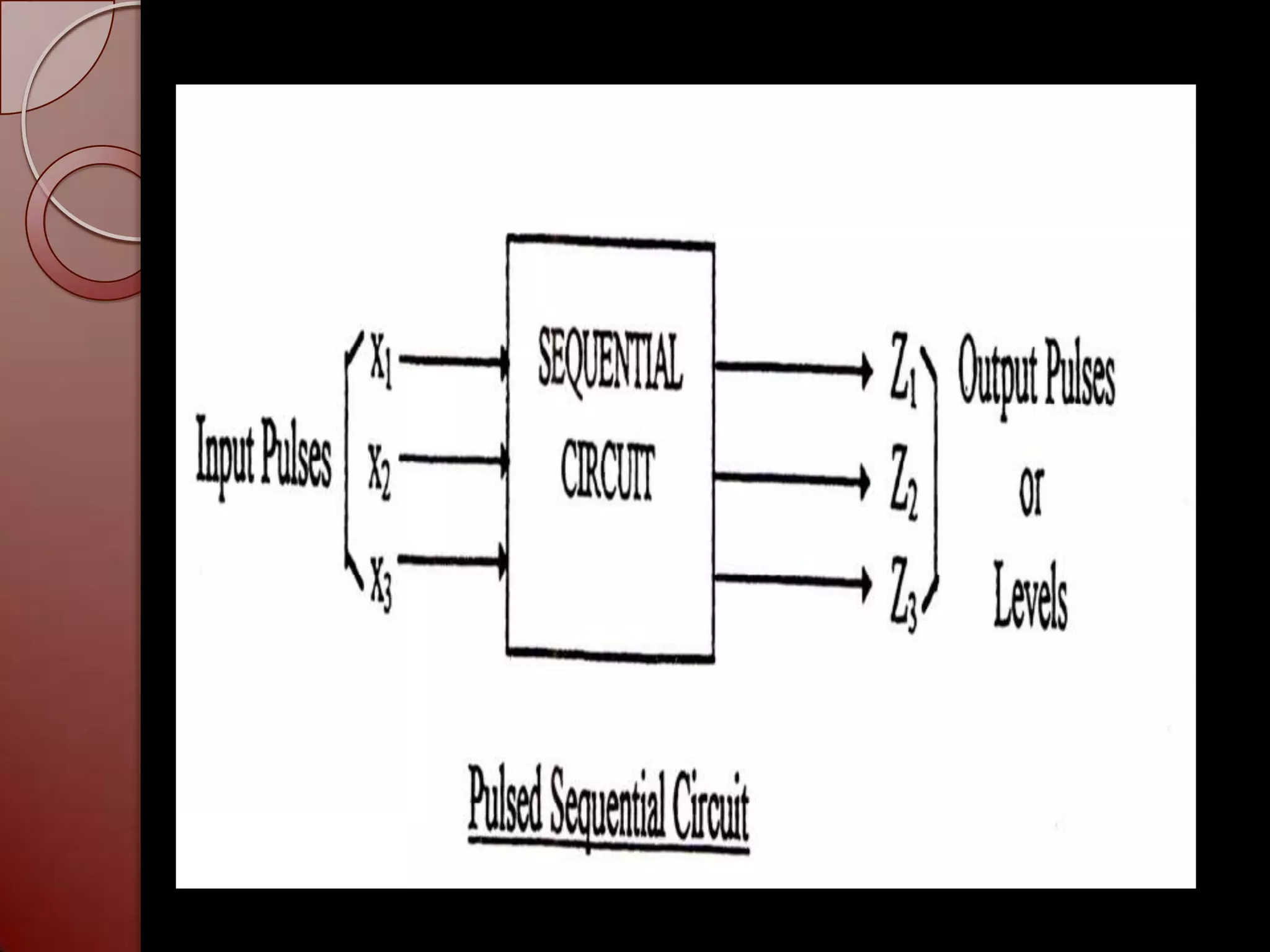
Pulse mode circuits require two
consecutive transitions between 0 and
1 - that is a 0-pulseor a 1 pulse to
alter the circuit’s state. A pulse -mode
circuit is designed to respond to
pulses of certain duration; the
constant signals between the pulses
are null or spacer signals, which do
not affect the circuit’s behavior.
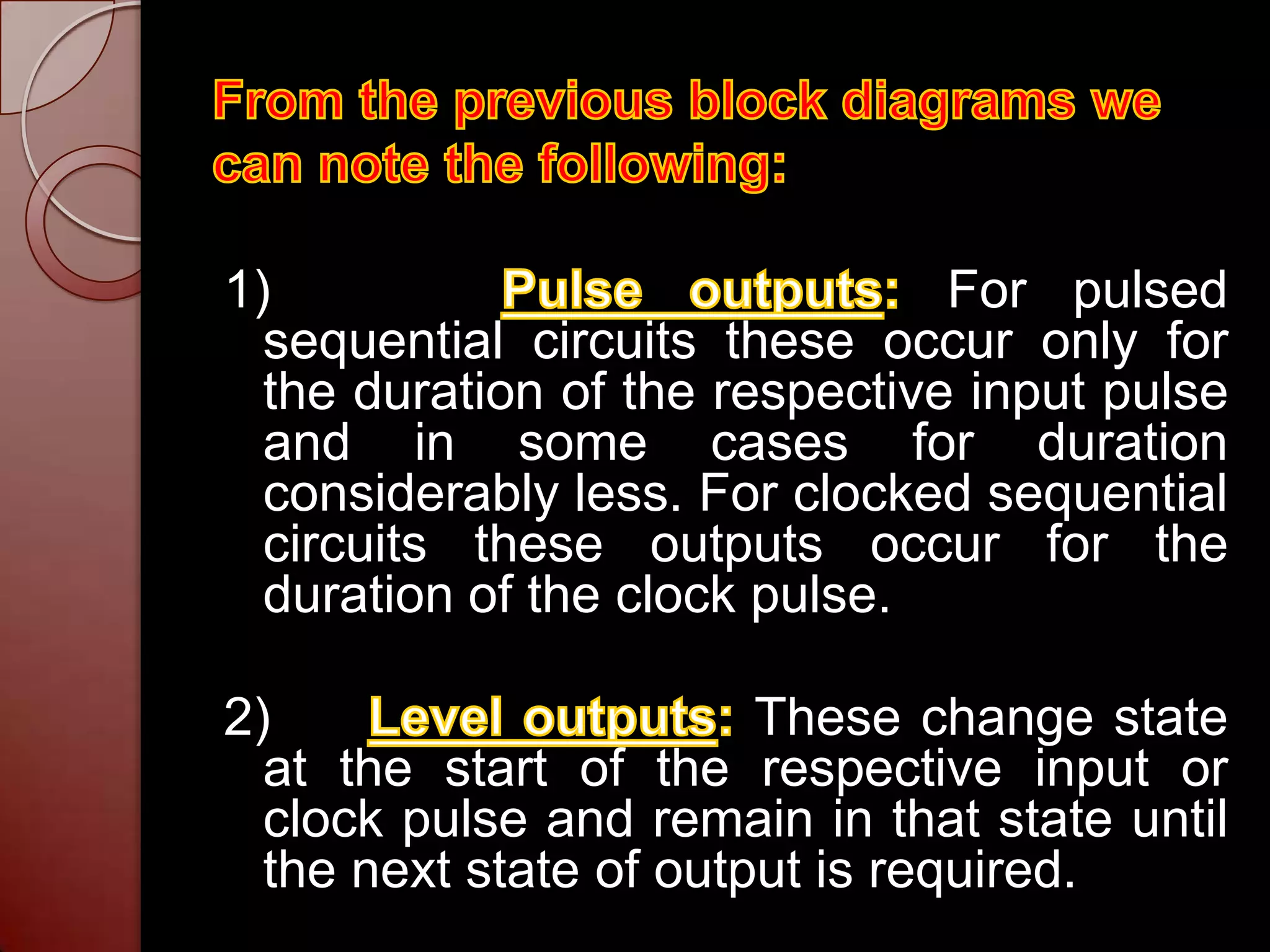
1)                              For pulsed
  sequential circuits these occur only for
  the duration of the respective input pulse
  and in some cases for duration
  considerably less. For clocked sequential
  circuits these outputs occur for the
  duration of the clock pulse.

2)                      These change state
  at the start of the respective input or
  clock pulse and remain in that state until
  the next state of output is required.
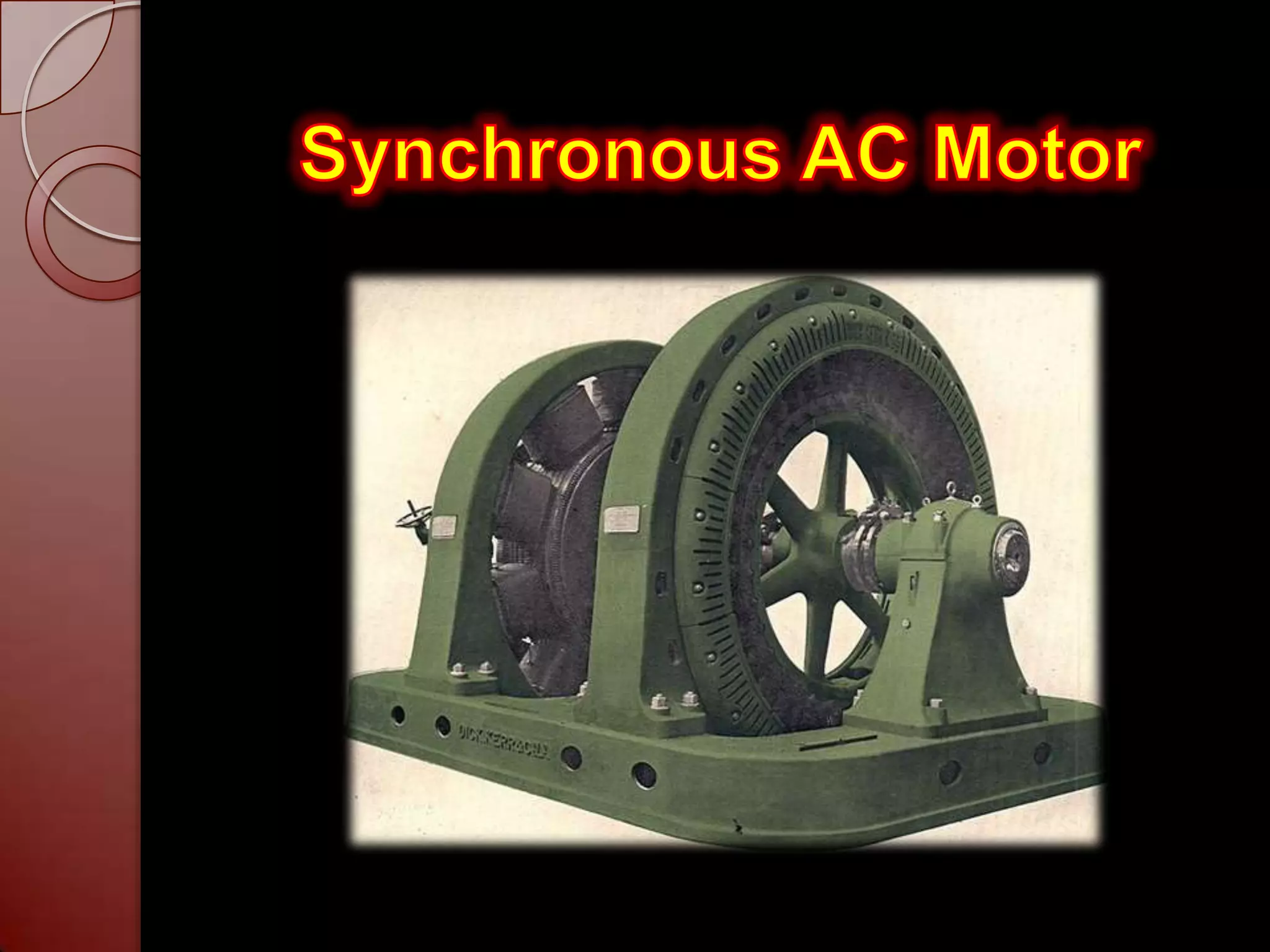
A synchronous electric motor is
an               in which the rotation of
the shaft is synchronized with the
              of the      supply current;
the rotation period is exactly equal to
an integral number of AC cycles.
Synchronous          motors         contain
                    on the           of the
motor that create a
which rotates in time with the
oscillations of the line current. The
       turns in step with this field, at the
same rate.
J. parallel (synchronous) counters

J. parallel (synchronous) counters

  • 2.
     Synchronous means : Working or moving at the same rate Having the same period and phase of oscillation or cyclic movement.
  • 3.
     Circuitmeans: a route around which an electrical current can flow, beginning and ending at the same point.
  • 4.
    In this chapterwe deal with synchronous counters. From a functional point of view, synchronous counters implement finite state machines. However, we use a syntactic definition and show that every circuit that obeys these syntactic rules implements a finite state machine. Correct functionality of a synchronous counters requires satisfaction of certain timing constraints. Most importantly, all data inputs of flip-flops must be stable during the critical sections. A key advantage of the model (in which the critical section and the instability interval of each flip-flop are disjoint) is that it is possible to satisfy all the timing constraints if the clock period is sufficiently long.
  • 6.
    In the canonicform, a synchronous counter is decomposed into three parts: (i) the flip-flops store the state, (ii) a combinational circuit computes the output, and (iii) a combinational circuit computes the next state. Finally, we deal with the issue of initialization. Loosely speaking, initialization of the circuit means that the ip-ops output correct and stable values during the rst clock period.
  • 7.
    1. combinational gates 2.nets 3. flip-flops
  • 8.
    A synchronous circuitis a circuit C composed of combinational gates, nets, and flip-flops that satisfies the following conditions: 1. There is a net called clk that carries a clock signal. 2. The clk net is fed by an input gate. 3. The set of ports that are fed by the clk net equals the set of clock-inputs of the flip-flops. 4. Define the circuit C0 as follows: The circuit C0 is obtained by (i) deleting the clk net, (ii) deleting the input gate that feeds the clk net, and (iii) replacing each flip-flop with an output gate (instead of the port D) and an input gate (instead of the port Q). We require that the circuit C0 is combinational.
  • 10.
    In parallel (synchronous) counters the input are pulses (or levels and pulses) with certain restrictions on pulse width and circuit propagation delay. Therefore synchronous circuits can be divided into sequential circuits and or pulsed sequential circuits.
  • 11.
    In a sequential circuit which has flip-flops or, in some instances, gated latches, for its memory elements there is a(synchronizing) periodic clock connected to the clock inputs of all the memory elements of the circuit, to synchronize all internal changes of state.
  • 13.
    On the other hand in an or pulsed sequential circuit, such a clock is not present. Pulse mode circuits require two consecutive transitions between 0 and 1 - that is a 0-pulseor a 1 pulse to alter the circuit’s state. A pulse -mode circuit is designed to respond to pulses of certain duration; the constant signals between the pulses are null or spacer signals, which do not affect the circuit’s behavior.
  • 15.
    1) For pulsed sequential circuits these occur only for the duration of the respective input pulse and in some cases for duration considerably less. For clocked sequential circuits these outputs occur for the duration of the clock pulse. 2) These change state at the start of the respective input or clock pulse and remain in that state until the next state of output is required.
  • 16.
    A synchronous electricmotor is an in which the rotation of the shaft is synchronized with the of the supply current; the rotation period is exactly equal to an integral number of AC cycles. Synchronous motors contain on the of the motor that create a which rotates in time with the oscillations of the line current. The turns in step with this field, at the same rate.