Prepared by: Mr. John Lexter L. Emberador
Analog Multimeter
Lesson Objectives
At the end of the lesson, the student will
be able to:
1. Identify the different parts of analog
multimeter;
2. Perform the mensuration and calculation of
different instruments used in electronics
servicing; and
3. Appreciate the importance of the lesson as
practical skills in electronics.
Analog Multimeter
• It has a moving coil assembly which is
characterized by a needle pointer. The
advantage of analog multimeter over digital
multimeter is a resistance test in testing
electronic components such as capacitor and
transistor.
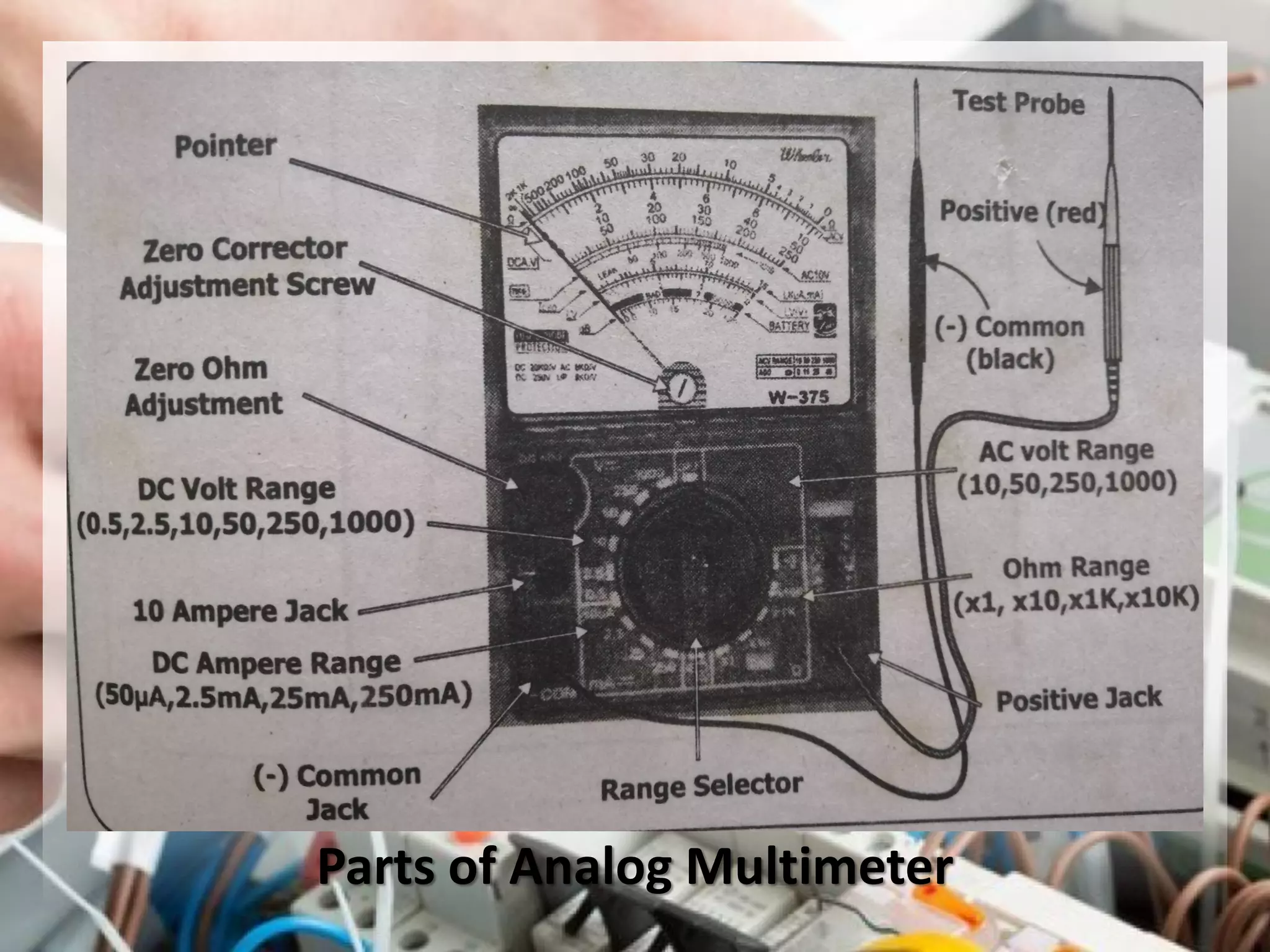
Parts of Analog Multimeter
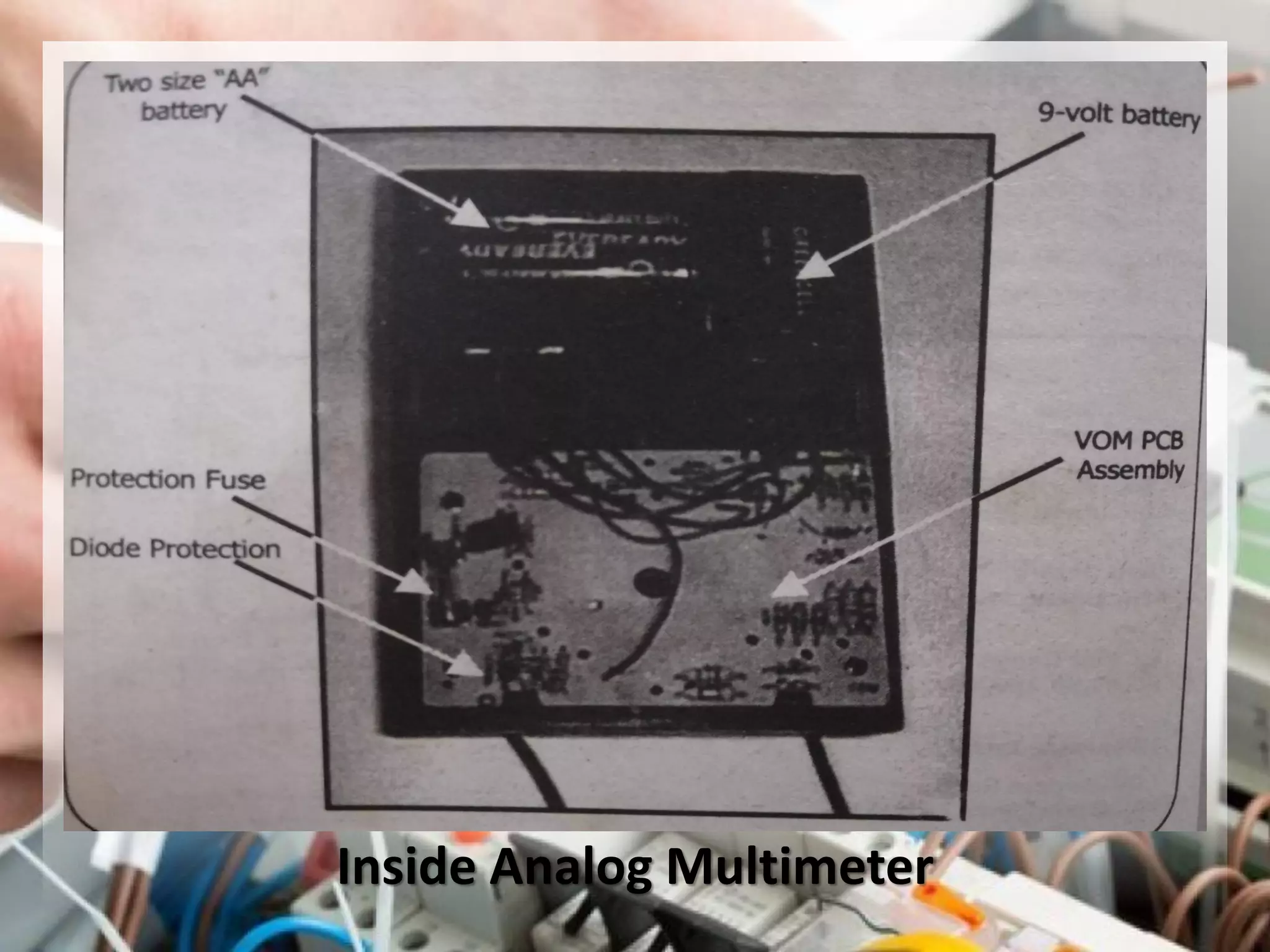
Inside Analog Multimeter
Steps in using Analog Multimeter
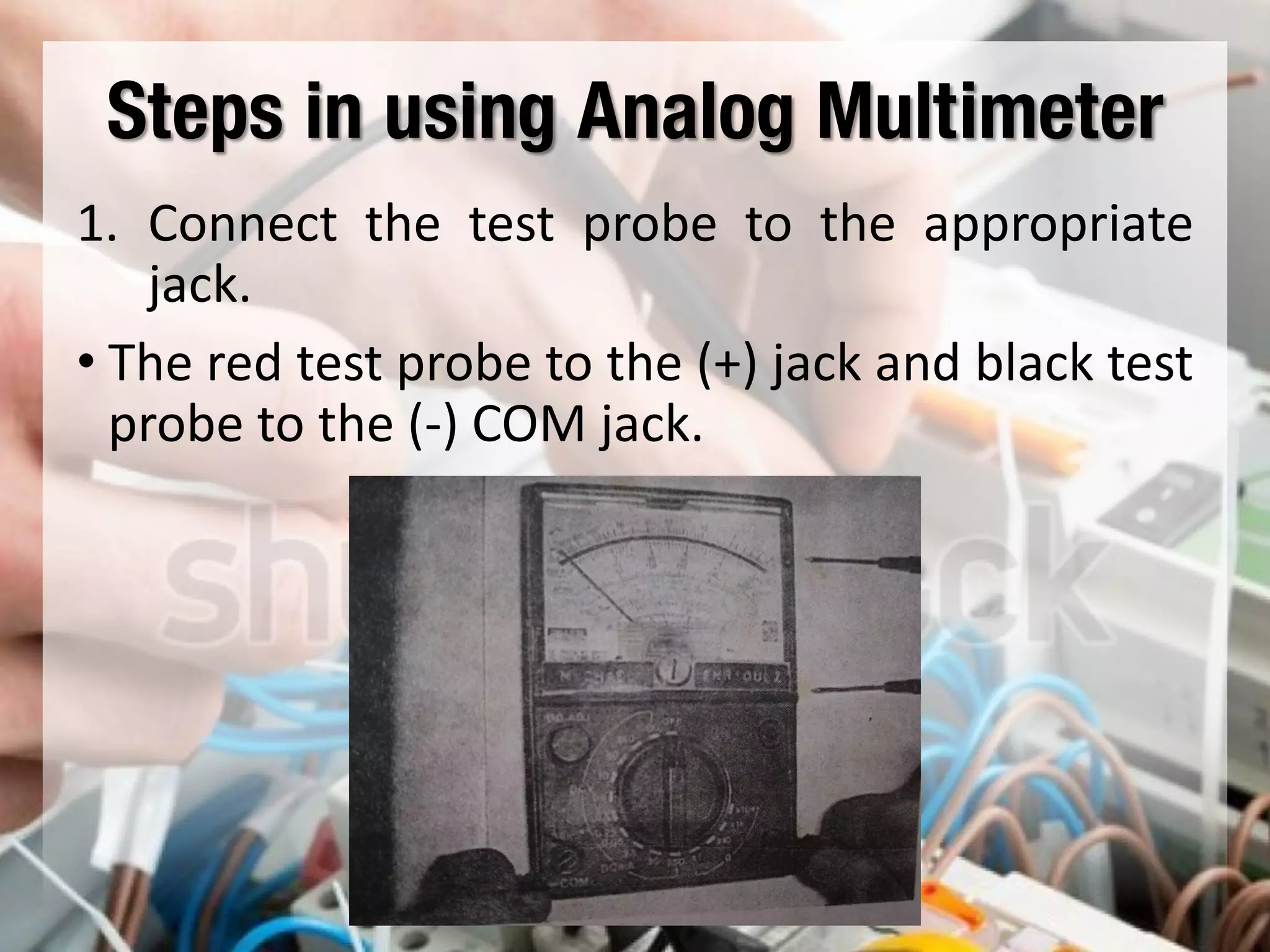
1. Connect the test probe to the appropriate
jack.
• The red test probe to the (+) jack and black test
probe to the (-) COM jack.
Steps in using Analog Multimeter
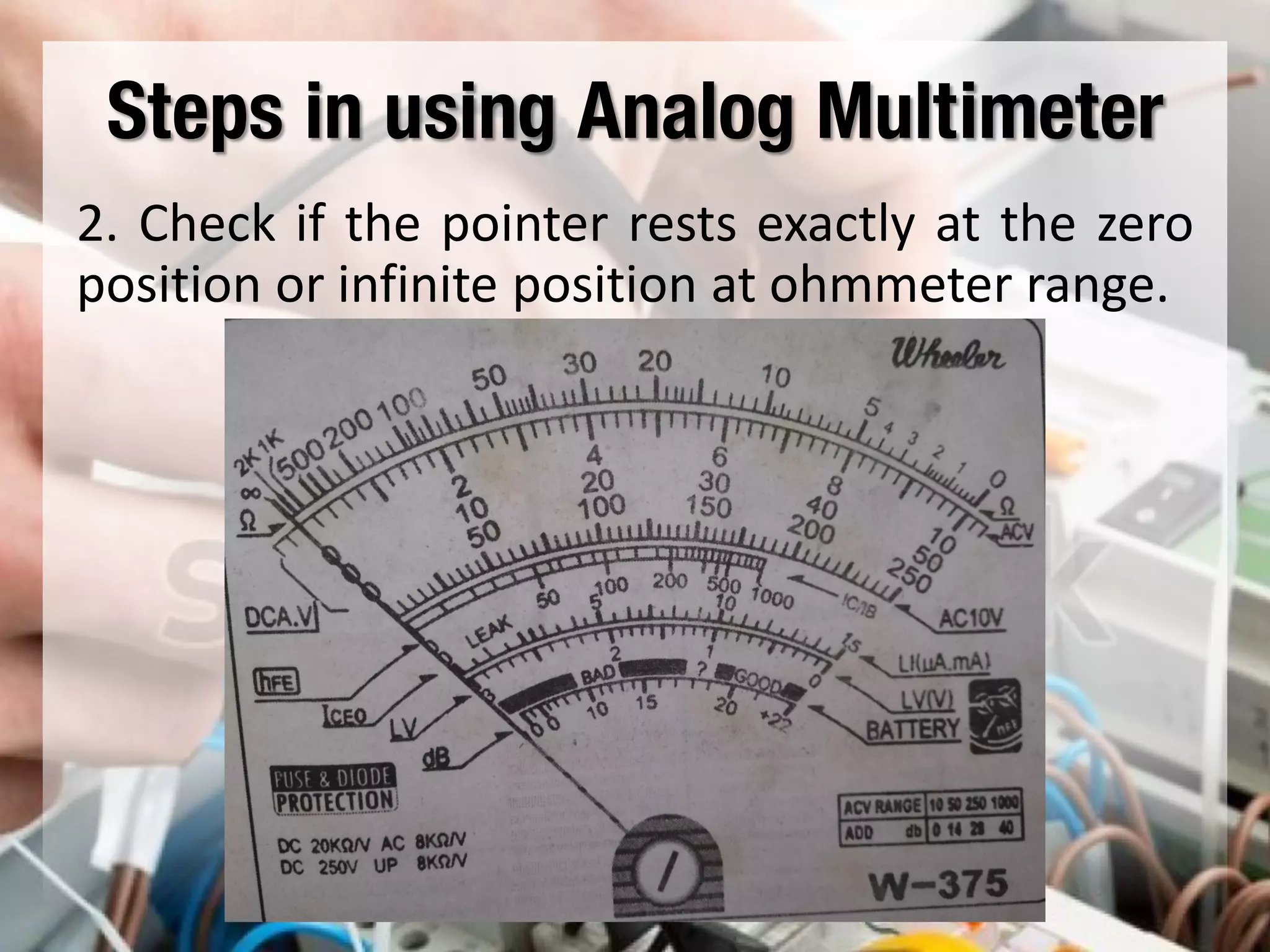
2. Check if the pointer rests exactly at the zero
position or infinite position at ohmmeter range.
Steps in using Analog Multimeter
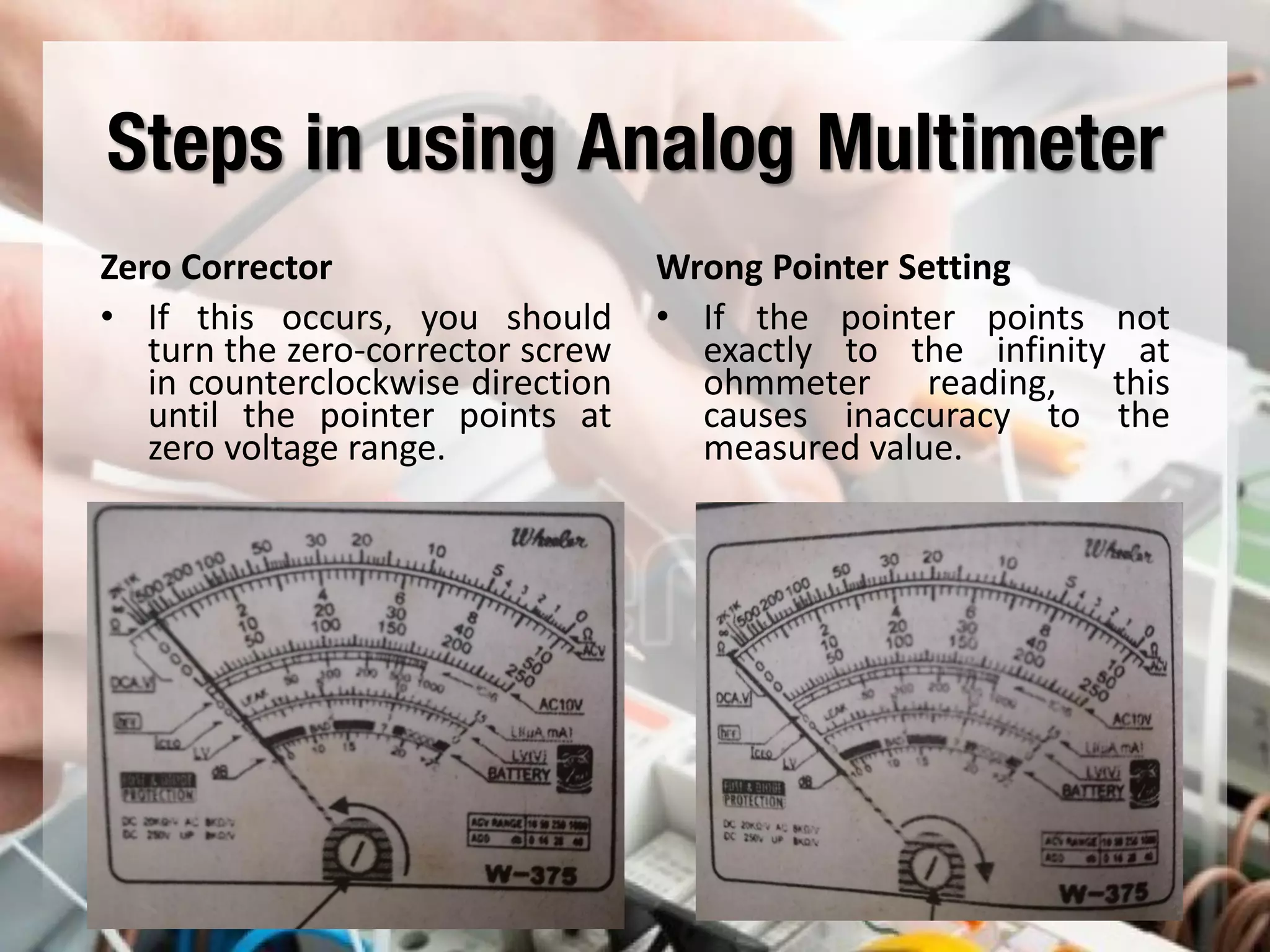
Zero Corrector
• If this occurs, you should
turn the zero-corrector screw
in counterclockwise direction
until the pointer points at
zero voltage range.
Wrong Pointer Setting
• If the pointer points not
exactly to the infinity at
ohmmeter reading, this
causes inaccuracy to the
measured value.
Steps in using Analog Multimeter
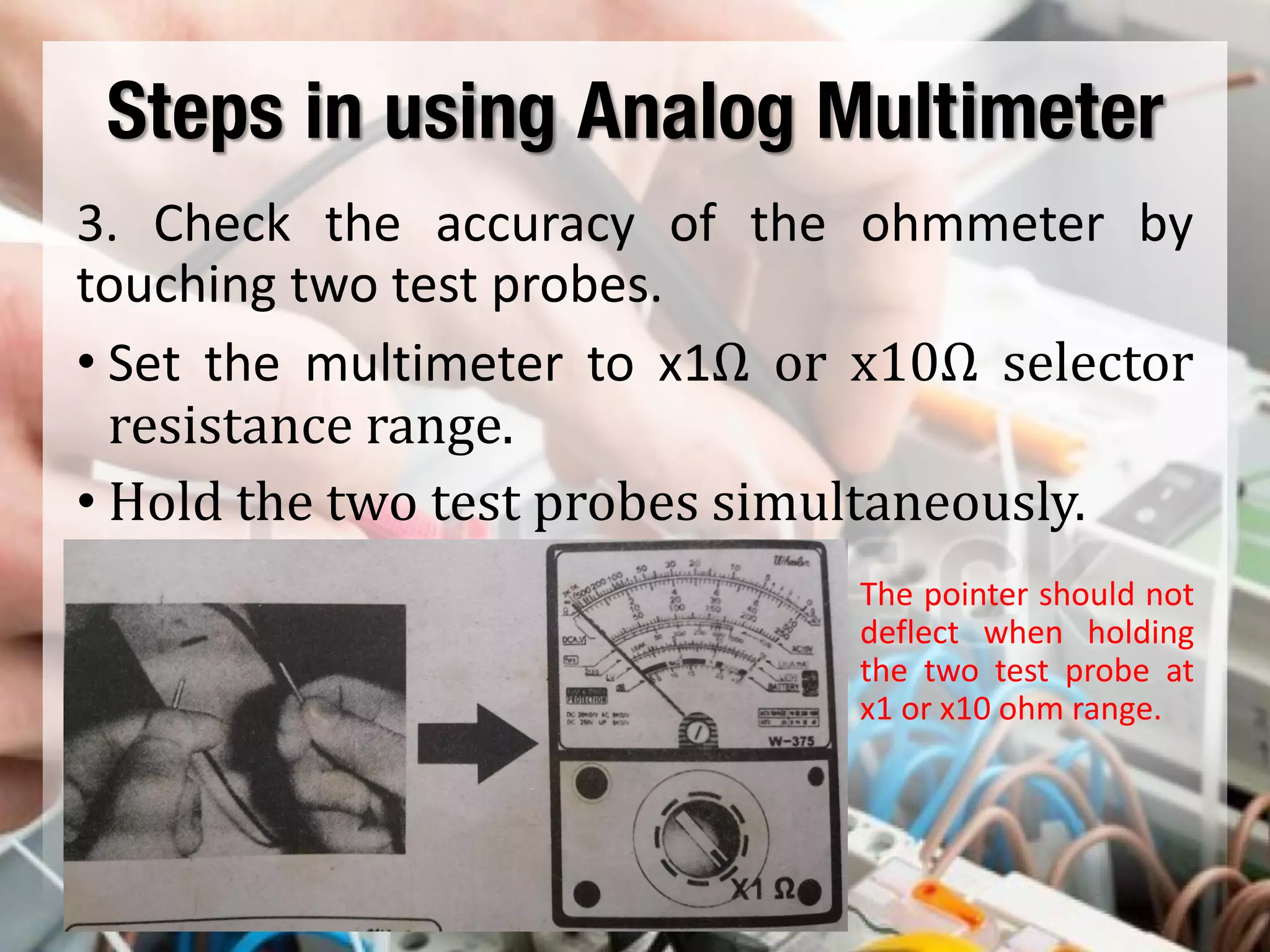
3. Check the accuracy of the ohmmeter by
touching two test probes.
• Set the multimeter to x1Ω or x10Ω selector
resistance range.
• Hold the two test probes simultaneously.
The pointer should not
deflect when holding
the two test probe at
x1 or x10 ohm range.
Steps in using Analog Multimeter
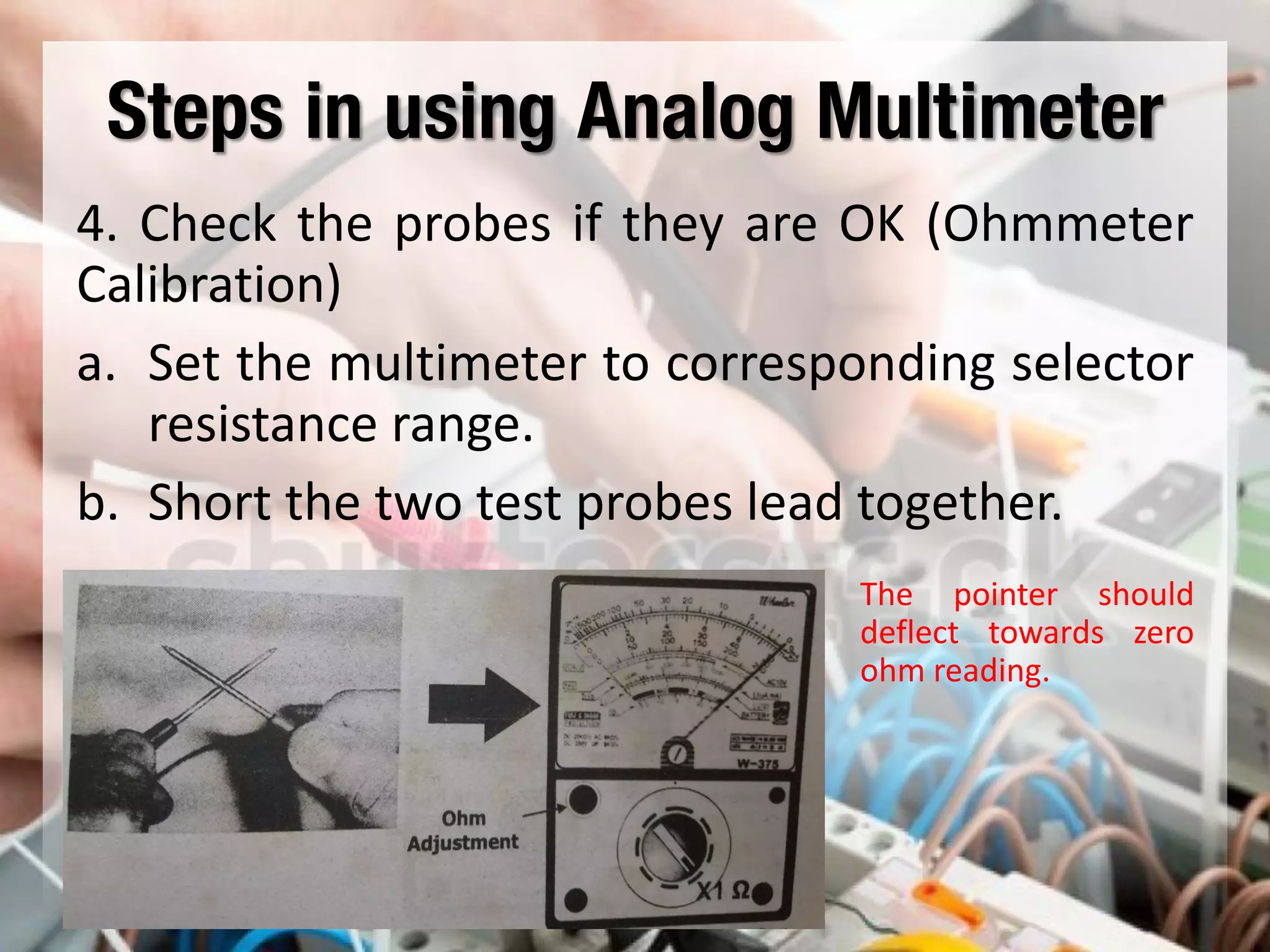
4. Check the probes if they are OK (Ohmmeter
Calibration)
a. Set the multimeter to corresponding selector
resistance range.
b. Short the two test probes lead together.
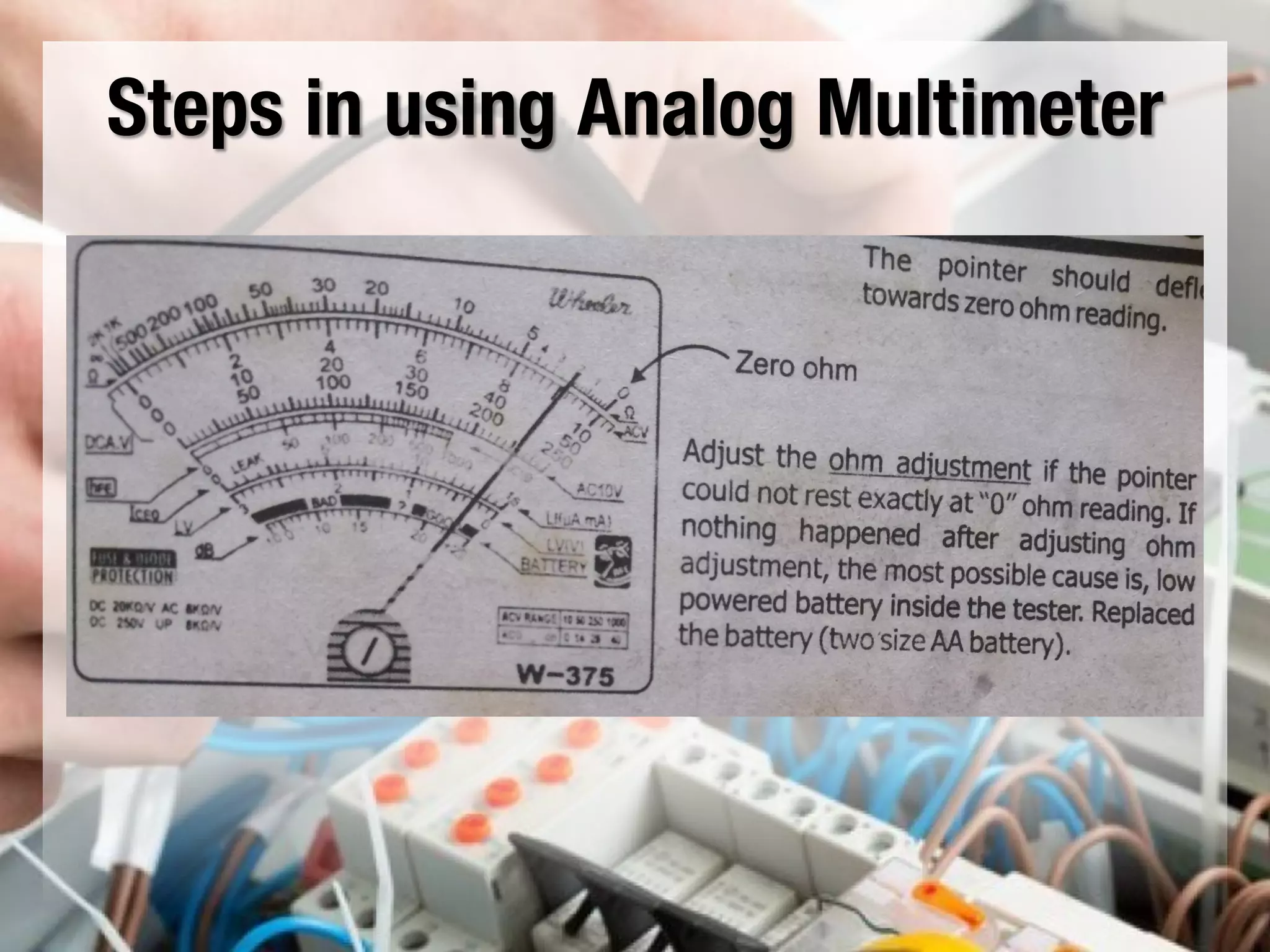
The pointer should
deflect towards zero
ohm reading.
Steps in using Analog Multimeter
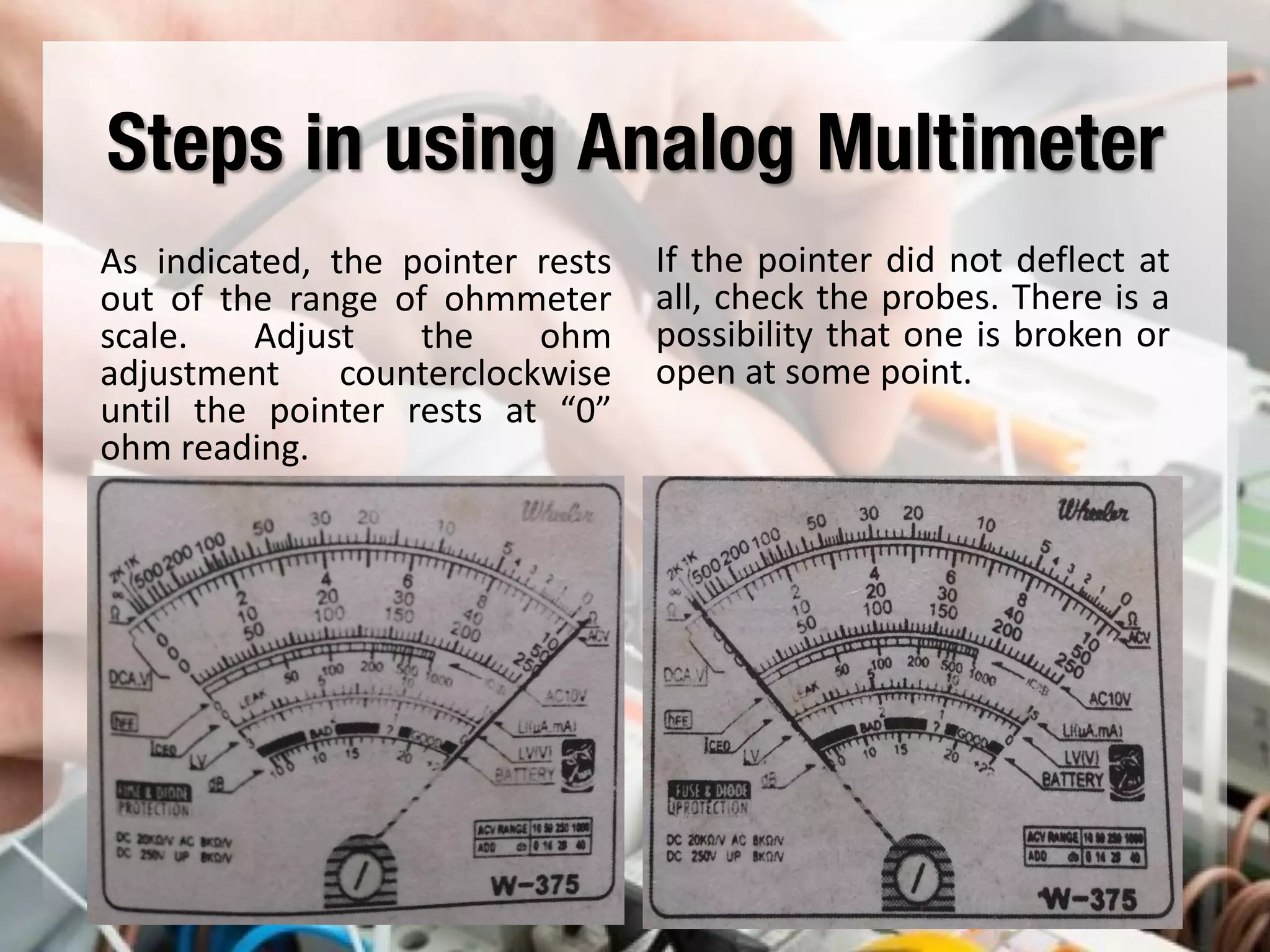
As indicated, the pointer rests
out of the range of ohmmeter
scale. Adjust the ohm
adjustment counterclockwise
until the pointer rests at “0”
ohm reading.
If the pointer did not deflect at
all, check the probes. There is a
possibility that one is broken or
open at some point.
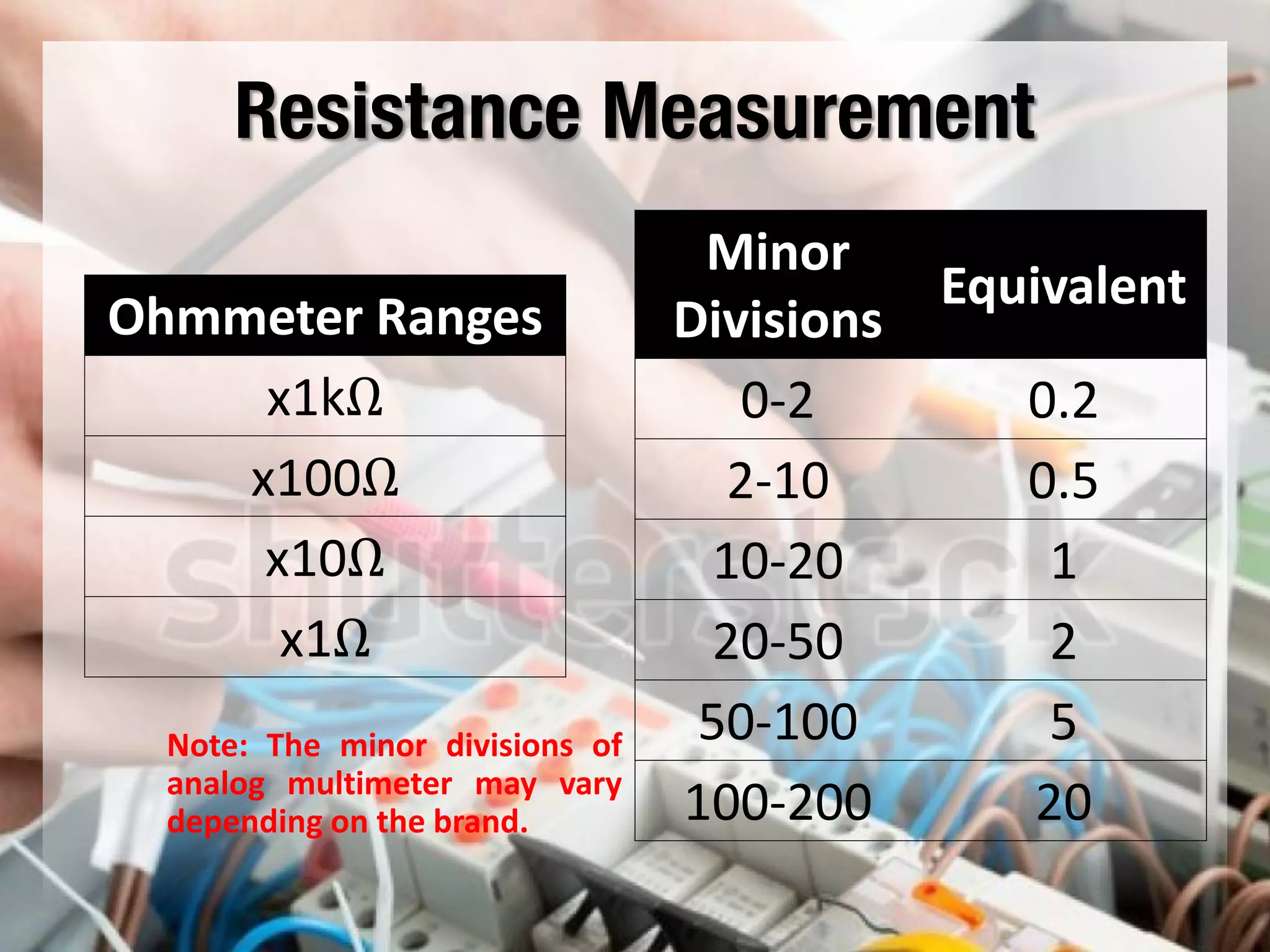
Resistance Measurement
Ohmmeter Ranges
x1kΩ
x100Ω
x10Ω
x1Ω
Minor
Divisions
Equivalent
0-2 0.2
2-10 0.5
10-20 1
20-50 2
50-100 5
100-200 20
Note: The minor divisions of
analog multimeter may vary
depending on the brand.
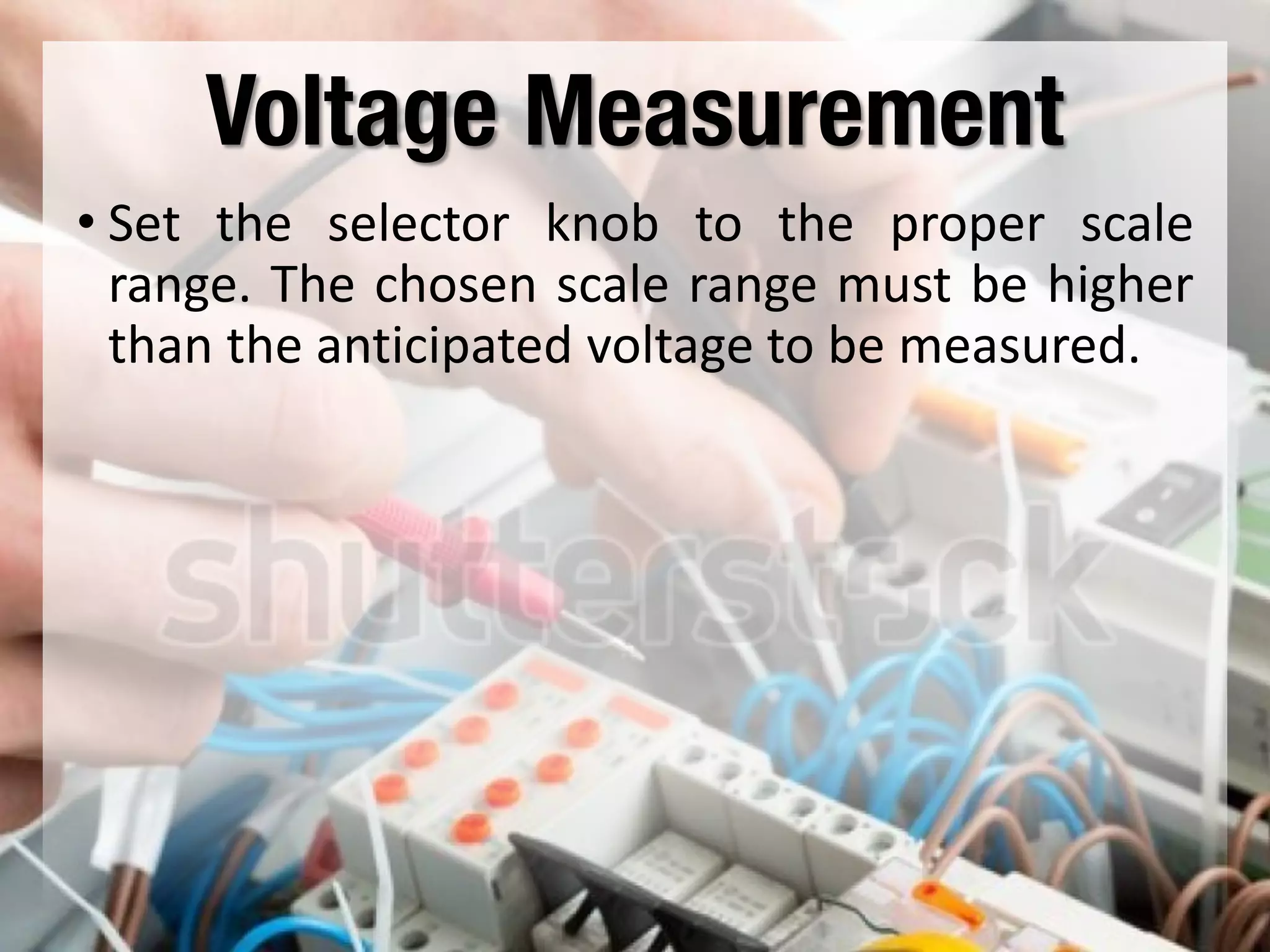
Voltage Measurement
• Set the selector knob to the proper scale
range. The chosen scale range must be higher
than the anticipated voltage to be measured.
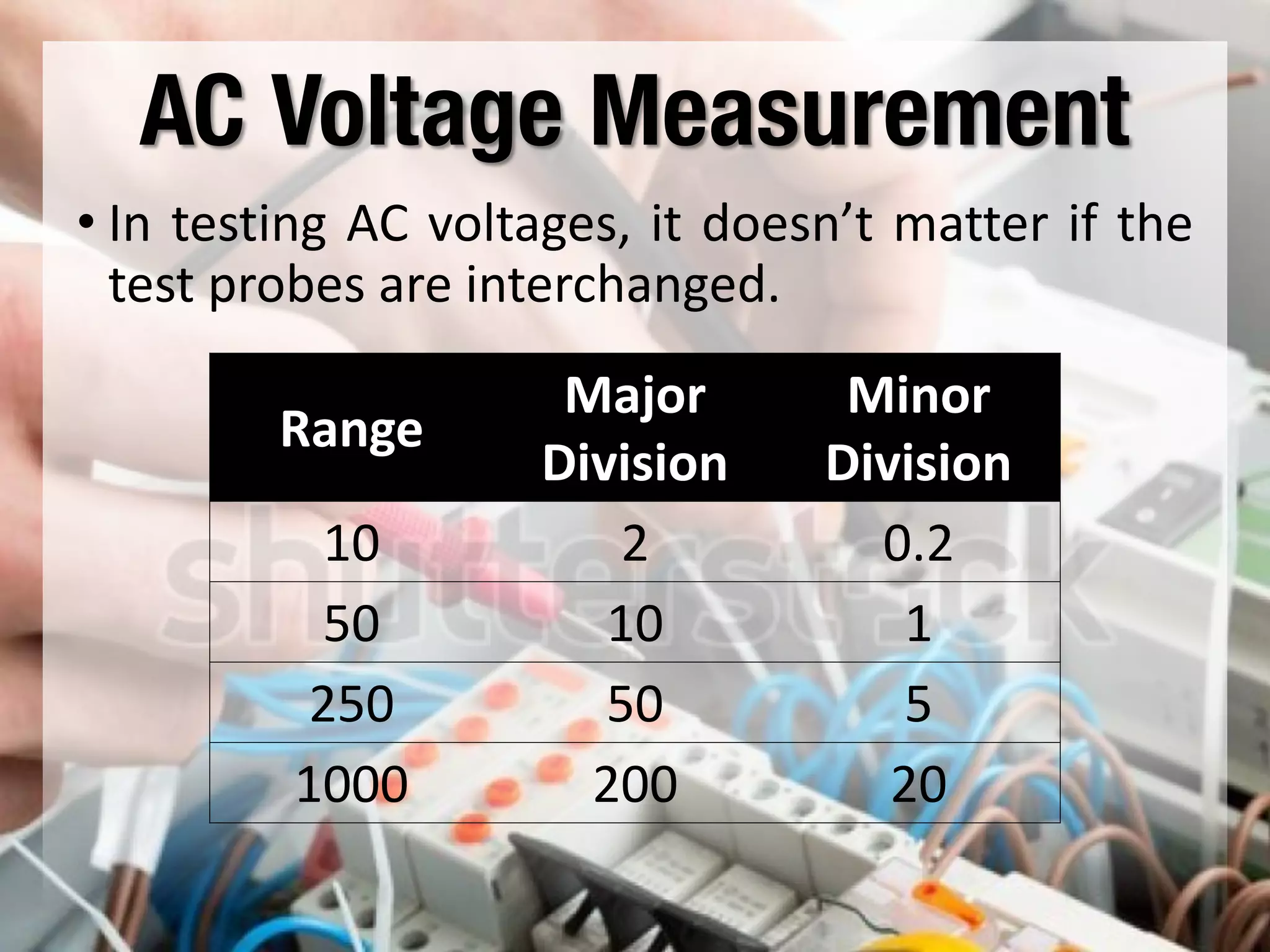
AC Voltage Measurement
• In testing AC voltages, it doesn’t matter if the
test probes are interchanged.
Range
Major
Division
Minor
Division
10 2 0.2
50 10 1
250 50 5
1000 200 20
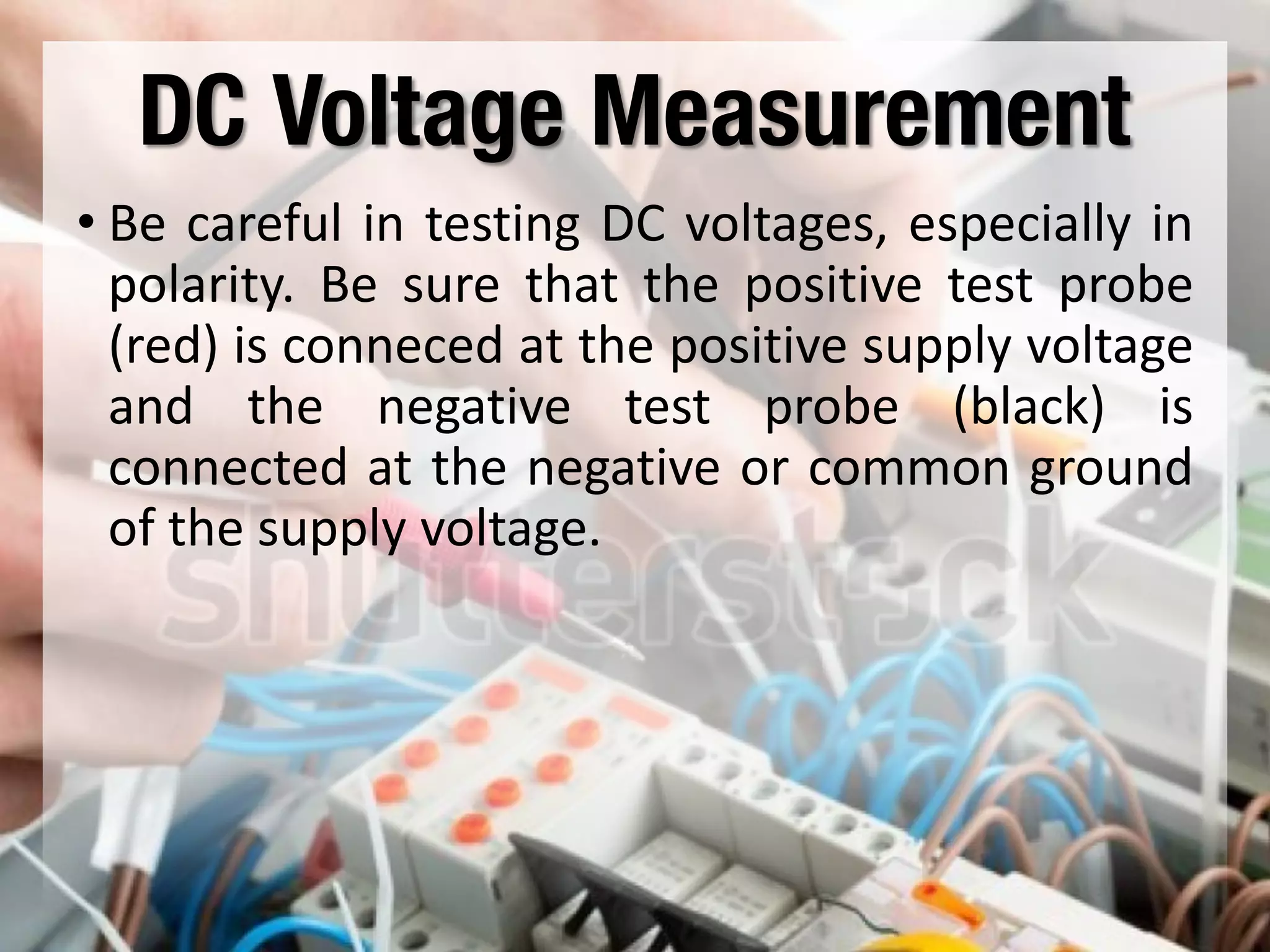
DC Voltage Measurement
• Be careful in testing DC voltages, especially in
polarity. Be sure that the positive test probe
(red) is conneced at the positive supply voltage
and the negative test probe (black) is
connected at the negative or common ground
of the supply voltage.
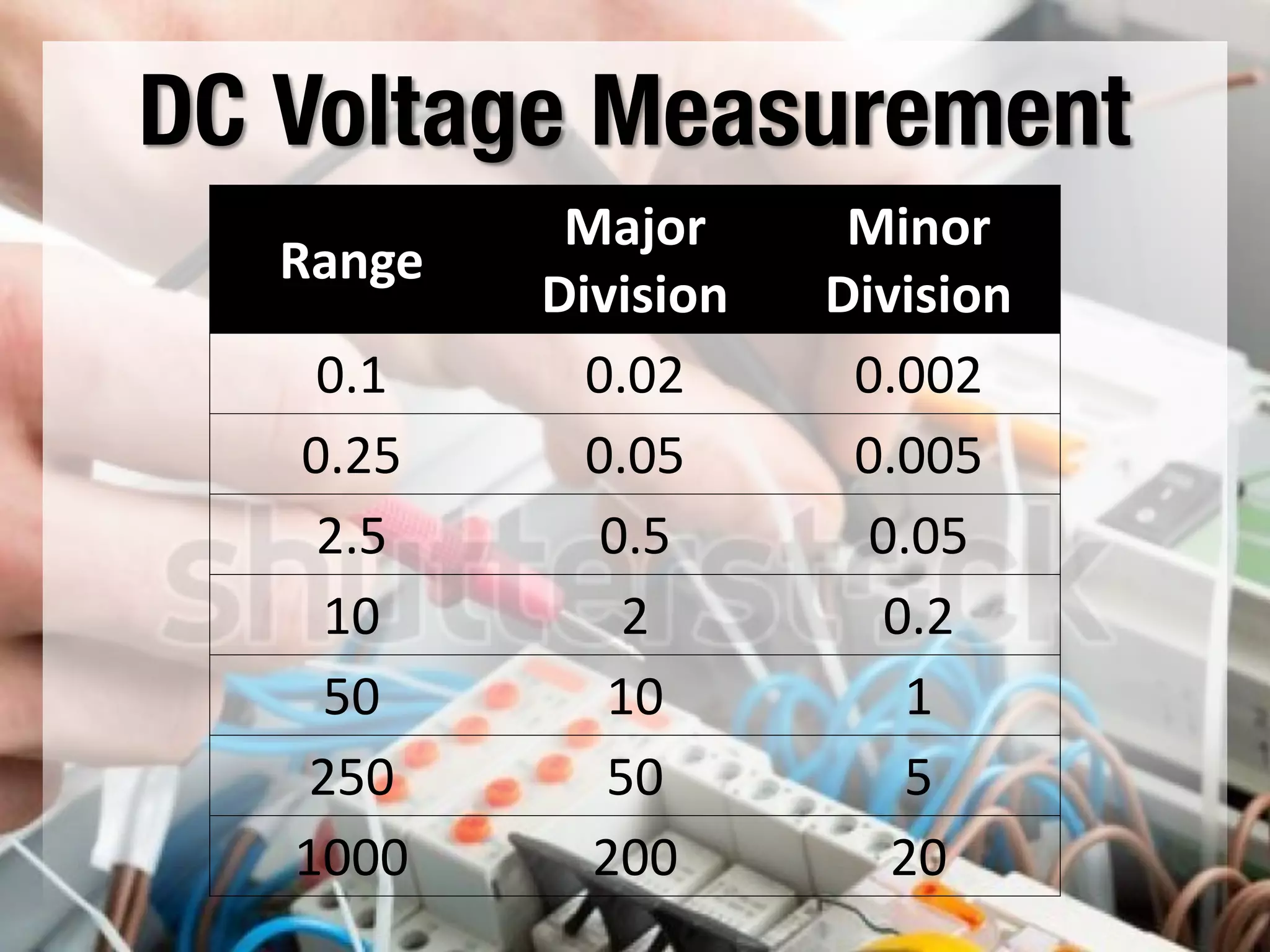
DC Voltage Measurement
Range
Major
Division
Minor
Division
0.1 0.02 0.002
0.25 0.05 0.005
2.5 0.5 0.05
10 2 0.2
50 10 1
250 50 5
1000 200 20
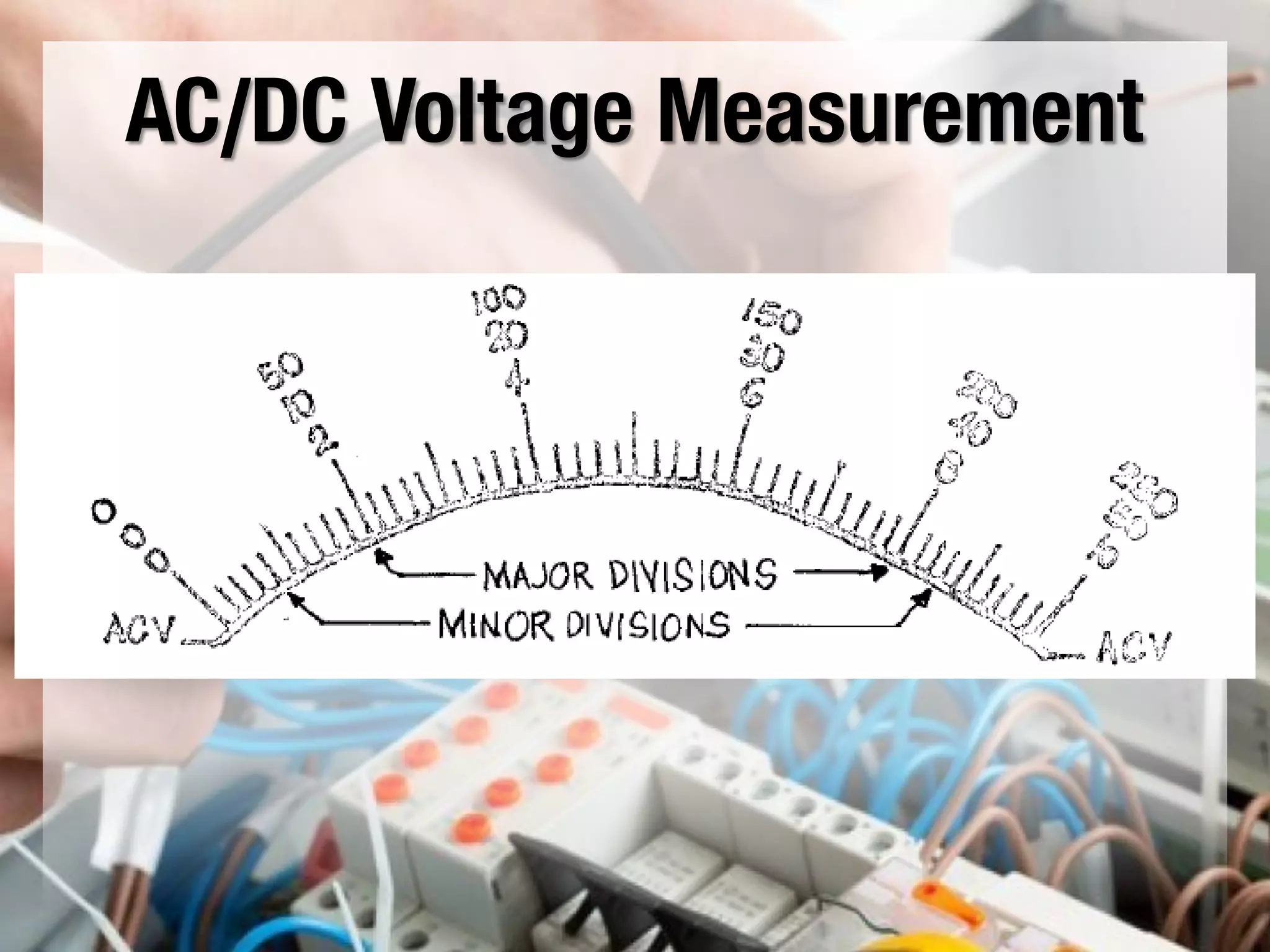
AC/DC Voltage Measurement
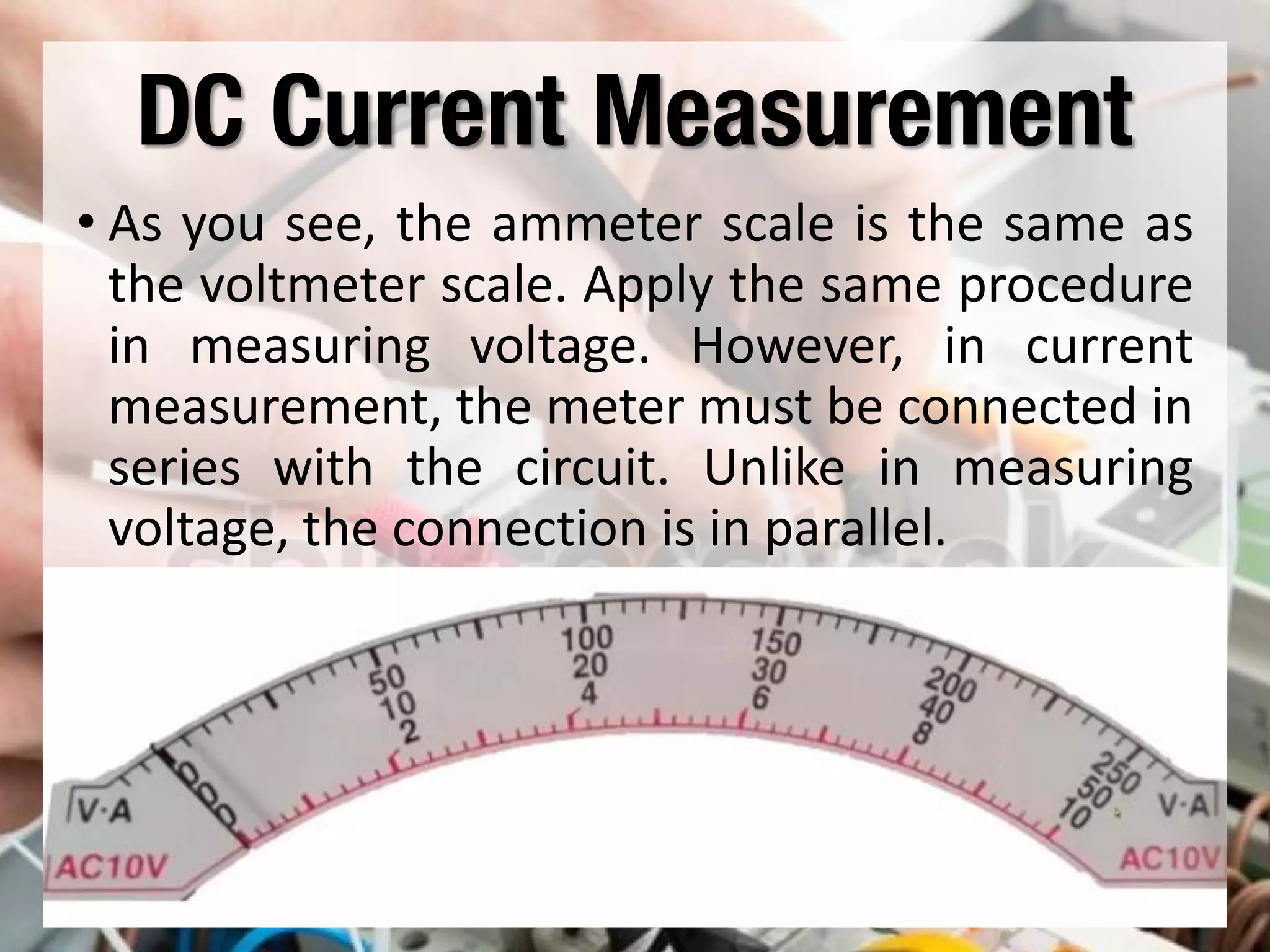
DC Current Measurement
• As you see, the ammeter scale is the same as
the voltmeter scale. Apply the same procedure
in measuring voltage. However, in current
measurement, the meter must be connected in
series with the circuit. Unlike in measuring
voltage, the connection is in parallel.
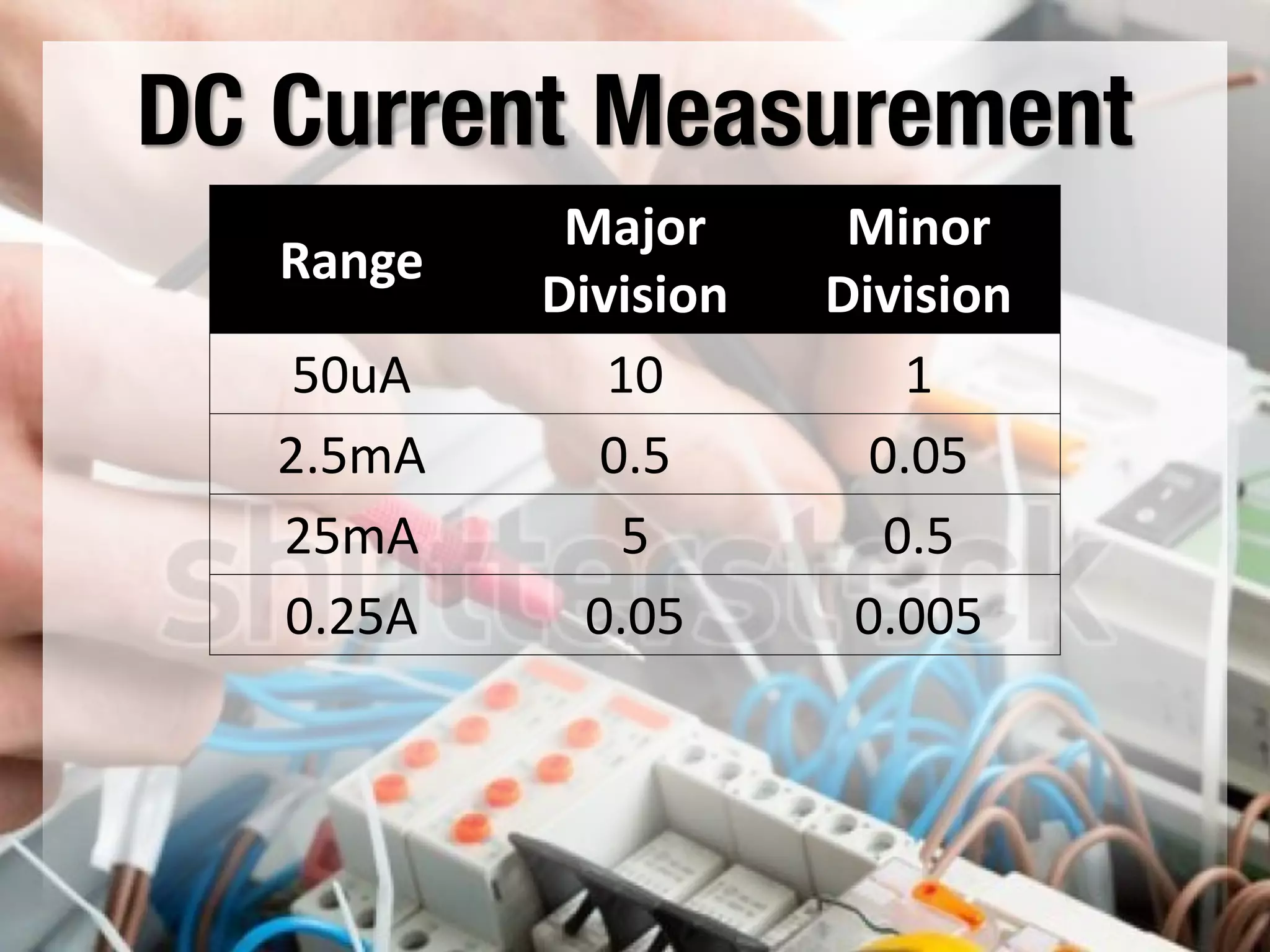
DC Current Measurement
Range
Major
Division
Minor
Division
50uA 10 1
2.5mA 0.5 0.05
25mA 5 0.5
0.25A 0.05 0.005
THANK YOU!

Analog Multimeter.pdf

  • 1.
    Prepared by: Mr.John Lexter L. Emberador Analog Multimeter
  • 2.
    Lesson Objectives At theend of the lesson, the student will be able to: 1. Identify the different parts of analog multimeter; 2. Perform the mensuration and calculation of different instruments used in electronics servicing; and 3. Appreciate the importance of the lesson as practical skills in electronics.
  • 3.
    Analog Multimeter • Ithas a moving coil assembly which is characterized by a needle pointer. The advantage of analog multimeter over digital multimeter is a resistance test in testing electronic components such as capacitor and transistor.
  • 4.
    Parts of AnalogMultimeter
  • 5.
  • 6.
    Steps in usingAnalog Multimeter 1. Connect the test probe to the appropriate jack. • The red test probe to the (+) jack and black test probe to the (-) COM jack.
  • 7.
    Steps in usingAnalog Multimeter 2. Check if the pointer rests exactly at the zero position or infinite position at ohmmeter range.
  • 8.
    Steps in usingAnalog Multimeter Zero Corrector • If this occurs, you should turn the zero-corrector screw in counterclockwise direction until the pointer points at zero voltage range. Wrong Pointer Setting • If the pointer points not exactly to the infinity at ohmmeter reading, this causes inaccuracy to the measured value.
  • 9.
    Steps in usingAnalog Multimeter 3. Check the accuracy of the ohmmeter by touching two test probes. • Set the multimeter to x1Ω or x10Ω selector resistance range. • Hold the two test probes simultaneously. The pointer should not deflect when holding the two test probe at x1 or x10 ohm range.
  • 10.
    Steps in usingAnalog Multimeter 4. Check the probes if they are OK (Ohmmeter Calibration) a. Set the multimeter to corresponding selector resistance range. b. Short the two test probes lead together. The pointer should deflect towards zero ohm reading.
  • 11.
    Steps in usingAnalog Multimeter
  • 12.
    Steps in usingAnalog Multimeter As indicated, the pointer rests out of the range of ohmmeter scale. Adjust the ohm adjustment counterclockwise until the pointer rests at “0” ohm reading. If the pointer did not deflect at all, check the probes. There is a possibility that one is broken or open at some point.
  • 13.
    Resistance Measurement Ohmmeter Ranges x1kΩ x100Ω x10Ω x1Ω Minor Divisions Equivalent 0-20.2 2-10 0.5 10-20 1 20-50 2 50-100 5 100-200 20 Note: The minor divisions of analog multimeter may vary depending on the brand.
  • 14.
    Voltage Measurement • Setthe selector knob to the proper scale range. The chosen scale range must be higher than the anticipated voltage to be measured.
  • 15.
    AC Voltage Measurement •In testing AC voltages, it doesn’t matter if the test probes are interchanged. Range Major Division Minor Division 10 2 0.2 50 10 1 250 50 5 1000 200 20
  • 16.
    DC Voltage Measurement •Be careful in testing DC voltages, especially in polarity. Be sure that the positive test probe (red) is conneced at the positive supply voltage and the negative test probe (black) is connected at the negative or common ground of the supply voltage.
  • 17.
    DC Voltage Measurement Range Major Division Minor Division 0.10.02 0.002 0.25 0.05 0.005 2.5 0.5 0.05 10 2 0.2 50 10 1 250 50 5 1000 200 20
  • 18.
  • 19.
    DC Current Measurement •As you see, the ammeter scale is the same as the voltmeter scale. Apply the same procedure in measuring voltage. However, in current measurement, the meter must be connected in series with the circuit. Unlike in measuring voltage, the connection is in parallel.
  • 20.
    DC Current Measurement Range Major Division Minor Division 50uA10 1 2.5mA 0.5 0.05 25mA 5 0.5 0.25A 0.05 0.005
  • 21.