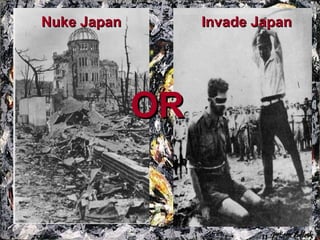
OR Nuke Japan Invade Japan
Nuclear weapons have only been used twice Was the USA forced to drop the bomb on Japan Or Were Hiroshima & Nagasaki the first shots of the Cold War?
When you’ve finished doing that begin preparing for the debate… that is: consider what each of the documents says; what are your most compelling arguments?
Your Tasks Today 2) Discuss your group’s perspective and debate strategy (What are you going to say?) 3) Homework: Explain whether or not YOU think the bombings were justified (give three reasons why or why not, use complete sentences)
Right now Get your arguments organized Get ready to verbally make those arguments You will have 2 minutes to make your opening statement Next group makes opening statement 1 minute each for rebuttal Each group will make a closing statement (no more than 2 minutes)
The Cold War
 
FEAR Fear was the motivation behind many decisions made during the cold war The West was afraid of communist USSR The USSR was afraid of the West
Why was   Communism scary? “ the communist revolution will not merely be a national phenomenon but must take place simultaneously in all civilized countries “- Marx
“ (Communists) openly declare that their ends can be attained only by the forcible overthrow of all existing social conditions. Let the ruling classes tremble at a Communistic revolution. The proletarians have nothing to lose but their chains. They have a world to win!” - Marx.
Why was the USSR afraid of the West? The USA, UK, & France had sent soldiers to Russia in 1917 to stop the Revolution Their “communist” revolution was not very successful The USSR had just lost tens of millions of people in the war and Stalin’s purges… they were not prepared to fight the USA & UK They were a paper tiger


Causes of the Cold War 1) Capitalism vs. Communism US & Great Britain don’t like or trust communist ideas such as the rejection of private property & religion.  Soviets wanted to destroy capitalism & overthrow democratic governments in Europe. USSR afraid US & England would attack them (they had before) & that they would rebuild Germany & Germany would attack USSR  again .
Capitalism vs. communism Karl Marx, wrote Communist Manifesto (no real founder) Adam Smith, wrote Wealth of Nations  Founder Communism Capitalism
Desperate people, people who’ve never had very much . (lower classes, peasants) “ When you ‘aint got nothing, you’ve got nothing to lose” People seeking freedom, people who aren’t totally desperate (middle & upper class) Who does this appeal to?
Everything is owned by the government Government closely regulates the economy (sets prices, tells factories what to make, etc.) Government should not interfere with economy:  laissez-faire View of Government
Government determines the job you get Religion is the “opiate of the masses” and should be done away with Sacrifice freedom for security People are free to choose their own careers Freedom of religion Freedom is more important than security Individual Freedoms
Capitalism will destroy itself Workers will eventually rise up in a violent revolution and take power The future of the world is communism Capitalism is the only efficient economic system “ It’s not perfect, but it’s the best we can do” On the future
The Cold War in Europe As WWII was ending, the Soviet army occupied all of Eastern Europe (except Yugoslavia) Poland, East Germany, Czechoslovakia, Hungary, Romania, Bulgaria, & Albania became Soviet  satellite countries The Iron Curtain
 
IRON CURTAIN
Soviet Threat in Europe; America Responds Fear of a Communist takeover of all of Europe led to  The Truman Doctrine The Truman Doctrine:  Encourage countries to resist Soviet Influence Containment:  Do not allow communism to spread or expand to any more countries in the world.
Truman Doctrine in full effect 1) $400 million in aid to Greece & Turkey 2)  The Marshall Plan : $12 billion in aid to help western European countries rebuild after the war
 
Germany After the war, the Allies divided up Germany into 4 zones Berlin
Berlin Airlift Berlin (capital of Germany, largest city) was in the Soviet Zone & the city itself was divided
Berlin Airlift Stalin  blockaded  West Berlin, trying to make the entire city part of East Germany. Truman ordered supplies to be airlifted to West Berlin.  Stalin ended blockade, W. Berlin remained part of W. Germany.
Operation Vittles
Berlin Wall Many people in East Berlin were very poor and ruled by a dictator, so they fled to West Berlin The Soviet Government was embarrassed by this, so they built a wall around West Berlin.
 
Cold War  Alliances NATO: USA UK France W. Germany Italy Greece Turkey Norway Warsaw Pact USSR Poland Czechoslovakia Hungary E. Germany Romania Bulgaria Albania
United Nations League of Nations…the Sequel Created in 1945 Settle arguments between countries Humanitarian Aid (UNICEF, etc.)
1949… a scary year Soviets successfully test atomic bomb Chinese Communists led by Mao Zedong take over.  China becomes a communist country The West feels very threatened by International Communism
Superpowers The US & the Soviet Union are now the two most powerful countries on earth and they both have nuclear weapons They are the two superpowers
Communism in Asia Korea Japanese colony for decades Kim Il Sung very popular communist leader/resistance fighter After Japanese surrender, USA & USSR divided Korea at 38 th  parallel. North Korea = communist  South Korea = capitalist
 
The Korean War June, 1950: North Korean troops crossed 38 th  parallel, and invaded the South South Korean Army defeated quickly UN sent military force to help South Korea at Truman’s request 16 countries involved, 80% of troops from USA
 
The War North Korean forces almost won right away. MacArthur lead daring landing at Incheon North Korea retreated, MacArthur pursued Chinese enter the war, beat back Americans Armistice ended fighting in 1953 Still technically at war, but no shooting Demilitarized Zone between two countries N. Korea still communist, S. Korea still capitalist
DMZ Fortifications
Panmunjeon Treaty Sight
Treaty Room
Door to North Korea That way to the PRK
“ Freedom” Bridge to North Korea
The DMZ
North Korean Tunnels of Aggression
 
North Korean Tunnels of Aggression
 
 
The U-2 Incident  (how the Cold War almost ended early) The spy plane had been spying on the USSR since 1956. President Eisenhower knew that the USA had far more bombers, missiles, & weapons than the USSR. Because of this,  Ike wanted to end the Cold War at a peace conference in Paris in 1960.
Shot Down! 1960: Francis Gary Powers was shot down flying a U-2 Spy plane over the USSR Eisenhower refused to apologize to Khrushchev, so Khrushchev (Soviet Premier) cancelled the Paris Summit. Whoops!
Africa & Asia Issue: After WWII many colonies began demanding and fighting for their independence
Cold War Conflict Chart After WWII many colonies began demanding and fighting for their independence Africa & Asia Superpower Actions Issue or Conflict Region or Country
Superpower Actions US grants independence to the Philippines  In Africa the US and Soviet Union gave $ & weapons to opposing sides in many civil wars (Angola, Somalia, Ethiopia) Pakistan became an ally of the US, India stayed neutral, but took $ & weapons from the US & USSR
Cold War Conflict Chart US grants independence to the Philippines  In Africa the US and Soviet Union gave $ & weapons to opposing sides in many civil wars (Angola, Somalia, Ethiopia) Pakistan became an ally of the US, India stayed neutral, but took $ & weapons from the US & USSR After WWII many colonies began demanding and fighting for their independence Africa & Asia Superpower Actions Issue or Conflict Region or Country
Cuba Issue: In 1959 Fidel Castro led a successful communist revolution in Cuba
Superpower Actions (part 1) The Bay of Pigs Invasion : The Soviet Union gave Cuba a lot of $ and support. The CIA trained a group of Cuban exiles to invade Cuba & overthrow their government.  The invasion was a total failure.
Superpower Actions (part 2) The Cuban Missile Crisis:  USSR begins building missile bases in Cuba.  Nukes threatened the US.  JFK warned that he would stop any Soviet boat carrying missiles to Cuba.  The USSR backed off. The closest the world has ever come to total nuclear war
“ The Button”
 
Other Parts of Latin America Issue: Many parts  of  Latin America were desperately poor.  They thought becoming communist countries might help stop their suffering
Superpower Actions US provides aid to many Latin American countries:  US intervenes militarily to overthrow suspected communist leaders in Honduras, Guatemala, Dominican Republic, Panama, Chile, Grenada, El Salvador
Arms Race By the 1950’s The US & USSR both had enough nuclear weapons to destroy each other several times over 1957 USSR launched 1 st  ever satellite:  Sputnik . “ Space Race” began, NASA is created Both countries develop rocket technology
Vietnam Vietnam was a French colony Vietnamese communists led by Ho Chi Minh (Uncle Ho) defeated the French in 1954 International Peace Conference  temporarily  divided Vietnam into 2 zones (not separate countries) North Vietnam (Communist) {USSR} South Vietnam (Capitalist) {USA}
Things go South in the South South Vietnam led by corrupt leader (Diem) By 1960 communist guerrillas (Viet Cong/Viet Minh) begin fighting in South Vietnam USA worried that Vietnam would become a communist country Domino Theory: when one country “falls” to communism, countries near it will fall to communism as well.
 
 
Burma


US Involvement During the 1950’s & 1960’s, both Presidents Eisenhower & Kennedy sent “military advisors” to Vietnam (1,000’s of US soldiers) 1964: Gulf of Tonkin Incident lead to US escalation in Vietnam. By 1968 there were over 50,000 American soldiers in Vietnam
Insurgent War American troops were fighting a difficult, insurgent war in the jungle They couldn’t tell friend from foe. Draft was instituted 1 st  TV war led to decreasing popularity of draft & war at home Tet Offensive 1968 = turning point for the Viet Cong & North Vietnam
 
1970: Nixon authorizes bombing Cambodia
The End of the War Longest, most unpopular war in US history US forces left Vietnam in 1975 Vietnam is now a communist country
Evacuation of Saigon 1975
Khmer Rouge Khmer   Rouge :  The Khmer Rouge were a group of  communist   guerillas,  led by   Pol Pot Gained control of  Cambodia  after the withdrawal of American troops from the  Vietnam War .   They initiated a reign of terror,  killing  over a  million   people  to remove all western influence from the country.   This gross violation of human rights ended when Vietnam invaded and occupied the country in 1979.  In the 1990s, the United Nations negotiated a peace settlement, and began the democratic process in Cambodia
 
 
The End of the Cold War Beginning with the Nixon administration, the US pursued less hostile relations with the USSR ( Détente)  The policy of  détente  led to agreements SALT I & SALT II:  S trategic  A rms  L imitation  T alks
End of the Cold War Building more and more weapons to keep up with the USA crippled the Soviet economy USSR collapsed in 1991 despite attempts by  Gorbachev  to make structural changes (glasnost & perestroika)  By 1992, the Berlin wall had fallen, Eastern Europe became independent (satellites no more!)   USA!  USA!  USA! USA! ...
Berlin Wall comes down 1989
You’re Welcome
Communism ends in Russia The Soviet Union breaks up
The Cold War Causes Effects
 
Your Assignment now: I have chosen the 22 most important events of the Cold War.  Using your notes, your textbook (855-879), and the attached summary  create a timeline of 20 events with your group.  This is a 20 point assignment; you can only pick 20 events.  I will award you points based on whether or not the events you choose match mine.   Your timeline should be in chronological order PLEASE USE PENCIL!
On the back of your timeline,  list and explain the top 10 events of the Cold War.  Three sentences at least for each event

The cold war global

  • 1.
    OR Nuke JapanInvade Japan
  • 2.
    Nuclear weapons haveonly been used twice Was the USA forced to drop the bomb on Japan Or Were Hiroshima & Nagasaki the first shots of the Cold War?
  • 3.
    When you’ve finisheddoing that begin preparing for the debate… that is: consider what each of the documents says; what are your most compelling arguments?
  • 4.
    Your Tasks Today2) Discuss your group’s perspective and debate strategy (What are you going to say?) 3) Homework: Explain whether or not YOU think the bombings were justified (give three reasons why or why not, use complete sentences)
  • 5.
    Right now Getyour arguments organized Get ready to verbally make those arguments You will have 2 minutes to make your opening statement Next group makes opening statement 1 minute each for rebuttal Each group will make a closing statement (no more than 2 minutes)
  • 6.
  • 7.
  • 8.
    FEAR Fear wasthe motivation behind many decisions made during the cold war The West was afraid of communist USSR The USSR was afraid of the West
  • 9.
    Why was Communism scary? “ the communist revolution will not merely be a national phenomenon but must take place simultaneously in all civilized countries “- Marx
  • 10.
    “ (Communists) openlydeclare that their ends can be attained only by the forcible overthrow of all existing social conditions. Let the ruling classes tremble at a Communistic revolution. The proletarians have nothing to lose but their chains. They have a world to win!” - Marx.
  • 11.
    Why was theUSSR afraid of the West? The USA, UK, & France had sent soldiers to Russia in 1917 to stop the Revolution Their “communist” revolution was not very successful The USSR had just lost tens of millions of people in the war and Stalin’s purges… they were not prepared to fight the USA & UK They were a paper tiger
  • 12.
  • 13.
  • 14.
  • 15.
  • 16.
  • 17.
    Causes of theCold War 1) Capitalism vs. Communism US & Great Britain don’t like or trust communist ideas such as the rejection of private property & religion. Soviets wanted to destroy capitalism & overthrow democratic governments in Europe. USSR afraid US & England would attack them (they had before) & that they would rebuild Germany & Germany would attack USSR again .
  • 18.
    Capitalism vs. communismKarl Marx, wrote Communist Manifesto (no real founder) Adam Smith, wrote Wealth of Nations Founder Communism Capitalism
  • 19.
    Desperate people, peoplewho’ve never had very much . (lower classes, peasants) “ When you ‘aint got nothing, you’ve got nothing to lose” People seeking freedom, people who aren’t totally desperate (middle & upper class) Who does this appeal to?
  • 20.
    Everything is ownedby the government Government closely regulates the economy (sets prices, tells factories what to make, etc.) Government should not interfere with economy: laissez-faire View of Government
  • 21.
    Government determines thejob you get Religion is the “opiate of the masses” and should be done away with Sacrifice freedom for security People are free to choose their own careers Freedom of religion Freedom is more important than security Individual Freedoms
  • 22.
    Capitalism will destroyitself Workers will eventually rise up in a violent revolution and take power The future of the world is communism Capitalism is the only efficient economic system “ It’s not perfect, but it’s the best we can do” On the future
  • 23.
    The Cold Warin Europe As WWII was ending, the Soviet army occupied all of Eastern Europe (except Yugoslavia) Poland, East Germany, Czechoslovakia, Hungary, Romania, Bulgaria, & Albania became Soviet satellite countries The Iron Curtain
  • 24.
  • 25.
  • 26.
    Soviet Threat inEurope; America Responds Fear of a Communist takeover of all of Europe led to The Truman Doctrine The Truman Doctrine: Encourage countries to resist Soviet Influence Containment: Do not allow communism to spread or expand to any more countries in the world.
  • 27.
    Truman Doctrine infull effect 1) $400 million in aid to Greece & Turkey 2) The Marshall Plan : $12 billion in aid to help western European countries rebuild after the war
  • 28.
  • 29.
    Germany After thewar, the Allies divided up Germany into 4 zones Berlin
  • 30.
    Berlin Airlift Berlin(capital of Germany, largest city) was in the Soviet Zone & the city itself was divided
  • 31.
    Berlin Airlift Stalin blockaded West Berlin, trying to make the entire city part of East Germany. Truman ordered supplies to be airlifted to West Berlin. Stalin ended blockade, W. Berlin remained part of W. Germany.
  • 32.
  • 33.
    Berlin Wall Manypeople in East Berlin were very poor and ruled by a dictator, so they fled to West Berlin The Soviet Government was embarrassed by this, so they built a wall around West Berlin.
  • 34.
  • 35.
    Cold War Alliances NATO: USA UK France W. Germany Italy Greece Turkey Norway Warsaw Pact USSR Poland Czechoslovakia Hungary E. Germany Romania Bulgaria Albania
  • 36.
    United Nations Leagueof Nations…the Sequel Created in 1945 Settle arguments between countries Humanitarian Aid (UNICEF, etc.)
  • 37.
    1949… a scaryyear Soviets successfully test atomic bomb Chinese Communists led by Mao Zedong take over. China becomes a communist country The West feels very threatened by International Communism
  • 38.
    Superpowers The US& the Soviet Union are now the two most powerful countries on earth and they both have nuclear weapons They are the two superpowers
  • 39.
    Communism in AsiaKorea Japanese colony for decades Kim Il Sung very popular communist leader/resistance fighter After Japanese surrender, USA & USSR divided Korea at 38 th parallel. North Korea = communist South Korea = capitalist
  • 40.
  • 41.
    The Korean WarJune, 1950: North Korean troops crossed 38 th parallel, and invaded the South South Korean Army defeated quickly UN sent military force to help South Korea at Truman’s request 16 countries involved, 80% of troops from USA
  • 42.
  • 43.
    The War NorthKorean forces almost won right away. MacArthur lead daring landing at Incheon North Korea retreated, MacArthur pursued Chinese enter the war, beat back Americans Armistice ended fighting in 1953 Still technically at war, but no shooting Demilitarized Zone between two countries N. Korea still communist, S. Korea still capitalist
  • 44.
  • 45.
  • 46.
  • 47.
    Door to NorthKorea That way to the PRK
  • 48.
    “ Freedom” Bridgeto North Korea
  • 49.
  • 50.
    North Korean Tunnelsof Aggression
  • 51.
  • 52.
    North Korean Tunnelsof Aggression
  • 53.
  • 54.
  • 55.
    The U-2 Incident (how the Cold War almost ended early) The spy plane had been spying on the USSR since 1956. President Eisenhower knew that the USA had far more bombers, missiles, & weapons than the USSR. Because of this, Ike wanted to end the Cold War at a peace conference in Paris in 1960.
  • 56.
    Shot Down! 1960:Francis Gary Powers was shot down flying a U-2 Spy plane over the USSR Eisenhower refused to apologize to Khrushchev, so Khrushchev (Soviet Premier) cancelled the Paris Summit. Whoops!
  • 57.
    Africa & AsiaIssue: After WWII many colonies began demanding and fighting for their independence
  • 58.
    Cold War ConflictChart After WWII many colonies began demanding and fighting for their independence Africa & Asia Superpower Actions Issue or Conflict Region or Country
  • 59.
    Superpower Actions USgrants independence to the Philippines In Africa the US and Soviet Union gave $ & weapons to opposing sides in many civil wars (Angola, Somalia, Ethiopia) Pakistan became an ally of the US, India stayed neutral, but took $ & weapons from the US & USSR
  • 60.
    Cold War ConflictChart US grants independence to the Philippines In Africa the US and Soviet Union gave $ & weapons to opposing sides in many civil wars (Angola, Somalia, Ethiopia) Pakistan became an ally of the US, India stayed neutral, but took $ & weapons from the US & USSR After WWII many colonies began demanding and fighting for their independence Africa & Asia Superpower Actions Issue or Conflict Region or Country
  • 61.
    Cuba Issue: In1959 Fidel Castro led a successful communist revolution in Cuba
  • 62.
    Superpower Actions (part1) The Bay of Pigs Invasion : The Soviet Union gave Cuba a lot of $ and support. The CIA trained a group of Cuban exiles to invade Cuba & overthrow their government. The invasion was a total failure.
  • 63.
    Superpower Actions (part2) The Cuban Missile Crisis: USSR begins building missile bases in Cuba. Nukes threatened the US. JFK warned that he would stop any Soviet boat carrying missiles to Cuba. The USSR backed off. The closest the world has ever come to total nuclear war
  • 64.
  • 65.
  • 66.
    Other Parts ofLatin America Issue: Many parts of Latin America were desperately poor. They thought becoming communist countries might help stop their suffering
  • 67.
    Superpower Actions USprovides aid to many Latin American countries: US intervenes militarily to overthrow suspected communist leaders in Honduras, Guatemala, Dominican Republic, Panama, Chile, Grenada, El Salvador
  • 68.
    Arms Race Bythe 1950’s The US & USSR both had enough nuclear weapons to destroy each other several times over 1957 USSR launched 1 st ever satellite: Sputnik . “ Space Race” began, NASA is created Both countries develop rocket technology
  • 69.
    Vietnam Vietnam wasa French colony Vietnamese communists led by Ho Chi Minh (Uncle Ho) defeated the French in 1954 International Peace Conference temporarily divided Vietnam into 2 zones (not separate countries) North Vietnam (Communist) {USSR} South Vietnam (Capitalist) {USA}
  • 70.
    Things go Southin the South South Vietnam led by corrupt leader (Diem) By 1960 communist guerrillas (Viet Cong/Viet Minh) begin fighting in South Vietnam USA worried that Vietnam would become a communist country Domino Theory: when one country “falls” to communism, countries near it will fall to communism as well.
  • 71.
  • 72.
  • 73.
  • 74.
  • 75.
  • 76.
  • 77.
    US Involvement Duringthe 1950’s & 1960’s, both Presidents Eisenhower & Kennedy sent “military advisors” to Vietnam (1,000’s of US soldiers) 1964: Gulf of Tonkin Incident lead to US escalation in Vietnam. By 1968 there were over 50,000 American soldiers in Vietnam
  • 78.
    Insurgent War Americantroops were fighting a difficult, insurgent war in the jungle They couldn’t tell friend from foe. Draft was instituted 1 st TV war led to decreasing popularity of draft & war at home Tet Offensive 1968 = turning point for the Viet Cong & North Vietnam
  • 79.
  • 80.
    1970: Nixon authorizesbombing Cambodia
  • 81.
    The End ofthe War Longest, most unpopular war in US history US forces left Vietnam in 1975 Vietnam is now a communist country
  • 82.
  • 83.
    Khmer Rouge Khmer Rouge :  The Khmer Rouge were a group of communist guerillas, led by Pol Pot Gained control of Cambodia after the withdrawal of American troops from the Vietnam War .  They initiated a reign of terror, killing over a million people to remove all western influence from the country.  This gross violation of human rights ended when Vietnam invaded and occupied the country in 1979.  In the 1990s, the United Nations negotiated a peace settlement, and began the democratic process in Cambodia
  • 84.
  • 85.
  • 86.
    The End ofthe Cold War Beginning with the Nixon administration, the US pursued less hostile relations with the USSR ( Détente) The policy of détente led to agreements SALT I & SALT II: S trategic A rms L imitation T alks
  • 87.
    End of theCold War Building more and more weapons to keep up with the USA crippled the Soviet economy USSR collapsed in 1991 despite attempts by Gorbachev to make structural changes (glasnost & perestroika) By 1992, the Berlin wall had fallen, Eastern Europe became independent (satellites no more!) USA! USA! USA! USA! ...
  • 88.
  • 89.
  • 90.
    Communism ends inRussia The Soviet Union breaks up
  • 91.
    The Cold WarCauses Effects
  • 92.
  • 93.
    Your Assignment now:I have chosen the 22 most important events of the Cold War. Using your notes, your textbook (855-879), and the attached summary create a timeline of 20 events with your group. This is a 20 point assignment; you can only pick 20 events. I will award you points based on whether or not the events you choose match mine. Your timeline should be in chronological order PLEASE USE PENCIL!
  • 94.
    On the backof your timeline, list and explain the top 10 events of the Cold War. Three sentences at least for each event