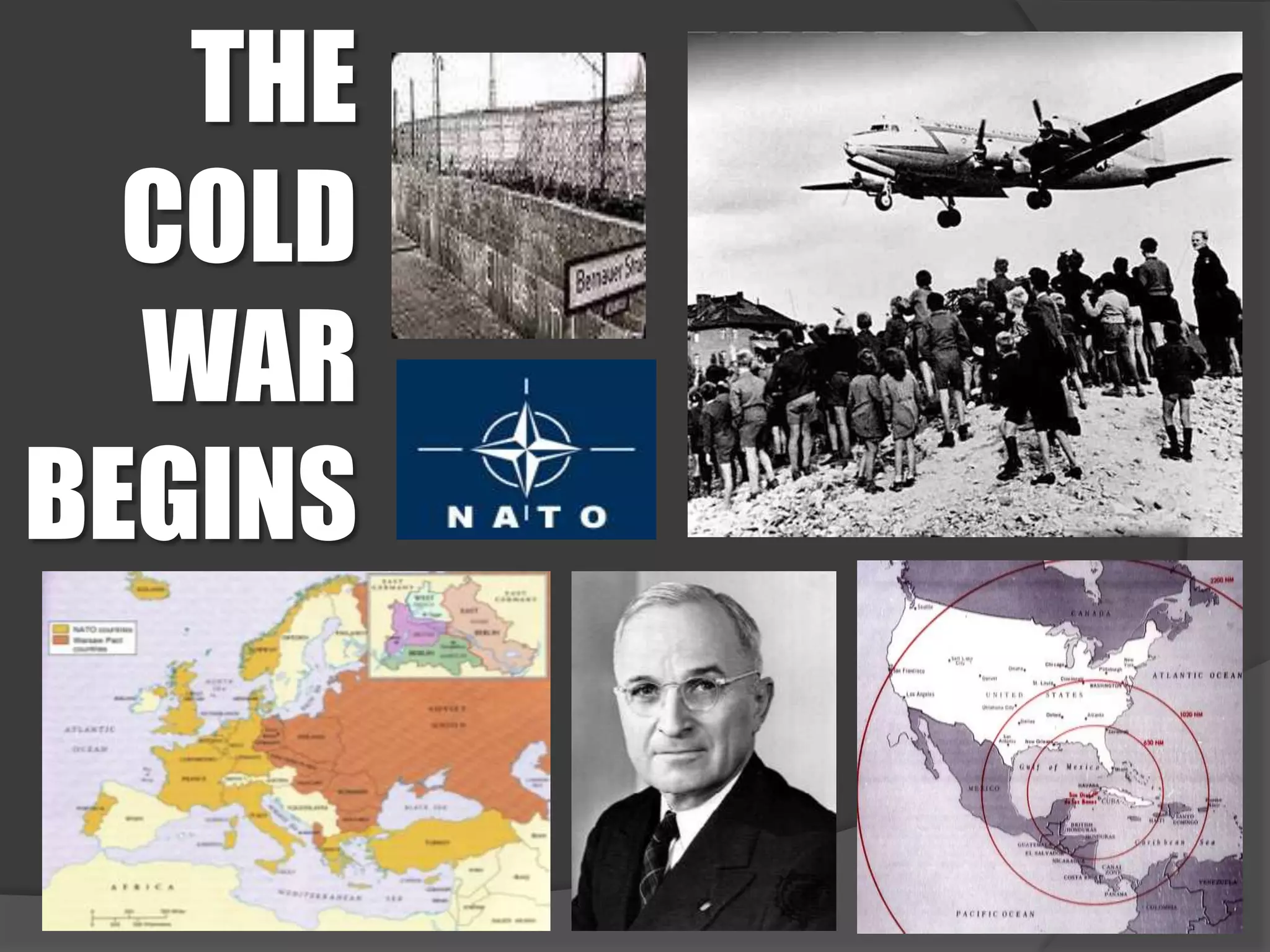
THE COLD WAR BEGINS
THE G.I. BILLProvided college for returning World War II veterans (commonly referred to as GIs)Provided one year of unemployment compensationMillions of GIs bought homes, attended college, started business venture, or found jobs
THE G.I. BILLVA Mortgages paid for nearly 5 million new homes, by making homes affordable with low interest rates and 30 year loans.   President Franklin Roosevelt signs the GI Bill in 1944Between 1945 and 1954, the U.S. added 13 million new homes to its housing stock
Truman and civil rightsOne of the major acts made by Truman was when he made an executive orderto end segregation in the armed forcesTruman also asked Congress to pass a civil rights bill that would make lynching a federal crime
ELECTION of 1948Truman angered many Southern Democrats by supporting integrationMany people didn’t think he would be re-electedThomas DeweyHarry S TrumanStrom ThurmondPeople were so sure that Truman would lose that one headline even incorrectly said that Dewey had wonHistorians view the Election of 1948 as the greatest election upset in U.S.history
THE COLD WARThe era of confrontation and competition between the U.S. and the Soviet Union when the threat of nuclear war created constant world tensionUnited States Soviet Unionvs.DemocracyCommunism
Differing PhilosophiesBelieved in democratic forms of government
Believed economic stability would keep peace in the word
Believed the free enterprise system was necessary for economic growth
Believed in a communistic forms of government
 Believed in workers revolting (striking) against business owners and taking control of government
 Wanted to control countries between Russia and GermanySoviets take over Eastern EuropeSoviet troops move into Germany near the end of World War IIAs World War II ended, the Soviet army occupied the countries of Eastern Europe that Germany had conquered during the war
The Iron CurtainPoland, Romania, Czechoslovakia, Hungary Bulgaria and East Germany became satellite nations of Soviet Union“An iron curtain has descended across the Continent” – Prime Minister Winston Churchill
Peep under the Iron curtainMarch 6, 1946 Who is “Joe”?
 What part of Europe is sealed off?
 What does the wall symbolize?Letter from U.S. diplomat George Kennan that led to the U.S. policy of containment of communism.Kennan said the Russians were concerned about invasions from the west and wanted a buffer zone Russians wanted to spread communism world-wideU.S. should use diplomatic, economic and military actions to keep communism contained
Truman DoctrineU.S. foreign policy established by President Truman saying the U.S. would protect democracies throughout the world“It must be the policy of the United States to support free peoples who are resisting attempted subjugation by armed minorities or outside pressures”       -- Harry Truman
Truman DoctrineIt pledged that the United States would fight Communism worldwideTruman Doctrine was an extension to the U.S. foreign policy set forth in the Monroe Doctrine (1823) and the Roosevelt Corollary (1904) American tanks provided by the Truman Doctrine roll through Turkey
Aid for EuropeSecretary of State George Marshall toured Western Europe; witnessed widespread homelessness and famine.Fearing Europeans would turn to communism as an answer to their economic problems, Marshall proposed the U.S. help to rebuild Europe, leading to…Children in a London suburb, waiting outside the wreckage of what was their home
Marshall PlanU.S. plan for rebuilding Western Europe, and repelling communismafter World War IIPlan pumped billions of dollars into Western Europe for food and suppliesPlan made U.S. heroes to people of Western EuropeGeorge C. Marshall
Marshall Plan aids Western EuropeThe Marshall Plan proved to be a great successWithin 4 years, countries receiving aid saw a 41% higher industrial production than on the eve of World War IICountries were stabilized and exports were rising rapidlyCountries receiving aid under Marshall Plan
Eastern European countries were offered to take part in the Marshall Plan…What is this cartoon trying to say?… but Stalin and other East European leaders refused financial help from the United States
The Potsdam ConferenceThe Potsdam Conference was a meeting of the Allied leaders during World War II to decide what to do with Germany
Germany DividedBritishAfter World War II, Germany was divided into four zones, occupied by French, British, American, and Soviet troops.SovietFrenchOccupation zones after 1945. Berlin is the multinational area within the Soviet zone.American
East and West Germany formedEast BerlinWest BerlinEast GermanyWest GermanyIn June of 1948, the French, British and American zones were joined into the nation of West Germany after the Soviets refused to end their occupation of Germany.
In response, the Soviets cut off West Berlin from the rest of the world with a blockade. (video – 1:46)Eventual site of the Berlin Wall
Berlin AirliftPresident Truman decided to avoid the blockade by flying in food and other supplies to the needy people of West BerlinAt times, over 5,000 tons of supplies arrived daily
Berlin AirliftThe airlift continued for 11 months before Stalin finally lifted the blockadeThe Berlin Airlift saved the people of West Berlin from falling under Soviet Union controlSoviet blockade of West Germany convinced many Americans that the Soviets were trying to conquer other nations
Birth of NATONorth Atlantic Treaty OrganizationFormed in 1949 to protect Western Europe from Soviet aggression
The Warsaw PactPoland, Romania, Czechoslovakia, Hungary Bulgaria and East Germany became satellite nations of Soviet UnionThe Warsaw Pact was the Soviet Union’s response to the creation of the North Atlantic Treaty Organization
Coming Up…The Korean WarMcCarthyism
The Cold War Heats Up
Cold War spreads to AsiaCommunists take over in ChinaMao Zedong takes control of Chinese government from Chang Kai-shek’s Nationalist PartyHalf the world now appeared to be under Communist controlChinaKoreaThe country of Korea became the next battleground in the Cold War
The Korean WarThe  Cold War gets HOTFollowing World War II, the Allies divided Korea at the 38th parallel Soviets controlled North Korea; U.S. sets up a democracy in South Korea Both governments claimed to control all of Korea
The Korean WarA “Police Action” (1950-1953)Kim Il-SungLeader ofNorth KoreaSyngman Rhee“Domino Theory”President ofSouth KoreaIf one country falls to communism, others around it will fall as well
The Korean WarThe Cold War gets HOTOn June 25, 1950, North Korea invades South KoreaUN forces under Macarthur  come to the aid of South KoreaCommunist forces push UN forces to brink of defeatUN forces push North Koreans back to border of China
The Korean WarChina enters the warNorth Koreans pushed back to border with ChinaChinese enter war on the side of North KoreansMacarthur calls for an invasion of China, wants to use the atomic bombMacarthur criticized Truman for wanting a “limited war” An artillery officer directs UN troops as they drop white phosphorous on a Communist-held post in February 1951.
The Korean WarWar ends in a stalemateAn armistice was signed ending the war in July 1953Korea was divided at the 38th parallelKorean War marked an important turning point in the Cold WarU.S. began a major military build-up; began using military force to prevent spread of communism
A New Red ScareU.S. citizens in 1950s feared Communists wanted to take over the world. This fear was known as the Red Scare.Spies like Julius and Ethel Rosenberg and Alger Hiss caused fear that our government was infiltrated by the Communists
A New Red ScareHouse Un-American Activities Committee Committee set up to investigate Communist activities in the U.S.HUAC searched for Soviet spies   and Communist sympathizers. “Are you now or have you ever been a Communist?”House Un-American Committee meeting in 1948
The Hollywood TenPeople who were accused of being Communists were often “blacklisted”A group of Hollywood actors who were blacklisted for refusing to answer HUAC questions became known as the “Hollywood Ten”If someone was  blacklisted, it meant they were denied work or ostracized from societyMovie stars Lauren Bacall and Humphrey Bogart lead a protest during height of Hollywood Blacklist controversy
McCarthyismIn 1952, U.S. Senator Joe McCarthy began holding Senate hearingsNumerous Americans accused of having ties to the Communist PartyMcCarthy turned the hearings into witch-hunts, destroying numerous people’s reputations on rumor and weak evidence
U-2 IncidentCol. Francis Gary Powers’ spy plane was shot down over Soviet airspace in 1960Incident cools Soviet-U.S. relations
Russians launch SputnikThe Russians have beaten America into space—they have the technological edge!
Russians launch SputnikImpact of SputnikCongress establishes the National Aeronautics and  Space Agency (NASA) to conduct research in rocket and space technologyCongress also passed the National Defense Education Act, which provided money for education and training in science, math and foreign languages
The Space Race BeginsIn 1961, Russian cosmonaut Yuri Gagarin blasted off into space, making the Soviet Union the first nation to launch a human into orbitKennedy said he wanted U.S. to land a man on the moon by the end of the 1960s
The Space Race BeginsKennedy’s challenge was met on July 20, 1969, when Neil Armstrong became the first human to step foot on the moon“That’s one small step for man, one giant leap for mankind.” – Neil Armstrong
Berlin Wall BuiltSoviets wanted to keep Germans from moving out of East Germany into West Berlin, where they could become freeBerlin Wall became the symbol of Communist oppression around the world
Ich bin ein Berliner!(1963)President Kennedy tells Berliners that the West is with them!
Castro embraces Communism(1959) Cuban dictator Fidel Castro embraces Soviet premier Nikita Khrushchev
Bay of Pigs Debacle (1961)CIA-trained Cuban exiles led an attack at the Bay of Pigs in Cuba in an attempt to overthrow CastroInvasion was a disaster and failed; was a huge foreign policy blunder for the United States
Cuban Missile CrisisU.S. and Russia came extremely close to nuclear war when Russians place nuclear missiles in Cuba in November of 1962In response to U.S. missiles in Turkey, the Russians began building missile bases in Cuba
Cuban Missile CrisisUnited States places an embargo on incoming shipments to Cuba from the Soviet Union, U.S. goes to DEFCON-3Soviet ships reach the quarantine line, but receive radio orders from Moscow to hold their positions
Cuban Missile CrisisKennedy threatens a U.S. invasion of Cuba unless Soviet missiles are removed; U.S. moves to DEFCON-2The Russians agreed to take their missiles out of Cuba if the U.S. removed theirs from TurkeyPresident John F. Kennedy thinking in the Oval Office during the Cuban Missile Crisis in 1962
Vietnam War: 1965-1973
THE VIETNAM WAR
Key figures in the Vietnam WarHo Chi MinhWilliam Westmoreland Lyndon B. JohnsonAmerican commander in South Vietnam who told people in the media that the United States was close to winning the war, even though it wasn’tPresident of North Vietnam who led the efforts to defeat South Vietnam and support of the South Vietnamese VietcongPresident of the United States who was president during much of Vietnam War; greatly escalated the U.S. soldier involvement in the conflict
Key figures in the Vietnam WarRobert McNamaraRichard NixonNgo Dinh DiemU.S. Secretary of Defense during the Vietnam War who made the American republic feel like we were winning the war President of South Vietnam who whose corruption and harsh standards led numerous people to turn to the Vietcong President of the United States during the latter part of the Vietnam War
Vietnam in the ’50sFollowing World War II, the French controlled southeast Asia (known as Indochina)Ho Chi Minh led a revolt against the French to gain independence for VietnamBy 1954, the French fell to the Vietminh and they withdrew from Indochina, leaving Vietnam a divided countrySoutheast Asia (aka: French Indochina)
Domino TheoryThe Domino Theory was the belief that if one country fell to communism, the other Southeast Asian nations would eventually fall to communism as well
This map from an American magazine published 14th November 1950 shows how much they feared the spread of Communism in the Far East.
South Vietnam problemsThe people of South Vietnam hated South Vietnamese president Ngo Dinh Diem. He was corrupt and did not govern in the best interest of the citizens.Diem was disliked because he discriminated against the Buddhist populationSome Buddhist monks protested Diem’s rule by setting themselves on fireA Buddhist monk commits suicide in protest to the harsh policies of the S. Vietnamese government
Gulf of Tonkin Incident In August of 1964, Pres. Johnson announced that North Vietnam ships had fired on two American destroyers in the Gulf of TonkinUSS MaddoxJohnson insisted that the North Vietnamese attack was unprovoked and responded by ordering American airplanes to attack North Vietnam
Gulf of Tonkin ResolutionAfter accusing N. Vietnam of attacking the U.S., Johnson asked Congress to give him the authorization to use force to defend American forcesWhen, in August of 1964, Congress passed the Gulf of Tonkin Resolution, Congress handed over war powers to the president The President had the power to send U.S. troops into battle without a declaration of war
Operation Rolling ThunderThe U.S. bombing campaign conducted against the North Vietnam from 1965 until 1968The three-year assault was intended to get North Vietnam to stop supporting South Vietnamese guerrillasOperation became most intense air/ground battle waged during the Cold War
VietcongGuerrilla army based in South Vietnam (also known as the NLF) that fought the U.S. and South Vietnamese governments during the Vietnam WarThe Vietcong were South Vietnamese communistswho fought for Vietnamese unification on the side of the North Vietnamese
Vietcong AdvantagesThey were familiar with the landscape (rivers, lakes, etc.)
They could find a safe haven in Cambodia, Laos or South Vietnam
They could often count on the support of the local populationHo Chi Minh TrailPath that ran from North Vietnam to South Vietnam through Laos and Cambodia system providing manpower and materiel to the VietcongRed line indicates Ho Chi Minh Trail through Laos and CambodiaA look at the Ho Chi Minh Trail from road level, with camouflaged convoy truck approaching.
Tet OffensiveJanuary 30 – June 8, 1968In early 1968, the Vietcong and the North Vietnamese launched a surprise attack throughout South Vietnam during the Tet, which is the Vietnamese New Year
Tet OffensiveWhile the Vietcong suffered heavy losses, it was a major political victory for the VietcongTet was the turning point in the war and showed that the U.S. was  nowhere close to winning the warThe Tet Offensive in 1968 was a surprise attack by the Vietcong throughout South Vietnam
Credibility GapOpposition to the Vietnam War grew in the United States in the late 1960sMany Americans were suspicious of the government’s truthfulness about the warWilliam Westmoreland Robert McNamaraMany Americans believed a credibility gap had developed (people lost trust in what the government was telling them)
My Lai MassacreMarch 16th, 1968An American platoon had massacred more than 200 South Vietnamese civilians who they thought were members of the Vietcong in a village called My LaiMost of the victims were old men, women and childrenThe My Lai massacre increased feelings among many Americans that the war was brutal and senseless
Election of 1968Johnson refuses to run for re-electionAfter Johnson refused to run for re-election and Bobby Kennedy was assassinated, the Democrats ended up choosing LBJ’s vice-president, Hubert Humphrey, as their presidential candidateRepublicans nominate former vice-president Richard Nixon, who lost to JFK in 1960"I shall not seek, and I will not accept the nomination of my party for another term as your President." March 31, 1968
Election of 1968Nixon becomes president!
Draft Lottery BeginsMany Americans who were against the war believed the United States had an unfair draft systemMinorities made up a large percentage of people drafted and most soldiers were under 21 years old
Kent State MassacreMay 4, 1970In April of 1970, President Nixon announced that American troops had invaded CambodiaAnti-war protestors saw this as an escalation of the war, sparking violent protests on college campusesAt Kent State University in Ohio, protestors became violent. The Ohio National Guard was called in and fired upon the student demonstrators, killing four students

Unit 8 Powerpoint (The Cold War Begins)

  • 1.
  • 2.
    THE G.I. BILLProvidedcollege for returning World War II veterans (commonly referred to as GIs)Provided one year of unemployment compensationMillions of GIs bought homes, attended college, started business venture, or found jobs
  • 3.
    THE G.I. BILLVAMortgages paid for nearly 5 million new homes, by making homes affordable with low interest rates and 30 year loans. President Franklin Roosevelt signs the GI Bill in 1944Between 1945 and 1954, the U.S. added 13 million new homes to its housing stock
  • 4.
    Truman and civilrightsOne of the major acts made by Truman was when he made an executive orderto end segregation in the armed forcesTruman also asked Congress to pass a civil rights bill that would make lynching a federal crime
  • 5.
    ELECTION of 1948Trumanangered many Southern Democrats by supporting integrationMany people didn’t think he would be re-electedThomas DeweyHarry S TrumanStrom ThurmondPeople were so sure that Truman would lose that one headline even incorrectly said that Dewey had wonHistorians view the Election of 1948 as the greatest election upset in U.S.history
  • 6.
    THE COLD WARTheera of confrontation and competition between the U.S. and the Soviet Union when the threat of nuclear war created constant world tensionUnited States Soviet Unionvs.DemocracyCommunism
  • 7.
    Differing PhilosophiesBelieved indemocratic forms of government
  • 8.
    Believed economic stabilitywould keep peace in the word
  • 9.
    Believed the freeenterprise system was necessary for economic growth
  • 10.
    Believed in acommunistic forms of government
  • 11.
    Believed inworkers revolting (striking) against business owners and taking control of government
  • 12.
    Wanted tocontrol countries between Russia and GermanySoviets take over Eastern EuropeSoviet troops move into Germany near the end of World War IIAs World War II ended, the Soviet army occupied the countries of Eastern Europe that Germany had conquered during the war
  • 13.
    The Iron CurtainPoland,Romania, Czechoslovakia, Hungary Bulgaria and East Germany became satellite nations of Soviet Union“An iron curtain has descended across the Continent” – Prime Minister Winston Churchill
  • 14.
    Peep under theIron curtainMarch 6, 1946 Who is “Joe”?
  • 15.
    What partof Europe is sealed off?
  • 16.
    What doesthe wall symbolize?Letter from U.S. diplomat George Kennan that led to the U.S. policy of containment of communism.Kennan said the Russians were concerned about invasions from the west and wanted a buffer zone Russians wanted to spread communism world-wideU.S. should use diplomatic, economic and military actions to keep communism contained
  • 17.
    Truman DoctrineU.S. foreignpolicy established by President Truman saying the U.S. would protect democracies throughout the world“It must be the policy of the United States to support free peoples who are resisting attempted subjugation by armed minorities or outside pressures” -- Harry Truman
  • 18.
    Truman DoctrineIt pledgedthat the United States would fight Communism worldwideTruman Doctrine was an extension to the U.S. foreign policy set forth in the Monroe Doctrine (1823) and the Roosevelt Corollary (1904) American tanks provided by the Truman Doctrine roll through Turkey
  • 19.
    Aid for EuropeSecretaryof State George Marshall toured Western Europe; witnessed widespread homelessness and famine.Fearing Europeans would turn to communism as an answer to their economic problems, Marshall proposed the U.S. help to rebuild Europe, leading to…Children in a London suburb, waiting outside the wreckage of what was their home
  • 20.
    Marshall PlanU.S. planfor rebuilding Western Europe, and repelling communismafter World War IIPlan pumped billions of dollars into Western Europe for food and suppliesPlan made U.S. heroes to people of Western EuropeGeorge C. Marshall
  • 21.
    Marshall Plan aidsWestern EuropeThe Marshall Plan proved to be a great successWithin 4 years, countries receiving aid saw a 41% higher industrial production than on the eve of World War IICountries were stabilized and exports were rising rapidlyCountries receiving aid under Marshall Plan
  • 22.
    Eastern European countrieswere offered to take part in the Marshall Plan…What is this cartoon trying to say?… but Stalin and other East European leaders refused financial help from the United States
  • 23.
    The Potsdam ConferenceThePotsdam Conference was a meeting of the Allied leaders during World War II to decide what to do with Germany
  • 24.
    Germany DividedBritishAfter WorldWar II, Germany was divided into four zones, occupied by French, British, American, and Soviet troops.SovietFrenchOccupation zones after 1945. Berlin is the multinational area within the Soviet zone.American
  • 25.
    East and WestGermany formedEast BerlinWest BerlinEast GermanyWest GermanyIn June of 1948, the French, British and American zones were joined into the nation of West Germany after the Soviets refused to end their occupation of Germany.
  • 26.
    In response, theSoviets cut off West Berlin from the rest of the world with a blockade. (video – 1:46)Eventual site of the Berlin Wall
  • 27.
    Berlin AirliftPresident Trumandecided to avoid the blockade by flying in food and other supplies to the needy people of West BerlinAt times, over 5,000 tons of supplies arrived daily
  • 28.
    Berlin AirliftThe airliftcontinued for 11 months before Stalin finally lifted the blockadeThe Berlin Airlift saved the people of West Berlin from falling under Soviet Union controlSoviet blockade of West Germany convinced many Americans that the Soviets were trying to conquer other nations
  • 29.
    Birth of NATONorthAtlantic Treaty OrganizationFormed in 1949 to protect Western Europe from Soviet aggression
  • 30.
    The Warsaw PactPoland,Romania, Czechoslovakia, Hungary Bulgaria and East Germany became satellite nations of Soviet UnionThe Warsaw Pact was the Soviet Union’s response to the creation of the North Atlantic Treaty Organization
  • 31.
  • 32.
    The Cold WarHeats Up
  • 33.
    Cold War spreadsto AsiaCommunists take over in ChinaMao Zedong takes control of Chinese government from Chang Kai-shek’s Nationalist PartyHalf the world now appeared to be under Communist controlChinaKoreaThe country of Korea became the next battleground in the Cold War
  • 34.
    The Korean WarThe Cold War gets HOTFollowing World War II, the Allies divided Korea at the 38th parallel Soviets controlled North Korea; U.S. sets up a democracy in South Korea Both governments claimed to control all of Korea
  • 35.
    The Korean WarA“Police Action” (1950-1953)Kim Il-SungLeader ofNorth KoreaSyngman Rhee“Domino Theory”President ofSouth KoreaIf one country falls to communism, others around it will fall as well
  • 36.
    The Korean WarTheCold War gets HOTOn June 25, 1950, North Korea invades South KoreaUN forces under Macarthur come to the aid of South KoreaCommunist forces push UN forces to brink of defeatUN forces push North Koreans back to border of China
  • 37.
    The Korean WarChinaenters the warNorth Koreans pushed back to border with ChinaChinese enter war on the side of North KoreansMacarthur calls for an invasion of China, wants to use the atomic bombMacarthur criticized Truman for wanting a “limited war” An artillery officer directs UN troops as they drop white phosphorous on a Communist-held post in February 1951.
  • 38.
    The Korean WarWarends in a stalemateAn armistice was signed ending the war in July 1953Korea was divided at the 38th parallelKorean War marked an important turning point in the Cold WarU.S. began a major military build-up; began using military force to prevent spread of communism
  • 39.
    A New RedScareU.S. citizens in 1950s feared Communists wanted to take over the world. This fear was known as the Red Scare.Spies like Julius and Ethel Rosenberg and Alger Hiss caused fear that our government was infiltrated by the Communists
  • 40.
    A New RedScareHouse Un-American Activities Committee Committee set up to investigate Communist activities in the U.S.HUAC searched for Soviet spies and Communist sympathizers. “Are you now or have you ever been a Communist?”House Un-American Committee meeting in 1948
  • 41.
    The Hollywood TenPeoplewho were accused of being Communists were often “blacklisted”A group of Hollywood actors who were blacklisted for refusing to answer HUAC questions became known as the “Hollywood Ten”If someone was blacklisted, it meant they were denied work or ostracized from societyMovie stars Lauren Bacall and Humphrey Bogart lead a protest during height of Hollywood Blacklist controversy
  • 42.
    McCarthyismIn 1952, U.S.Senator Joe McCarthy began holding Senate hearingsNumerous Americans accused of having ties to the Communist PartyMcCarthy turned the hearings into witch-hunts, destroying numerous people’s reputations on rumor and weak evidence
  • 43.
    U-2 IncidentCol. FrancisGary Powers’ spy plane was shot down over Soviet airspace in 1960Incident cools Soviet-U.S. relations
  • 44.
    Russians launch SputnikTheRussians have beaten America into space—they have the technological edge!
  • 45.
    Russians launch SputnikImpactof SputnikCongress establishes the National Aeronautics and Space Agency (NASA) to conduct research in rocket and space technologyCongress also passed the National Defense Education Act, which provided money for education and training in science, math and foreign languages
  • 46.
    The Space RaceBeginsIn 1961, Russian cosmonaut Yuri Gagarin blasted off into space, making the Soviet Union the first nation to launch a human into orbitKennedy said he wanted U.S. to land a man on the moon by the end of the 1960s
  • 47.
    The Space RaceBeginsKennedy’s challenge was met on July 20, 1969, when Neil Armstrong became the first human to step foot on the moon“That’s one small step for man, one giant leap for mankind.” – Neil Armstrong
  • 48.
    Berlin Wall BuiltSovietswanted to keep Germans from moving out of East Germany into West Berlin, where they could become freeBerlin Wall became the symbol of Communist oppression around the world
  • 49.
    Ich bin einBerliner!(1963)President Kennedy tells Berliners that the West is with them!
  • 50.
    Castro embraces Communism(1959)Cuban dictator Fidel Castro embraces Soviet premier Nikita Khrushchev
  • 51.
    Bay of PigsDebacle (1961)CIA-trained Cuban exiles led an attack at the Bay of Pigs in Cuba in an attempt to overthrow CastroInvasion was a disaster and failed; was a huge foreign policy blunder for the United States
  • 52.
    Cuban Missile CrisisU.S.and Russia came extremely close to nuclear war when Russians place nuclear missiles in Cuba in November of 1962In response to U.S. missiles in Turkey, the Russians began building missile bases in Cuba
  • 53.
    Cuban Missile CrisisUnitedStates places an embargo on incoming shipments to Cuba from the Soviet Union, U.S. goes to DEFCON-3Soviet ships reach the quarantine line, but receive radio orders from Moscow to hold their positions
  • 54.
    Cuban Missile CrisisKennedythreatens a U.S. invasion of Cuba unless Soviet missiles are removed; U.S. moves to DEFCON-2The Russians agreed to take their missiles out of Cuba if the U.S. removed theirs from TurkeyPresident John F. Kennedy thinking in the Oval Office during the Cuban Missile Crisis in 1962
  • 56.
  • 57.
  • 58.
    Key figures inthe Vietnam WarHo Chi MinhWilliam Westmoreland Lyndon B. JohnsonAmerican commander in South Vietnam who told people in the media that the United States was close to winning the war, even though it wasn’tPresident of North Vietnam who led the efforts to defeat South Vietnam and support of the South Vietnamese VietcongPresident of the United States who was president during much of Vietnam War; greatly escalated the U.S. soldier involvement in the conflict
  • 59.
    Key figures inthe Vietnam WarRobert McNamaraRichard NixonNgo Dinh DiemU.S. Secretary of Defense during the Vietnam War who made the American republic feel like we were winning the war President of South Vietnam who whose corruption and harsh standards led numerous people to turn to the Vietcong President of the United States during the latter part of the Vietnam War
  • 60.
    Vietnam in the’50sFollowing World War II, the French controlled southeast Asia (known as Indochina)Ho Chi Minh led a revolt against the French to gain independence for VietnamBy 1954, the French fell to the Vietminh and they withdrew from Indochina, leaving Vietnam a divided countrySoutheast Asia (aka: French Indochina)
  • 61.
    Domino TheoryThe DominoTheory was the belief that if one country fell to communism, the other Southeast Asian nations would eventually fall to communism as well
  • 62.
    This map froman American magazine published 14th November 1950 shows how much they feared the spread of Communism in the Far East.
  • 63.
    South Vietnam problemsThepeople of South Vietnam hated South Vietnamese president Ngo Dinh Diem. He was corrupt and did not govern in the best interest of the citizens.Diem was disliked because he discriminated against the Buddhist populationSome Buddhist monks protested Diem’s rule by setting themselves on fireA Buddhist monk commits suicide in protest to the harsh policies of the S. Vietnamese government
  • 64.
    Gulf of TonkinIncident In August of 1964, Pres. Johnson announced that North Vietnam ships had fired on two American destroyers in the Gulf of TonkinUSS MaddoxJohnson insisted that the North Vietnamese attack was unprovoked and responded by ordering American airplanes to attack North Vietnam
  • 65.
    Gulf of TonkinResolutionAfter accusing N. Vietnam of attacking the U.S., Johnson asked Congress to give him the authorization to use force to defend American forcesWhen, in August of 1964, Congress passed the Gulf of Tonkin Resolution, Congress handed over war powers to the president The President had the power to send U.S. troops into battle without a declaration of war
  • 66.
    Operation Rolling ThunderTheU.S. bombing campaign conducted against the North Vietnam from 1965 until 1968The three-year assault was intended to get North Vietnam to stop supporting South Vietnamese guerrillasOperation became most intense air/ground battle waged during the Cold War
  • 67.
    VietcongGuerrilla army basedin South Vietnam (also known as the NLF) that fought the U.S. and South Vietnamese governments during the Vietnam WarThe Vietcong were South Vietnamese communistswho fought for Vietnamese unification on the side of the North Vietnamese
  • 68.
    Vietcong AdvantagesThey werefamiliar with the landscape (rivers, lakes, etc.)
  • 69.
    They could finda safe haven in Cambodia, Laos or South Vietnam
  • 70.
    They could oftencount on the support of the local populationHo Chi Minh TrailPath that ran from North Vietnam to South Vietnam through Laos and Cambodia system providing manpower and materiel to the VietcongRed line indicates Ho Chi Minh Trail through Laos and CambodiaA look at the Ho Chi Minh Trail from road level, with camouflaged convoy truck approaching.
  • 71.
    Tet OffensiveJanuary 30– June 8, 1968In early 1968, the Vietcong and the North Vietnamese launched a surprise attack throughout South Vietnam during the Tet, which is the Vietnamese New Year
  • 72.
    Tet OffensiveWhile theVietcong suffered heavy losses, it was a major political victory for the VietcongTet was the turning point in the war and showed that the U.S. was nowhere close to winning the warThe Tet Offensive in 1968 was a surprise attack by the Vietcong throughout South Vietnam
  • 73.
    Credibility GapOpposition tothe Vietnam War grew in the United States in the late 1960sMany Americans were suspicious of the government’s truthfulness about the warWilliam Westmoreland Robert McNamaraMany Americans believed a credibility gap had developed (people lost trust in what the government was telling them)
  • 74.
    My Lai MassacreMarch16th, 1968An American platoon had massacred more than 200 South Vietnamese civilians who they thought were members of the Vietcong in a village called My LaiMost of the victims were old men, women and childrenThe My Lai massacre increased feelings among many Americans that the war was brutal and senseless
  • 75.
    Election of 1968Johnsonrefuses to run for re-electionAfter Johnson refused to run for re-election and Bobby Kennedy was assassinated, the Democrats ended up choosing LBJ’s vice-president, Hubert Humphrey, as their presidential candidateRepublicans nominate former vice-president Richard Nixon, who lost to JFK in 1960"I shall not seek, and I will not accept the nomination of my party for another term as your President." March 31, 1968
  • 76.
    Election of 1968Nixonbecomes president!
  • 77.
    Draft Lottery BeginsManyAmericans who were against the war believed the United States had an unfair draft systemMinorities made up a large percentage of people drafted and most soldiers were under 21 years old
  • 78.
    Kent State MassacreMay4, 1970In April of 1970, President Nixon announced that American troops had invaded CambodiaAnti-war protestors saw this as an escalation of the war, sparking violent protests on college campusesAt Kent State University in Ohio, protestors became violent. The Ohio National Guard was called in and fired upon the student demonstrators, killing four students
  • 81.
    26th Amendment ratifiedAngerover the draft led to debates about the voting age. Demonstrators help public rallies and marches.The average age of a American soldier in Vietnam was 19. Because you had to be 21 to vote, many people called for changes in voting laws, saying that if you’re old enough to fight in war, you should be old enough to vote.President Nixon signs the 26th Amendment guaranteeing the right to vote for people over 18.In 1971, the 26th Amendment was ratified, lowered the legal voting age from 21 to 18
  • 82.
    VietnamizationVietnamization called fora gradual withdrawal of American troops as South Vietnamese took more controlEven though the U.S. had begun cutting back its involvement in the Vietnam War, the American home front remained divided and volatile as Nixon’s war policies stirred up new waves of protest
  • 83.
    U.S. pulls outof VietnamIn January of 1973, North and South Vietnamese reach a cease-fire agreement;By 1975, the United States withdraws all of its people from VietnamIn late1975, North Vietnam violated the ceasefire and captured the South Vietnamese capital of Saigon. The war was over and the communists had won
  • 84.
    War Powers Act(1973)Law was an attempt to set limits on the power of the president during wartimeRequired the president to inform Congress of any commitment of troops with 48 hours
  • 85.
    The Pentagon PapersIn1971, a former Defense Department worker leaked what were known as the Pentagon Papers to the New York TimesThe documents showed how various administrations deceived Congress, the media, and the public about how the war was goingThe government had not been honest with the American people