THE COLD WAR
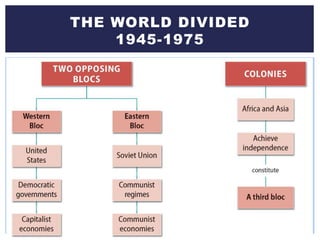
THE WORLD DIVIDED
1945-1975
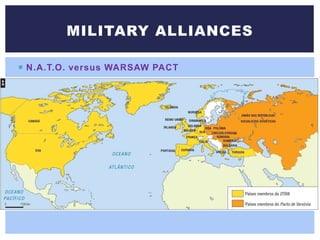
 N.A.T.O. versus WARSAW PACT
MILITARY ALLIANCES
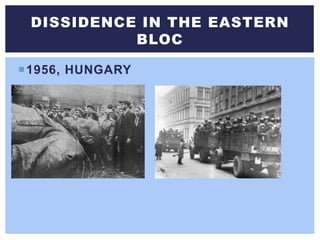
1956, HUNGARY
DISSIDENCE IN THE EASTERN
BLOC
1968, the Prague Spring
DISSIDENCE IN THE EASTERN
BLOC
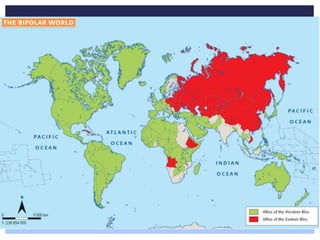
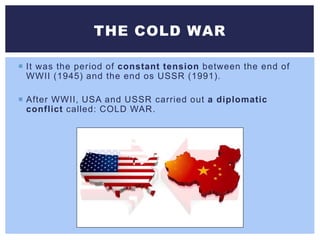
 It was the period of constant tension between the end of
WWII (1945) and the end os USSR (1991).
 After WWII, USA and USSR carried out a diplomatic
conflict called: COLD WAR.
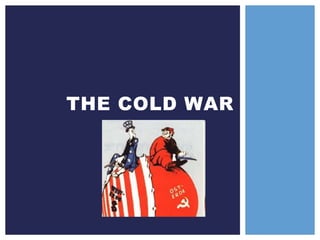
THE COLD WAR
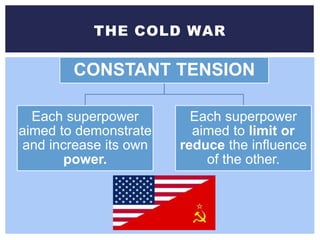
CONSTANT TENSION
Each superpower
aimed to demonstrate
and increase its own
power.
Each superpower
aimed to limit or
reduce the influence
of the other.
THE COLD WAR
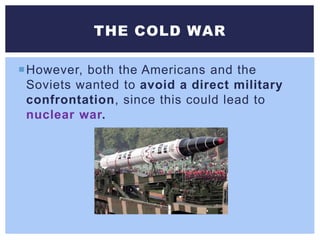
However, both the Americans and the
Soviets wanted to avoid a direct military
confrontation, since this could lead to
nuclear war.
THE COLD WAR
PRELUDE TO THE
COLD WAR:
THE DETERIORATION
RELATIONS BETWEEN
THE ALLIES
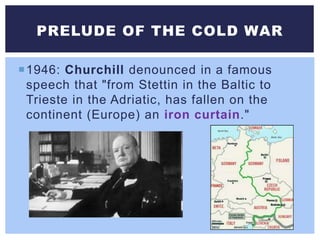
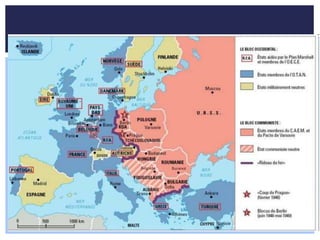
1946: Churchill denounced in a famous
speech that "from Stettin in the Baltic to
Trieste in the Adriatic, has fallen on the
continent (Europe) an iron curtain."
PRELUDE OF THE COLD WAR
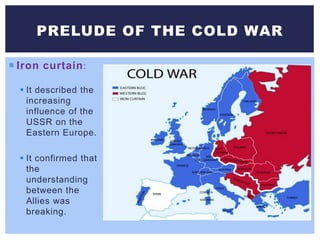
 Iron curtain:
 It described the
increasing
influence of the
USSR on the
Eastern Europe.
 It confirmed that
the
understanding
between the
Allies was
breaking.
PRELUDE OF THE COLD WAR
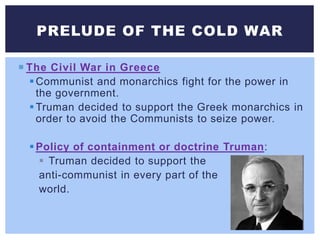
 The Civil War in Greece
Communist and monarchics fight for the power in
the government.
Truman decided to support the Greek monarchics in
order to avoid the Communists to seize power.
Policy of containment or doctrine Truman:
 Truman decided to support the
anti-communist in every part of the
world.
PRELUDE OF THE COLD WAR
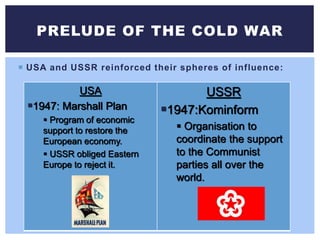
 USA and USSR reinforced their spheres of influence:
PRELUDE OF THE COLD WAR
USA
1947: Marshall Plan
 Program of economic
support to restore the
European economy.
 USSR obliged Eastern
Europe to reject it.
USSR
1947:Kominform
 Organisation to
coordinate the support
to the Communist
parties all over the
world.
INITIAL CONFLICTS
(1948-1962
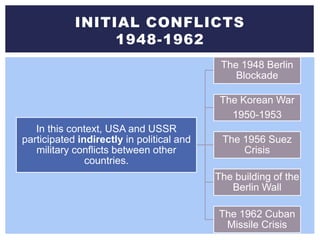
In this context, USA and USSR
participated indirectly in political and
military conflicts between other
countries.
The 1948 Berlin
Blockade
The Korean War
1950-1953
The 1956 Suez
Crisis
The building of the
Berlin Wall
The 1962 Cuban
Missile Crisis
INITIAL CONFLICTS
1948-1962
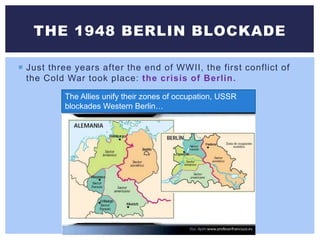
 Just three years after the end of WWII, the first conflict of
the Cold War took place: the crisis of Berlin.
THE 1948 BERLIN BLOCKADE
The Allies unify their zones of occupation, USSR
blockades Western Berlin…
THE 1948 BERLIN BLOCKADE
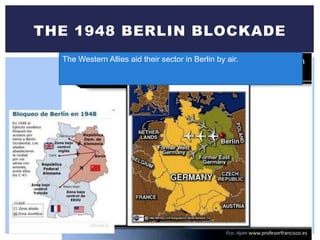
The Western Allies aid their sector in Berlin by air.
THE 1948 BERLIN BLOCKADE
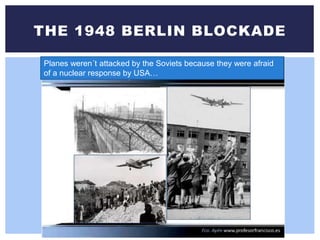
Planes weren´t attacked by the Soviets because they were afraid
of a nuclear response by USA…
THE 1948 BERLIN BLOCKADE
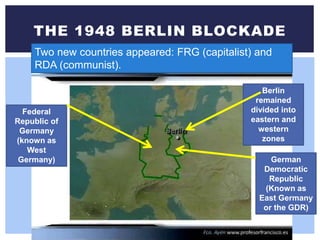
Federal
Republic of
Germany
(known as
West
Germany) German
Democratic
Republic
(Known as
East Germany
or the GDR)
Berlin
remained
divided into
eastern and
western
zones
Two new countries appeared: FRG (capitalist) and
RDA (communist).
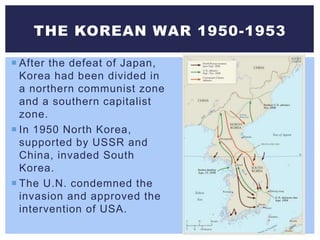
 After the defeat of Japan,
Korea had been divided in
a northern communist zone
and a southern capitalist
zone.
 In 1950 North Korea,
supported by USSR and
China, invaded South
Korea.
 The U.N. condemned the
invasion and approved the
intervention of USA.
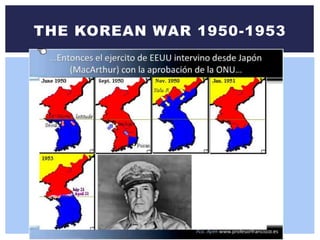
THE KOREAN WAR 1950-1953
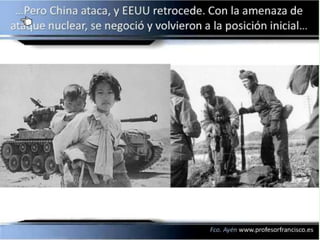
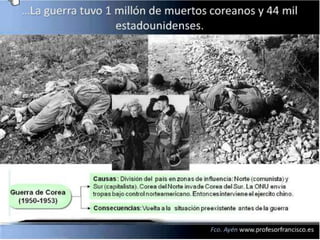
 The conflict ended with the division of the two countries
along the 38th parallel. In 1953 the peace was signed
and the borders of 1950 were maintained.
THE KOREAN WAR 1950-1953
THE 1956 SUEZ CRISIS
• Nasser
nationalised the
Suez Canal,
which had been
controlled by
France and
Great Britain.
• Nasser was
supported by
the USSR.
French and British troops were sent to Egypt, but the USA did not
support this operation so the troops were withdrawn.
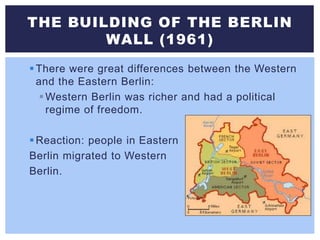
There were great differences between the Western
and the Eastern Berlin:
Western Berlin was richer and had a political
regime of freedom.
Reaction: people in Eastern
Berlin migrated to Western
Berlin.
THE BUILDING OF THE BERLIN
WALL (1961)
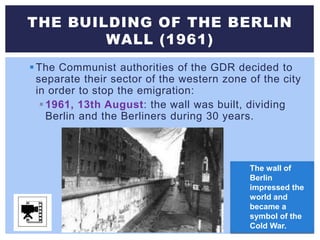
The Communist authorities of the GDR decided to
separate their sector of the western zone of the city
in order to stop the emigration:
1961, 13th August: the wall was built, dividing
Berlin and the Berliners during 30 years.
THE BUILDING OF THE BERLIN
WALL (1961)
The wall of
Berlin
impressed the
world and
became a
symbol of the
Cold War.
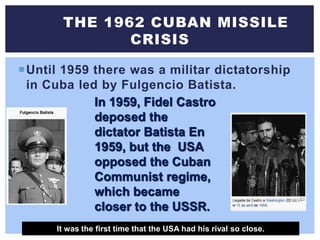
Until 1959 there was a militar dictatorship
in Cuba led by Fulgencio Batista.
THE 1962 CUBAN MISSILE
CRISIS
In 1959, Fidel Castro
deposed the
dictator Batista En
1959, but the USA
opposed the Cuban
Communist regime,
which became
closer to the USSR.
It was the first time that the USA had his rival so close.
In 1962, Castro gave permission for the USSR
to install nuclear weapons on the island.
In response, Kennedy decreed the naval
blockade to avoid the arrival of Sovietic
material to Cuba.
THE 1962 CUBAN MISSILE
CRISIS
THE 1962 CUBAN MISSILE
CRISIS
During 13 days,
it was thought
that a war
between the
two blocs was
possible.
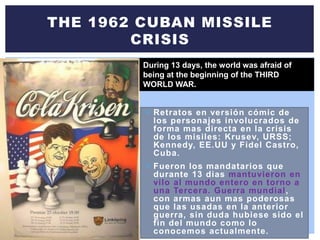
 Retratos en versión cómic de
los personajes involucrados de
forma mas directa en la crisis
de los misiles: Krusev, URSS;
Kennedy, EE.UU y Fidel Castro,
Cuba.
 Fueron los mandatarios que
durante 13 dias mantuvieron en
vilo al mundo entero en torno a
una Tercera. Guerra mundial,
con armas aun mas poderosas
que las usadas en la anterior
guerra, sin duda hubiese sido el
fin del mundo como lo
conocemos actualmente.
THE 1962 CUBAN MISSILE
CRISIS
During 13 days, the world was afraid of
being at the beginning of the THIRD
WORLD WAR.
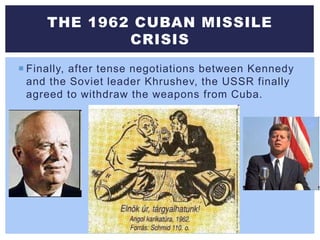
 Finally, after tense negotiations between Kennedy
and the Soviet leader Khrushev, the USSR finally
agreed to withdraw the weapons from Cuba.
THE 1962 CUBAN MISSILE
CRISIS
1963-1975
PEACEFUL
COEXISTENCE
PEACEFUL COEXISTENCE
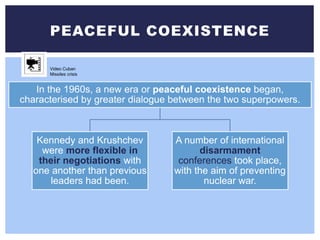
In the 1960s, a new era or peaceful coexistence began,
characterised by greater dialogue between the two superpowers.
Kennedy and Krushchev
were more flexible in
their negotiations with
one another than previous
leaders had been.
A number of international
disarmament
conferences took place,
with the aim of preventing
nuclear war.
Video Cuban
Missiles crisis
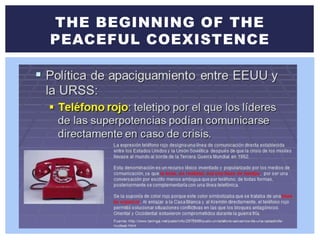
THE BEGINNING OF THE
PEACEFUL COEXISTENCE
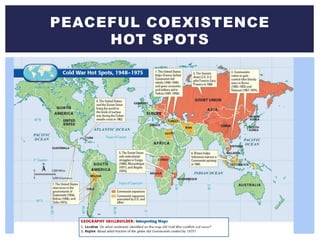
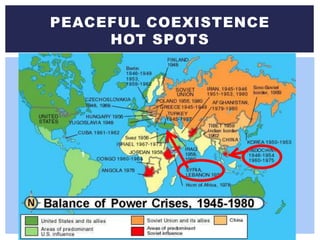
HOT SPOTS
THE VIETNAM WAR
(1961-1975)
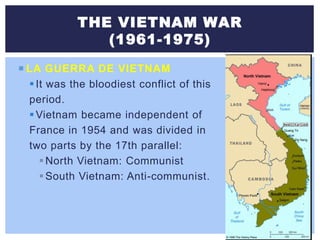
 LA GUERRA DE VIETNAM
It was the bloodiest conflict of this
period.
Vietnam became independent of
France in 1954 and was divided in
two parts by the 17th parallel:
North Vietnam: Communist
South Vietnam: Anti-communist.
PEACEFUL COEXISTENCE
HOT SPOTS
THE VIETNAM WAR
(1961-1975)
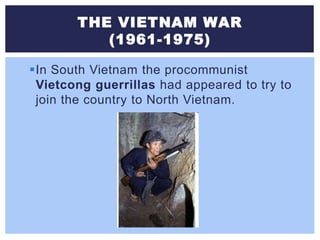
In South Vietnam the procommunist
Vietcong guerrillas had appeared to try to
join the country to North Vietnam.
THE VIETNAM WAR
(1961-1975)
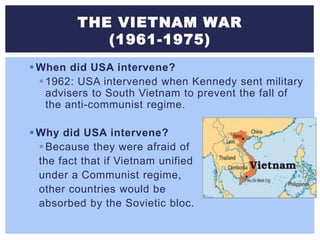
When did USA intervene?
1962: USA intervened when Kennedy sent military
advisers to South Vietnam to prevent the fall of
the anti-communist regime.
Why did USA intervene?
Because they were afraid of
the fact that if Vietnam unified
under a Communist regime,
other countries would be
absorbed by the Sovietic bloc.
THE VIETNAM WAR
(1961-1975)
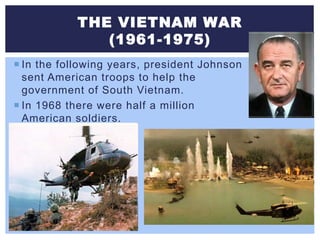
 In the following years, president Johnson
sent American troops to help the
government of South Vietnam.
 In 1968 there were half a million
American soldiers.
THE VIETNAM
WAR (1961-1975)
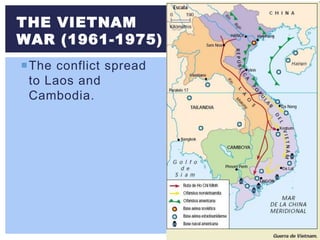
The conflict spread
to Laos and
Cambodia.
THE VIETNAM WAR
(1961-1975)
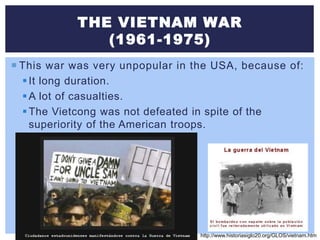
 This war was very unpopular in the USA, because of:
It long duration.
A lot of casualties.
The Vietcong was not defeated in spite of the
superiority of the American troops.
http://www.historiasiglo20.org/GLOS/vietnam.htm
THE VIETNAM WAR
(1961-1975)
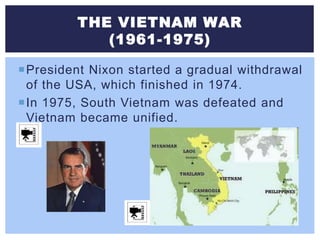
President Nixon started a gradual withdrawal
of the USA, which finished in 1974.
In 1975, South Vietnam was defeated and
Vietnam became unified.
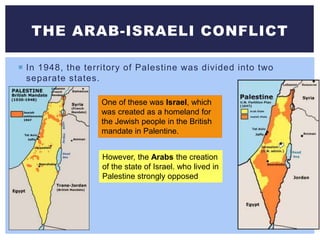
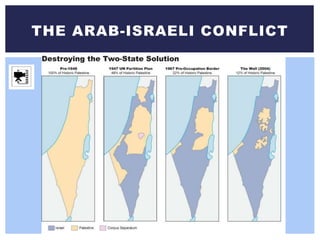
 In 1948, the territory of Palestine was divided into two
separate states.
THE ARAB-ISRAELI CONFLICT
One of these was Israel, which
was created as a homeland for
the Jewish people in the British
mandate in Palentine.
However, the Arabs the creation
of the state of Israel. who lived in
Palestine strongly opposed
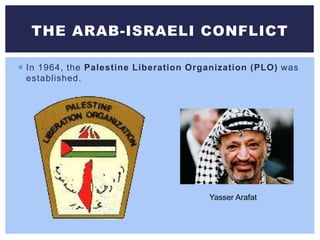
 In 1964, the Palestine Liberation Organization (PLO) was
established.
THE ARAB-ISRAELI CONFLICT
Yasser Arafat
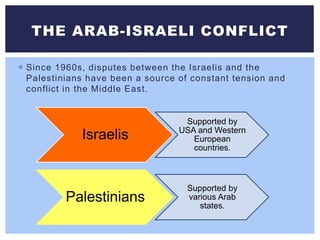
 Since 1960s, disputes between the Israelis and the
Palestinians have been a source of constant tension and
conflict in the Middle East.
THE ARAB-ISRAELI CONFLICT
Israelis
Supported by
USA and Western
European
countries.
Palestinians
Supported by
various Arab
states.
THE ARAB-ISRAELI CONFLICT

The cold war

  • 1.
  • 3.
  • 4.
     N.A.T.O. versusWARSAW PACT MILITARY ALLIANCES
  • 5.
  • 6.
    1968, the PragueSpring DISSIDENCE IN THE EASTERN BLOC
  • 7.
     It wasthe period of constant tension between the end of WWII (1945) and the end os USSR (1991).  After WWII, USA and USSR carried out a diplomatic conflict called: COLD WAR. THE COLD WAR
  • 8.
    CONSTANT TENSION Each superpower aimedto demonstrate and increase its own power. Each superpower aimed to limit or reduce the influence of the other. THE COLD WAR
  • 9.
    However, both theAmericans and the Soviets wanted to avoid a direct military confrontation, since this could lead to nuclear war. THE COLD WAR
  • 10.
    PRELUDE TO THE COLDWAR: THE DETERIORATION RELATIONS BETWEEN THE ALLIES
  • 11.
    1946: Churchill denouncedin a famous speech that "from Stettin in the Baltic to Trieste in the Adriatic, has fallen on the continent (Europe) an iron curtain." PRELUDE OF THE COLD WAR
  • 12.
     Iron curtain: It described the increasing influence of the USSR on the Eastern Europe.  It confirmed that the understanding between the Allies was breaking. PRELUDE OF THE COLD WAR
  • 13.
     The CivilWar in Greece Communist and monarchics fight for the power in the government. Truman decided to support the Greek monarchics in order to avoid the Communists to seize power. Policy of containment or doctrine Truman:  Truman decided to support the anti-communist in every part of the world. PRELUDE OF THE COLD WAR
  • 14.
     USA andUSSR reinforced their spheres of influence: PRELUDE OF THE COLD WAR USA 1947: Marshall Plan  Program of economic support to restore the European economy.  USSR obliged Eastern Europe to reject it. USSR 1947:Kominform  Organisation to coordinate the support to the Communist parties all over the world.
  • 16.
  • 17.
    In this context,USA and USSR participated indirectly in political and military conflicts between other countries. The 1948 Berlin Blockade The Korean War 1950-1953 The 1956 Suez Crisis The building of the Berlin Wall The 1962 Cuban Missile Crisis INITIAL CONFLICTS 1948-1962
  • 18.
     Just threeyears after the end of WWII, the first conflict of the Cold War took place: the crisis of Berlin. THE 1948 BERLIN BLOCKADE The Allies unify their zones of occupation, USSR blockades Western Berlin…
  • 19.
    THE 1948 BERLINBLOCKADE The Western Allies aid their sector in Berlin by air.
  • 20.
    THE 1948 BERLINBLOCKADE Planes weren´t attacked by the Soviets because they were afraid of a nuclear response by USA…
  • 21.
    THE 1948 BERLINBLOCKADE Federal Republic of Germany (known as West Germany) German Democratic Republic (Known as East Germany or the GDR) Berlin remained divided into eastern and western zones Two new countries appeared: FRG (capitalist) and RDA (communist).
  • 22.
     After thedefeat of Japan, Korea had been divided in a northern communist zone and a southern capitalist zone.  In 1950 North Korea, supported by USSR and China, invaded South Korea.  The U.N. condemned the invasion and approved the intervention of USA. THE KOREAN WAR 1950-1953
  • 23.
    THE KOREAN WAR1950-1953
  • 26.
     The conflictended with the division of the two countries along the 38th parallel. In 1953 the peace was signed and the borders of 1950 were maintained. THE KOREAN WAR 1950-1953
  • 27.
    THE 1956 SUEZCRISIS • Nasser nationalised the Suez Canal, which had been controlled by France and Great Britain. • Nasser was supported by the USSR. French and British troops were sent to Egypt, but the USA did not support this operation so the troops were withdrawn.
  • 28.
    There were greatdifferences between the Western and the Eastern Berlin: Western Berlin was richer and had a political regime of freedom. Reaction: people in Eastern Berlin migrated to Western Berlin. THE BUILDING OF THE BERLIN WALL (1961)
  • 29.
    The Communist authoritiesof the GDR decided to separate their sector of the western zone of the city in order to stop the emigration: 1961, 13th August: the wall was built, dividing Berlin and the Berliners during 30 years. THE BUILDING OF THE BERLIN WALL (1961) The wall of Berlin impressed the world and became a symbol of the Cold War.
  • 30.
    Until 1959 therewas a militar dictatorship in Cuba led by Fulgencio Batista. THE 1962 CUBAN MISSILE CRISIS In 1959, Fidel Castro deposed the dictator Batista En 1959, but the USA opposed the Cuban Communist regime, which became closer to the USSR. It was the first time that the USA had his rival so close.
  • 31.
    In 1962, Castrogave permission for the USSR to install nuclear weapons on the island. In response, Kennedy decreed the naval blockade to avoid the arrival of Sovietic material to Cuba. THE 1962 CUBAN MISSILE CRISIS
  • 32.
    THE 1962 CUBANMISSILE CRISIS During 13 days, it was thought that a war between the two blocs was possible.
  • 33.
     Retratos enversión cómic de los personajes involucrados de forma mas directa en la crisis de los misiles: Krusev, URSS; Kennedy, EE.UU y Fidel Castro, Cuba.  Fueron los mandatarios que durante 13 dias mantuvieron en vilo al mundo entero en torno a una Tercera. Guerra mundial, con armas aun mas poderosas que las usadas en la anterior guerra, sin duda hubiese sido el fin del mundo como lo conocemos actualmente. THE 1962 CUBAN MISSILE CRISIS During 13 days, the world was afraid of being at the beginning of the THIRD WORLD WAR.
  • 34.
     Finally, aftertense negotiations between Kennedy and the Soviet leader Khrushev, the USSR finally agreed to withdraw the weapons from Cuba. THE 1962 CUBAN MISSILE CRISIS
  • 35.
  • 36.
    PEACEFUL COEXISTENCE In the1960s, a new era or peaceful coexistence began, characterised by greater dialogue between the two superpowers. Kennedy and Krushchev were more flexible in their negotiations with one another than previous leaders had been. A number of international disarmament conferences took place, with the aim of preventing nuclear war. Video Cuban Missiles crisis
  • 37.
    THE BEGINNING OFTHE PEACEFUL COEXISTENCE
  • 38.
  • 39.
    THE VIETNAM WAR (1961-1975) LA GUERRA DE VIETNAM It was the bloodiest conflict of this period. Vietnam became independent of France in 1954 and was divided in two parts by the 17th parallel: North Vietnam: Communist South Vietnam: Anti-communist.
  • 40.
  • 41.
    THE VIETNAM WAR (1961-1975) InSouth Vietnam the procommunist Vietcong guerrillas had appeared to try to join the country to North Vietnam.
  • 42.
    THE VIETNAM WAR (1961-1975) Whendid USA intervene? 1962: USA intervened when Kennedy sent military advisers to South Vietnam to prevent the fall of the anti-communist regime. Why did USA intervene? Because they were afraid of the fact that if Vietnam unified under a Communist regime, other countries would be absorbed by the Sovietic bloc.
  • 43.
    THE VIETNAM WAR (1961-1975) In the following years, president Johnson sent American troops to help the government of South Vietnam.  In 1968 there were half a million American soldiers.
  • 44.
    THE VIETNAM WAR (1961-1975) Theconflict spread to Laos and Cambodia.
  • 45.
    THE VIETNAM WAR (1961-1975) This war was very unpopular in the USA, because of: It long duration. A lot of casualties. The Vietcong was not defeated in spite of the superiority of the American troops. http://www.historiasiglo20.org/GLOS/vietnam.htm
  • 46.
    THE VIETNAM WAR (1961-1975) PresidentNixon started a gradual withdrawal of the USA, which finished in 1974. In 1975, South Vietnam was defeated and Vietnam became unified.
  • 47.
     In 1948,the territory of Palestine was divided into two separate states. THE ARAB-ISRAELI CONFLICT One of these was Israel, which was created as a homeland for the Jewish people in the British mandate in Palentine. However, the Arabs the creation of the state of Israel. who lived in Palestine strongly opposed
  • 48.
     In 1964,the Palestine Liberation Organization (PLO) was established. THE ARAB-ISRAELI CONFLICT Yasser Arafat
  • 49.
     Since 1960s,disputes between the Israelis and the Palestinians have been a source of constant tension and conflict in the Middle East. THE ARAB-ISRAELI CONFLICT Israelis Supported by USA and Western European countries. Palestinians Supported by various Arab states.
  • 50.