COLD WAR CONFLICTS U.S vs. U.S.S.R.
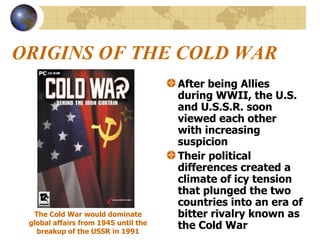
ORIGINS OF THE COLD WAR After being Allies during WWII, the U.S. and U.S.S.R. soon viewed each other with increasing suspicion Their political differences created a climate of icy tension that plunged the two countries into an era of bitter rivalry known as the Cold War The Cold War would dominate global affairs from 1945 until the breakup of the USSR in 1991
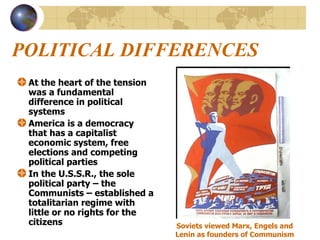
POLITICAL DIFFERENCES At the heart of the tension was a fundamental difference in political systems  America is a democracy that has a capitalist economic system, free elections and competing political parties In the U.S.S.R., the sole political party – the Communists – established a totalitarian regime with little or no rights for the citizens   Soviets viewed Marx, Engels and Lenin as founders of Communism
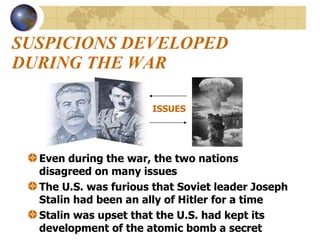
SUSPICIONS DEVELOPED DURING THE WAR Even during the war, the two nations disagreed on many issues The U.S. was furious that Soviet leader Joseph Stalin had been an ally of Hitler for a time Stalin was upset that the U.S. had kept its development of the atomic bomb a secret ISSUES
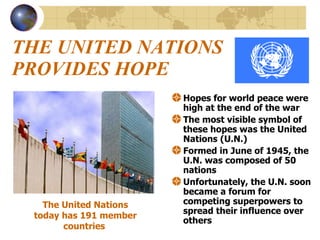
THE UNITED NATIONS PROVIDES HOPE Hopes for world peace were high at the end of the war The most visible symbol of these hopes was the United Nations (U.N.) Formed in June of 1945, the U.N. was composed of 50 nations  Unfortunately, the U.N. soon became a forum for competing superpowers to spread their influence over others  The United Nations today has 191 member countries
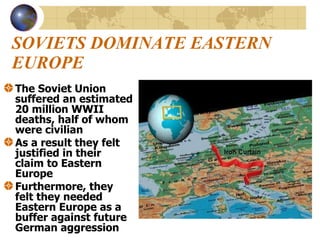
SOVIETS DOMINATE EASTERN EUROPE The Soviet Union suffered an estimated 20 million WWII deaths, half of whom were civilian As a result they felt justified in their claim to Eastern Europe Furthermore, they felt they needed Eastern Europe as a buffer against future German aggression
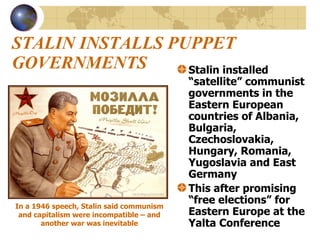
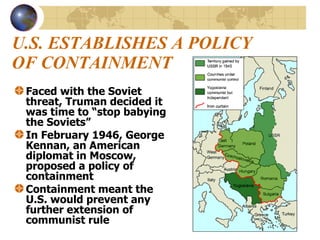
STALIN INSTALLS PUPPET GOVERNMENTS Stalin installed “satellite” communist governments in the Eastern European countries of Albania, Bulgaria, Czechoslovakia, Hungary, Romania, Yugoslavia and East Germany This after promising “free elections” for Eastern Europe at the Yalta Conference In a 1946 speech, Stalin said communism and capitalism were incompatible – and another war was inevitable
 
U.S. ESTABLISHES A POLICY OF CONTAINMENT Faced with the Soviet threat, Truman decided it was time to “stop babying the Soviets” In February 1946, George Kennan, an American diplomat in Moscow, proposed a policy of containment Containment meant the U.S. would prevent any further extension of communist rule
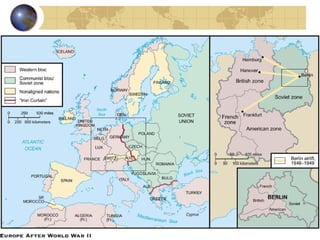
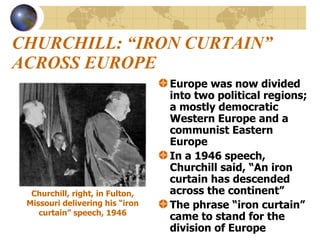
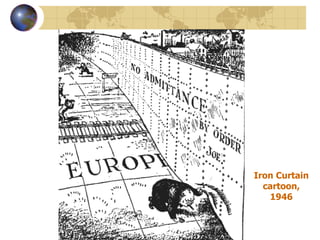
CHURCHILL: “IRON CURTAIN” ACROSS EUROPE Europe was now divided into two political regions; a mostly democratic Western Europe and a communist Eastern Europe In a 1946 speech, Churchill said, “An iron curtain has descended across the continent” The phrase “iron curtain” came to stand for the division of Europe Churchill, right, in Fulton, Missouri delivering his “iron curtain” speech, 1946
Iron Curtain cartoon, 1946
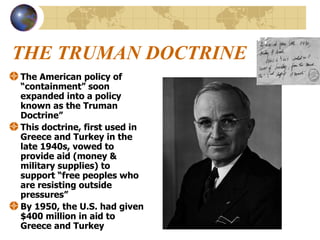
THE TRUMAN DOCTRINE The American policy of “containment” soon expanded into a policy known as the Truman Doctrine” This doctrine, first used in Greece and Turkey in the late 1940s, vowed to provide aid (money & military supplies) to support “free peoples who are resisting outside pressures” By 1950, the U.S. had given $400 million in aid to Greece and Turkey
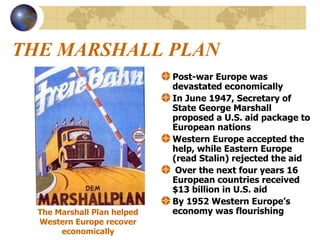
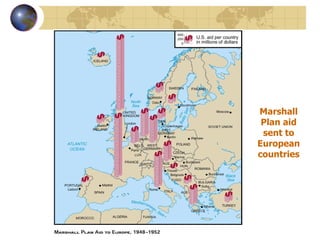
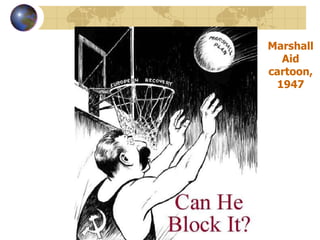
THE MARSHALL PLAN Post-war Europe was devastated economically In June 1947, Secretary of State George Marshall proposed a U.S. aid package to European nations Western Europe accepted the help, while Eastern Europe (read Stalin) rejected the aid  Over the next four years 16 European countries received $13 billion in U.S. aid  By 1952 Western Europe’s economy was flourishing The Marshall Plan helped Western Europe recover economically
Marshall Plan aid sent to European countries
Marshall Aid cartoon, 1947
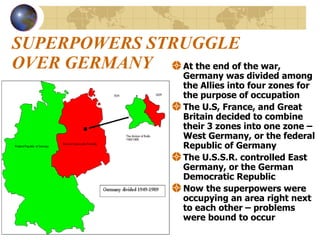
SUPERPOWERS STRUGGLE OVER GERMANY At the end of the war, Germany was divided among the Allies into four zones for the purpose of occupation The U.S, France, and Great Britain decided to combine their 3 zones into one zone – West Germany, or the federal Republic of Germany The U.S.S.R. controlled East Germany, or the German Democratic Republic  Now the superpowers were occupying an area right next to each other – problems were bound to occur
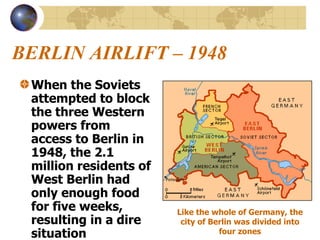
BERLIN AIRLIFT – 1948 When the Soviets attempted to block the three Western powers from access to Berlin in 1948, the 2.1 million residents of West Berlin had only enough food for five weeks, resulting in a dire situation  Like the whole of Germany, the city of Berlin was divided into four zones
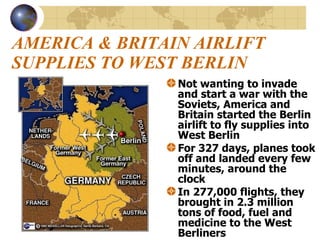
AMERICA & BRITAIN AIRLIFT SUPPLIES TO WEST BERLIN Not wanting to invade and start a war with the Soviets, America and Britain started the Berlin airlift to fly supplies into West Berlin For 327 days, planes took off and landed every few minutes, around the clock In 277,000 flights, they brought in 2.3 million tons of food, fuel and medicine to the West Berliners
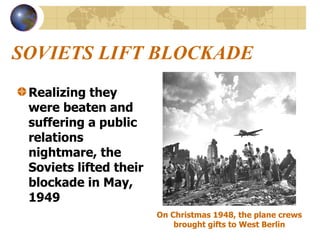
SOVIETS LIFT BLOCKADE Realizing they were beaten and suffering a public relations nightmare, the Soviets lifted their blockade in May, 1949 On Christmas 1948, the plane crews brought gifts to West Berlin
NATO FORMED The Berlin blockade increased Western Europe’s fear of Soviet aggression As a result, ten West European nations joined the U.S and Canada on April 4, 1949 to form a defensive alliance known as the North Atlantic Treaty Organization The NATO flag
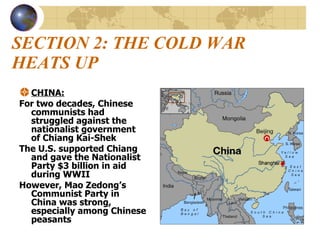
SECTION 2: THE COLD WAR HEATS UP CHINA: For two decades, Chinese communists had struggled against the nationalist government of Chiang Kai-Shek The U.S. supported Chiang and gave the Nationalist Party $3 billion in aid during WWII However, Mao Zedong’s Communist Party in China was strong, especially among Chinese peasants
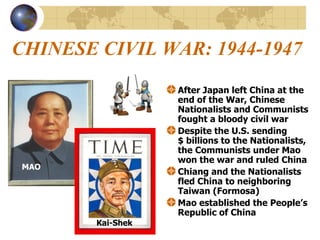
CHINESE CIVIL WAR: 1944-1947 After Japan left China at the end of the War, Chinese Nationalists and Communists fought a bloody civil war Despite the U.S. sending  $ billions to the Nationalists, the Communists under Mao won the war and ruled China Chiang and the Nationalists fled China to neighboring Taiwan (Formosa) Mao established the People’s Republic of China MAO Kai-Shek
AMERICA STUNNED The American public was shocked that China had fallen to the Communists Many believed containment had failed and communism was expanding American fear of communism and communist expansion was increasing
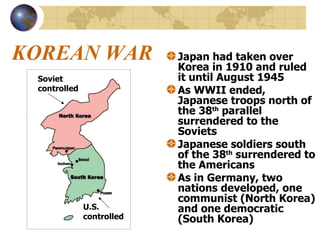
KOREAN WAR Japan had taken over Korea in 1910 and ruled it until August 1945 As WWII ended, Japanese troops north of the 38 th  parallel surrendered to the Soviets Japanese soldiers south of the 38 th  surrendered to the Americans As in Germany, two nations developed, one communist (North Korea) and one democratic (South Korea) Soviet controlled U.S. controlled
NORTH KOREA ATTACKS SOUTH KOREA On June 25, 1950, North Korean forces swept across the 38 th  parallel in a surprise attack on South Korea With only 500 U.S. troops in South Korea, the Soviets figured the Americans would not fight to save South Korea Instead, America sent troops, planes and ships to South Korea
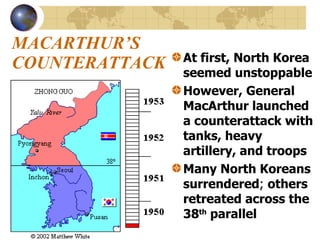
MACARTHUR’S COUNTERATTACK At first, North Korea seemed unstoppable However, General MacArthur launched a counterattack with tanks, heavy artillery, and troops Many North Koreans surrendered ;  others retreated across the 38 th  parallel
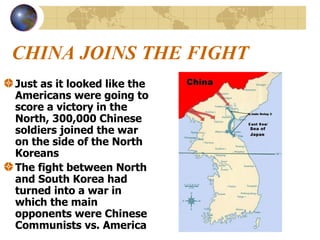
CHINA JOINS THE FIGHT Just as it looked like the Americans were going to score a victory in the North, 300,000 Chinese soldiers joined the war on the side of the North Koreans The fight between North and South Korea had turned into a war in which the main opponents were Chinese Communists vs. America
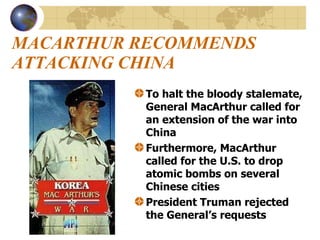
MACARTHUR RECOMMENDS ATTACKING CHINA To halt the bloody stalemate, General MacArthur called for an extension of the war into China Furthermore, MacArthur called for the U.S. to drop atomic bombs on several Chinese cities President Truman rejected the General’s requests
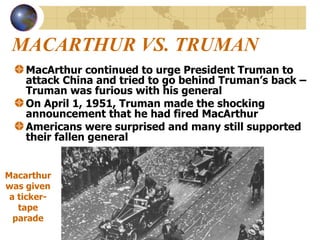
MACARTHUR VS. TRUMAN MacArthur continued to urge President Truman to attack China and tried to go behind Truman’s back – Truman was furious with his general On April 1, 1951, Truman made the shocking announcement that he had fired MacArthur Americans were surprised and many still supported their fallen general  Macarthur was given a ticker-tape parade
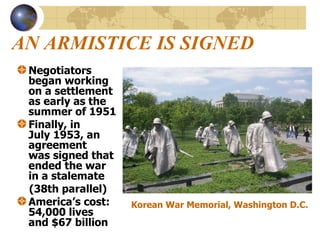
AN ARMISTICE IS SIGNED Negotiators  began working  on a settlement  as early as the  summer of 1951 Finally, in  July 1953, an agreement  was signed that  ended the war  in a stalemate (38th parallel)  America’s cost:  54,000 lives  and $67 billion  Korean War Memorial, Washington D.C.
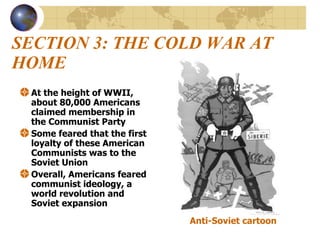
SECTION 3: THE COLD WAR AT HOME At the height of WWII, about 80,000 Americans claimed membership in the Communist Party Some feared that the first loyalty of these American Communists was to the Soviet Union Overall, Americans feared communist ideology, a world revolution and Soviet expansion Anti-Soviet cartoon
U.S. GOVERNMENT TAKES ACTION In March of 1947, President Truman set up the Loyalty Review Board The board was created to investigate federal employees and dismiss those disloyal to the U.S. government The U.S. Attorney General also drew up a list of 91 “subversive” organizations – membership in any of these was ground for suspicion
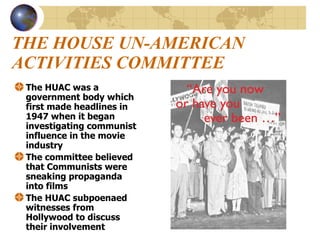
THE HOUSE UN-AMERICAN ACTIVITIES COMMITTEE The HUAC was a government body which first made headlines in 1947 when it began investigating communist influence in the movie industry The committee believed that Communists were sneaking propaganda into films The HUAC subpoenaed witnesses from Hollywood to discuss their involvement
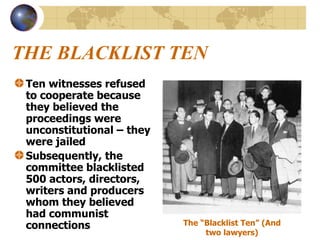
THE BLACKLIST TEN Ten witnesses refused to cooperate because they believed the proceedings were unconstitutional – they were jailed Subsequently, the committee blacklisted 500 actors, directors, writers and producers whom they believed had communist connections The “Blacklist Ten” (And two lawyers)
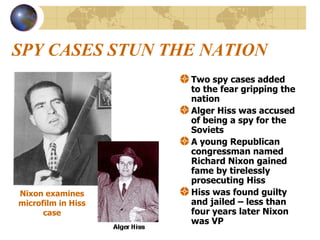
SPY CASES STUN THE NATION Two spy cases added to the fear gripping the nation Alger Hiss was accused of being a spy for the Soviets A young Republican congressman named Richard Nixon gained fame by tirelessly prosecuting Hiss   Hiss was found guilty and jailed – less than four years later Nixon was VP Nixon examines microfilm in Hiss case
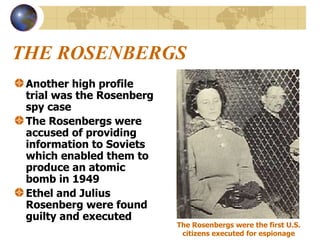
THE ROSENBERGS   Another high profile trial was the Rosenberg spy case The Rosenbergs were accused of providing information to Soviets which enabled them to produce an atomic bomb in 1949 Ethel and Julius Rosenberg were found guilty and executed   The Rosenbergs were the first U.S. citizens executed for espionage
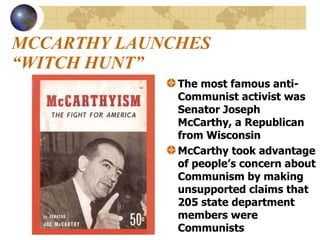
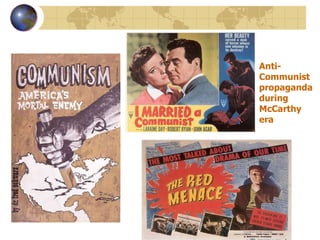
MCCARTHY LAUNCHES “WITCH HUNT”   The most famous anti-Communist activist was Senator Joseph McCarthy, a Republican from Wisconsin McCarthy took advantage of people’s concern about Communism by making unsupported claims that 205 state department members were Communists
Anti-Communist propaganda during McCarthy era
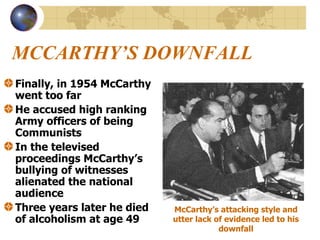
MCCARTHY’S DOWNFALL Finally, in 1954 McCarthy went too far He accused high ranking Army officers of being Communists In the televised proceedings McCarthy’s bullying of witnesses alienated the national audience Three years later he died of alcoholism at age 49 McCarthy’s attacking style and utter lack of evidence led to his downfall
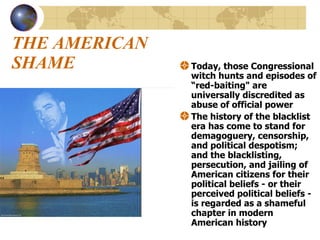
THE AMERICAN SHAME Today, those Congressional witch hunts and episodes of “red-baiting" are universally discredited as abuse of official power  The history of the blacklist era has come to stand for demagoguery, censorship, and political despotism; and the blacklisting, persecution, and jailing of American citizens for their political beliefs - or their perceived political beliefs - is regarded as a shameful chapter in modern American history
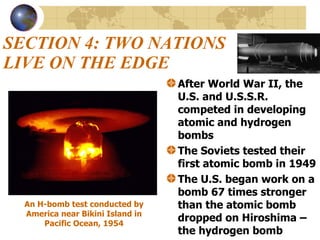
SECTION 4: TWO NATIONS LIVE ON THE EDGE After World War II, the U.S. and U.S.S.R. competed in developing atomic and hydrogen bombs The Soviets tested their first atomic bomb in 1949  The U.S. began work on a bomb 67 times stronger than the atomic bomb dropped on Hiroshima – the hydrogen bomb An H-bomb test conducted by America near Bikini Island in Pacific Ocean, 1954
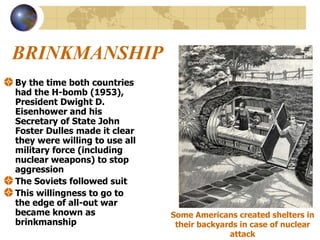
BRINKMANSHIP By the time both countries had the H-bomb (1953), President Dwight D. Eisenhower and his Secretary of State John Foster Dulles made it clear they were willing to use all military force (including nuclear weapons) to stop aggression The Soviets followed suit  This willingness to go to the edge of all-out war became known as brinkmanship Some Americans created shelters in their backyards in case of nuclear attack
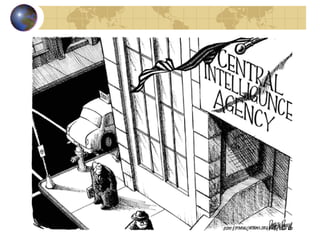
THE COLD WAR SPREADS As the Cold War heated up, the U.S. depended more and more on information compiled by the Central Intelligence Agency (CIA) The CIA began attempts to weaken or overthrow governments unfriendly to the U.S.
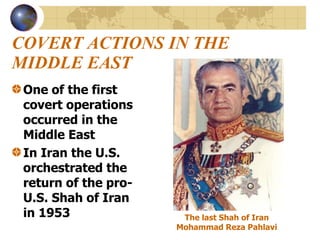
COVERT ACTIONS IN THE MIDDLE EAST One of the first covert operations occurred in the Middle East In Iran the U.S. orchestrated the return of the pro-U.S. Shah of Iran in 1953 The last Shah of Iran  Mohammad Reza Pahlavi
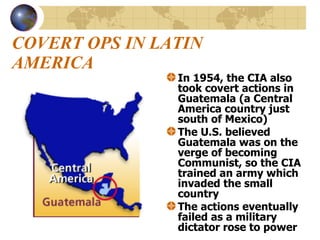
COVERT OPS IN LATIN AMERICA In 1954, the CIA also took covert actions in Guatemala (a Central America country just south of Mexico) The U.S. believed Guatemala was on the verge of becoming Communist, so the CIA trained an army which invaded the small country  The actions eventually failed as a military dictator rose to power
 
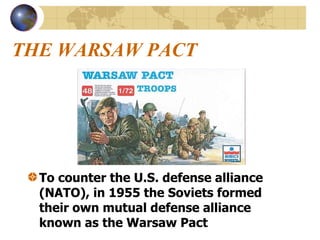
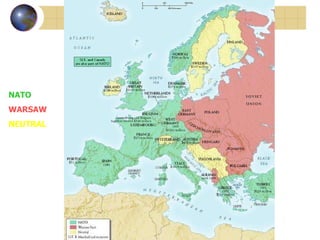
THE WARSAW PACT To counter the U.S. defense alliance (NATO), in 1955 the Soviets formed their own mutual defense alliance known as the Warsaw Pact
NATO WARSAW NEUTRAL
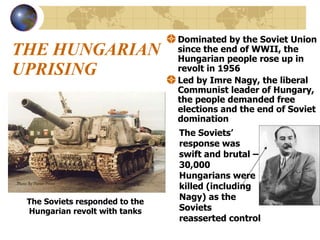
THE HUNGARIAN UPRISING Dominated by the Soviet Union since the end of WWII, the Hungarian people rose up in revolt in 1956 Led by Imre Nagy, the liberal Communist leader of Hungary, the people demanded free elections and the end of Soviet domination The Soviets responded to the Hungarian revolt with tanks The Soviets’ response was swift and brutal – 30,000 Hungarians were killed (including Nagy) as the Soviets reasserted control
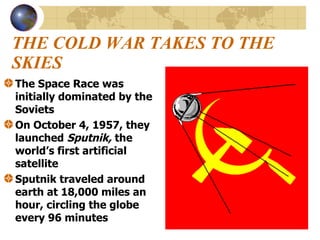
THE COLD WAR TAKES TO THE SKIES The Space Race was initially dominated by the Soviets On October 4, 1957, they launched  Sputnik,  the world’s first artificial satellite Sputnik traveled around earth at 18,000 miles an hour, circling the globe every 96 minutes
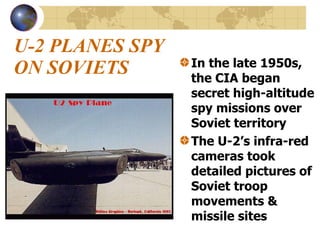
U-2 PLANES SPY ON SOVIETS   In the late 1950s, the CIA began  secret high-altitude spy missions over Soviet territory The U-2’s infra-red cameras took detailed pictures of Soviet troop movements & missile sites
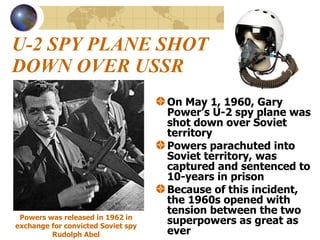
U-2 SPY PLANE SHOT DOWN OVER USSR On May 1, 1960, Gary Power’s U-2 spy plane was shot down over Soviet territory Powers parachuted into Soviet territory, was captured and sentenced to 10-years in prison Because of this incident, the 1960s opened with tension between the two superpowers as great as ever Powers was released in 1962 in exchange for convicted Soviet spy Rudolph Abel

Cold war ppt from web.

  • 1.
    COLD WAR CONFLICTSU.S vs. U.S.S.R.
  • 2.
    ORIGINS OF THECOLD WAR After being Allies during WWII, the U.S. and U.S.S.R. soon viewed each other with increasing suspicion Their political differences created a climate of icy tension that plunged the two countries into an era of bitter rivalry known as the Cold War The Cold War would dominate global affairs from 1945 until the breakup of the USSR in 1991
  • 3.
    POLITICAL DIFFERENCES Atthe heart of the tension was a fundamental difference in political systems America is a democracy that has a capitalist economic system, free elections and competing political parties In the U.S.S.R., the sole political party – the Communists – established a totalitarian regime with little or no rights for the citizens Soviets viewed Marx, Engels and Lenin as founders of Communism
  • 4.
    SUSPICIONS DEVELOPED DURINGTHE WAR Even during the war, the two nations disagreed on many issues The U.S. was furious that Soviet leader Joseph Stalin had been an ally of Hitler for a time Stalin was upset that the U.S. had kept its development of the atomic bomb a secret ISSUES
  • 5.
    THE UNITED NATIONSPROVIDES HOPE Hopes for world peace were high at the end of the war The most visible symbol of these hopes was the United Nations (U.N.) Formed in June of 1945, the U.N. was composed of 50 nations Unfortunately, the U.N. soon became a forum for competing superpowers to spread their influence over others The United Nations today has 191 member countries
  • 6.
    SOVIETS DOMINATE EASTERNEUROPE The Soviet Union suffered an estimated 20 million WWII deaths, half of whom were civilian As a result they felt justified in their claim to Eastern Europe Furthermore, they felt they needed Eastern Europe as a buffer against future German aggression
  • 7.
    STALIN INSTALLS PUPPETGOVERNMENTS Stalin installed “satellite” communist governments in the Eastern European countries of Albania, Bulgaria, Czechoslovakia, Hungary, Romania, Yugoslavia and East Germany This after promising “free elections” for Eastern Europe at the Yalta Conference In a 1946 speech, Stalin said communism and capitalism were incompatible – and another war was inevitable
  • 8.
  • 9.
    U.S. ESTABLISHES APOLICY OF CONTAINMENT Faced with the Soviet threat, Truman decided it was time to “stop babying the Soviets” In February 1946, George Kennan, an American diplomat in Moscow, proposed a policy of containment Containment meant the U.S. would prevent any further extension of communist rule
  • 10.
    CHURCHILL: “IRON CURTAIN”ACROSS EUROPE Europe was now divided into two political regions; a mostly democratic Western Europe and a communist Eastern Europe In a 1946 speech, Churchill said, “An iron curtain has descended across the continent” The phrase “iron curtain” came to stand for the division of Europe Churchill, right, in Fulton, Missouri delivering his “iron curtain” speech, 1946
  • 11.
  • 12.
    THE TRUMAN DOCTRINEThe American policy of “containment” soon expanded into a policy known as the Truman Doctrine” This doctrine, first used in Greece and Turkey in the late 1940s, vowed to provide aid (money & military supplies) to support “free peoples who are resisting outside pressures” By 1950, the U.S. had given $400 million in aid to Greece and Turkey
  • 13.
    THE MARSHALL PLANPost-war Europe was devastated economically In June 1947, Secretary of State George Marshall proposed a U.S. aid package to European nations Western Europe accepted the help, while Eastern Europe (read Stalin) rejected the aid Over the next four years 16 European countries received $13 billion in U.S. aid By 1952 Western Europe’s economy was flourishing The Marshall Plan helped Western Europe recover economically
  • 14.
    Marshall Plan aidsent to European countries
  • 15.
  • 16.
    SUPERPOWERS STRUGGLE OVERGERMANY At the end of the war, Germany was divided among the Allies into four zones for the purpose of occupation The U.S, France, and Great Britain decided to combine their 3 zones into one zone – West Germany, or the federal Republic of Germany The U.S.S.R. controlled East Germany, or the German Democratic Republic Now the superpowers were occupying an area right next to each other – problems were bound to occur
  • 17.
    BERLIN AIRLIFT –1948 When the Soviets attempted to block the three Western powers from access to Berlin in 1948, the 2.1 million residents of West Berlin had only enough food for five weeks, resulting in a dire situation Like the whole of Germany, the city of Berlin was divided into four zones
  • 18.
    AMERICA & BRITAINAIRLIFT SUPPLIES TO WEST BERLIN Not wanting to invade and start a war with the Soviets, America and Britain started the Berlin airlift to fly supplies into West Berlin For 327 days, planes took off and landed every few minutes, around the clock In 277,000 flights, they brought in 2.3 million tons of food, fuel and medicine to the West Berliners
  • 19.
    SOVIETS LIFT BLOCKADERealizing they were beaten and suffering a public relations nightmare, the Soviets lifted their blockade in May, 1949 On Christmas 1948, the plane crews brought gifts to West Berlin
  • 20.
    NATO FORMED TheBerlin blockade increased Western Europe’s fear of Soviet aggression As a result, ten West European nations joined the U.S and Canada on April 4, 1949 to form a defensive alliance known as the North Atlantic Treaty Organization The NATO flag
  • 21.
    SECTION 2: THECOLD WAR HEATS UP CHINA: For two decades, Chinese communists had struggled against the nationalist government of Chiang Kai-Shek The U.S. supported Chiang and gave the Nationalist Party $3 billion in aid during WWII However, Mao Zedong’s Communist Party in China was strong, especially among Chinese peasants
  • 22.
    CHINESE CIVIL WAR:1944-1947 After Japan left China at the end of the War, Chinese Nationalists and Communists fought a bloody civil war Despite the U.S. sending $ billions to the Nationalists, the Communists under Mao won the war and ruled China Chiang and the Nationalists fled China to neighboring Taiwan (Formosa) Mao established the People’s Republic of China MAO Kai-Shek
  • 23.
    AMERICA STUNNED TheAmerican public was shocked that China had fallen to the Communists Many believed containment had failed and communism was expanding American fear of communism and communist expansion was increasing
  • 24.
    KOREAN WAR Japanhad taken over Korea in 1910 and ruled it until August 1945 As WWII ended, Japanese troops north of the 38 th parallel surrendered to the Soviets Japanese soldiers south of the 38 th surrendered to the Americans As in Germany, two nations developed, one communist (North Korea) and one democratic (South Korea) Soviet controlled U.S. controlled
  • 25.
    NORTH KOREA ATTACKSSOUTH KOREA On June 25, 1950, North Korean forces swept across the 38 th parallel in a surprise attack on South Korea With only 500 U.S. troops in South Korea, the Soviets figured the Americans would not fight to save South Korea Instead, America sent troops, planes and ships to South Korea
  • 26.
    MACARTHUR’S COUNTERATTACK Atfirst, North Korea seemed unstoppable However, General MacArthur launched a counterattack with tanks, heavy artillery, and troops Many North Koreans surrendered ; others retreated across the 38 th parallel
  • 27.
    CHINA JOINS THEFIGHT Just as it looked like the Americans were going to score a victory in the North, 300,000 Chinese soldiers joined the war on the side of the North Koreans The fight between North and South Korea had turned into a war in which the main opponents were Chinese Communists vs. America
  • 28.
    MACARTHUR RECOMMENDS ATTACKINGCHINA To halt the bloody stalemate, General MacArthur called for an extension of the war into China Furthermore, MacArthur called for the U.S. to drop atomic bombs on several Chinese cities President Truman rejected the General’s requests
  • 29.
    MACARTHUR VS. TRUMANMacArthur continued to urge President Truman to attack China and tried to go behind Truman’s back – Truman was furious with his general On April 1, 1951, Truman made the shocking announcement that he had fired MacArthur Americans were surprised and many still supported their fallen general Macarthur was given a ticker-tape parade
  • 30.
    AN ARMISTICE ISSIGNED Negotiators began working on a settlement as early as the summer of 1951 Finally, in July 1953, an agreement was signed that ended the war in a stalemate (38th parallel) America’s cost: 54,000 lives and $67 billion Korean War Memorial, Washington D.C.
  • 31.
    SECTION 3: THECOLD WAR AT HOME At the height of WWII, about 80,000 Americans claimed membership in the Communist Party Some feared that the first loyalty of these American Communists was to the Soviet Union Overall, Americans feared communist ideology, a world revolution and Soviet expansion Anti-Soviet cartoon
  • 32.
    U.S. GOVERNMENT TAKESACTION In March of 1947, President Truman set up the Loyalty Review Board The board was created to investigate federal employees and dismiss those disloyal to the U.S. government The U.S. Attorney General also drew up a list of 91 “subversive” organizations – membership in any of these was ground for suspicion
  • 33.
    THE HOUSE UN-AMERICANACTIVITIES COMMITTEE The HUAC was a government body which first made headlines in 1947 when it began investigating communist influence in the movie industry The committee believed that Communists were sneaking propaganda into films The HUAC subpoenaed witnesses from Hollywood to discuss their involvement
  • 34.
    THE BLACKLIST TENTen witnesses refused to cooperate because they believed the proceedings were unconstitutional – they were jailed Subsequently, the committee blacklisted 500 actors, directors, writers and producers whom they believed had communist connections The “Blacklist Ten” (And two lawyers)
  • 35.
    SPY CASES STUNTHE NATION Two spy cases added to the fear gripping the nation Alger Hiss was accused of being a spy for the Soviets A young Republican congressman named Richard Nixon gained fame by tirelessly prosecuting Hiss Hiss was found guilty and jailed – less than four years later Nixon was VP Nixon examines microfilm in Hiss case
  • 36.
    THE ROSENBERGS Another high profile trial was the Rosenberg spy case The Rosenbergs were accused of providing information to Soviets which enabled them to produce an atomic bomb in 1949 Ethel and Julius Rosenberg were found guilty and executed The Rosenbergs were the first U.S. citizens executed for espionage
  • 37.
    MCCARTHY LAUNCHES “WITCHHUNT” The most famous anti-Communist activist was Senator Joseph McCarthy, a Republican from Wisconsin McCarthy took advantage of people’s concern about Communism by making unsupported claims that 205 state department members were Communists
  • 38.
  • 39.
    MCCARTHY’S DOWNFALL Finally,in 1954 McCarthy went too far He accused high ranking Army officers of being Communists In the televised proceedings McCarthy’s bullying of witnesses alienated the national audience Three years later he died of alcoholism at age 49 McCarthy’s attacking style and utter lack of evidence led to his downfall
  • 40.
    THE AMERICAN SHAMEToday, those Congressional witch hunts and episodes of “red-baiting" are universally discredited as abuse of official power The history of the blacklist era has come to stand for demagoguery, censorship, and political despotism; and the blacklisting, persecution, and jailing of American citizens for their political beliefs - or their perceived political beliefs - is regarded as a shameful chapter in modern American history
  • 41.
    SECTION 4: TWONATIONS LIVE ON THE EDGE After World War II, the U.S. and U.S.S.R. competed in developing atomic and hydrogen bombs The Soviets tested their first atomic bomb in 1949 The U.S. began work on a bomb 67 times stronger than the atomic bomb dropped on Hiroshima – the hydrogen bomb An H-bomb test conducted by America near Bikini Island in Pacific Ocean, 1954
  • 42.
    BRINKMANSHIP By thetime both countries had the H-bomb (1953), President Dwight D. Eisenhower and his Secretary of State John Foster Dulles made it clear they were willing to use all military force (including nuclear weapons) to stop aggression The Soviets followed suit This willingness to go to the edge of all-out war became known as brinkmanship Some Americans created shelters in their backyards in case of nuclear attack
  • 43.
    THE COLD WARSPREADS As the Cold War heated up, the U.S. depended more and more on information compiled by the Central Intelligence Agency (CIA) The CIA began attempts to weaken or overthrow governments unfriendly to the U.S.
  • 44.
    COVERT ACTIONS INTHE MIDDLE EAST One of the first covert operations occurred in the Middle East In Iran the U.S. orchestrated the return of the pro-U.S. Shah of Iran in 1953 The last Shah of Iran Mohammad Reza Pahlavi
  • 45.
    COVERT OPS INLATIN AMERICA In 1954, the CIA also took covert actions in Guatemala (a Central America country just south of Mexico) The U.S. believed Guatemala was on the verge of becoming Communist, so the CIA trained an army which invaded the small country The actions eventually failed as a military dictator rose to power
  • 46.
  • 47.
    THE WARSAW PACTTo counter the U.S. defense alliance (NATO), in 1955 the Soviets formed their own mutual defense alliance known as the Warsaw Pact
  • 48.
  • 49.
    THE HUNGARIAN UPRISINGDominated by the Soviet Union since the end of WWII, the Hungarian people rose up in revolt in 1956 Led by Imre Nagy, the liberal Communist leader of Hungary, the people demanded free elections and the end of Soviet domination The Soviets responded to the Hungarian revolt with tanks The Soviets’ response was swift and brutal – 30,000 Hungarians were killed (including Nagy) as the Soviets reasserted control
  • 50.
    THE COLD WARTAKES TO THE SKIES The Space Race was initially dominated by the Soviets On October 4, 1957, they launched Sputnik, the world’s first artificial satellite Sputnik traveled around earth at 18,000 miles an hour, circling the globe every 96 minutes
  • 51.
    U-2 PLANES SPYON SOVIETS In the late 1950s, the CIA began secret high-altitude spy missions over Soviet territory The U-2’s infra-red cameras took detailed pictures of Soviet troop movements & missile sites
  • 52.
    U-2 SPY PLANESHOT DOWN OVER USSR On May 1, 1960, Gary Power’s U-2 spy plane was shot down over Soviet territory Powers parachuted into Soviet territory, was captured and sentenced to 10-years in prison Because of this incident, the 1960s opened with tension between the two superpowers as great as ever Powers was released in 1962 in exchange for convicted Soviet spy Rudolph Abel