Reconstruction of the South
The End Results 258,000 Confederates died in the war Most were adult males South’s economy & society needed rebuilding
Reconstruction
Everybody had a plan … Lincoln’s 10% plan 10% of states’ voters vowed loyalty to Union Form a new government & constitution No slavery
Lincoln Was Soft on the South Punishment served no useful purpose Offered amnesty/swear loyalty Not to Confederate leaders Right to vote to African Americans Force equal rights in Southern states (states rights vs. federal government)
Some jumped in quick Louisiana, Arkansas & Tennessee agreed in 1864  Lincoln’s congress refused to let it occur
Plan 2- The Radical Republicans Thought Lincoln was too mild Congress should decide the South’s fate
The Wade-Davis Bill July 1864 51% swear loyalty to Union Only males who never took arms against the North could vote on new state congress & constitution Former Confederates – no public office No slavery Lincoln refused to sign this into law
Freedmen’s Bureau-What was life like for African Americans Helped African Americans freed from slavery Established- March 1865  Food, clothes, medical services Established schools Established universities Howard, Atlanta, Fisk Helped them acquire land
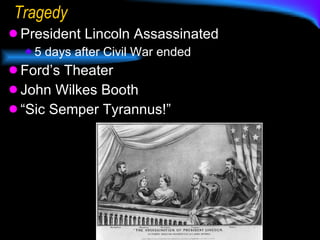
Tragedy President Lincoln Assassinated 5 days after Civil War ended Ford’s Theater John Wilkes Booth “ Sic Semper Tyrannus!”
Ford’s Theater
Lincoln Memorial
O Captain My Captain by Walt Whitman  O Captain my Captain! our fearful trip is done, The ship has weathered every rack, the prize we sought is won, The port is near, the bells I hear, the people all exulting, While follow eyes the steady keel, the vessel grim and daring; But O heart! heart! heart! O the bleeding drops of red, Where on the deck my Captain lies, Fallen cold and dead. O Captain! my Captain! rise up and hear the bells; Rise up--for you the flag is flung for you the bugle trills, For you bouquets and ribboned wreaths for you the shores a-crowding, For you they call, the swaying mass, their eager faces turning; Here Captain! dear father! This arm beneath your head! It is some dream that on the deck, You've fallen cold and dead.
My Captain does not answer, his lips are pale and still; My father does not feel my arm, he has no pulse nor will; The ship is anchored safe and sound, its voyage closed and done; From fearful trip the victor ship comes in with object won; Exult O shores, and ring O bells! But I, with mournful tread, Walk the deck my Captain lies, Fallen cold and dead.
A New President Vice President Andrew Johnson becomes President Not quite as “gentle” as Lincoln Wanted to punish South No desire to help African Americans
Johnson’s Plan  Restoration
Amnesty – for those who swore an oath to the Union High ranking officials had to do it personally Appointed governors Only pardoned, whites could vote No equal rights for African Americans, no voting Left it up to individual states to “manage their freed people”
No slavery Denounce secession Ratify the 13 th  Amendment Abolished slavery End of 1865 most of the South was “restored”
South “Restored” but not settled Struggle in Washington D.C. Congress did not want to readmit southern states on Johnson’s terms felt it robbed the Union of it’s victory treatment of African Americans was not improving Ku Klux Klan emerged terrorized African Americans in the South– burning houses, churches, schools, rioting and murder
 
Black Codes passed by southern states to control freed men, women children helped plantation owners exploit them as workers Similar to “slave codes”
Examples of the Code could be arrested for not having a job forced to work for plantation owner to pay off the fine some laws refused to let freed slaves own or rent farms orphaned babies were taken as unpaid apprentices Freed slaves could neither vote nor own guns
Radical Republicans vs. Black Codes Republicans in Congress very angry about Black Codes. They blamed Johnson’s Restoration Plan for encouraging southern states to pass these codes In response to Black Codes, Republicans pass the Civil Rights Act of 1866
Civil Rights Act of 1866-passed by Congress full citizenship to African Americans Federal government could intervene in state affairs overturned black codes Dred Scott decision African Americans were no longer seen as “property,” they were now citizens
President Johnson says no! Vetoes both the Freedmen’s Bureau Bill and Civil Rights Amendment Congress had enough votes to override Rift between Congress and President grew
14 th  Amendment of 1866 Congress passed Amendment to ensure Civil Rights Act was not overturned by Supreme Court Full citizenship to anyone born in the USA No state could take away ones life, liberty or property without due process all had equal protection of the laws
The 14 th  Amendment Section 1.  All persons born or naturalized in the United States, and subject to the jurisdiction thereof, are citizens of the United States and of the State wherein they reside. No State shall make or enforce any law which shall  abridge the privileges or immunities of citizens of the United States; nor shall any State deprive any person of life, liberty, or property, without due process of law; nor deny to any person within its jurisdiction the equal protection of the laws. Section 2.  Representatives shall be apportioned among the several States according to their respective numbers,  counting the whole number of persons in each State , excluding Indians not taxed.  But when the right to vote at any election … is denied  to any of the male inhabitants of such State, being twenty-one years of age, and citizens of the United States, or in any way abridged, except for participation in rebellion, or other crime, the basis of representation therein shall be reduced in the proportion which the number of such male citizens shall bear to the whole number of male citizens twenty-one years of age in such State.
Section 4.  The validity of the public debt of the United States, authorized by law, including debts incurred for payment of pensions and bounties for services in suppressing insurrection or rebellion, shall not be questioned.  But neither the United States nor any State shall assume or pay any debt or obligation incurred in aid of insurrection or rebellion against the United States, or any claim for the loss or emancipation of any slave; but all such debts, obligations and claims shall be held illegal and void. Section 5.  The Congress shall have power to enforce, by appropriate legislation, the provisions of this article.
-Johnson to Congress, “It’s on NOW!” Johnson encourages southern states to reject 14 th  Amendment Johnson campaigns against his own (Republican) party and their reconstruction plan in 1866
Election of 1866 Johnson rallied for rejection of Amendment from North and South campaigned against the Republicans Republicans gained control of congress created their own reconstruction plan
Radical Reconstruction Congress was in control could override any veto that Johnson issued 10 remaining states that did not accept 14 th  amendment divided into 5  MILITARY  districts African American males allowed to vote former Confederate leaders could not hold office
How to get back into the Union… ratify the 14 th  amendment submit new constitutions for approval
Johnson and Congress Fight Congress passed Tenure of Office Act; didn’t allow the President to remove government officials without Senate approval
Johnson suspends the Secretary of War without approval Appointed commanders to southern districts that congress opposed
Impeach, Impeach, Impeach House of Representatives vote to impeach trial lasted 3 months both sides saying it was just politically motivated 35-19 to convict. 1 vote short of 2/3rds majority
Identify & evaluate the Reconstruction Plans conditions Proposed by Rad Reconstruction Restoration Wade-Davis 10% Plan Plan
New Election, New President 1868 Gen. Ulysses S. Grant– Republican Horatio Seymour– Democrat  Grant won; also received 500,000 African American votes in the South
15 th  Amendment– 1869  prohibited state and federal governments from denying the right to vote to any MALE citizen because of race, color or previous condition of servitude
The Reconstruction Amendments 15 th  Amendment 14 th  Amendment 13 th  Amendment
The South During Reconstruction 3 groups in the South African Americans- supported Republicans white Southerners– supported Democrats white settlers from the North- supported Republicans
Group 1– African Americans important in politics helped with Republican victories held some positions in political office at state level national level: Hiram Revels– senator Blanche K Bruce former runaway slave established a school for African Americans became superintendent of schools in MS US senator
Scalawags Some southerners didn’t want to secede agreed with Republicans in the North non-slave holding farmers businessmen Called Scalawags
Carpetbaggers Northerners who moved South to make a new life doctors, lawyers, teachers, former Union soldiers
Resistance to Reconstruction Some white Southerners could not let go of old ways wouldn’t let ex-slaves leave refused to rent land to ex-slaves stores refused to grant credit employers would not hire them used fear to keep them in line
Ku Klux Klan formed in 1866 “midnight rides” kept African Americans from voting or standing up for their rights
The White League Terrorist organization  Kept African Americans from voting or asserting their rights They operated openly – no masks – their identities weren’t secret
Some Improvements Education Freedmen’s bureau helped create schools teachers from North came South by 1870 50% white kids and 40% African Americans in public school;  segregated
Life for the freed slaves Sharecropping Rented: land, crude shacks, seeds, tools, mule % of crop back to landowner not much better than slavery Always owed the landlord
End of Reconstruction Both sides tired of it; ready to move on Amnesty act– 1872 pardoned most Confederates They could vote, hold office, & get their land back Democrats regained political power in the South
Democrats take control Democrats easily took over in former Confederate states Ku Klux Klan & White league helped democrats gain control in heavily African American populated states by terrorizing black voters
Republican Scandals Grant chose old war buddies instead of qualified people to be in his cabinet Many of those friends were very corrupt They got caught in large scandals Grant pardoned them or did nothing
1876 election Grant does not run for a third term (scandals) Rutherford B. Hayes (R)  vs. Samuel Tilden (D)  Close election 1 electoral vote (20 disputed votes)
Compromise of 1877 deal made to settle election dispute Republicans get Presidency if… more aid ($) to the South withdraw troops from Southern states
Hayes: no friend to the African American states would deal with the “African American” issue alone. Reconstruction was over Republicans traded Presidency for an end to Reconstruction (party abandons African Americans)
Changes in the South Democrats in control Redeemers: “ save” the south from republican rule
The South’s Economy lags behind the nation industrialization slow Rise of “New South” Henry Grady  rise of textile mills; Northern companies moved south James Duke; tobacco
The “New South” industry grew (not as fast as North) workers worked hard, long hours cheap wages child labor RR boom
A divided society 15 th  Amendment allowed African Americans to vote Southern states looked for loop holes
Loopholes poll tax – had to pay before you could vote literacy test – read & explain constitution grandfather clause – if father or grandfather voted before Reconstruction; didn’t have to pass literacy test Very few African Americans voted
Jim Crow Laws 1890’s– segregation was prominent  Laws required separation in most public places
Who was Jim Crow? ‘ Jim Crow’ was a character in an old song who was revived by a white comedian called ‘Daddy’ Rice. Rice used the character to make fun of African Americans and the way that they spoke. The term ‘Jim Crow’ came to be used as an insult against African Americans.
 
 
Segregation becomes Legal Plessy vs. Ferguson separate section on train access to  public facilities = to whites kept segregation in south for 50 years “ Separate but equal” Facilities for African Americans were not equal
 
Legal Segregation  African Americans lost jobs in government, which they gained after the Civil War. Whites owned the land, the police, the government, the courtrooms, the law, the armed forces, and the press. The political system denied blacks the right to vote.
Terror Murders were conducted in secret and in public by white men. The blacks were harassed and abused, physically and verbally. These violent acts became a part of their life.
“ The slave went free, stood a brief moment in the sun then moved back again toward slavery.”  W.E.B. DuBois
Writing a DBQ There is no right or wrong answer. Your answer is YOUR interpretation of what’s in of the documents. As long as your answer makes sense and is supported by the content of the document you are correct.
1. Read carefully the question and the historical background. Underline the tasks. 2. Read the documents carefully.  a) Make sure that you  understand the content of the  document.  b) What is the author's Point  of View?
3. Don’t just list the documents, organize them into categories and use them appropriately 4. Re-read the question just to make sure
Steps 1-4 Read Question, Read Documents, organize documents, re-read question
Thesis Topic + What you’re trying to prove Example: Social Studies (Topic) is the most important subject in school (what you’re trying to prove)
Use the Documents to support your thesis You have already organized the docs and you understand what each is trying to say Plug them in and cite them in some way “ ..as shown in document 2” “… according to document 5” “… the population of immigrants steadily rose (doc. 7).”
Using Documents Use at least ½ the number of documents + 1, for example; if there are 8 documents use at least 5 in your essay.
Outside Information In order to get the highest DBQ score possible, you must use outside information.
Conclusion Restate (don’t recopy) thesis  Summarize your points

Reconstruction 2009

  • 1.
  • 2.
    The End Results258,000 Confederates died in the war Most were adult males South’s economy & society needed rebuilding
  • 3.
  • 4.
    Everybody had aplan … Lincoln’s 10% plan 10% of states’ voters vowed loyalty to Union Form a new government & constitution No slavery
  • 5.
    Lincoln Was Softon the South Punishment served no useful purpose Offered amnesty/swear loyalty Not to Confederate leaders Right to vote to African Americans Force equal rights in Southern states (states rights vs. federal government)
  • 6.
    Some jumped inquick Louisiana, Arkansas & Tennessee agreed in 1864 Lincoln’s congress refused to let it occur
  • 7.
    Plan 2- TheRadical Republicans Thought Lincoln was too mild Congress should decide the South’s fate
  • 8.
    The Wade-Davis BillJuly 1864 51% swear loyalty to Union Only males who never took arms against the North could vote on new state congress & constitution Former Confederates – no public office No slavery Lincoln refused to sign this into law
  • 9.
    Freedmen’s Bureau-What waslife like for African Americans Helped African Americans freed from slavery Established- March 1865 Food, clothes, medical services Established schools Established universities Howard, Atlanta, Fisk Helped them acquire land
  • 10.
    Tragedy President LincolnAssassinated 5 days after Civil War ended Ford’s Theater John Wilkes Booth “ Sic Semper Tyrannus!”
  • 11.
  • 12.
  • 13.
    O Captain MyCaptain by Walt Whitman O Captain my Captain! our fearful trip is done, The ship has weathered every rack, the prize we sought is won, The port is near, the bells I hear, the people all exulting, While follow eyes the steady keel, the vessel grim and daring; But O heart! heart! heart! O the bleeding drops of red, Where on the deck my Captain lies, Fallen cold and dead. O Captain! my Captain! rise up and hear the bells; Rise up--for you the flag is flung for you the bugle trills, For you bouquets and ribboned wreaths for you the shores a-crowding, For you they call, the swaying mass, their eager faces turning; Here Captain! dear father! This arm beneath your head! It is some dream that on the deck, You've fallen cold and dead.
  • 14.
    My Captain doesnot answer, his lips are pale and still; My father does not feel my arm, he has no pulse nor will; The ship is anchored safe and sound, its voyage closed and done; From fearful trip the victor ship comes in with object won; Exult O shores, and ring O bells! But I, with mournful tread, Walk the deck my Captain lies, Fallen cold and dead.
  • 15.
    A New PresidentVice President Andrew Johnson becomes President Not quite as “gentle” as Lincoln Wanted to punish South No desire to help African Americans
  • 16.
    Johnson’s Plan Restoration
  • 17.
    Amnesty – forthose who swore an oath to the Union High ranking officials had to do it personally Appointed governors Only pardoned, whites could vote No equal rights for African Americans, no voting Left it up to individual states to “manage their freed people”
  • 18.
    No slavery Denouncesecession Ratify the 13 th Amendment Abolished slavery End of 1865 most of the South was “restored”
  • 19.
    South “Restored” butnot settled Struggle in Washington D.C. Congress did not want to readmit southern states on Johnson’s terms felt it robbed the Union of it’s victory treatment of African Americans was not improving Ku Klux Klan emerged terrorized African Americans in the South– burning houses, churches, schools, rioting and murder
  • 20.
  • 21.
    Black Codes passedby southern states to control freed men, women children helped plantation owners exploit them as workers Similar to “slave codes”
  • 22.
    Examples of theCode could be arrested for not having a job forced to work for plantation owner to pay off the fine some laws refused to let freed slaves own or rent farms orphaned babies were taken as unpaid apprentices Freed slaves could neither vote nor own guns
  • 23.
    Radical Republicans vs.Black Codes Republicans in Congress very angry about Black Codes. They blamed Johnson’s Restoration Plan for encouraging southern states to pass these codes In response to Black Codes, Republicans pass the Civil Rights Act of 1866
  • 24.
    Civil Rights Actof 1866-passed by Congress full citizenship to African Americans Federal government could intervene in state affairs overturned black codes Dred Scott decision African Americans were no longer seen as “property,” they were now citizens
  • 25.
    President Johnson saysno! Vetoes both the Freedmen’s Bureau Bill and Civil Rights Amendment Congress had enough votes to override Rift between Congress and President grew
  • 26.
    14 th Amendment of 1866 Congress passed Amendment to ensure Civil Rights Act was not overturned by Supreme Court Full citizenship to anyone born in the USA No state could take away ones life, liberty or property without due process all had equal protection of the laws
  • 27.
    The 14 th Amendment Section 1. All persons born or naturalized in the United States, and subject to the jurisdiction thereof, are citizens of the United States and of the State wherein they reside. No State shall make or enforce any law which shall abridge the privileges or immunities of citizens of the United States; nor shall any State deprive any person of life, liberty, or property, without due process of law; nor deny to any person within its jurisdiction the equal protection of the laws. Section 2. Representatives shall be apportioned among the several States according to their respective numbers, counting the whole number of persons in each State , excluding Indians not taxed. But when the right to vote at any election … is denied to any of the male inhabitants of such State, being twenty-one years of age, and citizens of the United States, or in any way abridged, except for participation in rebellion, or other crime, the basis of representation therein shall be reduced in the proportion which the number of such male citizens shall bear to the whole number of male citizens twenty-one years of age in such State.
  • 28.
    Section 4. The validity of the public debt of the United States, authorized by law, including debts incurred for payment of pensions and bounties for services in suppressing insurrection or rebellion, shall not be questioned. But neither the United States nor any State shall assume or pay any debt or obligation incurred in aid of insurrection or rebellion against the United States, or any claim for the loss or emancipation of any slave; but all such debts, obligations and claims shall be held illegal and void. Section 5. The Congress shall have power to enforce, by appropriate legislation, the provisions of this article.
  • 29.
    -Johnson to Congress,“It’s on NOW!” Johnson encourages southern states to reject 14 th Amendment Johnson campaigns against his own (Republican) party and their reconstruction plan in 1866
  • 30.
    Election of 1866Johnson rallied for rejection of Amendment from North and South campaigned against the Republicans Republicans gained control of congress created their own reconstruction plan
  • 31.
    Radical Reconstruction Congresswas in control could override any veto that Johnson issued 10 remaining states that did not accept 14 th amendment divided into 5 MILITARY districts African American males allowed to vote former Confederate leaders could not hold office
  • 32.
    How to getback into the Union… ratify the 14 th amendment submit new constitutions for approval
  • 33.
    Johnson and CongressFight Congress passed Tenure of Office Act; didn’t allow the President to remove government officials without Senate approval
  • 34.
    Johnson suspends theSecretary of War without approval Appointed commanders to southern districts that congress opposed
  • 35.
    Impeach, Impeach, ImpeachHouse of Representatives vote to impeach trial lasted 3 months both sides saying it was just politically motivated 35-19 to convict. 1 vote short of 2/3rds majority
  • 36.
    Identify & evaluatethe Reconstruction Plans conditions Proposed by Rad Reconstruction Restoration Wade-Davis 10% Plan Plan
  • 37.
    New Election, NewPresident 1868 Gen. Ulysses S. Grant– Republican Horatio Seymour– Democrat Grant won; also received 500,000 African American votes in the South
  • 38.
    15 th Amendment– 1869 prohibited state and federal governments from denying the right to vote to any MALE citizen because of race, color or previous condition of servitude
  • 39.
    The Reconstruction Amendments15 th Amendment 14 th Amendment 13 th Amendment
  • 40.
    The South DuringReconstruction 3 groups in the South African Americans- supported Republicans white Southerners– supported Democrats white settlers from the North- supported Republicans
  • 41.
    Group 1– AfricanAmericans important in politics helped with Republican victories held some positions in political office at state level national level: Hiram Revels– senator Blanche K Bruce former runaway slave established a school for African Americans became superintendent of schools in MS US senator
  • 42.
    Scalawags Some southernersdidn’t want to secede agreed with Republicans in the North non-slave holding farmers businessmen Called Scalawags
  • 43.
    Carpetbaggers Northerners whomoved South to make a new life doctors, lawyers, teachers, former Union soldiers
  • 44.
    Resistance to ReconstructionSome white Southerners could not let go of old ways wouldn’t let ex-slaves leave refused to rent land to ex-slaves stores refused to grant credit employers would not hire them used fear to keep them in line
  • 45.
    Ku Klux Klanformed in 1866 “midnight rides” kept African Americans from voting or standing up for their rights
  • 46.
    The White LeagueTerrorist organization Kept African Americans from voting or asserting their rights They operated openly – no masks – their identities weren’t secret
  • 47.
    Some Improvements EducationFreedmen’s bureau helped create schools teachers from North came South by 1870 50% white kids and 40% African Americans in public school; segregated
  • 48.
    Life for thefreed slaves Sharecropping Rented: land, crude shacks, seeds, tools, mule % of crop back to landowner not much better than slavery Always owed the landlord
  • 49.
    End of ReconstructionBoth sides tired of it; ready to move on Amnesty act– 1872 pardoned most Confederates They could vote, hold office, & get their land back Democrats regained political power in the South
  • 50.
    Democrats take controlDemocrats easily took over in former Confederate states Ku Klux Klan & White league helped democrats gain control in heavily African American populated states by terrorizing black voters
  • 51.
    Republican Scandals Grantchose old war buddies instead of qualified people to be in his cabinet Many of those friends were very corrupt They got caught in large scandals Grant pardoned them or did nothing
  • 52.
    1876 election Grantdoes not run for a third term (scandals) Rutherford B. Hayes (R) vs. Samuel Tilden (D) Close election 1 electoral vote (20 disputed votes)
  • 53.
    Compromise of 1877deal made to settle election dispute Republicans get Presidency if… more aid ($) to the South withdraw troops from Southern states
  • 54.
    Hayes: no friendto the African American states would deal with the “African American” issue alone. Reconstruction was over Republicans traded Presidency for an end to Reconstruction (party abandons African Americans)
  • 55.
    Changes in theSouth Democrats in control Redeemers: “ save” the south from republican rule
  • 56.
    The South’s Economylags behind the nation industrialization slow Rise of “New South” Henry Grady rise of textile mills; Northern companies moved south James Duke; tobacco
  • 57.
    The “New South”industry grew (not as fast as North) workers worked hard, long hours cheap wages child labor RR boom
  • 58.
    A divided society15 th Amendment allowed African Americans to vote Southern states looked for loop holes
  • 59.
    Loopholes poll tax– had to pay before you could vote literacy test – read & explain constitution grandfather clause – if father or grandfather voted before Reconstruction; didn’t have to pass literacy test Very few African Americans voted
  • 60.
    Jim Crow Laws1890’s– segregation was prominent Laws required separation in most public places
  • 61.
    Who was JimCrow? ‘ Jim Crow’ was a character in an old song who was revived by a white comedian called ‘Daddy’ Rice. Rice used the character to make fun of African Americans and the way that they spoke. The term ‘Jim Crow’ came to be used as an insult against African Americans.
  • 62.
  • 63.
  • 64.
    Segregation becomes LegalPlessy vs. Ferguson separate section on train access to public facilities = to whites kept segregation in south for 50 years “ Separate but equal” Facilities for African Americans were not equal
  • 65.
  • 66.
    Legal Segregation African Americans lost jobs in government, which they gained after the Civil War. Whites owned the land, the police, the government, the courtrooms, the law, the armed forces, and the press. The political system denied blacks the right to vote.
  • 67.
    Terror Murders wereconducted in secret and in public by white men. The blacks were harassed and abused, physically and verbally. These violent acts became a part of their life.
  • 68.
    “ The slavewent free, stood a brief moment in the sun then moved back again toward slavery.” W.E.B. DuBois
  • 69.
    Writing a DBQThere is no right or wrong answer. Your answer is YOUR interpretation of what’s in of the documents. As long as your answer makes sense and is supported by the content of the document you are correct.
  • 70.
    1. Read carefullythe question and the historical background. Underline the tasks. 2. Read the documents carefully. a) Make sure that you understand the content of the document. b) What is the author's Point of View?
  • 71.
    3. Don’t justlist the documents, organize them into categories and use them appropriately 4. Re-read the question just to make sure
  • 72.
    Steps 1-4 ReadQuestion, Read Documents, organize documents, re-read question
  • 73.
    Thesis Topic +What you’re trying to prove Example: Social Studies (Topic) is the most important subject in school (what you’re trying to prove)
  • 74.
    Use the Documentsto support your thesis You have already organized the docs and you understand what each is trying to say Plug them in and cite them in some way “ ..as shown in document 2” “… according to document 5” “… the population of immigrants steadily rose (doc. 7).”
  • 75.
    Using Documents Useat least ½ the number of documents + 1, for example; if there are 8 documents use at least 5 in your essay.
  • 76.
    Outside Information Inorder to get the highest DBQ score possible, you must use outside information.
  • 77.
    Conclusion Restate (don’trecopy) thesis Summarize your points