THE END OF THE
COLD WAR
In the final decades of the 20th, the Eastern
bloc collapsed.
THE END OF THE COLD WAR
The end
of the
cold war
Reform in
the Soviet
Union
The
collapse of
the Eastern
Bloc The
dissolution
of the
USSR
THE END OF THE COLD WAR
The collapse
of
Communism
The Russian
Federation
The survival
of
Communism
China
REFORM IN THE SOVIET UNION
After 1975, important
developments occured
in the Eastern Bloc.
Repressive policies in
Eastern Europe
USSR economic
stagnation
Perestroika
Repressive policies in Eastern Europe
There was increasing
popular discontent in Eastern
Europe.
This was caused by the
Soviet Union´s repressive
policies, which prevented
democratic reform.
REFORM IN THE SOVIET UNION
USSR economic stagnation
Causes:
The Soviet´s high military expenditure.
Consequences:
This reduced investment in other areas and led to
a fall in agricultural and industrial productivity.
There were shortages of food and consumer
goods.
REFORM IN THE SOVIET UNION
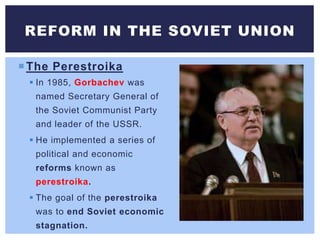
The Perestroika
 In 1985, Gorbachev was
named Secretary General of
the Soviet Communist Party
and leader of the USSR.
 He implemented a series of
political and economic
reforms known as
perestroika.
 The goal of the perestroika
was to end Soviet economic
stagnation.
REFORM IN THE SOVIET UNION
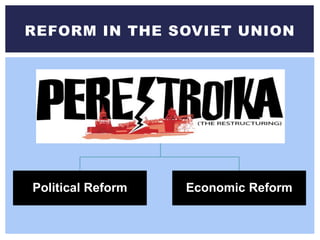
Political Reform Economic Reform
REFORM IN THE SOVIET UNION
PERESTROIKA: POLITICAL REFORM
 The USSR evolved from a single-party system to one in
which other political parties were permitted.
 The State also adopted a policy known as glasnost, which
aimed to make government more open and transparent.
 As a part of glasnost,
limitations on freedom of
speech were also relaxed.
REFORM IN THE SOVIET UNION
PERESTROIKA: ECONOMIC REFORM
 In order to increase agricultural productivity, PRIVATE
OWNERSHIP OF LAND was allowed.
 SPENDING CUTS were also introduced in an attempt to reduce
state expenditure.
 However, these measures failed to improve the economic situation.
REFORM IN THE SOVIET UNION
In 1987, United States President Reagan
and Gorbachev had commited to withdraw
Soviet troops from Eastern Europe.
THE COLLAPSE OF THE
EASTERN BLOC
As a result, popular
protest movements
emerged in these
countries.
They wanted to
remove the
Communist regimes
from power.
In 1989, the Eastern European Communist
regimes were in a very weak position.
The most important revolutions occured in:
POLAND
In 1989 elections were
won by Solidarity. This
led to the formation of a
non-Communist
government.
THE COLLAPSE OF THE
EASTERN BLOC
In 1989, the Eastern European Communist
regimes were in a very weak position.
The most important revolutions occured in:
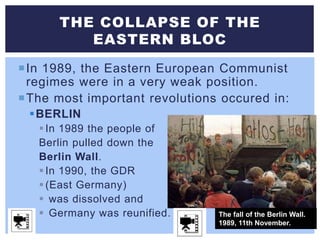
BERLIN
In 1989 the people of
Berlin pulled down the
Berlin Wall.
In 1990, the GDR
(East Germany)
 was dissolved and
 Germany was reunified.
THE COLLAPSE OF THE
EASTERN BLOC
The fall of the Berlin Wall.
1989, 11th November.
 Independent movements had
emerged in the Soviet republics
after the introduction of perestroika.
 In 1991, a number of these
republics gained independence.
 Gorbachev resigned and the
Soviet Union was dissolved.
 As a result, the Cold War
ended.
THE DISSOLUTION OF THE USSR
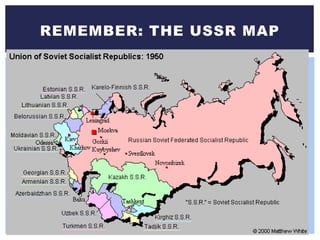
REMEMBER: THE USSR MAP
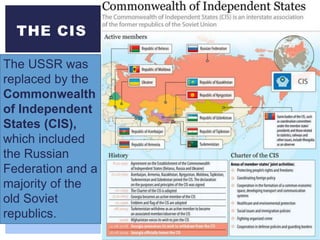
THE CIS
The USSR was
replaced by the
Commonwealth
of Independent
States (CIS),
which included
the Russian
Federation and a
majority of the
old Soviet
republics.
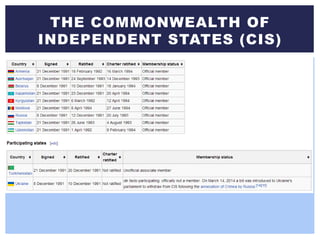
THE COMMONWEALTH OF
INDEPENDENT STATES (CIS)
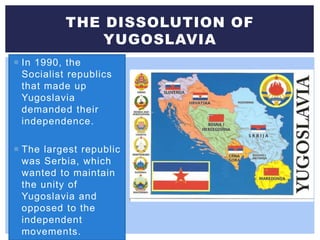
 In 1990, the
Socialist republics
that made up
Yugoslavia
demanded their
independence.
 The largest republic
was Serbia, which
wanted to maintain
the unity of
Yugoslavia and
opposed to the
independent
movements.
THE DISSOLUTION OF
YUGOSLAVIA
 The independence
movements were based
in religious differences
among the different
republics of Yugoslavia.
THE DISSOLUTION OF
YUGOSLAVIA
 As a consequence of political and religious conflicts there
was a Civil war (1991-1995).
 As a result, Yugoslavia was divided into various states:
Slovenia, Macedonia, Croatia, Bosnia-Herzegovina, and
Serbia and Montenegro.
 In 2006, Montenegro
became independent.
 In 2008, the region of
Kosovo declared its
independencde from Serbia.
THE DISSOLUTION OF
YUGOSLAVIA
However, Serbia and Russia, and
some European countries didn´t
recognise Kosovo as an
independent state.
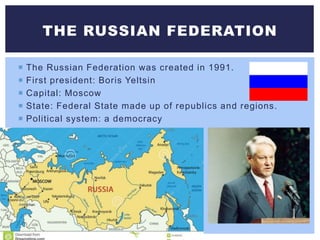
 The Russian Federation was created in 1991.
 First president: Boris Yeltsin
 Capital: Moscow
 State: Federal State made up of republics and regions.
 Political system: a democracy
THE RUSSIAN FEDERATION
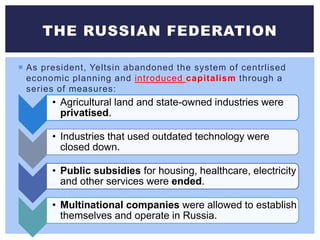
 As president, Yeltsin abandoned the system of centrlised
economic planning and introduced capitalism through a
series of measures:
THE RUSSIAN FEDERATION
• Agricultural land and state-owned industries were
privatised.
• Industries that used outdated technology were
closed down.
• Public subsidies for housing, healthcare, electricity
and other services were ended.
• Multinational companies were allowed to establish
themselves and operate in Russia.
THE RUSSIAN FEDERATION
 Negative consequences of the introdution of capitalism
 The closure of state-owned companies produced high
unemployment, and this led to an economic crisis.
 In 2000, Putin became president and the economy began to
recover.
THE RUSSIAN FEDERATION
Consequences of the introdution of capitalism
Russian society became more like other Western
societies with peculiar features:
Social inequalities
A small minority have
become very rich
because they bought
state companies at very
low prices when they
were privatised.
Most Russians are
poorer due to the end
of state subsidies.
High unemployment
This has produced high
levels of emigration to
Western Europe.
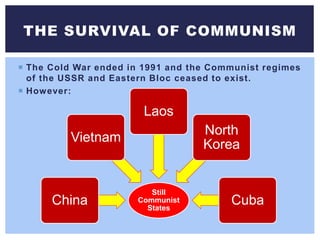
 The Cold War ended in 1991 and the Communist regimes
of the USSR and Eastern Bloc ceased to exist.
 However:
THE SURVIVAL OF COMMUNISM
Still
Communist
States
China
Vietnam
Laos
North
Korea
Cuba
Still Communist States
Citizens do
not enjoy
many
freedoms
They have gradually introduced capitalist
economic reforms to estimulate grouth
and development..
Communist
states now
allow private
property.
Foreign
countries can
operate in
these
countries
The exception
is North Korea:
centrally
planned
economy.
THE SURVIVAL OF COMMUNISM
 Mao Zedong´s successors have maintained the Communist
Party in power in China.
THE SURVIVAL OF COMMUNISM
A picture of the Communist Party on 24 january 2014
Xi Jinping is
the General
Secretary of the
Communist Party of
China and the
Presiden of the
People´s Republic
of China (P.R.C.)
THE SURVIVAL OF COMMUNISM
 The Chinese regime has intensified its repression of protest
movements which demand democratic reform.
THE SURVIVAL OF COMMUNISM
Tiananmen Square protests of 1989
 China has resisted political reform but it has introduced
capitalist economic reforms:
 Since 1980, foreign businesses have been allowed to operate in
certain areas of the country.
 These companies have been benefited from cheap Chinese
labour, while the arrival of foreign capital has enabled the Chinese
to invest in their own industrial develpment.
THE SURVIVAL OF COMMUNISM
 As a consequence of these changes, China has experienced
dramatic economic growth.
 Its products have flooded the markets of Western countries
because they are much cheaper than European or American-
made goods.
 Today China is the second leading economic power.
THE SURVIVAL OF COMMUNISM

The cold war 3

  • 1.
    THE END OFTHE COLD WAR
  • 2.
    In the finaldecades of the 20th, the Eastern bloc collapsed. THE END OF THE COLD WAR
  • 3.
    The end of the coldwar Reform in the Soviet Union The collapse of the Eastern Bloc The dissolution of the USSR THE END OF THE COLD WAR
  • 4.
    THE END OFTHE COLD WAR The collapse of Communism The Russian Federation The survival of Communism China
  • 5.
    REFORM IN THESOVIET UNION After 1975, important developments occured in the Eastern Bloc. Repressive policies in Eastern Europe USSR economic stagnation Perestroika
  • 6.
    Repressive policies inEastern Europe There was increasing popular discontent in Eastern Europe. This was caused by the Soviet Union´s repressive policies, which prevented democratic reform. REFORM IN THE SOVIET UNION
  • 7.
    USSR economic stagnation Causes: TheSoviet´s high military expenditure. Consequences: This reduced investment in other areas and led to a fall in agricultural and industrial productivity. There were shortages of food and consumer goods. REFORM IN THE SOVIET UNION
  • 8.
    The Perestroika  In1985, Gorbachev was named Secretary General of the Soviet Communist Party and leader of the USSR.  He implemented a series of political and economic reforms known as perestroika.  The goal of the perestroika was to end Soviet economic stagnation. REFORM IN THE SOVIET UNION
  • 9.
    Political Reform EconomicReform REFORM IN THE SOVIET UNION
  • 10.
    PERESTROIKA: POLITICAL REFORM The USSR evolved from a single-party system to one in which other political parties were permitted.  The State also adopted a policy known as glasnost, which aimed to make government more open and transparent.  As a part of glasnost, limitations on freedom of speech were also relaxed. REFORM IN THE SOVIET UNION
  • 11.
    PERESTROIKA: ECONOMIC REFORM In order to increase agricultural productivity, PRIVATE OWNERSHIP OF LAND was allowed.  SPENDING CUTS were also introduced in an attempt to reduce state expenditure.  However, these measures failed to improve the economic situation. REFORM IN THE SOVIET UNION
  • 12.
    In 1987, UnitedStates President Reagan and Gorbachev had commited to withdraw Soviet troops from Eastern Europe. THE COLLAPSE OF THE EASTERN BLOC As a result, popular protest movements emerged in these countries. They wanted to remove the Communist regimes from power.
  • 13.
    In 1989, theEastern European Communist regimes were in a very weak position. The most important revolutions occured in: POLAND In 1989 elections were won by Solidarity. This led to the formation of a non-Communist government. THE COLLAPSE OF THE EASTERN BLOC
  • 14.
    In 1989, theEastern European Communist regimes were in a very weak position. The most important revolutions occured in: BERLIN In 1989 the people of Berlin pulled down the Berlin Wall. In 1990, the GDR (East Germany)  was dissolved and  Germany was reunified. THE COLLAPSE OF THE EASTERN BLOC The fall of the Berlin Wall. 1989, 11th November.
  • 15.
     Independent movementshad emerged in the Soviet republics after the introduction of perestroika.  In 1991, a number of these republics gained independence.  Gorbachev resigned and the Soviet Union was dissolved.  As a result, the Cold War ended. THE DISSOLUTION OF THE USSR
  • 16.
  • 17.
    THE CIS The USSRwas replaced by the Commonwealth of Independent States (CIS), which included the Russian Federation and a majority of the old Soviet republics.
  • 18.
  • 20.
     In 1990,the Socialist republics that made up Yugoslavia demanded their independence.  The largest republic was Serbia, which wanted to maintain the unity of Yugoslavia and opposed to the independent movements. THE DISSOLUTION OF YUGOSLAVIA
  • 21.
     The independence movementswere based in religious differences among the different republics of Yugoslavia. THE DISSOLUTION OF YUGOSLAVIA
  • 22.
     As aconsequence of political and religious conflicts there was a Civil war (1991-1995).  As a result, Yugoslavia was divided into various states: Slovenia, Macedonia, Croatia, Bosnia-Herzegovina, and Serbia and Montenegro.  In 2006, Montenegro became independent.  In 2008, the region of Kosovo declared its independencde from Serbia. THE DISSOLUTION OF YUGOSLAVIA However, Serbia and Russia, and some European countries didn´t recognise Kosovo as an independent state.
  • 23.
     The RussianFederation was created in 1991.  First president: Boris Yeltsin  Capital: Moscow  State: Federal State made up of republics and regions.  Political system: a democracy THE RUSSIAN FEDERATION
  • 24.
     As president,Yeltsin abandoned the system of centrlised economic planning and introduced capitalism through a series of measures: THE RUSSIAN FEDERATION • Agricultural land and state-owned industries were privatised. • Industries that used outdated technology were closed down. • Public subsidies for housing, healthcare, electricity and other services were ended. • Multinational companies were allowed to establish themselves and operate in Russia.
  • 25.
  • 26.
     Negative consequencesof the introdution of capitalism  The closure of state-owned companies produced high unemployment, and this led to an economic crisis.  In 2000, Putin became president and the economy began to recover. THE RUSSIAN FEDERATION
  • 27.
    THE RUSSIAN FEDERATION Consequencesof the introdution of capitalism Russian society became more like other Western societies with peculiar features: Social inequalities A small minority have become very rich because they bought state companies at very low prices when they were privatised. Most Russians are poorer due to the end of state subsidies. High unemployment This has produced high levels of emigration to Western Europe.
  • 28.
     The ColdWar ended in 1991 and the Communist regimes of the USSR and Eastern Bloc ceased to exist.  However: THE SURVIVAL OF COMMUNISM Still Communist States China Vietnam Laos North Korea Cuba
  • 29.
    Still Communist States Citizensdo not enjoy many freedoms They have gradually introduced capitalist economic reforms to estimulate grouth and development.. Communist states now allow private property. Foreign countries can operate in these countries The exception is North Korea: centrally planned economy. THE SURVIVAL OF COMMUNISM
  • 30.
     Mao Zedong´ssuccessors have maintained the Communist Party in power in China. THE SURVIVAL OF COMMUNISM A picture of the Communist Party on 24 january 2014
  • 31.
    Xi Jinping is theGeneral Secretary of the Communist Party of China and the Presiden of the People´s Republic of China (P.R.C.) THE SURVIVAL OF COMMUNISM
  • 32.
     The Chineseregime has intensified its repression of protest movements which demand democratic reform. THE SURVIVAL OF COMMUNISM Tiananmen Square protests of 1989
  • 33.
     China hasresisted political reform but it has introduced capitalist economic reforms:  Since 1980, foreign businesses have been allowed to operate in certain areas of the country.  These companies have been benefited from cheap Chinese labour, while the arrival of foreign capital has enabled the Chinese to invest in their own industrial develpment. THE SURVIVAL OF COMMUNISM
  • 34.
     As aconsequence of these changes, China has experienced dramatic economic growth.  Its products have flooded the markets of Western countries because they are much cheaper than European or American- made goods.  Today China is the second leading economic power. THE SURVIVAL OF COMMUNISM