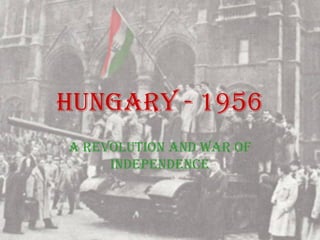
HUNGARY - 1956
A REVOLUTION AND WAR OF
     INDEPENDENCE
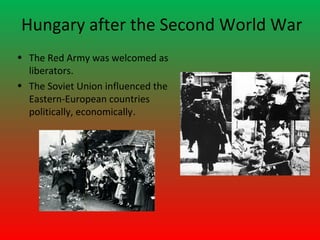
Hungary after the Second World War
• The Red Army was welcomed as
  liberators.
• The Soviet Union influenced the
  Eastern-European countries
  politically, economically.
1949-1953: The Years of Stalinist
             Depression
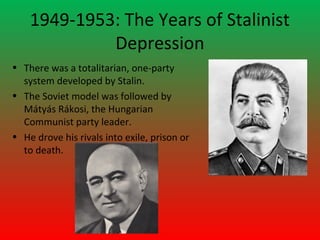
• There was a totalitarian, one-party
  system developed by Stalin.
• The Soviet model was followed by
  Mátyás Rákosi, the Hungarian
  Communist party leader.
• He drove his rivals into exile, prison or
  to death.
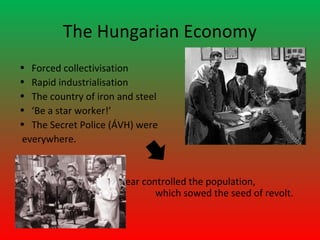
The Hungarian Economy
• Forced collectivisation
• Rapid industrialisation
• The country of iron and steel
• ‘Be a star worker!’
• The Secret Police (ÁVH) were
everywhere.


                      Fear controlled the population,
                              which sowed the seed of revolt.
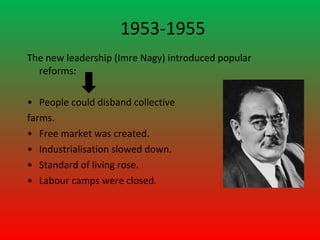
1953-1955
The new leadership (Imre Nagy) introduced popular
  reforms:

• People could disband collective
farms.
• Free market was created.
• Industrialisation slowed down.
• Standard of living rose.
• Labour camps were closed.
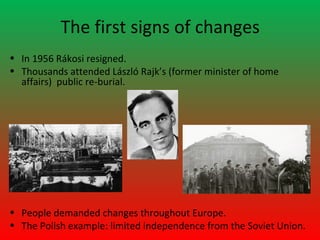
The first signs of changes
• In 1956 Rákosi resigned.
• Thousands attended László Rajk’s (former minister of home
  affairs) public re-burial.


• People demanded changes throughout Europe.
• The Polish example: limited independence from the Soviet Union.
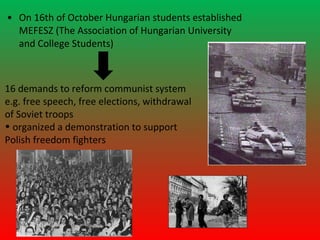
• On 16th of October Hungarian students established
  MEFESZ (The Association of Hungarian University
  and College Students)


16 demands to reform communist system
e.g. free speech, free elections, withdrawal
of Soviet troops
• organized a demonstration to support
Polish freedom fighters
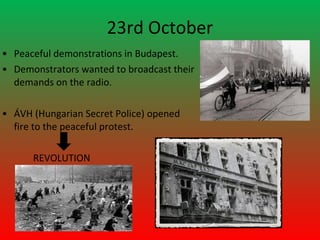
23rd October
• Peaceful demonstrations in Budapest.
• Demonstrators wanted to broadcast their
  demands on the radio.

• ÁVH (Hungarian Secret Police) opened
  fire to the peaceful protest.

      REVOLUTION
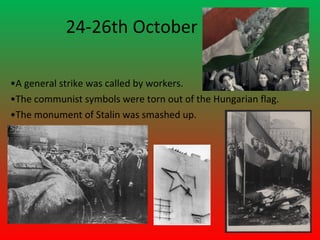
24-26th October

•A general strike was called by workers.
•The communist symbols were torn out of the Hungarian flag.
•The monument of Stalin was smashed up.
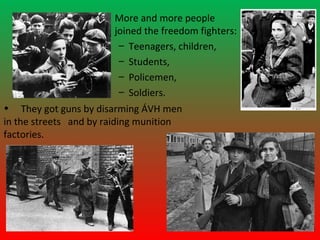
• More and more people
                       joined the freedom fighters:
                        – Teenagers, children,
                        – Students,
                        – Policemen,
                        – Soldiers.
• They got guns by disarming ÁVH men
in the streets and by raiding munition
factories.
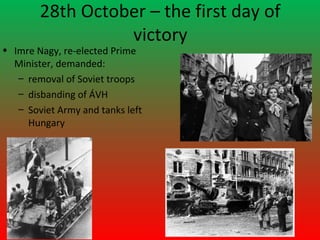
28th October – the first day of
                  victory
• Imre Nagy, re-elected Prime
  Minister, demanded:
   – removal of Soviet troops
   – disbanding of ÁVH
   – Soviet Army and tanks left
     Hungary
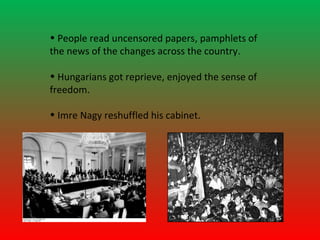
• People read uncensored papers, pamphlets of
the news of the changes across the country.

• Hungarians got reprieve, enjoyed the sense of
freedom.

• Imre Nagy reshuffled his cabinet.
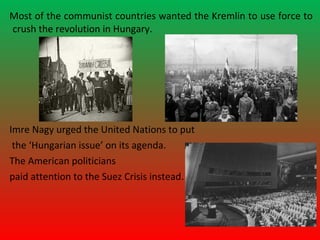
Most of the communist countries wanted the Kremlin to use force to
crush the revolution in Hungary.


Imre Nagy urged the United Nations to put
 the ‘Hungarian issue’ on its agenda.
The American politicians
paid attention to the Suez Crisis instead.
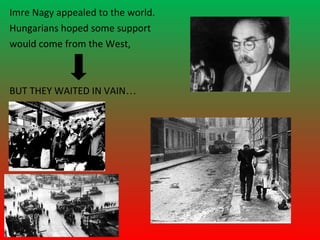
Imre Nagy appealed to the world.
Hungarians hoped some support
would come from the West,


BUT THEY WAITED IN VAIN…
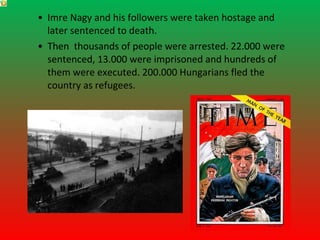
• Imre Nagy and his followers were taken hostage and
  later sentenced to death.
• Then thousands of people were arrested. 22.000 were
  sentenced, 13.000 were imprisoned and hundreds of
  them were executed. 200.000 Hungarians fled the
  country as refugees.

The Hungarian Revolution in 1956

  • 1.
    HUNGARY - 1956 AREVOLUTION AND WAR OF INDEPENDENCE
  • 2.
    Hungary after theSecond World War • The Red Army was welcomed as liberators. • The Soviet Union influenced the Eastern-European countries politically, economically.
  • 3.
    1949-1953: The Yearsof Stalinist Depression • There was a totalitarian, one-party system developed by Stalin. • The Soviet model was followed by Mátyás Rákosi, the Hungarian Communist party leader. • He drove his rivals into exile, prison or to death.
  • 4.
    The Hungarian Economy •Forced collectivisation • Rapid industrialisation • The country of iron and steel • ‘Be a star worker!’ • The Secret Police (ÁVH) were everywhere. Fear controlled the population, which sowed the seed of revolt.
  • 5.
    1953-1955 The new leadership(Imre Nagy) introduced popular reforms: • People could disband collective farms. • Free market was created. • Industrialisation slowed down. • Standard of living rose. • Labour camps were closed.
  • 6.
    The first signsof changes • In 1956 Rákosi resigned. • Thousands attended László Rajk’s (former minister of home affairs) public re-burial. • People demanded changes throughout Europe. • The Polish example: limited independence from the Soviet Union.
  • 7.
    • On 16thof October Hungarian students established MEFESZ (The Association of Hungarian University and College Students) 16 demands to reform communist system e.g. free speech, free elections, withdrawal of Soviet troops • organized a demonstration to support Polish freedom fighters
  • 8.
    23rd October • Peacefuldemonstrations in Budapest. • Demonstrators wanted to broadcast their demands on the radio. • ÁVH (Hungarian Secret Police) opened fire to the peaceful protest. REVOLUTION
  • 9.
    24-26th October •A generalstrike was called by workers. •The communist symbols were torn out of the Hungarian flag. •The monument of Stalin was smashed up.
  • 10.
    • More andmore people joined the freedom fighters: – Teenagers, children, – Students, – Policemen, – Soldiers. • They got guns by disarming ÁVH men in the streets and by raiding munition factories.
  • 11.
    28th October –the first day of victory • Imre Nagy, re-elected Prime Minister, demanded: – removal of Soviet troops – disbanding of ÁVH – Soviet Army and tanks left Hungary
  • 12.
    • People readuncensored papers, pamphlets of the news of the changes across the country. • Hungarians got reprieve, enjoyed the sense of freedom. • Imre Nagy reshuffled his cabinet.
  • 13.
    Most of thecommunist countries wanted the Kremlin to use force to crush the revolution in Hungary. Imre Nagy urged the United Nations to put the ‘Hungarian issue’ on its agenda. The American politicians paid attention to the Suez Crisis instead.
  • 14.
    Imre Nagy appealedto the world. Hungarians hoped some support would come from the West, BUT THEY WAITED IN VAIN…
  • 15.
    • Imre Nagyand his followers were taken hostage and later sentenced to death. • Then thousands of people were arrested. 22.000 were sentenced, 13.000 were imprisoned and hundreds of them were executed. 200.000 Hungarians fled the country as refugees.