Dr. Rene V. Yat The Brain and Human Behavior


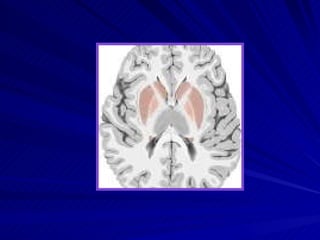
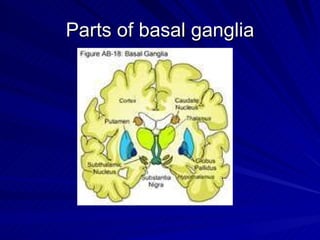
Parts of basal ganglia
 
 
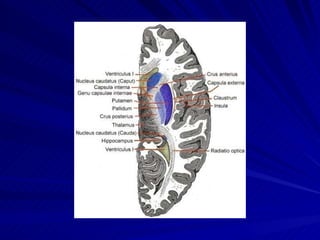
The brain structures that comprise The Basal Ganglia  Putamen,  Caudate nucleus,  Globus pallidus  Substantia nigra  Subthalamic nucleus of Luys
 
Conditions that cause basal ganglia dysfunction Drug overdose Head injury Infection Liver disease Metabolic processes Multiple sclerosis Stroke Tumours Side effects of medications
Brain Disorders associated with Basal ganglia dysfunction Dystonias  Huntington’s disease Parkinson’s disease Supranuclear Palsy Wilson’s disease
The dopamine pathways in schizophrenia In schizophrenia there is an increase in dopamine transmission between the substantia nigra to the caudate nucleus-putamen (neostriatum) compared with normal. While in the other major dopaminergic pathways — to the mesolimbic forebrain and the tubero-infundibular system — dopamine transmission is reduced. The dopamine hypothesis of schizophrenia proposes that increased levels of dopamine or dopamine receptors in the dorsal and or ventral striatum underlie the disorder.
The glutamate pathways in a brain affected by schizophrenia In the normal brain the prominent glutaminergic pathways are: the cortico-cortical pathways; the pathways between the thalamus and the cortex; and the extrapyramidal pathway (the projections between the cortex and striatum). Other glutamate projections exist between the cortex, substantia nigra, subthalamic nucleus and pallidum.  The glutaminergic pathways are hypoactive in the brains of people diagnosed with schizophrenia and this is thought to cause the confusion and psychosis associated with the disorder.
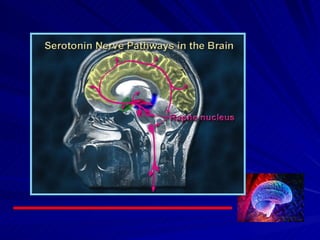
The serotonergic pathway showing the effects of schizophrenia The two key serotonergic pathways in schizophrenia are the projections from the dorsal raphe nuclei into the substantia nigra and the projections from the rostral raphe nuclei ascending into the cerebral cortex, limbic regions and basal ganglia. The up-regulation of these pathways leads to hypofunction of the dopaminergic system, and this effect may be responsible for the negative symptoms of schizophrenia. The serotonergic nuclei in the brainstem that give rise to descending serotonergic axons remain unaffected in schizophrenia.
 
 
NEUROTRANSMITTERS Biogenic amines Amino acids Peptides
NEUROTRANSMITTERS Biogenic amines Dopamine Norepinephrine Epinephrine Serotonin Histamine Acetylcholine
NEUROTRANSMITTERS Amino Acids Amino acids are the most abundant neurotransmitters in the brain. Nichols suggested: “amino acids synapses exceed those of all the other neurotransmitters combined…amino acids are responsible for almost all the fast signaling between neurons, leaving predominantly modulatory roles for the other transmitters.” 
Amino acid NEUROTRANSMITTERS The second neurotransmitter family is composed of  amino acids , organic compounds containing both an amino group (NH2) and a carboxylic acid group (COOH). Amino acids that serve as neurotransmitters include glycine, glutamic and aspartic acids, and gamma-amino butyric acid (GABA). Glutamic acid and GABA are the most abundant neurotransmitters within the central nervous system, and especially in the cerebral cortex, which is largely responsible for such higher brain functions as thought and interpreting sensations
NEUROTRANSMITTERS Amino Acids Glutamate GABA Glycine L-Arginine
NEUROTRANSMITTERS Amino Acids Glutamate  is the major excitatory neurotransmitter and is distributed in all regions of the brain. Aspartate is closely related to glutamate and the two amino acids are often found together at axon terminals. Neurons synthesize glutamate and aspartate and are independent of dietary supply.
NEUROTRANSMITTERS Amino Acids Gamma amino butyric acid (GABA)  is the major inhibitory neurotransmitter in the brain, derived from glucose, which is transaminated in the Kreb’s cycle to glutamine and then converted to GABA by the enzyme, glutamic acid decarboxylase. The production of GABA appears to be independent of the dietary supply of glutamine but requires dietary pyridoxine
NEUROTRANSMITTERS Amino Acids Glycine  is an inhibitory neurotransmitter found mostly in the brain stem and spinal cord. A major discovery that adds complexity to the already confusing story of neurotransmitters is that glycine acts as a co-transmitter in excitatory NMDA synapses.
NEUROTRANSMITTERS Amino Acids L-Arginine  is the precursor of endogenous nitric oxide (NO), which is a vasodilator acting via the intracellular second-messenger cGMP. In healthy humans, L-arginine induces peripheral vasodilation and inhibits platelet aggregation due to an increased NO production. Prostaglandin E1 (PGE1) induces peripheral vasodilation via stimulating prostacyclin receptors.  A mixture of branch-chain amino acids, leucine, valine and isoleucine will reduce tardive dyskinesia and movement disorder that is caused by anti-schizophrenic drugs. Tarvil, has been marketed in the USA that delivers 6.0 grams of the 3 amino acids per packet. A dose of 6 gm three times a day has been recommended. 
Neuropeptides Function of Neuropeptides:     There are cells in the brain that produce various neuropeptides, and these neuropeptides do just about everything.   They can be either pro-inflammatory or anti-inflammatory, with anti-inflammatory being preferred. They are responsible for many functions:   They control our mood, energy levels, pain and pleasure reception, body weight, and ability to solve problems; they also form memories and regulate our immune system.   These active little messengers in the brain actually turn on cellular function in the skin.
Characteristics of Neuropeptides:     Peptides are compounds consisting of two or more amino acids (the building blocks of proteins), chained together by what is called a peptide bond.    Neuropeptides are peptides released by neurons (brain cells) as intercellular messengers. Some neuropeptides function as neurotransmitters, and others function as hormones.    Peptides and neuropeptides, like many substances in our bodies (think cholesterol) can work both for and against us. Anti-inflammatory neuropeptides work for us to reduce inflamation fo the skin.
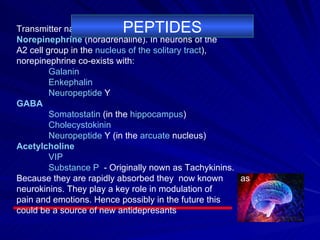
Transmitter names are shown in bold. Norepinephrine  (noradrenaline). In neurons of the  A2 cell group in the  nucleus of the solitary tract ),  norepinephrine co-exists with: Galanin   Enkephalin   Neuropeptide  Y   GABA Somatostatin  (in the  hippocampus )  Cholecystokinin   Neuropeptide  Y  (in the  arcuate  nucleus )  Acetylcholine VIP   Substance P   - Originally nown as Tachykinins.  Because they are rapidly absorbed they  now known  as neurokinins. They play a key role in modulation of  pain and emotions. Hence possibly in the future this  could be a source of new antidepresants PEPTIDES
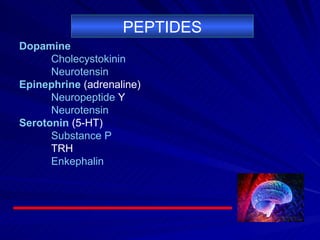
Dopamine Cholecystokinin   Neurotensin   Epinephrine  (adrenaline) Neuropeptide  Y   Neurotensin   Serotonin  (5-HT) Substance P   TRH  Enkephalin   PEPTIDES
 
 
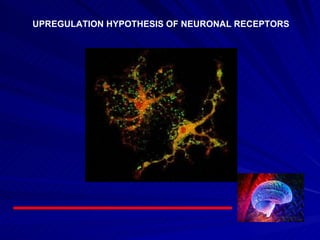
UPREGULATION HYPOTHESIS OF NEURONAL RECEPTORS
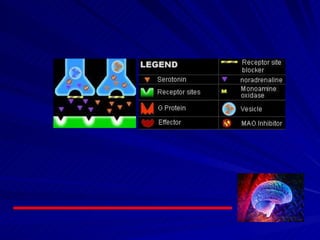
Supersensitivity is a compensatory response of the postsynaptic neuron when it receives too little stimulation. The neuron tries to make up for a lack of stimulation by increasing receptor responsiveness. Over time, the postsynaptic neuron may also compensate for lack of stimulation by synthesizing additional receptor sites. This process is known as up-regulation. Supersensitivity is a compensatory response of the postsynaptic neuron when it receives too little stimulation. The neuron tries to make up for a lack of stimulation by increasing receptor responsiveness. Over time, the postsynaptic neuron may also compensate for lack of stimulation by synthesizing additional receptor sites. This process is known as up-regulation. Supersensitivity is a compensatory response of the postsynaptic neuron when it receives too little stimulation. The neuron tries to make up for a lack of stimulation by increasing receptor responsiveness. Over time, the postsynaptic neuron may also compensate for lack of stimulation by synthesizing additional receptor sites. This process is known as up-regulation. Supersensitivity is a compensatory response of the postsynaptic neuron when it receives too little stimulation. The neuron tries to make up for a lack of stimulation by increasing receptor responsiveness. Over time, the postsynaptic neuron may also compensate for lack of stimulation by synthesizing additional receptor sites. This process is known as up-regulation. Supersensitivity is a compensatory response of the postsynaptic neuron when it receives too little stimulation. The neuron tries to make up for a lack of stimulation by increasing receptor responsiveness. Over time, the postsynaptic neuron may also compensate for lack of stimulation by synthesizing additional receptor sites. This process is known as up-regulation. Supersensitivity is a compensatory response of the postsynaptic neuron when it receives too little stimulation. The neuron tries to make up for a lack of stimulation by increasing receptor responsiveness. Over time, the postsynaptic neuron may also compensate for lack of stimulation by synthesizing additional receptor sites. This process is known as up-regulation. Supersensitivity is a compensatory response of the postsynaptic neuron when it receives too little stimulation. The neuron tries to make up for a lack of stimulation by increasing receptor responsiveness. Over time, the postsynaptic neuron may also compensate for lack of stimulation by synthesizing additional receptor sites. This process is known as up-regulation. Supersensitivity is a compensatory response of the postsynaptic neuron when it receives too little stimulation. The neuron tries to make up for a lack of stimulation by increasing receptor responsiveness. Over time, the postsynaptic neuron may also compensate for lack of stimulation by synthesizing additional receptor sites. This process is known as up-regulation. Upregulation theory Supersensitivity (up-regulation) Supersensitivity (up-regulation) Supersensitivity (up-regulation) Supersensitivity (up-regulation) Supersensitivity (up-regulation) Supersensitivity (up-regulation) Supersensitivity (up-regulation)
By increasing the amount of neurotransmitter in the cleft, you can normalize responsiveness. Increased neurotransmitter increases stimulation of receptor sites, which prompts the postsynaptic neuron to compensate by decreasing receptor sensitivity, a process known as desensitization  DESENSITIZATION  THEORY
The postsynaptic neuron is also thought to compensate for increasing stimulation by decreasing the number of receptor sites, a process known as down-regulation. Downregulation hypothesis
 
“ Prolonged sitting can cause ischial bursitis”.
“ To study medicine without books and mentors is like a shaman who professes who know everything but deep inside he knows nothing at all.   You can shake, rattle, and roll. But at the end of the day, you wish that you have studied hard for the life you are handling in front of you is not a guinea pig at all”.
END OF THE LECTURE

The Brain And Human Behavior2

  • 1.
    Dr. Rene V.Yat The Brain and Human Behavior
  • 2.
  • 3.
  • 4.
  • 5.
  • 6.
  • 7.
  • 8.
  • 9.
  • 10.
  • 11.
  • 12.
  • 13.
  • 14.
    The brain structuresthat comprise The Basal Ganglia Putamen, Caudate nucleus, Globus pallidus Substantia nigra Subthalamic nucleus of Luys
  • 15.
  • 16.
    Conditions that causebasal ganglia dysfunction Drug overdose Head injury Infection Liver disease Metabolic processes Multiple sclerosis Stroke Tumours Side effects of medications
  • 17.
    Brain Disorders associatedwith Basal ganglia dysfunction Dystonias Huntington’s disease Parkinson’s disease Supranuclear Palsy Wilson’s disease
  • 18.
    The dopamine pathwaysin schizophrenia In schizophrenia there is an increase in dopamine transmission between the substantia nigra to the caudate nucleus-putamen (neostriatum) compared with normal. While in the other major dopaminergic pathways — to the mesolimbic forebrain and the tubero-infundibular system — dopamine transmission is reduced. The dopamine hypothesis of schizophrenia proposes that increased levels of dopamine or dopamine receptors in the dorsal and or ventral striatum underlie the disorder.
  • 19.
    The glutamate pathwaysin a brain affected by schizophrenia In the normal brain the prominent glutaminergic pathways are: the cortico-cortical pathways; the pathways between the thalamus and the cortex; and the extrapyramidal pathway (the projections between the cortex and striatum). Other glutamate projections exist between the cortex, substantia nigra, subthalamic nucleus and pallidum.  The glutaminergic pathways are hypoactive in the brains of people diagnosed with schizophrenia and this is thought to cause the confusion and psychosis associated with the disorder.
  • 20.
    The serotonergic pathwayshowing the effects of schizophrenia The two key serotonergic pathways in schizophrenia are the projections from the dorsal raphe nuclei into the substantia nigra and the projections from the rostral raphe nuclei ascending into the cerebral cortex, limbic regions and basal ganglia. The up-regulation of these pathways leads to hypofunction of the dopaminergic system, and this effect may be responsible for the negative symptoms of schizophrenia. The serotonergic nuclei in the brainstem that give rise to descending serotonergic axons remain unaffected in schizophrenia.
  • 21.
  • 22.
  • 23.
  • 24.
    NEUROTRANSMITTERS Biogenic aminesDopamine Norepinephrine Epinephrine Serotonin Histamine Acetylcholine
  • 25.
    NEUROTRANSMITTERS Amino AcidsAmino acids are the most abundant neurotransmitters in the brain. Nichols suggested: “amino acids synapses exceed those of all the other neurotransmitters combined…amino acids are responsible for almost all the fast signaling between neurons, leaving predominantly modulatory roles for the other transmitters.” 
  • 26.
    Amino acid NEUROTRANSMITTERSThe second neurotransmitter family is composed of amino acids , organic compounds containing both an amino group (NH2) and a carboxylic acid group (COOH). Amino acids that serve as neurotransmitters include glycine, glutamic and aspartic acids, and gamma-amino butyric acid (GABA). Glutamic acid and GABA are the most abundant neurotransmitters within the central nervous system, and especially in the cerebral cortex, which is largely responsible for such higher brain functions as thought and interpreting sensations
  • 27.
    NEUROTRANSMITTERS Amino AcidsGlutamate GABA Glycine L-Arginine
  • 28.
    NEUROTRANSMITTERS Amino AcidsGlutamate is the major excitatory neurotransmitter and is distributed in all regions of the brain. Aspartate is closely related to glutamate and the two amino acids are often found together at axon terminals. Neurons synthesize glutamate and aspartate and are independent of dietary supply.
  • 29.
    NEUROTRANSMITTERS Amino AcidsGamma amino butyric acid (GABA) is the major inhibitory neurotransmitter in the brain, derived from glucose, which is transaminated in the Kreb’s cycle to glutamine and then converted to GABA by the enzyme, glutamic acid decarboxylase. The production of GABA appears to be independent of the dietary supply of glutamine but requires dietary pyridoxine
  • 30.
    NEUROTRANSMITTERS Amino AcidsGlycine is an inhibitory neurotransmitter found mostly in the brain stem and spinal cord. A major discovery that adds complexity to the already confusing story of neurotransmitters is that glycine acts as a co-transmitter in excitatory NMDA synapses.
  • 31.
    NEUROTRANSMITTERS Amino AcidsL-Arginine  is the precursor of endogenous nitric oxide (NO), which is a vasodilator acting via the intracellular second-messenger cGMP. In healthy humans, L-arginine induces peripheral vasodilation and inhibits platelet aggregation due to an increased NO production. Prostaglandin E1 (PGE1) induces peripheral vasodilation via stimulating prostacyclin receptors. A mixture of branch-chain amino acids, leucine, valine and isoleucine will reduce tardive dyskinesia and movement disorder that is caused by anti-schizophrenic drugs. Tarvil, has been marketed in the USA that delivers 6.0 grams of the 3 amino acids per packet. A dose of 6 gm three times a day has been recommended. 
  • 32.
    Neuropeptides Function ofNeuropeptides:   There are cells in the brain that produce various neuropeptides, and these neuropeptides do just about everything.   They can be either pro-inflammatory or anti-inflammatory, with anti-inflammatory being preferred. They are responsible for many functions:   They control our mood, energy levels, pain and pleasure reception, body weight, and ability to solve problems; they also form memories and regulate our immune system.   These active little messengers in the brain actually turn on cellular function in the skin.
  • 33.
    Characteristics of Neuropeptides:   Peptides are compounds consisting of two or more amino acids (the building blocks of proteins), chained together by what is called a peptide bond.   Neuropeptides are peptides released by neurons (brain cells) as intercellular messengers. Some neuropeptides function as neurotransmitters, and others function as hormones.   Peptides and neuropeptides, like many substances in our bodies (think cholesterol) can work both for and against us. Anti-inflammatory neuropeptides work for us to reduce inflamation fo the skin.
  • 34.
    Transmitter names areshown in bold. Norepinephrine (noradrenaline). In neurons of the A2 cell group in the nucleus of the solitary tract ), norepinephrine co-exists with: Galanin Enkephalin Neuropeptide Y GABA Somatostatin (in the hippocampus ) Cholecystokinin Neuropeptide Y (in the arcuate nucleus ) Acetylcholine VIP Substance P - Originally nown as Tachykinins. Because they are rapidly absorbed they now known as neurokinins. They play a key role in modulation of pain and emotions. Hence possibly in the future this could be a source of new antidepresants PEPTIDES
  • 35.
    Dopamine Cholecystokinin Neurotensin Epinephrine (adrenaline) Neuropeptide Y Neurotensin Serotonin (5-HT) Substance P TRH Enkephalin PEPTIDES
  • 36.
  • 37.
  • 38.
    UPREGULATION HYPOTHESIS OFNEURONAL RECEPTORS
  • 39.
    Supersensitivity is acompensatory response of the postsynaptic neuron when it receives too little stimulation. The neuron tries to make up for a lack of stimulation by increasing receptor responsiveness. Over time, the postsynaptic neuron may also compensate for lack of stimulation by synthesizing additional receptor sites. This process is known as up-regulation. Supersensitivity is a compensatory response of the postsynaptic neuron when it receives too little stimulation. The neuron tries to make up for a lack of stimulation by increasing receptor responsiveness. Over time, the postsynaptic neuron may also compensate for lack of stimulation by synthesizing additional receptor sites. This process is known as up-regulation. Supersensitivity is a compensatory response of the postsynaptic neuron when it receives too little stimulation. The neuron tries to make up for a lack of stimulation by increasing receptor responsiveness. Over time, the postsynaptic neuron may also compensate for lack of stimulation by synthesizing additional receptor sites. This process is known as up-regulation. Supersensitivity is a compensatory response of the postsynaptic neuron when it receives too little stimulation. The neuron tries to make up for a lack of stimulation by increasing receptor responsiveness. Over time, the postsynaptic neuron may also compensate for lack of stimulation by synthesizing additional receptor sites. This process is known as up-regulation. Supersensitivity is a compensatory response of the postsynaptic neuron when it receives too little stimulation. The neuron tries to make up for a lack of stimulation by increasing receptor responsiveness. Over time, the postsynaptic neuron may also compensate for lack of stimulation by synthesizing additional receptor sites. This process is known as up-regulation. Supersensitivity is a compensatory response of the postsynaptic neuron when it receives too little stimulation. The neuron tries to make up for a lack of stimulation by increasing receptor responsiveness. Over time, the postsynaptic neuron may also compensate for lack of stimulation by synthesizing additional receptor sites. This process is known as up-regulation. Supersensitivity is a compensatory response of the postsynaptic neuron when it receives too little stimulation. The neuron tries to make up for a lack of stimulation by increasing receptor responsiveness. Over time, the postsynaptic neuron may also compensate for lack of stimulation by synthesizing additional receptor sites. This process is known as up-regulation. Supersensitivity is a compensatory response of the postsynaptic neuron when it receives too little stimulation. The neuron tries to make up for a lack of stimulation by increasing receptor responsiveness. Over time, the postsynaptic neuron may also compensate for lack of stimulation by synthesizing additional receptor sites. This process is known as up-regulation. Upregulation theory Supersensitivity (up-regulation) Supersensitivity (up-regulation) Supersensitivity (up-regulation) Supersensitivity (up-regulation) Supersensitivity (up-regulation) Supersensitivity (up-regulation) Supersensitivity (up-regulation)
  • 40.
    By increasing theamount of neurotransmitter in the cleft, you can normalize responsiveness. Increased neurotransmitter increases stimulation of receptor sites, which prompts the postsynaptic neuron to compensate by decreasing receptor sensitivity, a process known as desensitization DESENSITIZATION THEORY
  • 41.
    The postsynaptic neuronis also thought to compensate for increasing stimulation by decreasing the number of receptor sites, a process known as down-regulation. Downregulation hypothesis
  • 42.
  • 43.
    “ Prolonged sittingcan cause ischial bursitis”.
  • 44.
    “ To studymedicine without books and mentors is like a shaman who professes who know everything but deep inside he knows nothing at all. You can shake, rattle, and roll. But at the end of the day, you wish that you have studied hard for the life you are handling in front of you is not a guinea pig at all”.
  • 45.
    END OF THELECTURE