INDORE INSTITUTE OF MEDICAL SCIENCES
SENSORY PROCESSING DISORDER
Submitted to: submitted by:
Dr. Subhash Garg Shefali Parmar
Dept. of occupational therapy BOT 4th year
SENSORY
PROCESSING
DISORDER
CONTENTS
• INTRODUCTION.
• WHAT IS SENSORY PROCESSING?
• WHAT IS SENSORY PROCESSING DISORDER?
• STATISTICS.
• CAUSES.
• PROBLEMS FACING.
• POSSIBLE SIGNS.
• TYPES OF SPD.
• DIFFERENTIAL DIAGNOSIS.
• OCCUPATIONAL THERAPY ASSESSMENT OF SPD.
• FRAME OF REFERENCE.
• OCCUPATIONAL THERAPY INTERVENTION.
• RESEARCH.
• REFERENCES.
INTRODUCTION
Sensory processing disorder came into knowledge in late
1970’s when an occupational therapist by the name of Dr.
A. Jean Ayres laid the groundwork for sensory integration
dysfunction (Biel & Peske, 2009).
WHAT IS SENSORY PROCESSING?
• In order to under Sensory Processing Disorder, it’s important to understand what “sensory
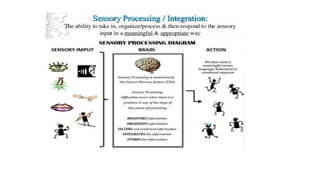
processing” or “sensory integration SI” is and how it works. Sensory processing refers to the way
the central nervous system accepts signals from the surrounding environment through our senses
and converts them into motor and behavioral responses.
• For example, you smell your mother cooking spaghetti and meatballs, your tummy rumbles, you
realize your hungry and the appropriate response is to eat food so the feeling goes away. All of this
is your brain processing multiple sensations – sensory integration.
• Sensory processing or sensory integration refers to the nervous system’s job of taking in all the
information around us through our senses (movement, touch, smell, taste, visual, and hearing) and
organizing that information so that we can attach meaning to it and act on it accordingly.
• Sensory integration is the basis for learning. It is what allows us to get an idea of what is going on
in the world around us. We learn when we take in new information, cross reference the new
information to previous similar experiences, and make an assessment as to how we should
proceed given the current set of information.
• The development of sensory systems begins in the womb and continues throughout our lives. In
the early childhood years, the nervous system is in hyper-development and sensory integration is
being refined through typical childhood activities
WHAT IS SENSORY PROCESSING DISORDER?
• SPD which stands for Sensory Processing Disorder is a mental disorder in which information from stimuli that is
perceived by the senses turns into behavior that is considered to be abnormal.
• Gallagher and Weigel (2005) define Sensory Processing Disorder (SPD) as the inability to “interpret
sensations and organize a purposeful response.”
• This disorder used to be called Sensory Integration Dysfunction. It’s also important to know that despite popular
belief that there are more than the 5 senses that we learn in school – in fact, there are 8 sensory systems that can
be affected with SPD:
 Visual (see)
 Auditory (hear)
 Tactile (touch)
 Olfactory (smell)
 Gustatory (taste)
 Vestibular (spatial surrounding)
 Proprioception (relation to one’s body parts and effort to move them)
 Introception (internal body senses like hunger, thirst, heart beat, etc).
SPD can also be a presentation of other neurological conditions, including ADHD, Autism spectrum disorders,
or developmental dyspraxia.
WHAT CAUSES SPD?
The exact cause of SPD- like the causes of ADHD or ASD and so many
other neurodevelopmental disorders-has not been identified.
Preliminary research suggests that SPD is often inherited.
Prenatal and birth complications have been implicated.
Environmental factors may be involved.
POSSIBLE CAUSES SPD?
• Genetic or Heredity
• Prenatal exposure to chemicals, medications, toxins, smoke, drugs, alcohol
, great emotional stress, virus, chronic illness or problem with the placenta.
• Multiple births, such as twins or triplets.
• Prematurity or low birth weight.
• Birth trauma, including emergency caesarean section, lack of oxygen, or
surgery soon after birth.
• Postnatal exposure to environmental pollutants, child abuse, insufficient
stimulation (limited play and interaction), lengthy hospitalization, and
placement in an orphanage.
WHAT ARE THE STATISTICS?
• According to Dr. Lucy Jane Miller, the statistics report a minimum of 1 in 20
children in the US have SPD. This is the only published statistic and is based
on her research thus far. As awareness increases and more studies are
done, we may very well find the statistics to be higher.
5 - 16% of typically developing children.
70 – 90% children and adults with ASD have impairments in sensory processing.
40 – 60 % with ADHD have SPD.
PROBLEMS FACING IN SENSORY PROCESSING
DISORDER-
• Under-responsiveness and sensory registration problems.
• Over-responsiveness.
• Tactile defensiveness.
• Gravitational insecurity.
• Over-responsiveness in other sensory modalities.
• Sensory discrimination and perception problems.
• Tactile discrimination and perception problems.
• proprioceptive problems.
• Visual perception problems.
• Other perceptual problems.
• Vestibular bilateral problems.
• Praxis problems.
• Somatodyspraxia.
• Sensory-seeking behaviour.
VISUAL PERCEPTUAL SKILLS
NAME
Visual discrimination, visual
foreground, visual figure ground.
Visual memory
visualization
DEFINITION
Ability to discriminate visual likeness and
difference, figure ground from
foreground; visual closure.
Ability to visually recall past information.
Ability to take the visual information that
you already know and use it to project
into the future a new visual scenario.
IMPACT
Reverse words or letters, poor
discrimination with similar words or
shapes; usually slow readers.
Lack of reading comprehension, may
require an auditory cue to remember
past visual information.
Difficulty with spelling, math
problems that deviate from specific
learned skill; cannot project attaining
future goals.
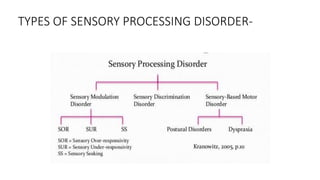
TYPES OF SENSORY PROCESSING DISORDER-
SENSORY MODULATION DISORDER• Difficulty regulating responses to sensory stimuli.
• The term, sensory modulation refers to the tendency to generate responses that are
appropriately graded in relation to incoming sensory stimuli, rather than under-responsive
or over-responding to them.
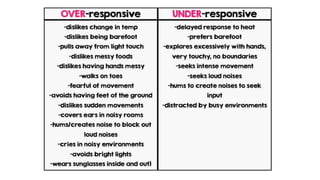
• A. Over-Responsivity (may also be characterized as sensory avoiding): An exaggerated
response of the nervous system to sensory input that most people find tolerable. For
example, the nervous system may go into fight-or-flight mode even when no real danger
exists. The child might also:
• Present as over-responsive to sensory information in one or more sensory systems.
• Present as tactile defensive and not tolerate clothing or other tactile input (paint, glue,
soap) on their bodies.
• Present as fearful of movement (resists swinging or playing on playground equipment).
• Demonstrate difficulty tolerating a wide variety of food textures or smells and appear as a
“picky eater” with exaggerated gag responses.
• Avoidance behaviors may interfere with the ability to effectively interact with others. A
child with over-responsivity is easily overwhelmed by sensory components of tasks.
• B. Under-Responsivity (may also be characterized as passive): A lack
of response or insufficient response to sensory input. The child can
also be unaware of sensory stimuli or demonstrate delayed or less-
intense responses than most people. The child may also:
• Appear to be daydreaming or unfocused on what is happening
around them.
• Appear to be quiet or a loner.
• Appear uninterested and difficult to engage.
• Demonstrate low endurance.
• Require more sensory input to get their sensory system to respond.
• Mouth objects.
• Tasks that do not provide extra sensory input may be perceived as
difficult or unrewarding.
• C. Sensory-Craving (may also be characterized as sensory
seeking): The nervous system of the sensory-craver needs
intense input in order for the sensation to be registered.
Sensory-cravers seek out intense sensations constantly but
are often disorganized due to high levels of random
sensory input. They are constantly touching, crashing, and
moving, and they have no awareness of personal space.
The child may also:
• Demonstrate decreased safety due to impulsiveness and
excessive risk taking behaviors.
• Appear to be constant motion but may be clumsy and
awkward, frequently falling and bruising (but may not
notice injury until pointed out).
• Constantly break their crayons or hurt others unknowingly.
• Sensory cravers are in constant movement and may not
develop skills needed for gross and fine motor skills.
SENSORY BASED MOTOR DISORDER
• Children with Sensory Based Motor Disorder have a hard time
coordinating their brains and the bodies. Normally, the brain receives
sensory messages (sensory input) and produces an adaptive response
(motor output). When a child suffers from Sensory Based Motor
Disorder, they respond incorrectly to the surrounding environment
whether it’s by not understanding the space around them or inability
to move the body in the right way.
There are two different types of Sensory Based Motor Disorder:
o Dyspraxia
o Postural Disorder
DYSPRAXIA-
• Dyspraxia comes from the two Latin words “praxis” to do and “dys” badly. Children that
suffer from this condition have a hard time processing environmental
stimuli and following through with a motor action.
• Common symptoms of dyspraxia include:
• difficulty handling scissors, eating utensils and other hand held devices
• difficulting buttoning, zipping and other fine motor activities
• difficulty dressing themselves
• illegible handwriting
• poor hand eye coordination
• difficulty navigating through a crowd
• inability to learn complex sequence of movement
• anxiety walking up or down stairs
• visual perception issues including crossing the midline.
• Always reluctant or refuses to try a new activity.
• Insists on being last for familiar or new motor activities.
• Acts like the class clown who is always falling or tripping.
• Has difficulty imitating movements for games such as “Simon says”.
• Does not follow verbal directions for motor movements well.
• Often lacks ideas for play.
• Some children with dyspraxia have problems with ideation.
• SOMATODYSPRAXIA involves poor tactile perception in conjunction with
signs of poor motor planning (poor praxis and impaired tactile and
proprioceptive processing).
• Children with Somatodyspraxia have decreased body awareness and
ability to grade their force appropriately on an object. These children are
often described as clumsy, fidgety, talk constantly, and have poor
coordination and ideation.
• Several clinical observation are commonly associated with
somatodyspraxia:
o inadequate supine flexion.
o difficulty with sequential finger touching.
o impaired ability to perform slow, controlled (ramp) movements.
o impaired in-hand manipulation.
POSTURAL DISORDER-
• Postural disorder deals with the child’s ability to operate their muscles and
move their own bodies successfully. Children usually have difficulty keeping
their body on task while moving or keeping their body still at rest.
Common symptoms of postural disorder include:
Frequently drooling or inability to keep things in the mouth while eating
Not chewing food thoroughly
Poor depth perception
Difficulty focusing eyes
Terrible aim when reaching for objects
Poor sports performance
Difficulty maintaining balance for long periods of time
Frequently leaning on furniture or wall
Very clumsy
Sits in awkward positions
Low muscle tone
Difficulty using the rest room
SENSORY DISCRIMINATION DISORDER-
• Sensory discrimination refers to the process whereby specific
qualities of sensory stimuli are perceived and meaning attributed to
them. Discriminate means understanding accurately what is seen,
heard, felt, tasted, or smelled. Individuals with SDD difficulties have
problems determining the characteristics of sensory stimuli.
Individuals with poor sensory discrimination may appear awkward in
both gross and fine motor abilities and/or inattentive to people and
objects in their environment. They may take extra time to process the
important aspects of sensory stimuli.
Auditory DD
Difficulty interpreting characteristics of sensory stimuli that is heard; (may be called Auditory
Discrimination Disorder)
Visual DD Difficulty determining/interpreting characteristics of sensory stimuli that is seen
Tactile DD
Difficulty determining/interpreting characteristics of sensory stimuli that is felt on the skin or
interpreting higher level visual/spatial characteristics of touch (includes stereognosis and
graphesthesia disorders)
Vestibular DD
Difficulty interpreting characteristics of sensory stimuli, experienced through movement of the body
through space or against gravity
Proprioceptive
DD
Difficulty determining/interpreting characteristics of sensory stimuli experienced through use of the
muscles and joints
Gustatory DD Difficulty determining/interpreting characteristics of sensory stimuli that is tasted
Olfactory DD
Difficulty determining/interpreting characteristics of sensory stimuli that is smelled
Interoception
Difficulty interpreting stimulation from internal organs (may not feel need to use the toilet or may
have frequent somatic complaints such as stomach aches)
CONCOMITANT DIAGNOSES –OR MISS
DIAGNOSES ?
o ADD/ ADHD
oBehavioural issues
o Anxiety
o OCD
o ASD
ASSESSMENT OF SENSORY INTEGRATIVE
FUNCTIONS
• Diagnosis is primarily arrived at by the use of standardized tests,
standardized questionnaires, expert observational scales, and free play
observation at an occupational therapy gym. Observation of functional
activities might be carried at school and home as well.
• Depending on the country, diagnosis is made by different professionals,
such as occupational therapists, psychologists, learning specialists,
physiotherapists and/or speech and language therapists. In some countries
it is recommended to have a full psychological and neurological evaluation
if symptoms are too severe.
• Assessment tools employed by occupational therapists using a sensory
integration perspective include interviews and questionnaires, informal
and formal observations, standardized tests, and consideration of
services and resources available to and appropriate for the family.
INTERVIEW AND QUESTIONNAIRES
• The referral source, family members, and others who work with the
child may all be valuable sources of information through interviews or
questionnaires.
• The initial interview with the parent, teacher, or other referral source
provides an opportunity for the therapist to gather important
information about sensory integration problems that may be present.
• Questionnaires, checklists, and histories given be caregivers and other
adults who knows the child well are other means for gathering
information that aids in identifying presenting problems and
strengths, and in clarifying the priorities of the family.
• The SENSORY PROFILE and the SENSORY PROCESSING MEASURE (SPM) are two questionnaires used
extensively in paediatric occupational therapy.
► Sensory Profile 2
5 questionnaires in the kit:
Infant
Toddler
Child
School Companion
Short
• Sensory Profile for Adolescents and Adults
o Adolescent/Adult Self Rating Questionnaire
o Adolescent/Adult Caregiver Questionnaire
It’s never too late to seek help for sensory processing challenges
Sensory profile-
• With the Sensory Processing Measure (SPM), you can now get a complete picture of children's
sensory functioning at home, at school and in the community.
• The SPM consists of three forms:
o Home Form
o Main Classroom Form
o School Environments Form
• The Home Form (75 items) is completed by the child's parent or home-based care provider. The
Main Classroom Form (62 items) is filled out by the child's primary classroom teacher. And the
School Environments Form (10 to 15 items per environment) is completed by other school
personnel who work with and observe the child.
The SENSORY PROCESSING MEASURE-PRESCHOOL (SPM-P) is normed for ages 2 to 5 years
old, and is structured similarly, with separate home and school forms for parents and day care
providers or preschool teachers, respectively.
DIRECT OBSERVATION
• Direct observation of the child is essential to the evaluation of
sensory integration.
NATURALISTIC OBSERVATION
• Informal observation of the child during familiar routines in natural
settings, such as classroom, playground, or home, is informative and
helpful.
• Observation of the child in the clinical setting can also be helpful for
discovering how the child responds to situations that are novel or
unpredictable.
STRUCTURED CLINICAL OBSERVATION
• Examples of commonly used clinical
observations-
oCrossing body midline: Intentional
movements of a body part (usually the
hand) to reach for or manipulate an
object in contralateral space. This
capacity typically emerges during
toddlerhood and early childhood and
is related to the development of hand
preference. Delays in midline crossing
may be related to inadequate hand
preference and bilateral integration.
oEquilibrium reaction: Automatic postural and limb
adjustments that occur when the body’s center of gravity is
displaced enough to cause potential loss of balance. These
adjustments serve to restore the body’s COG over its BOS so
that balance is maintained or restored. Difficulties with
equilibrium reactions are associated with vestibular
processing problems.
oMuscle tone: the readiness of a muscle to contract. Force
with which a muscle resists being lengthened.
oProne extension: ability to assume and hold an “air plane”
position while lying prone. Difficulty maintaining this
position for 30 sec is related to inefficient vestibular
processing in children 6 years of age and older.
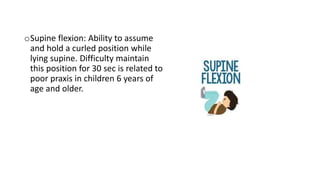
oSupine flexion: Ability to assume
and hold a curled position while
lying supine. Difficulty maintain
this position for 30 sec is related to
poor praxis in children 6 years of
age and older.
Standardized testing-
• The Sensory Integration and Praxis test (SIPT)-
• The Miller function and participate scales: include tests that
challenge praxis, visual-motor integration, figure ground
perception, and some vestibular functions.
• The Bruininks - Oseretsky test of motor proficiency (BOT-2):
measures aspects of fine and gross motor skills (such as
bilateral integration).
• Other test-
 Development test of visual motor integration, provides specific
information related to visual perceptual and perceptual-motor
skills.
 School function assessment (SFA.
 The goal-oriented assessment of life skills (GOAL).
 The social participation scale of the SPM.
 De Gangi-Berk Test of Sensory Integration (TSI).
 Test of Sensory Functions in Infants (TSFI).
INTERPRETING DATA AND MAKING
RECOMMENDATIONS-
• Once the information from interviews, questionnaires, informal and
formal observations, and standardized tests has been collected, the
occupational therapist must integrate and interpret these data to
reach meaningful conclusions and appropriate recommendations for
the individual child.
ROLE OF OCCUPATIONAL THERAPY IN SPD:
o Direct intervention.
o Coach parents.
o Educate family to help their home to be more sensory
friendly.
o Consult re: equipment, toys and materials.
o Home modifications
o Occupational Therapy is a “related service” in the child’s Individualized Educational
Plan (IEP).
o The goal is to increase participation in the academic environment.
o Social participation.
FRAME OR REFERENCES:
• Sensory integration frame of reference.
• Behavioral frame of reference.
• Spatiotemporal adaptation frame of reference.
OCCUPATIONAL THERAPY INTERVENTIONS
FOR CHILDREN WITH SPD-
CLINIC SCHOOL
HOME
AYRES SENSORY INTEGRATION
INTERVENTION- OT-SI
• The term Ayres sensory integration (ASI) intervention
refers to the individualize occupational therapy
practice approach that Ayres developed specifically to
remediate sensory integrative problems of children.
• The occupational therapist presents activity
challenges that are individually tailored to improve
sensory integration capacities of the child. Ultimately,
this intervention is designed to help a child gain
competencies and confidence in performing everyday
occupations at home, in play, at school, or in the
community.
Basic assumptions underlying Ayres sensory integration
intervention-
1. Sensory input can be used systematically to elicit an adaptive response.
2. Registration of meaningful sensory input is necessary before an adaptive
response can be made.
3. An adaptive response contributes to the development of sensory
integration.
4. Better organization of adaptive responses enhances the child’s general
behavioral organization.
5. More mature and complex patterns of behavior emerge from
consolidation of simpler behaviors.
6. The more inner-directed a child’s activities are, the greater the potential
for the activities to improve neural organization.
• Sensory integration therapy is driven by four main
principles:
oJust right challenge (the child must be able to successfully
meet the challenges that are presented through playful
activities)
oAdaptive response (the child adapts his behavior with new
and useful strategies in response to the challenges
presented)
oActive engagement (the child will want to participate
because the activities are fun)
oChild directed (the child's preferences are used to initiate
therapeutic experiences within the session
Activities-
• 1. Play Dough, Funny Foam, etc...
Children need and love play dough and messy play, unless
they have tactile defensiveness that is. There are so many
versions of play dough, from pre-package to homemade,
scented to unscented, textured to non-textured, cooked to
uncooked.
• 2. Heavy Work Activities:
These types of activities are imperative for children who have
difficulty regulating their arousal levels.
These activities will include using weights, weighted
products, jumping, bouncing, rocking, pushing, pulling,
swinging and being "squished".
3. Sleep Programs / Products:
• weighted blankets.
• relaxation cd’s.
• unique children’s sleeping bags.
• vibrating mattresses and vibrating pillows.
• heavy work activities prior to bed.
• aromatherapy machines.
4. Sand And Water Play:
Playing in the sand or water provides essential yet fun ways to
experience necessary tactile input. Use your creativity, get plenty
of towels, and have fun filling these tables with sand, rice,
shaving cream, water, or any textured substance you can think of.
Of course, put little toys in as well to encourage exploration.
5. Vestibular Movement:
• Rolling
• Swinging
• Spinning
• Sliding
• Riding Vehicles
• Rocking
• Walking on Unstable Surfaces
• Riding, Balancing and Walking on a Seesaw
• Sitting on a T Stool
• Balancing on a Therapy Ball
• Tummy Down, Head Up
• Jogging
6. Massagers, Vibrating Toys And Products: Vibration is an essential
tool when doing sensory integration activities and therapy.
• massage mats
• vibrating baby seats
• massaging chairs and recliners
• vibrating toothbrushes
7. Wilbarger Brushing Protocol:
It is one successful method of treating children with tactile defensiveness and sensory regulation
issues. One of the biggest reasons to use it is to desensitize the skin so touch sensations can be more
easily tolerated.
8. Play Tunnels And Tents:
use the tunnels as an active gross motor and
bilateral motor
coordination activity just by having the child
crawl through them.
• create a tactile experience by placing
different textured objects or
carpet squares inside the tunnel.
• shake the tunnel up (as in an earthquake)
while the children are in
it for increased proprioceptive input and
vestibular reactions.
• use play tents as a safe haven for children
who are overwhelmed by sensory stimuli or
as a sensory controlled environment for
napping, resting or reading.
9. Proprioceptive Activities:
• Lifting and Carrying Heavy Loads
• Pushing and Pulling
• Hanging by the Arms
• Hermit Crab
• Joint Squeeze
• Body Squeeze
• Bear Hugs
• Pouring
• Opening Doors
• Back-To-Back Standing Up
• Arm Wrestling
10. Sensory Rooms:The sensory gym: Treatment usually
takes place in a setting outfitted with specialized
equipment, called a sensory gym. The equipment allows
kids to safely spin, swing, and crash into padded surfaces.
The gym may also be outfitted with things like weighted
vests and ”squeeze machines”—developed by the autistic
writer/inventor Temple Grandin— to provide deep pressure
that is calming to kids with sensory processing issues.
11. Sensory Toys:
• The fidget spinner sensory toy.
• Hand fidget sensory toys.
• Chew sensory toys
• Fidget cube.
• Sensory rings.
Sensory diet-
• A balanced sensory diet is a planned and scheduled activity program that a therapist
develops to meet the needs of a specific child’s nervous system. Its purpose is to help the
child become better regulated and more focused, adaptable and skillful. A sensory diet
fulfills the physical and emotional needs of the child and it includes a combination of
alerting, organizing and calming activities.
Alerting activities benefit the under-responsive child and include:
• Crunching dry cereal, popcorn, crisps, nuts, crackers, pretzels, carrots, celery, apples and
ice-cubes.
• Taking a shower.
• Bouncing a therapy ball or beach ball.
• Jumping up and down on a trampoline.
Organizing activities help regulate the child’s responses and include:
• Chewing granola bars, fruit bars, licorice, dried apricots, chees, gum, bagels or bread crusts.
• Hanging by the hands from a chinning bar.
• Pushing or pulling heavy loads.
• Getting into an upside down position.
Calming activities help the child decrease sensory over-
responsivity or over stimulation and include:
• Sucking a soother, hard candy, frozen fruit bar or spoonful
of peanut butter.
• Pushing against walls with hands, shoulders, back,
buttocks and head.
• Rocking, swaying or swinging slowly to and fro.
• Cuddling or back rubbing.
• Taking a bath.
Activities to develop tactile sense
• Encourage the child to rub a variety of textiles against her skin.
• Water Play – Fill the kitchen sink with sudsy water and fill the sink with
various kitchen items such as bottles, sponges, egg cups, plastic cups and
encourage the child to play with the items in the water.
• Water Painting – Give the child a bucket of water and paintbrush to paint
the fence or outdoor steps.
• Finger Painting
• Finger Drawing
• Sand Play
• Feelie Box
• Can You Describe It Game?
• Oral Motor Activities – licking stickers , blowing whistles, blowing bubbles,
drinking through straws, chewing gum.
• Hands-On-Cooking
• Science Activities – Touching worms, egg yolks, collecting acorns and
chestnuts, planting seeds, digging in the garden.
• Handling Pets
Activities to develop auditory sense
• Simplify your language.
• Speak slowly and shorten your comments.
• Abbreviate instructions and repeat.
• Reinforce verbal messages with gestural communication: facial
expressions, hand movements and body language.
• Talk to your child while she dresses, eats or bathes to teach her
words and concepts such as nouns, body parts, prepositions,
adjectives, time, categories of items, actions and emotions.
• Model good speech and communication skills.
• Take the time to let your child respond to our words and
express his thoughts.
• Pay attention.
• Look at your child in the eye when she speaks and show that
her thoughts interest you.
• Reward her comments with smiles, hugs and verbal praise as
positive feedback will encourage her to strive to communicate.
• Use rhythm and beat to improve your child’s memory.
• Read to your child.
Activities to develop visual sense
• Making shapes
• Mazes and Dot-to-Dot
• Peg Board
• Cutting Activities
• Tracking Activities e.g. watching planes or birds in the sky.
• Jigsaw Puzzles
• Block Building
Activities to develop fine-motor skills
• Flour Sifting
• Stringing and Lacing
• Egg Carton Collections e.g sorting objects in the individual
compartments.
• Household Tools e.g picking up cereal pieces with tweezers, stretching
rubber bands over a box to make a guitar, hanging clothes with pegs
on a line.
• Office and Classroom Tools e.g. cutting with scissors, using a stapler
or punch, drawing with crayons and chalk, painting with brushes,
feathers, sticks and eyedroppers, using sprinkles and glue.
Activities to develop motor-planning skills
• Jumping from a Table
• Walking with Animals
• Playground Games
• Inside-Outside Games e.g. teach your child to get in and
out of clothes, the front door and the car
Activities to develop bilateral co-ordination
• Ball Catch
• Ball Whack
• Swing Ball
• Balloon Fun
• Rolling Pin Fun
• Body Rhythms
• Eggbeater Fun
• Marble Painting
• Ribbon Dancing
• Two-Sided Activities e.g. encourage the child to jump rope, swim, cycle a bicycle, row,
paddle
Suggestions to develop self-help skills
DRESSING
• Buy or make a dressing board with a variety of snaps, buttons, zippers, buttonholes, hooks and eyes, buckle
and shoelaces.
• Provide things that are not her own clothes for the child to zip, button and fasten such as sleeping bags,
backpacks, coin purses, lunch boxes, dolls clothes and cosmetic cases.
• Provide oversized clothing with zippers, buttons, buckles and snaps for your child to dress up in.
• Eliminate unnecessary choices in your child’s wardrobe e.g clothes that are not appropriate for that season.
• Install large hooks inside wardrobe doors at the child’s eye level so he can hang up his own coat etc.
• Comfort is what matters.
• Set out tomorrow’s clothes the night before.
• Encourage the child to dress himself.
• Allow for extra time.
• Start the zipper and let him zip it up himself.
SNACK AND MEAL TIME
• Provide a chair that allows the child’s elbows to be at table
height and feet to be flat on the floor.
• Offer a variety of ways to eat food.
• Offer a variety of foods with different textures.
• Let the child pour his milk or juice into the cup.
• Encourage the child to handle snack-time or mealtime objects
e.g opening crackers, spreading butter, and eating with utensils.
CHORES
• Make a list of chores that your child CAN do.
• Make a list of chores that your child may need your help with.
• Show your appreciation.
• Make the chores a routine and stick to it
BATHING
• Allow your child help regulate the water temperature.
• Provide a variety of bath time toys.
• Scrub the child with firm, downward strokes.
• Provide a large bath sheet for a tight wrap-up afterwards.
SLEEPING
• Give your child notice.
• Stick to a bedtime routine.
• Include stories and songs.
• Chat about the days events.
• Chat about the next days plans.
• Provide comfortable pyjamas.
• Provide comfortable bed linen
EXPECTED OUTCOME OF OCCUPATIONAL THERAPY USING A
SENSORY INTEGRATION APPROACH INTERVENTION
• Increase in the frequency or duration of adaptive responses.
• Development of increasingly more complex adaptive responses.
• Improvement in gross and fine motor skills.
• Improvement in cognitive, language and academic performance.
• Increase in self-confidence and self-esteem.
• Enhanced occupational and engagement and social
participation.
• Enhanced family life.
SIPT and goal attainment scaling (GAS) are standardized tests that addresses the uniquely
individualized nature of expected outcome of OT-SI.
Alternative interventions-
• Sensory stimulation protocols.
• Sensory-based strategies.
• Group interventions.
• Consultation on modification of activities, routines, and environments.
• Psychotherapy for people who have developed a mood disorder or anxiety
because of SPD.
• Visual /vestibular therapy.
• Berard auditory integration training (AIT).
• SOS (Sequential oral sensory) approach to feeding for oral /motor defensiveness.
• Play therapy.
• Craniosacral therapy and myofascial release.
• Aquatic Therapy or Hydrotherapy—Water-based activities
that are done in warm water. Many occupational and physical
therapists will conduct therapies in warm-water pools for
people with neurological and orthopaedic impairments. For
many children with SPD, a pool can be scary; however, once
they adjust to being immersed in the water, they become very
secure and may even seek it out to help calm themselves.
Water acts like a Lycra suit on the body, giving continuous non
graded input. Jets in a hydro spa provide increased resistance
to a child’s movement.
• Aquatic therapy programs encourage improvements in
balance, bilateral control, and motor planning, as well as a
general increase in body strength and body awareness.
.
LISTENING THERAPY (LT)-
• Listening therapy (LT) is a therapeutic program to improve
the neurophysiological foundation for integrating sensory
input by using specific sound frequencies and patterns to
stimulate the brain. Like occupational therapy, LT is based
on the theory of neuroplasticity, which refers to brain
changes that occurs as a result of experience.
HIPPOTHERAPY
• Hippotherapy is a powerful therapeutic
tool that is compatible with both
sensory integration and occupation.
• Riding a horse provides many different
kinds of sensory information, including
tactile, visual, auditory, vestibular, and
proprioceptive.
• Horseback riding is motivating and
pleasurable and can be medium for
attaining numerous physical and
psychosocial benefits.
• Additionally, hippotherapy can lead to
the development of a meaningful
recreational interest or hobby.
• Required a trained profession.
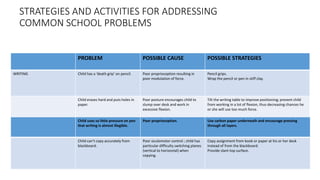
STRATEGIES AND ACTIVITIES FOR ADDRESSING
COMMON SCHOOL PROBLEMS
PROBLEM POSSIBLE CAUSE POSSIBLE STRATEGIES
WRITING Child has a ‘death grip’ on pencil. Poor proprioception resulting in
poor modulation of force.
Pencil grips.
Wrap the pencil or pen in stiff clay.
Child erases hard and puts holes in
paper.
Poor posture encourages child to
slump over desk and work in
excessive flexion.
Tilt the writing table to improve positioning; prevent child
from working in a lot of flexion, thus decreasing chances he
or she will use too much force.
Child uses so little pressure on pen
that writing is almost illegible.
Poor proprioception. Use carbon paper underneath and encourage pressing
through all layers.
Child can’t copy accurately from
blackboard.
Poor oculomotor control ; child has
particular difficulty switching planes
(vertical to horizontal) when
copying.
Copy assignment from book or paper at his or her desk
instead of from the blackboard.
Provide slant-top surface.
WRITING Child uses so little pressure on pen that writing is almost
illegible.
Poor proprioception. Use carbon paper underneath and encourage
pressing through all layers.
Child can’t copy accurately from blackboard. Poor oculomotor control ; child has
particular difficulty switching planes
(vertical to horizontal) when
copying.
Copy assignment from book or paper at his or her
desk instead of from the blackboard.
Provide slant-top surface.
Child has difficulty forming letters or shapes. Decreased awareness of what
letters look like or poor form and
space skills.
Place a piece of clear plexiglass in a stand; an adult
sitting behind the plexiglass can draw letters
(backwards), which the child traces on his or her
side; when the child is finished, the adult can erase
the lines.
Runs out of space on paper, seems not to recognize
boundaries of paper.
Decreased visuomotor skills
secondary to poor proprioceptive
information.
Use paper with raised lines.
Art and
construction
Cannot cut with regular scissors. Poor fine motor coordination,
possibly secondary to poor tactile
or proprioception.
Use alternative types of scissor (e.g. fiskar soft
touch scissors that evenly distribute pressure, loop
scissors).
Have child cut thick paper (e.g. file folder weight)
which gives a bit more resistance and is easier to
cut.
Poor bilateral integration. Fasten loop scissors to a scissors to a small board
and fasten that to the top of the child’s desk; child
can cut by pushing down.
DISTRACTIBILITY Wanders around, disturbs class when
overstimulated or tired.
Distractibility secondary to
sensory defensiveness.
Reduce amount of stimuli.
Place desk in least noise and activity.
Decrease bright light.
May have motor planning
problems.
Build in many opportunities for child to get up and move around
during the day.
Help out with “chores” around the classroom.
Provide the child with clay or fidget toys to use at desk.
SOCIAL BEHAVIOUR Pushes other children who come close. Fight-or-flight reaction secondary
to sensory defensiveness.
Place where is least activity.
Quiet place.
Talk to the child and try to explain.
Help the child to develop strategies for acceptable behaviour to
be used.
Teach the whole class about the imp of respecting other’s
personal space and individual differences about comfort level in
being to close to others.
SOCIAL BEHAVIOUR gets to close to other children while
playing or circle around
Problem seems related to the
knowledge of the boundaries of
the body.
Provide the child with external guides to help him or her stay
out of others’ personal space.
Allow the child to choose stuffed small animal, which he had to
held firmly through out the circle time activity.
One arm distance.
During playtime, engage the child in games.
Child needs help to be able to enter groups
of children with whom he or she wants to
play.
Does not associated with any
particular aspect of sensory
integration theory.
Teach child the strategy of finding something very enticing with
which to play that will draw other children to help him or her
identify a role for him- or herself in the game and then just
assume it without asking permission.
ADVICE TO PARENTS:
• Prepare for new experience.
• Story telling.
• Picture showing.
• Videotaping during activities, birthday parties.
• Avoid stressful situations to prevent anxiety in child.
• Never allow your child to watch a video of himself behaving abnormally
because that negative visual will play over and over in his head.
• Remember your child’s sensory sensitivity.
• Make sure to discuss the changes in your child’s day/week beforehand
RESEARCHES
Caregivers' perceptions of barriers and supports for
children with sensory processing disorders
• INTRODUCTION:
This study explored caregivers' perceptions of how children with sensory processing disorders participate in community outings,
strategies to support successful outings and if multi-sensory environments mitigate participation barriers.
• METHODS:
Seven mothers and two grandmothers of children with sensory challenges participated in focus groups. Following focus groups,
participants took part in a workshop on sensory processing disorders and behaviour management strategies and experienced a
multi-sensory environment. To ensure trustworthiness, researchers individually coded data, corroborated to develop categories,
then recoded until reaching consensus. Three participants reviewed conclusions that the researchers derived from audit trails and
focus groups to verify credibility.
• RESULTS:
When asked about their child's participation challenges, participants identified sensory processing difficulties, environmental
triggers, specific locations visited and how caregivers managed participation challenges. Participants relied on preparation,
planning and consistency. Participants had varying exposure to multi-sensory environments and some were uncertain how they
supported participation.
• CONCLUSION:
Participants reported positive outcomes resulting from proactive planning to manage behaviour, anticipating environmental
triggers and challenges posed by locations they visited, and that their child's challenges and their own abilities to meet them
evolved over time. They speculated multi-sensory environments could support participation when they were well-designed.
.
Early Identification of Sensory Processing Difficulties in
High-Risk Infants.
• OBJECTIVE:
Our objective was to determine the extent to which young children at high risk for sensory processing difficulties
differed from those who were at low risk.
• METHOD:
We compared high- versus low-risk young children using standardized measures. High-risk participants had older
siblings identified as having sensory processing difficulties after a comprehensive occupational therapy
evaluation (n = 13); low-risk participants (n = 16) had typically developing siblings and no family history of
sensory or other neurological disorders.
• RESULTS:
High-risk infants scored significantly lower on the Language and Cognitive scales of the Bayley Scales of Infant
and Toddler Development-Third Edition. The high-risk group presented with more atypical positions on the
Toddler and Infant Motor Evaluation and fewer sensation-seeking behaviors on the Toddler Sensory Profile-2.
• CONCLUSION:
Results suggest that sensory, motor, cognitive, and language dimensions may be associated with sensory
processing difficulties. Implications exist for the design of future studies and for early intervention.
REFERENCES-
1. OCCUPATIONAL THERAPY CHILDREN ADOLESCENTS-7th edition jane
case-smith.
2. Sensory integration theory and practice-2nd edition Anita C. Bundy.
3. Wikipedia.org.
4. www.spdstar.org.
5. PubMed.
Sensory processing disorder

Sensory processing disorder

  • 1.
    INDORE INSTITUTE OFMEDICAL SCIENCES SENSORY PROCESSING DISORDER Submitted to: submitted by: Dr. Subhash Garg Shefali Parmar Dept. of occupational therapy BOT 4th year
  • 2.
  • 3.
    CONTENTS • INTRODUCTION. • WHATIS SENSORY PROCESSING? • WHAT IS SENSORY PROCESSING DISORDER? • STATISTICS. • CAUSES. • PROBLEMS FACING. • POSSIBLE SIGNS. • TYPES OF SPD. • DIFFERENTIAL DIAGNOSIS. • OCCUPATIONAL THERAPY ASSESSMENT OF SPD. • FRAME OF REFERENCE. • OCCUPATIONAL THERAPY INTERVENTION. • RESEARCH. • REFERENCES.
  • 4.
    INTRODUCTION Sensory processing disordercame into knowledge in late 1970’s when an occupational therapist by the name of Dr. A. Jean Ayres laid the groundwork for sensory integration dysfunction (Biel & Peske, 2009).
  • 5.
    WHAT IS SENSORYPROCESSING? • In order to under Sensory Processing Disorder, it’s important to understand what “sensory processing” or “sensory integration SI” is and how it works. Sensory processing refers to the way the central nervous system accepts signals from the surrounding environment through our senses and converts them into motor and behavioral responses. • For example, you smell your mother cooking spaghetti and meatballs, your tummy rumbles, you realize your hungry and the appropriate response is to eat food so the feeling goes away. All of this is your brain processing multiple sensations – sensory integration. • Sensory processing or sensory integration refers to the nervous system’s job of taking in all the information around us through our senses (movement, touch, smell, taste, visual, and hearing) and organizing that information so that we can attach meaning to it and act on it accordingly. • Sensory integration is the basis for learning. It is what allows us to get an idea of what is going on in the world around us. We learn when we take in new information, cross reference the new information to previous similar experiences, and make an assessment as to how we should proceed given the current set of information. • The development of sensory systems begins in the womb and continues throughout our lives. In the early childhood years, the nervous system is in hyper-development and sensory integration is being refined through typical childhood activities
  • 8.
    WHAT IS SENSORYPROCESSING DISORDER? • SPD which stands for Sensory Processing Disorder is a mental disorder in which information from stimuli that is perceived by the senses turns into behavior that is considered to be abnormal. • Gallagher and Weigel (2005) define Sensory Processing Disorder (SPD) as the inability to “interpret sensations and organize a purposeful response.” • This disorder used to be called Sensory Integration Dysfunction. It’s also important to know that despite popular belief that there are more than the 5 senses that we learn in school – in fact, there are 8 sensory systems that can be affected with SPD:  Visual (see)  Auditory (hear)  Tactile (touch)  Olfactory (smell)  Gustatory (taste)  Vestibular (spatial surrounding)  Proprioception (relation to one’s body parts and effort to move them)  Introception (internal body senses like hunger, thirst, heart beat, etc). SPD can also be a presentation of other neurological conditions, including ADHD, Autism spectrum disorders, or developmental dyspraxia.
  • 9.
    WHAT CAUSES SPD? Theexact cause of SPD- like the causes of ADHD or ASD and so many other neurodevelopmental disorders-has not been identified. Preliminary research suggests that SPD is often inherited. Prenatal and birth complications have been implicated. Environmental factors may be involved.
  • 10.
    POSSIBLE CAUSES SPD? •Genetic or Heredity • Prenatal exposure to chemicals, medications, toxins, smoke, drugs, alcohol , great emotional stress, virus, chronic illness or problem with the placenta. • Multiple births, such as twins or triplets. • Prematurity or low birth weight. • Birth trauma, including emergency caesarean section, lack of oxygen, or surgery soon after birth. • Postnatal exposure to environmental pollutants, child abuse, insufficient stimulation (limited play and interaction), lengthy hospitalization, and placement in an orphanage.
  • 11.
    WHAT ARE THESTATISTICS? • According to Dr. Lucy Jane Miller, the statistics report a minimum of 1 in 20 children in the US have SPD. This is the only published statistic and is based on her research thus far. As awareness increases and more studies are done, we may very well find the statistics to be higher. 5 - 16% of typically developing children. 70 – 90% children and adults with ASD have impairments in sensory processing. 40 – 60 % with ADHD have SPD.
  • 12.
    PROBLEMS FACING INSENSORY PROCESSING DISORDER-
  • 13.
    • Under-responsiveness andsensory registration problems. • Over-responsiveness. • Tactile defensiveness. • Gravitational insecurity. • Over-responsiveness in other sensory modalities. • Sensory discrimination and perception problems. • Tactile discrimination and perception problems. • proprioceptive problems. • Visual perception problems. • Other perceptual problems. • Vestibular bilateral problems. • Praxis problems. • Somatodyspraxia. • Sensory-seeking behaviour.
  • 14.
    VISUAL PERCEPTUAL SKILLS NAME Visualdiscrimination, visual foreground, visual figure ground. Visual memory visualization DEFINITION Ability to discriminate visual likeness and difference, figure ground from foreground; visual closure. Ability to visually recall past information. Ability to take the visual information that you already know and use it to project into the future a new visual scenario. IMPACT Reverse words or letters, poor discrimination with similar words or shapes; usually slow readers. Lack of reading comprehension, may require an auditory cue to remember past visual information. Difficulty with spelling, math problems that deviate from specific learned skill; cannot project attaining future goals.
  • 15.
    TYPES OF SENSORYPROCESSING DISORDER-
  • 16.
    SENSORY MODULATION DISORDER•Difficulty regulating responses to sensory stimuli. • The term, sensory modulation refers to the tendency to generate responses that are appropriately graded in relation to incoming sensory stimuli, rather than under-responsive or over-responding to them. • A. Over-Responsivity (may also be characterized as sensory avoiding): An exaggerated response of the nervous system to sensory input that most people find tolerable. For example, the nervous system may go into fight-or-flight mode even when no real danger exists. The child might also: • Present as over-responsive to sensory information in one or more sensory systems. • Present as tactile defensive and not tolerate clothing or other tactile input (paint, glue, soap) on their bodies. • Present as fearful of movement (resists swinging or playing on playground equipment). • Demonstrate difficulty tolerating a wide variety of food textures or smells and appear as a “picky eater” with exaggerated gag responses. • Avoidance behaviors may interfere with the ability to effectively interact with others. A child with over-responsivity is easily overwhelmed by sensory components of tasks.
  • 18.
    • B. Under-Responsivity(may also be characterized as passive): A lack of response or insufficient response to sensory input. The child can also be unaware of sensory stimuli or demonstrate delayed or less- intense responses than most people. The child may also: • Appear to be daydreaming or unfocused on what is happening around them. • Appear to be quiet or a loner. • Appear uninterested and difficult to engage. • Demonstrate low endurance. • Require more sensory input to get their sensory system to respond. • Mouth objects. • Tasks that do not provide extra sensory input may be perceived as difficult or unrewarding.
  • 21.
    • C. Sensory-Craving(may also be characterized as sensory seeking): The nervous system of the sensory-craver needs intense input in order for the sensation to be registered. Sensory-cravers seek out intense sensations constantly but are often disorganized due to high levels of random sensory input. They are constantly touching, crashing, and moving, and they have no awareness of personal space. The child may also: • Demonstrate decreased safety due to impulsiveness and excessive risk taking behaviors. • Appear to be constant motion but may be clumsy and awkward, frequently falling and bruising (but may not notice injury until pointed out). • Constantly break their crayons or hurt others unknowingly. • Sensory cravers are in constant movement and may not develop skills needed for gross and fine motor skills.
  • 23.
    SENSORY BASED MOTORDISORDER • Children with Sensory Based Motor Disorder have a hard time coordinating their brains and the bodies. Normally, the brain receives sensory messages (sensory input) and produces an adaptive response (motor output). When a child suffers from Sensory Based Motor Disorder, they respond incorrectly to the surrounding environment whether it’s by not understanding the space around them or inability to move the body in the right way. There are two different types of Sensory Based Motor Disorder: o Dyspraxia o Postural Disorder
  • 24.
    DYSPRAXIA- • Dyspraxia comesfrom the two Latin words “praxis” to do and “dys” badly. Children that suffer from this condition have a hard time processing environmental stimuli and following through with a motor action. • Common symptoms of dyspraxia include: • difficulty handling scissors, eating utensils and other hand held devices • difficulting buttoning, zipping and other fine motor activities • difficulty dressing themselves • illegible handwriting • poor hand eye coordination • difficulty navigating through a crowd • inability to learn complex sequence of movement • anxiety walking up or down stairs • visual perception issues including crossing the midline. • Always reluctant or refuses to try a new activity.
  • 25.
    • Insists onbeing last for familiar or new motor activities. • Acts like the class clown who is always falling or tripping. • Has difficulty imitating movements for games such as “Simon says”. • Does not follow verbal directions for motor movements well. • Often lacks ideas for play. • Some children with dyspraxia have problems with ideation. • SOMATODYSPRAXIA involves poor tactile perception in conjunction with signs of poor motor planning (poor praxis and impaired tactile and proprioceptive processing). • Children with Somatodyspraxia have decreased body awareness and ability to grade their force appropriately on an object. These children are often described as clumsy, fidgety, talk constantly, and have poor coordination and ideation. • Several clinical observation are commonly associated with somatodyspraxia: o inadequate supine flexion. o difficulty with sequential finger touching. o impaired ability to perform slow, controlled (ramp) movements. o impaired in-hand manipulation.
  • 26.
    POSTURAL DISORDER- • Posturaldisorder deals with the child’s ability to operate their muscles and move their own bodies successfully. Children usually have difficulty keeping their body on task while moving or keeping their body still at rest. Common symptoms of postural disorder include: Frequently drooling or inability to keep things in the mouth while eating Not chewing food thoroughly Poor depth perception Difficulty focusing eyes Terrible aim when reaching for objects Poor sports performance Difficulty maintaining balance for long periods of time Frequently leaning on furniture or wall Very clumsy Sits in awkward positions Low muscle tone Difficulty using the rest room
  • 27.
    SENSORY DISCRIMINATION DISORDER- •Sensory discrimination refers to the process whereby specific qualities of sensory stimuli are perceived and meaning attributed to them. Discriminate means understanding accurately what is seen, heard, felt, tasted, or smelled. Individuals with SDD difficulties have problems determining the characteristics of sensory stimuli. Individuals with poor sensory discrimination may appear awkward in both gross and fine motor abilities and/or inattentive to people and objects in their environment. They may take extra time to process the important aspects of sensory stimuli.
  • 28.
    Auditory DD Difficulty interpretingcharacteristics of sensory stimuli that is heard; (may be called Auditory Discrimination Disorder) Visual DD Difficulty determining/interpreting characteristics of sensory stimuli that is seen Tactile DD Difficulty determining/interpreting characteristics of sensory stimuli that is felt on the skin or interpreting higher level visual/spatial characteristics of touch (includes stereognosis and graphesthesia disorders) Vestibular DD Difficulty interpreting characteristics of sensory stimuli, experienced through movement of the body through space or against gravity Proprioceptive DD Difficulty determining/interpreting characteristics of sensory stimuli experienced through use of the muscles and joints Gustatory DD Difficulty determining/interpreting characteristics of sensory stimuli that is tasted Olfactory DD Difficulty determining/interpreting characteristics of sensory stimuli that is smelled Interoception Difficulty interpreting stimulation from internal organs (may not feel need to use the toilet or may have frequent somatic complaints such as stomach aches)
  • 29.
    CONCOMITANT DIAGNOSES –ORMISS DIAGNOSES ? o ADD/ ADHD oBehavioural issues o Anxiety o OCD o ASD
  • 30.
    ASSESSMENT OF SENSORYINTEGRATIVE FUNCTIONS • Diagnosis is primarily arrived at by the use of standardized tests, standardized questionnaires, expert observational scales, and free play observation at an occupational therapy gym. Observation of functional activities might be carried at school and home as well. • Depending on the country, diagnosis is made by different professionals, such as occupational therapists, psychologists, learning specialists, physiotherapists and/or speech and language therapists. In some countries it is recommended to have a full psychological and neurological evaluation if symptoms are too severe. • Assessment tools employed by occupational therapists using a sensory integration perspective include interviews and questionnaires, informal and formal observations, standardized tests, and consideration of services and resources available to and appropriate for the family.
  • 31.
    INTERVIEW AND QUESTIONNAIRES •The referral source, family members, and others who work with the child may all be valuable sources of information through interviews or questionnaires. • The initial interview with the parent, teacher, or other referral source provides an opportunity for the therapist to gather important information about sensory integration problems that may be present. • Questionnaires, checklists, and histories given be caregivers and other adults who knows the child well are other means for gathering information that aids in identifying presenting problems and strengths, and in clarifying the priorities of the family.
  • 32.
    • The SENSORYPROFILE and the SENSORY PROCESSING MEASURE (SPM) are two questionnaires used extensively in paediatric occupational therapy. ► Sensory Profile 2 5 questionnaires in the kit: Infant Toddler Child School Companion Short • Sensory Profile for Adolescents and Adults o Adolescent/Adult Self Rating Questionnaire o Adolescent/Adult Caregiver Questionnaire It’s never too late to seek help for sensory processing challenges
  • 33.
  • 38.
    • With theSensory Processing Measure (SPM), you can now get a complete picture of children's sensory functioning at home, at school and in the community. • The SPM consists of three forms: o Home Form o Main Classroom Form o School Environments Form • The Home Form (75 items) is completed by the child's parent or home-based care provider. The Main Classroom Form (62 items) is filled out by the child's primary classroom teacher. And the School Environments Form (10 to 15 items per environment) is completed by other school personnel who work with and observe the child. The SENSORY PROCESSING MEASURE-PRESCHOOL (SPM-P) is normed for ages 2 to 5 years old, and is structured similarly, with separate home and school forms for parents and day care providers or preschool teachers, respectively.
  • 39.
    DIRECT OBSERVATION • Directobservation of the child is essential to the evaluation of sensory integration. NATURALISTIC OBSERVATION • Informal observation of the child during familiar routines in natural settings, such as classroom, playground, or home, is informative and helpful. • Observation of the child in the clinical setting can also be helpful for discovering how the child responds to situations that are novel or unpredictable.
  • 40.
    STRUCTURED CLINICAL OBSERVATION •Examples of commonly used clinical observations- oCrossing body midline: Intentional movements of a body part (usually the hand) to reach for or manipulate an object in contralateral space. This capacity typically emerges during toddlerhood and early childhood and is related to the development of hand preference. Delays in midline crossing may be related to inadequate hand preference and bilateral integration.
  • 41.
    oEquilibrium reaction: Automaticpostural and limb adjustments that occur when the body’s center of gravity is displaced enough to cause potential loss of balance. These adjustments serve to restore the body’s COG over its BOS so that balance is maintained or restored. Difficulties with equilibrium reactions are associated with vestibular processing problems. oMuscle tone: the readiness of a muscle to contract. Force with which a muscle resists being lengthened. oProne extension: ability to assume and hold an “air plane” position while lying prone. Difficulty maintaining this position for 30 sec is related to inefficient vestibular processing in children 6 years of age and older.
  • 42.
    oSupine flexion: Abilityto assume and hold a curled position while lying supine. Difficulty maintain this position for 30 sec is related to poor praxis in children 6 years of age and older.
  • 43.
    Standardized testing- • TheSensory Integration and Praxis test (SIPT)-
  • 45.
    • The Millerfunction and participate scales: include tests that challenge praxis, visual-motor integration, figure ground perception, and some vestibular functions. • The Bruininks - Oseretsky test of motor proficiency (BOT-2): measures aspects of fine and gross motor skills (such as bilateral integration). • Other test-  Development test of visual motor integration, provides specific information related to visual perceptual and perceptual-motor skills.  School function assessment (SFA.  The goal-oriented assessment of life skills (GOAL).  The social participation scale of the SPM.  De Gangi-Berk Test of Sensory Integration (TSI).  Test of Sensory Functions in Infants (TSFI).
  • 46.
    INTERPRETING DATA ANDMAKING RECOMMENDATIONS- • Once the information from interviews, questionnaires, informal and formal observations, and standardized tests has been collected, the occupational therapist must integrate and interpret these data to reach meaningful conclusions and appropriate recommendations for the individual child.
  • 47.
    ROLE OF OCCUPATIONALTHERAPY IN SPD: o Direct intervention. o Coach parents. o Educate family to help their home to be more sensory friendly. o Consult re: equipment, toys and materials. o Home modifications o Occupational Therapy is a “related service” in the child’s Individualized Educational Plan (IEP). o The goal is to increase participation in the academic environment. o Social participation.
  • 48.
    FRAME OR REFERENCES: •Sensory integration frame of reference. • Behavioral frame of reference. • Spatiotemporal adaptation frame of reference.
  • 49.
    OCCUPATIONAL THERAPY INTERVENTIONS FORCHILDREN WITH SPD- CLINIC SCHOOL HOME
  • 50.
    AYRES SENSORY INTEGRATION INTERVENTION-OT-SI • The term Ayres sensory integration (ASI) intervention refers to the individualize occupational therapy practice approach that Ayres developed specifically to remediate sensory integrative problems of children. • The occupational therapist presents activity challenges that are individually tailored to improve sensory integration capacities of the child. Ultimately, this intervention is designed to help a child gain competencies and confidence in performing everyday occupations at home, in play, at school, or in the community.
  • 51.
    Basic assumptions underlyingAyres sensory integration intervention- 1. Sensory input can be used systematically to elicit an adaptive response. 2. Registration of meaningful sensory input is necessary before an adaptive response can be made. 3. An adaptive response contributes to the development of sensory integration. 4. Better organization of adaptive responses enhances the child’s general behavioral organization. 5. More mature and complex patterns of behavior emerge from consolidation of simpler behaviors. 6. The more inner-directed a child’s activities are, the greater the potential for the activities to improve neural organization.
  • 52.
    • Sensory integrationtherapy is driven by four main principles: oJust right challenge (the child must be able to successfully meet the challenges that are presented through playful activities) oAdaptive response (the child adapts his behavior with new and useful strategies in response to the challenges presented) oActive engagement (the child will want to participate because the activities are fun) oChild directed (the child's preferences are used to initiate therapeutic experiences within the session
  • 53.
    Activities- • 1. PlayDough, Funny Foam, etc... Children need and love play dough and messy play, unless they have tactile defensiveness that is. There are so many versions of play dough, from pre-package to homemade, scented to unscented, textured to non-textured, cooked to uncooked. • 2. Heavy Work Activities: These types of activities are imperative for children who have difficulty regulating their arousal levels. These activities will include using weights, weighted products, jumping, bouncing, rocking, pushing, pulling, swinging and being "squished".
  • 54.
    3. Sleep Programs/ Products: • weighted blankets. • relaxation cd’s. • unique children’s sleeping bags. • vibrating mattresses and vibrating pillows. • heavy work activities prior to bed. • aromatherapy machines. 4. Sand And Water Play: Playing in the sand or water provides essential yet fun ways to experience necessary tactile input. Use your creativity, get plenty of towels, and have fun filling these tables with sand, rice, shaving cream, water, or any textured substance you can think of. Of course, put little toys in as well to encourage exploration.
  • 55.
    5. Vestibular Movement: •Rolling • Swinging • Spinning • Sliding • Riding Vehicles • Rocking • Walking on Unstable Surfaces • Riding, Balancing and Walking on a Seesaw • Sitting on a T Stool • Balancing on a Therapy Ball • Tummy Down, Head Up • Jogging
  • 56.
    6. Massagers, VibratingToys And Products: Vibration is an essential tool when doing sensory integration activities and therapy. • massage mats • vibrating baby seats • massaging chairs and recliners • vibrating toothbrushes
  • 57.
    7. Wilbarger BrushingProtocol: It is one successful method of treating children with tactile defensiveness and sensory regulation issues. One of the biggest reasons to use it is to desensitize the skin so touch sensations can be more easily tolerated.
  • 58.
    8. Play TunnelsAnd Tents: use the tunnels as an active gross motor and bilateral motor coordination activity just by having the child crawl through them. • create a tactile experience by placing different textured objects or carpet squares inside the tunnel. • shake the tunnel up (as in an earthquake) while the children are in it for increased proprioceptive input and vestibular reactions. • use play tents as a safe haven for children who are overwhelmed by sensory stimuli or as a sensory controlled environment for napping, resting or reading.
  • 59.
    9. Proprioceptive Activities: •Lifting and Carrying Heavy Loads • Pushing and Pulling • Hanging by the Arms • Hermit Crab • Joint Squeeze • Body Squeeze • Bear Hugs • Pouring • Opening Doors • Back-To-Back Standing Up • Arm Wrestling 10. Sensory Rooms:The sensory gym: Treatment usually takes place in a setting outfitted with specialized equipment, called a sensory gym. The equipment allows kids to safely spin, swing, and crash into padded surfaces. The gym may also be outfitted with things like weighted vests and ”squeeze machines”—developed by the autistic writer/inventor Temple Grandin— to provide deep pressure that is calming to kids with sensory processing issues.
  • 60.
    11. Sensory Toys: •The fidget spinner sensory toy. • Hand fidget sensory toys. • Chew sensory toys • Fidget cube. • Sensory rings.
  • 61.
    Sensory diet- • Abalanced sensory diet is a planned and scheduled activity program that a therapist develops to meet the needs of a specific child’s nervous system. Its purpose is to help the child become better regulated and more focused, adaptable and skillful. A sensory diet fulfills the physical and emotional needs of the child and it includes a combination of alerting, organizing and calming activities. Alerting activities benefit the under-responsive child and include: • Crunching dry cereal, popcorn, crisps, nuts, crackers, pretzels, carrots, celery, apples and ice-cubes. • Taking a shower. • Bouncing a therapy ball or beach ball. • Jumping up and down on a trampoline. Organizing activities help regulate the child’s responses and include: • Chewing granola bars, fruit bars, licorice, dried apricots, chees, gum, bagels or bread crusts. • Hanging by the hands from a chinning bar. • Pushing or pulling heavy loads. • Getting into an upside down position.
  • 62.
    Calming activities helpthe child decrease sensory over- responsivity or over stimulation and include: • Sucking a soother, hard candy, frozen fruit bar or spoonful of peanut butter. • Pushing against walls with hands, shoulders, back, buttocks and head. • Rocking, swaying or swinging slowly to and fro. • Cuddling or back rubbing. • Taking a bath.
  • 63.
    Activities to developtactile sense • Encourage the child to rub a variety of textiles against her skin. • Water Play – Fill the kitchen sink with sudsy water and fill the sink with various kitchen items such as bottles, sponges, egg cups, plastic cups and encourage the child to play with the items in the water. • Water Painting – Give the child a bucket of water and paintbrush to paint the fence or outdoor steps. • Finger Painting • Finger Drawing • Sand Play • Feelie Box • Can You Describe It Game? • Oral Motor Activities – licking stickers , blowing whistles, blowing bubbles, drinking through straws, chewing gum. • Hands-On-Cooking • Science Activities – Touching worms, egg yolks, collecting acorns and chestnuts, planting seeds, digging in the garden. • Handling Pets
  • 64.
    Activities to developauditory sense • Simplify your language. • Speak slowly and shorten your comments. • Abbreviate instructions and repeat. • Reinforce verbal messages with gestural communication: facial expressions, hand movements and body language. • Talk to your child while she dresses, eats or bathes to teach her words and concepts such as nouns, body parts, prepositions, adjectives, time, categories of items, actions and emotions. • Model good speech and communication skills. • Take the time to let your child respond to our words and express his thoughts. • Pay attention. • Look at your child in the eye when she speaks and show that her thoughts interest you. • Reward her comments with smiles, hugs and verbal praise as positive feedback will encourage her to strive to communicate. • Use rhythm and beat to improve your child’s memory. • Read to your child.
  • 65.
    Activities to developvisual sense • Making shapes • Mazes and Dot-to-Dot • Peg Board • Cutting Activities • Tracking Activities e.g. watching planes or birds in the sky. • Jigsaw Puzzles • Block Building
  • 66.
    Activities to developfine-motor skills • Flour Sifting • Stringing and Lacing • Egg Carton Collections e.g sorting objects in the individual compartments. • Household Tools e.g picking up cereal pieces with tweezers, stretching rubber bands over a box to make a guitar, hanging clothes with pegs on a line. • Office and Classroom Tools e.g. cutting with scissors, using a stapler or punch, drawing with crayons and chalk, painting with brushes, feathers, sticks and eyedroppers, using sprinkles and glue.
  • 67.
    Activities to developmotor-planning skills • Jumping from a Table • Walking with Animals • Playground Games • Inside-Outside Games e.g. teach your child to get in and out of clothes, the front door and the car
  • 68.
    Activities to developbilateral co-ordination • Ball Catch • Ball Whack • Swing Ball • Balloon Fun • Rolling Pin Fun • Body Rhythms • Eggbeater Fun • Marble Painting • Ribbon Dancing • Two-Sided Activities e.g. encourage the child to jump rope, swim, cycle a bicycle, row, paddle
  • 69.
    Suggestions to developself-help skills DRESSING • Buy or make a dressing board with a variety of snaps, buttons, zippers, buttonholes, hooks and eyes, buckle and shoelaces. • Provide things that are not her own clothes for the child to zip, button and fasten such as sleeping bags, backpacks, coin purses, lunch boxes, dolls clothes and cosmetic cases. • Provide oversized clothing with zippers, buttons, buckles and snaps for your child to dress up in. • Eliminate unnecessary choices in your child’s wardrobe e.g clothes that are not appropriate for that season. • Install large hooks inside wardrobe doors at the child’s eye level so he can hang up his own coat etc. • Comfort is what matters. • Set out tomorrow’s clothes the night before. • Encourage the child to dress himself. • Allow for extra time. • Start the zipper and let him zip it up himself.
  • 70.
    SNACK AND MEALTIME • Provide a chair that allows the child’s elbows to be at table height and feet to be flat on the floor. • Offer a variety of ways to eat food. • Offer a variety of foods with different textures. • Let the child pour his milk or juice into the cup. • Encourage the child to handle snack-time or mealtime objects e.g opening crackers, spreading butter, and eating with utensils. CHORES • Make a list of chores that your child CAN do. • Make a list of chores that your child may need your help with. • Show your appreciation. • Make the chores a routine and stick to it
  • 71.
    BATHING • Allow yourchild help regulate the water temperature. • Provide a variety of bath time toys. • Scrub the child with firm, downward strokes. • Provide a large bath sheet for a tight wrap-up afterwards. SLEEPING • Give your child notice. • Stick to a bedtime routine. • Include stories and songs. • Chat about the days events. • Chat about the next days plans. • Provide comfortable pyjamas. • Provide comfortable bed linen
  • 72.
    EXPECTED OUTCOME OFOCCUPATIONAL THERAPY USING A SENSORY INTEGRATION APPROACH INTERVENTION • Increase in the frequency or duration of adaptive responses. • Development of increasingly more complex adaptive responses. • Improvement in gross and fine motor skills. • Improvement in cognitive, language and academic performance. • Increase in self-confidence and self-esteem. • Enhanced occupational and engagement and social participation. • Enhanced family life. SIPT and goal attainment scaling (GAS) are standardized tests that addresses the uniquely individualized nature of expected outcome of OT-SI.
  • 73.
    Alternative interventions- • Sensorystimulation protocols. • Sensory-based strategies. • Group interventions. • Consultation on modification of activities, routines, and environments. • Psychotherapy for people who have developed a mood disorder or anxiety because of SPD. • Visual /vestibular therapy. • Berard auditory integration training (AIT). • SOS (Sequential oral sensory) approach to feeding for oral /motor defensiveness. • Play therapy. • Craniosacral therapy and myofascial release.
  • 74.
    • Aquatic Therapyor Hydrotherapy—Water-based activities that are done in warm water. Many occupational and physical therapists will conduct therapies in warm-water pools for people with neurological and orthopaedic impairments. For many children with SPD, a pool can be scary; however, once they adjust to being immersed in the water, they become very secure and may even seek it out to help calm themselves. Water acts like a Lycra suit on the body, giving continuous non graded input. Jets in a hydro spa provide increased resistance to a child’s movement. • Aquatic therapy programs encourage improvements in balance, bilateral control, and motor planning, as well as a general increase in body strength and body awareness. .
  • 75.
    LISTENING THERAPY (LT)- •Listening therapy (LT) is a therapeutic program to improve the neurophysiological foundation for integrating sensory input by using specific sound frequencies and patterns to stimulate the brain. Like occupational therapy, LT is based on the theory of neuroplasticity, which refers to brain changes that occurs as a result of experience.
  • 76.
    HIPPOTHERAPY • Hippotherapy isa powerful therapeutic tool that is compatible with both sensory integration and occupation. • Riding a horse provides many different kinds of sensory information, including tactile, visual, auditory, vestibular, and proprioceptive. • Horseback riding is motivating and pleasurable and can be medium for attaining numerous physical and psychosocial benefits. • Additionally, hippotherapy can lead to the development of a meaningful recreational interest or hobby. • Required a trained profession.
  • 77.
    STRATEGIES AND ACTIVITIESFOR ADDRESSING COMMON SCHOOL PROBLEMS PROBLEM POSSIBLE CAUSE POSSIBLE STRATEGIES WRITING Child has a ‘death grip’ on pencil. Poor proprioception resulting in poor modulation of force. Pencil grips. Wrap the pencil or pen in stiff clay. Child erases hard and puts holes in paper. Poor posture encourages child to slump over desk and work in excessive flexion. Tilt the writing table to improve positioning; prevent child from working in a lot of flexion, thus decreasing chances he or she will use too much force. Child uses so little pressure on pen that writing is almost illegible. Poor proprioception. Use carbon paper underneath and encourage pressing through all layers. Child can’t copy accurately from blackboard. Poor oculomotor control ; child has particular difficulty switching planes (vertical to horizontal) when copying. Copy assignment from book or paper at his or her desk instead of from the blackboard. Provide slant-top surface.
  • 78.
    WRITING Child usesso little pressure on pen that writing is almost illegible. Poor proprioception. Use carbon paper underneath and encourage pressing through all layers. Child can’t copy accurately from blackboard. Poor oculomotor control ; child has particular difficulty switching planes (vertical to horizontal) when copying. Copy assignment from book or paper at his or her desk instead of from the blackboard. Provide slant-top surface. Child has difficulty forming letters or shapes. Decreased awareness of what letters look like or poor form and space skills. Place a piece of clear plexiglass in a stand; an adult sitting behind the plexiglass can draw letters (backwards), which the child traces on his or her side; when the child is finished, the adult can erase the lines. Runs out of space on paper, seems not to recognize boundaries of paper. Decreased visuomotor skills secondary to poor proprioceptive information. Use paper with raised lines. Art and construction Cannot cut with regular scissors. Poor fine motor coordination, possibly secondary to poor tactile or proprioception. Use alternative types of scissor (e.g. fiskar soft touch scissors that evenly distribute pressure, loop scissors). Have child cut thick paper (e.g. file folder weight) which gives a bit more resistance and is easier to cut. Poor bilateral integration. Fasten loop scissors to a scissors to a small board and fasten that to the top of the child’s desk; child can cut by pushing down.
  • 79.
    DISTRACTIBILITY Wanders around,disturbs class when overstimulated or tired. Distractibility secondary to sensory defensiveness. Reduce amount of stimuli. Place desk in least noise and activity. Decrease bright light. May have motor planning problems. Build in many opportunities for child to get up and move around during the day. Help out with “chores” around the classroom. Provide the child with clay or fidget toys to use at desk. SOCIAL BEHAVIOUR Pushes other children who come close. Fight-or-flight reaction secondary to sensory defensiveness. Place where is least activity. Quiet place. Talk to the child and try to explain. Help the child to develop strategies for acceptable behaviour to be used. Teach the whole class about the imp of respecting other’s personal space and individual differences about comfort level in being to close to others. SOCIAL BEHAVIOUR gets to close to other children while playing or circle around Problem seems related to the knowledge of the boundaries of the body. Provide the child with external guides to help him or her stay out of others’ personal space. Allow the child to choose stuffed small animal, which he had to held firmly through out the circle time activity. One arm distance. During playtime, engage the child in games. Child needs help to be able to enter groups of children with whom he or she wants to play. Does not associated with any particular aspect of sensory integration theory. Teach child the strategy of finding something very enticing with which to play that will draw other children to help him or her identify a role for him- or herself in the game and then just assume it without asking permission.
  • 80.
    ADVICE TO PARENTS: •Prepare for new experience. • Story telling. • Picture showing. • Videotaping during activities, birthday parties. • Avoid stressful situations to prevent anxiety in child. • Never allow your child to watch a video of himself behaving abnormally because that negative visual will play over and over in his head. • Remember your child’s sensory sensitivity. • Make sure to discuss the changes in your child’s day/week beforehand
  • 81.
  • 82.
    Caregivers' perceptions ofbarriers and supports for children with sensory processing disorders • INTRODUCTION: This study explored caregivers' perceptions of how children with sensory processing disorders participate in community outings, strategies to support successful outings and if multi-sensory environments mitigate participation barriers. • METHODS: Seven mothers and two grandmothers of children with sensory challenges participated in focus groups. Following focus groups, participants took part in a workshop on sensory processing disorders and behaviour management strategies and experienced a multi-sensory environment. To ensure trustworthiness, researchers individually coded data, corroborated to develop categories, then recoded until reaching consensus. Three participants reviewed conclusions that the researchers derived from audit trails and focus groups to verify credibility. • RESULTS: When asked about their child's participation challenges, participants identified sensory processing difficulties, environmental triggers, specific locations visited and how caregivers managed participation challenges. Participants relied on preparation, planning and consistency. Participants had varying exposure to multi-sensory environments and some were uncertain how they supported participation. • CONCLUSION: Participants reported positive outcomes resulting from proactive planning to manage behaviour, anticipating environmental triggers and challenges posed by locations they visited, and that their child's challenges and their own abilities to meet them evolved over time. They speculated multi-sensory environments could support participation when they were well-designed. .
  • 83.
    Early Identification ofSensory Processing Difficulties in High-Risk Infants. • OBJECTIVE: Our objective was to determine the extent to which young children at high risk for sensory processing difficulties differed from those who were at low risk. • METHOD: We compared high- versus low-risk young children using standardized measures. High-risk participants had older siblings identified as having sensory processing difficulties after a comprehensive occupational therapy evaluation (n = 13); low-risk participants (n = 16) had typically developing siblings and no family history of sensory or other neurological disorders. • RESULTS: High-risk infants scored significantly lower on the Language and Cognitive scales of the Bayley Scales of Infant and Toddler Development-Third Edition. The high-risk group presented with more atypical positions on the Toddler and Infant Motor Evaluation and fewer sensation-seeking behaviors on the Toddler Sensory Profile-2. • CONCLUSION: Results suggest that sensory, motor, cognitive, and language dimensions may be associated with sensory processing difficulties. Implications exist for the design of future studies and for early intervention.
  • 84.
    REFERENCES- 1. OCCUPATIONAL THERAPYCHILDREN ADOLESCENTS-7th edition jane case-smith. 2. Sensory integration theory and practice-2nd edition Anita C. Bundy. 3. Wikipedia.org. 4. www.spdstar.org. 5. PubMed.