INTERFERENTIAL
CURRENTS
-Dr. Aniruddha Barot (PT)
B.P.T., M.P.T.(Musculoskeletal),
C.K.T.T.
Civil Hospital, Ahmedabad
1
Outline
• History
• What is Interferential therapy ?
• Need for interference
• Physical principles of IFT
• What is interferential current ?
• Production of interferential currents
• Beat frequency
• Method of application
• Electrodes
• Current intensity
• Treatment duration
• Physiological effects
• Principles of clinical application
• Indications
• Contraindications
• References
2
History
• IFT was developed in 1950s by Dr. Hans Nemec in Vienna and became
increasingly popular in UK during 1970s.
• Medium frequency currents ranges from 1000 to 10,000 Hz.
3
INTERFERENTIAL THERAPY
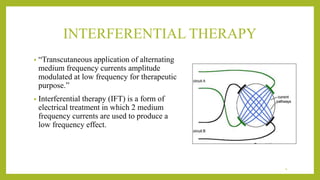
• “Transcutaneous application of alternating
medium frequency currents amplitude
modulated at low frequency for therapeutic
purpose.”
• Interferential therapy (IFT) is a form of
electrical treatment in which 2 medium
frequency currents are used to produce a
low frequency effect.
4
Need for Interference
[1]: Difficulty with low frequency:-
a. More intensity is needed which is not tolerated by patient
b. To overcome skin resistance
c. To stimulate deeper tissue
5
Need for Interference
[2]: Benefits of medium frequency currents:-
a. Easy to overcome skin resistance
b. Capacitive resistance is also reduced due to high frequency
6
Need for Interference
[3]: Wedensky inhibition:
• Every cycle of medium frequency current will not result in
depolarization of nerve as in low frequency current
• Continuous application of medium frequency current will lead to
inhibition of depolarization of nerve.
7
Need for Interference
[4]: Glidemeister’s effect:-
• With medium frequency current ,the depolarization frequency of
nerve neither coincides with the frequency of current nor with the
depolarizing frequency of the other nerve fibers in the nerve
bundle .
8
Physical principle of IFT
[1]: Superposition theory:-
• “When two or more waves travel through the same medium each wave acts on the every
particle of the medium as if the other wave is not existing, the resultant displacement is
obtained by adding vectorially the displacement due to the individual waves”
• The medium will have a displacement, that is the sum of displacement of individual waves
• Ǿ1=displacement of wave 1
• Ǿ2=displacement of wave 2,
• Total displacement will be Ǿ =Ǿ1 +Ǿ2
9
Physical principle of IFT
[2]: Interference of waves:-
• Combining two or more waves by superposition is known as interference.
• If you have two waves & you superimpose them, they can either build on each other
or may cancel out each other.
10
Physical principle of IFT
[3]: Constructive interference:-
• Reinforcement of amplitude by
summation of 2 sine waves that are
exactly in phase is called “Constructive
interference”.
• Resultant amplitude: Sum of 2 waves.
• Maximum interference occurs whenever
2 sine waves are exactly in phase or when
one of two waves is one or more
wavelengths out of phase.
11
Physical principle of IFT
[4]: Destructive interference:-
• The upward alteration of one wave cancels
the downward alteration of the other wave
resulting in the destructive Interference.
• Resultant amplitude: zero.
12
Interferential Current
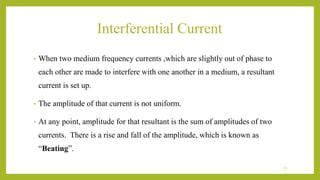
• When two medium frequency currents ,which are slightly out of phase to
each other are made to interfere with one another in a medium, a resultant
current is set up.
• The amplitude of that current is not uniform.
• At any point, amplitude for that resultant is the sum of amplitudes of two
currents. There is a rise and fall of the amplitude, which is known as
“Beating”.
13
Production of Interferential current
• Two oscillators are used to produce medium frequency currents.
• They are made to interfere within tissues and resultant wave with beat frequency is set up
endogenously.
• One oscillator will produce static frequency known as “Carrier Frequency”.
• The other oscillator will produce a frequency which have a constant difference in relation to the
first oscillator which is known as “Base Frequency”.
• EXAMPLE :
 Carrier frequency in one oscillator :- 4000 Hz
 Frequency in other oscillator :- 4100 Hz
 Beat frequency:- 100 Hz
14
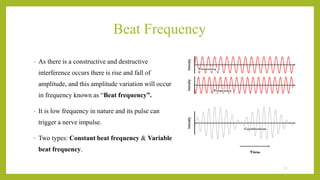
Beat Frequency
• As there is a constructive and destructive
interference occurs there is rise and fall of
amplitude, and this amplitude variation will occur
in frequency known as “Beat frequency”.
• It is low frequency in nature and its pulse can
trigger a nerve impulse.
• Two types: Constant beat frequency & Variable
beat frequency.
15
Constant beat frequency
• In this carrier frequency and base frequency are fixed.
• So beat frequency= base frequency - carrier frequency.
• Different selective beat frequency can be selected in between 0 to 100 Hz.
• IFT devices allow selection of any constant beat frequency.
16
Variable beat frequency
• In this the second oscillator will produce a medium frequency current which
varies rhythmically between base frequency and above the base frequency
• This results in a rhythmical variation from the base frequency to the highest
frequency, known as Sweep frequency or frequency modulation.
• Advantages of frequency modulation or sweep:
1. Reduces habituation of treated tissues
2. Types of nerves of various size of diameter can be treated
17
Variable beat frequency
[1]: Rectangular form:-
• Oscillations are maintained at the preset base frequency for 1s and
immediately it switches over to the sweep frequency and it is retained there
for another one second.
• Again it will come back to the base frequency and the cycle is repeated.
• For vigorous treatment purpose
• Aggressive form of treatment
• Chronic conditions
18
Variable beat frequency
[2]: Trapezoidal form:-
• Maintains base frequency for 5 sec and take one second to climb to the
sweep frequency
• It retains the sweep frequency for 5 sec and again swing back to the base
frequency in 1 sec
• milder form
• Sub acute conditions.
19
Variable beat frequency
[3]: Triangular form:-
• It moves upwards from base frequency to sweep frequency for 6 sec.
• After reaching the highest frequency it swings back immediately..
• Mildest form
• Acute conditions
20
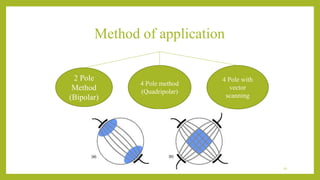
2 Pole
Method
(Bipolar)
4 Pole with
vector
scanning
4 Pole method
(Quadripolar)
Method of application
21
2 Pole method
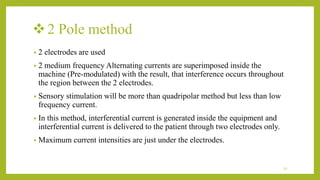
• 2 electrodes are used
• 2 medium frequency Alternating currents are superimposed inside the
machine (Pre-modulated) with the result, that interference occurs throughout
the region between the 2 electrodes.
• Sensory stimulation will be more than quadripolar method but less than low
frequency current.
• In this method, interferential current is generated inside the equipment and
interferential current is delivered to the patient through two electrodes only.
• Maximum current intensities are just under the electrodes.
22
4 Pole method
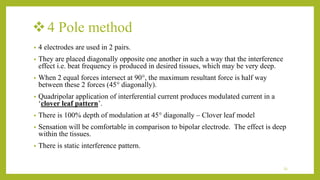
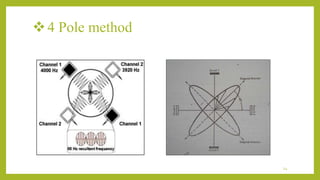
• 4 electrodes are used in 2 pairs.
• They are placed diagonally opposite one another in such a way that the interference
effect i.e. beat frequency is produced in desired tissues, which may be very deep.
• When 2 equal forces intersect at 90°, the maximum resultant force is half way
between these 2 forces (45° diagonally).
• Quadripolar application of interferential current produces modulated current in a
‘clover leaf pattern’.
• There is 100% depth of modulation at 45° diagonally – Clover leaf model
• Sensation will be comfortable in comparison to bipolar electrode. The effect is deep
within the tissues.
• There is static interference pattern.
23
4 Pole method
24
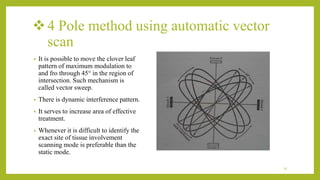
4 Pole method using automatic vector
scan
• It is possible to move the clover leaf
pattern of maximum modulation to
and fro through 45° in the region of
intersection. Such mechanism is
called vector sweep.
• There is dynamic interference pattern.
• It serves to increase area of effective
treatment.
• Whenever it is difficult to identify the
exact site of tissue involvement
scanning mode is preferable than the
static mode.
25
Electrodes
26
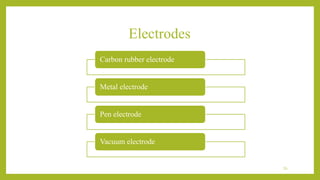
Carbon rubber electrode
Metal electrode
Pen electrode
Vacuum electrode
Electrodes
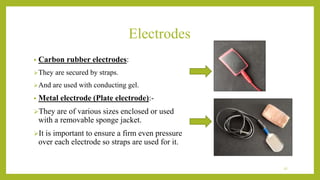
• Carbon rubber electrodes:
They are secured by straps.
And are used with conducting gel.
• Metal electrode (Plate electrode):-
They are of various sizes enclosed or used
with a removable sponge jacket.
It is important to ensure a firm even pressure
over each electrode so straps are used for it.
27
Electrodes
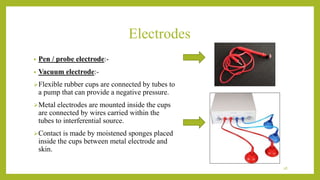
• Pen / probe electrode:-
• Vacuum electrode:-
Flexible rubber cups are connected by tubes to
a pump that can provide a negative pressure.
Metal electrodes are mounted inside the cups
are connected by wires carried within the
tubes to interferential source.
Contact is made by moistened sponges placed
inside the cups between metal electrode and
skin.
28
Electrodes
• Two types of vacuum can be used: Continuous & Intermittent.
• Effect of vacuum:
1. Negative pressure is set very rhythmically during treatment , which
diminishes the skin damage.
2. Good electrode contact without discomfort.
3. Mild massaging effect on skin—stimulate sensory nerve stimulation
causing slight vasodilatation.
4. Negative pressure draw the fluid near to the electrode which enhance the
current conductivity.
29
Electrodes
• Contraindication of vacuum electrode
◦ Poor skin
E.g. edema, elderly
30
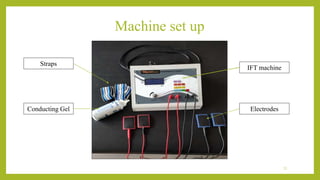
Machine set up
31
Straps
Conducting Gel
IFT machine
Electrodes
Current intensity
• A current intensity that produces a strong but comfortable
sensation is recommended.
• The intensity should be slowly turned up until the patient signals
that the required sensation has been reached.
32
Treatment duration
• 10-15 minutes duration is recommended.
• And it should not increased more than 20 minutes on one area.
33
Physiological effects
[1] Relief of pain :- it is relieved through following mechanisms.
• Pain gate theory - a short duration pulses of 100 Hz may
stimulate Aβ fibers that inhibit transmission of small diameter C
and Aδ fibers, which closes the gate. A frequency of 80 – 100 Hz
rhythmic is chosen for this effect.
34
• Descending pain suppression – with frequency of 15 Hz, the
stimulation of C and Aδ fibers increase activity of descending
fibers from raphe nuclei, that release inhibitory
neurotransmitters.
• Increased circulation – due to mild muscle contraction, action
on autonomic nervous system or decreasing tone of blood
vessels causes wash of chemicals that is responsible for pain.
• Placebo
35
Physiological effects
[2] Motor Stimulation :- frequencies between 1-100 Hz rhythmic
are used.
• Muscle contraction is produced because of stimulation of deeply
placed muscles. e.g. Pelvic floor.
[3] Absorption of exudates :- Frequency of 1-10 Hz rhythmic is
used.
• It produces pumping action by muscle contraction which help in
absorption of exudates and reduction of oedema.
36
Physiological effects
Principles of clinical application
Collect the necessary equipment e.g. interferential machine, appropriate
electrodes, appropriate wires, water for cleaning the skin, contact gel or lint
pads, Velcro strap/tape.
Position the patient in comfortable position
Test the equipment and demonstrate the technique to the patient.
Evaluate the patient to determine that sensation are intact.
37
Principles of clinical application
Wash the skin that will reduce the impedance to the current
Place the electrodes, so that, the currents cross one another in target tissues. Secure
the pad electrodes by Velcro strap / tape
Electrode should not place over cuts, abrasion, etc. because current may concentrate
in those areas and cause discomfort & Electrode should be of equal size.
Choice appropriate type, size, and position of the electrode.
38
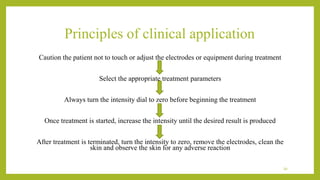
Caution the patient not to touch or adjust the electrodes or equipment during treatment
Select the appropriate treatment parameters
Always turn the intensity dial to zero before beginning the treatment
Once treatment is started, increase the intensity until the desired result is produced
After treatment is terminated, turn the intensity to zero, remove the electrodes, clean the
skin and observe the skin for any adverse reaction
39
Principles of clinical application
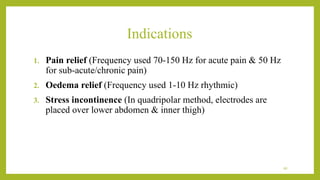
Indications
1. Pain relief (Frequency used 70-150 Hz for acute pain & 50 Hz
for sub-acute/chronic pain)
2. Oedema relief (Frequency used 1-10 Hz rhythmic)
3. Stress incontinence (In quadripolar method, electrodes are
placed over lower abdomen & inner thigh)
40
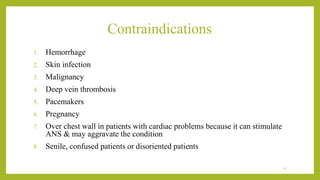
Contraindications
1. Hemorrhage
2. Skin infection
3. Malignancy
4. Deep vein thrombosis
5. Pacemakers
6. Pregnancy
7. Over chest wall in patients with cardiac problems because it can stimulate
ANS & may aggravate the condition
8. Senile, confused patients or disoriented patients
41
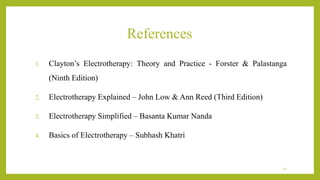
References
1. Clayton’s Electrotherapy: Theory and Practice - Forster & Palastanga
(Ninth Edition)
2. Electrotherapy Explained – John Low & Ann Reed (Third Edition)
3. Electrotherapy Simplified – Basanta Kumar Nanda
4. Basics of Electrotherapy – Subhash Khatri
42
Thank you
43

Interferential Therapy by Dr.Aniruddha Barot (PT)

  • 1.
    INTERFERENTIAL CURRENTS -Dr. Aniruddha Barot(PT) B.P.T., M.P.T.(Musculoskeletal), C.K.T.T. Civil Hospital, Ahmedabad 1
  • 2.
    Outline • History • Whatis Interferential therapy ? • Need for interference • Physical principles of IFT • What is interferential current ? • Production of interferential currents • Beat frequency • Method of application • Electrodes • Current intensity • Treatment duration • Physiological effects • Principles of clinical application • Indications • Contraindications • References 2
  • 3.
    History • IFT wasdeveloped in 1950s by Dr. Hans Nemec in Vienna and became increasingly popular in UK during 1970s. • Medium frequency currents ranges from 1000 to 10,000 Hz. 3
  • 4.
    INTERFERENTIAL THERAPY • “Transcutaneousapplication of alternating medium frequency currents amplitude modulated at low frequency for therapeutic purpose.” • Interferential therapy (IFT) is a form of electrical treatment in which 2 medium frequency currents are used to produce a low frequency effect. 4
  • 5.
    Need for Interference [1]:Difficulty with low frequency:- a. More intensity is needed which is not tolerated by patient b. To overcome skin resistance c. To stimulate deeper tissue 5
  • 6.
    Need for Interference [2]:Benefits of medium frequency currents:- a. Easy to overcome skin resistance b. Capacitive resistance is also reduced due to high frequency 6
  • 7.
    Need for Interference [3]:Wedensky inhibition: • Every cycle of medium frequency current will not result in depolarization of nerve as in low frequency current • Continuous application of medium frequency current will lead to inhibition of depolarization of nerve. 7
  • 8.
    Need for Interference [4]:Glidemeister’s effect:- • With medium frequency current ,the depolarization frequency of nerve neither coincides with the frequency of current nor with the depolarizing frequency of the other nerve fibers in the nerve bundle . 8
  • 9.
    Physical principle ofIFT [1]: Superposition theory:- • “When two or more waves travel through the same medium each wave acts on the every particle of the medium as if the other wave is not existing, the resultant displacement is obtained by adding vectorially the displacement due to the individual waves” • The medium will have a displacement, that is the sum of displacement of individual waves • Ǿ1=displacement of wave 1 • Ǿ2=displacement of wave 2, • Total displacement will be Ǿ =Ǿ1 +Ǿ2 9
  • 10.
    Physical principle ofIFT [2]: Interference of waves:- • Combining two or more waves by superposition is known as interference. • If you have two waves & you superimpose them, they can either build on each other or may cancel out each other. 10
  • 11.
    Physical principle ofIFT [3]: Constructive interference:- • Reinforcement of amplitude by summation of 2 sine waves that are exactly in phase is called “Constructive interference”. • Resultant amplitude: Sum of 2 waves. • Maximum interference occurs whenever 2 sine waves are exactly in phase or when one of two waves is one or more wavelengths out of phase. 11
  • 12.
    Physical principle ofIFT [4]: Destructive interference:- • The upward alteration of one wave cancels the downward alteration of the other wave resulting in the destructive Interference. • Resultant amplitude: zero. 12
  • 13.
    Interferential Current • Whentwo medium frequency currents ,which are slightly out of phase to each other are made to interfere with one another in a medium, a resultant current is set up. • The amplitude of that current is not uniform. • At any point, amplitude for that resultant is the sum of amplitudes of two currents. There is a rise and fall of the amplitude, which is known as “Beating”. 13
  • 14.
    Production of Interferentialcurrent • Two oscillators are used to produce medium frequency currents. • They are made to interfere within tissues and resultant wave with beat frequency is set up endogenously. • One oscillator will produce static frequency known as “Carrier Frequency”. • The other oscillator will produce a frequency which have a constant difference in relation to the first oscillator which is known as “Base Frequency”. • EXAMPLE :  Carrier frequency in one oscillator :- 4000 Hz  Frequency in other oscillator :- 4100 Hz  Beat frequency:- 100 Hz 14
  • 15.
    Beat Frequency • Asthere is a constructive and destructive interference occurs there is rise and fall of amplitude, and this amplitude variation will occur in frequency known as “Beat frequency”. • It is low frequency in nature and its pulse can trigger a nerve impulse. • Two types: Constant beat frequency & Variable beat frequency. 15
  • 16.
    Constant beat frequency •In this carrier frequency and base frequency are fixed. • So beat frequency= base frequency - carrier frequency. • Different selective beat frequency can be selected in between 0 to 100 Hz. • IFT devices allow selection of any constant beat frequency. 16
  • 17.
    Variable beat frequency •In this the second oscillator will produce a medium frequency current which varies rhythmically between base frequency and above the base frequency • This results in a rhythmical variation from the base frequency to the highest frequency, known as Sweep frequency or frequency modulation. • Advantages of frequency modulation or sweep: 1. Reduces habituation of treated tissues 2. Types of nerves of various size of diameter can be treated 17
  • 18.
    Variable beat frequency [1]:Rectangular form:- • Oscillations are maintained at the preset base frequency for 1s and immediately it switches over to the sweep frequency and it is retained there for another one second. • Again it will come back to the base frequency and the cycle is repeated. • For vigorous treatment purpose • Aggressive form of treatment • Chronic conditions 18
  • 19.
    Variable beat frequency [2]:Trapezoidal form:- • Maintains base frequency for 5 sec and take one second to climb to the sweep frequency • It retains the sweep frequency for 5 sec and again swing back to the base frequency in 1 sec • milder form • Sub acute conditions. 19
  • 20.
    Variable beat frequency [3]:Triangular form:- • It moves upwards from base frequency to sweep frequency for 6 sec. • After reaching the highest frequency it swings back immediately.. • Mildest form • Acute conditions 20
  • 21.
    2 Pole Method (Bipolar) 4 Polewith vector scanning 4 Pole method (Quadripolar) Method of application 21
  • 22.
    2 Pole method •2 electrodes are used • 2 medium frequency Alternating currents are superimposed inside the machine (Pre-modulated) with the result, that interference occurs throughout the region between the 2 electrodes. • Sensory stimulation will be more than quadripolar method but less than low frequency current. • In this method, interferential current is generated inside the equipment and interferential current is delivered to the patient through two electrodes only. • Maximum current intensities are just under the electrodes. 22
  • 23.
    4 Pole method •4 electrodes are used in 2 pairs. • They are placed diagonally opposite one another in such a way that the interference effect i.e. beat frequency is produced in desired tissues, which may be very deep. • When 2 equal forces intersect at 90°, the maximum resultant force is half way between these 2 forces (45° diagonally). • Quadripolar application of interferential current produces modulated current in a ‘clover leaf pattern’. • There is 100% depth of modulation at 45° diagonally – Clover leaf model • Sensation will be comfortable in comparison to bipolar electrode. The effect is deep within the tissues. • There is static interference pattern. 23
  • 24.
  • 25.
    4 Pole methodusing automatic vector scan • It is possible to move the clover leaf pattern of maximum modulation to and fro through 45° in the region of intersection. Such mechanism is called vector sweep. • There is dynamic interference pattern. • It serves to increase area of effective treatment. • Whenever it is difficult to identify the exact site of tissue involvement scanning mode is preferable than the static mode. 25
  • 26.
    Electrodes 26 Carbon rubber electrode Metalelectrode Pen electrode Vacuum electrode
  • 27.
    Electrodes • Carbon rubberelectrodes: They are secured by straps. And are used with conducting gel. • Metal electrode (Plate electrode):- They are of various sizes enclosed or used with a removable sponge jacket. It is important to ensure a firm even pressure over each electrode so straps are used for it. 27
  • 28.
    Electrodes • Pen /probe electrode:- • Vacuum electrode:- Flexible rubber cups are connected by tubes to a pump that can provide a negative pressure. Metal electrodes are mounted inside the cups are connected by wires carried within the tubes to interferential source. Contact is made by moistened sponges placed inside the cups between metal electrode and skin. 28
  • 29.
    Electrodes • Two typesof vacuum can be used: Continuous & Intermittent. • Effect of vacuum: 1. Negative pressure is set very rhythmically during treatment , which diminishes the skin damage. 2. Good electrode contact without discomfort. 3. Mild massaging effect on skin—stimulate sensory nerve stimulation causing slight vasodilatation. 4. Negative pressure draw the fluid near to the electrode which enhance the current conductivity. 29
  • 30.
    Electrodes • Contraindication ofvacuum electrode ◦ Poor skin E.g. edema, elderly 30
  • 31.
    Machine set up 31 Straps ConductingGel IFT machine Electrodes
  • 32.
    Current intensity • Acurrent intensity that produces a strong but comfortable sensation is recommended. • The intensity should be slowly turned up until the patient signals that the required sensation has been reached. 32
  • 33.
    Treatment duration • 10-15minutes duration is recommended. • And it should not increased more than 20 minutes on one area. 33
  • 34.
    Physiological effects [1] Reliefof pain :- it is relieved through following mechanisms. • Pain gate theory - a short duration pulses of 100 Hz may stimulate Aβ fibers that inhibit transmission of small diameter C and Aδ fibers, which closes the gate. A frequency of 80 – 100 Hz rhythmic is chosen for this effect. 34
  • 35.
    • Descending painsuppression – with frequency of 15 Hz, the stimulation of C and Aδ fibers increase activity of descending fibers from raphe nuclei, that release inhibitory neurotransmitters. • Increased circulation – due to mild muscle contraction, action on autonomic nervous system or decreasing tone of blood vessels causes wash of chemicals that is responsible for pain. • Placebo 35 Physiological effects
  • 36.
    [2] Motor Stimulation:- frequencies between 1-100 Hz rhythmic are used. • Muscle contraction is produced because of stimulation of deeply placed muscles. e.g. Pelvic floor. [3] Absorption of exudates :- Frequency of 1-10 Hz rhythmic is used. • It produces pumping action by muscle contraction which help in absorption of exudates and reduction of oedema. 36 Physiological effects
  • 37.
    Principles of clinicalapplication Collect the necessary equipment e.g. interferential machine, appropriate electrodes, appropriate wires, water for cleaning the skin, contact gel or lint pads, Velcro strap/tape. Position the patient in comfortable position Test the equipment and demonstrate the technique to the patient. Evaluate the patient to determine that sensation are intact. 37
  • 38.
    Principles of clinicalapplication Wash the skin that will reduce the impedance to the current Place the electrodes, so that, the currents cross one another in target tissues. Secure the pad electrodes by Velcro strap / tape Electrode should not place over cuts, abrasion, etc. because current may concentrate in those areas and cause discomfort & Electrode should be of equal size. Choice appropriate type, size, and position of the electrode. 38
  • 39.
    Caution the patientnot to touch or adjust the electrodes or equipment during treatment Select the appropriate treatment parameters Always turn the intensity dial to zero before beginning the treatment Once treatment is started, increase the intensity until the desired result is produced After treatment is terminated, turn the intensity to zero, remove the electrodes, clean the skin and observe the skin for any adverse reaction 39 Principles of clinical application
  • 40.
    Indications 1. Pain relief(Frequency used 70-150 Hz for acute pain & 50 Hz for sub-acute/chronic pain) 2. Oedema relief (Frequency used 1-10 Hz rhythmic) 3. Stress incontinence (In quadripolar method, electrodes are placed over lower abdomen & inner thigh) 40
  • 41.
    Contraindications 1. Hemorrhage 2. Skininfection 3. Malignancy 4. Deep vein thrombosis 5. Pacemakers 6. Pregnancy 7. Over chest wall in patients with cardiac problems because it can stimulate ANS & may aggravate the condition 8. Senile, confused patients or disoriented patients 41
  • 42.
    References 1. Clayton’s Electrotherapy:Theory and Practice - Forster & Palastanga (Ninth Edition) 2. Electrotherapy Explained – John Low & Ann Reed (Third Edition) 3. Electrotherapy Simplified – Basanta Kumar Nanda 4. Basics of Electrotherapy – Subhash Khatri 42
  • 43.