Brain and Behaviour
What are nerves?How do they work?Where do you find them in the body?Can our bodies function without nerves?
Structure of the Nervous system
Central Nervous SystemBrain + spinal cord.Oversees everything we do, feel and think
Peripheral Nervous SystemRelays messages to and from outer parts of the body (periphery) and the brain.Sensory nerves collect information from the senses.Motor  nerves control the muscles. (pg 289. 9.3)
Autonomic nervous system	the part of the nervous system outside conscious control  	affects the cardiovascular, digestive, reproductive and respiratory organs.		sympathetic			parasympathetic		(fight/flight)			 (restores calm) (Pg 289 activity 9.4)
NervesNerves  Collections of neurons that are joined together by connective tissue.Responsible for transferring impulses from receptors to CNS and back to effectors (muscles or glands).
The Neuronthe basic functional unit of the nervous system.is a cell that processes and transmits information by electrochemical signalingYou have around 100 billion neurons
Basic Neuron Structure
Dendrite extensions that receive information from other neuronsCell Body or Soma The control center of the neuron, contains nucleusAxon transmits infomation from dendrites to other neuronsMyelin Sheath  An insulating layer around an axon.
Types of Neurons1. Sensory Neurons 	Neurons located in receptororgans (skin, eyes, ears). Function: receive incoming stimuli from the environment.2. Motor Neurons Neurons located near effectors (muscles and glands) Function: Carry impulses to initiate a  response.3. Interneurons Neurons that relay messages between other neurons eg between sensory and motor neurons. (found most often in brain and spinal cord).
Motor end plates© David B. Fankhauser, Ph.D., Professor of Biology and Chemistry, University of Cincinnati Clermont College
Don’t draw
Communication within neurons is electricalAn electrical signal is sent down the length of the axon.  This electrical signal is called an “action potential”
Neurotransmisson
Communication between neurons is chemicalWhen the electrical impulse reaches the terminal buttons, they release chemicals called neurotransmitters(NTs) into the synapse.
Communication between neurons is chemicalThese NTs connect with receptor sites of nearby neurons.  The neurotransmitters “fit in” to these receptor sites like a key into a lock.
Neurotransmitters……are chemicals that are released into the synapse by neurons.These NTs are “taken back up” into the terminal buttons of neurons through the process of reuptake
How anxiety effects the body
Excitoryvs Inhibitory neurotransmittersDepending on the neurotransmitter released into the synapse it either excites or inhibits the next neuron from firing.Some neurotransmitters do both!
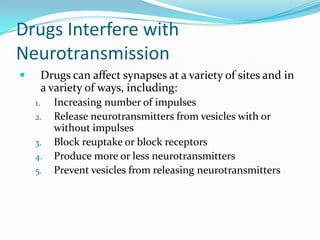
Drugs Interfere with NeurotransmissionDrugs can affect synapses at a variety of sites and in a variety of ways, including:Increasing number of impulsesRelease neurotransmitters from vesicles with or without impulsesBlock reuptake or block receptorsProduce more or less neurotransmittersPrevent vesicles from releasing neurotransmitters
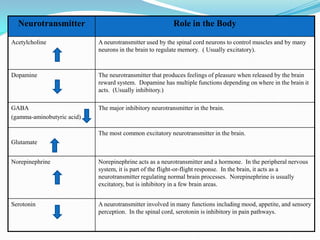
Drugs That Influence Neurotransmitters
Electroencephalograph (EEG)machine designed to record the brain wave patterns produced by electrical activity of the surface of the brain.
Computed tomography (CT)brain-imaging method using computer controlled X-rays of the brain.
Magnetic resonance imaging (MRI)brain-imaging method using radio waves and magnetic fields of the body to produce detailed images of the brain.Functional Magnetic resonance imaging (fMRI)Functional MRI (fMRI) – computer makes a sort of “movie” of changes in the activity of the brain using images from different time periods.Menu
Positron emission tomography (PET)brain-imaging method in which a radioactive sugar is injected into the subject and a computer compiles a color-coded image of the activity of the brain with lighter colors indicating more activity.
Brain PlasticityNeuroplasticity or brain plasticity refers to the brain’s ability to CHANGE through­out life. The brain has the amazing ability to reorganise itself by forming new connections between neurons.
Brain Plasticity
Brain and behaviour 2010

Brain and behaviour 2010

  • 1.
  • 2.
    What are nerves?Howdo they work?Where do you find them in the body?Can our bodies function without nerves?
  • 3.
    Structure of theNervous system
  • 5.
    Central Nervous SystemBrain+ spinal cord.Oversees everything we do, feel and think
  • 6.
    Peripheral Nervous SystemRelaysmessages to and from outer parts of the body (periphery) and the brain.Sensory nerves collect information from the senses.Motor nerves control the muscles. (pg 289. 9.3)
  • 7.
    Autonomic nervous system thepart of the nervous system outside conscious control affects the cardiovascular, digestive, reproductive and respiratory organs. sympathetic parasympathetic (fight/flight) (restores calm) (Pg 289 activity 9.4)
  • 8.
    NervesNerves  Collectionsof neurons that are joined together by connective tissue.Responsible for transferring impulses from receptors to CNS and back to effectors (muscles or glands).
  • 9.
    The Neuronthe basicfunctional unit of the nervous system.is a cell that processes and transmits information by electrochemical signalingYou have around 100 billion neurons
  • 10.
  • 11.
    Dendrite extensions thatreceive information from other neuronsCell Body or Soma The control center of the neuron, contains nucleusAxon transmits infomation from dendrites to other neuronsMyelin Sheath  An insulating layer around an axon.
  • 12.
    Types of Neurons1.Sensory Neurons Neurons located in receptororgans (skin, eyes, ears). Function: receive incoming stimuli from the environment.2. Motor Neurons Neurons located near effectors (muscles and glands) Function: Carry impulses to initiate a response.3. Interneurons Neurons that relay messages between other neurons eg between sensory and motor neurons. (found most often in brain and spinal cord).
  • 13.
    Motor end plates©David B. Fankhauser, Ph.D., Professor of Biology and Chemistry, University of Cincinnati Clermont College
  • 14.
  • 16.
    Communication within neuronsis electricalAn electrical signal is sent down the length of the axon. This electrical signal is called an “action potential”
  • 17.
  • 18.
    Communication between neuronsis chemicalWhen the electrical impulse reaches the terminal buttons, they release chemicals called neurotransmitters(NTs) into the synapse.
  • 19.
    Communication between neuronsis chemicalThese NTs connect with receptor sites of nearby neurons. The neurotransmitters “fit in” to these receptor sites like a key into a lock.
  • 20.
    Neurotransmitters……are chemicals thatare released into the synapse by neurons.These NTs are “taken back up” into the terminal buttons of neurons through the process of reuptake
  • 22.
  • 23.
    Excitoryvs Inhibitory neurotransmittersDependingon the neurotransmitter released into the synapse it either excites or inhibits the next neuron from firing.Some neurotransmitters do both!
  • 25.
    Drugs Interfere withNeurotransmissionDrugs can affect synapses at a variety of sites and in a variety of ways, including:Increasing number of impulsesRelease neurotransmitters from vesicles with or without impulsesBlock reuptake or block receptorsProduce more or less neurotransmittersPrevent vesicles from releasing neurotransmitters
  • 26.
    Drugs That InfluenceNeurotransmitters
  • 27.
    Electroencephalograph (EEG)machine designedto record the brain wave patterns produced by electrical activity of the surface of the brain.
  • 28.
    Computed tomography (CT)brain-imagingmethod using computer controlled X-rays of the brain.
  • 29.
    Magnetic resonance imaging(MRI)brain-imaging method using radio waves and magnetic fields of the body to produce detailed images of the brain.Functional Magnetic resonance imaging (fMRI)Functional MRI (fMRI) – computer makes a sort of “movie” of changes in the activity of the brain using images from different time periods.Menu
  • 30.
    Positron emission tomography(PET)brain-imaging method in which a radioactive sugar is injected into the subject and a computer compiles a color-coded image of the activity of the brain with lighter colors indicating more activity.
  • 31.
    Brain PlasticityNeuroplasticity orbrain plasticity refers to the brain’s ability to CHANGE through­out life. The brain has the amazing ability to reorganise itself by forming new connections between neurons.
  • 32.