The Model of Human Occupation (MOHO) is an occupation-focused framework developed in the 1980s to explain how engaging in occupations occurs and problems can arise from illness or disability. MOHO views humans as dynamic systems influenced by volition (motivation), habituation (routines), performance capacity, and environment. Through participating in meaningful occupations, people can reshape their occupational abilities and identities to become more adaptive. MOHO provides resources for occupational therapists to engage clients in therapeutic occupations to restore, reorganize, or maintain their occupational performance.
The Model ofHuman Occupation (MOHO) was first developed
in the 1980s by Gary Kielhofner. Since then, other occupational
therapists have also been involved in its further development,
revision and refinement of the concepts. MOHO is an
occupation-focused framework that aims to explain aspects of
engaging in occupations and how illness and disability related
problems arise.
MOHO is said to be client-centered, evidence based and holistic
in nature. The client's thinking, feeling and doing are central to
therapy and the model takes into account both mind and body
and it has been designed to complement other occupational
therapy theories. MOHO puts more emphasis on occupational
performance than on performance components. In MOHO the
environment can demand and offer opportunities for
occupational performance.
4.
FOCUS OF MODEL
-Occupationin practice
-The motivation for occupation
-The patterning of occupational behavior/ performance into
routines and lifestyles
-The nature of skilled performance
-The influence of the environment on occupational performance
This model views the human being as a system and describes
this human system using systems theories. According to the
dynamic systems theory interaction between the human as a
system, the task and the environment result in occupational
behavior. Occupational performance results in health, well-
being, development and change, therefore making it dynamic.
The human system is constantly changing, unfolding and
reorganizing itself through engagement.
5.
FOCUS OF MODEL
Occupationis a process through which we organize our mind
and body and through our minds and body we organize our
occupation: we become what we do- occupational identity.
FUNDAMENTAL CONCEPTS OF THE MODEL
-Human occupation is complex
-A person is made up of components
-The environment influences performance
-Occupational performance
6.
Basic assumptions tounderstanding the complexity of human
occupation
The human is a dynamic system. Elements of the system work
together to produce behavior. Behavior is dynamic and context
dependent. Behavior changes continuously to meet the demands
and opportunities afforded by the context.
Occupations are the essence of self organization, therefore
through everyday doing, people shape who they are.
Occupation is a result of motivation, patterns, performance
capacity factors and environmental influences. Doing during the
therapy process enables people to reshape their occupational
abilities and identities, therefore becoming more adaptive.
7.
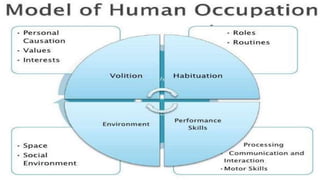
The components ofthe person
Occupational participation is chosen, patterned and performed
through three interrelated components of the person, namely:
Volition - values, interests and personal causation
Habituation- habits and roles
Performance capacity- the mental and physical attributes and
lived experiences
8.
Volition
Volition constitutes selfknowledge or common sense that is
gained through experience and dispositions.
Dispositions refer to the cognitive/ emotional orientation towards
occupations, such as enjoyment, value, feelings of competence
and others.
It enables humans to anticipate, choose, experience and interpret
occupational behavior and it results in thoughts, feelings and
decisions about engaging in occupations.
Volition could simply be articulated as the motivation process of
choosing what to do. Personal narratives could be used to elicit
information on volition. Volition encompasses values, interests
and personal causation.
9.
Volition
Values are aboutthe beliefs, commitments and significance that
people attach to occupations and they are likely to engage in
those that they deem as important. Values create a strong
disposition to perform according to standards set by context.
There are consequences attached to not acting according to
values.
Interests relates to perceptions, feelings and emotions associated
with pleasure and satisfaction. Therefore, the person would
choose to engage in an occupation that he/she finds satisfying
and enjoyable. Interests are generated from positive experiences
or can be based on the anticipation of enjoyment attached to
engagement. Personal causation refers to the perceived present
and potential effectiveness to act on the world with regards to
mental and physical capabilities.
10.
Volition
This knowledge aboutown capabilities is dynamic and
continuously unfolds to the individual. This process is internally
controlled and informed.
Volition is continuously changing as new experiences can
reinforce, challenge and elaborate on existing dispositions and
self knowledge.
In summary our motivation to choose to engage in occupations is
influenced by our values, beliefs about ability and meaning
attached to activity and capabilities.
11.
Habituation
Actions are organizedinto patterns of behavior that become
routines. Integration into our temporal, social, physical and
cultural environments is through these patterns of behavior.
Habituation comprises of habits and roles, which are often
resistant to change.
Habits are automatic learned ways in which we respond and
perform in familiar situations. For habits to develop actions have
to be repeated to be able to establish a pattern and there has to
be consistency in the environment.
Habits operate at a subconscious level and they influence a wide
range of behavior patterns.
12.
Roles
MOHO states thatwe behave and act in learned ways that are
associated with a social identity or status. Our actions are
embedded in our social roles or are performed in full or partial
fulfilment of a social role. Roles influence our interactions with
others, the style, manner and content as well as the role related
tasks that form daily routine.
Habits regulate routine actions and behavior within a role. The
interwoven nature of habits and roles is evident in daily life and
in turn, routine behavior is organized. The onset of disability or
illness can disturb established habits and therefore would require
relearning or developing new habits. This would require
sustained practice in order to change habituation.
13.
Performance Capacity
This isthe ability to perform an act, based on the status of one's
mental and physical capabilities, as well as lived experiences.
Capabilities include the musculoskeletal, cardiopulmonary,
neurological and other physiological systems that enable action.
The capabilities are objectively assessed and the experiences are
subjective and they shape performance. An area of interest in
MOHO is on the lived experiences of people with disabilities
and how they perform.
14.
Environment
The environment ismade up the physical, social, cultural,
economic and political aspects that impact on how occupations
are motivated, organized and performed. It provides the
opportunities and resources for engagement and also presses for
certain behavior or presents constraints to engagement.
Within the environment there are objects, spaces, occupational
tasks or form, culture and political and economic influences
that affect occupational performance. Different environments
will have different effects on each person, because humans are
unique beings.
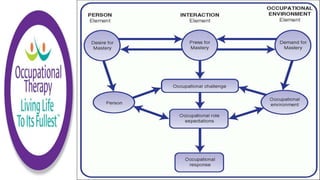
According to MOHO, the contribution of the three components
and environment to occupation is heterarchical in nature. This
means that aspects of the components and the environment all
contribute to a dynamic whole.
16.
Occupational Performance
This constitutesthe actual doing which can be demonstrated at
different levels, namely: skill, occupational performance,
identity, participation, competence and adaptation. It results from
a heterarchical contribution from the components of the
person, namely; volition, habituation and performance capacity
and the environment.
Occupational performance is dynamic in nature, because it is
influenced and shaped by external environment that is
continuously changing. It is also spontaneous and must be
understood within the context of emerging action and
conditions.
18.
FUNCTION - DYSFUNCTIONCONTINUUM
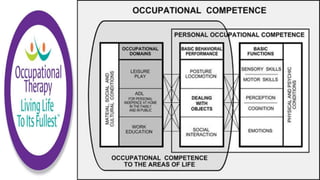
Through behavior we create identity, concepts and motor
abilities, therefore when we engage in new behavior we reshape
ourselves, hence our occupational identities.
Consistent practice enables one to progress to the level of
mastery, therefore occupational competence.
Continuously reshaping and refining both occupational identity
and occupational competence results in becoming more
occupationally adaptive.
Through participation in therapeutic occupations we become
adaptive and healthier.
19.
IMPLICATIONS FOR PRACTICE
MOHOhas a range of resources that can be used in practice.
When using the framework, occupational therapists engage
people in occupations that restore, reorganize or maintain their
motivation, patterning and performance capacity, therefore
their occupational lives.
MOHO RESOURCES
-Assessment tools
-Intervention protocols
-Programmes
-Case examples