
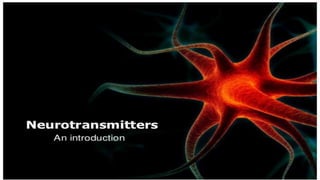


Neurotransmitt
er
University of Georgia
School of public health
Dentistry faculty
By: abdullah saad
Neurotransmitters
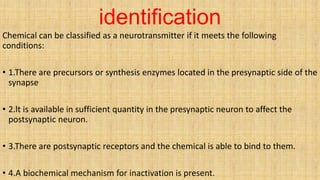
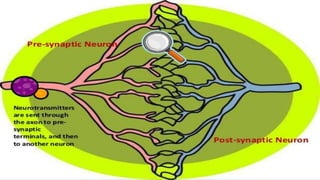
•Neurotransmitters are the chemicals which allow the
transmission of signals from one neuron to the next across
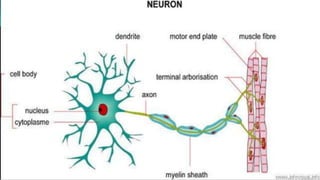
synapses. They are also found at the axon endings of motor
neurons, where they stimulate the muscle fibers. And they
and their close relatives are produced by some glands such as
the pituitary and the adrenal glands.
•Target cell my be a neuron or some other kind of cell like
muscle or gland cell
•Neurotransmitters shows a rang of different effects on human
behavior
Properties of neurotransmitters:
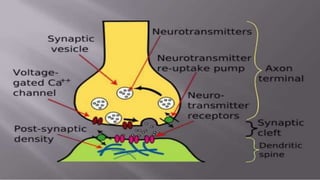
• 1) synthesized in the presynaptic neuron .
• 2) Localized to vesicles in the presynaptic neuron.
• 3) Released from the presynaptic neuron under physiological
conditions .
• 4) Rabidly removed from the synaptic cleft by uptake or
degradation.
• 5) Presence of receptor on the post-synaptic neuron.
• 6) Binding to the receptor elicits a biological response .
How do we
identify if the
compuned is
Neurotransmitter
?
identification
Chemical can be classified as a neurotransmitter if it meets the following
conditions:
• 1.There are precursors or synthesis enzymes located in the presynaptic side of the
synapse
• 2.lt is available in sufficient quantity in the presynaptic neuron to affect the
postsynaptic neuron.
• 3.There are postsynaptic receptors and the chemical is able to bind to them.
• 4.A biochemical mechanism for inactivation is present.
Types of
Neurotransmitters
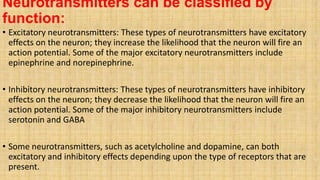
Neurotransmitters can be classified by
function:
• Excitatory neurotransmitters: These types of neurotransmitters have excitatory
effects on the neuron; they increase the likelihood that the neuron will fire an
action potential. Some of the major excitatory neurotransmitters include
epinephrine and norepinephrine.
• Inhibitory neurotransmitters: These types of neurotransmitters have inhibitory
effects on the neuron; they decrease the likelihood that the neuron will fire an
action potential. Some of the major inhibitory neurotransmitters include
serotonin and GABA
• Some neurotransmitters, such as acetylcholine and dopamine, can both
excitatory and inhibitory effects depending upon the type of receptors that are
present.
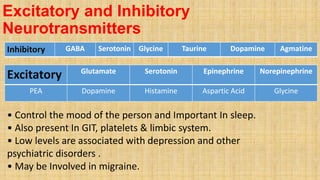
Excitatory and Inhibitory
Neurotransmitters
Inhibitory GABA Serotonin Glycine Taurine Dopamine Agmatine
Excitatory Glutamate Serotonin Epinephrine Norepinephrine
PEA Dopamine Histamine Aspartic Acid Glycine
• Control the mood of the person and Important In sleep.
• Also present In GIT, platelets & limbic system.
• Low levels are associated with depression and other
psychiatric disorders .
• May be Involved in migraine.
Acetylcholine:
• Acetylcholine was the first neurotransmitter to be discovered. It was
isolated in 1921 by a German biologist named Otto Loewi,
Acetylcholine has many functions: It is responsible for much of the
stimulation of muscles, including the muscles of the gastro-intestinal
system. It is also found in sensory neurons and in the autonomic
nervous system, and has a part in (dream) sleep.
• also, there is a link between acetylcholine and Alzheimer's disease:
There is something on the order of a 90% loss of acetylcholine in the
brains of people suffering from Alzheimer's, which is a major cause of
senility.
Norepinephrine:
• In 1946, a Swedish biologist by the name of Ulf von Euler discovered
norepinephrine (formerly called noradrenalin). . Norepinephrine is
strongly associated with bringing our nervous systems into "high
alert." It is prevalent in the sympathetic nervous system, and it
increases our heart rate and our blood pressure. Our adrenal glands
release it into the blood stream, along with its close relative
epinephrine (aka adrenalin). It is also important for forming
memories.
• Stress tends to deplete our store of adrenalin, while exercise tends to
increase it. Amphetamines ("speed") work by causing the release of
norepinephrine, as well as other neurotransmitters called dopamine
and seratonin.
Dopamine:
• relative of norepinephrine and epinephrine is dopamine, discovered to be a neurotransmitter
in the 1950s by another Swede, Arvid Carlsson. It is an inhibitory neurotransmitter,. Dopamine
is strongly associated with reward mechanisms in the brain. Drugs like
cocaine, opium, heroin, and alcohol increase the levels of dopamine, as does nicotine. If it
feels good, dopamine neurons are probably involved!
• The severe mental illness schizophrenia has been shown to involve excessive amounts of
dopamine in the frontal lobes, and drugs that block dopamine are used to help schizophrenics.
On the other hand, too little dopamine in the motor areas of the brain are responsible for
Parkinson's disease, which involves uncontrollable muscle tremors.
• In 1950, Eugene Roberts and J. Awapara discovered GABA (gamma aminobutyric acid), which is
also usually an inhibitory neurotransmitter. GABA acts like a brake to the excitatory
neurotransmitters that lead to anxiety. People with too little GABA tend to suffer from anxiety
disorders, and drugs like Valium work by enhancing the effects of GABA. Lots of other drugs
influence GABA receptors, including alcohol. If GABA is lacking in certain parts of the
brain, epilepsy results.
Glutamate:
• Glutamate is an excitatory relative of GABA. It is the most common
neurotransmitter in the central nervous system - as much as half of all
neurons in the brain - and is especially important in regards to memory.
Curiously, glutamate is actually toxic to neurons, and an excess will kill them.
Sometimes brain damage or a stroke will lead to an excess and end with
many more brain cells dying than from the original trauma. ALS, more
commonly known as Lou Gehrig's disease, results from excessive glutamate
production.
• Glutamate was discovered by Kikunae Ikeda .
Serotonin:
• Serotonin is an inhibitory neurotransmitter that has been found to be
intimately involved in emotion and mood. Too little serotonin has
been shown to lead to depression, problems with anger
control, obsessive-compulsive disorder, and suicide. Too little also
leads to an increased appetite for carbohydrates (starchy foods) and
trouble sleeping, which are also associated with depression and other
emotional disorders.
Degradation and elimination
• A neurotransmitter must be broken down once it reaches the post-
synaptic cell to prevent further excitatory or inhibitory signal
transduction. For example, acetylcholine (ACh), an excitatory
neurotransmitter, is broken down by acetylcholinesterase (AChE).
Choline is taken up and recycled by the pre-synaptic neuron to
synthesize more ACh. Other neurotransmitters such as dopamine are
able to diffuse away from their targeted synaptic junctions and are
eliminated from the body via the kidneys, or destroyed in the liver.
Each neurotransmitter has very specific degradation pathways at
regulatory points, which may be the target of the body's own
regulatory system against recreational drugs.
Thank you
for listening to
my presentation
And now let us go home
THE END

Neurotransmitters

  • 1.
    Neurotransmitt er University of Georgia Schoolof public health Dentistry faculty By: abdullah saad
  • 3.
    Neurotransmitters •Neurotransmitters are thechemicals which allow the transmission of signals from one neuron to the next across synapses. They are also found at the axon endings of motor neurons, where they stimulate the muscle fibers. And they and their close relatives are produced by some glands such as the pituitary and the adrenal glands. •Target cell my be a neuron or some other kind of cell like muscle or gland cell •Neurotransmitters shows a rang of different effects on human behavior
  • 4.
    Properties of neurotransmitters: •1) synthesized in the presynaptic neuron . • 2) Localized to vesicles in the presynaptic neuron. • 3) Released from the presynaptic neuron under physiological conditions . • 4) Rabidly removed from the synaptic cleft by uptake or degradation. • 5) Presence of receptor on the post-synaptic neuron. • 6) Binding to the receptor elicits a biological response .
  • 5.
    How do we identifyif the compuned is Neurotransmitter ?
  • 6.
    identification Chemical can beclassified as a neurotransmitter if it meets the following conditions: • 1.There are precursors or synthesis enzymes located in the presynaptic side of the synapse • 2.lt is available in sufficient quantity in the presynaptic neuron to affect the postsynaptic neuron. • 3.There are postsynaptic receptors and the chemical is able to bind to them. • 4.A biochemical mechanism for inactivation is present.
  • 10.
  • 11.
    Neurotransmitters can beclassified by function: • Excitatory neurotransmitters: These types of neurotransmitters have excitatory effects on the neuron; they increase the likelihood that the neuron will fire an action potential. Some of the major excitatory neurotransmitters include epinephrine and norepinephrine. • Inhibitory neurotransmitters: These types of neurotransmitters have inhibitory effects on the neuron; they decrease the likelihood that the neuron will fire an action potential. Some of the major inhibitory neurotransmitters include serotonin and GABA • Some neurotransmitters, such as acetylcholine and dopamine, can both excitatory and inhibitory effects depending upon the type of receptors that are present.
  • 12.
    Excitatory and Inhibitory Neurotransmitters InhibitoryGABA Serotonin Glycine Taurine Dopamine Agmatine Excitatory Glutamate Serotonin Epinephrine Norepinephrine PEA Dopamine Histamine Aspartic Acid Glycine • Control the mood of the person and Important In sleep. • Also present In GIT, platelets & limbic system. • Low levels are associated with depression and other psychiatric disorders . • May be Involved in migraine.
  • 13.
    Acetylcholine: • Acetylcholine wasthe first neurotransmitter to be discovered. It was isolated in 1921 by a German biologist named Otto Loewi, Acetylcholine has many functions: It is responsible for much of the stimulation of muscles, including the muscles of the gastro-intestinal system. It is also found in sensory neurons and in the autonomic nervous system, and has a part in (dream) sleep. • also, there is a link between acetylcholine and Alzheimer's disease: There is something on the order of a 90% loss of acetylcholine in the brains of people suffering from Alzheimer's, which is a major cause of senility.
  • 14.
    Norepinephrine: • In 1946,a Swedish biologist by the name of Ulf von Euler discovered norepinephrine (formerly called noradrenalin). . Norepinephrine is strongly associated with bringing our nervous systems into "high alert." It is prevalent in the sympathetic nervous system, and it increases our heart rate and our blood pressure. Our adrenal glands release it into the blood stream, along with its close relative epinephrine (aka adrenalin). It is also important for forming memories. • Stress tends to deplete our store of adrenalin, while exercise tends to increase it. Amphetamines ("speed") work by causing the release of norepinephrine, as well as other neurotransmitters called dopamine and seratonin.
  • 15.
    Dopamine: • relative ofnorepinephrine and epinephrine is dopamine, discovered to be a neurotransmitter in the 1950s by another Swede, Arvid Carlsson. It is an inhibitory neurotransmitter,. Dopamine is strongly associated with reward mechanisms in the brain. Drugs like cocaine, opium, heroin, and alcohol increase the levels of dopamine, as does nicotine. If it feels good, dopamine neurons are probably involved! • The severe mental illness schizophrenia has been shown to involve excessive amounts of dopamine in the frontal lobes, and drugs that block dopamine are used to help schizophrenics. On the other hand, too little dopamine in the motor areas of the brain are responsible for Parkinson's disease, which involves uncontrollable muscle tremors. • In 1950, Eugene Roberts and J. Awapara discovered GABA (gamma aminobutyric acid), which is also usually an inhibitory neurotransmitter. GABA acts like a brake to the excitatory neurotransmitters that lead to anxiety. People with too little GABA tend to suffer from anxiety disorders, and drugs like Valium work by enhancing the effects of GABA. Lots of other drugs influence GABA receptors, including alcohol. If GABA is lacking in certain parts of the brain, epilepsy results.
  • 16.
    Glutamate: • Glutamate isan excitatory relative of GABA. It is the most common neurotransmitter in the central nervous system - as much as half of all neurons in the brain - and is especially important in regards to memory. Curiously, glutamate is actually toxic to neurons, and an excess will kill them. Sometimes brain damage or a stroke will lead to an excess and end with many more brain cells dying than from the original trauma. ALS, more commonly known as Lou Gehrig's disease, results from excessive glutamate production. • Glutamate was discovered by Kikunae Ikeda .
  • 17.
    Serotonin: • Serotonin isan inhibitory neurotransmitter that has been found to be intimately involved in emotion and mood. Too little serotonin has been shown to lead to depression, problems with anger control, obsessive-compulsive disorder, and suicide. Too little also leads to an increased appetite for carbohydrates (starchy foods) and trouble sleeping, which are also associated with depression and other emotional disorders.
  • 18.
    Degradation and elimination •A neurotransmitter must be broken down once it reaches the post- synaptic cell to prevent further excitatory or inhibitory signal transduction. For example, acetylcholine (ACh), an excitatory neurotransmitter, is broken down by acetylcholinesterase (AChE). Choline is taken up and recycled by the pre-synaptic neuron to synthesize more ACh. Other neurotransmitters such as dopamine are able to diffuse away from their targeted synaptic junctions and are eliminated from the body via the kidneys, or destroyed in the liver. Each neurotransmitter has very specific degradation pathways at regulatory points, which may be the target of the body's own regulatory system against recreational drugs.
  • 20.
    Thank you for listeningto my presentation And now let us go home
  • 21.