ROODS APPROACH
SENSORY MOTOR SYSTEM
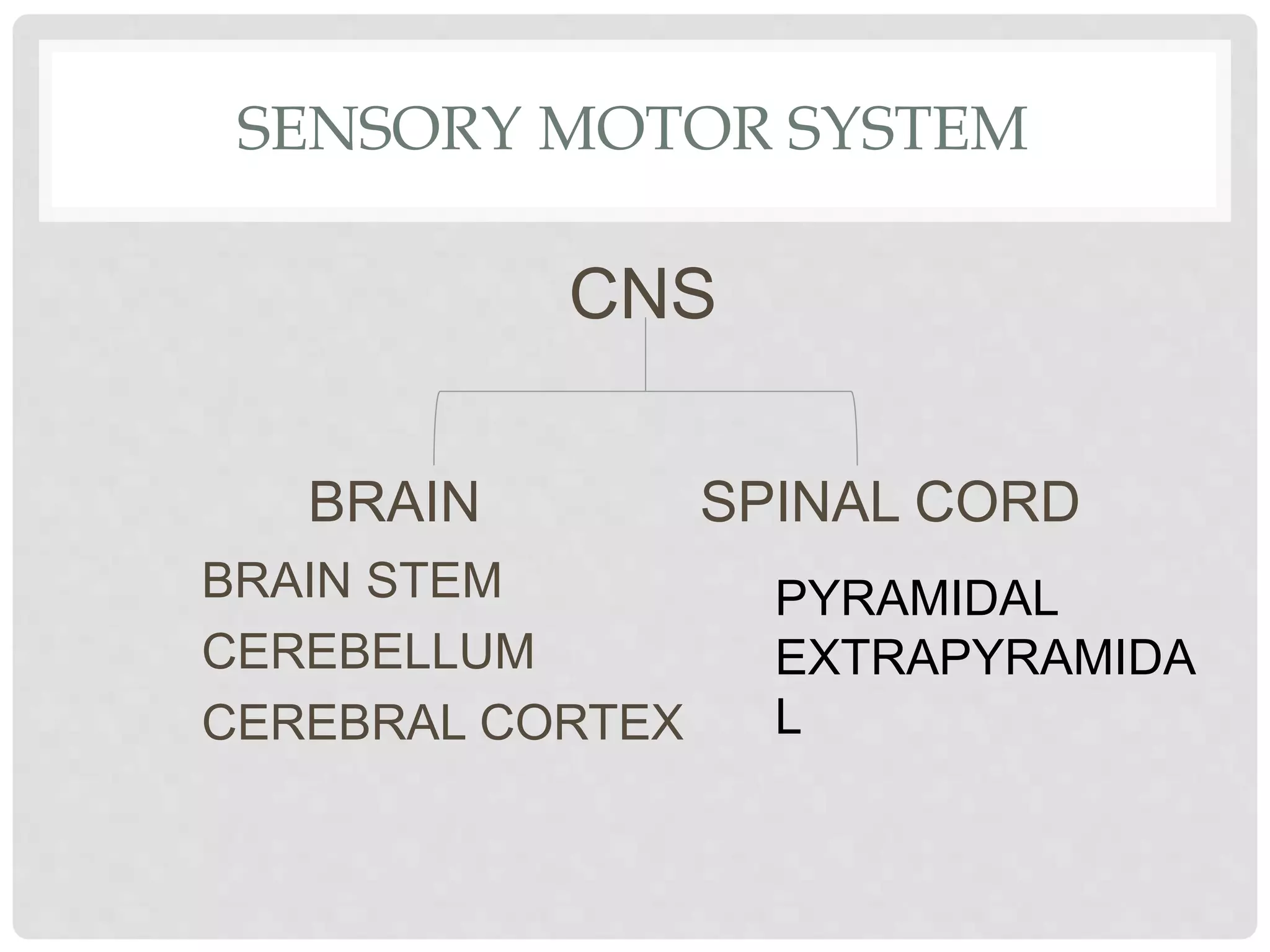
CNS
BRAIN SPINAL CORD
BRAIN STEM
CEREBELLUM
CEREBRAL CORTEX
PYRAMIDAL
EXTRAPYRAMIDA
L
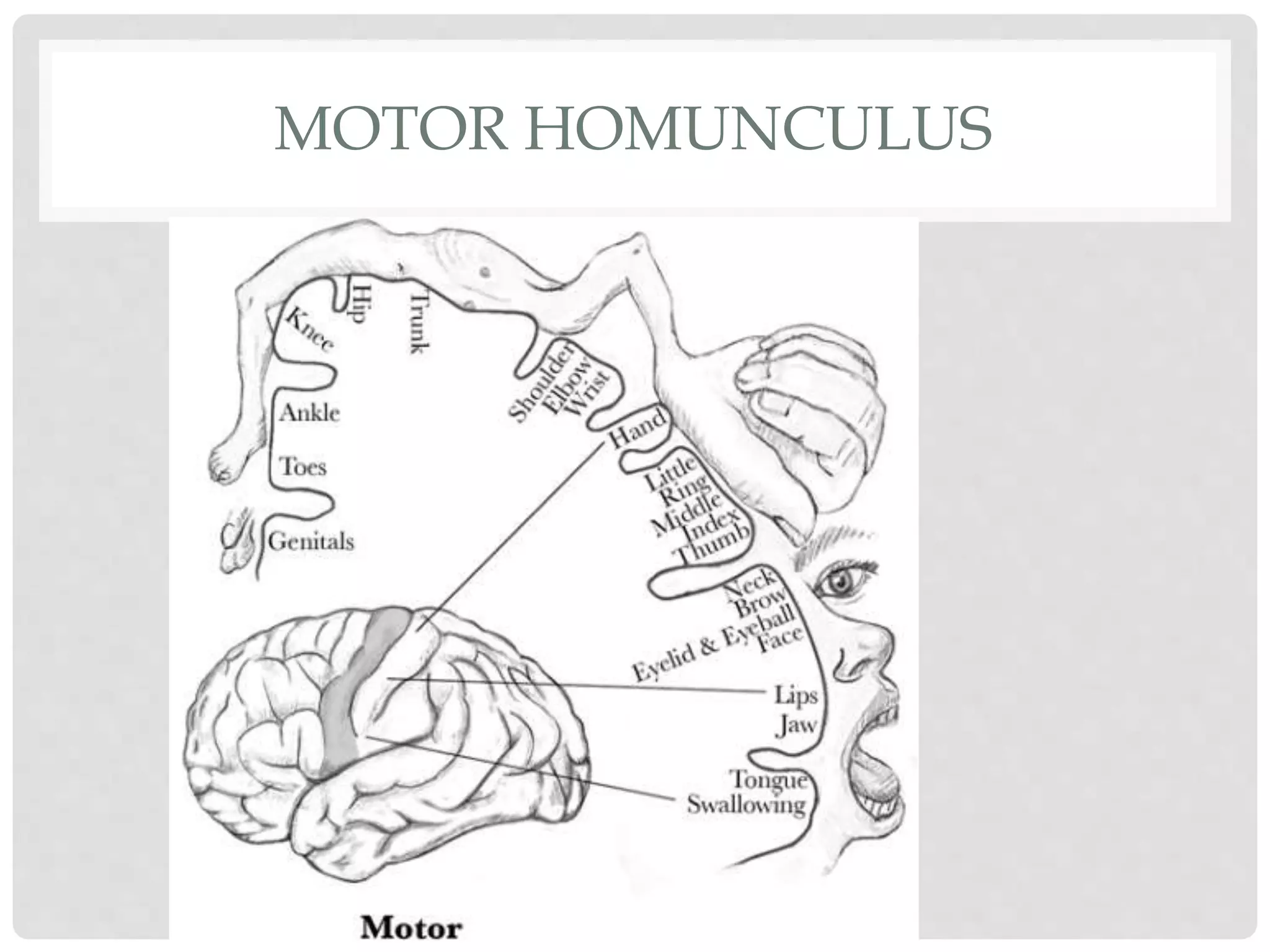
MOTOR HOMUNCULUS
SENSORY + MOTOR = MOVEMENT
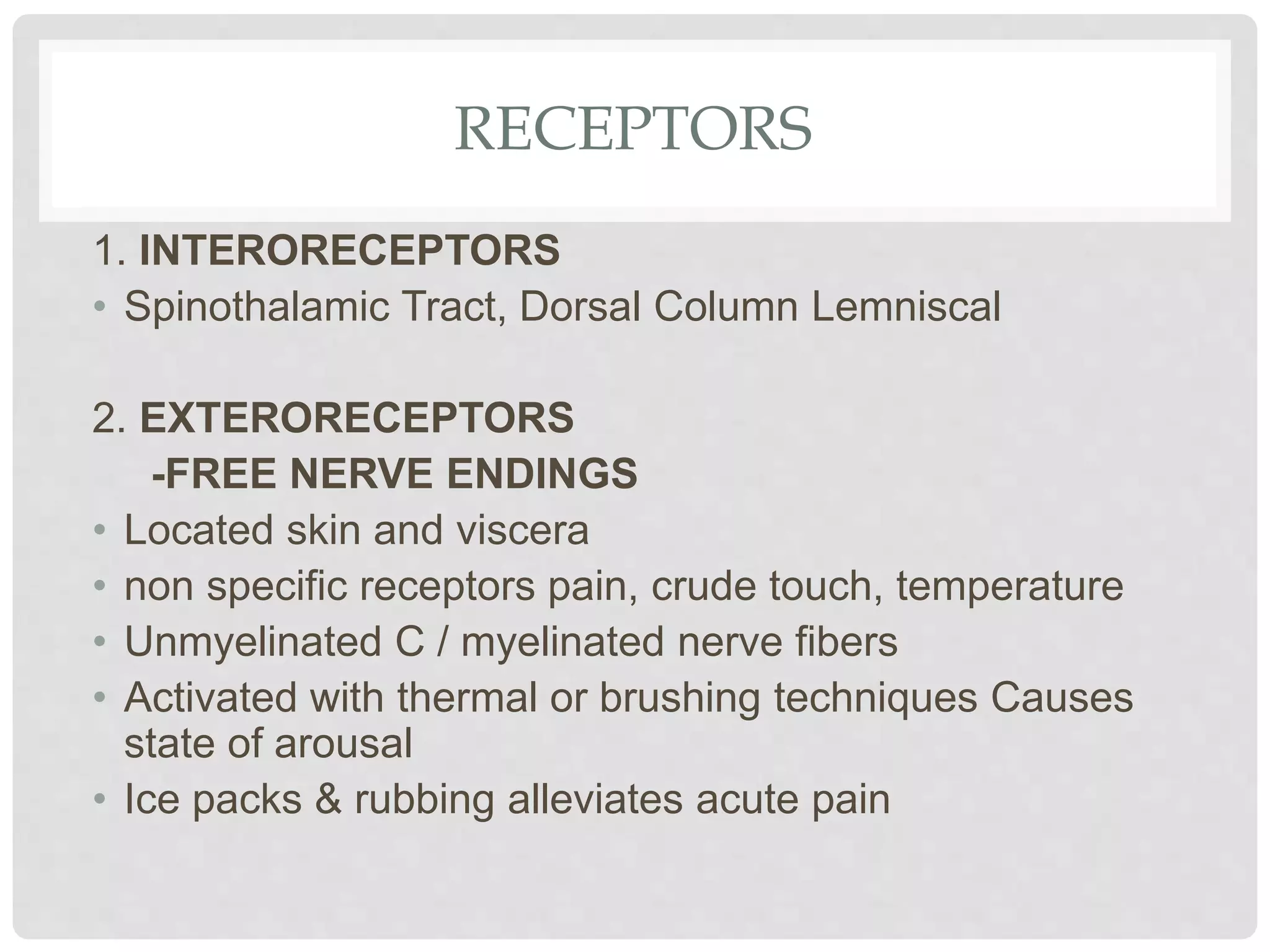
RECEPTORS
1. INTERORECEPTORS
• Spinothalamic Tract, Dorsal Column Lemniscal
2. EXTERORECEPTORS
-FREE NERVE ENDINGS
• Located skin and viscera
• non specific receptors pain, crude touch, temperature
• Unmyelinated C / myelinated nerve fibers
• Activated with thermal or brushing techniques Causes
state of arousal
• Ice packs & rubbing alleviates acute pain
HAIR END ORGANS
• Type of free nerve ending wrap around the base of hair
follicle
• Activated by bending / displacement of hair
• A delta (group III) fibers
• Stimulated with light touch or stroking of the skin
• Primitive humanity and Goosebumps
MEISSNER CORPUSCLES
• Found just beneath the epidermis in hairless skin
• Thicker A beta ( group II) fibers
• Responsible for fine tactile discriminination
• Important digital exploration and sensory substitution
skills (reading braille)
• Responsive to low frequency vibration
PACINIAN CORPUSCLES
• Located deep layers of the skin, viscera, mesenteries,
ligaments, near blood vessels, periosteum of long bones
• Most rapidly adapting receptors
• Respond to deep pressure but are sensitive to light touch
• Stimulated by high frequency vibration
• Plays a role tonic vibration reflex
• Aids desensitization of hypersensitive skin in children who
exhibits tactile defensiveness
• Suppresses pain perception at the cutaneous level
• Calming effect
MERKEL TACTILE DISKS
• Found deepest epidermis in hairless skin
• Volar surface of fingers, lips and external genitalia
• Fast-conducting A beta (group II) fibers
• Slowly adapting touch-pressure receptors
• Sensitive to slow movements across the skin’s surface
• Related to sense of tickle and pleasurable touch
sensation
ROODS
• Margret Roods was a OT as well as PT she
designed the treatment approach for the patients
with CP, which was also applicable to any
patients with motor control problem.
Aim for roods approach.
• To Gain motor Control
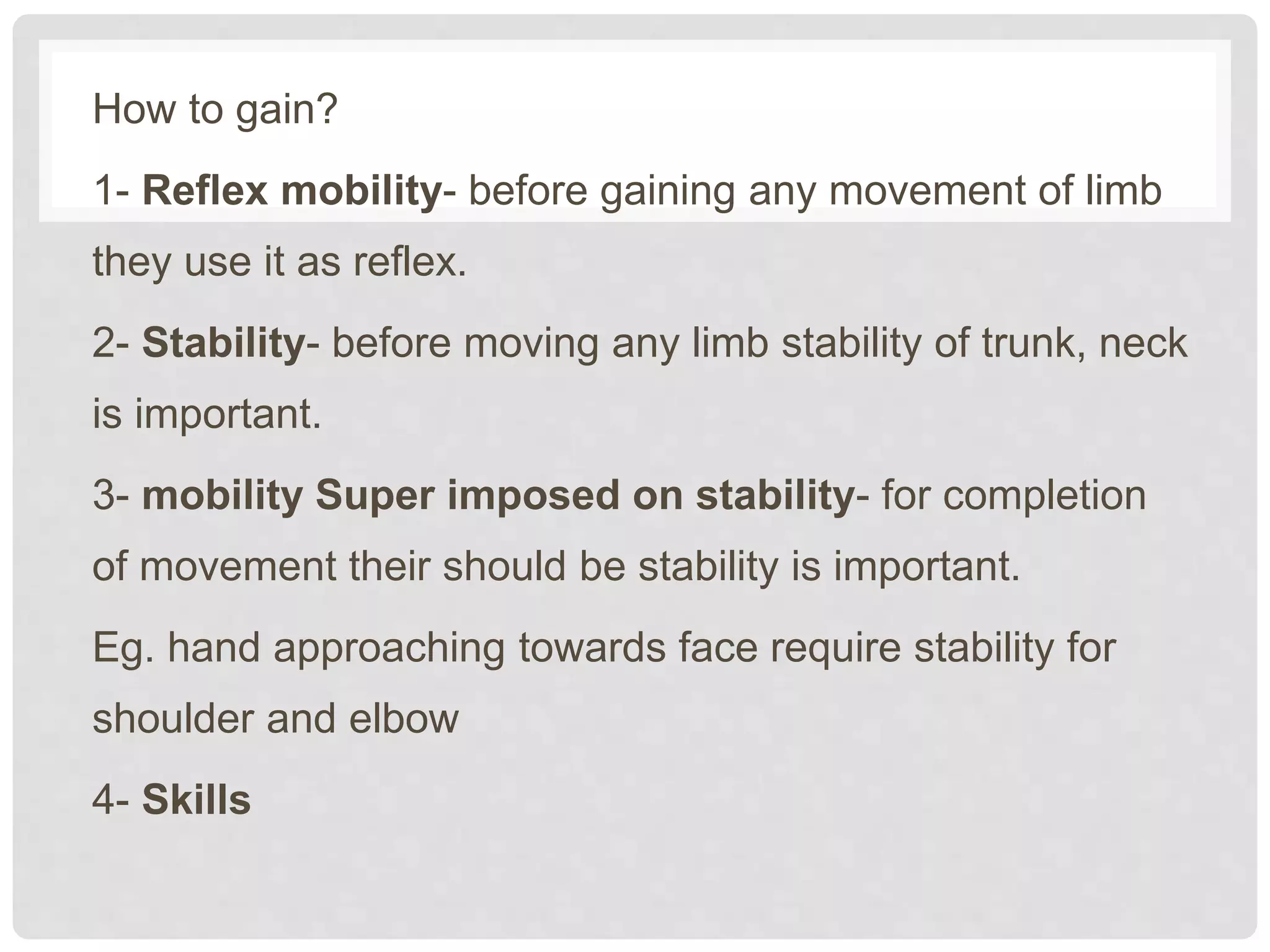
How to gain?
1- Reflex mobility- before gaining any movement of limb
they use it as reflex.
2- Stability- before moving any limb stability of trunk, neck
is important.
3- mobility Super imposed on stability- for completion
of movement their should be stability is important.
Eg. hand approaching towards face require stability for
shoulder and elbow
4- Skills
PRINCIPLES
• Continuous sensory stimulation
• Use of developmental sequence
• Use of activity to demand a purposeful response
• Practice of sensory motor response is necessary
for motor learning
SEQUENCE OF MOTOR DEVELOPMENT
She proposed 4 sequential phases of development.
• RECIPROCAL INHIBITION (INNERVATION)
• CO-CONTRACTION (C0-INNERVATION)
• HEAVY WORK
• SKILL
RECIPROCAL INHIBITION/(INNERVATION)
• A phasic(quick) type of movement that require
contraction of the agonist muscle. As the antagonist ms.
relaxes. It is an early mobility pattern protective in
nature.
Co-contraction
• It Is defined as simultaneous contraction of agonist and
antagonist ms. With antagonist supreme.
Heavy work
• It is described by stock meyer (1967) as’mobility
superimposed on stability’.
• In heavy work the proximal ms.contract and move and
the distal segment is fixed.
• Eg.creeping in quadruped position (the wrist and ankle
are in fixed position). The neck and thorax (proximal
joints) are stable where as the shoulder and hip girdle
are free to move.
SKILL
It is the highest level of motor control and combines the
effect of mobility and stability.
In skilled pattern the proximal segment is stabilized while
the distal segment moves freely.
Eg. Typing requires stability in proximal joints(elbow and
shoulder) while mobility in distal finger joints
LEVELS OF MOTOR CONTROL
• Supine withdrawal
• Roll over
• Pivot prone
• Neck co-contraction
• Prone on elbow
• Quadruped
• Standing
• walking
SUPINE WITHDRAWAL
• Total flexion response towards vertebral level T10
• The flexion of neck and crossing of the arm and the legs
protect the anterior surface of the body.
• Requires reciprocal innervation with heavy work of
proximal segments
• Aids in integration of TLR
RECOMMENDED:
• patients with no reciprocal flexion
• Patients dominated by extensor tone
ROLL OVER
Mobility pattern for the extremities and activates the lateral
musculature
Stimulation of semi-circular canal which in turn activates
neck and extra ocular ms.
RECOMMENDED:
• Patients dominated by tonic reflex patterns in supine
PIVOT PRONE
• It Is both mobility and stability pattern.in this pattern
there is full range of extension of neck,shoulder, trunk,
and lower extremity.
• This position is diff to hold it prepares the ext. muscle for
upright position and indicate integration of symmetric
tonic neck reflex and tonic lyabrinthine reflex.
•
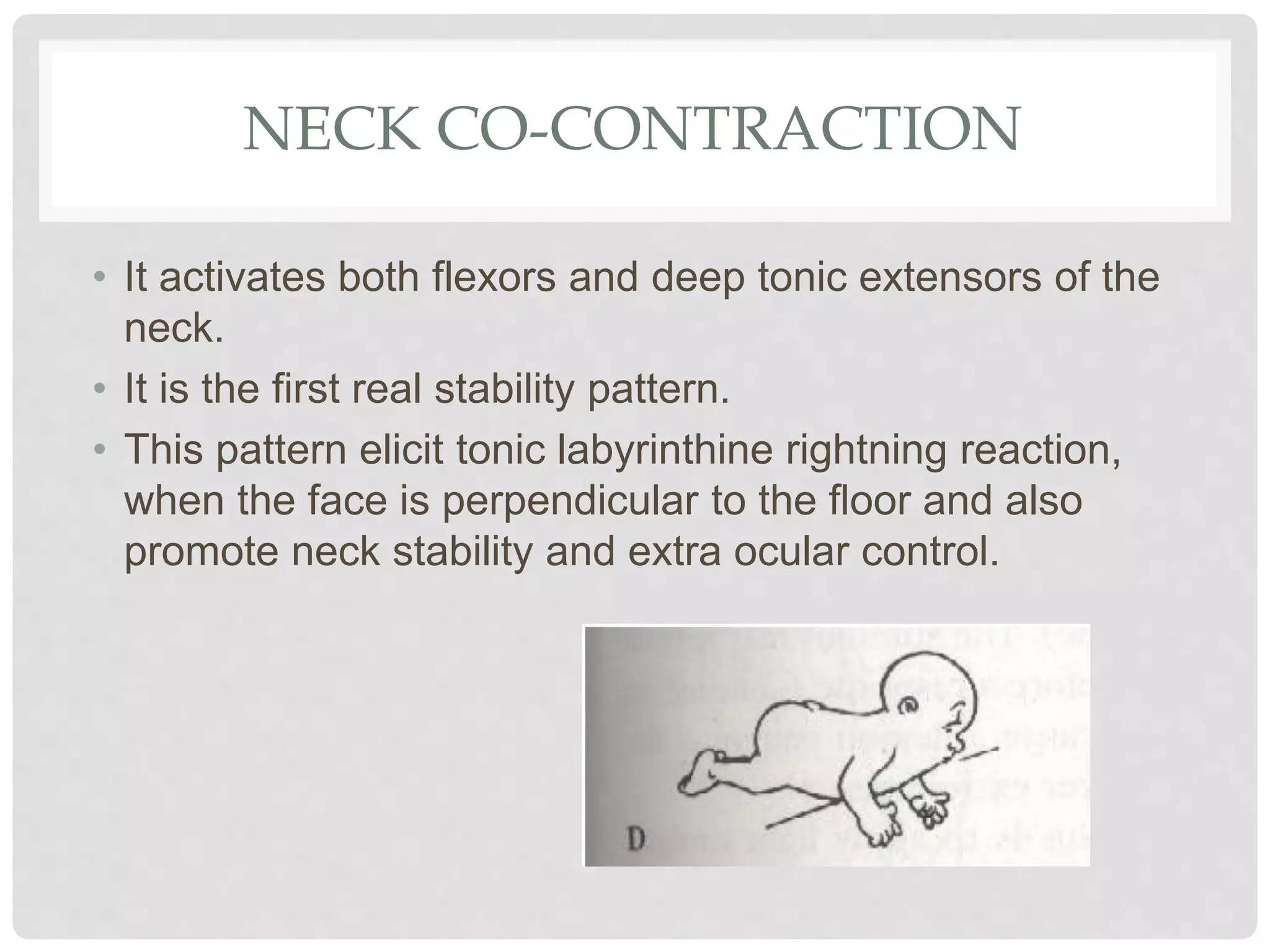
NECK CO-CONTRACTION
• It activates both flexors and deep tonic extensors of the
neck.
• It is the first real stability pattern.
• This pattern elicit tonic labyrinthine rightning reaction,
when the face is perpendicular to the floor and also
promote neck stability and extra ocular control.
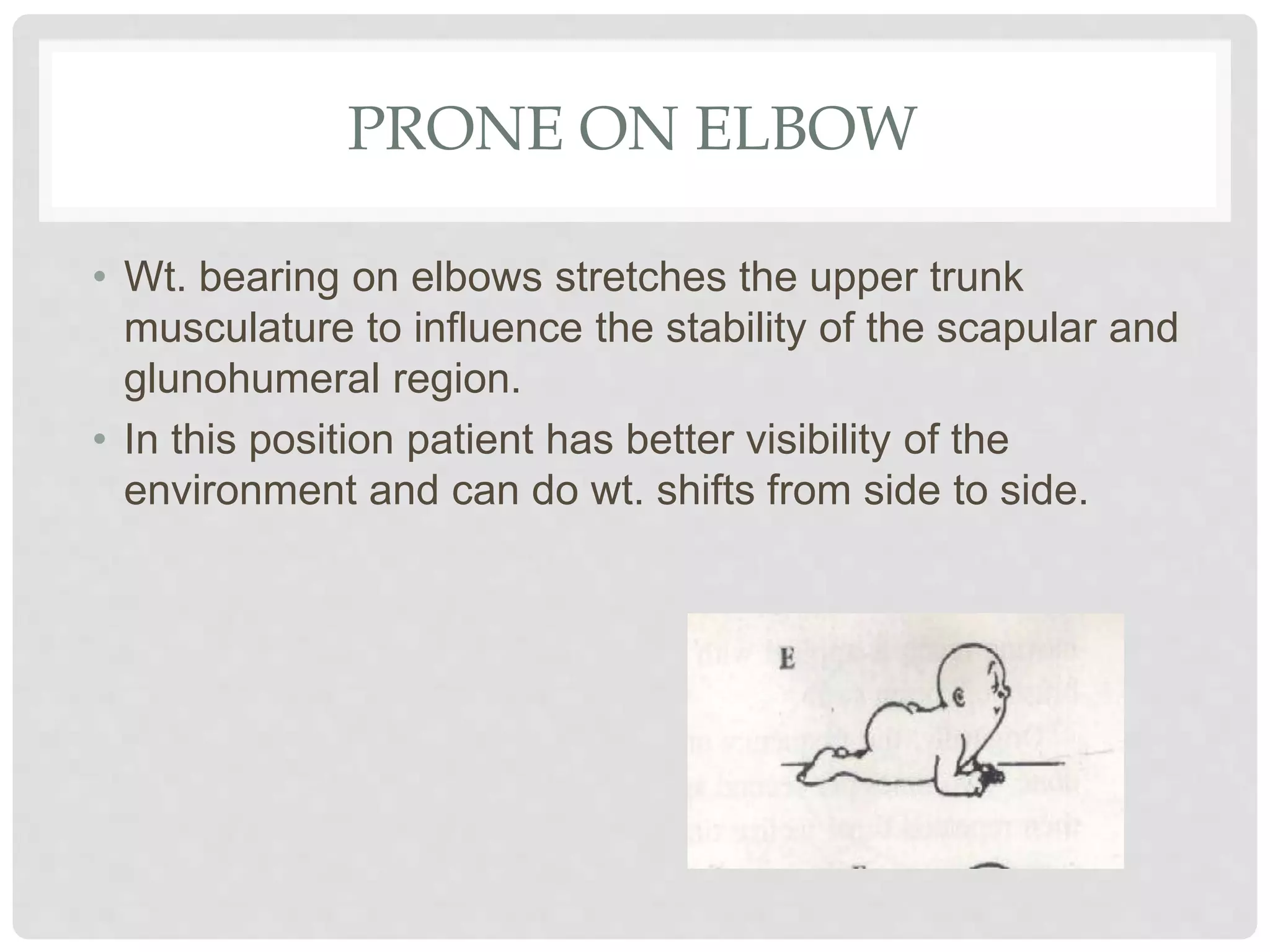
PRONE ON ELBOW
• Wt. bearing on elbows stretches the upper trunk
musculature to influence the stability of the scapular and
glunohumeral region.
• In this position patient has better visibility of the
environment and can do wt. shifts from side to side.
QUADRUPED POSITION
• In this pattern the lower trunk and lower extremities are
in co-contraction.
• The patient can do weight wt.shifts in all 6 direction.
• This provides mobility super-imposed on stability and
prepare for equilibrium response.
STANDING AND WALKING
• In this position weight is equally distributed on both legs
after that weight shifts begins.
• The upper extremities are free to perform functions, also
standing brings in integration of righting reaction and
equilibrium reaction.
SENSORY INPUTS
• Tactile
• Thermal
• Olfactory
• Gustatory
• Auditory
• Visual
• Proprioceptive (Stretch,resistance)
RULES OF SENSORY INPUT
MARGRET ROODS DESCRIBE 4 RULES OF SENSORY INPUT
• Fast Brief Stimulus produces large synchronous motor
output. This type of stimulus confirms reflexes are
functioning.
• Fast repetitive sensory input produces maintained
response.
• Maintained sensory input produces a maintained
response. Eg.Gravity- has a constant effect on sensory
system. In All position (standing,sitting,lying)
• Slow, rhythmical, repetitive sensory input deactivates
body and mind. Eg.Slow rocking or soft music activates
the parasympathetic system leads to generalized
relaxation.
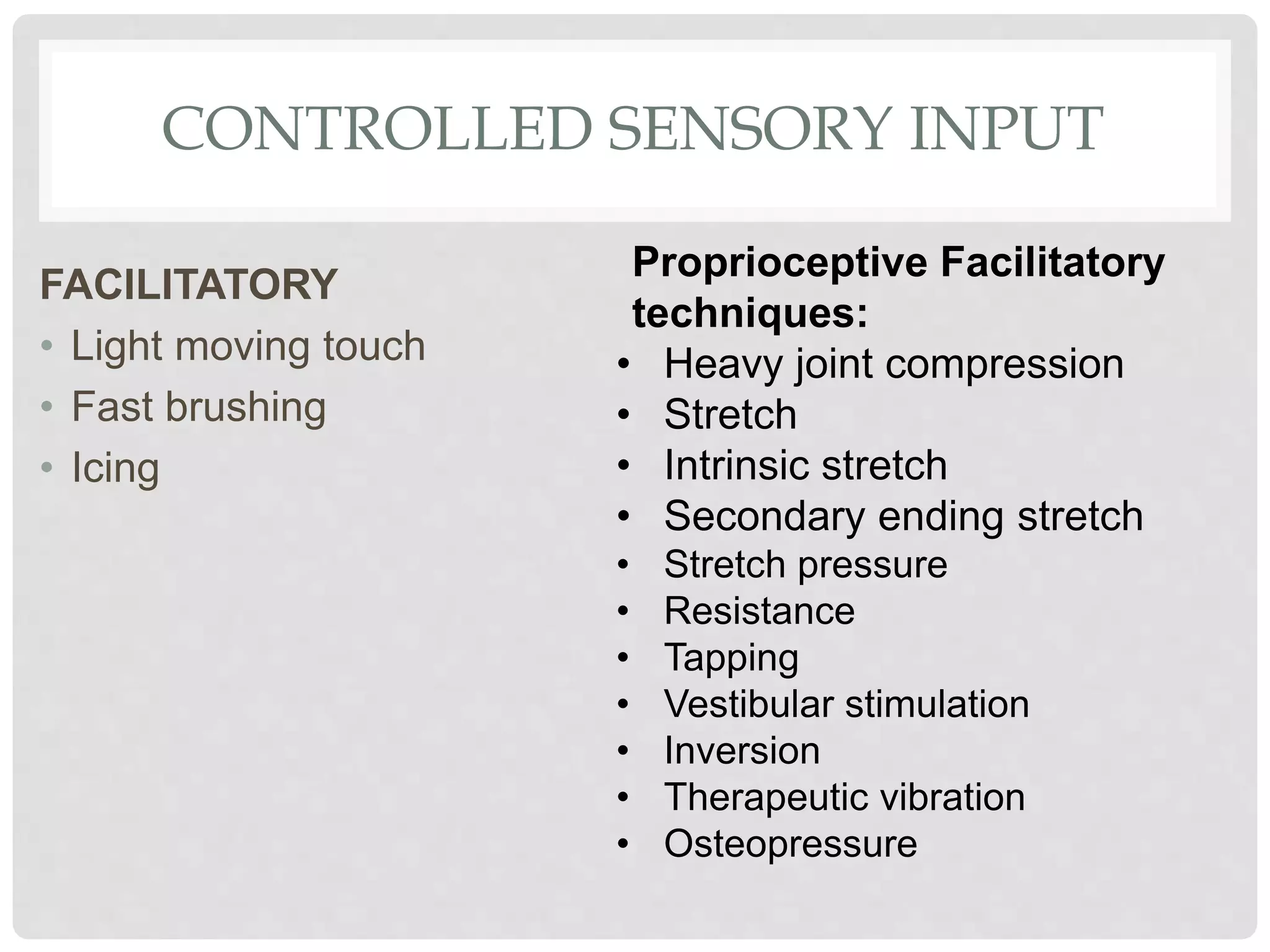
CONTROLLED SENSORY INPUT
FACILITATORY
• Light moving touch
• Fast brushing
• Icing
Proprioceptive Facilitatory
techniques:
• Heavy joint compression
• Stretch
• Intrinsic stretch
• Secondary ending stretch
• Stretch pressure
• Resistance
• Tapping
• Vestibular stimulation
• Inversion
• Therapeutic vibration
• Osteopressure
INHIBITATORY
• Gentle shaking or rocking
• Slow stroking
• Slow rolling
• Light joint compression
• Tendinous pressure
• Maintained stretch
• Rocking in developmental stages
• Neutral Warmth
WHICH SENSORY INPUT WILL I USE FOR MY
PATIENT?
MEDIATED BY:
PROCEDURE:
EFFECT:
Facilitatory
LIGHT MOVING TOUCH
• Sends input limbic structure
• Increases corticosteroids levels in blood stream
• ACTIVATES SUPERFICIAL MOBILIZING MUSCLES
(light work group that performs skilled task)
• STIMULATES A delta sensory fibers synapses with
fusimotor system reciprocal innervation ( phasic
withdrawal response)
• camel hair, finger tip, brush, cotton swab
Reticular
activation system.
A Icing
a.k.a. QUICK ICING
• Patients hypotonia
• Are in state of relaxation
• Alerts the mental processes
C Icing
• Promotes RECIPROCAL PATTERN between diaphragm
& abdominal muscles
• Increase breathing patterns, voice production and
general vitality
PROPRIOCEPTIVE FACILITATORY
TECHNIQUE
• Heavy joint compression
• Stretch
• Intrinsic stretch
• Secondary ending stretch
• Stretch pressure
• Resistance
• Tapping
• Vestibular stimulation
• Inversion
• Therapeutic vibration
• Osteopressure
VIBRATION
• It can be used for tactile stimulation to desensitize by
hypersensitive skin and to produce tonal changes in
muscles.
• Vibratory stimuli applied over a muscle belly to
activate the Ia afferent of muscle spindle, causing
contraction of that muscles and suppression of the
stretch reflex.
• This response is called the tonic vibration reflex and is
best elicited by a high frequency vibration device that
delivers 100-300 c/s.
• The duration of the vibration should not exceed 1-2
min per application because heat and friction will
result.
• The prone position may be best while vibrating flexor
muscle groups and the supine position may enhance
the extensor muscles.
• It is best to have the pt in a warm environment
because the skin receptors are at a lower threshold
for firing.
• Tapping
With the fingertips or percussed 3-5 times and may be
done before or during the time the px is voluntary
contracting the muscles. This stimulus acts on the afferent
of the muscle spindles and increases the tone of the
underlying muscles.
VESTIBULAR STIMULATION
• Vestibular stimulation is a powerful type of proprioceptive unit.
The vestibular system is found to activate the antigravity
muscles and their antagonist muscle before the stretch reflex of
the muscle spindles.
• The system affects tone, balance, directionality, protective
response, cranial nerve function, bilateral integration, auditory
language development and eye pursuits.
• It is stimulated through linear acceleration and deceleration in
horizontal and vertical planes and angular acceleration and
deceleration such as spinning, rolling or swinging. Fast
stimulation tends to stimulate while slow rhythmical rocking
tends to relax.
INHIBITATORY TECHNIQUES
TECHNIQUE EFFECT
SPECIAL SENSES FOR FACILITATION
• Pleasant Odors
• Unpleasant Odors
• Noxious Substance
• Warm Liquids
• Sweet Foods/Sweet Taste
REFERANCES
• Manual Therapy Approach in NEUROTHERAPY
by. Suvarna Ganvir
• Cash Textbook for Physiotherapist 4th Edition
• Concise exercise therapy : A Comprehensive TB
For physical and occupational therapy
• THANK YOU
THANK

Roods approach a For Neuro Physiotherapy

  • 1.
  • 2.
    SENSORY MOTOR SYSTEM CNS BRAINSPINAL CORD BRAIN STEM CEREBELLUM CEREBRAL CORTEX PYRAMIDAL EXTRAPYRAMIDA L
  • 4.
  • 5.
    SENSORY + MOTOR= MOVEMENT
  • 6.
    RECEPTORS 1. INTERORECEPTORS • SpinothalamicTract, Dorsal Column Lemniscal 2. EXTERORECEPTORS -FREE NERVE ENDINGS • Located skin and viscera • non specific receptors pain, crude touch, temperature • Unmyelinated C / myelinated nerve fibers • Activated with thermal or brushing techniques Causes state of arousal • Ice packs & rubbing alleviates acute pain
  • 7.
    HAIR END ORGANS •Type of free nerve ending wrap around the base of hair follicle • Activated by bending / displacement of hair • A delta (group III) fibers • Stimulated with light touch or stroking of the skin • Primitive humanity and Goosebumps
  • 8.
    MEISSNER CORPUSCLES • Foundjust beneath the epidermis in hairless skin • Thicker A beta ( group II) fibers • Responsible for fine tactile discriminination • Important digital exploration and sensory substitution skills (reading braille) • Responsive to low frequency vibration
  • 9.
    PACINIAN CORPUSCLES • Locateddeep layers of the skin, viscera, mesenteries, ligaments, near blood vessels, periosteum of long bones • Most rapidly adapting receptors • Respond to deep pressure but are sensitive to light touch • Stimulated by high frequency vibration • Plays a role tonic vibration reflex • Aids desensitization of hypersensitive skin in children who exhibits tactile defensiveness • Suppresses pain perception at the cutaneous level • Calming effect
  • 10.
    MERKEL TACTILE DISKS •Found deepest epidermis in hairless skin • Volar surface of fingers, lips and external genitalia • Fast-conducting A beta (group II) fibers • Slowly adapting touch-pressure receptors • Sensitive to slow movements across the skin’s surface • Related to sense of tickle and pleasurable touch sensation
  • 11.
    ROODS • Margret Roodswas a OT as well as PT she designed the treatment approach for the patients with CP, which was also applicable to any patients with motor control problem. Aim for roods approach. • To Gain motor Control
  • 12.
    How to gain? 1-Reflex mobility- before gaining any movement of limb they use it as reflex. 2- Stability- before moving any limb stability of trunk, neck is important. 3- mobility Super imposed on stability- for completion of movement their should be stability is important. Eg. hand approaching towards face require stability for shoulder and elbow 4- Skills
  • 13.
    PRINCIPLES • Continuous sensorystimulation • Use of developmental sequence • Use of activity to demand a purposeful response • Practice of sensory motor response is necessary for motor learning
  • 14.
    SEQUENCE OF MOTORDEVELOPMENT She proposed 4 sequential phases of development. • RECIPROCAL INHIBITION (INNERVATION) • CO-CONTRACTION (C0-INNERVATION) • HEAVY WORK • SKILL
  • 15.
    RECIPROCAL INHIBITION/(INNERVATION) • Aphasic(quick) type of movement that require contraction of the agonist muscle. As the antagonist ms. relaxes. It is an early mobility pattern protective in nature. Co-contraction • It Is defined as simultaneous contraction of agonist and antagonist ms. With antagonist supreme.
  • 16.
    Heavy work • Itis described by stock meyer (1967) as’mobility superimposed on stability’. • In heavy work the proximal ms.contract and move and the distal segment is fixed. • Eg.creeping in quadruped position (the wrist and ankle are in fixed position). The neck and thorax (proximal joints) are stable where as the shoulder and hip girdle are free to move.
  • 18.
    SKILL It is thehighest level of motor control and combines the effect of mobility and stability. In skilled pattern the proximal segment is stabilized while the distal segment moves freely. Eg. Typing requires stability in proximal joints(elbow and shoulder) while mobility in distal finger joints
  • 19.
    LEVELS OF MOTORCONTROL • Supine withdrawal • Roll over • Pivot prone • Neck co-contraction • Prone on elbow • Quadruped • Standing • walking
  • 21.
    SUPINE WITHDRAWAL • Totalflexion response towards vertebral level T10 • The flexion of neck and crossing of the arm and the legs protect the anterior surface of the body. • Requires reciprocal innervation with heavy work of proximal segments • Aids in integration of TLR RECOMMENDED: • patients with no reciprocal flexion • Patients dominated by extensor tone
  • 22.
    ROLL OVER Mobility patternfor the extremities and activates the lateral musculature Stimulation of semi-circular canal which in turn activates neck and extra ocular ms. RECOMMENDED: • Patients dominated by tonic reflex patterns in supine
  • 23.
    PIVOT PRONE • ItIs both mobility and stability pattern.in this pattern there is full range of extension of neck,shoulder, trunk, and lower extremity. • This position is diff to hold it prepares the ext. muscle for upright position and indicate integration of symmetric tonic neck reflex and tonic lyabrinthine reflex. •
  • 24.
    NECK CO-CONTRACTION • Itactivates both flexors and deep tonic extensors of the neck. • It is the first real stability pattern. • This pattern elicit tonic labyrinthine rightning reaction, when the face is perpendicular to the floor and also promote neck stability and extra ocular control.
  • 25.
    PRONE ON ELBOW •Wt. bearing on elbows stretches the upper trunk musculature to influence the stability of the scapular and glunohumeral region. • In this position patient has better visibility of the environment and can do wt. shifts from side to side.
  • 26.
    QUADRUPED POSITION • Inthis pattern the lower trunk and lower extremities are in co-contraction. • The patient can do weight wt.shifts in all 6 direction. • This provides mobility super-imposed on stability and prepare for equilibrium response.
  • 27.
    STANDING AND WALKING •In this position weight is equally distributed on both legs after that weight shifts begins. • The upper extremities are free to perform functions, also standing brings in integration of righting reaction and equilibrium reaction.
  • 31.
    SENSORY INPUTS • Tactile •Thermal • Olfactory • Gustatory • Auditory • Visual • Proprioceptive (Stretch,resistance)
  • 32.
    RULES OF SENSORYINPUT MARGRET ROODS DESCRIBE 4 RULES OF SENSORY INPUT • Fast Brief Stimulus produces large synchronous motor output. This type of stimulus confirms reflexes are functioning. • Fast repetitive sensory input produces maintained response. • Maintained sensory input produces a maintained response. Eg.Gravity- has a constant effect on sensory system. In All position (standing,sitting,lying) • Slow, rhythmical, repetitive sensory input deactivates body and mind. Eg.Slow rocking or soft music activates the parasympathetic system leads to generalized relaxation.
  • 33.
    CONTROLLED SENSORY INPUT FACILITATORY •Light moving touch • Fast brushing • Icing Proprioceptive Facilitatory techniques: • Heavy joint compression • Stretch • Intrinsic stretch • Secondary ending stretch • Stretch pressure • Resistance • Tapping • Vestibular stimulation • Inversion • Therapeutic vibration • Osteopressure
  • 34.
    INHIBITATORY • Gentle shakingor rocking • Slow stroking • Slow rolling • Light joint compression • Tendinous pressure • Maintained stretch • Rocking in developmental stages • Neutral Warmth
  • 35.
    WHICH SENSORY INPUTWILL I USE FOR MY PATIENT? MEDIATED BY: PROCEDURE: EFFECT:
  • 36.
  • 38.
    LIGHT MOVING TOUCH •Sends input limbic structure • Increases corticosteroids levels in blood stream • ACTIVATES SUPERFICIAL MOBILIZING MUSCLES (light work group that performs skilled task) • STIMULATES A delta sensory fibers synapses with fusimotor system reciprocal innervation ( phasic withdrawal response) • camel hair, finger tip, brush, cotton swab
  • 39.
  • 42.
    A Icing a.k.a. QUICKICING • Patients hypotonia • Are in state of relaxation • Alerts the mental processes
  • 43.
    C Icing • PromotesRECIPROCAL PATTERN between diaphragm & abdominal muscles • Increase breathing patterns, voice production and general vitality
  • 44.
    PROPRIOCEPTIVE FACILITATORY TECHNIQUE • Heavyjoint compression • Stretch • Intrinsic stretch • Secondary ending stretch • Stretch pressure • Resistance • Tapping • Vestibular stimulation • Inversion • Therapeutic vibration • Osteopressure
  • 47.
    VIBRATION • It canbe used for tactile stimulation to desensitize by hypersensitive skin and to produce tonal changes in muscles. • Vibratory stimuli applied over a muscle belly to activate the Ia afferent of muscle spindle, causing contraction of that muscles and suppression of the stretch reflex. • This response is called the tonic vibration reflex and is best elicited by a high frequency vibration device that delivers 100-300 c/s.
  • 48.
    • The durationof the vibration should not exceed 1-2 min per application because heat and friction will result. • The prone position may be best while vibrating flexor muscle groups and the supine position may enhance the extensor muscles. • It is best to have the pt in a warm environment because the skin receptors are at a lower threshold for firing.
  • 52.
    • Tapping With thefingertips or percussed 3-5 times and may be done before or during the time the px is voluntary contracting the muscles. This stimulus acts on the afferent of the muscle spindles and increases the tone of the underlying muscles.
  • 53.
    VESTIBULAR STIMULATION • Vestibularstimulation is a powerful type of proprioceptive unit. The vestibular system is found to activate the antigravity muscles and their antagonist muscle before the stretch reflex of the muscle spindles. • The system affects tone, balance, directionality, protective response, cranial nerve function, bilateral integration, auditory language development and eye pursuits. • It is stimulated through linear acceleration and deceleration in horizontal and vertical planes and angular acceleration and deceleration such as spinning, rolling or swinging. Fast stimulation tends to stimulate while slow rhythmical rocking tends to relax.
  • 54.
  • 58.
  • 60.
    SPECIAL SENSES FORFACILITATION • Pleasant Odors • Unpleasant Odors • Noxious Substance • Warm Liquids • Sweet Foods/Sweet Taste
  • 61.
    REFERANCES • Manual TherapyApproach in NEUROTHERAPY by. Suvarna Ganvir • Cash Textbook for Physiotherapist 4th Edition • Concise exercise therapy : A Comprehensive TB For physical and occupational therapy
  • 62.