THE AXILLA
2/10/2014

1
• The axilla is the gateway to the upper limb,
providing an area of transition between the
neck and the arm.
• Formed by the clavicle, the scapula, the upper
thoracic wall, the humerus, and related
muscles.
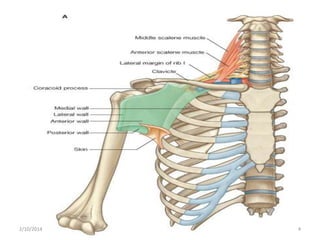
• The axilla is an irregularly shaped pyramidal
space with:
• four sides/walls
• an inlet/apex and
• a floor (base).
2/10/2014

2
• The axillary inlet is continuous superiorly
with the neck, and the lateral part of the
floor opens into the arm.
• The shape and size of the axilla varies
depending on the position of the arm; it
almost disappears when the arm is fully
abducted.
• The axilla provides a passageway for
vessels and nerves to reach the upper
limb.
2/10/2014

3
2/10/2014

4
2/10/2014

5
BOUNDARIES
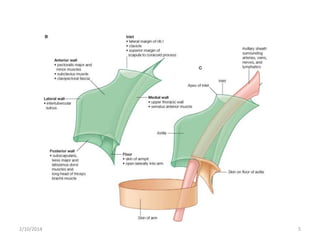
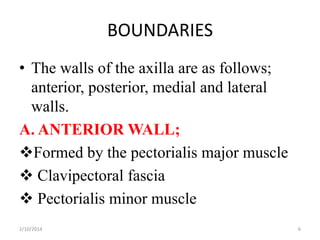
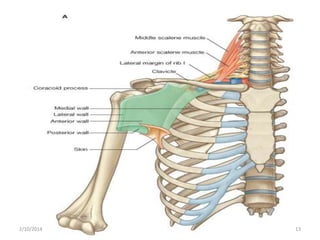
• The walls of the axilla are as follows;
anterior, posterior, medial and lateral
walls.
A. ANTERIOR WALL;
Formed by the pectorialis major muscle
 Clavipectoral fascia
 Pectorialis minor muscle
2/10/2014

6
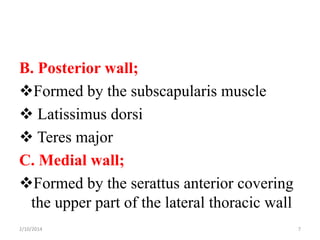
B. Posterior wall;
Formed by the subscapularis muscle
 Latissimus dorsi
 Teres major
C. Medial wall;
Formed by the serattus anterior covering
the upper part of the lateral thoracic wall
2/10/2014

7
D. Lateral wall;
Is a narrow wall formed by the shaft of the
humerus of arm
 Coracobrachialis muscle
 Short head of biceps brachii muscle

2/10/2014

8
E. Apex;
Is triangular and directed upwards and
medially towards the root of the neck.
It is bounded by the clavicle bone
anteriorly,
 First rib medially and
 Upper border of scapula posteriorly
2/10/2014

9
• Major vessels and nerves pass between the
neck and the axilla by crossing over the lateral
border of rib I and through the axillary inlet.
• The subclavian artery, the major blood vessel
supplying the upper limb, becomes the
axillary artery as it crosses the lateral margin
of 1st rib and enters the axilla.

2/10/2014

10
• Similarly, the axillary vein becomes the
subclavian vein as it passes over the lateral
margin of rib I and leaves the axilla to enter
the neck.
• At the axillary inlet, the axillary vein is anterior
to the axillary artery, which, in turn, is anterior
to the trunks of the brachial plexus.

2/10/2014

11
F. The base/floor;
The floor of the axilla is formed by fascia and a
dome of skin that spans the distance between
the inferior margins of the walls.
 It is supported by the clavipectoral fascia.

2/10/2014

12
2/10/2014

13
AXILLARY CONTENTS
• Contents of the axilla includes;
1. The three cords of the brachial plexus and
their branches
2. The axillary arteries and its branches
3. The axillary vein and its tributaries
4. The axillary lymph nodes
5. Fibro-fatty tissue
6. The axillary tail of Spence of mammary
gland in females
2/10/2014

14
Axillary artery
• The axillary artery supplies the walls of
the axilla and related regions, and
continues as the major blood supply to
the more distal parts of the upper limb.
• The subclavian artery in the neck
becomes the axillary artery at the lateral
margin of 1st rib and passes through the
axilla, becoming the brachial artery at the
inferior margin of the teres major muscle.
2/10/2014

15
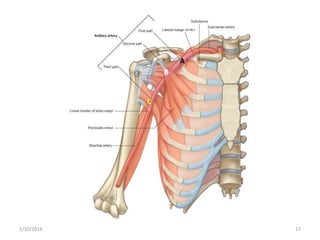
• The axillary artery is separated into three parts by
the pectoralis minor muscle, which crosses
anteriorly to the vessel.
the first part is proximal to pectoralis minor
(extends from the lateral border of 1st rib to
medial border of P.minor)
the second part is posterior to pectoralis minor
(behind the P. minor)
the third part is distal to pectoralis minor (the
longest part, extending from the lateral border of
P.minor to the lower border of teres major muscle.
2/10/2014

16
A

B

C

2/10/2014

17
Branches
• Generally, six branches arise from the axillary
artery: one from the first part, two from the
second part and three from the third part.
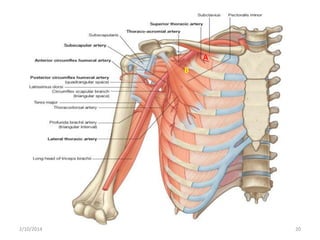
• First part; a) Superior thoracic artery, a small
branch supplying first intercostal space.
• Second part; b) the thoraco-acromial branch
which pieces the clavipectorial fascia and
divides into four branches thus;
i. The deltoid branch which lies in deltopectoral groove.
2/10/2014

18
ii. The clavicular branch which supplies
sternoclavicular joint and subclavius muscle
iii. The pectoral branch which supplies the
pectoral muscles
iv. The acromion branch which takes part in the
anastomosis over the acromial process

2/10/2014

19
A
B

2/10/2014

20
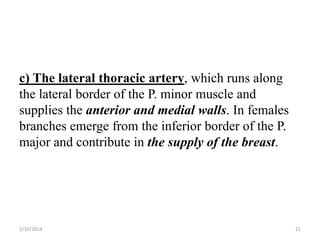
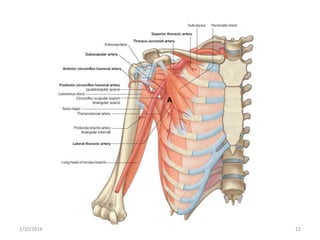
c) The lateral thoracic artery, which runs along
the lateral border of the P. minor muscle and
supplies the anterior and medial walls. In females
branches emerge from the inferior border of the P.
major and contribute in the supply of the breast.

2/10/2014

21
A

2/10/2014

22
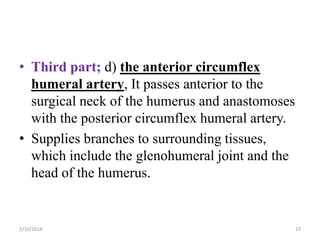
• Third part; d) the anterior circumflex
humeral artery, It passes anterior to the
surgical neck of the humerus and anastomoses
with the posterior circumflex humeral artery.
• Supplies branches to surrounding tissues,
which include the glenohumeral joint and the
head of the humerus.

2/10/2014

23
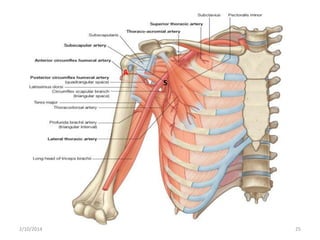
e) The posterior circumflex humeral artery; a much
larger artery than the anterior circumflex humeral
and accompanies the axillary nerve through the
quadrangular space.
Supplies the glenohumeral joint and surrounding
muscles i.e teres major, minor and long head of
triceps brachii.
f) The subscapular artery; is the largest branch of
the axillary artery and is the major blood supply to
the posterior wall of the axilla.
• It also contributes to the blood supply of the
posterior scapular region.
• It divides into its two terminal branches, the
circumflex scapular artery and the thoracodorsal
artery.
2/10/2014

24
A
S

2/10/2014

25
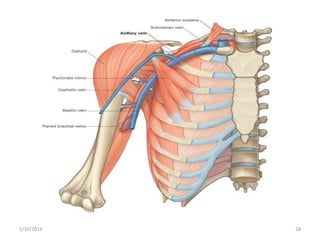
AXILLARY VEIN
• The axillary vein begins at the lower margin of
the teres major muscle and is the continuation of
the basilic vein, which is a superficial vein that
drains the posteromedial surface of the hand and
forearm and penetrates the deep fascia in the
middle of the arm.
• The axillary vein passes through the axilla medial
and anterior to the axillary artery and becomes the
subclavian vein as the vessel crosses the lateral
border of 1st rib at the axillary inlet.
• Tributaries of the axillary vein generally follow
the branches of the axillary artery. Other
tributaries include brachial veins that follow the
brachial artery, and the cephalic vein.
2/10/2014

26
• The cephalic vein is a superficial vein that drains the lateral
and posterior parts of the hand, the forearm, and the arm.
• In the area of the shoulder, it passes into an inverted
triangular cleft (the clavipectoral triangle) between the
deltoid muscle, pectoralis major muscle, and the clavicle.
• In the superior part of the clavipectoral triangle, the cephalic
vein passes deep to the clavicular head of the pectoralis
major muscle and pierces the clavipectoral fascia to join the
axillary vein.
• Many patients who are critically unwell have lost blood or
fluid, which requires replacement. Access to a peripheral
vein is necessary to replace the fluid. The typical sites for
venous access are the cephalic vein adjacent to the
anatomical snuffbox or the antecubital veins, which lie within
the superficial tissues of the cubital fossa.
2/10/2014

27
2/10/2014

28
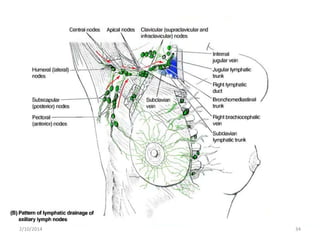
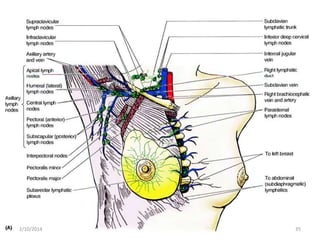
Axillary Lymph Nodes

• The fibrofatty connective tissue of the axilla has
many lymph nodes.
• They are arranged in five principal groups: apical,
pectoral, subscapular, humeral, and central.
• Apical group; consists of lymph nodes at the
apex of the axilla.
• Located along the medial side of the axillary vein
and the first part of the axillary artery.
• It receives lymph from all other groups of axillary
lymph nodes.
2/10/2014

29
• Pectoral (anterior) group;
• Consists of three to five lymph nodes that
lie along the medial wall of the axilla,
around the lateral thoracic vein and the
inferior border of the pectoralis minor.
• The pectoral group of nodes receives
lymph mainly from the anterior thoracic
wall including the breast.
2/10/2014

30
• The subscapular (posterior) group;
• Consists of six or seven lymph nodes that
lie along the posterior axillary fold and
subscapular blood vessels.
• This group of lymph nodes receives
lymph from the posterior aspect of the
thoracic wall and scapular region.
2/10/2014

31
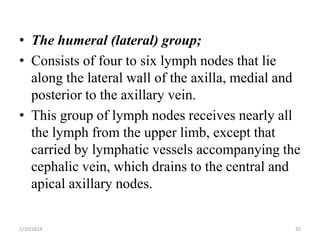
• The humeral (lateral) group;
• Consists of four to six lymph nodes that lie
along the lateral wall of the axilla, medial and
posterior to the axillary vein.
• This group of lymph nodes receives nearly all
the lymph from the upper limb, except that
carried by lymphatic vessels accompanying the
cephalic vein, which drains to the central and
apical axillary nodes.
2/10/2014

32
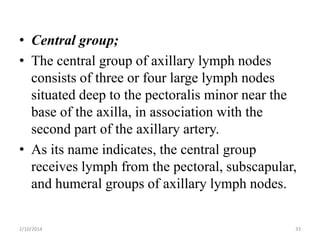
• Central group;
• The central group of axillary lymph nodes
consists of three or four large lymph nodes
situated deep to the pectoralis minor near the
base of the axilla, in association with the
second part of the axillary artery.
• As its name indicates, the central group
receives lymph from the pectoral, subscapular,
and humeral groups of axillary lymph nodes.
2/10/2014

33
2/10/2014

34
2/10/2014

35
GOODAFTERNOON

2/10/2014

36

The axilla

  • 1.
  • 2.
    • The axillais the gateway to the upper limb, providing an area of transition between the neck and the arm. • Formed by the clavicle, the scapula, the upper thoracic wall, the humerus, and related muscles. • The axilla is an irregularly shaped pyramidal space with: • four sides/walls • an inlet/apex and • a floor (base). 2/10/2014 2
  • 3.
    • The axillaryinlet is continuous superiorly with the neck, and the lateral part of the floor opens into the arm. • The shape and size of the axilla varies depending on the position of the arm; it almost disappears when the arm is fully abducted. • The axilla provides a passageway for vessels and nerves to reach the upper limb. 2/10/2014 3
  • 4.
  • 5.
  • 6.
    BOUNDARIES • The wallsof the axilla are as follows; anterior, posterior, medial and lateral walls. A. ANTERIOR WALL; Formed by the pectorialis major muscle  Clavipectoral fascia  Pectorialis minor muscle 2/10/2014 6
  • 7.
    B. Posterior wall; Formedby the subscapularis muscle  Latissimus dorsi  Teres major C. Medial wall; Formed by the serattus anterior covering the upper part of the lateral thoracic wall 2/10/2014 7
  • 8.
    D. Lateral wall; Isa narrow wall formed by the shaft of the humerus of arm  Coracobrachialis muscle  Short head of biceps brachii muscle 2/10/2014 8
  • 9.
    E. Apex; Is triangularand directed upwards and medially towards the root of the neck. It is bounded by the clavicle bone anteriorly,  First rib medially and  Upper border of scapula posteriorly 2/10/2014 9
  • 10.
    • Major vesselsand nerves pass between the neck and the axilla by crossing over the lateral border of rib I and through the axillary inlet. • The subclavian artery, the major blood vessel supplying the upper limb, becomes the axillary artery as it crosses the lateral margin of 1st rib and enters the axilla. 2/10/2014 10
  • 11.
    • Similarly, theaxillary vein becomes the subclavian vein as it passes over the lateral margin of rib I and leaves the axilla to enter the neck. • At the axillary inlet, the axillary vein is anterior to the axillary artery, which, in turn, is anterior to the trunks of the brachial plexus. 2/10/2014 11
  • 12.
    F. The base/floor; Thefloor of the axilla is formed by fascia and a dome of skin that spans the distance between the inferior margins of the walls.  It is supported by the clavipectoral fascia. 2/10/2014 12
  • 13.
  • 14.
    AXILLARY CONTENTS • Contentsof the axilla includes; 1. The three cords of the brachial plexus and their branches 2. The axillary arteries and its branches 3. The axillary vein and its tributaries 4. The axillary lymph nodes 5. Fibro-fatty tissue 6. The axillary tail of Spence of mammary gland in females 2/10/2014 14
  • 15.
    Axillary artery • Theaxillary artery supplies the walls of the axilla and related regions, and continues as the major blood supply to the more distal parts of the upper limb. • The subclavian artery in the neck becomes the axillary artery at the lateral margin of 1st rib and passes through the axilla, becoming the brachial artery at the inferior margin of the teres major muscle. 2/10/2014 15
  • 16.
    • The axillaryartery is separated into three parts by the pectoralis minor muscle, which crosses anteriorly to the vessel. the first part is proximal to pectoralis minor (extends from the lateral border of 1st rib to medial border of P.minor) the second part is posterior to pectoralis minor (behind the P. minor) the third part is distal to pectoralis minor (the longest part, extending from the lateral border of P.minor to the lower border of teres major muscle. 2/10/2014 16
  • 17.
  • 18.
    Branches • Generally, sixbranches arise from the axillary artery: one from the first part, two from the second part and three from the third part. • First part; a) Superior thoracic artery, a small branch supplying first intercostal space. • Second part; b) the thoraco-acromial branch which pieces the clavipectorial fascia and divides into four branches thus; i. The deltoid branch which lies in deltopectoral groove. 2/10/2014 18
  • 19.
    ii. The clavicularbranch which supplies sternoclavicular joint and subclavius muscle iii. The pectoral branch which supplies the pectoral muscles iv. The acromion branch which takes part in the anastomosis over the acromial process 2/10/2014 19
  • 20.
  • 21.
    c) The lateralthoracic artery, which runs along the lateral border of the P. minor muscle and supplies the anterior and medial walls. In females branches emerge from the inferior border of the P. major and contribute in the supply of the breast. 2/10/2014 21
  • 22.
  • 23.
    • Third part;d) the anterior circumflex humeral artery, It passes anterior to the surgical neck of the humerus and anastomoses with the posterior circumflex humeral artery. • Supplies branches to surrounding tissues, which include the glenohumeral joint and the head of the humerus. 2/10/2014 23
  • 24.
    e) The posteriorcircumflex humeral artery; a much larger artery than the anterior circumflex humeral and accompanies the axillary nerve through the quadrangular space. Supplies the glenohumeral joint and surrounding muscles i.e teres major, minor and long head of triceps brachii. f) The subscapular artery; is the largest branch of the axillary artery and is the major blood supply to the posterior wall of the axilla. • It also contributes to the blood supply of the posterior scapular region. • It divides into its two terminal branches, the circumflex scapular artery and the thoracodorsal artery. 2/10/2014 24
  • 25.
  • 26.
    AXILLARY VEIN • Theaxillary vein begins at the lower margin of the teres major muscle and is the continuation of the basilic vein, which is a superficial vein that drains the posteromedial surface of the hand and forearm and penetrates the deep fascia in the middle of the arm. • The axillary vein passes through the axilla medial and anterior to the axillary artery and becomes the subclavian vein as the vessel crosses the lateral border of 1st rib at the axillary inlet. • Tributaries of the axillary vein generally follow the branches of the axillary artery. Other tributaries include brachial veins that follow the brachial artery, and the cephalic vein. 2/10/2014 26
  • 27.
    • The cephalicvein is a superficial vein that drains the lateral and posterior parts of the hand, the forearm, and the arm. • In the area of the shoulder, it passes into an inverted triangular cleft (the clavipectoral triangle) between the deltoid muscle, pectoralis major muscle, and the clavicle. • In the superior part of the clavipectoral triangle, the cephalic vein passes deep to the clavicular head of the pectoralis major muscle and pierces the clavipectoral fascia to join the axillary vein. • Many patients who are critically unwell have lost blood or fluid, which requires replacement. Access to a peripheral vein is necessary to replace the fluid. The typical sites for venous access are the cephalic vein adjacent to the anatomical snuffbox or the antecubital veins, which lie within the superficial tissues of the cubital fossa. 2/10/2014 27
  • 28.
  • 29.
    Axillary Lymph Nodes •The fibrofatty connective tissue of the axilla has many lymph nodes. • They are arranged in five principal groups: apical, pectoral, subscapular, humeral, and central. • Apical group; consists of lymph nodes at the apex of the axilla. • Located along the medial side of the axillary vein and the first part of the axillary artery. • It receives lymph from all other groups of axillary lymph nodes. 2/10/2014 29
  • 30.
    • Pectoral (anterior)group; • Consists of three to five lymph nodes that lie along the medial wall of the axilla, around the lateral thoracic vein and the inferior border of the pectoralis minor. • The pectoral group of nodes receives lymph mainly from the anterior thoracic wall including the breast. 2/10/2014 30
  • 31.
    • The subscapular(posterior) group; • Consists of six or seven lymph nodes that lie along the posterior axillary fold and subscapular blood vessels. • This group of lymph nodes receives lymph from the posterior aspect of the thoracic wall and scapular region. 2/10/2014 31
  • 32.
    • The humeral(lateral) group; • Consists of four to six lymph nodes that lie along the lateral wall of the axilla, medial and posterior to the axillary vein. • This group of lymph nodes receives nearly all the lymph from the upper limb, except that carried by lymphatic vessels accompanying the cephalic vein, which drains to the central and apical axillary nodes. 2/10/2014 32
  • 33.
    • Central group; •The central group of axillary lymph nodes consists of three or four large lymph nodes situated deep to the pectoralis minor near the base of the axilla, in association with the second part of the axillary artery. • As its name indicates, the central group receives lymph from the pectoral, subscapular, and humeral groups of axillary lymph nodes. 2/10/2014 33
  • 34.
  • 35.
  • 36.