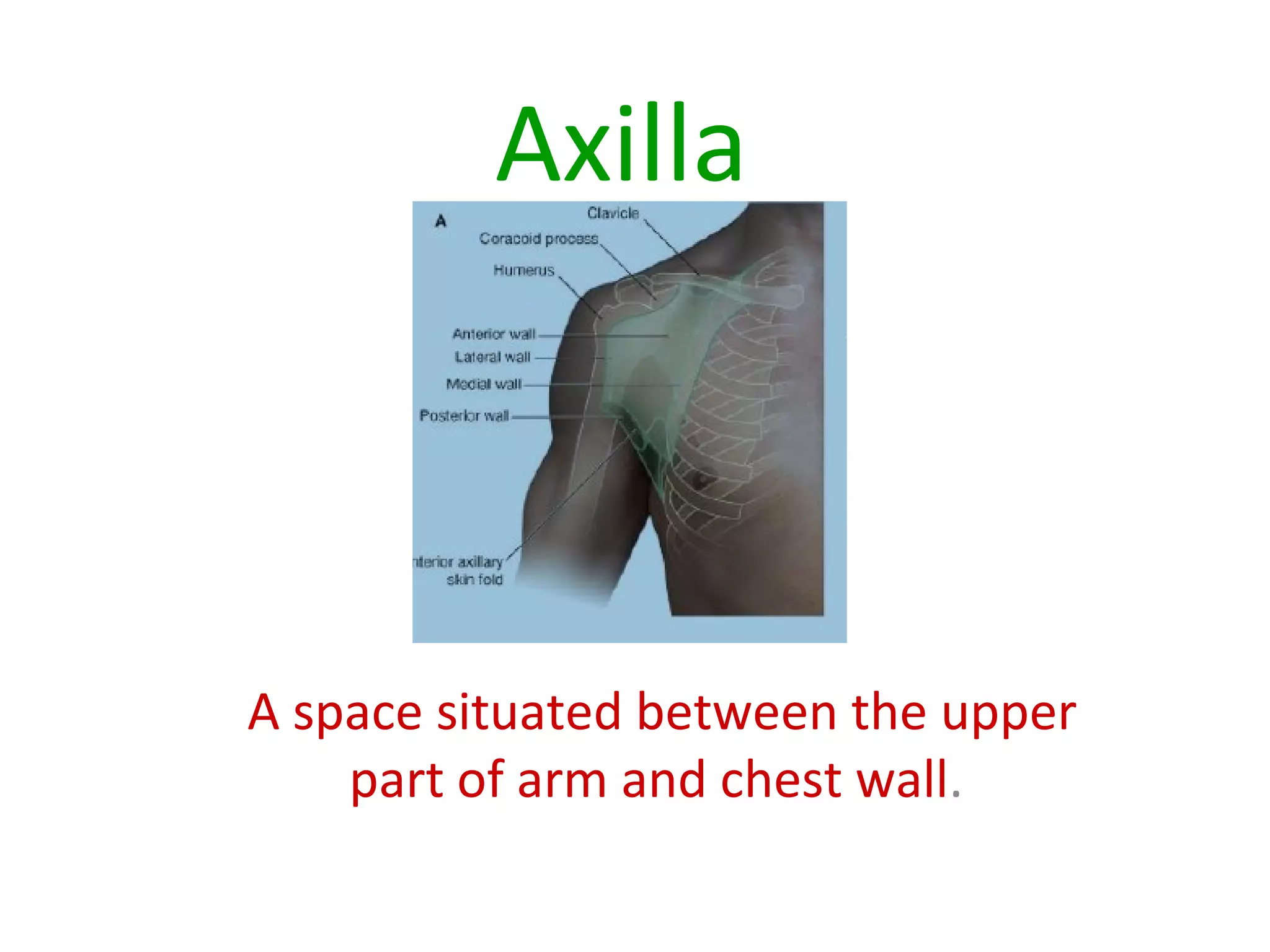
Axilla
A space situated between the upper
part of arm and chest wall.
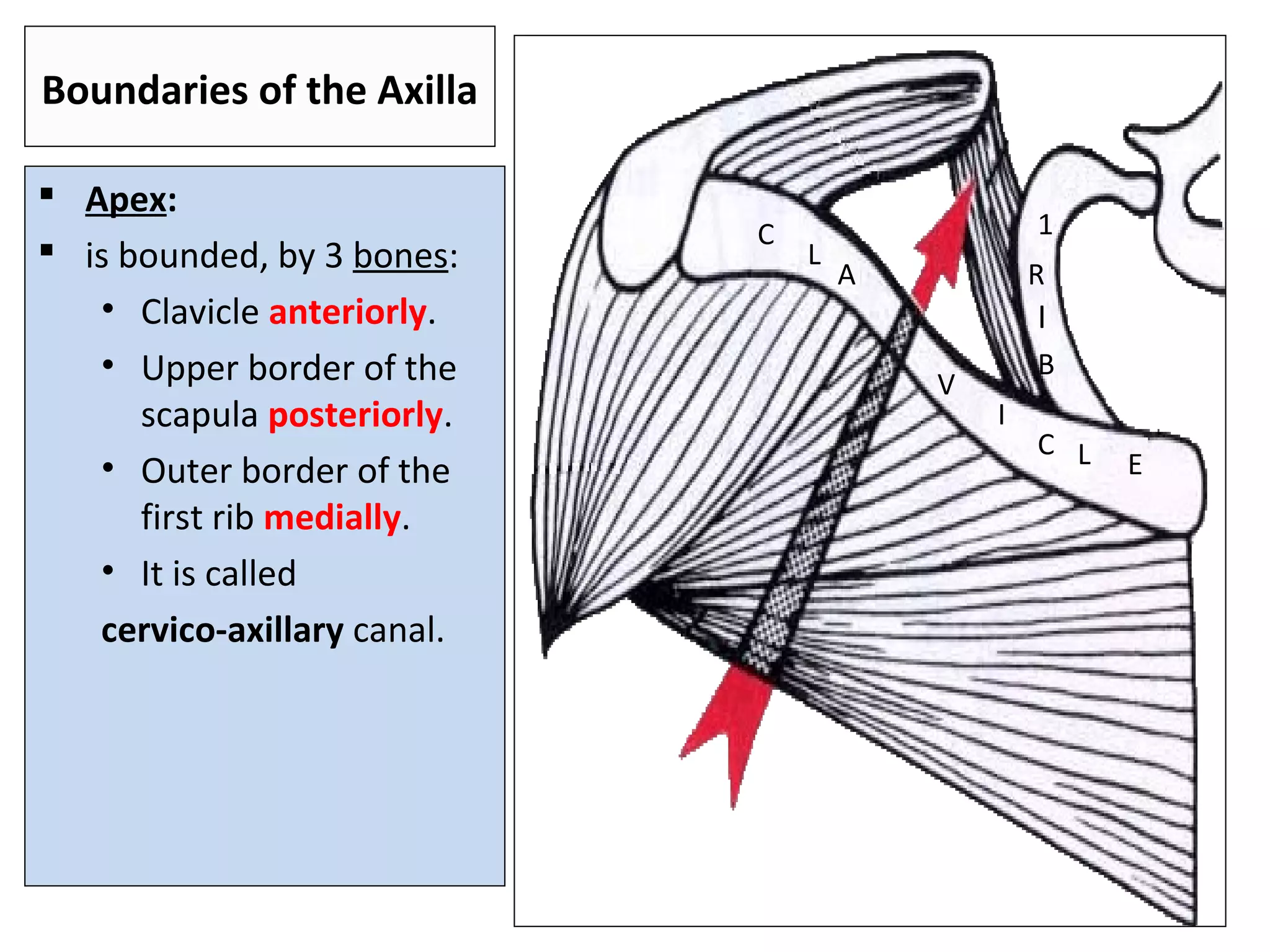
Boundaries of the Axilla
 Apex:
 is bounded, by 3 bones:
• Clavicle anteriorly.
• Upper border of the
scapula posteriorly.
• Outer border of the
first rib medially.
• It is called
cervico-axillary canal.
C
L
A
V
I
C L E
1
R
I
B
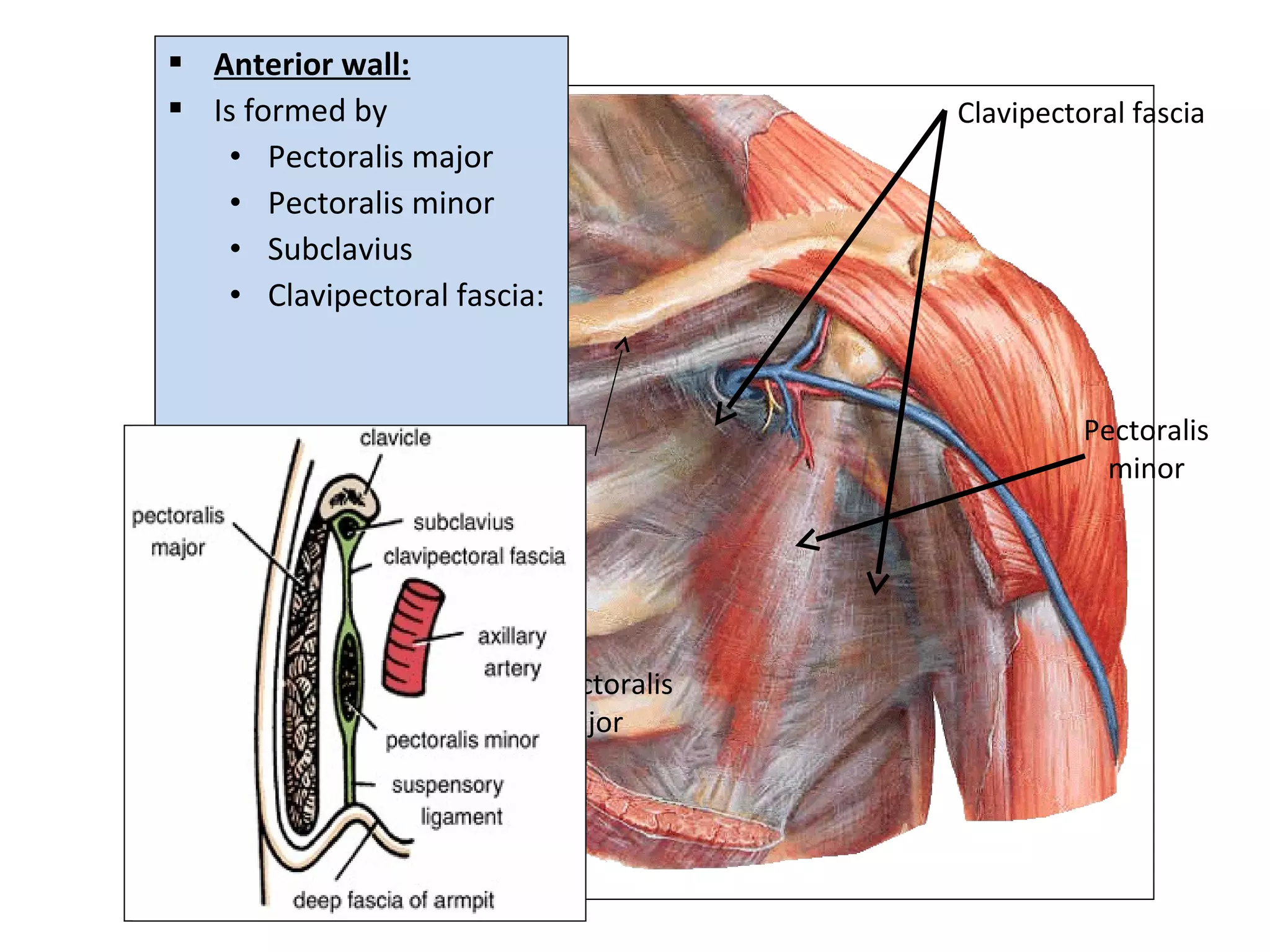
 Anterior wall:
 Is formed by
• Pectoralis major
• Pectoralis minor
• Subclavius
• Clavipectoral fascia:
Pectoralis
major
Pectoralis
minor
Clavipectoral fascia
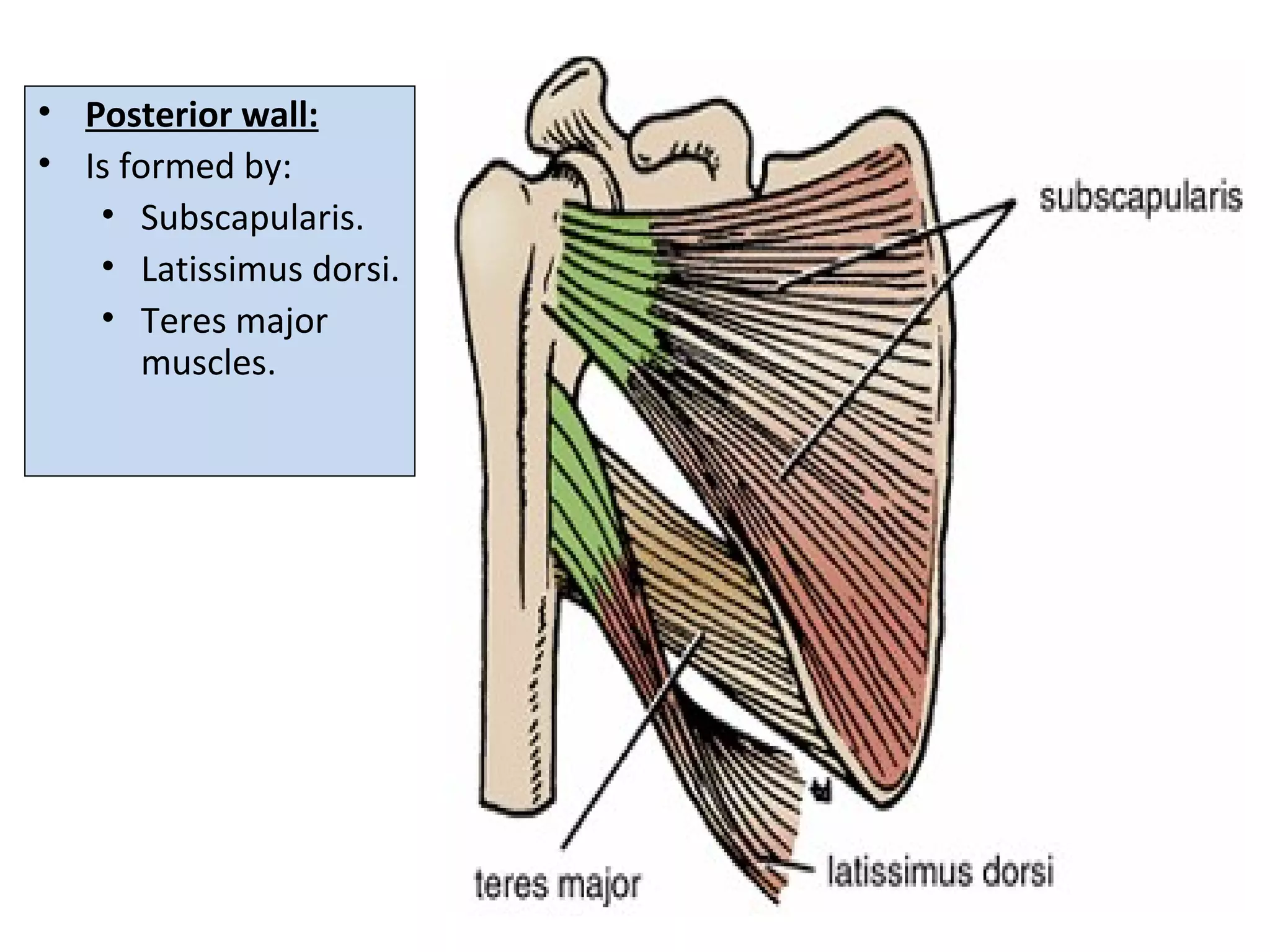
• Posterior wall:
• Is formed by:
• Subscapularis.
• Latissimus dorsi.
• Teres major
muscles.
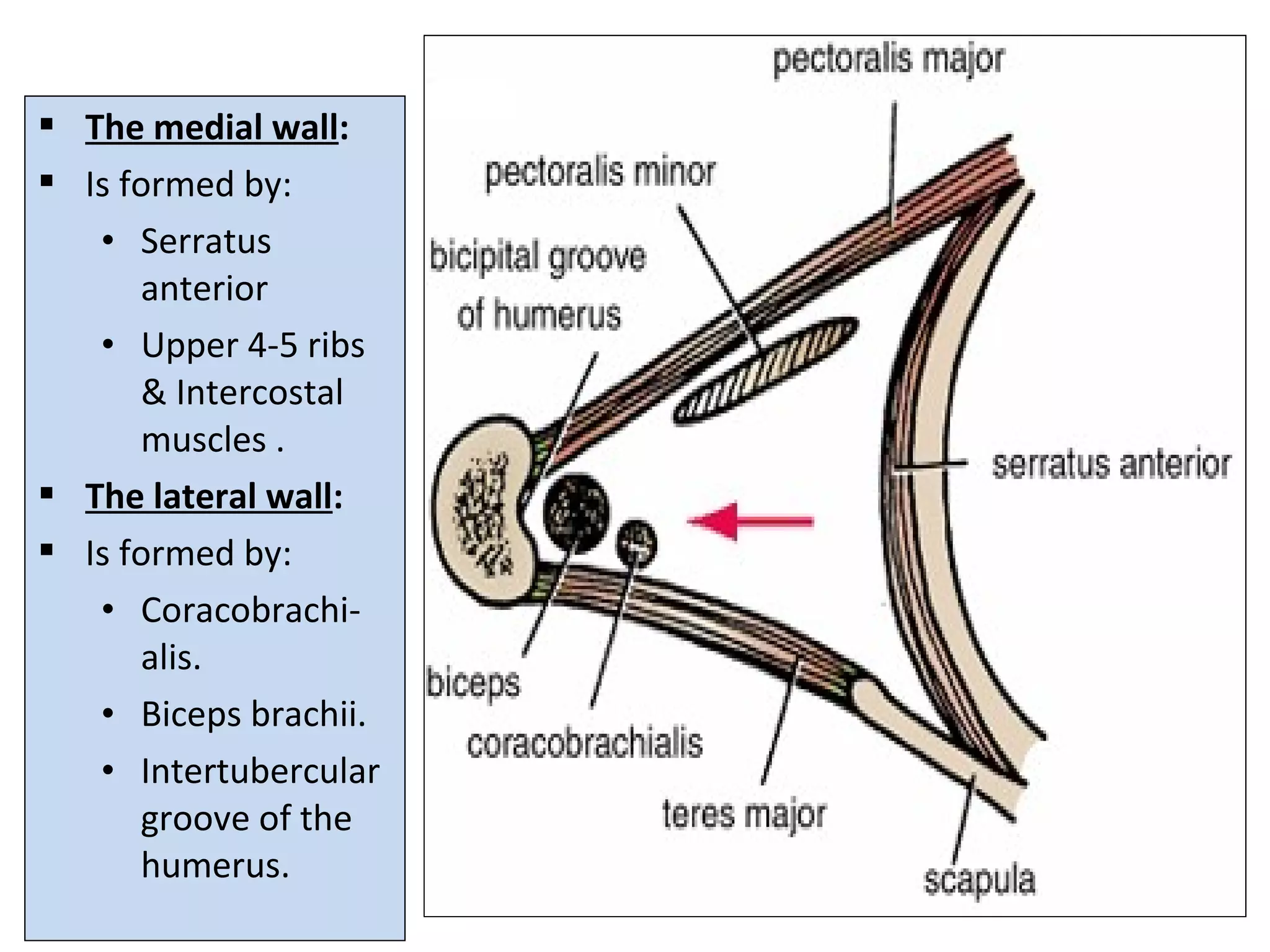
 The medial wall:
 Is formed by:
• Serratus
anterior
• Upper 4-5 ribs
& Intercostal
muscles .
 The lateral wall:
 Is formed by:
• Coracobrachi-
alis.
• Biceps brachii.
• Intertubercular
groove of the
humerus.
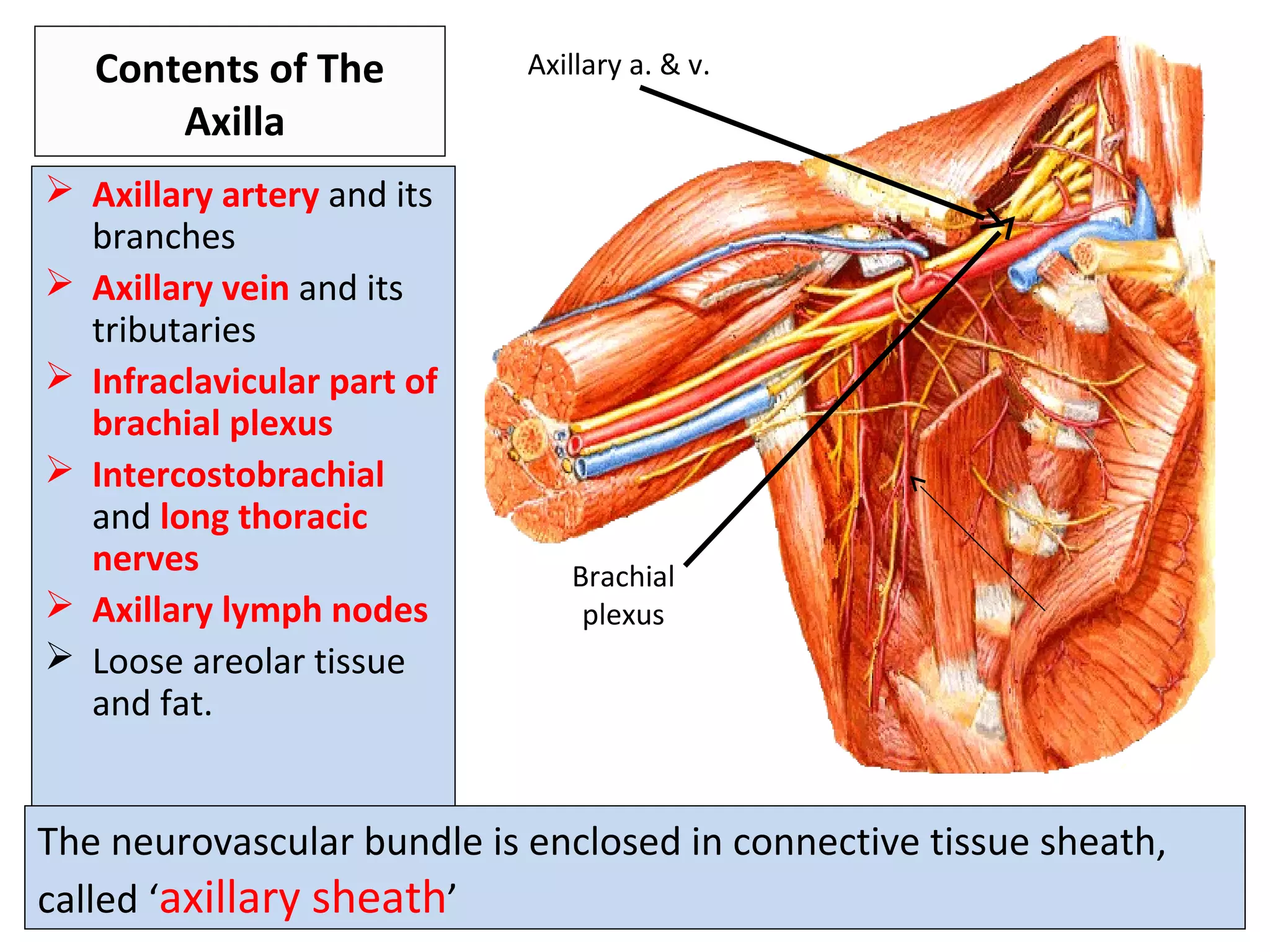
Contents of The
Axilla
 Axillary artery and its
branches
 Axillary vein and its
tributaries
 Infraclavicular part of
brachial plexus
 Intercostobrachial
and long thoracic
nerves
 Axillary lymph nodes
 Loose areolar tissue
and fat.
The neurovascular bundle is enclosed in connective tissue sheath,
called ‘axillary sheath’
Axillary a. & v.
Brachial
plexus
What is a Brachial Plexus ?
Brachial Plexus is a network of nerves present at
the root of the neck to enter the upper limb .
Brachial Plexus supplies muscles and skin of upper
limb except trapezius supplied by spinal accessory
nerve and an area of skin of axilla supplied by
intercostobrachial nerve
7
It is formed by the union of the anterior Rami of the
C 5th
, 6th
, 7th
& 8th
and the 1st
thoracic spinal nerve.
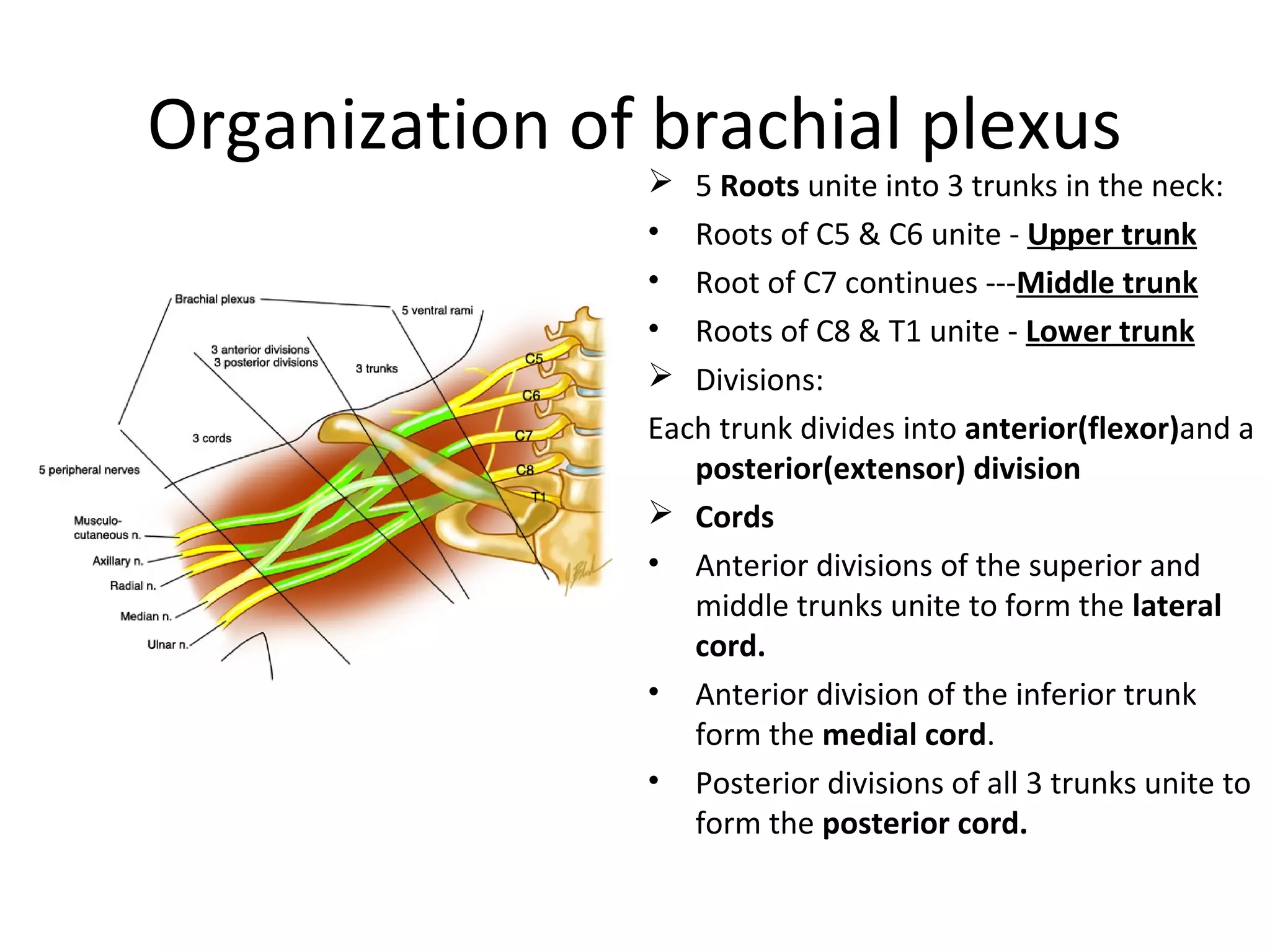
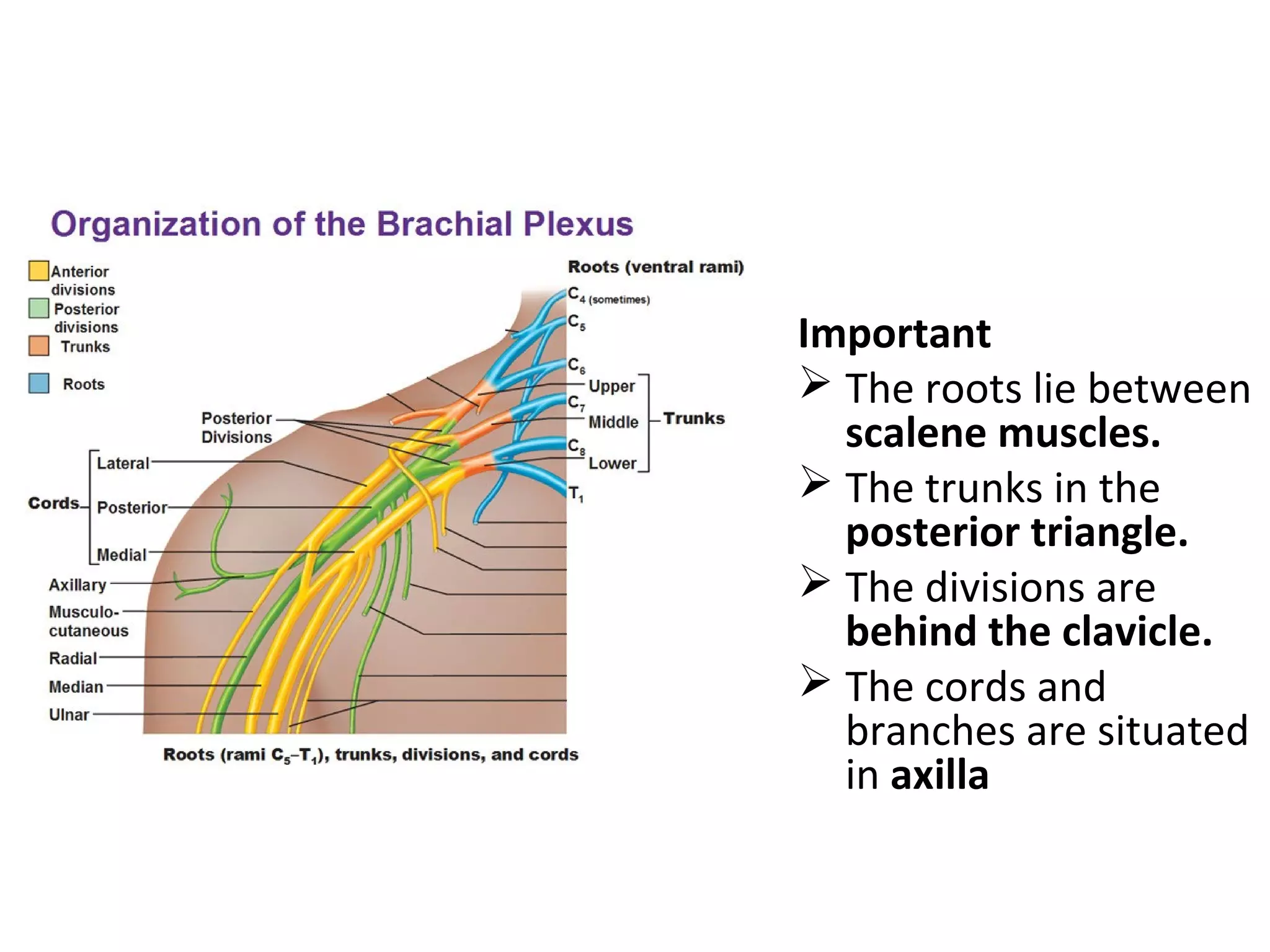
Organization of brachial plexus
 5 Roots unite into 3 trunks in the neck:
• Roots of C5 & C6 unite - Upper trunk
• Root of C7 continues ---Middle trunk
• Roots of C8 & T1 unite - Lower trunk
 Divisions:
Each trunk divides into anterior(flexor)and a
posterior(extensor) division
 Cords
• Anterior divisions of the superior and
middle trunks unite to form the lateral
cord.
• Anterior division of the inferior trunk
form the medial cord.
• Posterior divisions of all 3 trunks unite to
form the posterior cord.
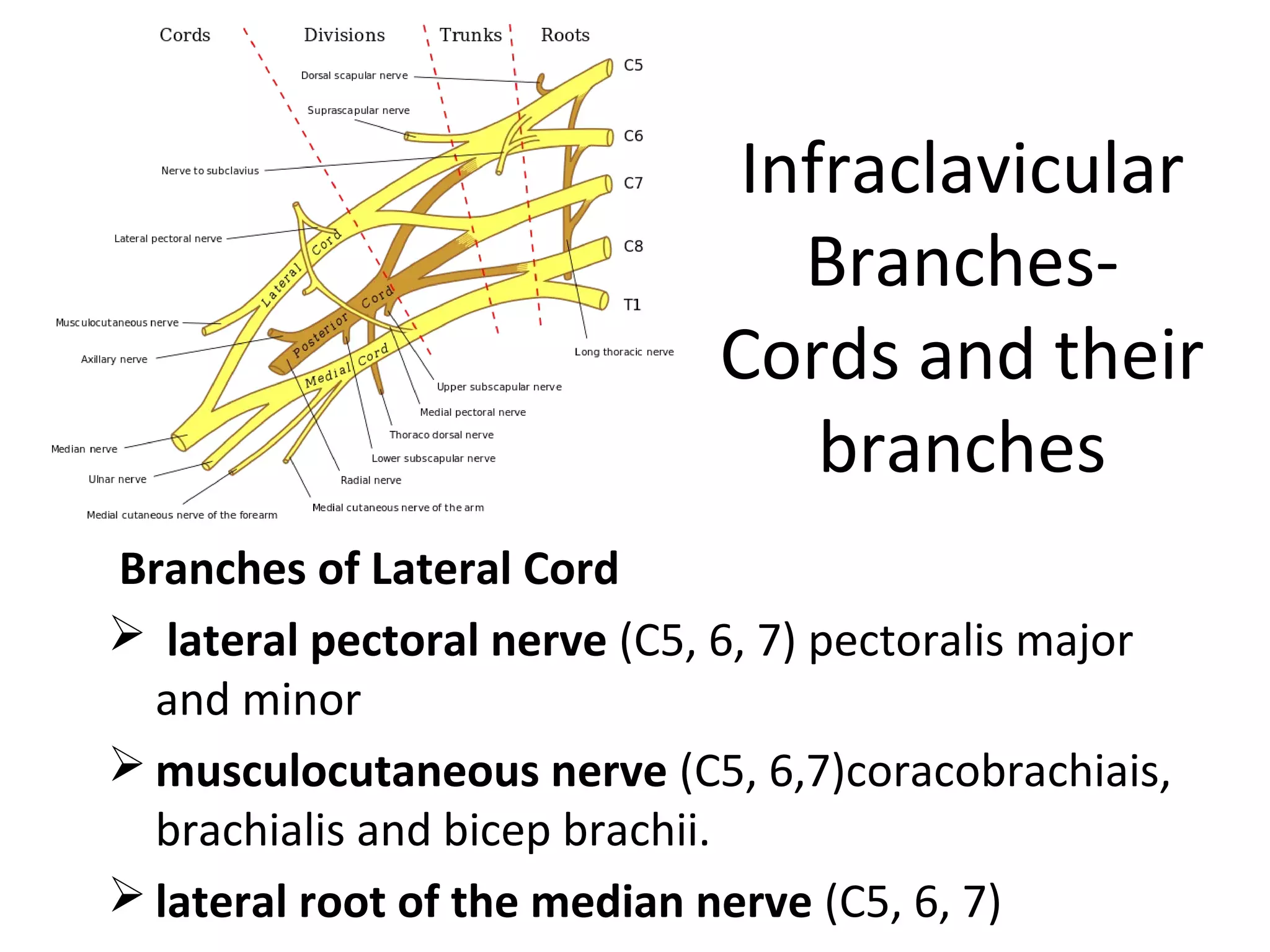
Supraclavicular branches (4)
 The dorsal scapular nerve
(C5), posterior to the roots –
Supplies rhomboids major,
rhomboid minor and levator
scapulae.
 The nerve to subclavius (C5,
6), anterior to the roots –
supplies subclavius
 The long thoracic nerve (C5,
6, 7) posterior to the roots-
supplies serratus anterior
 The suprascapular nerve (C5,
6) –supplies supraspinatus
and infraspinatus.
Important
 The roots lie between
scalene muscles.
 The trunks in the
posterior triangle.
 The divisions are
behind the clavicle.
 The cords and
branches are situated
in axilla
Infraclavicular
Branches-
Cords and their
branches
Branches of Lateral Cord
 lateral pectoral nerve (C5, 6, 7) pectoralis major
and minor
 musculocutaneous nerve (C5, 6,7)coracobrachiais,
brachialis and bicep brachii.
 lateral root of the median nerve (C5, 6, 7)
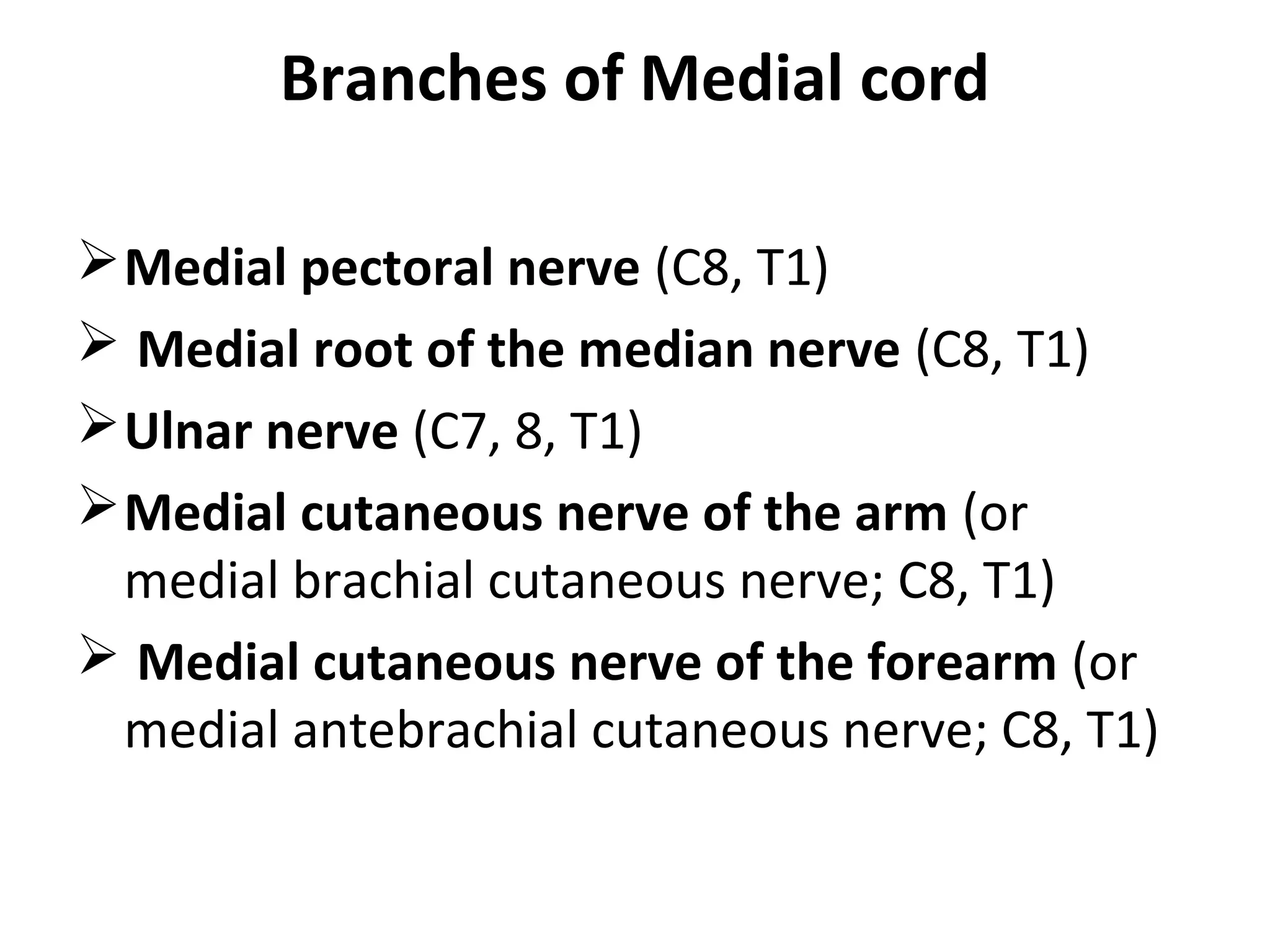
Branches of Medial cord
Medial pectoral nerve (C8, T1)
 Medial root of the median nerve (C8, T1)
Ulnar nerve (C7, 8, T1)
Medial cutaneous nerve of the arm (or
medial brachial cutaneous nerve; C8, T1)
 Medial cutaneous nerve of the forearm (or
medial antebrachial cutaneous nerve; C8, T1)
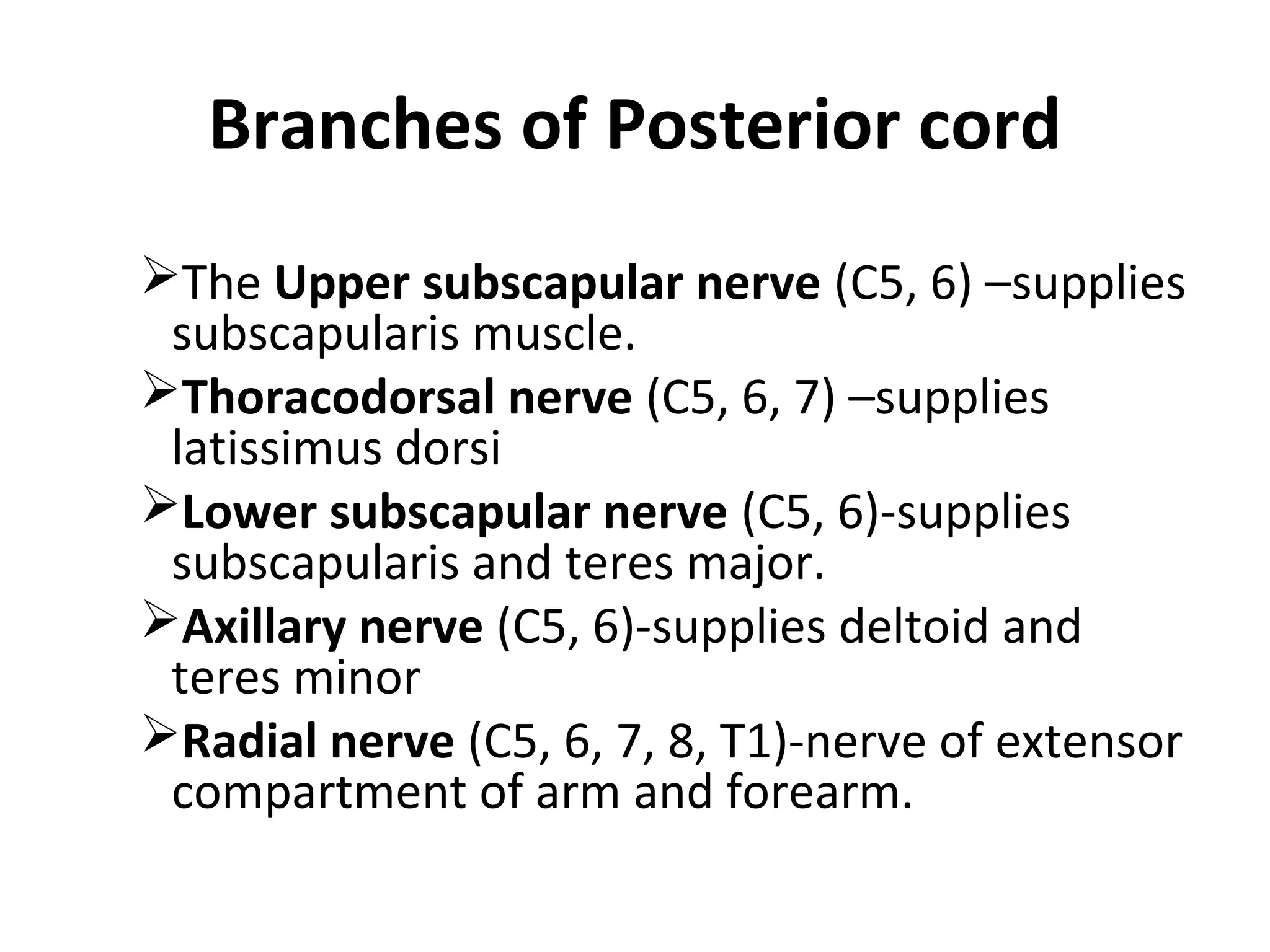
Branches of Posterior cord
The Upper subscapular nerve (C5, 6) –supplies
subscapularis muscle.
Thoracodorsal nerve (C5, 6, 7) –supplies
latissimus dorsi
Lower subscapular nerve (C5, 6)-supplies
subscapularis and teres major.
Axillary nerve (C5, 6)-supplies deltoid and
teres minor
Radial nerve (C5, 6, 7, 8, T1)-nerve of extensor
compartment of arm and forearm.
Intercostobrachial
nerve
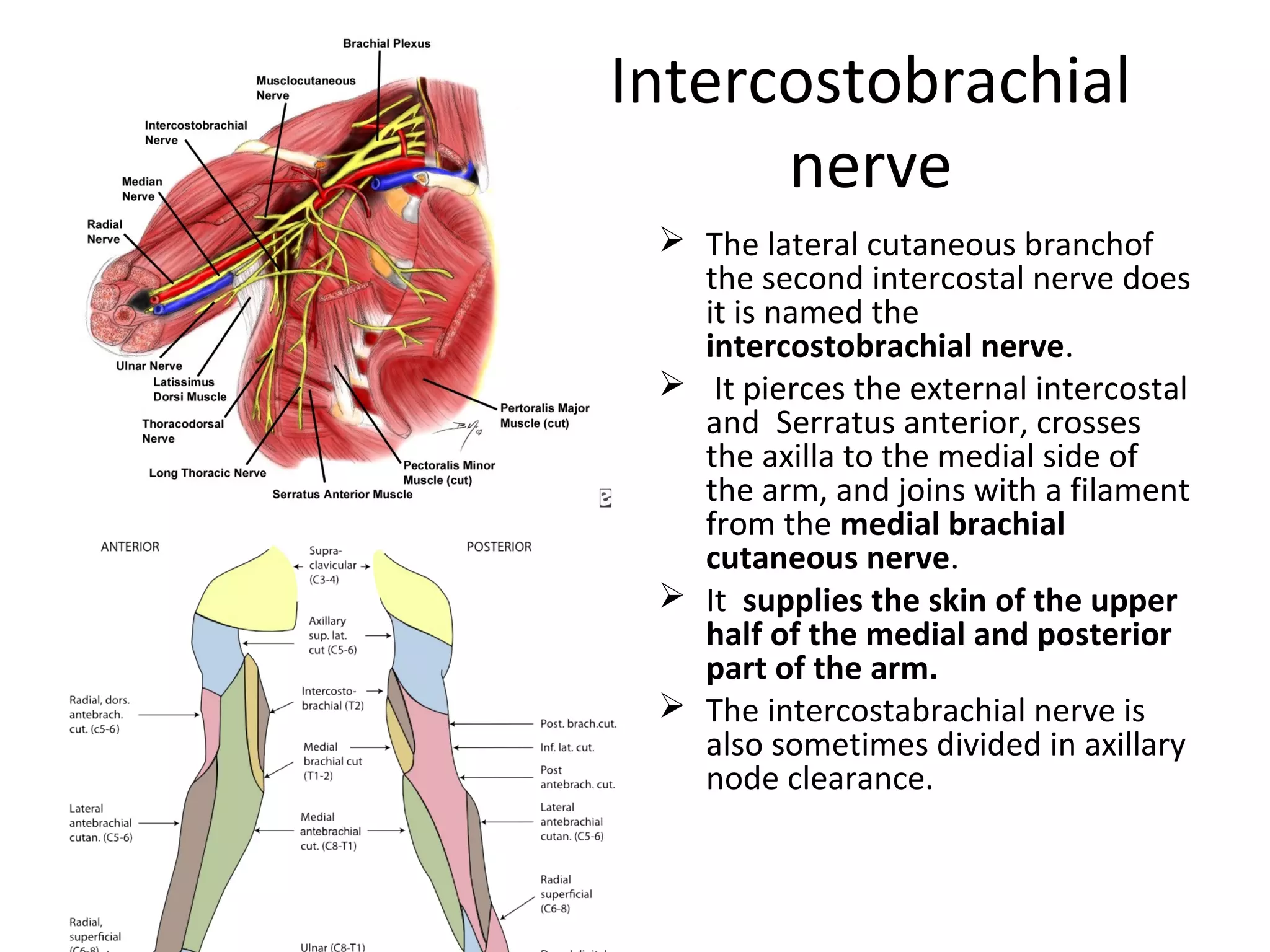
 The lateral cutaneous branchof
the second intercostal nerve does
it is named the
intercostobrachial nerve.
 It pierces the external intercostal
and Serratus anterior, crosses
the axilla to the medial side of
the arm, and joins with a filament
from the medial brachial
cutaneous nerve.
 It supplies the skin of the upper
half of the medial and posterior
part of the arm.
 The intercostabrachial nerve is
also sometimes divided in axillary
node clearance.
Axillary Artery
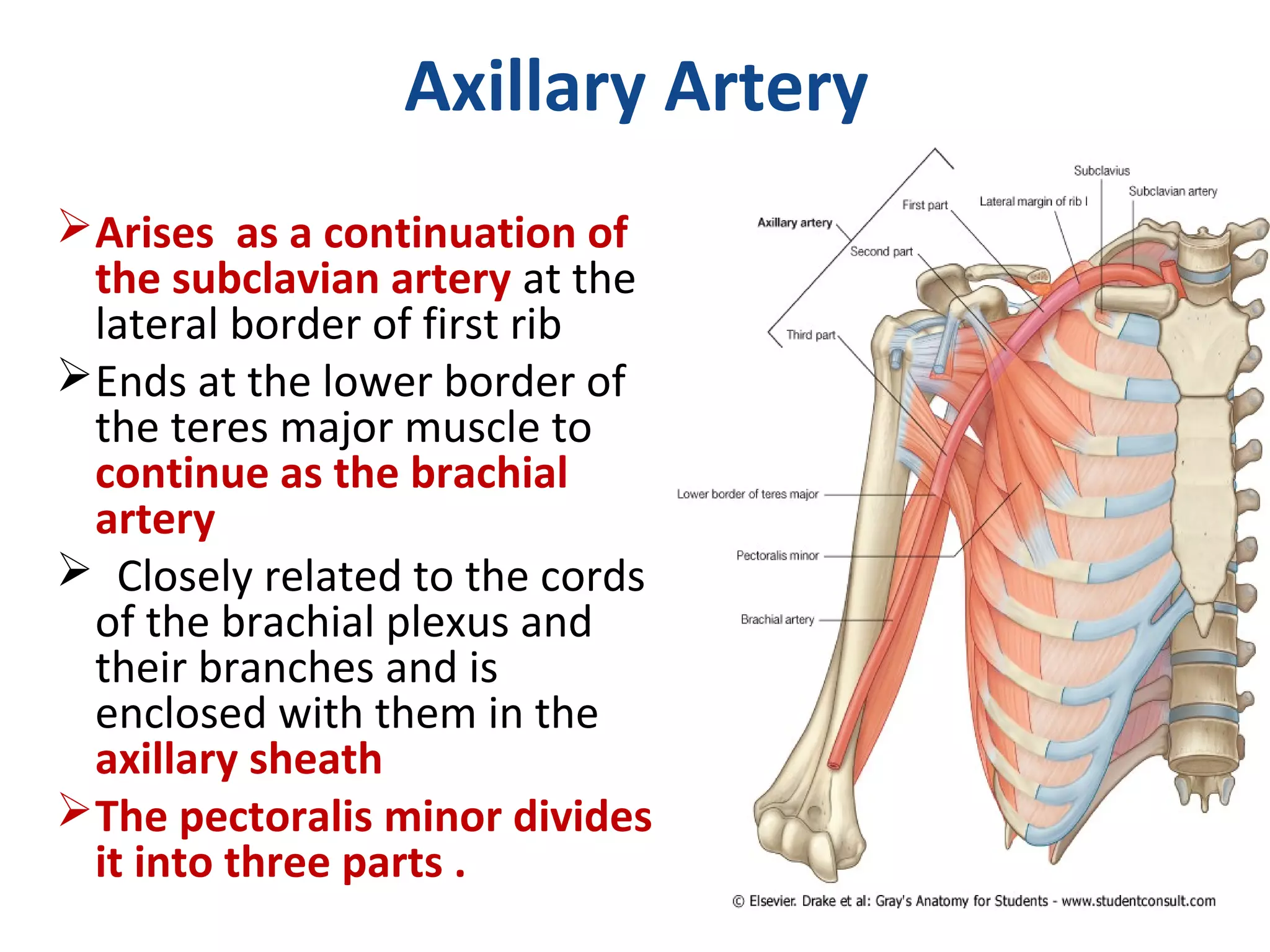
Arises as a continuation of
the subclavian artery at the
lateral border of first rib
Ends at the lower border of
the teres major muscle to
continue as the brachial
artery
 Closely related to the cords
of the brachial plexus and
their branches and is
enclosed with them in the
axillary sheath
The pectoralis minor divides
it into three parts .
Branches of Axillary
Artery
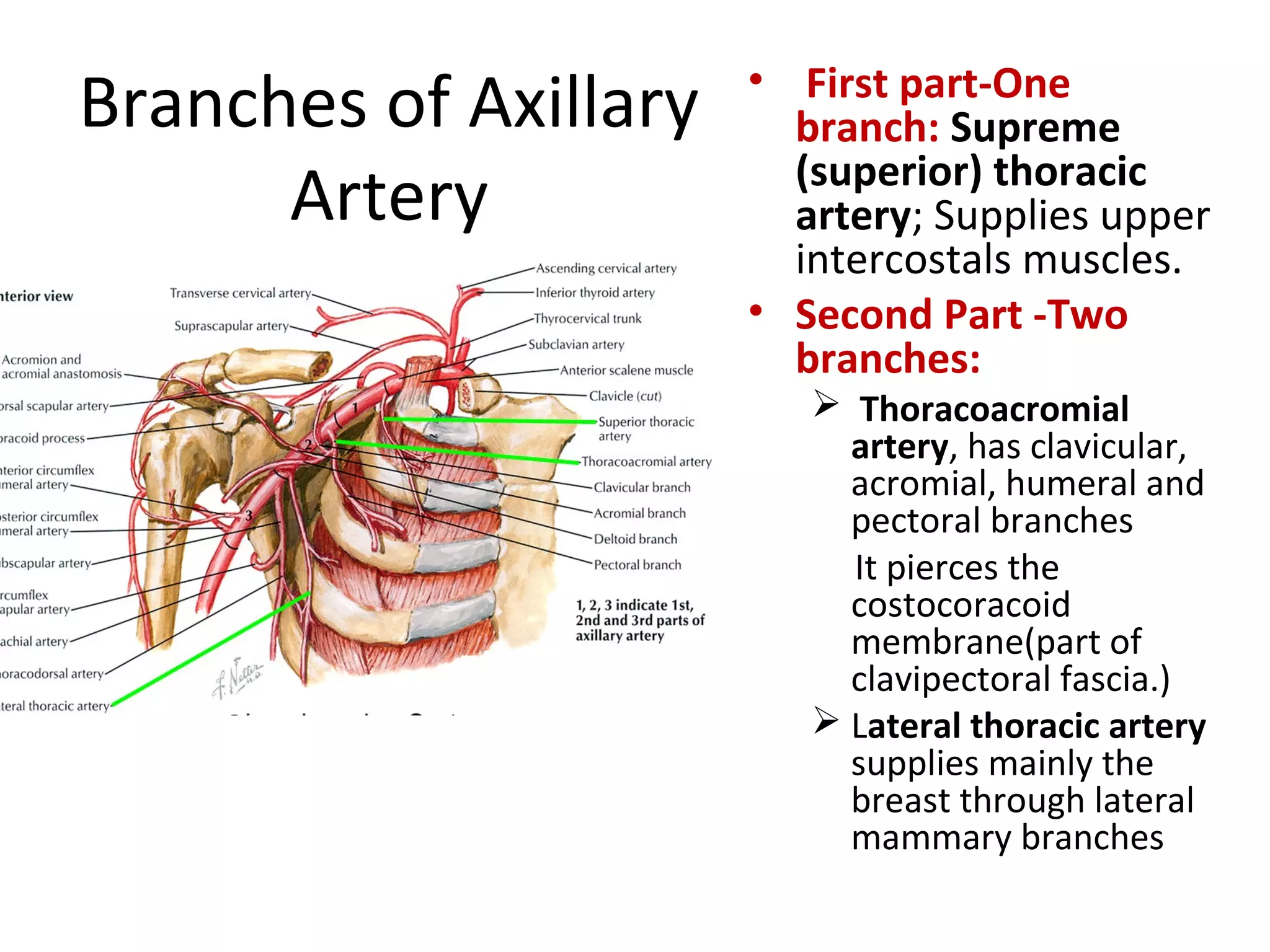
• First part-One
branch: Supreme
(superior) thoracic
artery; Supplies upper
intercostals muscles.
• Second Part -Two
branches:
 Thoracoacromial
artery, has clavicular,
acromial, humeral and
pectoral branches
It pierces the
costocoracoid
membrane(part of
clavipectoral fascia.)
 Lateral thoracic artery
supplies mainly the
breast through lateral
mammary branches
Branches of Axillary Artery-Third Part
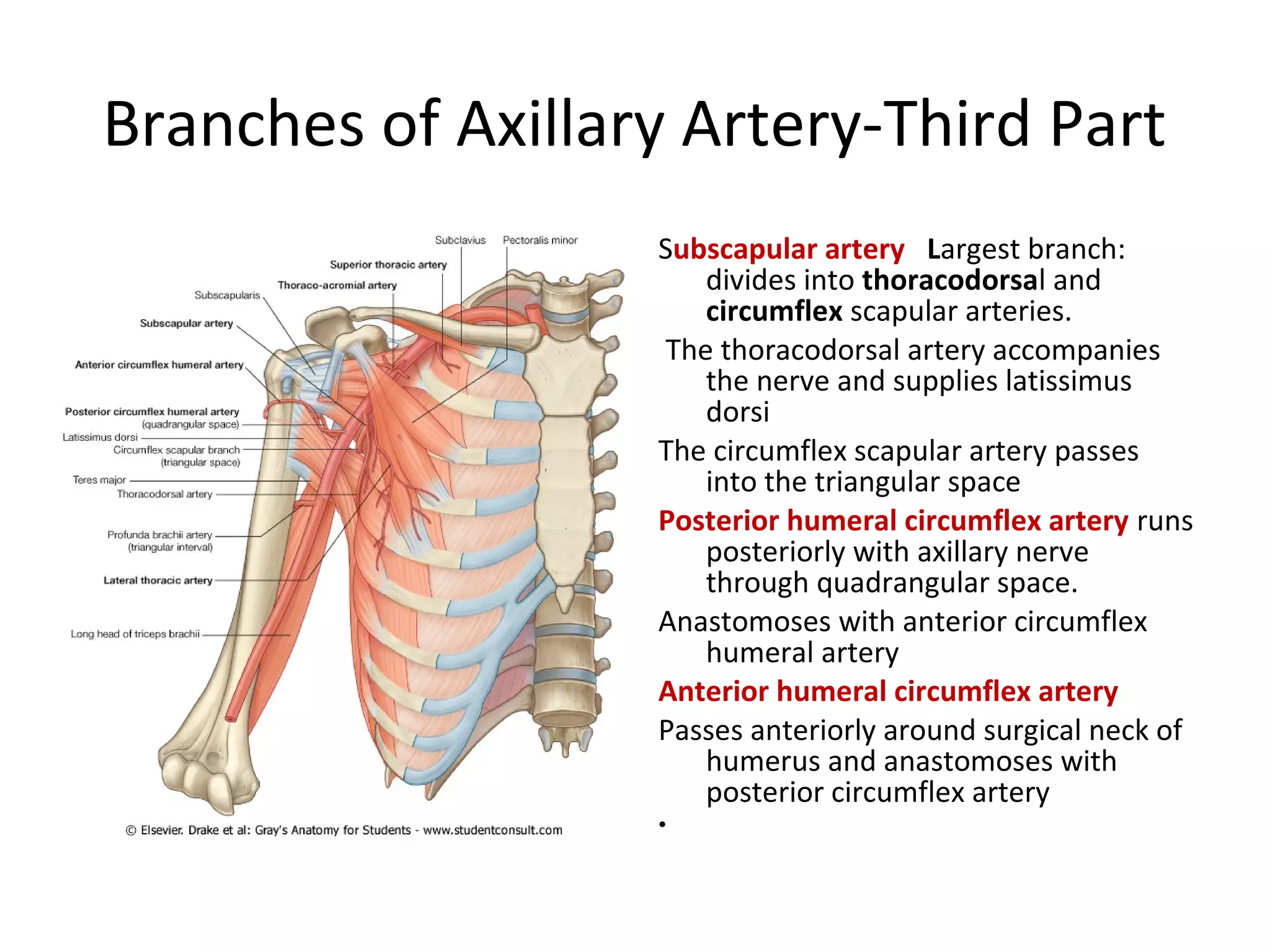
Subscapular artery Largest branch:
divides into thoracodorsal and
circumflex scapular arteries.
The thoracodorsal artery accompanies
the nerve and supplies latissimus
dorsi
The circumflex scapular artery passes
into the triangular space
Posterior humeral circumflex artery runs
posteriorly with axillary nerve
through quadrangular space.
Anastomoses with anterior circumflex
humeral artery
Anterior humeral circumflex artery
Passes anteriorly around surgical neck of
humerus and anastomoses with
posterior circumflex artery
•
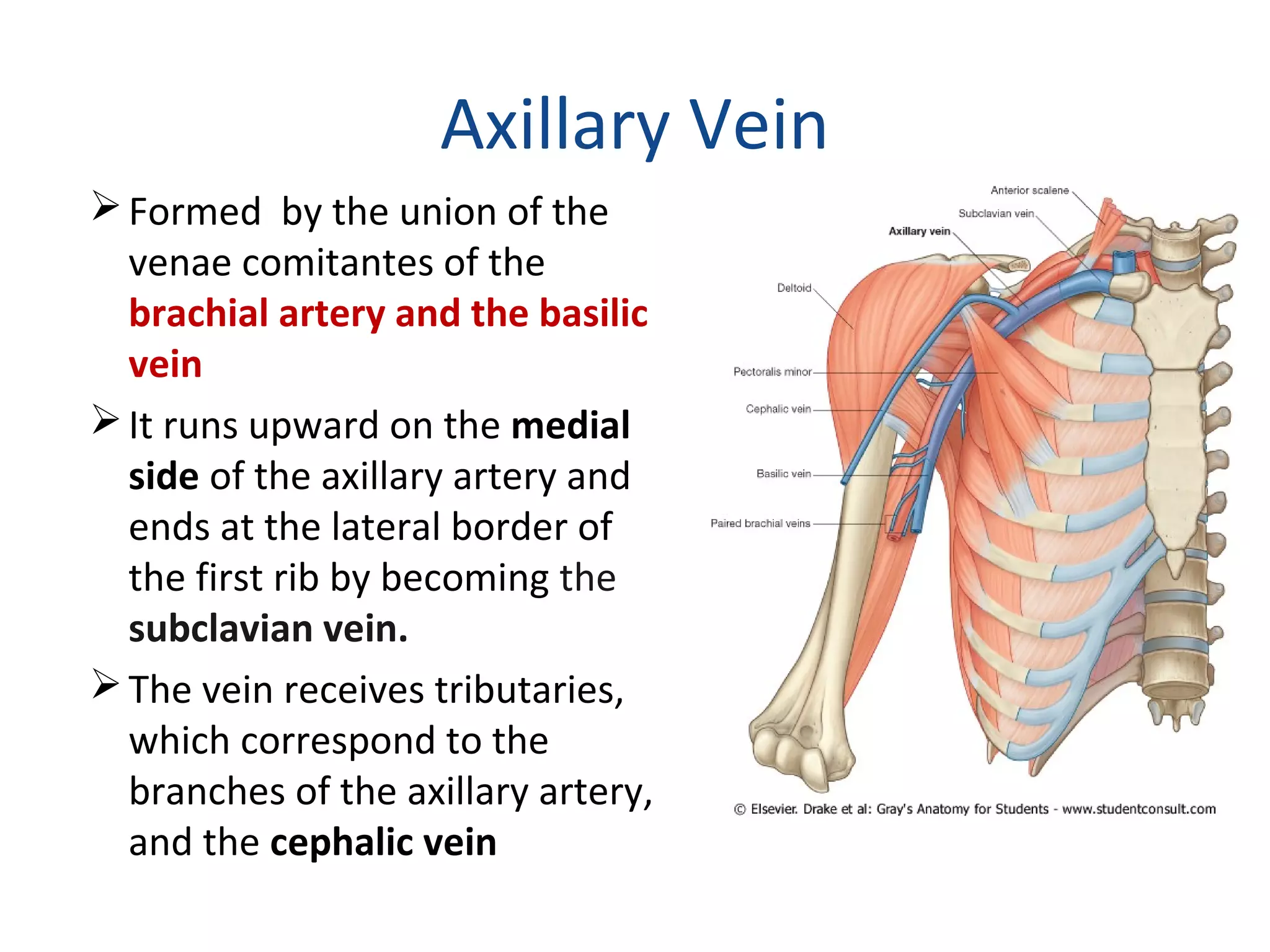
Axillary Vein
Formed by the union of the
venae comitantes of the
brachial artery and the basilic
vein
It runs upward on the medial
side of the axillary artery and
ends at the lateral border of
the first rib by becoming the
subclavian vein.
The vein receives tributaries,
which correspond to the
branches of the axillary artery,
and the cephalic vein
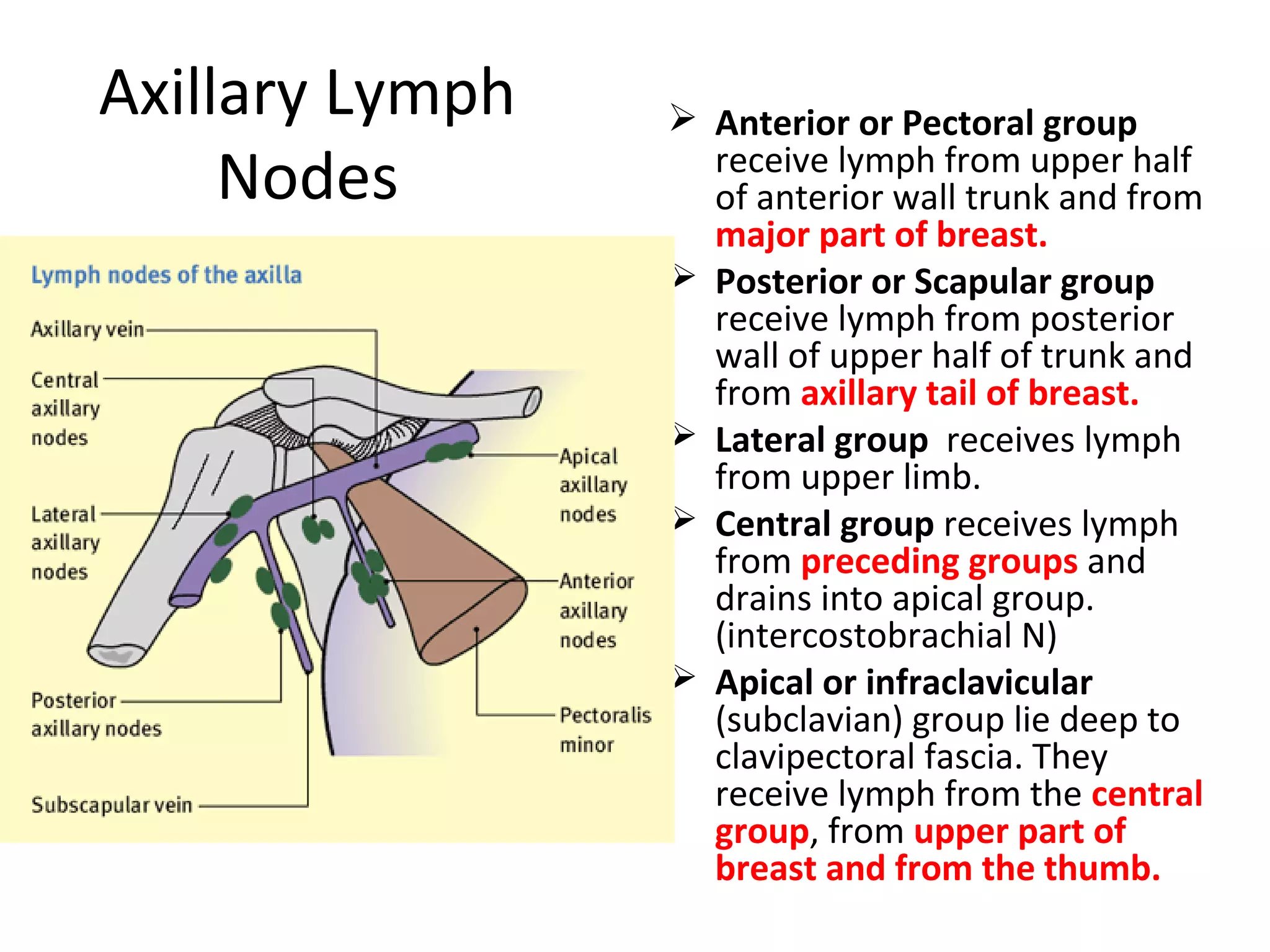
Axillary Lymph
Nodes
 Anterior or Pectoral group
receive lymph from upper half
of anterior wall trunk and from
major part of breast.
 Posterior or Scapular group
receive lymph from posterior
wall of upper half of trunk and
from axillary tail of breast.
 Lateral group receives lymph
from upper limb.
 Central group receives lymph
from preceding groups and
drains into apical group.
(intercostobrachial N)
 Apical or infraclavicular
(subclavian) group lie deep to
clavipectoral fascia. They
receive lymph from the central
group, from upper part of
breast and from the thumb.
Applied Aspect : Erbs Palsy
 Injury to the Upper trunk
called Erb-duchenne
paralysis or Erbs palsy is
caused by birth injury
during a breech delivery or
violent displacement of
head from shoulder such as
from fall from motorcycle
 Patient presents with loss
of abduction, flexion and
lateral rotation of arm,
producing a waiter’s tip
hand or porter’s hand.
Applied aspect: The Cervical rib
 A cervical rib represents a persistent ossification of the
C7 lateral costal element.
 The presence of a cervical rib can cause compression
of the lower trunk of the brachial plexus or subclavian
artery.
 Symptoms are weakness of the muscles around the
muscles in the hand, near the base of the thumb.
 Compression of the subclavian artery is often
diagnosed by finding a positive Adson's sign on
examination, where the radial pulse in the arm is lost
during abduction and external rotation of the
shoulder.
Klumpke’s Palsy or Dejerine-Klumpke palsy
 Lower trunk injury (C8,T1)may be caused by
a difficult breech delivery, by a cervical rib
or abnormal insertion of the anterior and
middle scalene muscles.
 Symptoms include paralysis of intrinsic
hand muscles, flexors of the wrist and
fingers (notably flexor carpi ulnaris and
ulnar half of the flexor digitorum
profundus) and C8/T1 Dermatome
distribution numbness.
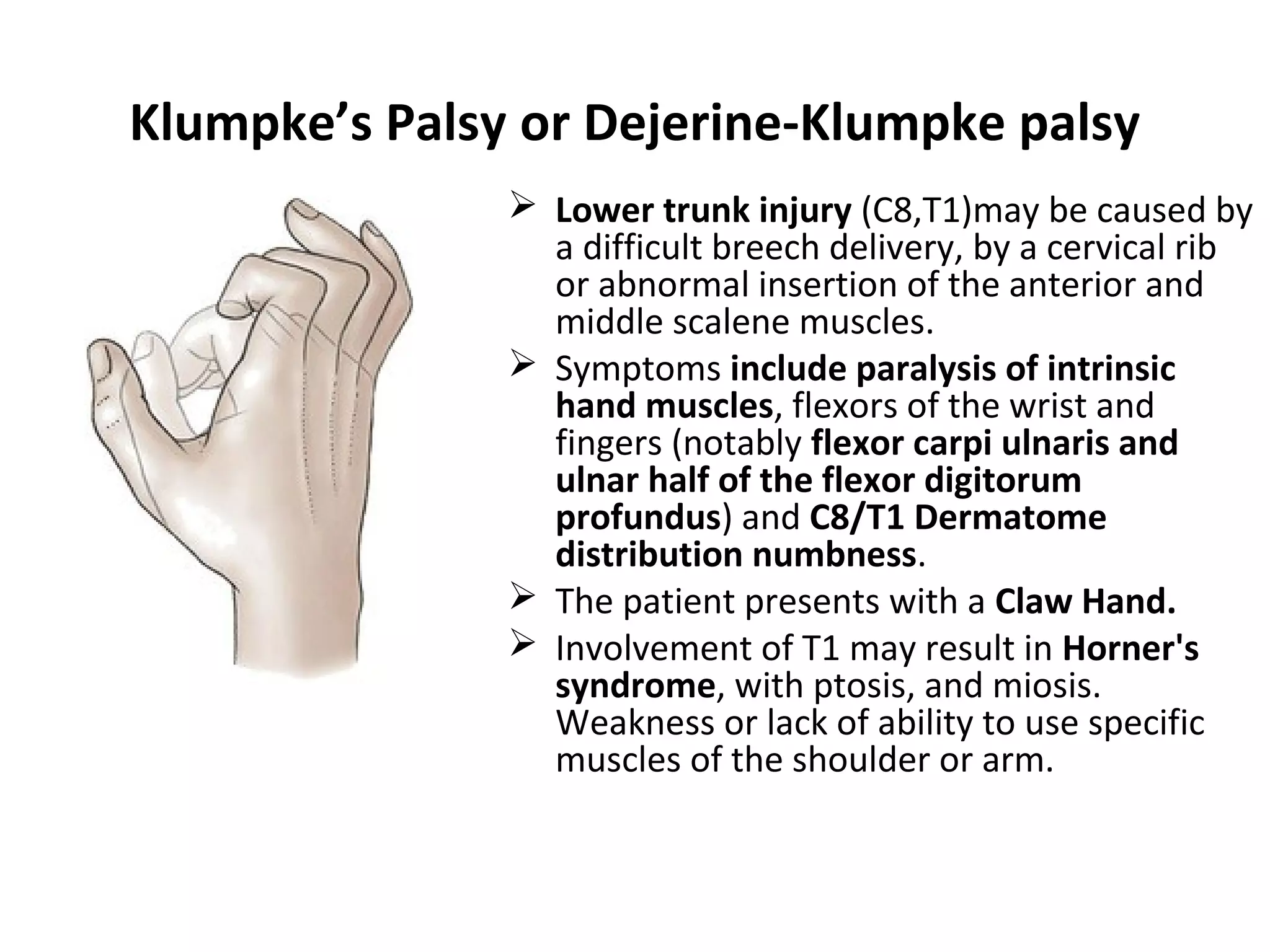
 The patient presents with a Claw Hand.
 Involvement of T1 may result in Horner's
syndrome, with ptosis, and miosis.
Weakness or lack of ability to use specific
muscles of the shoulder or arm.

Axilla & brachial plexus

  • 1.
    Axilla A space situatedbetween the upper part of arm and chest wall.
  • 2.
    Boundaries of theAxilla  Apex:  is bounded, by 3 bones: • Clavicle anteriorly. • Upper border of the scapula posteriorly. • Outer border of the first rib medially. • It is called cervico-axillary canal. C L A V I C L E 1 R I B
  • 3.
     Anterior wall: Is formed by • Pectoralis major • Pectoralis minor • Subclavius • Clavipectoral fascia: Pectoralis major Pectoralis minor Clavipectoral fascia
  • 4.
    • Posterior wall: •Is formed by: • Subscapularis. • Latissimus dorsi. • Teres major muscles.
  • 5.
     The medialwall:  Is formed by: • Serratus anterior • Upper 4-5 ribs & Intercostal muscles .  The lateral wall:  Is formed by: • Coracobrachi- alis. • Biceps brachii. • Intertubercular groove of the humerus.
  • 6.
    Contents of The Axilla Axillary artery and its branches  Axillary vein and its tributaries  Infraclavicular part of brachial plexus  Intercostobrachial and long thoracic nerves  Axillary lymph nodes  Loose areolar tissue and fat. The neurovascular bundle is enclosed in connective tissue sheath, called ‘axillary sheath’ Axillary a. & v. Brachial plexus
  • 7.
    What is aBrachial Plexus ? Brachial Plexus is a network of nerves present at the root of the neck to enter the upper limb . Brachial Plexus supplies muscles and skin of upper limb except trapezius supplied by spinal accessory nerve and an area of skin of axilla supplied by intercostobrachial nerve 7 It is formed by the union of the anterior Rami of the C 5th , 6th , 7th & 8th and the 1st thoracic spinal nerve.
  • 8.
    Organization of brachialplexus  5 Roots unite into 3 trunks in the neck: • Roots of C5 & C6 unite - Upper trunk • Root of C7 continues ---Middle trunk • Roots of C8 & T1 unite - Lower trunk  Divisions: Each trunk divides into anterior(flexor)and a posterior(extensor) division  Cords • Anterior divisions of the superior and middle trunks unite to form the lateral cord. • Anterior division of the inferior trunk form the medial cord. • Posterior divisions of all 3 trunks unite to form the posterior cord.
  • 9.
    Supraclavicular branches (4) The dorsal scapular nerve (C5), posterior to the roots – Supplies rhomboids major, rhomboid minor and levator scapulae.  The nerve to subclavius (C5, 6), anterior to the roots – supplies subclavius  The long thoracic nerve (C5, 6, 7) posterior to the roots- supplies serratus anterior  The suprascapular nerve (C5, 6) –supplies supraspinatus and infraspinatus.
  • 10.
    Important  The rootslie between scalene muscles.  The trunks in the posterior triangle.  The divisions are behind the clavicle.  The cords and branches are situated in axilla
  • 11.
    Infraclavicular Branches- Cords and their branches Branchesof Lateral Cord  lateral pectoral nerve (C5, 6, 7) pectoralis major and minor  musculocutaneous nerve (C5, 6,7)coracobrachiais, brachialis and bicep brachii.  lateral root of the median nerve (C5, 6, 7)
  • 12.
    Branches of Medialcord Medial pectoral nerve (C8, T1)  Medial root of the median nerve (C8, T1) Ulnar nerve (C7, 8, T1) Medial cutaneous nerve of the arm (or medial brachial cutaneous nerve; C8, T1)  Medial cutaneous nerve of the forearm (or medial antebrachial cutaneous nerve; C8, T1)
  • 13.
    Branches of Posteriorcord The Upper subscapular nerve (C5, 6) –supplies subscapularis muscle. Thoracodorsal nerve (C5, 6, 7) –supplies latissimus dorsi Lower subscapular nerve (C5, 6)-supplies subscapularis and teres major. Axillary nerve (C5, 6)-supplies deltoid and teres minor Radial nerve (C5, 6, 7, 8, T1)-nerve of extensor compartment of arm and forearm.
  • 14.
    Intercostobrachial nerve  The lateralcutaneous branchof the second intercostal nerve does it is named the intercostobrachial nerve.  It pierces the external intercostal and Serratus anterior, crosses the axilla to the medial side of the arm, and joins with a filament from the medial brachial cutaneous nerve.  It supplies the skin of the upper half of the medial and posterior part of the arm.  The intercostabrachial nerve is also sometimes divided in axillary node clearance.
  • 15.
    Axillary Artery Arises asa continuation of the subclavian artery at the lateral border of first rib Ends at the lower border of the teres major muscle to continue as the brachial artery  Closely related to the cords of the brachial plexus and their branches and is enclosed with them in the axillary sheath The pectoralis minor divides it into three parts .
  • 16.
    Branches of Axillary Artery •First part-One branch: Supreme (superior) thoracic artery; Supplies upper intercostals muscles. • Second Part -Two branches:  Thoracoacromial artery, has clavicular, acromial, humeral and pectoral branches It pierces the costocoracoid membrane(part of clavipectoral fascia.)  Lateral thoracic artery supplies mainly the breast through lateral mammary branches
  • 17.
    Branches of AxillaryArtery-Third Part Subscapular artery Largest branch: divides into thoracodorsal and circumflex scapular arteries. The thoracodorsal artery accompanies the nerve and supplies latissimus dorsi The circumflex scapular artery passes into the triangular space Posterior humeral circumflex artery runs posteriorly with axillary nerve through quadrangular space. Anastomoses with anterior circumflex humeral artery Anterior humeral circumflex artery Passes anteriorly around surgical neck of humerus and anastomoses with posterior circumflex artery •
  • 18.
    Axillary Vein Formed bythe union of the venae comitantes of the brachial artery and the basilic vein It runs upward on the medial side of the axillary artery and ends at the lateral border of the first rib by becoming the subclavian vein. The vein receives tributaries, which correspond to the branches of the axillary artery, and the cephalic vein
  • 19.
    Axillary Lymph Nodes  Anterioror Pectoral group receive lymph from upper half of anterior wall trunk and from major part of breast.  Posterior or Scapular group receive lymph from posterior wall of upper half of trunk and from axillary tail of breast.  Lateral group receives lymph from upper limb.  Central group receives lymph from preceding groups and drains into apical group. (intercostobrachial N)  Apical or infraclavicular (subclavian) group lie deep to clavipectoral fascia. They receive lymph from the central group, from upper part of breast and from the thumb.
  • 20.
    Applied Aspect :Erbs Palsy  Injury to the Upper trunk called Erb-duchenne paralysis or Erbs palsy is caused by birth injury during a breech delivery or violent displacement of head from shoulder such as from fall from motorcycle  Patient presents with loss of abduction, flexion and lateral rotation of arm, producing a waiter’s tip hand or porter’s hand.
  • 21.
    Applied aspect: TheCervical rib  A cervical rib represents a persistent ossification of the C7 lateral costal element.  The presence of a cervical rib can cause compression of the lower trunk of the brachial plexus or subclavian artery.  Symptoms are weakness of the muscles around the muscles in the hand, near the base of the thumb.  Compression of the subclavian artery is often diagnosed by finding a positive Adson's sign on examination, where the radial pulse in the arm is lost during abduction and external rotation of the shoulder.
  • 22.
    Klumpke’s Palsy orDejerine-Klumpke palsy  Lower trunk injury (C8,T1)may be caused by a difficult breech delivery, by a cervical rib or abnormal insertion of the anterior and middle scalene muscles.  Symptoms include paralysis of intrinsic hand muscles, flexors of the wrist and fingers (notably flexor carpi ulnaris and ulnar half of the flexor digitorum profundus) and C8/T1 Dermatome distribution numbness.  The patient presents with a Claw Hand.  Involvement of T1 may result in Horner's syndrome, with ptosis, and miosis. Weakness or lack of ability to use specific muscles of the shoulder or arm.