ANATOMY
BY
DR. THAAER MOHAMMED DAHER ALSAAD
M.B.CH.B.(MBBS) F.I.B.M.S.(PH.D.)
SPECIALIST IN GENERAL SURGERY
SENIOR LECTURER
IMS MSU
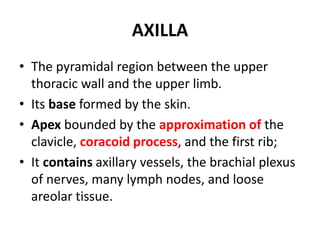
AXILLA
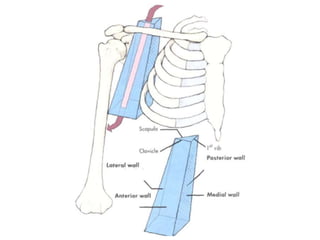
• The pyramidal region between the upper
thoracic wall and the upper limb.
• Its base formed by the skin.
• Apex bounded by the approximation of the
clavicle, coracoid process, and the first rib;
• It contains axillary vessels, the brachial plexus
of nerves, many lymph nodes, and loose
areolar tissue.
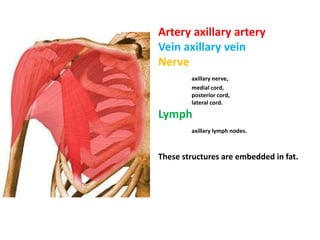
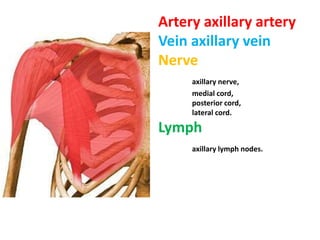
Artery axillary artery
Vein axillary vein
Nerve
axillary nerve,
medial cord,
posterior cord,
lateral cord.
Lymph
axillary lymph nodes.
These structures are embedded in fat.
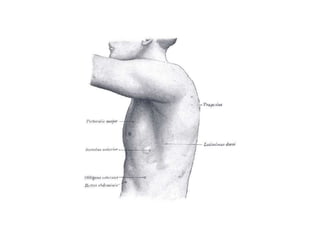
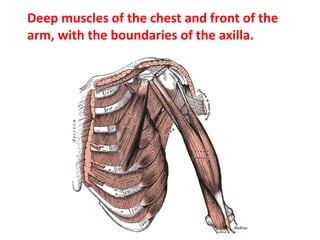
Deep muscles of the chest and front of the
arm, with the boundaries of the axilla.
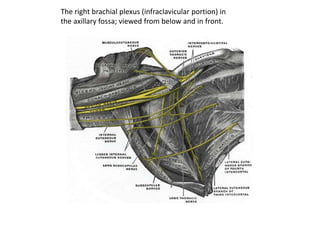
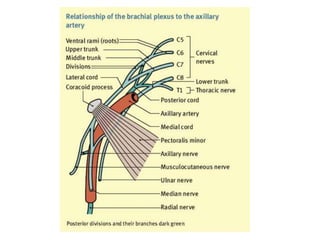
The right brachial plexus (infraclavicular portion) in
the axillary fossa; viewed from below and in front.
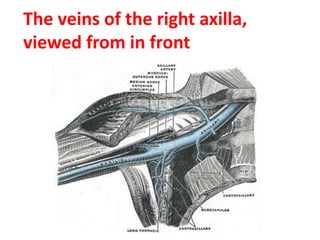
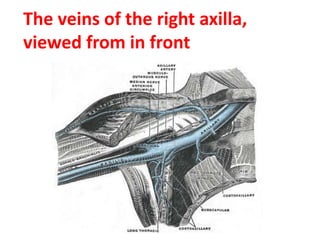
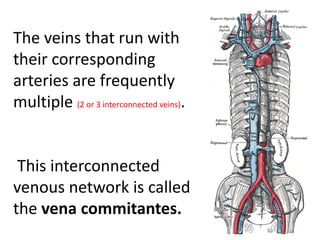
The veins of the right axilla,
viewed from in front
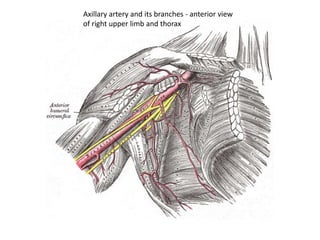
Axillary artery and its branches - anterior view
of right upper limb and thorax
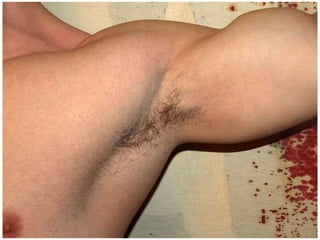
AXILLA/ ( ARMPIT)
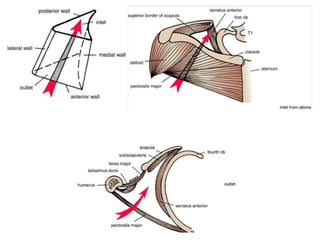
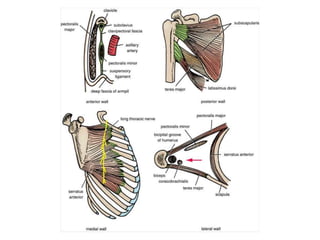
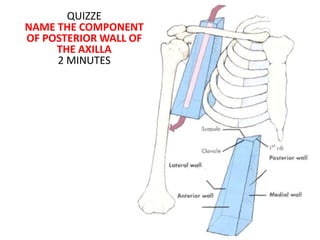
• Anatomically, the boundaries of the axilla are:
 MEDIALLY:
upper 4 or 5 ribs and intercostal spaces covered by serratus anterior muscle.
 ANTERIORLY:
by the pectoralis major, minor, and subclavius
 POSTERIORLY:
by the subscapularis, latissimus dorsi and teres major from above below.
 LATERALLY:
by the intertubercular sulcus (coracobrachialis and the short head of the biceps
brachii are in the axilla.)
 SUPERIORLY:
by the outer border of first rib, superior border of scapula, and posterior border of
clavicle.
floor/base: by the skin (visible surface of armpit).
Key Muscles in the Axilla
• Pectoralis Minor
• The pectoralis minor is a thin triangular
muscle that lies beneath the pectoralis major.
• It arises from the third, fourth, and fifth ribs
and runs upwards and laterally to be inserted
by its apex into the coracoid process of the
scapula.
• It crosses the axillary artery and the brachial
plexus of nerves
Clavipectoral Fascia
• The clavipectoral fascia is a strong sheet of
connective tissue that is attached above to the
clavicle.
• Below, it splits to enclose the pectoralis minor
muscle,
• Then continues downward as the suspensory
ligament of the axilla and joins the fascial
floor of the armpit.
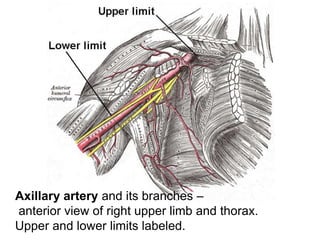
Axillary artery and its branches –
anterior view of right upper limb and thorax.
Upper and lower limits labeled.
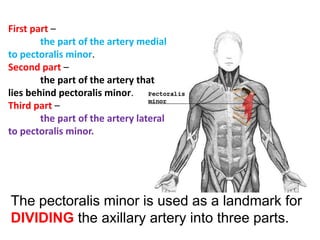
The pectoralis minor is used as a landmark for
DIVIDING the axillary artery into three parts.
First part –
the part of the artery medial
to pectoralis minor.
Second part –
the part of the artery that
lies behind pectoralis minor.
Third part –
the part of the artery lateral
to pectoralis minor.
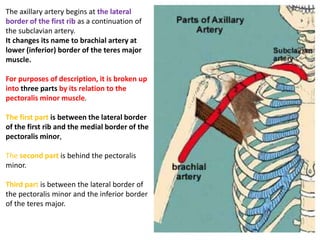
The axillary artery begins at the lateral
border of the first rib as a continuation of
the subclavian artery.
It changes its name to brachial artery at
lower (inferior) border of the teres major
muscle.
For purposes of description, it is broken up
into three parts by its relation to the
pectoralis minor muscle.
The first part is between the lateral border
of the first rib and the medial border of the
pectoralis minor,
The second part is behind the pectoralis
minor.
Third part is between the lateral border of
the pectoralis minor and the inferior border
of the teres major.
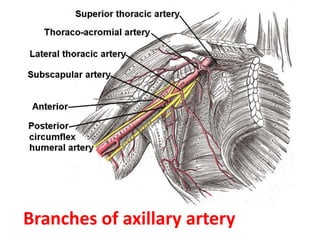
Branches of axillary artery
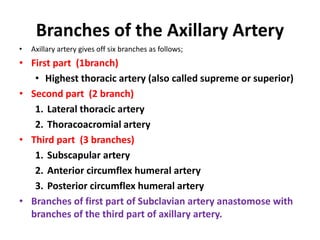
Branches of the Axillary Artery
• Axillary artery gives off six branches as follows;
• First part (1branch)
• Highest thoracic artery (also called supreme or superior)
• Second part (2 branch)
1. Lateral thoracic artery
2. Thoracoacromial artery
• Third part (3 branches)
1. Subscapular artery
2. Anterior circumflex humeral artery
3. Posterior circumflex humeral artery
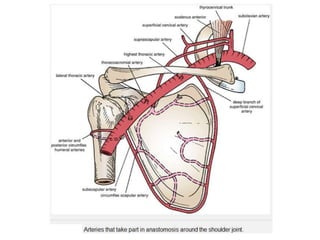
• Branches of first part of Subclavian artery anastomose with
branches of the third part of axillary artery.
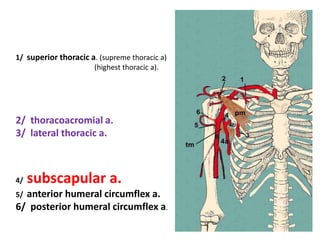
1/ superior thoracic a. (supreme thoracic a)
(highest thoracic a).
2/ thoracoacromial a.
3/ lateral thoracic a.
4/ subscapular a.
5/ anterior humeral circumflex a.
6/ posterior humeral circumflex a.
Axillary Artery
• The axillary artery is accompanied by the axillary
vein along its length.
• In the axilla, it is surrounded by the brachial
plexus.
• The second part of the axillary artery is the
reference for the locational descriptions of the
cords in the brachial plexus.
• For example, the posterior cord of the brachial
plexus is so named because it lies posterior to the
second part of the artery.
NOTE
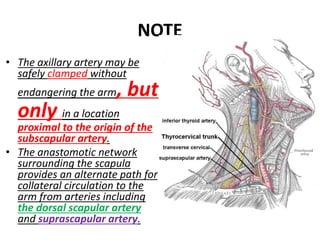
• The axillary artery may be
safely clamped without
endangering the arm, but
only in a location
proximal to the origin of the
subscapular artery.
• The anastomotic network
surrounding the scapula
provides an alternate path for
collateral circulation to the
arm from arteries including
the dorsal scapular artery
and suprascapular artery.
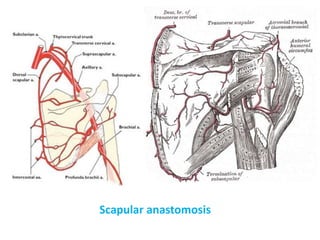
Scapular anastomosis
• The scapular anastomosis is a system connecting each subclavian artery and the
corresponding axillary artery, forming an anastomosis around the scapula. It allows
blood to flow past the joint regardless of the position of the arm. It includes:
1. transverse cervical artery.
2. transverse scapular artery.
3. branches of subscapular artery.
4. branches of thoracic aorta.
• The transverse cervical artery gives off a branch, the dorsal scapular artery, which
accompanies the dorsal scapular nerve and runs down the vertebral border of the
scapula to its inferior angle.
• The suprascapular artery branches off from the thyrocervical trunk, which in turn
arises from the first part of the subclavian artery. This suprascapular artery crosses
over the suprascapular ligament, passes through the supraspinous fossa and turns
around the lateral border of the spine of the scapula and supplies the infraspinous
fossa as far as the inferior angle.
• The subscapular artery branches from the third part of the axillary and supplies
the subscapularis muscle in the subscapular fossa as far as the inferior angle. The
subscapular artery gives off a circumflex scapular branch that enters the
infraspinous fossa on the dorsal surface of the bone, grooving the axillary border.
• All these vessels anastamose or join to connect the first part of the subclavian
with the third part of the axillary, providing a collateral circulation. This collateral
circulation allows for blood to continue circulating if the subclavian is obstructed.
Scapular anastomosis
The veins of the right axilla,
viewed from in front
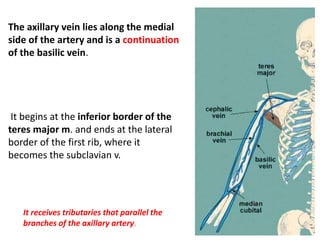
The axillary vein lies along the medial
side of the artery and is a continuation
of the basilic vein.
It begins at the inferior border of the
teres major m. and ends at the lateral
border of the first rib, where it
becomes the subclavian v.
It receives tributaries that parallel the
branches of the axillary artery.
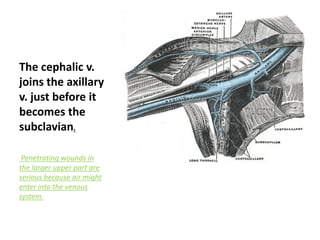
The cephalic v.
joins the axillary
v. just before it
becomes the
subclavian.
Penetrating wounds in
the larger upper part are
serious because air might
enter into the venous
system.
The veins that run with
their corresponding
arteries are frequently
multiple (2 or 3 interconnected veins).
This interconnected
venous network is called
the vena commitantes.
Artery axillary artery
Vein axillary vein
Nerve
axillary nerve,
medial cord,
posterior cord,
lateral cord.
Lymph
axillary lymph nodes.
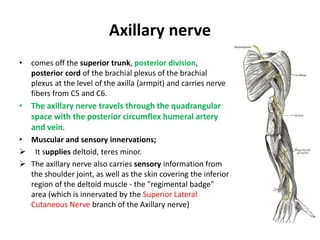
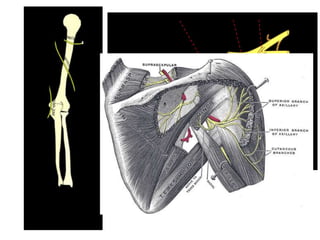
Axillary nerve
• comes off the superior trunk, posterior division,
posterior cord of the brachial plexus of the brachial
plexus at the level of the axilla (armpit) and carries nerve
fibers from C5 and C6.
• The axillary nerve travels through the quadrangular
space with the posterior circumflex humeral artery
and vein.
• Muscular and sensory innervations;
 It supplies deltoid, teres minor.
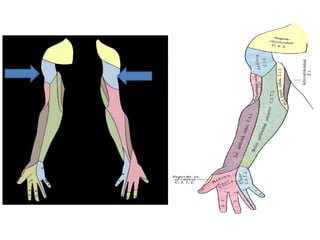
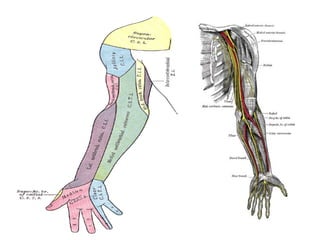
 The axillary nerve also carries sensory information from
the shoulder joint, as well as the skin covering the inferior
region of the deltoid muscle - the "regimental badge"
area (which is innervated by the Superior Lateral
Cutaneous Nerve branch of the Axillary nerve)
Axillary nerve/ Branches
• The anterior branch (upper branch) winds around the
surgical neck of the humerus, beneath the deltoid, with
the posterior humeral circumflex vessels.
• The posterior branch (lower branch) supplies the teres
minor and the posterior part of the deltoid.
• The posterior branch pierces the deep fascia and continues as the
superior lateral cutaneous nerve of arm.
• INJURY
• Paralysis of the teres minor muscle and deltoid muscle , resulting in loss of
abduction of arm (from 15-90 degrees), weak flexion, extension, and rotation of
shoulder. Paralysis of Deltiod & Teres minor results in Flat shoulder deformity.
• Loss of sensation in the skin over a small part of the lateral upper arm.
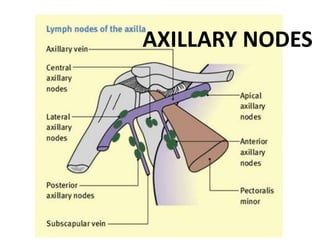
AXILLARY NODES
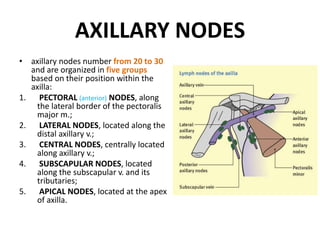
AXILLARY NODES
• axillary nodes number from 20 to 30
and are organized in five groups
based on their position within the
axilla:
1. PECTORAL (anterior) NODES, along
the lateral border of the pectoralis
major m.;
2. LATERAL NODES, located along the
distal axillary v.;
3. CENTRAL NODES, centrally located
along axillary v.;
4. SUBSCAPULAR NODES, located
along the subscapular v. and its
tributaries;
5. APICAL NODES, located at the apex
of axilla.
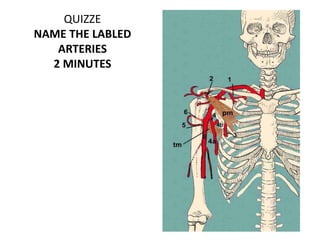
QUIZZE
QUIZZE
NAME THE LABLED
ARTERIES
2 MINUTES
QUIZZE
NAME THE COMPONENT
OF POSTERIOR WALL OF
THE AXILLA
2 MINUTES

Anatomy axilla 25112010

  • 1.
    ANATOMY BY DR. THAAER MOHAMMEDDAHER ALSAAD M.B.CH.B.(MBBS) F.I.B.M.S.(PH.D.) SPECIALIST IN GENERAL SURGERY SENIOR LECTURER IMS MSU
  • 3.
    AXILLA • The pyramidalregion between the upper thoracic wall and the upper limb. • Its base formed by the skin. • Apex bounded by the approximation of the clavicle, coracoid process, and the first rib; • It contains axillary vessels, the brachial plexus of nerves, many lymph nodes, and loose areolar tissue.
  • 6.
    Artery axillary artery Veinaxillary vein Nerve axillary nerve, medial cord, posterior cord, lateral cord. Lymph axillary lymph nodes. These structures are embedded in fat.
  • 10.
    Deep muscles ofthe chest and front of the arm, with the boundaries of the axilla.
  • 11.
    The right brachialplexus (infraclavicular portion) in the axillary fossa; viewed from below and in front.
  • 12.
    The veins ofthe right axilla, viewed from in front
  • 13.
    Axillary artery andits branches - anterior view of right upper limb and thorax
  • 14.
    AXILLA/ ( ARMPIT) •Anatomically, the boundaries of the axilla are:  MEDIALLY: upper 4 or 5 ribs and intercostal spaces covered by serratus anterior muscle.  ANTERIORLY: by the pectoralis major, minor, and subclavius  POSTERIORLY: by the subscapularis, latissimus dorsi and teres major from above below.  LATERALLY: by the intertubercular sulcus (coracobrachialis and the short head of the biceps brachii are in the axilla.)  SUPERIORLY: by the outer border of first rib, superior border of scapula, and posterior border of clavicle. floor/base: by the skin (visible surface of armpit).
  • 15.
    Key Muscles inthe Axilla • Pectoralis Minor • The pectoralis minor is a thin triangular muscle that lies beneath the pectoralis major. • It arises from the third, fourth, and fifth ribs and runs upwards and laterally to be inserted by its apex into the coracoid process of the scapula. • It crosses the axillary artery and the brachial plexus of nerves
  • 16.
    Clavipectoral Fascia • Theclavipectoral fascia is a strong sheet of connective tissue that is attached above to the clavicle. • Below, it splits to enclose the pectoralis minor muscle, • Then continues downward as the suspensory ligament of the axilla and joins the fascial floor of the armpit.
  • 17.
    Axillary artery andits branches – anterior view of right upper limb and thorax. Upper and lower limits labeled.
  • 18.
    The pectoralis minoris used as a landmark for DIVIDING the axillary artery into three parts. First part – the part of the artery medial to pectoralis minor. Second part – the part of the artery that lies behind pectoralis minor. Third part – the part of the artery lateral to pectoralis minor.
  • 19.
    The axillary arterybegins at the lateral border of the first rib as a continuation of the subclavian artery. It changes its name to brachial artery at lower (inferior) border of the teres major muscle. For purposes of description, it is broken up into three parts by its relation to the pectoralis minor muscle. The first part is between the lateral border of the first rib and the medial border of the pectoralis minor, The second part is behind the pectoralis minor. Third part is between the lateral border of the pectoralis minor and the inferior border of the teres major.
  • 20.
  • 21.
    Branches of theAxillary Artery • Axillary artery gives off six branches as follows; • First part (1branch) • Highest thoracic artery (also called supreme or superior) • Second part (2 branch) 1. Lateral thoracic artery 2. Thoracoacromial artery • Third part (3 branches) 1. Subscapular artery 2. Anterior circumflex humeral artery 3. Posterior circumflex humeral artery • Branches of first part of Subclavian artery anastomose with branches of the third part of axillary artery.
  • 22.
    1/ superior thoracica. (supreme thoracic a) (highest thoracic a). 2/ thoracoacromial a. 3/ lateral thoracic a. 4/ subscapular a. 5/ anterior humeral circumflex a. 6/ posterior humeral circumflex a.
  • 23.
    Axillary Artery • Theaxillary artery is accompanied by the axillary vein along its length. • In the axilla, it is surrounded by the brachial plexus. • The second part of the axillary artery is the reference for the locational descriptions of the cords in the brachial plexus. • For example, the posterior cord of the brachial plexus is so named because it lies posterior to the second part of the artery.
  • 24.
    NOTE • The axillaryartery may be safely clamped without endangering the arm, but only in a location proximal to the origin of the subscapular artery. • The anastomotic network surrounding the scapula provides an alternate path for collateral circulation to the arm from arteries including the dorsal scapular artery and suprascapular artery.
  • 25.
    Scapular anastomosis • Thescapular anastomosis is a system connecting each subclavian artery and the corresponding axillary artery, forming an anastomosis around the scapula. It allows blood to flow past the joint regardless of the position of the arm. It includes: 1. transverse cervical artery. 2. transverse scapular artery. 3. branches of subscapular artery. 4. branches of thoracic aorta. • The transverse cervical artery gives off a branch, the dorsal scapular artery, which accompanies the dorsal scapular nerve and runs down the vertebral border of the scapula to its inferior angle. • The suprascapular artery branches off from the thyrocervical trunk, which in turn arises from the first part of the subclavian artery. This suprascapular artery crosses over the suprascapular ligament, passes through the supraspinous fossa and turns around the lateral border of the spine of the scapula and supplies the infraspinous fossa as far as the inferior angle. • The subscapular artery branches from the third part of the axillary and supplies the subscapularis muscle in the subscapular fossa as far as the inferior angle. The subscapular artery gives off a circumflex scapular branch that enters the infraspinous fossa on the dorsal surface of the bone, grooving the axillary border. • All these vessels anastamose or join to connect the first part of the subclavian with the third part of the axillary, providing a collateral circulation. This collateral circulation allows for blood to continue circulating if the subclavian is obstructed.
  • 26.
  • 28.
    The veins ofthe right axilla, viewed from in front
  • 29.
    The axillary veinlies along the medial side of the artery and is a continuation of the basilic vein. It begins at the inferior border of the teres major m. and ends at the lateral border of the first rib, where it becomes the subclavian v. It receives tributaries that parallel the branches of the axillary artery.
  • 30.
    The cephalic v. joinsthe axillary v. just before it becomes the subclavian. Penetrating wounds in the larger upper part are serious because air might enter into the venous system.
  • 31.
    The veins thatrun with their corresponding arteries are frequently multiple (2 or 3 interconnected veins). This interconnected venous network is called the vena commitantes.
  • 32.
    Artery axillary artery Veinaxillary vein Nerve axillary nerve, medial cord, posterior cord, lateral cord. Lymph axillary lymph nodes.
  • 34.
    Axillary nerve • comesoff the superior trunk, posterior division, posterior cord of the brachial plexus of the brachial plexus at the level of the axilla (armpit) and carries nerve fibers from C5 and C6. • The axillary nerve travels through the quadrangular space with the posterior circumflex humeral artery and vein. • Muscular and sensory innervations;  It supplies deltoid, teres minor.  The axillary nerve also carries sensory information from the shoulder joint, as well as the skin covering the inferior region of the deltoid muscle - the "regimental badge" area (which is innervated by the Superior Lateral Cutaneous Nerve branch of the Axillary nerve)
  • 37.
    Axillary nerve/ Branches •The anterior branch (upper branch) winds around the surgical neck of the humerus, beneath the deltoid, with the posterior humeral circumflex vessels. • The posterior branch (lower branch) supplies the teres minor and the posterior part of the deltoid. • The posterior branch pierces the deep fascia and continues as the superior lateral cutaneous nerve of arm. • INJURY • Paralysis of the teres minor muscle and deltoid muscle , resulting in loss of abduction of arm (from 15-90 degrees), weak flexion, extension, and rotation of shoulder. Paralysis of Deltiod & Teres minor results in Flat shoulder deformity. • Loss of sensation in the skin over a small part of the lateral upper arm.
  • 38.
  • 39.
    AXILLARY NODES • axillarynodes number from 20 to 30 and are organized in five groups based on their position within the axilla: 1. PECTORAL (anterior) NODES, along the lateral border of the pectoralis major m.; 2. LATERAL NODES, located along the distal axillary v.; 3. CENTRAL NODES, centrally located along axillary v.; 4. SUBSCAPULAR NODES, located along the subscapular v. and its tributaries; 5. APICAL NODES, located at the apex of axilla.
  • 41.
  • 42.
  • 43.
    QUIZZE NAME THE COMPONENT OFPOSTERIOR WALL OF THE AXILLA 2 MINUTES