Joints of lower limb
k.Prashanth kumar
yr pg
HIP JOINT
 TYPE:
BALL & SOCKET VARIETY OF SYNOVIAL
JOINT
 ARTICULAR SURFACES :
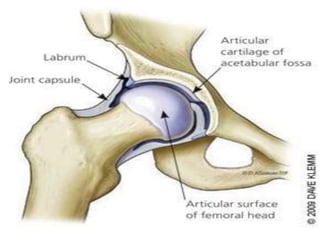
 The head of femur articulates with the acetabulam
of the hip bone to form hip joint.
 The head of femur forms more than half a
sphere,and is covered with the hyaline cartilage
except at the fovea capitis.
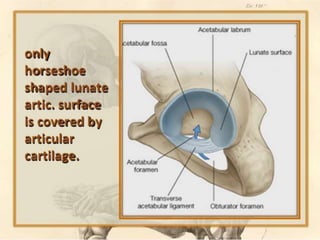
 The acetabulum presents a horseshoe shaped,lunate
articular surface ,an acetabular notch and a
acetabular fossa .
The lunate surface is covered with cartilage.
Though the articular surface on the head of
femur and the acetabulum are reciprocally
cured, they are not co-extensive.
The hip joint is unique in having a high
degree of stability a well as mobility.
• The stability depends on:
• 1)the depth of acetabulum & the narrowing of its
mouth by the acetabular labrum.
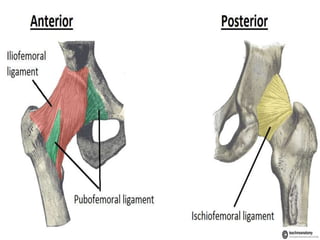
• 2)tension & the strength of ligaments.
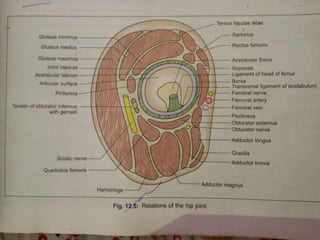
• 3)strenth of surrounding muscles.
• 4)length & obliquity of the neck of femur.
• 5)atmospheric pressure:a fairly wide range of
mobility is possible becoz of fact that the femur
has a long neckwhich is narrower than the
equatoial diameter of the head.
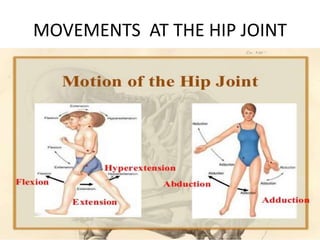
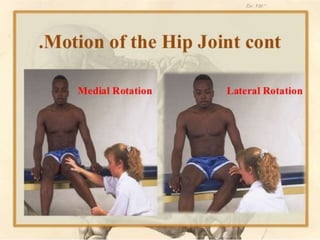
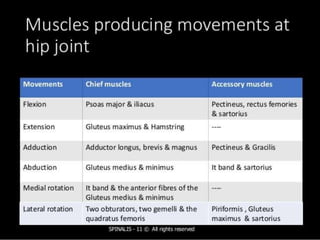
MOVEMENTS AT THE HIP JOINT
Clinical anatomy
• Congenital dislocation is more common in hip
than in any other joint of the body.the head
of femur slips upwards on to the gluteal
surface of the ilium because the upper
margin of the acetabulum is developmentally
deficient .this causes lurching gait &
trendelenburg +ve.
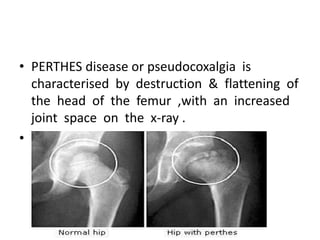
• PERTHES disease or pseudocoxalgia is
characterised by destruction & flattening of
the head of the femur ,with an increased
joint space on the x-ray .
• .
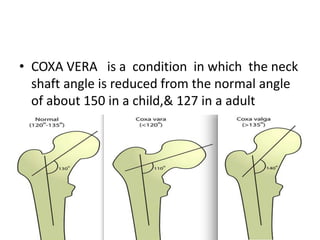
• COXA VERA is a condition in which the neck
shaft angle is reduced from the normal angle
of about 150 in a child,& 127 in a adult
• OSTEOARTHRITIS is a disease of old
age,characterised by growth of osteophytes at
the articular ends,which makes the
movements limited & painfull.
• In arthritis of hipjoint,the position of the joint
is partially flexed ,abducted& laterally rotated.
• FRACTURE OF THE NECK OF THE FEMUR may
be subcapital,cervical,or near the trochanter.
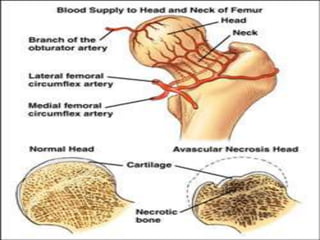
• Damage to the retinacular arteries causes
avascular necrosis of the head.such damage
is max. in subcapital # & least in basal #.
• This # are more common in age 40-60 yrs.
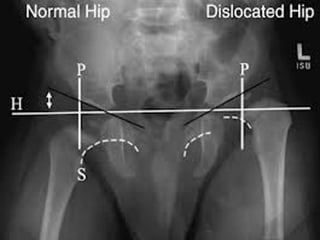
• SHENTONS LINE in an x-ray,is a continous
curve formed by upper border of obturator
foramen 7 the lower border of the neck of the
femur.In # neck femur ,line becomes
abnormal.
• HIP DISEASES show an interesting age
pattern:
• <5 yrs: congenital dislocation & tuberculosis
• 5-10 yrs:perthes disease
• 10-20 yrs:coxa vera
• >40 yrs :osteoarthritis
Knee joint
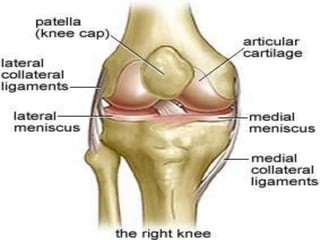
Largest & most complex joint of the body.
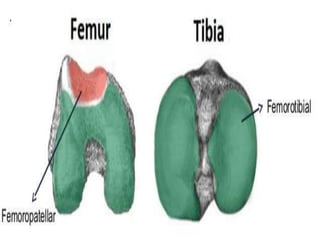
The complexity is the result of fusion of 3
joints in one.
Formed by fusion of lateral
femorotibial,medial
femorotibial,&femoropatellar
TYPE:
Compound synovial joint,incorporating 2
condylar joints between the condyles of the
femur & tibia,& 1 saddle joint between the
femur and the patella.
 ARTICULAR SURFACES:
1. THE CONDYLES OF THE FEMUR
2. THE PATELLA
3. THE CONDYLES OF THE TIBIA
 The femoral condyles articulates with the
tibial condyles below and behind and with
the patella in front.
LIGAMENTS:
1. EXTRACAPSULAR
a. fibrous capsule
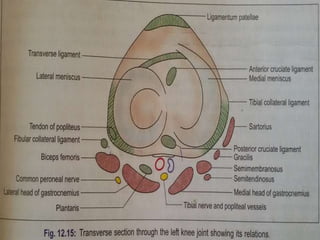
b. Ligamentum patella
c. Medial collateral ligament
d. Lateral collateral ligament
e. Oblique popliteal ligament
f. Arcuate popliteal ligament
2.INTRACAPSULAR:
a. Anterior cruciate ligament
b. Posterior cruciate ligament
c. Medial meniscus
d. Lateral meniscus
Bursae around the knee
 In anterior there are five bursae:
1) the suprapatellar bursa or recess between the
anterior surface of the lower part of the femur
and the deep surface of thequadriceps femoris. It
allows for movement of the quadriceps tendon
over the distal end of the femur
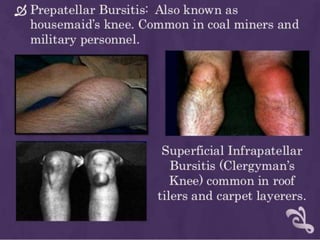
2) the prepatellar bursa between the patella and
the skin, results in "housemaid's knee" when
inflamed. It allows movement of the skin over
the underlying patella.
3) the deep infrapatellar bursa between the upper
part of the tibia and the patellar ligament. It
allows for movement of the patellar ligament
over the tibia.
4)the subcutaneous
[or superficial]
infrapatellar
bursa between
the patellar
ligament and skin.
5)the pretibial
bursa between
the tibial
tuberosity and
the skin. It allows
for movement of
the skin over the
tibial tuberosity.
Laterally there are four bursæ:
1) the lateral gastrocnemius [subtendinous]
bursa between the lateral head of
the gastrocnemius and the joint capsule
2) the fibular bursa between the lateral (fibular)
collateral ligament and the tendon of the biceps
femoris
3) the fibulopopliteal bursa between the fibular
collateral ligament and the tendon of
the popliteus
4) and the subpopliteal recess (or bursa) between
the tendon of the popliteus and the lateral
condyle of the femur
Medially, there are five bursae:
1. the medial gastrocnemius [subtendinous]
bursa between the medial head of
the gastrocnemius and the joint capsule
2. the anserine bursa between the medial (tibial)
collateral ligament and the tendons of
the sartorius, gracilis, and semitendinosus (i.e. the pes
anserinus)
3. the bursa semimembranosa between the medial
collateral ligament and the tendon of
the semimembranosus
4. there is one between the tendon of the
semimembranosus and the head of the tibia
5. and occasionally there is a bursa between the tendons
of the semimembranosus and semitendinosus
BLOOD SUPPLY
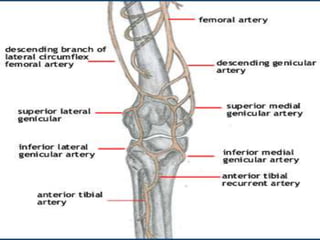
• The femoral artery and the popliteal artery help form
the arterial network surrounding the knee joint
(articular rete). There are 6 main branches:
• 1. Superior medial genicular artery
• 2. Superior lateral genicular artery
• 3. Inferior medial genicular artery
• 4. Inferior lateral genicular artery
• 5. Descending genicular artery
• 6. Recurrent branch of anterior tibial artery
• The medial genicular arteries penetrate the knee joint.
CLINICAL ANATOMY
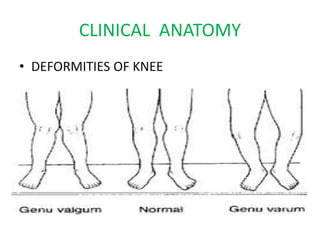
• DEFORMITIES OF KNEE
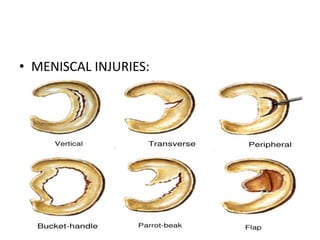
• MENISCAL INJURIES:
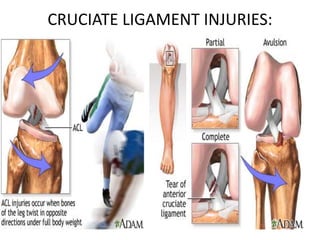
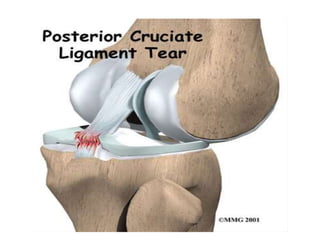
CRUCIATE LIGAMENT INJURIES:
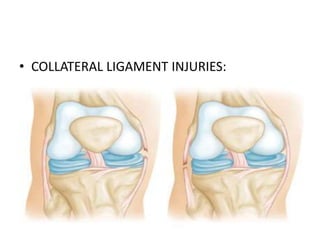
• COLLATERAL LIGAMENT INJURIES:
• Semimembranosus bursitis is quite common
.it causes swellling in the popliteal fossa
region on the posteromedial aspect.
• In knee joint disease ,vastus medialis is first to
atrophy and last to recover.
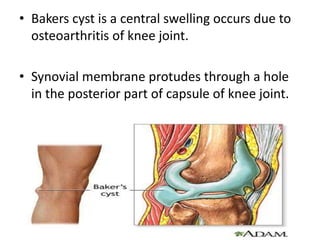
• Bakers cyst is a central swelling occurs due to
osteoarthritis of knee joint.
• Synovial membrane protudes through a hole
in the posterior part of capsule of knee joint.
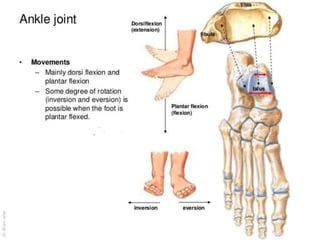
ANKLE JOINT
• TYPE: synovial joint of hinge variety.
• ARTICULAR SURFACES:
• Upper articular surface is formed by :
I. The lower end of tibia including the medial
malleolus
II. The lateral malleolus of the fibula
III. The inferior transverse tibiofibular ligament
.these structures form a deep socket
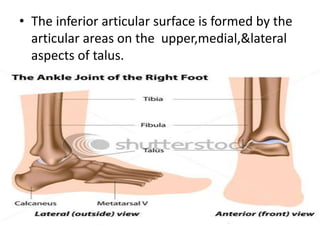
• The inferior articular surface is formed by the
articular areas on the upper,medial,&lateral
aspects of talus.
• Structurally,the joint is very strong.the stability
of the joint is ensuredby:
I. Close interlocking of the articular surfaces
II. Strong collateral ligaments on the sides
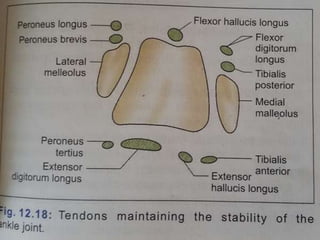
III. The tendons that crosses the joint ,4 in
front& 5 behind
• The depth of the superior areticular socket is
contributed by:
I. The downward projection of medial and lateral
malleoli,on the corresponding sites of talus.
II. By the inferior transverse tibiofibular ligament
that bridges across the gap between the tibia
and the fibulabehind the talus.thesocket is
provided flexibility by strong tibiofibular
ligaments and by slight movement of fibula at
the superior tibiofibular ligament.
• There are 2 factors,however,that tend to
displace the tibia and the fibula forwards over
the talus.these factors are
a) The forward pull of tendons which pass from
the leg to the foot.
b) The pull of gravity when the leg is raised.
• Displacement is prevented by the following factors:
I. The talus is wedge shaped,being wider anteriorly .the
malleoli are oriented to fit this wedge.
II. The posterior border of the lower end of the tibia is
prolonged downwards.
III. The presence of inferior transverse tibiofibular
ligament.
IV. The tibiocalcanean,posterior
tibiotalar,calcaneofibular and posterior talotalar
ligament pass backwards and resist forward
movement of the tibia and fibula.
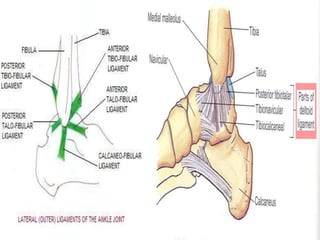
• LIGAMENTS:
• The joint is supported by:
a. The fibrous capsule
b. The deltiod or medial ligament
c. Lateral ligament
• BLOOD SUPPLY: from anterior tibial, posterior
tibial,and peroneal arteries.
• NERVE SUPPLY: from deep peroneal and tibial
nerves
Clinical anatomy
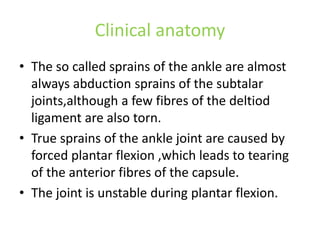
• The so called sprains of the ankle are almost
always abduction sprains of the subtalar
joints,although a few fibres of the deltiod
ligament are also torn.
• True sprains of the ankle joint are caused by
forced plantar flexion ,which leads to tearing
of the anterior fibres of the capsule.
• The joint is unstable during plantar flexion.
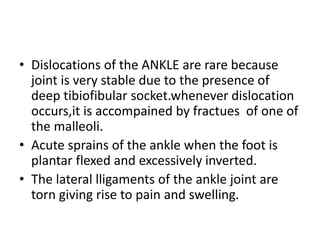
• Dislocations of the ANKLE are rare because
joint is very stable due to the presence of
deep tibiofibular socket.whenever dislocation
occurs,it is accompained by fractues of one of
the malleoli.
• Acute sprains of the ankle when the foot is
plantar flexed and excessively inverted.
• The lateral lligaments of the ankle joint are
torn giving rise to pain and swelling.
• Acute sprains of the medial ankle occur in
excessive eversion ,leading to tear of strong
deltiod ligament.these are less common.
• The optimal position of the ankle to avoid
ankylosis is one of slight plantar flexion.
• For injection in to ankle joint,the needle is
introduced between tendons of EHL and TA
with the ankle partially plantar flexed.
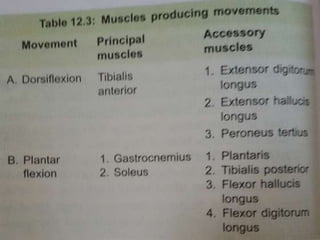
• During walking the plantar flexors raie the
heel from the ground.
• When the limb is moved forwards the
dorsiflexors help the foot in clearing the
ground.
• The value of ankle joint resides in this hinge
action,in this to and fro movements of the
joint during walking.
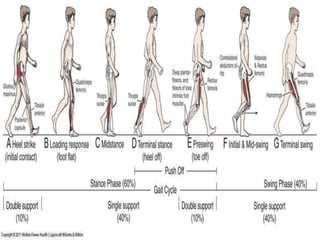
• GAIT: gait is defined as bipedal, biphasic
forward propulsion of center of gravity of the
human body, in which there are alternate
sinuous movements of different segments of
the body with least expenditure of energy.
• 2 phases of gait: swing and stance
• SWING PHASE:
a) FLEXION OF HIP,FLEXION OF KNEE,PLANTAR
FLEXION OF ANKLE
b) FLEXION OF HIP,EXTENSION OF KNEE,AND
DORSIFLEXION OF ANKLE
• STANCE PHASE:
C) FLEXION OF HIP ,EXTENSION OF KNEE,AND
FOOT ON THE GROUND
D) EXTENSION OF HIP,EXTENSION OF KNEE,AND
FOOT ON THE GROUND
PROXIMAL TIBIOFIBULAR JOINT
• Articulation is between the lateral condyle of the tibia and
the head of the fibula.the articular surfaces are flatenned
and covered by hyaline cartilage.
• This is a synovial,plane,gliding joint
• LIGAMENTS:
• Anterior and posterior ligaments strengthens the capsule.
• Capsule and synovial membrane attached to line of the
articular surface.
• Common peroneal nerve supplies the joint.
• MOVEMENTS:
• A small amount of gliding movement takes place during
movements at the ankle joint.
DISTAL TIBIOFIBULAR JOINT
• TYPE: FIBROUS JOINT
• ARTICULATION:
• Articulation is between fibular notch at the
lower end of the tibia and the lower end of
the fibula
• There is no capsule
• BLOOD SUPPLY:perforating branch of the
peroneal artery,and the malleolar branch of
the anterior and posterior tibial arteries.
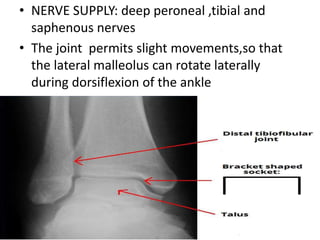
• NERVE SUPPLY: deep peroneal ,tibial and
saphenous nerves
• The joint permits slight movements,so that
the lateral malleolus can rotate laterally
during dorsiflexion of the ankle
joints of the foot
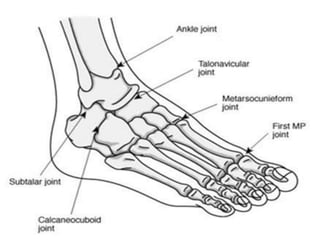
• Joints of the foot are numerous.they can be
classified are:
a. Intertarsal
b. Tarsometatarsal
c. Intermetatarsal
d. Metatarsophalanges and
e. Interphalanges
• The main intertarsal joints are the subtalar or
talocalcanean joint,the talocalcaneonavicular
joint and the calcaneocubiod joint.
• Smaller intertarsal joints include the
cuneonavicular,cubiodonavicular,intercuneifor
m and cuneocuboid joints
MOVEMENTS:
1) The intertarsal,tarsometatarsal and
intermetatarsal joints permit gliding and rotatory
movements ,which jointly bring about inversion
,eversion,supination,and pronation of the
foot.pronation is a component of eversion,while
supination is a component of inversion.
2) The metatarsophalangeal joints are similar to the
metacarpophalangeal joints of the hand.they
permit flexion , extension, adduction,and
abduction of thec toes.
3) The interphalangeal joints of hinge variety
permit flexion and extension of the distal
phalanges.
Clinical anatomy
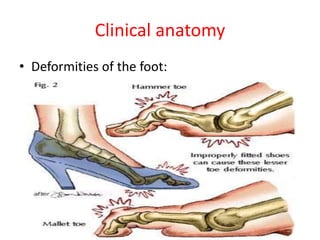
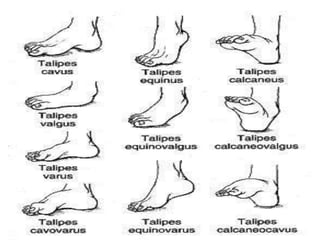
• Deformities of the foot:
Joints of lower limb

Joints of lower limb

  • 1.
    Joints of lowerlimb k.Prashanth kumar yr pg
  • 2.
    HIP JOINT  TYPE: BALL& SOCKET VARIETY OF SYNOVIAL JOINT  ARTICULAR SURFACES :  The head of femur articulates with the acetabulam of the hip bone to form hip joint.  The head of femur forms more than half a sphere,and is covered with the hyaline cartilage except at the fovea capitis.  The acetabulum presents a horseshoe shaped,lunate articular surface ,an acetabular notch and a acetabular fossa .
  • 3.
    The lunate surfaceis covered with cartilage. Though the articular surface on the head of femur and the acetabulum are reciprocally cured, they are not co-extensive. The hip joint is unique in having a high degree of stability a well as mobility.
  • 6.
    • The stabilitydepends on: • 1)the depth of acetabulum & the narrowing of its mouth by the acetabular labrum. • 2)tension & the strength of ligaments. • 3)strenth of surrounding muscles. • 4)length & obliquity of the neck of femur. • 5)atmospheric pressure:a fairly wide range of mobility is possible becoz of fact that the femur has a long neckwhich is narrower than the equatoial diameter of the head.
  • 13.
  • 16.
    Clinical anatomy • Congenitaldislocation is more common in hip than in any other joint of the body.the head of femur slips upwards on to the gluteal surface of the ilium because the upper margin of the acetabulum is developmentally deficient .this causes lurching gait & trendelenburg +ve.
  • 17.
    • PERTHES diseaseor pseudocoxalgia is characterised by destruction & flattening of the head of the femur ,with an increased joint space on the x-ray . • .
  • 18.
    • COXA VERAis a condition in which the neck shaft angle is reduced from the normal angle of about 150 in a child,& 127 in a adult
  • 19.
    • OSTEOARTHRITIS isa disease of old age,characterised by growth of osteophytes at the articular ends,which makes the movements limited & painfull. • In arthritis of hipjoint,the position of the joint is partially flexed ,abducted& laterally rotated. • FRACTURE OF THE NECK OF THE FEMUR may be subcapital,cervical,or near the trochanter.
  • 20.
    • Damage tothe retinacular arteries causes avascular necrosis of the head.such damage is max. in subcapital # & least in basal #. • This # are more common in age 40-60 yrs.
  • 21.
    • SHENTONS LINEin an x-ray,is a continous curve formed by upper border of obturator foramen 7 the lower border of the neck of the femur.In # neck femur ,line becomes abnormal.
  • 23.
    • HIP DISEASESshow an interesting age pattern: • <5 yrs: congenital dislocation & tuberculosis • 5-10 yrs:perthes disease • 10-20 yrs:coxa vera • >40 yrs :osteoarthritis
  • 24.
    Knee joint Largest &most complex joint of the body. The complexity is the result of fusion of 3 joints in one. Formed by fusion of lateral femorotibial,medial femorotibial,&femoropatellar
  • 26.
    TYPE: Compound synovial joint,incorporating2 condylar joints between the condyles of the femur & tibia,& 1 saddle joint between the femur and the patella.
  • 27.
     ARTICULAR SURFACES: 1.THE CONDYLES OF THE FEMUR 2. THE PATELLA 3. THE CONDYLES OF THE TIBIA  The femoral condyles articulates with the tibial condyles below and behind and with the patella in front.
  • 29.
    LIGAMENTS: 1. EXTRACAPSULAR a. fibrouscapsule b. Ligamentum patella c. Medial collateral ligament d. Lateral collateral ligament e. Oblique popliteal ligament f. Arcuate popliteal ligament
  • 30.
    2.INTRACAPSULAR: a. Anterior cruciateligament b. Posterior cruciate ligament c. Medial meniscus d. Lateral meniscus
  • 31.
    Bursae around theknee  In anterior there are five bursae: 1) the suprapatellar bursa or recess between the anterior surface of the lower part of the femur and the deep surface of thequadriceps femoris. It allows for movement of the quadriceps tendon over the distal end of the femur 2) the prepatellar bursa between the patella and the skin, results in "housemaid's knee" when inflamed. It allows movement of the skin over the underlying patella. 3) the deep infrapatellar bursa between the upper part of the tibia and the patellar ligament. It allows for movement of the patellar ligament over the tibia.
  • 32.
    4)the subcutaneous [or superficial] infrapatellar bursabetween the patellar ligament and skin. 5)the pretibial bursa between the tibial tuberosity and the skin. It allows for movement of the skin over the tibial tuberosity.
  • 33.
    Laterally there arefour bursæ: 1) the lateral gastrocnemius [subtendinous] bursa between the lateral head of the gastrocnemius and the joint capsule 2) the fibular bursa between the lateral (fibular) collateral ligament and the tendon of the biceps femoris 3) the fibulopopliteal bursa between the fibular collateral ligament and the tendon of the popliteus 4) and the subpopliteal recess (or bursa) between the tendon of the popliteus and the lateral condyle of the femur
  • 34.
    Medially, there arefive bursae: 1. the medial gastrocnemius [subtendinous] bursa between the medial head of the gastrocnemius and the joint capsule 2. the anserine bursa between the medial (tibial) collateral ligament and the tendons of the sartorius, gracilis, and semitendinosus (i.e. the pes anserinus) 3. the bursa semimembranosa between the medial collateral ligament and the tendon of the semimembranosus 4. there is one between the tendon of the semimembranosus and the head of the tibia 5. and occasionally there is a bursa between the tendons of the semimembranosus and semitendinosus
  • 36.
    BLOOD SUPPLY • Thefemoral artery and the popliteal artery help form the arterial network surrounding the knee joint (articular rete). There are 6 main branches: • 1. Superior medial genicular artery • 2. Superior lateral genicular artery • 3. Inferior medial genicular artery • 4. Inferior lateral genicular artery • 5. Descending genicular artery • 6. Recurrent branch of anterior tibial artery • The medial genicular arteries penetrate the knee joint.
  • 41.
  • 42.
  • 43.
  • 45.
  • 46.
    • Semimembranosus bursitisis quite common .it causes swellling in the popliteal fossa region on the posteromedial aspect. • In knee joint disease ,vastus medialis is first to atrophy and last to recover.
  • 47.
    • Bakers cystis a central swelling occurs due to osteoarthritis of knee joint. • Synovial membrane protudes through a hole in the posterior part of capsule of knee joint.
  • 49.
    ANKLE JOINT • TYPE:synovial joint of hinge variety. • ARTICULAR SURFACES: • Upper articular surface is formed by : I. The lower end of tibia including the medial malleolus II. The lateral malleolus of the fibula III. The inferior transverse tibiofibular ligament .these structures form a deep socket
  • 50.
    • The inferiorarticular surface is formed by the articular areas on the upper,medial,&lateral aspects of talus.
  • 51.
    • Structurally,the jointis very strong.the stability of the joint is ensuredby: I. Close interlocking of the articular surfaces II. Strong collateral ligaments on the sides III. The tendons that crosses the joint ,4 in front& 5 behind
  • 53.
    • The depthof the superior areticular socket is contributed by: I. The downward projection of medial and lateral malleoli,on the corresponding sites of talus. II. By the inferior transverse tibiofibular ligament that bridges across the gap between the tibia and the fibulabehind the talus.thesocket is provided flexibility by strong tibiofibular ligaments and by slight movement of fibula at the superior tibiofibular ligament.
  • 54.
    • There are2 factors,however,that tend to displace the tibia and the fibula forwards over the talus.these factors are a) The forward pull of tendons which pass from the leg to the foot. b) The pull of gravity when the leg is raised.
  • 55.
    • Displacement isprevented by the following factors: I. The talus is wedge shaped,being wider anteriorly .the malleoli are oriented to fit this wedge. II. The posterior border of the lower end of the tibia is prolonged downwards. III. The presence of inferior transverse tibiofibular ligament. IV. The tibiocalcanean,posterior tibiotalar,calcaneofibular and posterior talotalar ligament pass backwards and resist forward movement of the tibia and fibula.
  • 56.
    • LIGAMENTS: • Thejoint is supported by: a. The fibrous capsule b. The deltiod or medial ligament c. Lateral ligament
  • 59.
    • BLOOD SUPPLY:from anterior tibial, posterior tibial,and peroneal arteries. • NERVE SUPPLY: from deep peroneal and tibial nerves
  • 62.
    Clinical anatomy • Theso called sprains of the ankle are almost always abduction sprains of the subtalar joints,although a few fibres of the deltiod ligament are also torn. • True sprains of the ankle joint are caused by forced plantar flexion ,which leads to tearing of the anterior fibres of the capsule. • The joint is unstable during plantar flexion.
  • 63.
    • Dislocations ofthe ANKLE are rare because joint is very stable due to the presence of deep tibiofibular socket.whenever dislocation occurs,it is accompained by fractues of one of the malleoli. • Acute sprains of the ankle when the foot is plantar flexed and excessively inverted. • The lateral lligaments of the ankle joint are torn giving rise to pain and swelling.
  • 64.
    • Acute sprainsof the medial ankle occur in excessive eversion ,leading to tear of strong deltiod ligament.these are less common. • The optimal position of the ankle to avoid ankylosis is one of slight plantar flexion. • For injection in to ankle joint,the needle is introduced between tendons of EHL and TA with the ankle partially plantar flexed.
  • 65.
    • During walkingthe plantar flexors raie the heel from the ground. • When the limb is moved forwards the dorsiflexors help the foot in clearing the ground. • The value of ankle joint resides in this hinge action,in this to and fro movements of the joint during walking.
  • 66.
    • GAIT: gaitis defined as bipedal, biphasic forward propulsion of center of gravity of the human body, in which there are alternate sinuous movements of different segments of the body with least expenditure of energy. • 2 phases of gait: swing and stance
  • 68.
    • SWING PHASE: a)FLEXION OF HIP,FLEXION OF KNEE,PLANTAR FLEXION OF ANKLE b) FLEXION OF HIP,EXTENSION OF KNEE,AND DORSIFLEXION OF ANKLE • STANCE PHASE: C) FLEXION OF HIP ,EXTENSION OF KNEE,AND FOOT ON THE GROUND D) EXTENSION OF HIP,EXTENSION OF KNEE,AND FOOT ON THE GROUND
  • 69.
    PROXIMAL TIBIOFIBULAR JOINT •Articulation is between the lateral condyle of the tibia and the head of the fibula.the articular surfaces are flatenned and covered by hyaline cartilage. • This is a synovial,plane,gliding joint • LIGAMENTS: • Anterior and posterior ligaments strengthens the capsule. • Capsule and synovial membrane attached to line of the articular surface. • Common peroneal nerve supplies the joint. • MOVEMENTS: • A small amount of gliding movement takes place during movements at the ankle joint.
  • 70.
    DISTAL TIBIOFIBULAR JOINT •TYPE: FIBROUS JOINT • ARTICULATION: • Articulation is between fibular notch at the lower end of the tibia and the lower end of the fibula • There is no capsule • BLOOD SUPPLY:perforating branch of the peroneal artery,and the malleolar branch of the anterior and posterior tibial arteries.
  • 71.
    • NERVE SUPPLY:deep peroneal ,tibial and saphenous nerves • The joint permits slight movements,so that the lateral malleolus can rotate laterally during dorsiflexion of the ankle
  • 72.
    joints of thefoot • Joints of the foot are numerous.they can be classified are: a. Intertarsal b. Tarsometatarsal c. Intermetatarsal d. Metatarsophalanges and e. Interphalanges
  • 74.
    • The mainintertarsal joints are the subtalar or talocalcanean joint,the talocalcaneonavicular joint and the calcaneocubiod joint. • Smaller intertarsal joints include the cuneonavicular,cubiodonavicular,intercuneifor m and cuneocuboid joints
  • 75.
    MOVEMENTS: 1) The intertarsal,tarsometatarsaland intermetatarsal joints permit gliding and rotatory movements ,which jointly bring about inversion ,eversion,supination,and pronation of the foot.pronation is a component of eversion,while supination is a component of inversion. 2) The metatarsophalangeal joints are similar to the metacarpophalangeal joints of the hand.they permit flexion , extension, adduction,and abduction of thec toes. 3) The interphalangeal joints of hinge variety permit flexion and extension of the distal phalanges.
  • 76.